FINITE ELEMENT ANALYSIS OF GEARBOX AND
CASING FOR NVH BASED OPTIMIZATION OF AN
APPARATUS
*Mr. Sagar D. Rane 1st **Dr. Sanjiv M. Sansgiri 2nd
*PG Student, Sinhgad College of Engineering, Pune, India
** Professor, Sinhgad College of Engineering, Pune, India
ABSTRACT
Virtual Engineering Methods prove to be helpful in optimizing equipment without prototyping them; hence reducing cost and time. This paper presents an approach for Stress and Modal Analysis of Defibrillator Gearbox and Casing using Finite Element Analysis (FEA). Gearbox and Casing are subsequently optimized.
Keywords: Defibrillator, Gearbox, Finite Element Analysis, Modal Analysis, Stress Analysis, Optimization
INTRODUCTION
Many machines in our world fail due to various aspects such as excessive vibration, stress, fatigue, creep etc. Finite Element Analysis (FEA) gives us an opportunity to analyze these equipments virtually. Several researchers have found various techniques for FEA of particular type of tests.
75
an optimization procedure for composite panel structures with stiffening ribs [5]. The procedure employs standard Finite Element based structural analysis, structural system profile analysis, and multi-factor optimization techniques to predict the optimum structural design. A composite antenna reflector structure in space environment was optimized. Laminate, sandwich configuration and rib shape in the structure were optimized in this application. H. Hosseini-Toudeshky et al developed an approximate method for design of bead stiffened composite panels [6]. In their research, finite elements based buckling analyses were performed for various panels with different beads spacing, beads depths, beads radiuses and panels lengths. The analysis of results has shown that the beads spacing is of chief significance as far as the panel buckling load is concerned. H. Hosseini-Toudeshky et al again presented a study on new methods of stabilizing techniques used for the panels, webs and ribs of composite structures [7]. They performed parametric study to access the effects of important design parameters such as, bead length, number of beads, bead radius, bead depth and bead spacing on the initial buckling load of the panels. The results show that there is optimum bead spacing for each panel containing more than one bead, which can be estimated using a simple equation.
In this paper, an approach for Stress and Modal analyses of Defibrillator Casing and Geartrain will be presented using HyperWorks, and Optimization of the Casing and Gearbox apparatus will be carried out with the aim of reducing Stress, Noise, Vibrations and Harshness.
GEARTRAIN STRESS ANALYSIS
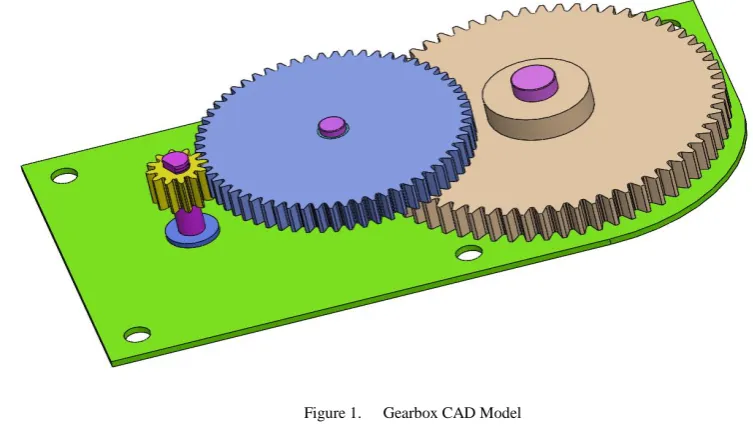
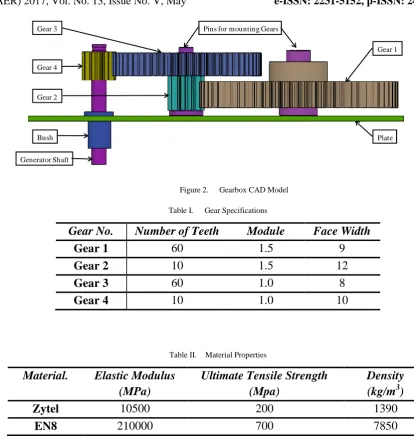
Figure 1 and Figure 2 show the Gearbox models and Table I show the specification of the Gearbox. Table II shows the specifications of the materials used. Gears are made from Zytel and all other components are made from EN8. Gear box consists of four gears, two pins and around which the Gears 1, 2 and 3 rotate; Gear 4 is firmly fit on Generator Shaft, which is guided with the help of a Bush and a Plate that are used to firmly hold the Pins and Bush.
Figure 2. Gearbox CAD Model Table I. Gear Specifications
Gear No. Number of Teeth Module Face Width
Gear 1 60 1.5 9
Gear 2 10 1.5 12
Gear 3 60 1.0 8
Gear 4 10 1.0 10
Table II. Material Properties
Material. Elastic Modulus
(MPa)
Ultimate Tensile Strength (Mpa)
Density (kg/m3)
Zytel 10500 200 1390
EN8 210000 700 7850
A. Meshing
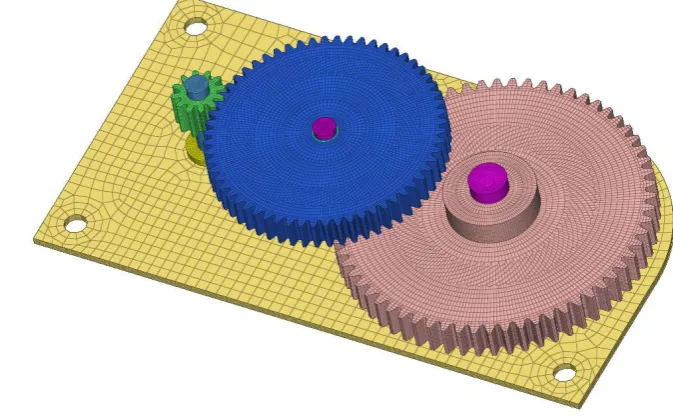
Only gear train including Gear 1, Gear 2, Gear 3, Gear 4, Pin 1 and Pin 2 will be considered for stress analysis of the gear box. Parts like Gears are liable for 3D mesh hence; the gearbox is meshed using 3D nine noded hexahedral and 7 noded pentagonal elements. Figure 3 show the meshed model of the gearbox. Gears were coincident noded with Pins so as to model contact between Gears and Pins. The model consists of 306817 Nodes and 274871 Elements.
77
Figure 3. Gearbox Finite Element Model
B. Boundary Conditions
Capturing proper boundary conditions is an important criterion for getting good results. To get an idea about the boundary conditions for stress analysis of a geartrain using HyperWorks, a small model was considered as shown in Figure 4. Rigid Body Elements (RBE2) were used as shown in Figure 5 for constraining the motion of Gear around Y axis and also imposing Torque. 100 Nmm torque was given at the independent node and one tooth of the Gear was fully constrained using SPCs as shown in Figure 6. Satisfactory reaction force was obtained at the constraints on tooth of Gear.
Figure 4. Small Model
Figure 5. Use of RBE2 Elements to Impose Torque
Independent node so as define constraints and torque
Figure 6. Constraints
C. Results
Gear to gear contact was simulated using RBE2 as shown in Figure 7. The Geartrain was analyzed with same approach as discussed. 15000 Nmm torque was imposed on Pin 1 about Y direction, Pin 2 was free to rotate around Y axis and Generator Shaft was kept stationary.
Figure 7. Contact between Gear 1 and Gear 2
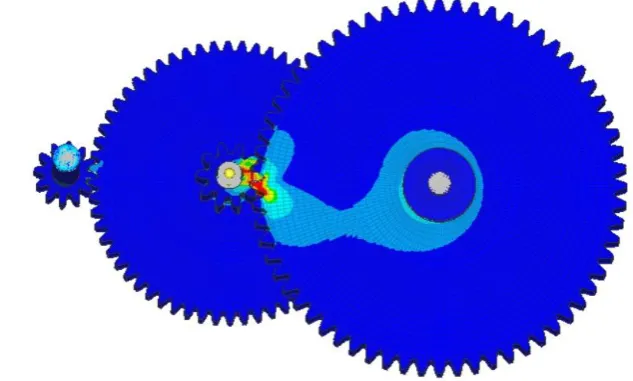
The result for stress analysis of gear train is shown in Figure 8. Maximum stress is found to be 78.4 MPa on Gear 1 which is less than the yield strength of the Gear material. Geartrain was hence found to be safe under 15000 Nmm torque.
Figure 8. Stress Analysis Result
Constraints to obtain support reactions due to torque.
Constrains to rotate only around Y-axis and 100 Nmm Torque
79
GEARBOX MODAL ANALYSIS
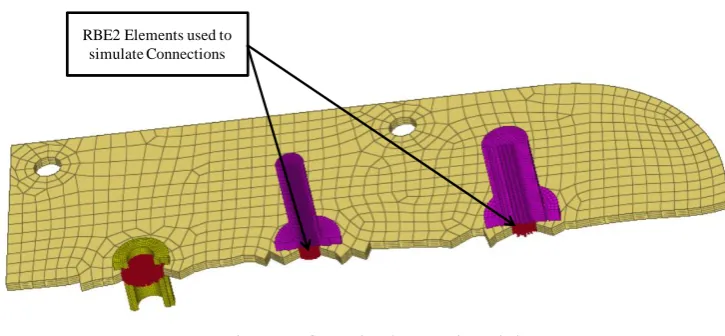
Modal Analysis of Gearbox was conducted in HyperWorks. All the parts of Gearbox were considered for analysis of gearbox. RBE2 elements were used to simulate contact between Pins, Bush and Plate as shown in Figure 9
Figure 9. Connections between Pins and Plate
Natural Frequency extraction by Modal analysis does not need any external constraints as well as support as undamped free response is simulated. Eigen value extraction was carried out in HyperWorks. Ten Eigen value and hence the natural frequencies were extracted and the first dominant one was in focus along with its Strain Energy Density.
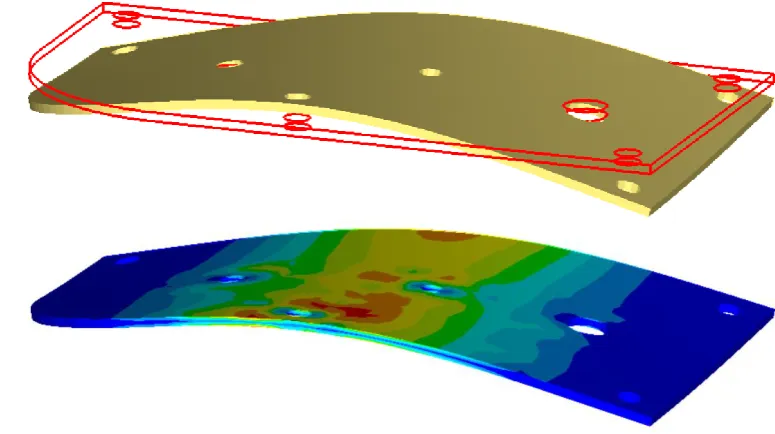
Results show that the gearbox has first natural frequency of 369.15 Hz, and the mode shape is as shown in Figure 10. When all the parts were analyzed individually, it was found that the Gears, Pins and Bush had first natural frequency beyond 3000 Hz and hence extremely stiff. The Plate has first natural frequency less than 460 Hz, which needs to be optimized. Figure 11 shows the mode shape associated with the extracted natural frequency of the plate.
Figure 10. Strain Energy of Gearbox, First Vibration Mode
Figure 11. Energy of Plate, First Vibration Mode
CASING MODAL ANALYSIS
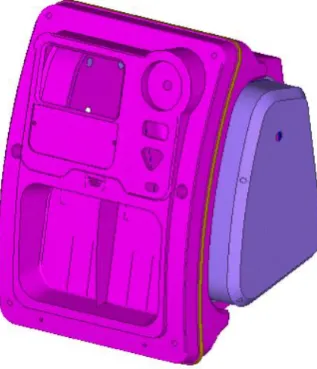
Apparatus Casing is a part that supports other small parts such as electrical circuits, gearbox etc. of the apparatus. Apparatus gets excited due to rotation of gears. The Gear Mesh Frequencies (GMF) of first and second stage are 60 Hz and 384 Hz respectively. Figure 12 shows the meshed model of Casing. The connection between the parts was modeled using RBE2s for simulating bolted joints.
81
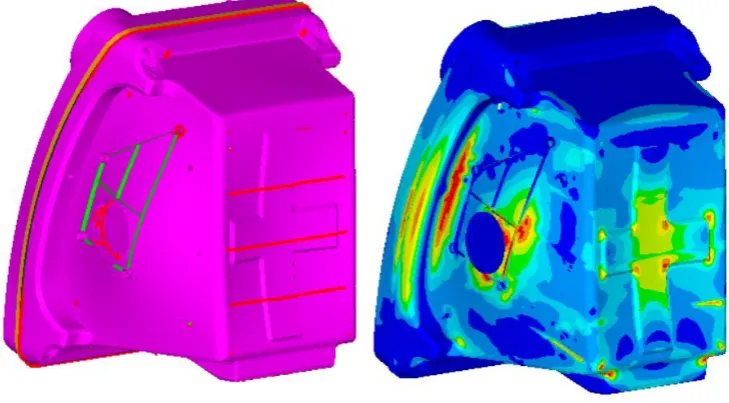
vibration for Casing and corresponding Strain Energy. It was seen that the first natural frequency for the casing is 158.6 Hz and Casing has First 10 natural frequencies below 330 Hz hence, it needs to be optimized.
Figure 12. Meshed Model of Casing
Figure 13. Use of RBE2 Elements to Simulate Bolted Joints
Front Panel
Main Body
Independent Node
Dependent Nodes to simulate Bolt
Head Dependent Nodes
Figure 14. Use of RBE2 Elements to Simulate Bolted Joints
OPTIMIZATION
Optimization of Gearbox and Casing is carried out on basis of NVH needs. Only the parts that show the critical strain energy were optimized. In Gearbox, the Plate needs to be optimized and in Casing needs to be optimized.
For optimization of Gearbox, the material of Plate can be changed to Zytel keeping the dimensions same. First natural frequency is found to be 268 Hz. Subsequently, some options such as thickening the plate was carried out and a bead was added in the centre of plate hence the modal frequency increased to 501 Hz. Figure 15 shows the mode shape for first natural frequency.
83
For optimization of Casing, Ribs and Beads can were employed on Main Body as shown in Figure 16.
Figure 16. Model of Casing with Ribs and Beads
After adding ribs and beads to the main body, first natural frequency is found to be 177.82 Hz. Figure 17 shows first vibration mode and strain energy associated with it.
Figure 17. Use of RBE2 Elements to Impose Torque
Beads
CONCLUSION
It is found that virtual engineering software such as HyperWorks can be effectively used to analyze the behavior of various parts using Finite Element Analysis as well as optimize them. The Approach for Stress Analysis developed, forms a basis for use of various conditions for simulating connections. Changing various parameters such as Material, Dimensions, etc plays a vital role in increasing the stiffness of components. Use of beads and ribs has noticeable effect on increasing the natural frequency of various geometries.
REFERENCES
[1] Sa'id Golabi, Javad Jafari Fesharaki, Maryam Yazdipoor, “Gear Train Optimization Based on
Minimum Volume/Weight Design”, Mechanism and Machine Theory 73 (2014) 197 – 217.
[2] Yi-Cheng Chen, Chung-Biau Tsay, “Stress Analysis of a Helical Gear Set with Localized Bearing
Contact”, Finite Elements in Analysis and Design 38 (2002) 707 – 723.
[3] Recep Halicioglu, Lale Canan Dulger, Ali Tolga Bozdana, “Structural Design and Analysis of A
Servo Crank Press”, Engineering Science and Technology, an International Journal (2016)
[4] Jong Boon Ooi, Xin Wang, Ching Seong Tan, Jee-Hou Ho and Ying Pio Lim, “Modal And Stress
Analysis of Gear Train Design in Portal Axle using Finite Element Modeling and Simulation”, Journal of Mechanical Science and Technology 26 (2) (2012) 575 – 589.
[5] Marcin Chybiński, Andrzej Garstecki, “Diagonal versus Orthogonal Ribs in Stability of Steel I
Beams”, Procedia Engineering, 172, 2017, 172 – 177.
[6] Jing-Sheng Liu, Len Hollaway, “Design Optimisation of Composite Panel Structures with
Stiffening Ribs under Multiple Loading Cases”, Computers and Structures, 78, 2000, 637 – 647.
[7] H. Hosseini-Toudeshky, H.R. Ovesy, M. Kharazi, “The Development of an Approximate Method