Higher Learning Institution Challenges of Decision Making for
Green Building Development
Gamal Alqaifi
1,a, Rozana Zakaria
1,b, Abd Latif Saleh
1,c, Wahid Omar
1,d, Azlan
bin Abdul Rahman
1,e, Redzuan Abdullah
1,f1
Faculty of Civil Engineering, Universiti Teknologi Malaysia UTM Johor Bahru, Johor, 81310, Skudai, Malaysia
a
[email protected], [email protected], [email protected], [email protected], [email protected],
f
Keywords: Barriers of Green building, Higher Learning Institution, green building investment, sustainable development.
Abstract. Developing a green building requires precise and effective preliminary planning in which it is clearly caused by the challenges and uncertainty measures that are faced by the investors. The barriers have challenged the process of making decisions by the stakeholders to proceed for a green building development. This paper aims to determine the green building investment barriers that hinder the penetration of this development into the market in institutional campuses in Malaysia. The barriers of green building investment were identified through a questionnaire survey. Higher Learning Institution (HLI) is the scope of the study to green building investment barriers and the university key leaders are the respondents. A statistical analysis was employed with descriptive analysis and correlational analysis to determine the level of challenges corresponding to the criterias that influence in decision making for green building investment and to identify the relationship between those main barriers with the main corresponding crieteria such as government, finance, stakeholders, compliance, technical knowledge, tools and methods. It has been found that the challenges of technical barriers including stakeholders, compliance, knowledge and tools influence significantly decision making process of green building development in institutional campuses.
Introduction
faces challenges and generates opportunities directly and indirectly to the green building construction [7].
[10] found out that more than half the number of barriers of green building are related to the wrong perception of transition and the expected run down of return on investment. The studies of [11] and [12] stated that inappropriate knowledge and wrong practical implementations of green building are considered as barriers of green buildings investment as well as lack of information, unpreferable organizational culture and the lack of effective management of financial resources. Some other studies went for specific issues whereby they indicated that lack of support from the governmental departments and social communities among the public and private sectors” is the most significant barrier followed by the compliance with employing extensive green feature systems in the existing buildings is very low due to the lack of financial support and professional experts as well as implementing green technologies proves to be a challenge [13].
[13] verified that lack of promotions and incentives from government as a lack of initiative from the government side while generally the lack of financial support is the main barrier to invest. [13] also clarified that there is a lack of experts while maintenance is a long term one and costly high. Not to mention that barriers exist in every stage of construction of green building. Obviously , green always costs more while no incentive regulatory in terms of code compliance to involve other alternative systems while materials limited availability presents a challenge for investors [14]. [14] also stated that time is money whereby any increment of time of construction means an increment of cost while the the limited understanding of green features by stakeholders present another barrier for the green building investment.
Conflict of interest factor appears between various stakeholders in using green measures [15]. The cost of design stage of green building and the materials for energy savings are cost factors that hinder the implementation of green features while insufficient policy efforts by stakeholders, construction technical difficulties, lack of professional experts and most importantly the small amount of awareness and knowledge by all participants of green technologies are barriers that challenge the investment of green building [15]. [12] stated that financial barriers are in the budget constraint and the high initial cost of green building construction while the awareness factor appears in the low innovation among designers and architects. Lack of internal leadership, lack of collaboration and communication are all barriers in terms of professional aspects [12]. Stakeholders at the administration level in the perception factor ignore green building features with the excuse of higher initial cost of construction and design [12]. Maintenance has a higher cost while no incentive are being provided to support the green agendas while lack of indicators to evaluate sustainability of a building presents another barriers [7].
too much [19]. [20] thinks that client plays a role in the willingness of employing green features. By the client perspective, green building implementations increase the cost of construction as well as the time needed. While stakeholders think it reduces the structure’s aesthetic, the suppliers have uncertain opinions of green materials performance and are uncertain about the green technological operations [21][22].
Methodology
In order to study the barriers that hinder the decision making of green building investment by the investors, the methodology of this study was conducted as follows:
1. Gather all barriers from previous studies that investigated the barriers that challenge the green building investment decision making.
2. Rearrange those barriers that have been found by previous studies into their main themes such as government, financial, stakeholders (professional skills), compliance (design code, regulations and standards), knowledge (Technical knowledge and awareness) and tools barriers (methods, green certificates, materials) using content analysis to retrieve meaningful information for the themes created.
3. Create a matrix questionnaire whereby all main barriers are corresponded by the main criterias in order for the respondents to put the scale required of the level of influence of each barrier that challenge the investment decision.
4. Distribute the questionnaire to the respondents that are involved in institutional campuses development including green development.
5. Determine the level of barriers (mean and standard deviation) that challenge the green building investment decision making corresponding to the main criterias using quantitative approach of descriptive analysis by (SPSS) version 16.
6. Investigate the relationship between the main criteria (main barriers) after rearranging them to dependent and independent variables using pearson correlation analysis by (SPSS) version 16.
Data Analysis
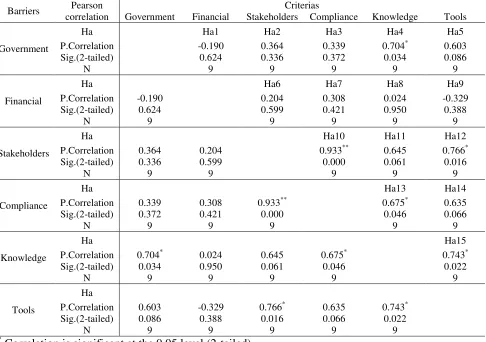
The content analysis was used to retrieve important information of the barriers collected from previous studies. The barriers collected were rearranged under the main themes created as a mute evidence of text to clarify why those themes have been created.the barriers of green building investment that challenge the decision making go under some themes that represent the source of each challenge as an entity that acts in the area of green building investment barrier to decision making. Table 1 shows the themes created as main criteria of the barriers that go under each theme as follows
Table 1: Content analysis for the themes created (Acting entities to barriers)
Theme Related information to the theme Barriers corresponding 1. Government Promotion from government ,incentives from
government
Lack of promotions and incentives from government[13]
2. Financial Financial support, financial budget, initial capital cost, maintenance cost, additional construction time cost, green appliances and energy saving material cost, financial incentives from related agencies.
Lack of financial support [13], financial constraints of budget [12], higher initial cost [12], increase of maintenance cost [13], additional time increase cost of construction [14], cost of green appliances and materials [15], lack of financial incentives from related agencies [12].
3. Stakeholders Professional experts, participants understanding, efficiency and green regulations, skills and specialized jobs. collaboration and communication, product representative and researchers feedback, decision makers and biases, stakeholders,
Lack of professional experts [15][13], participants misconception and uncertainty on green building [4], lack of efficiency for implementing green building regulations [13], lack of skills and specialized jobs [7], lack of collaboration and communication [7][12][16],
Theme Related information to the theme Barriers corresponding
3. Stakeholders interests, leadership. stakeholders do not trust information provided by products representatives and researchers [14], making suboptimal bias decisions [8], unfamiliarity with green technology resulting to delays [14], conflict of interests between stakeholders [14], lack of internal leadership [12]. 4. Compliance Regulatory agencies, alternative materials and
systems, innovation among designers and architects, standards of sustainable development, green building performance, green building complexity.
No incentives for regulatory agencies to include alternative materials and systems [14], low level of innovation among designers and architects [12], no standardized definitions of sustainable development to evaluate green building performance [7], participants accept the fact that green building is complex and problematic [17]. 5. Knowledge Technical construction processes, policy
implementation efforts, knowledge and awareness, building processes and policies, perception of administrative staff of green project.
Technical difficulties encountered during construction processes [15], insufficient policy implementation efforts [15], lack of knowledge and awareness of green technologies [15], weak building processes and policies [[12], low level of perception of administration staff of green project [12].
6. Tools Green materials, technical terms that establish a standard construction procedure, Green Building Challenge tool (GBC), Leadership in Energy and Environmental Design (LEED), accessible and reliable tools, systems of green building and application, stakeholders and tools.
Green building materials limited availability [14], lack of technical terms that establish standard construction procedure for a green building [7], (GBC) is a complex tool assessment while LEED is not applicable to certain type locations [18], lack of readily accessible and reliable information tools to facilitate the features of green building [14], the system applied and facilities are expensive to apply [14], the isolation of stakeholders among themselves weakens the process and tools to implement green features [14]
The mean scores were used to determine the level of barriers that challenge the green building investment decision making to explain the extent of the respondent’s perspective point of view through a scale from not related at all to extremely related regarding the relationship between the main barriers (main criterias) themselves.
Table 2 shows the arrangement of main barriers to decision making of green building investment corresponding to the other main criterias such as government, stakeholders, financial, compliance, knowledge and tools. The table presents the mean for the main government, financial, stakeholders, compliance, knowledge and tools barriers from a low mean of 2.91 (mean of government) to a high mean of 3.16 (mean of stakeholders) and all the means conducted by SPSS version 16 are in the moderate level of moderately related scale to the other criterias.
Table 2: Level of barriers corresponding to the main criteria
Barriers Mean Standard deviation
Government 2.91 0.540
Financial 3.02 0.267
Stakeholders 3.16 0.588
Compliance 2.97 0.347
Knowledge 3.04 0.307
Tools and methods 3.05 0.484
Table 3 shows that there are some significant positive relationships between some barriers whereby results show that there is a significant relationship between compliance barriers and stakeholders barriers (r = 0.933, p < 0.01), there is a significant relationship between knowledge barriers and compliance barriers (r = 0.675, p < 0.05), there is a significant relationship between knowledge barriers and government barriers (r = 0.704, p < 0.05), there is a significant relationship between tools barriers and stakeholders barriers (r = 0.766, p < 0.05) and there is a significant relationship between tools barriers and knowledge barriers (r = 0.743, p < 0.05), therefore the hypothesis Ha4, Ha10, Ha12, Ha13 and Ha15 are accepted while the relationship between compliance barriers and stakeholders barriers have proven to be the most significant relationship among all of them. However, the relationships between the other barriers is not totally ignored whereby pearson correlation factor has shown that the relationship between government barriers and tools barriers (Ha5), knowledge barriers and stakeholders barriers (Ha11) and compliance barriers and tools barriers (Ha14) are having relationships that vary from 60% to 65%.
Table 3: Pearson Correlation and significant relationships between barriers
Barriers Pearson correlation
Criterias
Government Financial Stakeholders Compliance Knowledge Tools
Government
Ha Ha1 Ha2 Ha3 Ha4 Ha5
P.Correlation Sig.(2-tailed) N -0.190 0.624 9 0.364 0.336 9 0.339 0.372 9 0.704* 0.034 9 0.603 0.086 9 Financial
Ha Ha6 Ha7 Ha8 Ha9
P.Correlation Sig.(2-tailed) N -0.190 0.624 9 0.204 0.599 9 0.308 0.421 9 0.024 0.950 9 -0.329 0.388 9 Stakeholders
Ha Ha10 Ha11 Ha12
P.Correlation Sig.(2-tailed) N 0.364 0.336 9 0.204 0.599 9 0.933** 0.000 9 0.645 0.061 9 0.766* 0.016 9 Compliance
Ha Ha13 Ha14
P.Correlation Sig.(2-tailed) N 0.339 0.372 9 0.308 0.421 9 0.933** 0.000 9 0.675* 0.046 9 0.635 0.066 9 Knowledge
Ha Ha15
P.Correlation Sig.(2-tailed) N 0.704* 0.034 9 0.024 0.950 9 0.645 0.061 9 0.675* 0.046 9 0.743* 0.022 9 Tools Ha P.Correlation Sig.(2-tailed) N 0.603 0.086 9 -0.329 0.388 9 0.766* 0.016 9 0.635 0.066 9 0.743* 0.022 9 *
Correlation is significant at the 0.05 level (2-tailed)
**
Correlation is significant at the 0.01 level (2-tailed)
and incentives to ease the decision making and to encourage the investors to go green. There is also the public and private sector whereby government public projects are funded and operated by the government with no financial constraints [23]. Ha9 is the hypothesis that assumed there was a relationship between financial and tools barriers, it has been found that there is no relationship between those two barriers whereby the tools in terms of certifcates and acknowledging a project to be green is not hard to purchase. Typically, a number of investors suggest that the requirement of green building projects does not encounter an increment of cost whereby some owners such as Toyota Motor Sales was able to accomplish a gold certified LEED without the disturbance of increased costs [24]. [25] stated that efficiency is the main core for delivering a low cost of sustainable development buildings as some companies and sectors become more adapted in the delivery of green building which completely supports the hypothesis Ha10 that showed the significant relationship between stakeholders and compliance barriers. The other relationships between barriers that have been found in the hypothesis Ha2, Ha3, Ha6, Ha7 and Ha8 are low as indicated by results generated through the responses given by the respondents of the questionnaire.
Conclusion
Green building investment in institutional campuses is challenged by many barriers that hinder the penetration of this development into the market. This paper highlights the achieved study objective, whereby the barriers of green building investment have been identified under their main categories which are government, financial, stakeholders, compliance, knowledge and tools by using content analysis through retrieving meaningful texts from previous studies. The mean of each barrier corresponding to the main barrier criterias have been determined whereby they all have been rearranged based on level. Stakeholders mean score is found to be the highest mean score of (3.16) while the barriers generated from government is found to be the least mean score of 2.91. However, financial, compliance, knowledge and tools were having mean scores of 3.02, 2.97, 3.04 and 3.05 respectively which clarify that all barriers are in moderate level of influencing each other by the understanding of all respondents of the study. The relationship between barriers have been found by the correlational analysis whereby knowledge and awareness barriers have a significant relationship with each of compliance, government and tools barriers while barriers generated by stakeholders have a significant relationship with compliance and tools barriers. Stakeholders and compliance barriers are having the most significant relationship among all hypothesis. 5 hypothesis out of 15 have been accepted to have significant relationships while two hypothesis have been found to be negative which indicate a no relationship at all between the corresponding barriers, while some previous studies support these negative relationships with justifications of some case studies. Meanwhile three hypothesis are found to have a moderate level of relationship that vary from 60% to 65%.
ACKNOWLEDGMENT
This paperwork was financially supported by Universiti Teknologi Malaysia, Fundamental Research Grant (Vot. No: 4F680), Reseach Management Centre, and research team members from Faculty of Civil Engineering, Construction Research Centre (CRC), IISIC and GreenPROMPT Research Group.
References
1. Ali, Hikmat H, and Saba F Al Nsairat. "Developing a Green Building Assessment Tool for Developing Countries–Case of Jordan." Building and Environment 44, no. 5 (2009): 1053-64.
3. Sussman, Edna. "Building Stock Offers Opportunities to Foster Sustainability and Provides Tools for Climate Change Mitigation and Adaption." Sustainable Development Law & Policy 7, no. 3 (2007): 6.
4. Yang, Rebecca J, and Patrick XW Zou. "Stakeholder-Associated Risks and Their
Interactions in Complex Green Building Projects: A Social Network Model." Building and Environment 73 (2014): 208-22.
5. Al Zubaidi, Hassan, and Srour Al Otaibi. "An Empirical Approach for Identifying Critical Time-Ovrerun Risk Factors in Kuwait's Construction Projects." Journal of Economic and Administrative Sciences 24, no. 2 (2008): 35-53.
6. Koh, SCL, SM Saad, Ammar Ahmed, Berman Kayis, and Sataporn Amornsawadwatana. "A Review of Techniques for Risk Management in Projects." Benchmarking: An International Journal 14, no. 1 (2007): 22-36.
7. Kasai, Nayara, and Charbel José Chiappetta Jabbour. "Barriers to Green Buildings at Two Brazilian Engineering Schools." International Journal of Sustainable Built Environment 3, no. 1 (2014): 87-95.
8. Hoffman, Andrew J, and Rebecca Henn. "Overcoming the Social and Psychological Barriers to Green Building." Organization & Environment 21, no. 4 (2008): 390-419.
9. Mills, Anthony. "A Systematic Approach to Risk Management for Construction." Structural survey 19, no. 5 (2001): 245-52.
10.Marker, Anthony W, Susan G Mason, and Paul Morrow. "Change Factors Influencing the Diffusion and Adoption of Green Building Practices." Performance Improvement Quarterly 26, no. 4 (2014): 5-24.
11.Hillary, Ruth. "Environmental Management Systems and the Smaller Enterprise." Journal of cleaner production 12, no. 6 (2004): 561-69.
12.Richardson, Gregory RA, and Jennifer K Lynes. "Institutional Motivations and Barriers to the Construction of Green Buildings on Campus: A Case Study of the University of Waterloo, Ontario." International Journal of Sustainability in Higher Education 8, no. 3 (2007): 339-54.
13.Zhang, Xiaoling, Liyin Shen, Vivian WY Tam, and Winnie Wing Yan Lee. "Barriers to Implement Extensive Green Roof Systems: A Hong Kong Study." Renewable and Sustainable Energy Reviews 16, no. 1 (2012): 314-19.
14.Griffin, CT, C Knowles, C Theodoropoulos, and JH Allen. Barriers to the Implementation of Sustainable Structural Materials in Green Buildings. Taylor & Francis, 2010.
15.Zhang, Xiaoling, Andrew Platten, and Liyin Shen. "Green Property Development Practice in China: Costs and Barriers." Building and Environment 46, no. 11 (2011): 2153-60.
16.Choi, Christopher. "Removing Market Barriers to Green Development: Principles and Action Projects to Promote Widespread Adoption of Green Development Practices." Journal of Sustainable Real Estate 1, no. 1 (2009): 107-38.
18.Todd, Joel Ann, Drury Crawley, Susanne Geissler, and Gail Lindsey. "Comparative Assessment of Environmental Performance Tools and the Role of the Green Building Challenge." Building Research & Information 29, no. 5 (2001): 324-35.
19.Williams, Katie, and Carol Dair. "What Is Stopping Sustainable Building in England?
Barriers Experienced by Stakeholders in Delivering Sustainable Developments." Sustainable development 15, no. 3 (2007): 135-47.
20.Love, Peter ED, Michael Niedzweicki, Peter A Bullen, and David J Edwards. "Achieving the Green Building Council of Australia’s World Leadership Rating in an Office Building in Perth." Journal of Construction Engineering and Management 138, no. 5 (2011): 652-60.
21.Shi, Qian, Jian Zuo, Rui Huang, Jing Huang, and Stephen Pullen. "Identifying the Critical Factors for Green Construction–an Empirical Study in China." Habitat international 40 (2013): 1-8.
22.Lam, Patrick TI, Edwin HW Chan, CS Poon, CK Chau, and KP Chun. "Factors Affecting the Implementation of Green Specifications in Construction." Journal of Environmental Management 91, no. 3 (2010): 654-61.
23.Brealey, Richard A, Ian A Cooper, and Michel A Habib. "Using Project Finance to Fund Infrastructure Investments." Journal of Applied Corporate Finance 9, no. 3 (1996): 25-39.
24.Pristin, T. "Toyota's New Main Campus: Green Goes Mainstream." The New York Times (2003).