Buletin Geolnformasl, .lId 1, NO.2, ms. 45 - 52 , September 1997 © Penerbitan Akademlk Fakulti Kejuruteraan & Salns Geoinformasi
Developing A Multi Discriminant Analysis Model As A Tool To Predict
Insolvency Of Property Development Firms
In Malaysia
Maziah Ismail, PhD, Assoc. Prof. Fredy Andereas Goentoro
1 ,I..:tlil~\It' LilgllKcring and G~oinrprlJ)ation)..:io.:n..:c (1IIiv..:r.\itl rd,nologi Mal:lv,,,ia
Abstract
~inel.: thl.: la,,1 Ihr..:..: d":":iltk\, ~li\lj\lk<tl tedllliqu~s \ueh <is I\-tuJtiplc UbcriminanL Analysis (MfM.) h~1\ch~ellu"cd by resean;h~rs 1O predict corporate failur~"(Altman: 1992) Ilo\\'e\c'L to date these techniques havc not been teslt:d on property-rclalcd
jlnanci~1rmil)S t.:\111l:t:lrling loans undcrtal\cn by properly development firms.
llence. this papa seel\...; to uncover th~ possibilities of applying a modified MDA based Illodd to measure the lcvl.:l of probable Jin:J.rlcial crisis. In this paper. lhe discussion is foeuscd on the proposed model whil.:h is designed to attempt to discriminate between a sample of banl\rupt property dt:velopment firm.'. and a matched "ample of healthy propert)- development l"llms Tht: exp~l:tedresult may be an effective aid t~lthe creditor: in this C'-lSi: Iht: flllJllcial institutions. in evaluating each debtors'; in this ,,;a~e property de\'elopment t1nm: financial position The aim of thi" paper is to seek comment on a proposed model from academiCS and practitioners, particularly those working. in this area Therernre. an outlim.' of the pwpllseJ modd is put forward along Y"iLh Ihe proposed research design lmd requireu data
Key word:.. Pmpl'rl) lkvclopl1l~111lirrn~, Fill;\Ilcial crisis. lJ1Sl)lven..:y. ilnd Financial r(llill:;
1. INTRODUCTION
A property development firm seeks its interest in property to maximize shareholder value through its activities. The property development firms will aim to fund their activities in order to produce an adequate return from the property after deducting finance costs. The firms are desirable to finance development activities with as much deb! as possible or lo increase gearing \\'hich usually be known as leverage concept. In Malaysia. in 1996. the Annual Economic RepOl1 reponed that the rcal estate and construction sector remains significant at a double digit growth rate for eight consecutive years. Apparently, the perfonnance of this sector is rcllccted by the increase not only in number but also in value of new and existing real estate transactions. that is. grew by 15.8% and 34.1 % in 1995 (and 8.9% and 25.9% in 1994; Bank Negara Report: Monthly Statistical Bulletin September 1996).
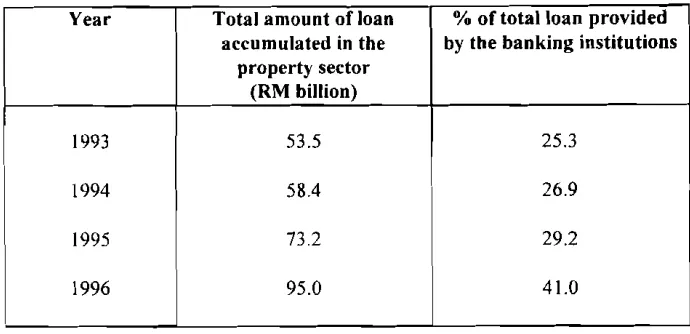
The total loan provided in the property sector was RM 53.5 billion. RM 58.4 billion and RM 73.2 billion for the years 1993. 1994 and 1995 respectively. [Jy the end of 1996 the total loan channeled into the property seclor increased to RM 95 billion which consumed 41 % of the total loan provided by the banking and financial institutions as opposed to 25.3%, 26.9% and 29 ..?O/o for the years 1993, 1994, and 1995 (Refer
Maziah Ismail I Fredy Andereas Goentoro
Year Total amount of loan
accumulated in the property sector
(RM billion)
% of total loan provided
by the banking institutions
1993 53.5 25.3
1994 58.4 26.9
1995 73.2 29.2
1996 95.0 41.0
Source: Fxtractcd from Annual El,;llnomic Reports and Annual Bank Negara Reports.
Table 1: Total loan accumulated in the property sector between 1993 and 1996
As illustrated in Table 1, the amount offund that has been channeled into the property sector has expanded enormously that, as reported in September 1996, the increase in loans had outpaced that of deposits. As a result, the banking system experienced a resource gap ofRM 3.5 billion in September 1996. The increase in loans was channeled mainly to fmance, insurance and business services sector followed by the broad property sector amounting to RM 1.3 billion.
These developments led to the implementation of a new guideline by the Bank Negara Malaysia whereby, effective from I" April 1997, banking and financial institutions are instructed to limit their total loan provision of not exceeding 20% to the property sector. The action undertaken indicates the awareness of the Government and the Bank Negara Malaysia of the existence of 'undesirable elements of influence' which continued to exert 'contractionary effects' on the financial resources. The 'undesirable elements of influence' has been identified as consisting of greedy spcculators and unhealthy property development firms.
Since the total loan provided in the property sector is huge, hence, any default in the repayment may result in a financial crisis impact in the country. Default in payment may result from insolvency of property development firms that undertake the loans. Though the creditors such as the banks and financial institutions have option to take legal actions against those firms, such as foreclosing on collateral, the actions entail much time and expenses. Therefore, the availability of an effective method that enable the creditors to predict the insolvency of property development firms is necessary to help avoid huge loan losses.
2. REVIEW OF RELATED LITERATURE
Developing A Multi Discriminant Analysis Model As A Tool To Predict
Insolvency Of Property Development Firms In Malaysia
two main types: investment and trading. Since trading is a fonn of short tenn investment, therefore this study does not differentiate them.
The property development firms recognize profits or losses from two main sources: rentals of the properties and sales of the properties. They may also recognize gains, the increase in value of property. Before undertaking its development, a property development finn will prepare an appraisal to assess the 'residual value' of an intended development site. For this reason, a developer has to know the factors that influence the value of a particular property in the long-tenn, that is: economic prospects; return on alternative investments, local and national market conditions, quality of the property; location of the property; nature and tenns of the lease; and quality of the tenant (or covenant) (Chidgey & Bevan; 1994).
If this value shows a positive outcome, the finn will proceed with the development activities. This involves the risk that the market has changed by the time the development is complete.
The possible illiquidity of property may mean that a property dealing finn cannot sell at the price anticipated when it did its assessment. The finn more likely fails to satisfy its objectives and faces fmancial distress. Financial distress can be defined as promise to creditors is broken or honored with difficulty (Brealey et aI., 1991).
Financial distress faced by a developer may cause a default on the repayment of the loan. Ongoing fmancial distresses are the earliest stage of poor conditions that may bring the development finns into failure. Failure rarely comes suddenly, it develops steadily passing several stages which development can be clearly discerned (Kharbanda, 1985). Developer's failure which brings both direct and indirect impacts to his creditor, such as 'financial crisis', hence the creditor's interest is the reason for developer's fum failure (Walters, 1991).
Review on related literature revealed that financial crisis has numerous definitions and often conflicting approaches (Woltson, 1986; Veblen, 1904; Mitchell, 1941; Bordo, 1992). The defmitions vary with the specific manifestations of crisis being studied. However, for the purpose of this study, financial crisis is defmed as follows:
"A situation in which a significant group of financial institutions have liabilities exceeding the market value of their assets, leading to runs and other portfolio shifts, collapse of some financial fmms, and government intervention" (~undararajan and Balino, 1992).
The tenn crisis refers to a situation in which a sudden and great reduction of the value of creditor's assets, caused by huge loan defaults, may result in apparent liquidity problems in his financial system. If the creditor's customers realize the problem, they will become panic. Banking panics occur almost simultaneously with financial crises and stock market crashes (Canova, 1994). This situation may worsen when the customers rush to withdraw their deposits and so lead the creditor's finn into a serious insolvency. The tenn insolvency is used for a company! finn which fails to pay its debts as they fall due, while the tenn bankruptcy applies to individuals and not finns (Rees, 1990).
Maziah Ismail I Fredy Andereas Goentoro
Early detection of a problem accompanied by appropriate action usually mItigates the impact to the creditor's institution. However, early detection of problem credits has not proved easy, moreover, an accurate and timely analysis and information is extremely required (Basu, 1995).
Hence, as long as financial institutions grant huge loans to developers, the institutions should prepare to be able to surmount the possible difficulties like the financial crisis. The seriousness of the default problems is a threat that may lead the bank to insolvency if they could not be detected and remedied on time; as exemplified by the liquidation of The Bank of New England in 1991 (Sinkey, 1992).
Hence, the act to limit the possibility of the occurrence of financial crisis can be viewed as an attempt to predict insolvency of the development firms. Insolvency is defined as the occurrence of: (1) negative cash flow from operations, (2) deteriorating financial structures, (3) negative net worth, and (4) inability of the firm to meet its financial obligations and the decreasing market price of the share.
3. DISCRIMINANT ANALYSIS AS BANKRUPTCY PREDICTION MODEL
Discriminant analysis is viewed as the appropriate statistical tecltnique in handling either two groups or multiple groups (multi discriminant analysis) of variables. It involves deriving the linear combination of the two (or more) independent variables that will discriminate best between the a priori defined groups (Hair et al.; 1990).
Among the researchers who had utilized this technique was Alttnan whose model known as Z-score model that was commenced in 1968 showed significant useful results in predicting bankruptcy of manufacturing frrrns. From the results of applying the model, Alttnan realized certain weaknesses in his prediction model, which seemed to be inherent in other similar models as well (Bettinger; 1981). First, the model resulted from the first study had been limited to manufacturing firms, therefore it might not be applicable to other kinds of frrrns. Second, most of the data used had been taken from Moody's or a similar source with the result being that most of the firms surveyed were large, publicly held firms for which a great deal of statistical information was available. Whereas, the fourth variable of the model, that is the market value of equity/ book value of total debt, has no constant ratio value in practice. This is because market value may easily change, therefore, tend to invalidate universal application of the model.
Nevertheless, these are only minor weaknesses and could probably be overcome. Moreover, Altman continued to develop further his study in predicting bankruptcy and tested it in many other countries suclt as France (1974), Brazil (1979), Australia (1981), Italy (1994) and others. The firms he had observed are manufacturing frrrns, textile industry, broker dealers, Savings and Loans Industry and banking industry. In 1977, assisted by Haldeman and Narayanan, he developed a new model based on Zeta analysis, which ntilized seven ratios. Some of tltese ratios were different from the five ratios of the first model. The change in the number and type of ratio on the first model and Zeta analysis model indicate that variable selection plays an important role in obtaining an accurate result.
The model also became an object of criticism by several other researchers, such as Gupta (1983), Kltarbanda and Stallworthy (1987) and others. Gupta (1983) considered Alttnan's multivariate analysis model as less reliable than other model like univariate analysis model that was utilized in 1967 by Beaver who formerly used the same sample data that Altman did. According to Gupta (1983) Beaver's study gave a more consistent results than Altman's in predicting bankruptcy for three to five years prior to b..-kruptcy.
Developing A Multi Discriminant Analysis Model As A Tool To Predict
Insolvency Of Property Development Firms In Malaysia
Altman's model, since it only utilized single ratio instead of multi ratios that Altman based on. Furthermore, the bankruptcy problem is complicated and is too complex to be analyzed using a single ratio. In his most recent work with Marco and Varetto (1994), Altman sought to compare corporate distress diagnosis using linear discriminant analysis and neural network and he stated that his model had not been less reliable than neural network model
To date, Altman's model is continuously developed and adjusted to suit current environment as well as the needs of the industry in which the research is conducted.
4. THE PROPOSED STUDY
This study intends to develop a model to predict insolvency level of property development firms by utilizing discriminant analysis technique as Altman's predictive bankruptcy approach. It attempts to adopt and modify accordingly Altman's model so that it is suitable for application to predict possible fmancial crisis in a property development firm.
5. THE PROPOSED APPROACH
In the study undertaken, in order to predict insolvency of property development firms, a sample of property
development firms showing early signs of insolvency is required. However, in Malaysia, financial data of insolvent firms are not easily available. Therefore, a number of property development firms, that involved in loan problem and under close observation of the Bank Negara Malay~a, will be used as insolvent fmns.
In addition, firms that do not show the signs of insqlvency or in the context of this study is categorized as healthy fmns, are also selected. The selection is based upon an approximately paired sample size, whereby for each sample of insolvent firm, a healthy firm of the same size and year of 'insolvency' is then selected.
In the context of this study, property development firm is a company that derives return from both rentals
and growth in value based on either the existing state of construction or a provision for the costs to complete construction (Chidgey and Bevan, 1994).
6. THE PROPOSED MDA MODEL
In this study, fmancial ratios are derived from the financial statements of the sample fmns. These ratios cover the key financial performance areas of profitability, activity, liquidity, leverage, efficiency and the uniqueness of real estate implied in cash position. All of the aggregated ratios are processed using principal components analysis. This analysis is utilized to reduce the number of ratios that are interrelated, remove ratio redundancy, and identify the salient dimensions represented by the ratios. The expected result is a set offactors (ratios) that are orthogonal (uncorrelated) to each other.
Multiple discriminant analysis (MDA) will then be performed on the remaining ratio set using a direct approach, whereby all of the ratios are used for computation at the same time. MDA is used as it considers linear combinations of the ratios to generate a combinatiM that best c1assifiet the sample used. The generated combination then forms the prediction model.
Maziah Ismail I Fredy Andereas Goentoro
Where:
Z ~ the discriminant score
W, , W , W, ~ the discriminant weights
X, , X, ", , X, ~the remaining ratio setthat represent the actual condition of the firm
The model has to be validated in terms of its predictive ability. The slight reduction in predictive ability is deemed satisfactory for this study, since it is important to take note that inherent qualitative elements affecting the financial statements of the property development firm will, to a certain extent, affect the accuracy level of the model.
7. BENEFITS AND LIMITATIONS
aJ Benefits
The prediction of insolvency of future property development firm is expected to provide a means to benefit the following groups. One, analysts, investors and potential investors· who are trying to form a view on a fmancial strength and stability of individual companies, often on a comparative basis. Two, lenders· who will normally have separately assessed the value of the property comprising the security for their lending, and who will be using this prediction to form a view on the continued financial viability of the borrower and the continuing adequacy of the security. Three, the taxation authorities· who used to focus on the profit and loss account and the company's accounting policies and may shift to this applicable prediction model.
bl Limitations
The result of this study is limited by a number of constraints.. One, it only views property development
firms that had fulfilled the requirements of obtaining credit. It does not take into consideration the
background of the firms before the credit were granted. Two, the objectivity of the data and information extracted from the financial statements are outside the control of the researcher. Finally, in this study a relative small sample sized is used. This is due to the problem of obtaining and gaining access to financial data which in most cases are confidential. Hence, this explain why the samples used in this study is not limited to one type of property only.
8. CONCLUSION
It is hoped that the model outlined here fulfills the criteria set out for it. In particular, it aims to capture the
Developing A Multi Discriminant Analysis Model As A Tool To Predict Insolvency Of Property Development Firms In Malaysia
The research required to investigate the financial performance of property development finns, in this way is, however, quite demanding. It involves careful and time-consuming documentary and difficult-to
interpret financial data. It is nevertheless, an essential for the researcher to understand and capable of interpreting financial statements of property development activities.
In particular. such research should enable the development of much richer hypotheses about indicators of financial performance of property development firms. On the other hand, in the practice and policy context many professionals and financial analysts are aware of the general signals that illustrate the financial perfonnance of property development finns. However, their difficulty is to make sense of the variety they encounter and most importantly to assess the performance objectively.
It is expected that the model proposed should help them to identify some of the model significant financial ratios shaping the financial performance of the property development firms in which they are involved. This might help them develop their own strategies to avoid financial crisis as early as possible, more effectively. More generally, the introduction of this model as an effective prediction instrument may lead to better decision making, better policy design as well as, undoubtedly, a useful and effective weapon to prevent financial crisis in the economy.
REFERENCES
Altman, E.!., Giancarlo Marco, and Franco Varetto(1994). Corporate Distress Diagnosis: COfl'lparisons Using Linear Discriminant Analysis and Neural Networks (the Italian experience). Journal of Banking and Finance 18.
Altman, E.I., R. Haldeman and P. Narayanan (1977). ZETA Analysis, A New Model To Identity Bankruptcy Risk O/Corporations.
Journal of Banking and Finance I (June).
Altman, E.I. (1968). l'itli.Ulclal Ratios, Discriminant Analysis And The Prediction o/Corporate Bankruptcy. Journal of Finance XXtll (Sept)
Annual Economic Report 1994 - 1995, Government Printers. Kuala Lumpur.
Annual Bank Ncgara Report 1994 - 1995, Bank Negara Malaysia. Kuala Lumpur.
Argenti. John (1976), Corporate Collapse, The Causes and ~ymptoms,McGraw-Hili Book Company Ltd., Maidenhead, 1976.
Bank Negara Report (1996), ,itfonthly StatistICal Bulletin. September 1996. Bank Negara Malaysia
Basu, Sam N. and Harold L. RoUes, Jr.(l995). Strategic Credit Management. John Wiley & Sons Inc. New York.
Bettinger, C. (1981). Bankruptcy Prediction as a Toolfor Commercial Lenders. The Journal of Commercial Bank Lending (July). Bordo, Michael (1992). Financial Crise.f Volume I. Edward Elgar Publishing Ltd. Gower House Hants.
Brealey, R.A., Stewart C. Myers, and Alan 1. Marcus (1995). Fundamental.f o/Corporate Finance. Me GrawHiIllnc., New York.
Canova, Fabio (1994). H/ere Fmancial Crist's Predictable? Journal of Money, Credit, and Banking, Vo1.26, NO.1 (Februari). Chidgey, Peter & Simon Bevan (1994). Accounts and Audit of Property Companies. Butterworths. I,ondon.
Gupta, L.C.(1983). Financial Ratiosfor Monitoring Corporate Sickness- Towards a More Systematic Approach. Oxford University Press.
Maziah Ismail J Fredy Andereas Goentoro
Kharbanda, O.P. & E.A. Stall worthy (1985). Corporall' Failure, Prediction, Panacea and Prevention. McGraw-Hili Book Co.Ltd, London.
Mitchell, Wesley Clair (1941). Business Cycfes and Their Causes. University of California Press, California. Rees, Bill (1990). Financial Analysis. Prentice lIall. New York.
Sinkey. Joseph F. Jr.(1992). Commercial Bank Financial Management, In thejinancial·sef1Jices induslryAth ed. Macmillan Publishing Company; New York.
Sundararajan and Tomas J.T Balino (1992). Banking Crises: Cases and Issues. Intemational Monetary Fund.
Tappan, William T. Jr.( 1992). Handbookjor lhe Financial Analysis ojReal Estate Investments. McGraw-Hili, Inc., New York. Veblen, Thorstein (1904). The n,eory ojBusiness Enterprise. Charles Scribner & Sons. New York.
Walters, Ann (1991). Accounting Policies & The Analysis ojFinancial Statements. Euromoney Publications PLC Kent.