SURAJO SULAIMAN
POLYNOMIAL RESULTANT BASED ON DIXON, JOUANOLOU AND JACOBIAN MATRICES
SURAJO SULAIMAN
A thesis submitted in fulfilment of the requirements for the award of the degree of
Doctor of Philosophy
Faculty of Science Universiti Teknologi Malaysia
ACKNOWLEDGEMENT
In the Name of Allah the Most Beneficent, the Most Merciful. All the praises and thanks be to Allah, the Owner of the day of recompense. May God guide us to the straight path Ameen.
I would like to thank and express my sincere gratitude to Assoc. Prof. Dr Nor’aini Aris, my main supervisor for her professional guidance, understanding and encouragement throughout my studies. I would also like to thank my co-supervisor Dr Shamsatun Nahar Ahmad for her fruitful contributions. May Allah reward my supervisors for guiding me to this milestone in my life.
I am particularly grateful to the management of Yusuf Maitama Sule University Kano for nominating me to receive the TEDFUND intervention; without the intervention, this success will almost be impossible considering the economic difficulties faced during my PhD journey. I will also like to thank and acknowledge the effort of Kano state government under the leadership of the Senator (Dr.) Rabi’u Musa Kwankwaso for sponsoring my MSc program with served as a basis for the success we are celebrating today, may Allah reward him, Ameen.
Mamunu Mustapha, Dalhatu Sani Aliyu, Mal. Umar Abubakar Aliyu, Darma Kabiru Rabiu, Dr. Dahiru Sale Muhd, Surajo Ibrahim Isah, Sadiq Ibrahim Ogu, Umar zangina, Shehu Maitma and Dr. Amina Salihi Bayero just to mention but few, I feel lucky to leave and work with you all.
Although it is impossible to mention everybody who had in one way or the other contributed to this work. However, there are those whose moral and spiritual support is even more important. I feel a deep sense of gratitude for my parents, who formed part of my vision and taught me good things that matter in life. Their patience and sacrifice will remain my inspiration throughout my life. I am also very much grateful to all my friends for their inspiration and encouragement.
ABSTRACT
ABSTRAK
TABLE OF CONTENTS
CHAPTER TITLE PAGE
DECLARATION ii
DEDICATION iii
ACKNOWLEDGEMENT iv
ABSTRACT vi
ABSTRAK vii
TABLE OF CONTENTS viii
LIST OF TABLES xi
LIST OF FIGURES xii
LIST OF ABBREVIATIONS xiii
LIST OF SYMBOLS xiv
LIST OF APPENDIX xvi
1 INTRODUCTION 1
1.1 Preface 1
1.2 Research Background 2
1.3 Statement of the Problem 7
1.4 Objectives of the Study 8
1.5 Scope of the Study 9
1.6 Significance of the Study 9
1.7 Thesis Organization 10
2 LITERATURE REVIEW 13
2.2 Preliminary Definitions and Theorems 16
2.2.1 Affine and Projective Space 18
2.3 Matrix Method for Computing Resultant 26
2.3.1 Sylvester Resultant 27
2.3.2 Bezout’s Resultant 29
2.3.3 Multivariate Resultant 32
2.3.4 Determinantal Formula 35
2.4 Dixon Resultant 37
2.4.1 Recursive Algorithm 45
2.4.2 Transformation from Sylvester to Dixon matrix 46
2.4.3 Entry Formula 52
2.5 Macaulay Resultant 57
2.5.1 Reduced and Non-reduced monomials 60
2.6 Jouanolou Resultant 65
2.7 Hybrid Resultant 72
2.8 Conclusion 75
3 METHODOLOGY 76
3.1 Introduction 76
3.2 Assumptions 76
3.3 Research Framework 77
3.3.1 Stage One: Background of the Research 77
3.3.2 Stage Two: Generalized Entry Formula 79
3.3.3 Stage Three: New Hybrid Formulations 79
3.3.4 Stage Four: Implementation and Complexity
Analysis 83
3.3.5 Stage Five: Summary and General Conclusions 83
3.4 Computational Tools 83
3.5 Conclusion 84
4 JOUANOLOU-JACOBIAN FORMULATION 85
4.2 Jacobian Block 86
4.3 Construction of Jouanolou-Jacobian method 88
4.4 Complexity Analysis of Jouanolou-Jacobian Method 102
4.5 Conclusion 108
5 TWO DIXON-JOUANOLOU RESULTANT
FORMULATION 110
5.1 Introduction 110
5.2 Pseudo-Homogenization 111
5.3 Dixon-Jouanolou Method 113
5.3.1 Dixon-Jouanolou Method Type 1 113
5.3.2 Elements of the Entry Formula 115
5.3.3 Dixon-Jouanolou Method Type 2 120
5.3.4 Extraneous Factors Reduction 123
5.3.5 Complexity Analysis of Dixon-Jouanolou Method 124
5.4 Conclusion 128
6 GENERALIZED DIXON-JOUANOLOU FORMULATION 129
6.1 Introduction 129
6.2 Generalized Dixon Resultant Matrix 130
6.3 Generalize Entry Formula 135
6.4 Generalized Dixon-Jouanolou Method 148
6.4.1 Computational Cost of the Dixon-Jouanolou 149
6.5 Conclusion 156
7 CONCLUSION 157
7.1 Introduction 157
7.2 Summary of the Thesis 158
7.3 Conclusion 162
7.4 Future directions 165
REFERENCES 167
LIST OF TABLES
TABLE NO. TITLE PAGE
2.1 Cost of computing Dixon matrix for bivariate system 51 2.2 Cost of computing the Dixon resultant matrix for system
ofn+ 1polynomials innvariables 51
2.3 Summary of multivariate resultant formulations 73
4.1 Estimation of number of monomials in a homogeneous
polynomial of degreemwithnvariables 103 4.2 Cost of computing Bezoutian and Jacobian matrix 107 4.3 Size comparison of some selected resultant formulations 108
5.1 Operational computing time for the standard Dixon
method versus the new hybrid Dixon-Jouanolou method 127
6.1 The computational complexity of the generalized standard
LIST OF FIGURES
FIGURE NO. TITLE PAGE
1.1 Usual routines when computing resultant 6
1.2 Thesis organization 12
2.1 Proposed and existing method of computing resultant 15
2.2 Support of the polynomials system 19
2.3 Minkowski Sum ofA0andA1 21
2.4 Different points at infinity 24
2.5 Horizon; the vanishing points of different sets of parallel
lines at infinity 25
2.6 Projective Plane in 3-Dimensional Plane 25
2.7 Strophoid 33
2.8 Process of computing resultant polynomial 36
2.9 A figure showing the intersection of surfaces 58 2.10 Summary of the Existing Matrix Methods of Computing
Resultant 74
3.1 Research Framework 78
3.2 Methodology of Computing Jouanolou-Jacobian Method 80 3.3 Methodology of Computing Dixon-Jouanolou Method
type 1 and 2 82
4.1 Procedure for recursive polynomial division of
multivariate polynomials using monomial ordering 106
LIST OF ABBREVIATIONS
BKK - Bernstein Kouhnirenko Khovanskii CAS - Computer Algebra System
LIST OF SYMBOLS
V(F) - Affine varieties of the systemF
Det(M) - Determinant of the square matrixM
∆i,j - Differentials
⊕ - Direct sum
θ(f1, f2, . . . , fn+1) - Dixon polynomial of the systemf1, f2, . . . , fn+1
Θ - Dixon resultant matrix
Rr(F) - Dixon-Jouanolou resultant matrix
D(f1, f2, . . . , fn+1) - Dixon resultant matrix of the systemf1, f2, . . . , fn+1
ξa1,a2,···,an,b1,b2,···,bn - Element of the loose entry formula
Da,b,c,d - Entries of the Dixon matrix for bivariate system
Dm1−1,...,nmn−1;nmn−1,...,mn−1 - Entries of the generalize Dixon matrix of the systemF
α= (α1, α2, . . . , αn) - Exponent vectors of the monomialxα
Jr(F) - Jouanolou resultant matrix
µ(Q1,Q2, . . . ,Qn) - Mixed volume of the polytopesQ1,Q2, . . . ,Qn
xα - Monomialxα11 xα22 · · ·xαn
n whereα ∈Nn
N(F) - Newton polytopes of the systemF
Pn - Projective space
P(F) - Projective varieties of the systemF
Hr(f1, f2, . . . , fn) - Resultant matrix of the Dixon-Jouanolou method
C[x1x−11 , . . . , xnx−1n ] - Ring of Laurent polynomial over a fieldC
K[x1, x2, . . . , xn] - Ring of polynomial over a fieldK
Z - Set of integers
N - Set of natural numbers
R - Set of real numbers
S(Hr(f1, f2, . . . , fn)) - Size of the Generalized Dixon-Jouanolou matrix
S(Rr) - Size of the Dixon-Jouanolou matrix
A=hA1, A2, . . . , An+1i - Support of the systemF
Syl(f1, f2, . . . , fn) - Sylvester resultant matrix of the systemf1, f2, . . . , fn
LIST OF APPENDIX
APPENDIX TITLE PAGE
A List of Publications and submitted manuscripts 175
INTRODUCTION
1.1 Preface
The role played by a system of polynomial equations in scientific research has a variety of applications in real life situations. For example, in modelling the components in computer-aided design represented by the Bezier Bernstein splines [1], detecting whether a moving robot will collide with an obstacle or not [2], designing curves and surfaces [3], differential elimination [4] and application of Global Positioning System (GPS) in geodesy and geoinformatics [5]. Another important application is the modelling of geometric and kinematics constraints where a well-constrained system of polynomials equations are used to represent the motion of a camera.
Dealing with the above-mentioned applications requires a technique of variables elimination. There are three powerful elimination techniques; Grobner basis [6, 7], set characteristics or Ritt-Wu method [8] and the resultant matrix method [9, 10]. Some of the disadvantages of both Grobner basis and Ritt-Wu as reported in [11, 12] are:
1. These methods require large storage capacity during the computations.
The matrix method for computing the resultant is a popular tool used in eliminating variables which reduces the system of polynomial equations into simpler forms. The resultant of a system of polynomial equations can be obtained from the determinant of the resultant matrix. The determinant of the resultant matrix is also referred to as the projection operator. Exact resultant can be achieved if the projection operator exactly equals the resultant. Otherwise, the projection operator consists of a product of polynomials which are multiples of the resultant. These other factors of the projection operator besides the resultant polynomial are called extraneous factors. The presence of extraneous factors in the resultant formulation gives rise to the problem of extracting the resultant polynomial from the determinant.
Much of the concern in researches related to multivariate polynomials resultant is to determine a method that can give exact resultant. In most cases, exact resultant only exist on certain classes of the generic system of polynomial equations and these conditions are determined and proven to give exact resultant. Besides finding methods that can produce a determinantal formula which can give exact resultant, a method that can reduce the presence of extraneous factors in the resultant matrix formulation reduces the complexity of the problem. It becomes the aim of this thesis to find new methods that can reduce the complexity of computing the resultant matrix and resultant polynomial.
The rest of this chapter is as follows. Section 1.2 gives the research background leading to the problem statement in Section 1.3. The objectives of the study are given in Section1.4 followed by the scope of the study, the significance of the study and thesis organization.
1.2 Research Background
zero, the matrix is regarded as Sylvester type [14]. Sometimes the entries of the resultant matrix are polynomials in terms of the coefficients of the given system of polynomial equations, such type is referred to as Cayley/Dixon type. Methods such as Macaulay, Jouanolou (Generalized Macaulay), Newton sparse, incremental and Salmon Jacobian which is also referred as Sturmfel resultant [5] are considered to be Sylvester type while Dixon is regarded as Cayley/Dixon type [15–17]. All Cayley/Dixon resultant matrix have complicated entries, but with relatively small matrix [18–23]. On the other hand, Sylvester type resultant matrix have simple entries with large size matrix [24, 25].
In a situation where the resultant matrix is constructed based on the two types of the constructions, such formulation is referred to as the hybrid resultant matrix [26]. The foundation work for hybrid resultant was first introduced in [27], derived for certain class of the multivariate polynomials of multi-graded type. Independently, in 1999 Chionhet al. in [28] had proposed another hybrid construction which possibly is the first construction that can be applied to a more general class of system of polynomials.
Apart from the classical hybrid resultant matrix, the sparse hybrid formulation was constructed, due to the frequent appearance of such systems in many engineering applications [29]. However, it is not clear whether or not the constructions can generate exact resultant. Another construction was given by [30] and unlike the work of [29], Khetan presents his formulation and computes the hybrid resultant matrix based on certain examples. His construction also only considers systems of polynomials with unmixed support and the size of the matrix can still be very large [30]. A complete implementation of the Sylvester-Bezout construction is given by Ahmad in [13] giving conditions that can give optimal resultant matrix and describes some limitations in the implementations.
A triangular set of polynomials with almost the same set of common solutions as the original system of equations is defined as the characteristic set of a set of polynomials [8, 34]. Ritt presents the first algorithm to compute the characteristic set that was resurrected by Wu and Ritt respectively in [8, 31]. Characteristic sets are typically computed by eliminating variables sequentially in some predetermined order using successive pseudo-division of polynomials.
Ritt-Wu’s method requires a large storage capacity during the computation. For example, Heymann’s question can be resolved using the matrix method within 300 seconds, compared to almost 19 hours using characteristics set method [11, 18]. The implementation by Gao and Wang in [11] is carried out using SUN 4/470.
The Grobner basis of a polynomial ideal is a basis with many useful properties and provides answers to most of the theoretic questions about the ideals, such as ideal description and membership problem. The notion generalizes three well-known algorithms namely; Gaussian elimination algorithm, particularly reduced row echelon form for linear systems, the Euclidean algorithm for computing the greatest common divisor of both univariate and multivariate polynomials and lastly, the simplex algorithm for minimizing or maximizing linear and non-linear functions.
Buchberger’s algorithms resolved the issue of the ideal membership using S−polynomial
of f1, f2· · · , fn ∈ k[x1, . . . , xn] which is defined to be S(f1, f2) = xα LT(f1)
f1 −
xα LT(f2)
f2,where LT is the leading term offi andxαis the least common multiple (LCM)
of the leading monomials LM off1 andf2 (xα =lcm(LM(f1),LM(f2)))[32, 35].
The Grobner basis method can also be used in a variety of applications such as solving polynomials systems and implicitization of curves and surfaces. This method computes the exact resultant [18, 37]. However, the Grobner basis approach is not as simple as the matrix method and run out of time when the total degree is very large since it requires large storage capacity during the computations.
The Grobner basis method also is less effective, when computing the resultant of a polynomial system, for example, deriving the implicit equation of a bi cubic surface takes only 50 seconds using the matrix method, compared to almost 10,000 seconds using Grobner basis. In an implementation using SUN 4/470, sometimes the system runs out of memory before the computation ends [11, 18].
Another setback of the Grobner basis method reported by Zheng et al. [12] is that the approach fails to generate the implicit equation of some parametric equations with base points as given in Equation (1.1). On the other hand, the matrix method of computing the resultant is able to compute the implicit equation despite having these base points. For rational parametric equations defined as
x= x(s, t)
w(s, t), y=
y(s, t)
w(s, t) and z =
z(s, t) w(s, t),
a base point is a value(s, t)for whichx(s, t) = y(s, t) = z(s, t) = w(s, t) = 0.At this point the valuesx, y andz are not defined. Another implication of the base point is that, no matter what values the coefficients of the rational curves or surfaces will be, there is always a common solution at infinity.
F =
x(s, t) = 2t3+ 4t2+ 2t+ 4st+s2t+ 2 + 3s+s2 y(s, t) =−2st2−2t−st+ 2 +s−2s2−s3 z(s, t) = 2t2−3st2−2t−3st−2s2t−2s−3s2−s3
w(s, t) =t3+t2−t+st−1−s+s2+s3
In the implementation of the Grobner basis method, some of the reasons for large storage requirement and the CPU time is the swell of intermediate system of equations encountered during the computation of the basis. These intermediate polynomials do not satisfy the requirement of the basis, thus, are not included in the resulting Grobner basis [38, 39].
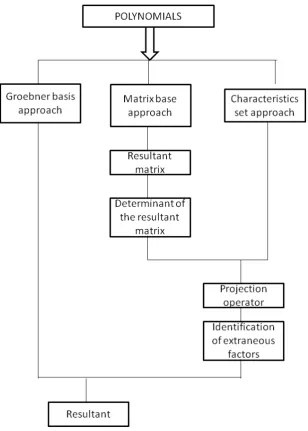
Figure 1.1 Usual routines when computing resultant
algorithms among others [42–44]. Until today reducing the cost of computing Grobner bases remain an open area of research. Figure 1.1 shows the different techniques of computing resultant and how they are related.
Since both Ritt-Wu and Grobner basis techniques require large storage capacity and huge CPU time while computing the resultant polynomial, this work focuses on the matrix approach of computing the resultant. Existing methods are revisited giving emphasis on the method of construction, complexity, size of the matrix, nature of the entries, size of the unwanted factors and space requirement in the implementation of these methods.
1.3 Statement of the Problem
The resultant techniques for solving multivariate polynomial equations have received lots of attention with emphasis on eliminating or at least reducing the terms of the extraneous factors in the projection operator. This is because the presence of extraneous factors constitute to one of the biggest problem common to all matrix methods. These factors do not provide any information on the solutions of the polynomials; thus can be misleading and the process of identifying them is time-consuming.
Recent research on the resultant matrix methods focus on the hybrid resultant formulations. However, the existing hybrid resultant matrix methods either produce a large resultant matrix size or extraneous factors embedded in the projection operator [13, 29]. On the other hand, there exist hybrid resultant matrix that gives exact resultant [30], but the method is confined to certain class of polynomials. The Sylvester Bezout type resultant matrix is implemented by [13] and proven to produce an exact result, but under certain conditions, the method had failed to generate the desired Bezout block of the matrix.
matrix methods can give exact resultant. However, in some special cases, almost all existing method can produce exact resultant [45] which is due to the special structure of the Newton polytopes corresponding to the system. Among the factors that contribute to the effectiveness and the efficiency of the resultant matrix method is the nature of the matrix elements and the large matrix size. If the entries of the matrix are polynomials, the symbolic computation of the determinant will be more complex then if the entries are numerical values [46]. Therefore the nature of the matrix entries as well as the size of the matrix determine the efficiency of computing the resultant polynomial.
Several formulations have been given with notable improvements. Yet the problem of reducing the size of the resultant matrix and reducing or eliminating extraneous factors is still an open problem in the study of resultant. Thus, deriving or constructing a new hybrid resultant matrix with considerable size, that can eliminate, or at least reduce, the number of extraneous factors remains an important problem of research, which when solved adequately will produce positive dividends.
1.4 Objectives of the Study
Based on the formulated problem, the following research objectives are outlined:
1. To derive, construct and implement the Dixon-Jouanolou methods for bivariate systems of polynomial equations and Jouanolou-Jacobian method fornpolynomial equations based on the Dixon, Jouanolou and Jacobian matrices.
2. To generalize the loose entry formula for computing the entries of the Dixon matrix and generalize the construction of Dixon-Jouanolou method to multivariate systems ofn+ 1polynomials withnvariables, applying the generalize loose entry formula to compute the entries of the Dixon-Jouanolou matrix.
Dixon and Jouanolou matrices respectively.
4. To determine the possible causes for the existence of extraneous factors and provide a suitable approach of eliminating them.
1.5 Scope of the Study
The research focuses on the construction of the hybrid resultant matrix methods for computing the resultant of a system of multivariate polynomial equation. The methods involved elimination theory, an area under algebraic geometry. The polynomials under consideration are assumed to be unmixed, generic and symbolic. Although, the new hybrid methods can handlensystem of polynomials withnorn−1variables, depending on the requirements of the method, the examples given in this thesis only include system of polynomials with at most four variables. Basic tools of algebraic geometry are applied in solving some problems encountered throughout this research. The computer algebra system Maple version 2015 is used to evaluate the resultant matrices.
1.6 Significance of the Study
algebraic geometry.
1.7 Thesis Organization
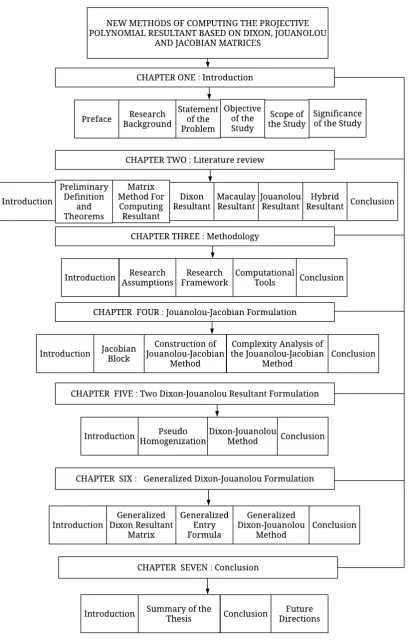
Chapter 1 introduces the concept of polynomial resultant which begins with preface, research background, statement of the problem, objectives of the study, scope of the study and finally the significance of the study. This chapter provides the introduction to the research area and highlights some of the existing problems. This chapter served as introductory part of this research work.
Chapter 2 serves as the review of the existing literatures. Referring to Figure 1.2, this chapter contains eight sections which include introduction, preliminary definitions and theorems and the matrix methods for computing resultant. Others are Dixon resultant, Macaulay resultant, Jouanolou resultant and the hybrid resultants. This chapter highlights major setbacks of the existing classical and hybrid techniques of computing resultant. Based on these limitations, the research problem have been identified. Hence the new constructions presented in Chapter 4, 5 and 6 are designed to reduce the size of extraneous factors, space requirements and cost of computations. The eighth section concludes the chapter.
Chapter 3 presents the methodology of this research work. As described in Figure 1.2, this chapter contains five sections which include introduction, research assumptions, research framework and computational tools. Details of the three constructions are provided with explanation. The chapter describes how these methods are designed to produce relatively smaller resultant matrix. Finally, the fifth section concludes the methodology.
the complexity analysis of the Jouanolou-Jacobian method. This complexity analysis provides a yardstick for comparison with the existing Jouanolou method to determine whether the Jouanolou-Jacobian technique is computationally expensive or not. Referring to Figure 1.2, the fifth section concludes the chapter.
Chapter 5 presents the Dixon-Jouanolou constructions of type 1 and 2. This chapter contains four sections which include introduction, pseudo-homogenization and Dixon-Jouanolou formulations for bivariate systems. The fourth section concludes the chapter. The concept of pseudo-homogenization allows the constructions to switch from a projective space to affine space using an artificial variable.
Chapter 6 presents the generalization of the Dixon-Jouanolou method, from the bivariate system to the system ofn+ 1 equations with n variables. The loose entry formula for computing the Dixon resultant matrix is generalized to the system ofn+ 1equations with n variables. This allows the generalization of the Dixon-Jouanolou method. Figure 1.2 shows that this chapter contained five sections which include introduction, generalized Dixon resultant matrix, generalized entry formula and the generalized Dixon-Jouanolou method is presented followed by conclusion.
1. Lewis,R.H.andStiller,P.F. Solvingtherecognitionproblemforsixlinesusingthe Dixonresultant. MathematicsandComputersinSimulation.1999.49(3): 205–219.
2. Yang, L., Fu, H. and Zeng, Z. A practical symbolic algorithm for the inverse kinematicsof 6rmanipulators withsimple geometry. Automated DeductionCADE-14.1997:73–86.
3. Wang,X.andChen,F. Implicitization,parameterizationandsingularitycomputation ofsteinersurfacesusingmovingsurfaces. Journal ofSymbolicComputation. 2012. 47(6):733–750.
4. Yang, L., Zeng, Z. and Zhang, W. Differential elimination withDixon resultants. Applied Mathematics and Computation. 2012. 218(21): 10679–10690.
5. Awange, J. L., Grafarend, E. W., Pal´ancz, B. and Zaletnyik, P.Algebraic geodesy and geoinformatics. Springer Science & Business Media. 2010.
6. Ahmad, S. N. and Aris, N. The Grobner package in maple and computer algebra system for solving multivariate polynomial equations. Academic Journal UiTM Johor.2011.
7. Buchberger, B. BrunoBuchbergersPh.D Thesis 1965:An algorithm for finding the basis elements of the residue class ring of a zero dimensional polynomial ideal. Journalofsymboliccomputation.2006.41(3): 475–511.
8. Wu, W. Basicprinciples ofmechanicaltheoremprovingin elementarygeometries.
Journal of Systems Sciences & Mathematical Sciences. 1984. 4(3): 207–235.
algebraical common measure. Philosophical transactions of the Royal Society of London. 1853. 143: 407–548.
10. B´ezout, E. Th´eorie g´en´erale des ´equations alg´ebriques; par m. B´ezout... de l’imprimerie de Ph.-D. Pierres, rue S. Jacques. 1779.
11. Gao, X.-S. and Wang, D.-K. On the automatic derivation of a set of geometric formulae. Journal of Geometry. 1995. 53(1): 79–88.
12. Zheng, J., Sederberg, T. W., Chionh, E.-W. and Cox, D. A. Implicitizing rational surfaces with base points using the method of moving surfaces. Contemporary Mathematics.2003.334: 151–168.
13. Ahmad, S. N.A HybridResultantMatrix AlgorithmBasedon theSylvester-Bezout Formulation. UniversitiTeknologiMalaysia:Ph.D.Thesis. 2016.
14. Ahmad,S.N.etal. Sylvester-typematricesforsparseresultants. MalaysianJournal ofFundamentalandAppliedSciences.2014.6(1).
15. Karimisangdehi,S.,Akbarpoor,S.,Valipour,A.,Khabiri,B.andMoosaviankhatir,S. Dixonresultant withoutextraneous factors. InternationalJournal ofMechatronics, ElectricalandComputerTechnology.2014: 2305–0543.
16. Mantzaflaris,A.andTsigaridas,E. Resultantsanddiscriminantsforbivariate tensor-product polynomials. In ISSAC 2017-International Symposium on Symbolic and AlgebraicComputation. 2017. 8.
17. Zippel,R. Effectivepolynomialcomputation.vol.241. SpringerScience&Business Media. 2012.
18. Karimisangdehi, S. New Algorithms for Optimizing the Sizes of Dixon and Dixon DialyticMatrices. UniversitiTeknologiMalaysia: Ph.D.Thesis. 2012.
20. Chtcherba, A. D. and Kapur, D.On the efficiency and optimality of Dixon-based resultantmethods. InProceedingsofthe2002internationalsymposiumonSymbolic andalgebraiccomputation.ACM. 2002. 29–36.
21. Chtcherba,A.D.andKapur,D.Resultantsforunmixedbivariatepolynomialsystems produced using the Dixon formulation.Journal of Symbolic Computation. 2004. 38(2):915–958.
22. Woody,H. Polynomialresultants. GNUoperatingsystem.2016.
23. Qin, X., Wu, D., Tang, L. and Ji, Z. Complexity of constructingDixon resultant matrix. International Journal of Computer Mathematics. 2017: 1–15.
24. Kalorkoti,K. OnMacaulayformoftheresultant. SchoolofInformatics,University ofEdinburgh.Web.2016.25.
25. Jeronimo, G.andSabia, J. Sparseresultantsandstraight-lineprograms. Journalof SymbolicComputation.2017.
26. Zhang,M.,Chionh,E.andGoldman,R. HybridDixonresultants. InProceedingsof theEighthIMAConferenceontheMathematicsofSurfaces.Citeseer.1998.193–212.
27. Weyman,J. and Zelevinsky, A. Determinantalformulas formultigradedresultants. Journal of Algebraic Geometry. 1994. 3(4): 569–598.
28. Chionh,E.-W.,Zhang,M.andGoldman,R. Transformationandtransitionsfromthe SylvestertotheB´ezoutresultant. TechnicalReport.Citeseer.1999.
29. DAndrea, C. and Emiris, I. Z. Hybrid sparse resultant matrices for bivariate polynomials. Journal of Symbolic Computation. 2002. 33(5): 587–608.
30. Khetan, A. The resultant of an unmixed bivariate system. Journal of Symbolic Computation. 2003. 36(3): 425–442.
31. Ritt, J. F. Differential algebra. vol. 33. American Mathematical Soc. 1950.
33. Jin, M., Li, X. and Wang, D. A new algorithmic scheme for computing characteristic sets. Journal of Symbolic Computation. 2013. 50: 431–449.
34. Wu, W. and Gao, X. Mathematics mechanization and applications after thirty years. Frontiers of Computer Science in China. 2007. 1(1): 1–8.
35. Cox, D. A.IntroductiontoGr¨obner bases. In Proceedingsof Symposiain Applied Mathematics.AmericanMathematicalSociety. 1998.vol.53. 1–24.
36. Buchberger,B.andWinkler,F.Gr¨obnerbasesandapplications.vol.251.Cambridge UniversityPress. 1998.
37. Elkadi, M., Mourrain, B. and Piene, R. Algebraic Geometry and Geometric Modeling. Springer. 2006.
38. Neun,W.andMelenk,H.VerylargeGr¨obnerbasiscalculations.In ComputerAlgebra and Parallelism. Springer. 89–99. 1992.
39. Gao, S., Volny, F. and Wang, M. A new algorithm for computingGrobner bases.
IACR Cryptology ePrint Archive. 2010. 2010: 641.
40. Eder, C. and Perry, J. E.Signature-based algorithms to compute Gr¨obner bases. In Proceedings of the 36th international symposium on Symbolic and algebraic computation.ACM. 2011. 99–106.
41. Sun, Y., Wang, D., Ma, X. and Zhang, Y. A signature-based algorithm for computing Gr¨obner bases in solvable polynomial algebras. In Proceedings of the 37thInternationalSymposiumonSymbolicandAlgebraicComputation.ACM.2012. 351–358.
42. Faugere,J.-C.AnewefficientalgorithmforcomputingGr¨obnerbases(f4). Journal of pure and applied algebra. 1999. 139(1): 61–88.
43. Eder,C. andPerry,J. F5c:avariant offaugeresf5algorithmwithreducedGr¨obner bases. JournalofSymbolicComputation.2010.45(12):1442–1458.
45. Kapur,D.andSaxena,T. Comparisonofvariousmultivariateresultantformulations. In Proceedings of the 1995 international symposium on Symbolic and algebraic computation.ACM. 1995. 187–194.
46. Chen, L. and Zeng, Z. Parallel computation of determinants of matrices with multivariatepolynomialentries. ScienceChinaInformationSciences.2013: 1–16.
47. Chtcherba, A. D.A newSylvester-type resultantmethod basedontheDixon-Bezout formulation. UniversityofNewMexico:Ph.D.Thesis. 2003.
48. Sederberg,T.W. Computer-aidedgeometricdesign. 2012.
49. Jia, X., Shi, X. and Chen, F. Survey on the theoryand applications ofµ-bases for rationalcurves and surfaces. Journal of Computationaland Applied Mathematics. 2018.329:2–23.
50. Shen, L.-Y.andGoldman, R. Algorithmsforcomputingstrongµ-basesforrational tensorproductsurfaces. ComputerAidedGeometricDesign.2017.52: 48–62.
51. Li,Y. Aneffectivehybridalgorithmforcomputingsymbolicdeterminants. Applied MathematicsandComputation.2009.215(7):2495–2501.
52. Emiris,I.Z.andCanny,J.F. Efficientincrementalalgorithmsforthesparseresultant andthemixedvolume. JournalofSymbolicComputation.1995.20(2):117–149.
53. Wang,W.andLian,X.Computationsofmulti-resultantwithmechanization. Applied mathematicsandcomputation.2005.170(1):237–257.
54. Gelfand, I. M., Kapranov, M. and Zelevinsky, A. Discriminants, resultants, and multidimensional determinants. Springer Science & Business Media. 2008.
55. Sturmfels, B. Solving systems of polynomial equations. 97. American Mathematical Soc. 2002.
56. Cox, D. A., Little, J. and O’shea, D. Using algebraic geometry. vol. 185. Springer Science & Business Media. 2006.
58. Aris,N.andAhmad,S.N. TheSylvestermethodsofconstructingresultantmatrices. J. Sains Malaysiana. 2012.
59. Cayley, A. On the theory of elimination. Cambridge and Dublin Math. J. 1848. 3: 116–120.
60. Macaulay, F. Some formulae in elimination. Proceedings of the London Mathematical Society. 1902. 1(1): 3–27.
61. Kapur,D.andLakshman,Y.N. Eliminationmethods:anintroduction.symbolicand numericalcomputationforartificialintelligenceb.donaldet.al.1992.
62. Ahmad,S.N.andAris,N. OptimalSylvester-typematricesforsparseresultants. The 2ndInternationalConferenceon AppliedPhysicsandMathematics(ICAPM2010).
2010.
63. Emiris, I.Z. andMourrain, B. Matricesin eliminationtheory. Journalof Symbolic Computation.1999.28(1): 3–44.
64. Dixon, A. L. The eliminant of three quantics in two independent variables. Proceedings of the London Mathematical Society. 1909. 2(1): 49–69.
65. Kapur,D.,Saxena,T.andYang,L. AlgebraicandgeometricreasoningusingDixon resultants. InProceedingsoftheinternationalsymposiumonSymbolicandalgebraic computation.ACM. 1994. 99–107.
66. Kapur, D. and Saxena, T.Extraneous factors in the Dixon resultant formulation. In Proceedings of the 1997 international symposium on Symbolic and algebraic computation.ACM. 1997. 141–148.
67. Ahmad, S. N. and Aris, N. The implementation of a hybrid resultant matrix In
formulation. AIP Conference Proceedings. AIP Publishing. 2015. vol. 1682. 020015.
68. Chionh, E.-W., Zhang, M. and Goldman, R. N. The block structure of three Dixonresultantsandtheiraccompanying transformationmatrices. InJ.of
69. D’Andrea,C.andEmiris,I.Z.Hybridsparseresultantmatricesforbivariatesystems. In Proceedings of the 2001 international symposium on Symbolic and algebraic computation.ACM. 2001. 24–31.
70. Sturmfels,B.andZelevinsky,A.MultigradedresultantsofSylvestertype. Journalof Algebra.1994.163(1):115–127.
71. Chionh,E.-W.,Zhang,M.andGoldman,R.N.ImplicitizationbyDixona-resultants. InGeometricModelingandProcessing2000.TheoryandApplications.Proceedings. IEEE. 2000. 310–318.
72. Mourrain,B. Computingtheisolatedrootsbymatrixmethods. JournalofSymbolic Computation.1998.26(6): 715–738.
73. Fu, H., Wang, Y., Zhao, S. and Wang, Q. A recursive algorithm for constructing complicatedDixonmatrices. AppliedMathematicsandComputation.2010. 217(6): 2595–2601.
74. Chionh, E.-W.,Zhang,M. andGoldman, R.N. Fastcomputationofthe Bezoutand Dixonresultantmatrices. JournalofSymbolicComputation.2002.33(1):13–29.
75. Zhao,S. andFu,H. Anextended fastalgorithmforconstructingtheDixonresultant matrix. ScienceinChinaSeriesA:Mathematics.2005.48(1):131–143.
76. Chionh, E.-W. Concise parallel Dixon determinant.Computer Aided Geometric Design. 1997. 14(6): 561–570.
77. J´onsson, G. and Vavasis, S. Accurate solution of polynomial equations using Macaulayresultantmatrices.Mathematicsofcomputation.2005.74(249):221–262.
78. LeGrand, K. A., DeMars, K. J. and Darling, J. E. Solutions of multivariate polynomialsystemusing Macaulayresultantexpressions.In paperAAS2014–229. 2014.
79. Li, Y. New method to extend Macaulay resultant.In Intelligent Computation TechnologyandAutomation,2009.ICICTA’09.SecondInternationalConferenceon.
80. Stiller, P. An introduction to the theory of resultants. Mathematics and Computer Science, T&M University, Texas, College Station, TX. 1996.
81. D’Andrea, C. and Dickenstein, A. Explicit formulas for the multivariate resultant. Journal of Pure and Applied Algebra. 2001. 164(1): 59–86.
82. Jouanolou, J.-P. Formes d’inertie et r´esultant: un formulaire. Advances in Mathematics. 1997. 126(2): 119–250.
83. Szanto, A. Multivariate subresultants using jouanolous resultant matrices. Preprint. 2001.
84. Canny, J. and Emiris, I. An efficient algorithm for the sparse mixed resultant. In International Symposium on Applied Algebra, Algebraic Algorithms, and Error-Correcting Codes. Springer. 1993. 89–104.
85. Canny, J. F. and Emiris, I. Z. A subdivision-based algorithm for the sparse resultant. Journal of the ACM (JACM). 2000. 47(3): 417–451.
86. Salmon, G. Lessons introductory to the modern higher algebra. Hodges, Figgis, and Company. 1885.