Analysis of Underwater Data
Priyanka A. Wankhade, Dr.S.R.Ganorkar,
Student, Department of Electronics & Telecommunication, Sinhgad College of Engineering, Pune, Savitribai
Phule Pune University Pune, India.
Professor, Department of Electronics & Telecommunication, Sinhgad College of Engineering, Pune, Savitribai
Phule Pune University Pune, India.
ABSTRACT: This paper is concerned with the problem of recognition of objects laying on the sea-bed and presented on sonar images. Identifying and arranging objects in side scan sonar pictures is a vital submerged application with pertinence to maritime transportation and barrier. Properties of the imaging modality, in this case, often introduce large infraclassvariability’s reducing the discriminative power of any classification algorithm and limiting the possibilities of improving classification accuracy by advances in pattern recognition only.Here,we are using the k means clustering for the segmentation and SVM classifier is used for the classification purpose.In this proposed system, we are classifying the objects using texture based classification.Objects in underwater images are classified as ‘Dynamic’ and ‘Static’.
KEYWORDS- side scans sonar images, k meansclustering method, HOG feature extractor, SVM classifier.
I. INTRODUCTIONS
The knowledge of oceanic environment is found to be necessary for many applications, such as coastal engineering, marine geology and marine biology Additionally, the earth needs to be known precisely for assessing the acoustic proliferation qualities in shallow-water conditions, e.g., for sonar execution appraisal. Henceforth this motivates us for extraction of data about properties of the water segment, buried items that is in the water– dregs interface and the more profound silt layers. The established method connected for social affair of data for submerged articles depends on taking specimens of the residue yet these procedures are exorbitant, tedious what's more, doesn't give enough data as estimations are taken at point positions as it were. Subsequently this audit paper is committed to strategies took into consideration submerged dregs order utilizing ultrasonic systems, for example, multibeamechosounders (MBESs); single-beam echosounders (SBESs); and sidescan sonars (SSSs), The advantage of utilizing these procedures for submerged question order is that they are as of now being used for distinctive marine applications and consequently no need of extra equipment. Additionally frequencies utilized for these ultrasonic methods lie in the scope of a few several hertz, consequently more profound residue layers will be portrayed. The main disservice of such frameworks is that these frameworks are commonly mounted on leading group of a ship, and whatever residue data got is just for the positions along the ship tracks.
II. LITERATURE SURVEY
Various authors work on the system, some of the literatures are listed below:
Naveen Kumar and ShrikantS.Narayanan[1] have detected and classified the objects in underwater images depending upon highlight and shadow features of the objects.
V. Myers et.al in this paper the template matching technique is discussed. The proposed template matching technique was tried on an extensive informational collection of genuine sonar information and was appeared to beat two different techniques in view of standardized cross-connection.[3]
J. Stack et.al.This paper has introduced a future methodology for automation of underwater mine recognition that is founded on adaptive perception algorithms, and this adaption depends on new data from both ecological portrayal and incidental presentation to a human administrator [4]. This paper has analyzed various image processing techniques which can possibly help the identification and characterization of mine-like protests in side output sonar symbolism. In side sweep sonar-imaging applications, five parts of Computer-Aided Detection and Classification (CADCAC) framework are analyzed. These parts are Image preprocessing, Segmentation, Feature extraction, Computer-Aided Detection and Computer-Aided Classification. For each of these parts, picture preparing procedures with the possibility to enhance the execution of submerged mine side output sonar frameworks were talked about, and cases of fruitful or informational techniques from the writing were given. At long last, some broad picture handling contemplations basic to each imaging technique were given Introduce the chose diagram of picture preparing methods among the current frameworks and furthermore show the discovering rate of mine location. The need of human element of the mine hunting system is emphasized [5].
J. Liu et.al.This paper introduced an utterance verification method in light of dynamic garbage evaluation. Recognition and verification on isolated and continuous words are tested.[6]
W. Kenneth Stewart, Min Jiang, and Martin Marraanalyzed the computerized segmentation method in the year (1994) . [7]
C. T. Zahn et.al. In this paper the family of graph- theoretical algorithms in light of the negligible traversing tree are fit for identifying a few sorts of cluster structure in discretionary point sets; depiction of the identified groups is conceivable now and again byaugmentations of the strategy. Brief examination is made of the utilization of group discovery to scientific classification and the choice of good component spaces for example acknowledgment. Point by point examinations of a few planar group location issues are outlined by content and figures [9].
III. SYSTEM ARCHITECTURE
The proposed system of the Object Classification in Underwater Side scan Sonar Images is given below
• Pre Processing:
Image preprocessing typically denotes a processing step transforming a source image into a new image which is fundamentally similar to the source image, but differs in certain aspects, e.g. improved contrast. According to the above defnition, preprocessing results in changing the brightness of individual image pixels. This step includes the physical transformation of the RGB and the grayscale image.
• Image Enhancement:
Image enhancement is the process of adjusting digital images so that results are more suitable for display or further image analysis. This project is using morphological filtering techniques such as top hat and bottom hat filtering using structuring element having shape disk. After that image is converted to YCbCr color mapping for further purpose.
• Image segmentation :
The image segmentation is the way toward dividing a computerized image into various fragments i.e. sets of pixels, otherwise called super-pixels. The objective of division is to rearrange or potentially change the portrayal of a image into something that is more important and less demanding to analyze.
Here, we are using K-means Clustering method for segmentation.The K-means algorithm is antechnique that is used to partition an image into K clusters. The basic algorithm is
1. Pick K cluster centers, either randomly or based on some heuristic method. i.e k means clustering. 2. Assign each pixel in the image to the cluster that minimizes the distance between the pixel and the cluster
center.
3. Re-compute the cluster centers by averaging all of the pixels in the cluster.
4. Repeat steps 2 and 3 until convergence is attained (i.e. no pixels change clusters) according to Euclidian distance.
In this case, distance is the squared or absolute difference between a pixel and a cluster center. The difference is typically based on pixel color, intensity, texture, and location, or a weighted combination of these factors. K can be selected manually, randomly, or by a heuristic. This algorithm is guaranteed to converge, but it may not return the optimal solution. The quality of the solution depends on the initial set of clusters and the value of K.
Feature Extraction:
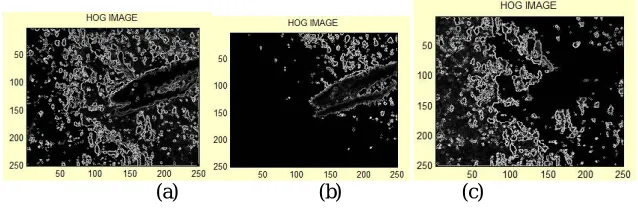
This step is basically responsible for extracting the key element which serves as the basis for analyzing the output. Here we are using the HOG i.e Histogram of Oriented Gradients for the feature extraction. The technique counts occurrences of gradient orientation in localized portions of an image. The HOG descriptor has a few key advantages over other descriptors. Since it operates on local cells, it is invariant to geometric and photometric transformations, except for object orientation. Such changes would only appear in larger spatial regions.
1. Gradient computation:
The first step of calculation in many feature detectors in image pre-processing is to ensure normalized color and gamma values. As Dalal and Triggs point out, however, this step can be omitted in HOG descriptor computation. Specifically, this method requires filtering the color or intensity data of the image with the following filter kernels.
2. Orientation binning:
The second step of calculation is creating the cell histograms. Each pixel within the cell casts a weighted vote for an orientation-based histogram channel based on the values found in the gradient computation. The cells themselves can either be rectangular or radial in shape, and the histogram channels are evenly spread over 0 to 180 degrees or 0 to 360 degrees, depending on whether the gradient is “unsigned” or “signed”.
3. Descriptor blocks:
concatenated vector of the components of the normalized cell histograms from all of the block regions. These blocks typically overlap, meaning that each cell contributes more than once to the final descriptor.
4. Block normalization:
Dalal and Triggs explored four different methods for block normalization. This project is using one of them as follows:
L1-sqrt: f =
|| || (1)
Classification:
Classification is a general process related to categorization, the process in which ideas and objects are recognized, differentiated, and understood. Here we are using SVM i.e. Support vector machine for classification purpose. For a dataset consisting of features set and labels set, an SVM classifier builds a model to predict classes for new examples. It assigns new example/data points to one of the classes. If there are only 2 classes then it can be called as a Binary SVM Classifier. In the linear classifier model, we assumed that training examples plotted in space. These data points are expected to be separated by an apparent gap. It predicts a straight hyperplane dividing 2 classes. The primary focus while drawing the hyperplane is on maximizing the distance from hyperplane to the nearest data point of either class. The drawn hyperplane called as a maximum-margin hyperplane.
IV. CONTRIBUTION
The main contribution to the existing system is the support vector machine along with K means clustering and Histogram of Gradients for feature extraction.
V. RESULTS
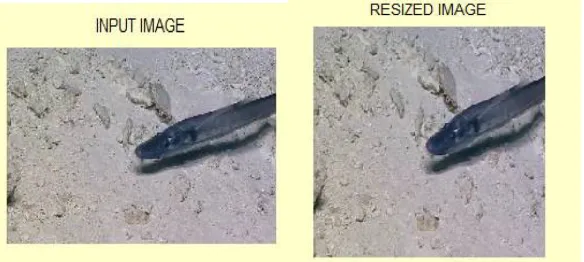
1] Image Resizing: The resizing of the input imageis done using ‘imresize’ MATLAB function.Figure 2 (a) and (b) represents the input image and resized image.
Fig 2 : Input and Resized Images
a.Resized Input Imageb. Enhanced Image
Fig 3 : Morphological Filtering Output
3] Color Transformation: Enhanced images aretransformed into LAB channel images for further segmentation process. Figure 4 (a),(b) and represents the output after color transformation.
a.YCbCr Image b. Labeled Image
Fig 4: Color Transformation
4] Image Segmentation: K means clustering algorithm calculates the shortest euclidean distance and cluster center. According to that we get the segmented images as follow:
(a) (b) (c)
Finally, object is detected and classify as follows:
(a)
(b)
VI. EXPERIMENTAL SETUP
The MATLAB functions have been used to calculate the values of various parameters of the images.These values are used to differentiate whether a given image is containing object in sea bed or not. 175 different images are used as training and testing set. Hundred of these images are positive images whereas the rest are negative images.The parameters of the two hundred images are arranged into a matrix form and fed to the Support Vector Machine.
Total data set taken: - 175 images
Out of which 76 images are related to class ‘Dynamic’ and 99 images are related to class ‘Static’. 1. For class ‘Dynamic’:
Confusion Matrix is given below:
Detected Non detected Detected 35[TP] 3[TN]
Non detected 4[FP] 34[FN]
Accuracy =
( )
= = = 91%
Sensitivity = = = 92%
Specificity = = 89%
2. For class ‘Static’ : Total dynamic images:99 images Confusion Matrix is given below:
Detected Non detected Detected 46[TP] 4[TN]
Non detected 4[FP] 45[FN]
Accuracy = ( )
= = = 91.9%
Sensitivity = = = 92%
Specificity = = 91.83%
VII. CONCLUSION
REFERENCES
[1]. Naveen Kumar,Shrikant S. Narayanan, “Robust Object Classifiaction in Underwater Sidescan Sonar Images by using Reliability Aware Fusion of Shadow Features”,2015
[2]. Anthony, R. Castellano, and Brian, C. Gray, “Autonomous Interpretation of Side Scan Sonar Returns” General Dynamics Electric Boat Division. [3]. Kenneth Stewart, Min Jiang, and Martin Marra “A Neural Network Approach to Classification of Side scan Sonar Imagery from a Miocene Ridge Area “Member, zee, IEEE journal of oceanic engineering, vol. 19, no. 2, April 1994.
[4]. Caminero, D. De La Torre, L. Villarrubia, C. Martin, and L. Hernández, “On-line garbage modeling with discriminant analysis for utterance verification,” in Proc. 4th Int. Conf. Spoken Lang., 1996, vol. 4, pp. 2111–2114.
[5]. V. Myers and J. Fawcett, “A template matching procedure for automatic target recognition in synthetic aperture sonar imagery,” IEEE Signal
Process. Lett., vol. 17, no. 7, pp. 683–686, Jul. 2010.
[6]. Stack, “Automation for underwater mine recognition: Current trendsand future strategy,” in Proc. SPIE, 2011, vol. 8017, DOI:
10.1117/12.884475.
[7]. “The WEKA Data Mining Software: An Update SIGKDD Explorations” Volume 11, Issue 1 Page 10-18
[8]. J. G. Wilpon, L. R. Rabiner, C.-H. Lee, and E. Goldman, “Automatic recognition of keywords in unconstrained speech using hidden Markov models,” IEEE Trans. Acoust. Speech Signal Process. vol. 38, no. 11, pp. 1870–1878, Nov. 1990.
[9]. J. Liu and X. Zhu, “Utterance verification based on dynamic garbage evaluation approach,” in Proc. IEEE 5th Int. Conf. Signal Process., 2000, vol. 2, pp. 819–822.