Available online:
https://edupediapublications.org/journals/index.php/IJR/
P a g e | 2205Approach User Informed Particular Schemain Sequential
Pattern Analysis
Koppisetti Manikiran#1,K Hima Bindu*2, D. Suryanarayana*3
#1PG Scholar, CSE, Vishnu Institute of Technology, Bhimavaram, A.P, India *2-3Professor, CSE, Vishnu Institute of Technology,Bhimavaram, A.P, India
1[email protected] ; 2 [email protected] ; [email protected]
ABSTRACT:The advances modelis
enabled the access to textual documents to
Internet users all over the world with ease.
Sequential patterns are focused theme in
data mining. Finding the behavior of
sequential pattern are helpful in finding
many analyzing applications like predicting
next event has been vital. Documents
created and distributed on the Internet are
ever changing in various forms. Most of
existing works is devoted to topic modeling
and the evolution of individual
topics.Documents created and distributed on
the Internet changing many forms. Most of
backend works is devoted to topic modeling
and the evolution of individual topics.The
advances of technology overtime have
enabled the access to textual documents to
internet users. Sequential patterns have been
a focused in data mining. Sequential pattern
are helpful in finding many analyzing
applications like predicting next event has
been vital.A lot of researches of text mining
focused on extracting topics from document
collections and document streams many
probabilistic topic models. To achieve this, a
set of algorithms is presented for
pre-processing the user contents, generate all
STP support values for efficient pattern
growth, and selecting user-aware rare
sequential topics by using rare pattern
domain analysis.
Index Terms:Data Mining, Information
Retrieval, Document Streams, Dynamic
Programming, Pattern-Growth,
INTRODUCTION
Data mining, also known as knowledge
discovery in databases has largely been a
promising area for database research. Web
services like Gmail and twitter provide a
rich and freely accessible database for
document streams generated and published
Available online:
https://edupediapublications.org/journals/index.php/IJR/
P a g e | 2206Fig no 1: Depicts Gmail and Twitter users
To tackle the problem of mining URSTPS in
document streams, many algorithms were
being used. First pre-processing phase is
carried out in order to get abstract and
probabilistic descriptions of documents by
topic extraction and then to recognize
common and repeated activities of internet
users by single sign on capability. In real
time run down both the preciseness and
potency of mining algorithms are important
[2]. Traditional Information Retrieval (IR)
has same objective of automatically
retrieving as many relevant documents as
possible, whilst filtering out irrelevant
documents at the same time. However,
IR-based systems do not provide users with
what they really need. Many text mining
methods have been developed for retrieving
useful information for users [3]. Most text
mining methods use keyword based
approaches, whereas others choose the
phrase method to construct a text
representation for a set of documents. The
phrase-based approaches perform better than
the keyword-based as it is considered that
more information is carried by a phrase than
by a single term. New studies have been
focusing on finding better text
representatives from a textual data collection
[4].
1. RELATED WORK
This paper presents SPADE, a new
algorithm for fast discovery of Sequential
Patterns. SPADE utilizes combinatorial
properties to decompose the original
problem into smaller units that can be
independently solved in main-memory using
efficient lattice search techniques, and using
simple join operations. [5] A novel approach
for extracting hot topics from disparate sets
of textual documents published in a given
time period. Solved by technique consists of
two steps. First, hot terms are extracted
thereby mapping their distribution over time.
Second, from the extracted hot terms, key
sentences are identified and then grouped
into clusters that represent hot topics by
using multidimensional sentence vectors.
[4]A novel topic model for multi-part
Available online:
https://edupediapublications.org/journals/index.php/IJR/
P a g e | 2207and develop its construction and inference
method with the aid of the techniques of
collapsed Gibbs sampling and maximum
likelihood estimation thus improving the
performance in information retrieval and
document classification.[8]Mines unseen
factors from web logs to personalized web
search [6]. These strategies were intended to
find visit successive examples whose
backings are at least a client characterized
edge minsupp. Notwithstanding, the
acquired examples are not continually
fascinating, on the grounds that those
uncommon but rather noteworthy examples
are pruned for their low backings. Moreover,
the incessant successive example mining
from deterministic databases is totally not
the same as the STP mining that handles
vulnerability of points [7]. Subsequent to
extricating topics from archives by LDA and
sorting the record stream into sessions for
various clients amid various eras, the
proposed calculations find uncommon STPs
digging STP possibility for every client
through a proficient calculation in view of
example development, and creating client
related uncommon STPs by example
irregularity examination [8].
Fig No 2.Multi-Part Topic Model
2. SYSTEM ARCHITECTURE
Sequential Topic Patterns (STPs). Each of
them records the complete and repeated
behavior of a user when she is publishing a
series. Topic mining in document collections
has been extensively studied in the
literature. Topic Detection and Tracking
(TDT) task aimed to detect and track topics
(events) in news streams with
clustering-based techniques on keywords. The
experiments conducted on both real
(Twitter) and synthetic datasets demonstrate
Available online:
https://edupediapublications.org/journals/index.php/IJR/
P a g e | 2208and efficient in discovering special users as
well as interesting and interpretable
URSTPs from Internet document streams,
which can well capture users’ personalized
and abnormal behaviors and characteristics
[9]. To filter out the patterns, the support
and the confidence information’s are used.
While the support represents the number of
times a pattern occurs in the initial database
(frequency), the confidence represents a
proportion value that shows how much of
the time a piece of the example, called
evidence happens among every one of the
records containing the entire body. Herein,
we classify pattern categories according to
the specific use of the support threshold. In
fact, by setting fields for the support, one
can obtain different categories of patterns
[10]
Fig-4:Pattern Discovery System
3. PROPOSED METHODOLOGY
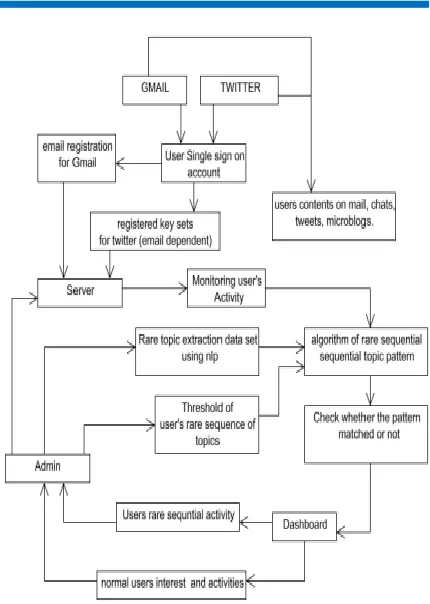
In our proposed system, user rare and
sequential activities are monitored using a
sequence of document streams from
multiple web applications. The documents
of inbox and send box mails of Gmail
contents and twitter’s tweet and individual
chats, to extract the topic and mining the
user’s activity is being used [11].We take
preprocessing strategies with heuristic
techniques for subject extraction and session
ID. The exchange off amongst precision and
proficiency.We exhibit a client mindful
irregularity examination calculation as
indicated by the formally characterized
model to select URSTPs and related clients
[12].
A. MATHEMATICAL MODEL
The Mathematical model this Query I1 is
submitted to state q1 where the Data
preparation is done then it is passed to state
q2 where the Data is pre-processed then in
state q3 the URSTP Mining is done and the
Available online:
https://edupediapublications.org/journals/index.php/IJR/
P a g e | 2209Figure-5: Mathematical Model of the
Proposed System
Input Parameter(I)
I = I1 where I is set of Input. I1= It is the
textual stream which is submitted to state
q1.
Functional Parameter (Q)
Q=q1,q2,q3,q4
where Q is functions/process done in the
URSTP mining.
q1 = Data preparation stage in which the
document stream crawling is done.
q2 = Data pre-processing stage in this topic
extraction is done and based on that sessions
are being identified.
q3 = URSTP mining stage in this STP
candidate discovery is done and user-aware
rarity analysis is done [14]
Output Parameter (O)
O = O1
Where O is an Output parameter
O1 = Result generated [15].
B. NLP(Natural Language
Preprocessing):
NLP process includes two phases: i) POS
tagging ii) Chunking. The input of
pre-processing is user’s documents and the
output is a list of words and their POS labels
word segmentation and POS tagging is
being done for the pre-processing stage.
• Word Segmentation: The main function of
this segmentation module is to identify and
separate the tokens present in the text in
such a way that every individual word, as
well as every punctuation mark, will be a
different token [16].
• POS tagging: The output of the
segmentation module is taken as input by
the POS tagging module. It tells you
whether words are nouns, verbs, adjectives.
Standard set of tags are used to do POS
tagging. One tag is assigned for each part of
Available online:
https://edupediapublications.org/journals/index.php/IJR/
P a g e | 2210Fig- 2: POS Tagging
C. ALOGRITHM
1. Locate the target word by the key phrase
and aspect extraction and start to combine it
with two or three surrounding words in
order to discover
2. Extract all domains from text for each
context word and count the frequency and
also determine the rarity of target words.
3. Order the domain list obtained on
previous step, in a descending order. For
each sense of the target word,
4. Select from array Votes, maximum value
and return the sense associated with this
value as the correct sense of the target word
5. CONCLUSION
It indeed accommodates a secret message
passing technique which cannot be
monitored by the system The proposed
display Maximum coordinated Pattern-based
Topic Model comprises of subject
disseminations depicting point inclinations
of every record or the archive accumulation
and example based theme representations
speaking to the semantic significance of
every theme. Here suggested that an
organized example based point
representation. This application can be left
as a recommendation for future work.
Elaboration more on the user-aware rarity by
obliging a variety of speculation, in order to
enhance the mining algorithm to focus on
degree of parallelism, and research
on-the-fly algorithms targeting at real-time
document streams. As this paper puts
forward an innovative research direction on
Web data mining, much work can be built
on it in the future.
6. FEATURE ENHANCEMENT
We open up the lower parts of the two
outlines. And estimation calculation is in
reality somewhat speedier particularly for
bigger scales. Notice that every execution of
the sub strategy is only for one client, so
when the client number expands the time
distinction for the entire methodology will
turn out to be increasingly obvious, even
with some degree of parallelism.
Available online:
https://edupediapublications.org/journals/index.php/IJR/
P a g e | 2211we can reason that the two calculations have
their particular points of interest proper for
the genuine undertaking mirrors an
exchange off between mining precision and
execution speed, and ought to rely on upon
the particular prerequisites of utilization
situations.
7. REFERENCES
[1] C. C. Aggarwal, Y. Li, J. Wang, and J.
Wang, “Frequent pattern mining with uncertain data,” in Proc. ACM SIGKDD’09,
2009, pp. 29–38.
[2] R. Agrawal and R. Srikant, “Mining sequential patterns,” in Proc.IEEE Int. Conf.
Data Eng., 1995, pp. 3–14.
[3] Y. Li, J. Bailey, L. Kulik, and J. Pei,
“Mining probabilistic frequent spatio -
temporal sequential patterns with gap
constraints from uncertain databases,” in Proc. IEEE ICDM’13, 2013, pp. 448 – 457.
[4] C. H. Mooney and J. F. Roddick,
“Sequential pattern mining - approaches and algorithms,” ACM Comput. Surv., vol. 45,
no. 2, pp. 19:1 – 19:39, 2013.
[5] K. Chen, L. Luesukprasert, and S. T.
Chou, “Hot topic extraction based on
timeline analysis and multidimensional
sentence modeling”, IEEE Trans. Knowl.
Data Eng., vol. 19, no. 8, pp. 1016–1025,
Aug. 2007.
[6] T. Hofmann, “Probabilistic latent
semantic indexing,” in Proc.22nd Annu. Int.
ACM SIGIR Conf. Res. Develop. Inf.
Retrieval, 1999, pp. 50–57.
[7] T. Bernecker, H.-P.Kriegel, M. Renz, F.
Verhein, and A. Zuefle, “Probabilistic
frequent itemset mining in uncertain
databases,” in Proc. ACM SIGKDD, 2009,
pp. 119–128.
[8] K. Chen, L. Luesukprasert, and S. T.
Chou, “Hot topic extraction based on
timeline analysis and multidimensional
sentence modeling,” IEEE Trans. Knowl.
Data Eng., vol. 19, no. 8, pp. 1016–1025,
2007.
[9] Z. Zhao, D. Yan, and W. Ng, “Mining
probabilistically frequent sequential patterns
in large uncertain databases,” IEEE
Trans.Knowl. Data Eng., vol. 26, no. 5, pp.
1171–1184, May 2014.
[10] W. X. Zhao, J. Jiang, J. Weng, J. He,
E.-P. Lim, H. Yan, and X. Li, “Comparing
Available online:
https://edupediapublications.org/journals/index.php/IJR/
P a g e | 2212models,” in Proc. 33rd Eur. Conf. Adv. Inf.
Retrieval, 2011, pp. 338–349.
[11] W. Dou, X. Wang, D. Skau, W.
Ribarsky, and M. X. Zhou, “LeadLine:
Interactive visual analysis of text data
through event identification and
exploration,” in Proc. IEEE VAST’12, 2012,
pp. 93–102.
[12] G. P. C. Fung, J. X. Yu, P. S. Yu, and
H. Lu, “Parameter free bursty events detection in text streams,” in Proc. VLDB’05, 2005, pp. 181–192.
[13] R. Agrawal and R. Srikant, “Mining
sequential patterns,” in Proc. IEEE Int.
Conf. Data Eng., 1995, pp. 3– 14.
[14] J. Allan, R. Papka, and V. Lavrenko,
“On-line new event detection and tracking,”
in Proc. 21st Annu. Int. ACM SIGIR Conf.
Res. Develop. Inf. Retrieval, 1998, pp. 37–
45.
[15] T. Bernecker, H.-P.Kriegel, M. Renz, F.
Verhein, and A. Zuefle, “Probabilistic
frequent itemset mining in uncertain
databases,” in Proc. ACM SIGKDD, 2009,
pp. 119–128.
[16] L. Sun, R. Cheng, D. W. Cheung, and J.
Cheng, “Mining uncertain data with
probabilistic guarantees,” in Proc. 16th
ACM SIGKDDInt. Conf. Knowl. Discovery
Data Mining, 2010, pp. 273–282.
[17] L. Wang, R. Cheng, S.D. Lee, and D.
Cheung, “Accelerating Probabilistic
Frequent Itemset Mining: A ModelBased
Approach,” Proc. 19th ACM Int’l Conf.
Information and Knowledge Management
(CIKM), 2010.
[18] R. Agrawal and R. Srikant, “Fast Algorithms for Mining Association Rules,” Proc. 1994 Int’l Conf. Very Large Data Bases (VLDB ’94), pp. 487-499, Sept. 1994.
About Authors:
K.Manikiran is currently pursuing his
M.Tech in Department of CSE, Vishnu
Institute of Technology,Bhimavaram, A.P, India . He received her Bachelor of
Available online:
https://edupediapublications.org/journals/index.php/IJR/
P a g e | 2213Mrs. K Hima Bindu, Ph.D ProfessorPhD
from University of Hyderabad (also known
as Hyderabad Central University) and
Graduation from NIT Warangal,. Presently
she is working as Professor in the
Department of CSE, Vishnu Institute of