Available online: https://edupediapublications.org/journals/index.php/IJR/ P a g e | 1483
Trust Managementfor Cloud Services Using Cloudarmor
P.AISHWARYA1& Dr. R.P RAM KUMAR2
1M-TECH, DEPT. OF CSE,MALLAREDDY ENGINEERING COLLEGE HYDERABAD
2PROFESSOR, DEPT. OF CSE,MALLAREDDY ENGINEERING COLLEGE
HYDERABAD ABSTRACT
Trust administration is a standout amongst the most difficult issues for the reception and
amplification of distributed computing. The profoundly unique, dispersed, and
non-straightforward nature of cloud lodging presents a few tests issues, for example, protection,
security, and accessibility. Protecting shoppers' security is not an easy assignment because of the
delicate data required in the collaborations amongst purchasers and the trust administration
convenience. Bulwarking cloud lodging against their pernicious clients (e.g., such clients may
give hoodwinking criticism to weakness a specific cloud settlement) is a problem. Guaranteeing
the accessibility of the trust administration convenience is another vital test due to the dynamic
way of cloud situations.[1] In this article, it portray the outline and usage of Cloud Armor, a
notoriety predicated trust administration structure that gives an arrangement of functionalities to
appropriate trust as a services (TaaS), which incorporates i) a novel convention to demonstrate
the validity of trust inputs and safeguard clients' protection, ii) a versatile and hearty believability
show for measuring the validity of trust criticisms to for end cloud housing from evil clients and
to think about the dependability of cloud lodging, and iii) an accessibility model to deal with the
accessibility of the decentralized execution of the trust administration convenience. The
achievability and advantages of our approach have been approved by a model and trial ponders
using a gathering of true world trust inputs on cloud lodging.
Keywords: - Trust Management, Cloud Computing, Distributed Computing, Credibility Model,
Malicious Feedback.
1.INTRODUCTION
THE way of cloud facilities make the trust
administration in profoundly powerful,
appropriated, and non-straightforward cloud
situations a central test. As indicated by
scientists at Berkeley, trust and security are
Available online: https://edupediapublications.org/journals/index.php/IJR/ P a g e | 1484 for the selection of distributed computing.
To be sure, convenience level acquiescent
(SLAs) alone are insufficient to set up trust
between cloud purchasers and suppliers due
to it’s darken and conflictingly flighty
provisions. Purchasers' input is a decent
source to survey the general dependability of
cloud housing. [2] A few scientists have
apperceived the centrality of trust
administration and proposed answers for
survey and oversee trust predicated on
inputs amassed from members.[9] In
credibility, it is not unconventional that a
cloud convenience encounters malicious
comportments (e.g., plot or Sybil assaults)
from its clients. This paper focuses on
improving trust administration in cloud
conditions by proposing novel approaches to
discover the believability of trust inputs.
2. RELEGATED WORK 2.1Existing System
As indicated by analysts at Berkeley, trust
and security are positioned one of the main
10 snags for the reception of distributed
computing. In fact, Benefit Level Assertions
(SLAs).[3] Shoppers' criticism is a decent
source to survey the general reliability of
cloud administrations. A few scientists have
perceived the noteworthiness of trust
administration and proposed answers for
evaluate and oversee trust in view of inputs
gathered from members.
2.2Proposed System
In this paper, the outline the plan and the
usage of Cloud Customers Believability
Evaluation and trust Administration of cloud
Administrations (Cloud Armor):[8] a system
for notoriety based trust administration in
cloud situations. In Cloud Armor, trust is
conveyed as an administration (TaaS) where
TMS traverses a few circulated hubs to
oversee criticisms decentralized. Cloud
Armor misuses strategies to distinguish
tenable criticisms from malevolent ones.
3. IMPLEMENTATION
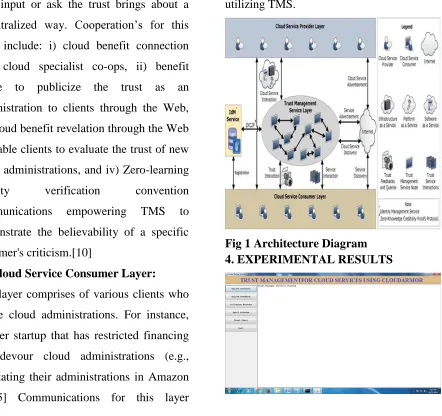
3.1Cloud Service Provider Layer:
This layer comprises of various cloud
specialist organizations who offer one or a
few cloud administrations, i.e.,
Infrastructure as an Administration (IaaS),
Stage as an Administration (PaaS), and
Programming as an Administration (SaaS),
openly on the web.[6] These cloud
administrations are open through online
interfaces and filed on web indexes, for
example, Google, Hurray, and Baidu.
Collaborations for this layer are considered
Available online: https://edupediapublications.org/journals/index.php/IJR/ P a g e | 1485 clients and TMS, and cloud administrations
commercials where suppliers can publicize
their administrations on the web.
3.2Trust Management Service Layer:
This layer comprises of a few disseminated
TMS hubs which are facilitated in numerous
cloud situations in various topographical
territories. [4] These TMS hubs uncover
interfaces with the goal that clients can give
their input or ask the trust brings about a
decentralized way. Cooperation’s for this
layer include: i) cloud benefit connection
with cloud specialist co-ops, ii) benefit
notice to publicize the trust as an
administration to clients through the Web,
iii) cloud benefit revelation through the Web
to enable clients to evaluate the trust of new
cloud administrations, and iv) Zero-learning
validity verification convention
communications empowering TMS to
demonstrate the believability of a specific
customer's criticism.[10]
3.3Cloud Service Consumer Layer:
This layer comprises of various clients who
utilize cloud administrations. For instance,
another startup that has restricted financing
can devour cloud administrations (e.g.,
facilitating their administrations in Amazon
S3).[5] Communications for this layer
include: i) benefit disclosure where clients
can find new cloud administrations and
different administrations through the Web,
ii) trust and administration cooperation
where clients can give their input or recover
the trust aftereffects of a specific cloud
administration, and iii) enlistment where
clients build up their personality through
enrolling their qualifications in IdM before
utilizing TMS.
Available online: https://edupediapublications.org/journals/index.php/IJR/ P a g e | 1486
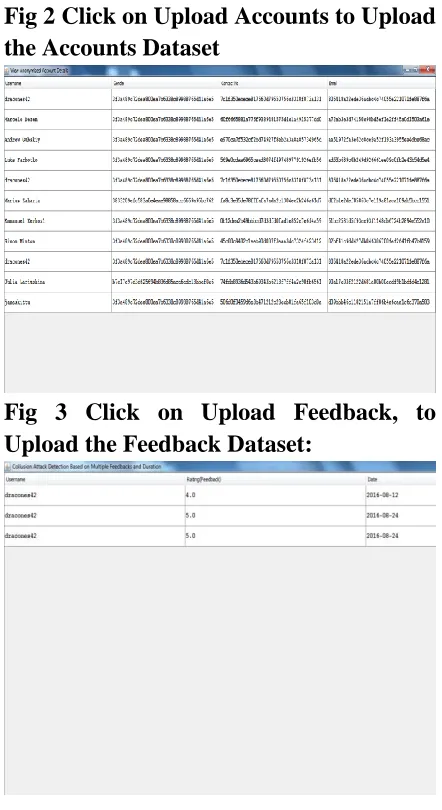
Fig 2 Click on Upload Accounts to Upload the Accounts Dataset
Fig 3 Click on Upload Feedback, to Upload the Feedback Dataset:
Fig 4 Click on Sybil attacks, to detect The Sybil attacks:
Fig 5 running the same for TM service 2:
Fig 6 Upload the feedback dataset: 5. CONCLUSION
Given the exceptionally powerful, dispersed,
and non-straightforward nature of cloud
housing, overseeing and setting up trust
between cloud convenience clients and
cloud lodging remains a significant test.
Cloud convenience clients' criticism is a
decent source to evaluate the general
dependability of cloud housing.
Notwithstanding, evil clients may work
together to i) burden a cloud settlement by
giving different hoodwinking trust criticisms
(i.e., intrigue assaults) or ii) trap clients into
trusting cloud facilities that are not reliable
by inducing a few records and giving
alluding trust inputs (i.e., Sybil assaults). In
this paper it show a novel strategies that
benefit in recognizing notoriety based
assaults and authorizing clients to
Available online: https://edupediapublications.org/journals/index.php/IJR/ P a g e | 1487 lodging.[7] Specifically, we present a
validity model that not just distinguishes
alluding trust inputs from agreement assaults
yet withal recognizes Sybil assaults
regardless of these assailments occur in a
long or brief timeframe (i.e., key or
occasional assaults individually). Paper have
a withal build up an accessibility model that
keeps up the trust administration settlement
at a coveted level. This have amassed a
cosmically gigantic number of shopper's
trust criticisms given on credible world
cloud lodging (i.e., more than 10,000
records) to assess our proposed strategies.
The trial comes about exhibit the
appropriateness of our approach and
demonstrates the capacity of recognizing
such baneful deportments. There are a
couple of headings for our future work. We
coordinate to combine diverse trust
administration systems, for example,
notoriety and proposal to increase the trust
comes about accuracy. Execution
improvement of the trust administration
settlement is another concentration of our
future research work.
6. REFERENCE
[1] S. M. Khan and K. W. Hameln,
“Hatman: Intra-cloud trust management for
Hadoop,” in Proc. 5th Int. Conf. Cloud
Comput., 2012, pp. 494–501.
[2] S. Pearson, “Privacy, security and trust in cloud computing,” in Privacy and
Security for Cloud Computing, ser.
Computer Communications and Networks.
New York, NY, USA: Springer, 2013, pp.
3–42.
[3] J. Huang and D. M. Nicol, “Trust
mechanisms for cloud computing,” J. Cloud
Comput., vol. 2, no. 1, pp. 1–14, 2013.
[4] K. Hwang and D. Li, “Trusted cloud
computing with secure resources and data
coloring,” IEEE Internet Comput., vol. 14,
no. 5, pp. 14–22, Sep./Oct. 2010.
[5] M. Armbrust, A. Fox, R. Griffith, A.
Joseph, R. Katz, A. Konwinski, G. Lee, D.
Patterson, A. Rabkin, I. Stoica, and M.
Zaharia, “A view of cloud computing,”
Commun. ACM, vol. 53, no. 4, pp. 50–58,
2010.
[6] S. Habib, S. Ries, and M. Muhlhauser,
“Towards a trust management system for cloud computing,” in Proc. 10th Int. Conf.
Trust, Security Privacy Comput. Commun.,
2011, pp. 933–939.
[7] I. Brandic, S. Dustdar, T. Anstett, D.
Schumm, F. Leymann, and R. Konrad,
Available online: https://edupediapublications.org/journals/index.php/IJR/ P a g e | 1488 Architecture and language support for
user-driven compliance management in clouds,”
in Proc. 3rd Int. Conf. Cloud Comput., 2010,
pp. 244–251.
[8] W. Conner, A. Iyengar, T. Mikalsen, I.
Rouvellou, and K. Nahrstedt, “A trust
management framework for service-oriented
environments,” in Proc. 18th Int. Conf.
World Wide Web, 2009,
pp. 891–900.
[9] T. H. Noor, Q. Z. Sheng, and A. Alfazi,
“Reputation attacks detection for effective trust assessment of cloud services,” in Proc.
12th Int. Conf. Trust, Security Privacy
Comput. Commun., 2013, pp. 469–476.
[10] T. H. Noor, Q. Z. Sheng, S. Zeadally,
and J. Yu, “Trust management of services in
cloud environments: Obstacles and
solutions,” ACM Comput. Surv., vol. 46, no.