c e-ISSN: 2348-6848, p- ISSN: 2348-795X Volume 2, Issue 11, November 2015
International Journal of Research (IJR)
Available at http://internationaljournalofresearch.orgStudy of Service Models in Cloud Computing
Manoj Kumar Dhruw
Student, Bachelor of Engineering in Computer Science & Engineering Kirodimal Institute of Technology,
Raigarh (C.G.), India
[email protected]
Amarjit Ram
Student, Bachelor of Engineering in Computer Science & Engineering Kirodimal Institute of Technology,
Raigarh (C.G.), India
[email protected]
Rakesh Patel
Lecturer, Department of Information Technology Kirodimal Institute of Technology, Raigarh (C.G.), India
[email protected]
Abstract
Cloud Computing is a technology which is based on Network or Internet. We can access the applications as utilities over the internet through the cloud computing technology. Here in this paper we have discussed in three service models in cloud computing.
1. What is cloud ?
The term Cloud refers to a Network or Internet. In other words, we can say that Cloud is something, which is present at remote location. Cloud can provide services over public and private networks, i.e., WAN, LAN or VPN.
Applications such as e-mail, web conferencing, customer relationship management (CRM) execute on cloud. [1]
2. What is cloud computing ?
Cloud Computing refers to manipulating, configuring, and accessing the hardware and software resources remotely. It offers online data storage, infrastructure, and application.
Fig. 1. Cloud computing
Cloud computing offers platform independency, as the software is not required to be installed locally on the PC. Hence, the Cloud Computing is making our business applications mobile and collaborative. [1]
3. History of Cloud Computing:
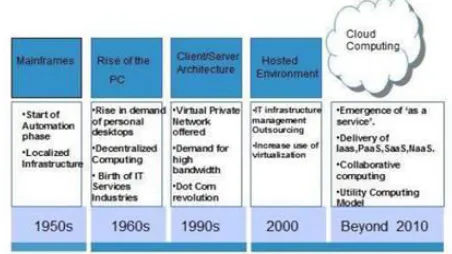
The concept of Cloud Computing came into existence in the year 1950 with implementation of mainframe computers, accessible via thin/static clients. Since then, cloud computing has been evolved from static clients to dynamic ones and from software to services. The following diagram explains the evolution of cloud computing: [1]
Fig. 2. History of Cloud Computing
4. Benefits:
Cloud Computing has numerous advantages. Some of them are listed below –
c e-ISSN: 2348-6848, p- ISSN: 2348-795X Volume 2, Issue 11, November 2015
International Journal of Research (IJR)
Available at http://internationaljournalofresearch.org One can manipulate and configure the applications online at any time.
It does not require to install a software to access or manipulate cloud application.
Cloud Computing offers online development and deployment tools, programming runtime environment through PaaS model.
Cloud resources are available over the network in a manner that provide platform independent access to any type of clients.
Cloud Computing offers on-demand self-service. The resources can be used without interaction with cloud service provider.
Cloud Computing is highly cost effective because it operates at high efficiency with optimum utilization. It just requires an Internet connection.
Cloud Computing offers load balancing that makes it more reliable. [1]
5. Service Models:
Cloud computing is based on service models. These are categorized into three basic service models which are –
Infrastructure-as–a-Service (IaaS)
Platform-as-a-Service (PaaS)
Software-as-a-Service (SaaS)
5.1 INFRASTRUCTURE-AS–A-SERVICE (IAAS):
Infrastructure-as-a-Service provides access to fundamental resources such as physical machines, virtual machines, virtual storage, etc. Apart from these resources, the IaaS also offers:
Virtual machine disk storage
Virtual local area network (VLANs)
Load balancers
IP addresses
Software bundles
All of the above resources are made available to end user via server virtualization. Moreover, these resources are accessed by the customers as if they own them. [1]
5. 1. 1 Benefits:
IaaS allows the cloud provider to freely locate the infrastructure over the Internet in a cost-effective manner. Some of the key benefits of IaaS are listed below:
Full control of the computing resources through administrative access to VMs.
Flexible and efficient renting of computer hardware.
c e-ISSN: 2348-6848, p- ISSN: 2348-795X Volume 2, Issue 11, November 2015
International Journal of Research (IJR)
Available at http://internationaljournalofresearch.org5. 1. 2 Full controls over computing resource through administrative access to virtual machines:
IaaS allows the customer to access computing resources through administrative access to virtual machines in the following manner:
Customer issues administrative command to cloud provider to run the virtual machine or to save data on cloud server.
Customer issues administrative command to virtual machines they owned to start web server or to install new applications. [1]
5. 1. 3 Flexible and efficient renting of computer hardware:
IaaS resources such as virtual machines, storage devices, bandwidth, IP addresses, monitoring services, firewalls, etc. are made available to the customers on rent. The payment is based upon the amount of time the customer retains a resource. Also with administrative access to virtual machines, the customer can run any software, even a custom operating system. [1]
5. 1. 4 Portability, interoperability with legacy applications:
It is possible to maintain legacy between applications and workloads between IaaS clouds. For example, network applications such as web server or e-mail server that normally runs on customer-owned server hardware can also run from VMs in IaaS cloud. [1]
5. 1. 5 Characteristics:
Here are the characteristics of IaaS service model:
Virtual machines with pre-installed software.
Virtual machines with pre-installed operating systems such as Windows, Linux, and Solaris.
On-demand availability of resources.
Allows to store copies of particular data at different locations.
The computing resources can be easily scaled up and down. [1]
5. 2 Platform as a Service (PaaS):
Platform as a Service (PaaS) is a way to build applications and have them hosted by the cloud provider. It allows you to deploy applications without having to spend the money to
buy the servers on which to house them. [2]
Platform-as-a-Service offers the runtime environment for applications. It also offers development and deployment tools required to develop applications. PaaS has a feature of pointand-click tools that enables non-developers to create web applications. [1]
App Engine of Google and Force.com are examples of PaaS offering vendors. Developer may log on to these websites and use the built-in API to create web-based applications. But the disadvantage of using PaaS is that, the developer locks-in with a particular vendor. For example, an application written in Python against API of Google, and using App Engine of Google is likely to work only in that environment.
The following diagram shows how PaaS offers an API and development tools to the developers and how it helps the end user to access business applications. [1]
5. 2. 1 Benefits:
Following are the benefits of PaaS model:
Lower administrative overhead
c e-ISSN: 2348-6848, p- ISSN: 2348-795X Volume 2, Issue 11, November 2015
International Journal of Research (IJR)
Available at http://internationaljournalofresearch.orgLower total cost of ownership
Customer need not purchase expensive hardware, servers, power, and data storage.
Scalable solutions
It is very easy to scale the resources up or down automatically, based on their demand.
More current system software
It is the responsibility of the cloud provider to maintain software versions and patch installations. [1]
5. 2. 2 Issues:
Like SaaS, PaaS also places significant burdens on customer's browsers to maintain reliable and secure connections to the provider’s systems. Therefore, PaaS shares many of the issues of SaaS. However, there are some specific issues associated with PaaS as shown in the following diagram: [1]
Lack of portability between PaaS clouds:
Although standard languages are used, yet the implementations of platform services may vary. For example, file, queue, or hash table interfaces of one platform may differ from another, making it difficult to transfer the workloads from one platform to another. [1]
Event based processor scheduling:
The PaaS applications are event-oriented which poses resource constraints on applications, i.e., they have to answer a request in a given interval of time. [1]
Security engineering of PaaS applications:
Since PaaS applications are dependent on network, they must explicitly use cryptography and manage security exposures. [1]
5. 2. 3 Characteristics:
Here are the characteristics of PaaS service model:
PaaS offers browser based development environment. It allows the developer to create database and edit the application code either via Application Programming Interface or point-and-click tools.
PaaS provides built-in security, scalability, and web service interfaces.
PaaS provides built-in tools for defining workflow, approval processes, and business rules.
It is easy to integrate PaaS with other applications on the same platform.
PaaS also provides web services interfaces that allow us to connect the applications outside the platform. [1]
5.3 Software-as-a-Service (SaaS):
The SaaS model provides software services that are complete applications that are ready to use. The cloud user simply connects to the application, which is running at a remote location; the user might not know where. The cloud service provider is responsible for managing the cloud infrastructure, the platform on which the application is running, and the application itself. This approach eliminates the need for the users to install and run the application on their own computers, thereby significantly reducing the need for maintenance and support. SaaS is sometimes referred to as applications as a service because SaaS essentially provides applications as a service, rather than simply software in general. SaaS also includes content services (for example, video on demand) and higher value network services (for example VoIP) as typically encountered in communication service provider scenarios.
Examples of commercial implementations of SaaS environments include IBM Payment Systems, IBM Smart Cloud for Social Business, PeopleSoft HR, Google Apps for Business. [3]
c e-ISSN: 2348-6848, p- ISSN: 2348-795X Volume 2, Issue 11, November 2015
International Journal of Research (IJR)
Available at http://internationaljournalofresearch.org Billing and invoicing system
Customer Relationship Management (CRM) applications
Help desk applications
Human Resource (HR) solutions
Some of the SaaS applications are not customizable such as Microsoft Office Suite. But SaaS provides us Application Programming Interface (API), which allows the developer to develop a customized application. [1]
5. 3. 1 Benefits:
Using SaaS has proved to be beneficial in terms of scalability, efficiency and performance. Some of the benefits are listed below:
Modest software tools
Efficient use of software licenses
Centralized management and data
Platform responsibilities managed by provider
Multitenant solutions. [1]
5. 3. 2 Characteristics:
Here are the characteristics of SaaS service model:
SaaS makes the software available over the Internet.
The software applications are maintained by the vendor.
The license to the software may be subscription based or usage based and it is billed on recurring basis.
SaaS applications are cost-effective since they do not require any maintenance at end user side.
They are available on demand.
They can be scaled up or down on demand.
They are automatically upgraded and updated.
SaaS offers shared data model. Therefore, multiple users can share single instance of infrastructure. It is not required to hard code the functionality for individual users.
All users run the same version of the software. [1]
5. 3. 3 Modest Software Tools:
The SaaS application deployment requires a little or no client side software installation, which results in the following benefits:
No requirement for complex software packages at client side.
Little or no risk of configuration at client side.
Low distribution cost. [1]
5. 3. 4 Issues:
There are several issues associated with SaaS, some of them are listed below:
Browser based risks:
If the customer visits malicious website and browser s infected, the subsequent access to SaaS application might compromise the customer's data.
To avoid such risks, the customer can use multiple browsers and dedicate a specific browser to access SaaS applications or can use virtual desktop while accessing the SaaS applications. [1]
Network dependence:
The SaaS application can be delivered only when network is continuously available. Also network should be reliable but the network reliability cannot be guaranteed either by cloud provider or by the customer. [1]
Lack of portability between SaaS clouds:
Transferring workloads from one SaaS cloud to another is not so easy because work flow, business logics, user interfaces, support scripts can be provider specific. [1]
Conclusion
The study of service models in cloud computing we can know that which service models provides which kind of services, benefits, characteristics, and limitation of service models. We can also analyze which kinds of security are necessary for service models.
c e-ISSN: 2348-6848, p- ISSN: 2348-795X Volume 2, Issue 11, November 2015
International Journal of Research (IJR)
Available at http://internationaljournalofresearch.orgReferences:
[1] http://www.tutorialspoint.com/cloud_computi ng/cloud_computing_overview
[2] Anthony T.Velte, Toby J.Velte, Robert Elsenpeter, Cloud Computing a Practical Approach, TATA McGraw-Hill Edition 2010.