ISSN 2286-4822 www.euacademic.org
Impact Factor: 3.1 (UIF) DRJI Value: 5.9 (B+)
Trust and Team Performance
RAFIULLAH
BS-(P&G Engineering), BUITEMS Quetta, Pakistan
SYED NISAR AHMED
Visiting Faculty Member, BUITEMS Quetta, Pakistan
Abstract:
Modern and competitive world is in the need of shorter time, lower cost and maximum solutions to the complex problems in the progress of the organization; all these play an important role in the team’s growing response and better performance. To survive in this competitive world organizations are in deep investigation to increase their performance and competitiveness by means of maximum solutions to organizational barriers in no time or the lowest one. The global forces in an organization are to rebuild the working methods around teams facilitating quick, supple and productive responses to the effectiveness and concerns of organizational performance.
The effectiveness of an organizational performance exists within its trust level between leadership and members. It is trust that can develop an effective and constructive environment in the organization to meet the modern standards. Thus a valuable relationship between trust level and team work can achieve the survival of organization in this new and fast world.
Key words: Trust, Team performance, Organization, effectiveness of leadership, Trust in leadership.
team performance, the challenges faced by it and ways to overcome these challenges. Trust between organization and its members can have an important impact on its performance, especially when we refer to working under pressure and in high risk conditions. Promoting team’s moral, working together and believing in the worth of organization, all these produce tremendous results. It is trust that has a greater influence on team performance by means of processes of interaction between leader and subordinators, working method, cooperation, communication, information sharing and satisfaction with the effective leadership (Burke et al. 2007).
Although researchers have investigated the area of trust and its impact on team performance to meet the requirements for settled goals yet we suggest that more research is required to increase the team performance. The new era and growing up of the new world has laid down more importance for working timely, at lower cost and with satisfactory results. Introduction to new technologies and communication media has improved working methodology, put the work at easier, quick and more effective pace (Ebrahim, Ahmed and Taha 2009).
We designed this article quite differently from the previous ones, as a greater number of questionnaires were distributed amongst the public and we received relevant responses. The people involved belonged to different fields such as business, management, banking, teachers, and students with different opinions.
Significance of the study
Literature Review:
Trust
Trust has become one of the most significant topics in different fields such as management, psychology, sociology, economics etc (Colquitt, Scott, and LePine 2007). Though trust for different writers has multiple definitions, trust is conceptually defined as one’s expectation or belief to rely upon another’s actions or words (Cummings and Bormiley 1996; Dirks and Robinson 1996; Roussean, Sitkin, Burt and Canerer 1998, Dirks 1999).
Trust is the main referent among the team members, as it is the expectation or belief upon which the group performances rely. It (trust) is the meaningful concept which enhances the capability of the team to achieve the settled goals (Bass 1990). Trust may be a prevailing process that bolsters or weakens the relationship between leader and team’s members, e.g. member may be willing to communicate with leader in common but lack of trust can prove the communication restricted (Burke et al. 2007). If, on the one hand, trust may bring about a variation of beneficent outcomes (Dirks and Ferrin 2001), too much trust can be harmful (Langfred 2004). In fact trust has an important effect on the team potential and increases its ability to work together (Dirks and Ferrin 2001).
Team performance
The social interaction of one or more individuals that share and perform on one or more common goals, process on relevant tasks and have different roles and responsibilities within prescribed boundaries of the organization defines team work. (Kolowski and Ilgen 2006; Mathieu, Maynard, Rapp and Gilson 2007). A group of individuals with complementary skills and who are equally devoted with a common task is called team (Ebrahim, Ahmed and Taha 2009).
together for better outcome in future. The effectiveness of the team performance depends on its focus to achieve the goals. It is the product of the interest level of individual’s ability of working together and the quality context into which they operate. Working in the given time frame and fulfilling the people’s standards who receive, review or use its output also counts a better team performance effectiveness. Coordination, cooperation and communication are the critical behavioral processes that play a key role in team’s performance. Coordination is the most important process for effective team performance (Kolowski and Ilgen 2006).
Link
Trust has an effective and significant role on team performance (Dirks and Ferrin 2001; Larson and Lafasto 1989). Trust and Team performance are the two fundamentals that promote the members’ cooperation and enhance the team ability to achieve their concerned goals successfully. Trust contemplates the relation of past and future team performances. The greater the trust level, the higher and better will be the team performance; trust is a one-directional product that measures the team work. Kramer, in his research from 1999, intended to the contribution of growing literature on the relationship of trust and its role on group performance, understanding the pivotal role of trust within team specifically for research and practical work. Effective outcome of team work depends upon the value of trust among team members, while lack of trust can abolish team performance (Bennis and Nanus 1985; Fairholm 1994; Zand 1997). No one can deny the importance of trust and its correlation with team performance.
H1: Trust is positively related to team performance.
Ho: Trust is not positively related to team performance.
We distributed 100 questionnaires in a variety of educational institutes and the response rate was positive. Their feedback was followed by using SPSS software for the completion of data analysis.
Questionnaire Respond Calculations:
Results and Discussion:
SPSS software estimated the following calculations: S.No
Occupation Number Percentage %
1 Ph.D 3 0.03
2 Lecturer 10 0.1
3 MBA (students) 15 0.15
4 IR (students) 7 0.07
5 BS engineering 45 0.45
6 Intermediate (students) 20 0.2
7 Male 90 0.9
8 Female 10 0.1
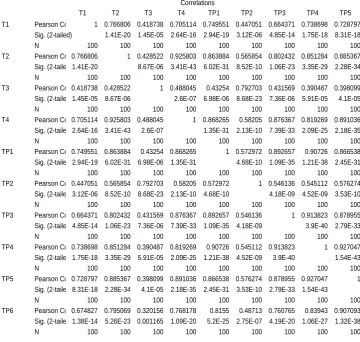
T1 T2 T3 T4 TP1 TP2 TP3 TP4 TP5 T1 Pearson Correlation 1 0.766806 0.418738 0.705114 0.749551 0.447051 0.664371 0.738698 0.728797
Sig. (2-tailed) 1.41E-20 1.45E-05 2.64E-16 2.94E-19 3.12E-06 4.85E-14 1.75E-18 8.31E-18 N 100 100 100 100 100 100 100 100 100 T2 Pearson Correlation0.766806 1 0.428522 0.925803 0.863884 0.565854 0.802432 0.851284 0.885367 Sig. (2-tailed)1.41E-20 8.67E-06 3.41E-43 6.02E-31 8.52E-10 1.06E-23 3.35E-29 2.28E-34 N 100 100 100 100 100 100 100 100 100 T3 Pearson Correlation0.418738 0.428522 1 0.488045 0.43254 0.792703 0.431569 0.390487 0.398099 Sig. (2-tailed)1.45E-05 8.67E-06 2.6E-07 6.98E-06 8.68E-23 7.36E-06 5.91E-05 4.1E-05 N 100 100 100 100 100 100 100 100 100 T4 Pearson Correlation0.705114 0.925803 0.488045 1 0.868265 0.58205 0.876367 0.819269 0.891036 Sig. (2-tailed)2.64E-16 3.41E-43 2.6E-07 1.35E-31 2.13E-10 7.39E-33 2.09E-25 2.18E-35 N 100 100 100 100 100 100 100 100 100 TP1 Pearson Correlation0.749551 0.863884 0.43254 0.868265 1 0.572972 0.892657 0.90726 0.866538 Sig. (2-tailed)2.94E-19 6.02E-31 6.98E-06 1.35E-31 4.68E-10 1.09E-35 1.21E-38 2.45E-31 N 100 100 100 100 100 100 100 100 100 TP2 Pearson Correlation0.447051 0.565854 0.792703 0.58205 0.572972 1 0.546136 0.545112 0.576274 Sig. (2-tailed)3.12E-06 8.52E-10 8.68E-23 2.13E-10 4.68E-10 4.18E-09 4.52E-09 3.53E-10 N 100 100 100 100 100 100 100 100 100 TP3 Pearson Correlation0.664371 0.802432 0.431569 0.876367 0.892657 0.546136 1 0.913823 0.878955 Sig. (2-tailed)4.85E-14 1.06E-23 7.36E-06 7.39E-33 1.09E-35 4.18E-09 3.9E-40 2.79E-33 N 100 100 100 100 100 100 100 100 100 TP4 Pearson Correlation0.738698 0.851284 0.390487 0.819269 0.90726 0.545112 0.913823 1 0.927047 Sig. (2-tailed)1.75E-18 3.35E-29 5.91E-05 2.09E-25 1.21E-38 4.52E-09 3.9E-40 1.54E-43 N 100 100 100 100 100 100 100 100 100 TP5 Pearson Correlation0.728797 0.885367 0.398099 0.891036 0.866538 0.576274 0.878955 0.927047 1
Sig. (2-tailed)8.31E-18 2.28E-34 4.1E-05 2.18E-35 2.45E-31 3.53E-10 2.79E-33 1.54E-43 N 100 100 100 100 100 100 100 100 100 TP6 Pearson Correlation0.674827 0.795069 0.320156 0.768178 0.8155 0.48713 0.760765 0.83943 0.907093 Sig. (2-tailed)1.38E-14 5.26E-23 0.001165 1.09E-20 5.2E-25 2.75E-07 4.19E-20 1.06E-27 1.32E-38 N 100 100 100 100 100 100 100 100 100
Correlations
1. Correlation Analysis:
The correlation between the two variables, namely trust and team performance, was checked the results of which are reported in the correlation matrix. The two variables in the study are found to be highly correlated with each other. Throughout the analysis, trust will be denoted by T, team performance will be denoted by TP.
T TP
T 1 0.866**
TP O.866** 1
Table 2 shows the correlation matrix. The correlation values show that trust is strongly, positively related to team performance with the values of 0.866 at the significance level of 0.01.
2. Regression Analysis:
To test the hypothesis of the study, regression analysis was used in the third step. In order to examine the H1 of the study, regression was run keeping trust independent and team performance as dependent variable, the results of which are as follows:
Variables Β t-stat Significance
T 0.866 18.907 0.00
R square = 78.5 % Adjusted R square = 78.3% ** correlation is significant at 0.01 level of significance
Table 3: Regression Analysis
The above table reveals that the coefficient of trust is 0.866, which is positive and highly significant at 0.01 level of significance. The coefficient of openness to experience is also found to be positive and significant. The t-stats of trust and openness to experience are 18.907, which also shows that the result is highly significant. The overall fit of the model is 78.5% (adjusted R square = 78.3%). Hence trust is found to be positively associated with team performance, accepting H1.
Conclusion and suggestions
and response of subordinators to their leaders which directly or indirectly influence the team performance. Rather than influencing team performance through informal attitude regarding events, working procedure etc, one should develop soft and formal attitude so that team members feel trusting and give positive results and successful outcomes.
BIBLIOGRAPHY:
Burk, C.S., Sims, D.E. Lazzara, E.H, and Salas, E. 2007. “Trust in leadership: A multi-level review and integration.” The Leadership Quarterly 18: 606-632.
Colquitt, J.A. Scott, B.A., and Lepine, J.A. 2007. “Trust, trustworthiness, and trust propensity: A meta- analytic test of their unique relationship with risk taking and job performance.” Journal of applied psychology. 92(4):909-27.
Dirks, K.T. and Ferrin, D.L. 2002. “Trust in leadership Meta- analysis.” Journal of applied psychology. 87(4):611-28. Ebrahim, N.A. Ahmed, S., and Taha, Z. 2009. “Virtual teams: a
literature review.” Australian Journal of Basic and Applied Sciences 3(3): 2653-2669.
Kozlwski, S.W.J. Ilgen, D.R. 2006. “Enhancing the effectiveness of work group and teams.” Psychological Science in the Public Interest 7(3): 77-124.
Kramer, R.M. 1999. “Trust & distrust in organization: Emerging perspective, enduring questions.” Annual review of psychology. 50: 569-598.
Mathieu, J. Maynard, M.T. Rapp, T. and Gilson, L. 2007. “Team effectiveness 1997-2007: A review of recent advancement and glimpse into the future.” Journal of Management34(3): 410-476.
Rousseau, D.M. Sitlin, S.B., and Burt, R.S. 1998. “Not so different after all: A cross discipline view of trust.”