Perception and Usage of Mobile Learning among Post Graduate
Students
Dr. Sushma H.B.
Assistant Professor
School of Education
Central University of Karnataka
[email protected] 9980095126
ABSTRACT
Technology, advancement always has a vast impact on education. One such technology is
mobile learning (m-Learning). It has become an emerging tool in our education system.
The main objective of the study is to know the perception and usage of mobile in learning
among post graduate students. For this purpose 100 sample were selected randomly,
which consists of (50 post graduate girl students and 50 post graduate boy students) of
Gulbarga University, Kalaburagi. Hypothesis was tested for significance at 0.05 margin
in error and “t” test is applied to test the hypothesis.
Key words: Mobile Learning, Post Graduate Students.
INTRODUCTION
In the term M-learning, M stands for mobile.
Any kind of learning that takes place
through portable, hand held electronic
devices is called m-learning. Though the
term immediately evokes images of smart
phones, but in fact also refers to, learning
through various other kinds of mobiles
devices such as tablet, computer and digital
readers. Mobile learning is known by many
different names, like M-learning,
personalized learning, learning while
mobile, ubiquitous learning,
anytime/anywhere and handheld learning.
With the advancement of mobile
technology, possibilities are emerging to
provide educational services through mobile
devices. Thus mobile technology and the
concept of m-learning is an emerging new
the idea of anytime, anywhere and anybody
learning.
Mobile learning is defined in various ways
by others, as the learning which takes place
by means of wireless technological devices
that can be pocketed and utilized where ever
the learner’s device is able to receive
unbroken transmission signals (Mohamed &
etal, 2010). Another definition is any sort of
learning that happens when the learner is not
at a fixed, predetermined location, or
learning that happens when the learner takes
advantages of the learning opportunities
offered by mobile technologies (Andrew,
2004). Mike Sherples (2007) defined
m-learning as, m-learning supported by mobile
devices such as cellular (mobile) phones,
portable computers and personal audio
players.
NEED AND IMPORTANCE OF THE STUDY
Mobile learning is a new learning approach.
It is often viewed as a component of a
learning programme which supports the
leaning process as an add-on-tool by
allowing the learners to obtain learning
material anywhere and anytime. It is more
interesting, interactive, widely available and
flexible helping students to learn more
without traditional restrictions. Hence the
study has taken and felt the need of the hour.
STATEMENT OF THE PROBLEM
“Perception and Usage of Mobile
Learning among Post Graduate Students”
OPERATIONAL DEFINITION OF KEY TERMS
Mobile – Learning: MOBI Learn, 2003. States “any sort of learning that happens
when the learner is not at a fixed,
predetermined location, or learning that
happens when the learner takes advantage of
the learning opportunities offered by mobile
technologies”.
According to Hyman, 2014. Mobile learning
(or m-learning), which means learning
through mobile devices (such as smart
mobile phones, tablet PCs and E-ink Book
devices), is changing the education
landscape by offering learners the
opportunity to engage in asynchronous,
ubiquitous instruction.
O’Malley,Vavoula, Glew, Taylor &
Sharples (2005) stated, M-learning refers to
any sort of learning that happens when the
learner is not at a fixed, predetermined
learner takes advantage of the learning
opportunities offered by mobile technologies
Post –Graduate Students: Are students who already have an undergraduate degree
and who are studying a post graduate
qualification which may be a diploma or a
degree such as honors, masters or doctor of
philosophy.
LITERATURE REVIEW
Seppala and Alamaki (2003) claimed that
the core characteristic of mobile learning
enables learners to be in the right place at
the right time, that is, to be where they are
able to experience the authentic joy of
learning. Huang, Lin & Chuang (2007)
according to them, Mobile learning allows
users to access learning material anytime
and anywhere. Mobile technologies are
support communication between students
and teachers. So mobile technologies may
use for collaborative learning activities in
the education (Uzunboylu, Cavus & Ercag,
2009; Virvou & Alepis, 2005). Al-Fahad
(2009) conducted a study to better
understand and measure students' attitudes
and effectiveness of mobile learning. The
result of his study revealed that the majority
of students supported the idea that the
wireless networks increase the flexibility of
independently in any place. Therefore,
students can save their time, effort and even
money. Mobile Learning is the use of
mobile or wireless technology and devices
for learning at anytime, anyplace and
anywhere (Quinn, 2000). Many researches
claimed that adopting mobile technologies
in higher education could create powerful
opportunities to access information anytime
and anywhere to perform authentic activities
in the context of students’ learning (Wesam,
2013; Martin, 2013). According to (Wagner,
2005) the value of deploying mobile
technologies in the service of learning and
teaching seems to be both self-evident and
unavoidable.
OBJECTIVES OF THE STUDY
To know the perception and usage of mobile
learning by boy and girl post graduate
students of arts and science.
HYPOTHESES
01. There would be significant difference in
usage of mobile learning among boys and
girls of post- graduate student.
02. There would be significant difference in
usage of mobile learning among arts boys
and science boys of post- graduate student.
03. There would be significant difference in
04. There would be significant difference in
usage of mobile learning among arts boys
and arts girls post- graduate student.
05. There would be significant difference in
usage of mobile learning among science
boys and science girls of post- graduate
student.
METHOD
A survey was conducted.
POPULATION AND SAMPLE
The population for this investigation
consisted of arts and science, boys and girls
post-graduate student of Gulbarga
University, Kalaburagi. It is from this
population that the sample of 100
post-graduate students (50 boys, 25 each from
arts and science and 50 girls 25 each from
arts and science) was drawn through simple
random sampling technique.
PROCEDURE
For the present study the researcher visited
various arts and science departments of
Gulbarga University, Kalaburagi.
Questionnaire on usage of mobile – phone
was given to students and next day it was
collected back. Based on the obtained data
statistical analysis was tested using SPSS 20
and the significance level for all analysis
was set at 0.05.
DATA ANALYSIS AND INTERPRETATION
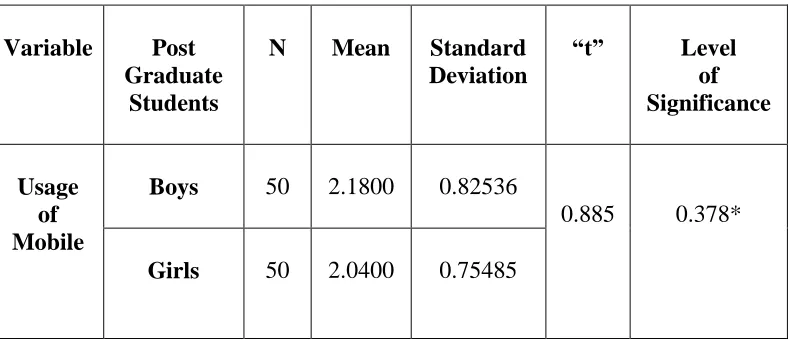
HYPOTHESIS 01- There would be significant difference in mobile usage by boy and girl post- graduate students.
Table 01- shows Mean score, Standard Deviation, “t” and significance value of post graduate students and usage of mobile.
Variable Post Graduate
Students
N Mean Standard Deviation
“t” Level of Significance
Usage of Mobile
Boys 50 2.1800 0.82536
0.885 0.378*
Girls 50 2.0400 0.75485
The Independent sample “t” test table-01
shows that the post graduate boy students
(N=50) mean value 2.1800 and standard
deviation 0.82536 is high compared to that
of girl post- graduate students (N=50) mean
value 2.0400 and standard deviation
0.75485, calculated “t” value is 0.885 and
obtained significant value 0.378 is not
significant at 0.05 level. Hence the proposed
hypotheses stated above can be stated as,
There is no significant difference in mobile
usage among boys and girls post- graduate
student.
HYPOTHESIS 02- There would be significant difference in mobile usage by
arts boys and science boys of post- graduate
student.
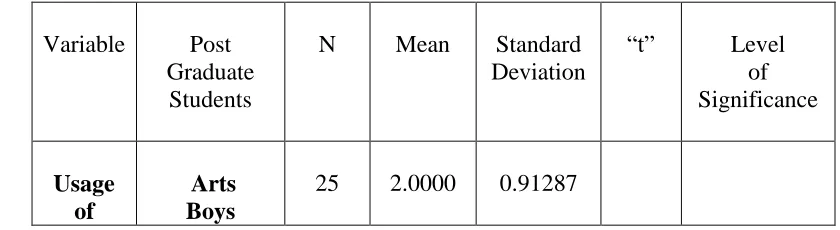
Table 02- shows Mean score, Standard Deviation, “t” and significance value of post graduate students and usage of mobile.
Variable Post Graduate
Students
N Mean Standard Deviation
“t” Level of Significance
Usage of Mobile
Arts Boys
25 2.0000 0.91287
1.565 0.124*
Science Boys
25 2.3600 0.70000
Note*- Significance at 0.05 level.
The Independent sample “t” test table-01
shows that the post graduate arts boy
students (N=25) mean value 2.0000 and
standard deviation 0.91287 is low compared
to that of post graduate science boy students
(N=25) mean value 2.3600 and standard
deviation 0.70000, calculated “t” value is
1.565 and obtained significant value 0.124 is
not significant at 0.05 level. Hence the
proposed hypotheses stated above can be
stated as,
There is no significant difference in mobile
usage among arts and science post- graduate
HYPOTHESIS 03- There would be significant difference in mobile usage by
arts girls and science girls of post- graduate
student.
Table 03- shows Mean score, Standard Deviation, “t” and significance value of post graduate students and usage of mobile.
Variable Post Graduate
Students
N Mean Standard Deviation
“t” Level of Significance
Usage of Mobile
Arts Girls
25 1.8400 0.74610
1.925 0.060*
Science Girls
25 2.2400 0.72342
Note*- Significance at 0.05 level.
The Independent sample “t” test table-01
shows that the post graduate arts girl
students (N=25) mean value 1.8400 and
standard deviation 0.74610 is low
compared to that of post graduate science
girl students (N=25) mean value 2.2400
and standard deviation 0.72342, calculated
“t” value is 1.925 and obtained significant
value 0.060 is not significant at 0.05 level.
Hence the proposed hypotheses stated
above can be stated as,
There is no significant difference in mobile
usage among arts and science post-
graduate girls student.
HYPOTHESIS 04- There would be significant difference in mobile usage by
arts boys and arts girls’ post- graduate
student.
Table 04- shows Mean score, Standard Deviation, “t” and significance value of post
graduate students and usage of mobile.
Variable Post
Graduate Students
N Mean Standard
Deviation
“t” Level
of Significance
Usage of
Arts Boys
Mobile 0.679 0.501*
Arts Girls
25 1.8400 0.74610
Note*- Significance at 0.05 level.
The Independent sample “t” test table-04
shows that the post graduate arts boy
students (N=25) mean value 2.0000 and
standard deviation 0.91287 is high compared
to that of post graduate arts girl students
(N=25) mean value 1.8400 and standard
deviation 0.74610, calculated “t” value is
0.679 and obtained significant value 0.501 is
not significant at 0.05 level. Hence the
proposed hypotheses stated above can be
stated as,
There is no significant difference in mobile
usage among arts boys and girls post-
graduate student.
HYPOTHESIS 05- There would be significant difference in mobile usage by
science boys and science girls of post-
graduate student.
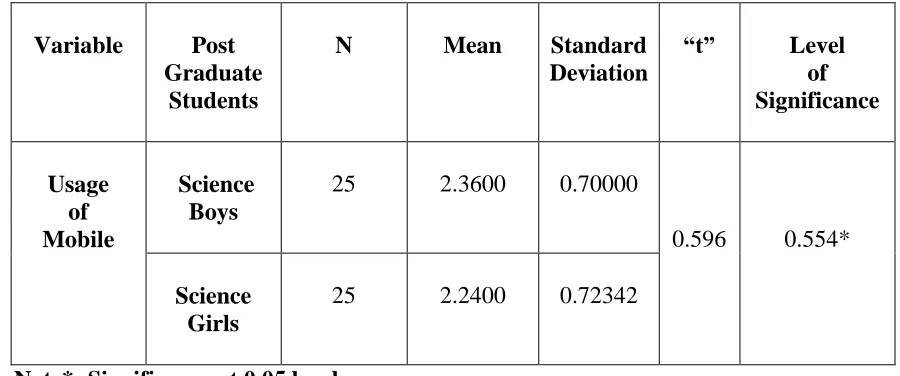
Table 05- shows Mean score, Standard Deviation, “t” and significance value of post
graduate students and usage of mobile.
Variable Post Graduate
Students
N Mean Standard Deviation
“t” Level of Significance
Usage of Mobile
Science Boys
25 2.3600 0.70000
0.596 0.554*
Science Girls
25 2.2400 0.72342
Note*- Significance at 0.05 level.
The Independent sample “t” test table-01
shows that the post graduate science boy
students (N=25) mean value 2.3600 and
standard deviation 0.70000 is high compared
to that of post graduate science girl students
(N=25) mean value 2.2400 and standard
deviation 0.72342, calculated “t” value is
0.596 and obtained significant value 0.554 is
proposed hypotheses stated above can be
stated as,
There is no significant difference in mobile
usage among science boys and girls post-
graduate student.
FINDINGS
01. There is no significant difference in
mobile usage among boys and girls post-
graduate student.
02. There is no significant difference in
mobile usage by arts and science post-
graduate boys’ student.
03. There is no significant difference in
mobile usage among arts and science post-
graduate girls’ student.
04. There is no significant difference in
mobile usage among arts boys and girls
post- graduate student.
05. There is no significant difference in
mobile usage among science boys and girls
post- graduate student.
SUGGESTION AND CONCLUSION
Now a day’s m-learning is a rising learning
trend and a new vital platform for the higher
educational environment. The findings of
the study shows there is no significant
difference among the perception and usage
of mobile phone for learning among post
graduate boys and girls student of Gulbarga
University, Kalaburagi. Based on the
findings it is very essential to suggest the
post graduate students about the advantages
of mobile using in learning as mobile
learning is self motivated, self disciplined
that supports studying with no time waste ,
and anywhere and at anytime. As much as
possible mobile learning must be strictly
implemented in teaching and learning
process and must be made easily accessible.
REFERENCES
01.Al-Fahad, F. N. (April 2009), Students'
Attitudes and Perceptions Towards the
effectiveness of Mobile learning in King
Saud University. The Turkish Online
Journal of Educational Technology. 8(2),
pp10.
02.Andrew, Josie, T. (2004). Development of a
research plan for use of ambient technology
to test mobile learning theories in mobile
learning anytime, everywhere: A book of
paper from MLEARN, eds.
03.Crescente. Mary Louise., Lee, Doris (2011).
Critical issues of M-Learning: design
models, adoption processes, and future
trends. Journal of the Chinese Institute of
Industrial Engineers 28(2), pp 111–123.
04.Huang, J., Lin, Y., & Chuang, S. (2007).
learning: A perspective of the extended
technology acceptance model. Electronic
Library, 25(5), pp 585-598.
05.Hyman, J. A., Moser, M. T., & Segala, L. N.
(2014). Electronic Reading and Digital
Library Technologies: Understanding
Learner Expectation and Usage Intent for
Mobile Learning. Educational Technology
Research and Development, 62, pp 35-52.
06.Martin, F., & Ertzberger, J. (2013). Here and
Now Mobile Learning: An Experimental
Study on the Use of Mobile Technology.
Computers & Education, 68, pp 76-85.
07.MOBIlearn, (2003). Guidelines for
learning/teaching/tutoring in a mobile
environment. MOBIlearn, pp 6.
08.O'Malley, C., Vavoula, G., Glew, J. P.,
Taylor, J., & Sharples, M. (2005).
Guidelines for Learning/Teaching/Tutoring
in a Mobile Environment.
09.Seppala, P. & Alamaki, H.(2003). Mobile
learning in teacher training. Journal of
Computer Assisted Learning, 19, pp
330-335.
10.Uzunboylu, H., Cavus, N. & Ercag, E.
(2009). Using mobile learning to increase
environmental awareness. Computers &
Education, 52(2), pp 381-389.
11.Virvou, M. & Alepis, E. (2005). Mobile
educational features in authoring tools for
personalized tutoring. Computers &
Education, 44, pp 53-68.
12.Wagner, E. D. (2005). Enabling Mobile
Learning. EDUCAUSE Review, 40(3), pp
40-53.
13.Wesam, S., Gail, H., Elizabeth, F. G., &
Colin, H. (2013). Supporting Interaction in
Learning Activities Using Mobile Devices
in Higher Education. 12th World
Conference on Mobile and Contextual