Implementation Fuzzy Irrigation Controller
(Mamdani and Sugeno Performance
Comparison)
EltahirHussan1, Ali Hamouda2
Associate Professor, Dept. of ME, Engineering College, Sudan University, Sudan 1
Instrumentation Assessor,Dept. of Instrumentation, Rusayl Institute, Muscat, Oman2
ABSTRACT:This paper ]presents a realization of fuzzy-logic of irrigation control in Khartoum area. Two sensors used to control irrigation pump , temperature sensor and humidity sensor . The model is done by means of computer simulation with the software MATLAB/SIMULINK. The operation of the model combines two control methods – open loop control and close loop control. Two algorithms Mamdani and Sugeno ware used. The rules were tabulated and Simulation results and their analysis are included. The operation of the model of the irrigation controller was analyzed in three different cases of the output signals and two different memberships with three and five memberships.
KEYWORDS:Irrigation, Control, Fuzz logic, Sensor .
I.INTRODUCTION
Agriculture is a source of livelihood of majority Sudanese and has great impact on the economy of the country. Efficient water management is a major concern in many cropping systems In dry areas or in case of inadequate rainfall, irrigation becomes difficult. So, it needs to be automated for proper yield and safe of water. This paper describes details of the design and instrumentation of variable rate irrigation, mature sensor , temperature sensor , microcontroller , valve and water pump to control water flow for sectored, sprinkler or drip section irrigation. This system will be very economical in terms of the hardware cost, power consumption and call charges. The proposed fuzzy control system programmed and simulated by MATLAB , Fuzzy logic Simulink , An irrigation machine was converted to be electronically controlled by a programming logic controller.This paper presents a realization of fuzzy-logic for controlling irrigation process in Khartoum area Sudan.
II.LITERATURE SURVEY
According to survey there are many paper in the field of irrigation control , solar smart irrigation systems are the answer of Indian Farmer he proposed system consist of solar powered water pump Irrigation is used to increase agricultural production to satisfy increasing need of increasing population as in paper [7]. The modern raingun irrigation systems, water is supplied half of the land zone of the plants by raingun due to which a large quantity of water is saved as in paper [8]. The continuous increasing demand of the food requires the rapid improvement in food production technology and irrigation control as in paper [6] .For Tempreature control using fuzzy logic controller is the best way as in paper [9]. The use of graphical dynamic simulation software is more popular as engineer to reduce time to develop new control systems as in paper[3]
III.METHODOLOGY
implemented and simulated with MATLAB\SIMULINK..Mamdani membership function method first used for the controller design G.S. Nhivekar [5]. Two input variables whose values are defined represent the fuzzy sets(Three and five membership ) as in Table 1. and Table 2. Philip [2]. The inputs variables were loads,temperature and humidity derivable from sensors. The output of the controller is the quantity that controls the irrigation pump.
Figure 1. Fuzzy logic controller block diagram
A. ACQUISITION OF CRISP INPUTS
The crisp inputs (temperature and humidity) are two signal generated by ramp signal followed via transfer function for temp and transfer function with gain form sensors ware read ed.
B. FUZZIFICATION
Fuzzification Interface converts the input values into linguistic terms of the input fuzzy variables Namitha [3]. The humidity read from sensor in range of (0-1000 mv) the Fuzzification process computing it as Dray ,moderate, or damp and the temperature sensor reading ( 0-1000) are also evaluated, in terms low , medium and high.
C. RULE EVALUATION
The Rule base is defined by the rules for the desired relationship between the input and output variables in terms of the membership functions illustrated in Table I. and Table 2. Namitha [3]. Rule evaluation is performed one rule at a time, using the membership grade of each condition obtained.
D. INFERENCE
The output of the fuzzy logic controller depends on the membership grades of the rules. Depending on the current input values . The inference methods may be classified according to the nature of the action part of each rule. The Mamdani method used, the result is collection of term or fuzzy set related via min-product method or min-correlation as in equation (1) and equation (2)
f (x) = F f (x) (1)
f (x) = max {F , f (x)} (2)
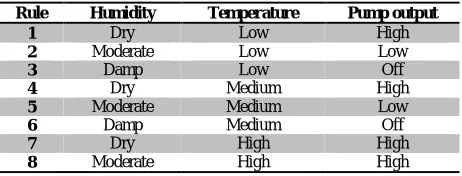
Table 1. -Fuzzy Rules with two inputs and one output
Rule Humidity Temperature Pump output
1 Dry Low High
2 Moderate Low Low
3 Damp Low Off
4 Dry Medium High
5 Moderate Medium Low
6 Damp Medium Off
7 Dry High High
9 Damp High Low
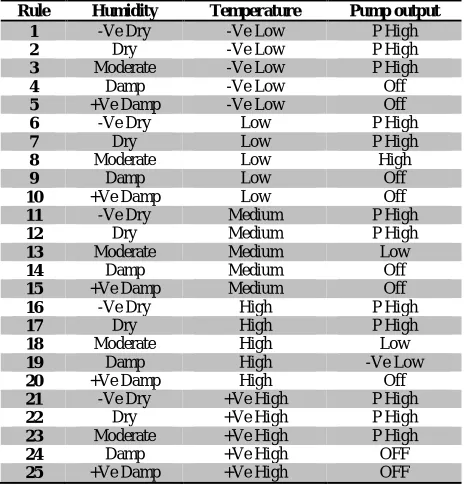
Table 2. –Fuzzy 25 Rules with two inputs and one output
Rule Humidity Temperature Pump output
1 -Ve Dry -Ve Low P High
2 Dry -Ve Low P High
3 Moderate -Ve Low P High
4 Damp -Ve Low Off
5 +Ve Damp -Ve Low Off
6 -Ve Dry Low P High
7 Dry Low P High
8 Moderate Low High
9 Damp Low Off
10 +Ve Damp Low Off
11 -Ve Dry Medium P High
12 Dry Medium P High
13 Moderate Medium Low
14 Damp Medium Off
15 +Ve Damp Medium Off
16 -Ve Dry High P High
17 Dry High P High
18 Moderate High Low
19 Damp High -Ve Low
20 +Ve Damp High Off
21 -Ve Dry +Ve High P High
22 Dry +Ve High P High
23 Moderate +Ve High P High
24 Damp +Ve High OFF
25 +Ve Damp +Ve High OFF E. AGGREGATION
The Mamdani method prescribes specific aggregation to combine a weighted fuzzy sets, into single fuzzy set as in eguation (3)
g(x) = min{f (x)} (3)
The aggregation is performed via computing the center of gravity (COG) of each fuzzy set using the formula in fig 5
COG = M F⁄ (4)
Where
M =∫xf (x)dx (5)
F =∫f (x)dx(6)
F. DEFUZZIFICATION
The output of inference stage of the Mamdain method is a fuzzy set. Defozzyificatin refers to evaluating a crisp output from a set of singletons, a set of center of gravities , or a fuzzy set. G.S. Nhivekar[5] the defuzzificationmethod can be partitioned into two method the centroid and the max methods.
G. CRISP OUTPUT
IV.RESULTS AND ANALYSIS
The simulation was performed in MATLAB / SIMULINK environment. Figure 1 presents the simulation models. Fuzzy controllers with two inputs temp and humidity , the input signal taken as random number connected to feedback signal with summing point, temp signal interred through transfer function and humidity through gain 2 and followed via transfer functions1.
Figure 1. Fuzzy controllers with two inputs temp and humidity
Figure 1 shows the simulation models. Fuzzy controllers with two inputs temp and humidity , the input signal taken as random number connected to feedback signal with summing point, temp signal interred through transfer function and humidity through gain 2 and followed via transfer functions1.
.
Figure 2 Two fuzzy controllers with two inputs temp and humidity
Figure 2 Two fuzzy controllers with two inputs temp and humidity , the input signal taken random number connected to feedback signal with summing point, temp signal interred through transfer function 1,3 and humidity through gain 2 and followed via transfer functions 2,4, the first controller is loaded via Mamdani fuzzy controller and the second controller loaded via Sugeno fuzzy controller. The rules were performed for three memberships and five memberships, for both methods Mamdani and Sugeno respectively.
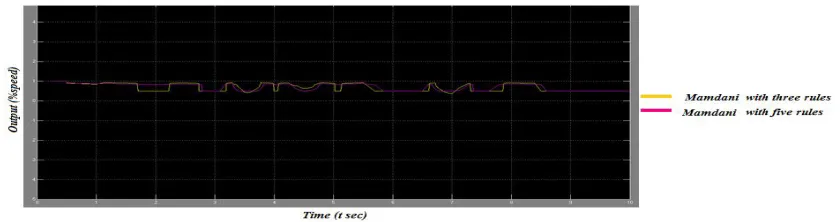
Figure 3.Shows the difference between the outputs of same type (Mamdani) with different memberships (three membership and five membership) , we can see that the increase of member ship function improves controller output
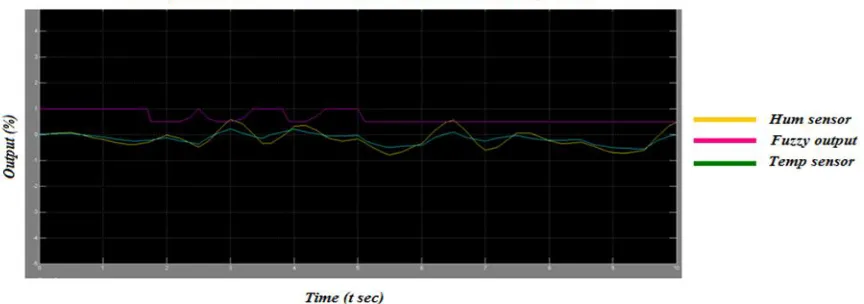
Figure 4. Mamdani Fuzzy controller with feedback signal
Figure 4.shows the effects of feedback on Mamdani controller efficiency, a variation is overcome by the closed loop controller rather than open loop
Figure 5. Fuzzy controller mamdani and sogemo with three membership and feedback
V.DISCUSSIONS
Results obtained shows that the Sugeno-type fuzzy inference based controller has a smooth operational inference based controller. Also, the Sugeno-type fuzzy inference system based controller with five memberships works better than that one with three memberships. It is also noted that the Sugeno-type fuzzy inference system based controller, respond to inputs values changes quite efficiently more than the Mamdani type.
VI. CONCLUSIONS
The development of Mamdani-type fuzzy inference system based irrigation controller and Sugeno-type fuzzy inference system based irrigation controller could be used to control the irrigation pump operations or any water control system .Sugeno-type fuzzy inference system gives better result in terms of performance and adaptability .Sugeno with more memberships more efficiency.
VII. ACKNOWLEDGEMENT
The authors wish to thank the college of engineering El_NeelainUniversity , Dr/ M. Al Duma and Dr/ M. AbdBasit Sudan University and head of the control engineering department for providing the facilities to carry out this wor
REFERENCES
[1] Angelina Tomova, MihailAntchev, MariyaPetkova, HristoAntchev.”Fuzzy Logic Hysteresis Control of А Single-Phase on-Grid Inverter: Computer Investigation”. International Journal of Power Electronics and Drive System (IJPEDS) Vol. 3, No. 2, June 2013, pp. 179~184 ISSN: 2088-8694
[2] Philip A. Adewuyi , “ Performance Evaluation of Mamdani-type and Sugeno-type Fuzzy Inference System Based Controllers for Computer Fan”, I.J. Information Technology and Computer Science, 2013, 01, 26-36 Published Online December 2012 in MECS (http://www.mecs-press.org/) DOI: 10.5815/ijitcs.2013.01.03
[3] NamithaSona, ShantharamaRai.c,” Fuzzy Logic Controller for the Speed Control of an IC Engine using Matlab \ Simulink”, International Journal of Recent Technology and Engineering (IJRTE) ISSN: 2277-3878, Volume-2, Issue-2, May 2013
[4] Timothy J. Ross “FUZZY LOGIC WITH ENGINEERING APPLICATIONS” Second Edition - University of New Mexico, USA World Applied Sciences Journal 6 (1): 16-23, 2009
[5] G.S. Nhivekar1*, S.S. Nirmale1, R.R. Mudholker1, “Implementation of fuzzy logic control algorithm in embedded microcomputers for dedicated application”, International Journal of Engineering, Science and Technology Vol. 3, No. 4, 2011, pp. 276-283
[6] K. MousaviMashhadi, M. Shokohinia, M. Shokohinia/,” Controlling the green- house irrigation system in fuzzy logic method” The Journal of Mathematics and Computer Science Vol .4 No.3 (2012) 361-370
[7] Ms. Neelam P. Naik ,”Fuzzy logic to control dam system for irrigation and flooding” Late BhausahebHiray S.S. Trust’s Institute of Computer Application, Government Colony, Bandra (East), Mumbai 400 051.
[8] R.suresh , S.Gopinath , K.Govindaraju , T.Devika , N.SuthanthiraVanitha / GSM based Automated Irrigation Control using Raingun Irrigation System, Embedded System Technologies, and Electrical & Electronics Engineering Knowledge Institute of Technology, Salem, India , International Journal of Advanced Research in Computer and Communication Engineering Vol. 3, Issue 2, February 2014