Third Party Auditing for Data Sharing in Cloud via Key
Encryption
Sathavelli Sindhu
M.Tech, Computer Science &Engineering Jj Institute Of Information Technology
M.Omprakash
Associate Professor & Hod, Department Of Cse Jj Institute Of Information Technology
Abstract: Customers can outsource data without the burden of regional data storage and upkeep. In Cloud computing, clients should be in a position to use cloud storage without annoying about the have to determine it’s integrity. So enabling public auditability for Cloud data storage should have valuable significance.So clients can use outside audit occasion to verify the integrity of data in Cloud Storage. Utilising third party Auditor(TPA) for checking integrity of data, the users or data owners must no longer need to keep online and the clients are be fear-free. For using TPA the auditing process will have to provide security to cloud storage. As a result TPA preserves to user data privacy. The regeneration code provide fault tolerance with low restore bandwidth. In regeneration coded data, there exists remote checking process offering confidential auditing, which involves data owners to stay online, which is impractical . To preclude this, public auditing scheme for regenerating code is proposed, proxy is used to solve drawback of regeneration concern used to generate failed authenticator in public auditing approach. This scheme eliminates data owners from online burden.
KeyWords: Cloud computing, Public Auditing, Data integrity, privacy-preserving.
I. INTRODUCTION
To protect outsourced data in cloud storage against corruptions, adding fault tolerance to cloud storage
together with data integrity checking and failure reparation turns into vital. Not too long ago, regenerating codes have gained popularity as a result of their decrease restore bandwidth while
offering fault tolerance.We advise a third party auditing scheme for checking de-duplication and regenerating-code-founded cloud storage. To clear up the regeneration quandary of failed authenticators within the absence of data owners, we introduce a internet provider, which is privileged to regenerate the authenticators, into the common third party auditing approach model. Moreover, we design a novel third party audting authenticator, which is generated by way of a couple of keys and will also be regenerated making use of partial keys. As a consequence, our scheme can wholly free up data owners from on-line burden. Cloud computing, to put it effortlessly, way ―internet Computing. The internet is customarily visualized as clouds; accordingly the time period ―cloud computing for computation accomplished through the web. With Cloud Computing clients can access database resources via the internet from wherever, for so long as they need, without traumatic about any security or administration of specific resources. Apart from, databases in cloud are very dynamic and scalable.― Cloud computing is a model for enabling easy, on-demand network access to a shared pool of configurable computing resources.
relied on and regeneration are carried out a semi-depended on proxy separately on- behalf of the data owner. After checking the integrity of data TPA send acknowledgement to proxy agent. If the data is corrupted or loss, the proxy agent then repairs the corrupted data after which stored in cloud server. For this reason to checking integrity and provide fully security and avert corruption the public Auditing is very useful procedure which can regenerate the code making use of proxy agent.
II. RELATED WORKS
H.C.H. Chen and P.P.C. Lee, “Enabling knowledge integrity safeguard in Regenerating-coding-based cloud storage: idea and Implementation.” in that case [4] provide safeguard to the users data I the cloud storage against corruptions, internal or external attacks and finally including failure compensation to the cloud storage along with data integrity checking ,verification and to recuperate faults ,turns into a relevant undertaking. Regenerating code presents failure toleration via segmenting logical sequential information across multiple number of servers also makes use of minimal restore traffic than natural remover for the period of failure reparation code. Seeing that we're going to talk about the difficulty of checking the integrity and verification of Regenerating-coding-based data towards internal and external attacks under an actual time life cloud storage surroundings .We design data integrity protection DIP scheme for regenerating code and the privacy retaining homes fault tolerance and repairing the minimum tragffic.
F. Sabahi faculty of computer engineering Azad tuition Iran.” Cloud Computing protection Threats and Responses”: [5] many IT businesses going through the valuable problems corresponding to safety and integrity that exist with improved implementation with the cloud computing. These types of standards initiate which is remotely stored from the user’s vicinity. Cloud computing expanded because of projecting safety hazards. Some quandary arises that clients’ wants to appreciate as they must observes these things severely relocating business in the direction of cloud computing.There is a approach to clear up this problems is RAS problems. These are projected safety dangers Reliability, protection and availability.
Yuchong Hu scholar Member, IEEE, Lee, P.P.C. Scholar Member, IEEE; Shum, k.W, ”analysis and building of sensible regenerating codes with uncoded repair for allotted storage techniques”:[6] if so the allotted storage techniques applies the overabundance coding approaches to store their data. Redundancy can curb the repairing bandwidth. i.e., the huge quantity of data transferred when repairing a failed storage device. Present regenerating codes most likely require surviving storage nodes encode data for the duration of repair. This paper suggests the functional minimum storage regenerating (FMSR) codes, which allows the uncoded restore. Even as retaining the much less restore bandwidth ensures our data and in addition minimizing disk reads time. FMSR codes provides intended FMSR codes.
Y. Hu, H. C. H. Chen, P. P. C. Lee, and Y. Tang, “NCCloud: applying network coding for the storage restore in a cloud-of-clouds”: in that case ,this paper[7] provides fault tolerance to spread data across more than one cloud companies. However, if a cloud suffers from a permanent failure and loses all its data, it is quintessential to repair the lost data with the support of the other surviving clouds to keep data redundancy. This paper provided a proxy-based storage system for fault-tolerant more than one-cloud storage known as NCCloud, which achieves price-amazing repair for a permanent single-cloud failure. NCCloud is constructed on higher layer of community-coding-established storage and its often called practical minimum storage regenerating codes which continues fault tolerance. FMSR provides economic price saving in restore over RAID-6 codes, even as having comparable response time efficiency in cloud storage operations equivalent to add or download.
The data/file is saved immediately into cloud, there is not any backup of equal data/file in any other desktop. This will affect the person to access data at any time when wanted. There is not any such situation exists as a way to regenerate lost data/file in case of system failure. So notion of privacy keeping public auditing along with regeneration code has been introduced.
It consists of entities like data owners, server, proxy, TPA, Attacker.
Fig. 1. The system model
1) Data owners
1. One whose going to entry documents, one who owns file, who requires his data to be at ease. 2. Data owners are liable for encrypting the data by way of generating private key.
3. Data/File is encrypted using AES Algorithm 4. Data owner sends data/file to TPA and takes support of TPA.
5. Data owner is in charge for captcha generation. Owner is going to entry half of information from utility and half of information via electronic mail and must mix it and ship it to TPA.
6. Data owner is provided with log window to peer how TPA is working and get file of the same. 7. Data owner can pay to TPA to get protection of its data and might access useful data at whenever.
2) Server
1. One whose going to access files, one who owns file, who requires his data to be secure.
2. Two distinct servers are used to store half –half information into each and every servers.
3. Now not critical that both the servers are unique but they can be same.
4. TPA is liable for splitting data/file into two materials so to at ease the information.
5. Attacker can attack either of the servers or both. Attacking both servers may also be rare , there's a likelihood of attacking one server at a time. 6. So, if both the servers are the identical then its simpler for attacker to retrieve data with no trouble from these both servers.
7. Ever since data is in encrypted layout, its in most cases intricate for attacker to decode it ; but this will ultimately result in data owner to endure in a single or the other way.
8. To be able to clear up this concern metadata is saved for each server content into proxy server. 9. Think measurement of data saved in server 1 is 2GB and in a similar way measurement of data saved in server2 is 2 GB. So backup of these two servers require 2GB area.
10. If we are utilising metadata to retailer backup of these servers it is going to typically require less storage measurement i.e less than 2GB.
3) TPA(third party Auditor)
1. There are in actual fact three varieties of audits product, approach and system. Audits are name according to there cause.
2. Audits are labeled into inside or external, depending upon relationship of individuals. 3. Interior audits are performed inside an organization by using workers.
4. Outside audits are performed with the aid of third party together agent or outside agents.
Auditing scheme includes three procedures setup, audit and repair.
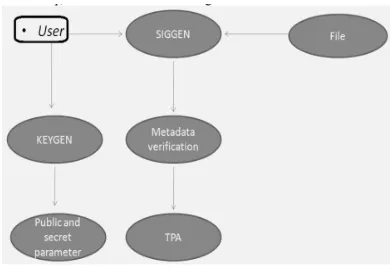
1) Setup: Three polynomial time algorithms are used:
i) KeyGen (1k) → (pk, sk) : By taking security parameter “k” as input data owners run this algorithm to initialize there public and secret parameters.
ii) Delegation (sk) → (x) : Interaction between data owners and proxy, proxy receive practical secret key “x” from data owners.
iii) Sinand blockgen (sk, F) → (ɸ,Ψ, t) : Its run by data owners which take input as secret parameter sk and file F and outputs coded block ɸ, authenticator Ψ and file tag t.
Fig. 2 Setup Phase of proposed scheme
i) Challenge (Finfo) → (C) : Its performed by TPA, Finfo file information and C challenge.
ii) Proofgen (C,ɸ,Ψ) → (P) : Its run by almost all cloud server.
iii) Verify (P, pk, C) → (0, 1) : Its run by TPA as soon as it receives proof. If output 1 verification is successful, else 0.
Fig. 3 Audit Phase of proposed scheme
3) Repair: Proxy interacts with cloud server in absence of data owners used to repair wrong server detected by the auditing process .
i) Claimforrep (Finfo) → (Cr) : Its same as challenge algorithm in audit phase.
ii) Genforrep (Cr,ɸ,Ψ) → (BA) : Cloud servers run this algorithm and output authenticators set BA with input set Cr, ɸ, Ψ.
iii) Blockandsigregen (Cr,BA) → (ɸ′,Ψ′,⊥) : This algorithm is implemented by proxy with claim Cr and output a new coded block set Ψ′, authenticator set ɸ′.
Algorithm for File Encryption
Its Advanced Encryption Standard use Rijndael block cipher.
Input : State (block from plaintext message to be encrypted)
Cipher Key. 2 Phases : A) To Encrypt process. B) To key schedule.
To Encrypt Process Perform encryption of the given plaintext block using four different transformation in the initial round,9 main rounds and final round.
Initial round : add round key. Main round : Four transformation SubBytes
ShiftRows MixColumn AddRoundKey
Final round : Include only three transformation
SubBytes ShiftRows AddRoundKey
Output : Generate Ciphertext.
The Four Types of transformation includes : a) SubBytes : State is converted into Hexadecimal using S-Box byte substitution table
b) ShiftRows : ShiftRow operation is performed in. substituted state.
Fig. 4 AES Algorithm using Rijndael Encryptor
c) MixColumn : This shifted row then undergoes mix column operation .
Four numbers of 1st column are modulo multiplied in Rijndael‟s Galois field by given matrix.
d) AddRound Key : Mixed column is xor with round key produced during key schedule. Final round include 3 transformation i.e subbytes shiftrows mixcolumn i.e 10th round. Output : Ciphertext.
ii) Key Schedule :Expansion of given cipher key into partial key used in the initial round, the nine main rounds and final round.
(1) The expanded key can be seen as an array of 32-bit words(column) numbered from 0 to 43.
(1) Applying the rot word and sub bytes transformation to the previous word wi-1.
(2) Adding (XOR) this result to word 4 position earlier wi-4 plus a round constant Rcon. Remaining 32-bit words Wi ,calculated by adding (XOR) the previous word wi-1,with the word 4 position earlier wi-4.
B. SHA-1 Algorithm It is used for digital signature
(1) It is a hashing algorithm having same structure to MD5, but producing a digest of 160 bits(20 bytes).
(2) Since its having large digest size, it is less likely that 2 different msgs will have the same SHA-1 msg digest
(3) Hence SHA-1 is recommended as compared to MD5.
IV. CONCLUSION
This paper has presented public auditing for regenerating code founded cloud storage method, which entails TPA, data owners, cloud servers and proxy server. Few schemes are proposed like setup audit and repair; whereas in earlier issues of privacy retaining public auditing for cloud storage simplest two schemes the place proposed audit and setup. But this subject involves additional scheme repair due to regeneration suggestion. Concept of proxy is offered which solves drawback of regeneration in case of authenticator failure.
REFERENCES
[1] Jian Liu, Kun Huang, Hong Rong, Huimei Wang and Ming Xian, “Privacy-Preserving Public Auditing forRegenerating-Code-Based Cloud Storage,” IEEE
TRANSACTIONS ON INFORMATION AND
SECURITY, vol. 1, Nov. 2015.
[2] Boyang Wang, Baochun Li, and Hui Li, “Oruta: Privacy-Preserving Public Auditing for Shared Data in the Cloud,” IEEE TRANSACTIONS ON CLOUD COMPUTING, vol. 2, pp. 43-56, January-March. 2014.
[3] Cong Wang, Sherman S.M. Chow, Qian Wang, Kui Ren, and Wenjing Lou, “Privacy-Preserving Public
Auditing for Secure Cloud Storage,” IEEE
TRANSACTIONS ON COMPUTERS, vol.62, pp. 362-375, Ferbruary. 2013.
[4] Cong Wang, Qian Wang, Kui Ren, and Wenjing Lou, " Privacy-Preserving Public Auditing for Data Storage
Security in Cloud Computing", in IEEE INFOCOM, 2010, pp. 1-15. 2009.
[5] F. sabahi Faculty of computer engineering Azad University Iran.” Cloud Computing Security Threats and Responses”.
[6] Yuchong Hu Student Member, IEEE, Lee, P.P.C. Student Member, IEEE; Shum, K.W, ”Analysis and construction of functional regenerating codes with uncoded repair for distributed storage systems”.
[7] Y. Hu, H. C. H. Chen, P. P. C. Lee, and Y. Tang, “NCCloud: Applying network coding for the storage repair in a cloud-of-clouds”.
Author’s Profile
SATHAVELLI SINDHU pursing M.Tech in Computer Science Engineering from JJ INSTITUTE OF INFORMATION TECHNOLOGY