Defect Detection of Regular Patterned Fabric by Spectral
Estimation Technique and Rough Set Classifier
Mr..Sudarshan Deshmukh.
Department of E&TC Siddhant College of Engg,
Sudumbare, Pune
Prof. S. S. Raut.
Department of E&TC Siddhant College of Engg,
Sudumbare, Pune
Prof. M. S. Biradar. Department of E&TC Siddhant College of Engg,
Sudumbare, Pune
ABSTRACT
Fabric detection has an outstanding importance in inspection of fabric quality and defects. It works on principle of spectral estimation technique vision. it gets bonded to locate defected regions accurately. This project represented a most accepted
method for patterned fabric defect detection and classification using spectral estimation technique and rough set theory. To extract the Regular pattern from the image of the patterned fabric, here use of Estimating Signal Parameter via Rotational Invariance Technique (ESPRIT) is done. In this technique the defected region i.e. the shape and location of the flawed areas are detected by comparing the pattern image and the source image also the rough set classifier is trained and tested to detect the types of defects in the patterned fabric image. Practically it is observed that this method can successfully be used to analyze & find the defects in patterned fabrics with nearly 96% success rate. This method is result oriented and better improving than previous method.
Keywords:-Patterned fabric, defect detection, spectral estimation, rough set theory, Rotational Invariance Technique.
INTRODUCTION
Defect detection is a concept used in quality control process that identifies and gives exact locations of deficiencies in the fabric manufactured in textile industry. Manual Defect detection which is generally tested with human eyes has low efficiency because of eye fatigue effect. Therefore to improve textile quality an automatic detection system becomes necessary because of progress of machines vision technology. Detection algorithm is the important factor in fabric detection system. Woven cloth fabrics are generally classified into two groups
Non patterned fabric and Patterned fabric
In Regular pattern fabric while the process is being carried out it should be consider that some structural and visual defects will occur. Fabric inspection is mostly used for quality assurance. Nowadays defect detection by an automated fabric inspection machine is mainly used for non-patterned fabrics. There are very limited reports available on automated patterned fabric online defect detection.
The reason for that is there are many technological difficulties in automated
defect detection for patterned fabric images. It includes following steps
The texture of the patterned fabric is much more complex than that of non-patterned fabric.
There are many types of defects that arise in patterned fabrics.
The shapes of the background of the patterned fabric and the defects can appear similar and therefore it is difficult to distinguish them by a machine.
So, it is the fact that a patterned fabric has significant repetitive units on its surface. Therefore it is required to use an RGB accumulative average method that can be used to test and locate flawed zones for printed fabric and then to confirm the flaw type, using fuzzy logic . To estimate Signal Parameter via Rotational Invariance Techniques (ESPRIT) is a high-resolution subspace-based method that can find the periods of a periodic signal. This theory has found applications in many artificial intelligence and cognitive science, & also used especially in the data classification, rule generation, machine learning, data mining and knowledge discovery. This regular patterned fabric has repetitive patterned units in its design after one another within periodic form. It is expected that the ESPRIT method can be used for effective pattern extraction. Two factors must be considered in choosing the detection algorithm, namely efficiency and real time. Rough set theory and methods generalize a well defined definition of knowledge and provide algorithms for attribute sensitivity analysis, rule generation and classification related to the information is presented. Thus, Rough set methods have shown to be an
effective tool method for the decision support system. Rough set classifier has capability to effectively deal with discrete valued attributes or features of fabrics that are normally used for feature extraction and feature selection for pattern recognition. It is expected that, based on the information obtained for a patterned fabric from the ESPRIT method, a rough set classifier will be an effective as well as best tool to identify defects in a regular patterned fabric. This report employs rough set theory as an image classifier to detect and classify patterned fabric defects. To achieve this goal, the report first adopts some of the spectral estimation method to extract the fabric structure of repetitive units, or the pattern, from the given acquired fabric image, and then detect the shape and location of the flawed area by identifying interrupted patterns in the image and Finally, the flawed areas are fed into a rough set classifier to discern the types of defects.
II. EXTRACTING THE REGULAR PATTERNS
The details have been explained by Mr. Richard Roy and Thomas Kailath of the ESPRIT algorithm. ESPRIT can be applied to a wide variety of problem including accurate detection and estimation of sinusoidal noise. The algorithm used in this report is composed of four steps. It starts First with the patterned fabric image is projected on the horizontal and vertical axes for estimating the repetition periods of the patterns by ESPRIT. In simply words it is, an image of size M×N can be denoted by
matrix F. The rows of F are 1×N vectors, and the columns of F are M×1 vectors respectively. Lets assume the vectors of the rows and columns be named by fi
(i=1,...,N) and gj (j=1,...,M), respectively. The horizontal projection of the image produces an N×1 vector x whose elements are shown in Equation 1.
𝑥𝑥1 = ∑𝑁𝑁𝑗𝑗=𝑖𝑖(𝑓𝑓𝑖𝑖)𝑗𝑗 , 𝑖𝑖= 1, … … .𝑁𝑁
……..(1)
The vertical projection of the image
produces a 1×M vector y whose elements are shown in Equation 2.
𝑥𝑥1 =∑ �𝑔𝑔𝑀𝑀𝑖𝑖=1 𝑗𝑗�𝑖𝑖 , 𝑗𝑗 = 1, … … .𝑀𝑀 …… (2)
Second, as the signals x and y are both are periodic signals, the frequency of x and y is estimated respectively by ESPRIT method. After obtaining good estimates for these periods, the regular pattern of the image is extracted through shifting a proper size window throughout the given image.
Third, the location and shape of a defect are determined by subtracting shifted versions of the extracted pattern and thresholding. Horizontal and vertical periods have been found out. After estimating the period of the pattern, the horizontal period Tx and vertical periods Ty
of the image are determined. Therefore, the pattern P can be denoted as a K×L matrix where
𝐾𝐾= 𝑖𝑖𝑖𝑖𝑖𝑖(𝑇𝑇𝑥𝑥) + 1 , 𝐿𝐿= 𝑖𝑖𝑖𝑖𝑖𝑖�𝑇𝑇𝑦𝑦�+ 1
(3)
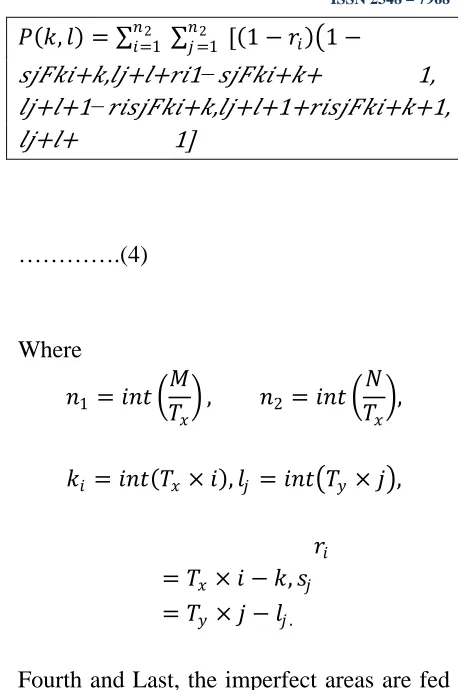
Assuming F(k,l) is the gray-value of the pixel located in the position (k,l) in image F, the pattern P can be obtained by Equation 4:
𝑃𝑃(𝑘𝑘,𝑙𝑙) =∑𝑖𝑖𝑖𝑖=12 ∑𝑖𝑖𝑗𝑗=12 [(1− 𝑟𝑟𝑖𝑖)�1−
𝑠𝑠𝑗𝑗𝐹𝐹𝑘𝑘𝑖𝑖+𝑘𝑘,𝑙𝑙𝑗𝑗+𝑙𝑙+𝑟𝑟𝑖𝑖1−𝑠𝑠𝑗𝑗𝐹𝐹𝑘𝑘𝑖𝑖+𝑘𝑘+ 1,
𝑙𝑙𝑗𝑗+𝑙𝑙+1−𝑟𝑟𝑖𝑖𝑠𝑠𝑗𝑗𝐹𝐹𝑘𝑘𝑖𝑖+𝑘𝑘,𝑙𝑙𝑗𝑗+𝑙𝑙+1+𝑟𝑟𝑖𝑖𝑠𝑠𝑗𝑗𝐹𝐹𝑘𝑘𝑖𝑖+𝑘𝑘+1, 𝑙𝑙𝑗𝑗+𝑙𝑙+ 1]
………….(4)
Where
𝑖𝑖1 =𝑖𝑖𝑖𝑖𝑖𝑖 �𝑀𝑀𝑇𝑇
𝑥𝑥�, 𝑖𝑖2 =𝑖𝑖𝑖𝑖𝑖𝑖 �
𝑁𝑁 𝑇𝑇𝑥𝑥�,
𝑘𝑘𝑖𝑖 =𝑖𝑖𝑖𝑖𝑖𝑖(𝑇𝑇𝑥𝑥×𝑖𝑖),𝑙𝑙𝑗𝑗 =𝑖𝑖𝑖𝑖𝑖𝑖�𝑇𝑇𝑦𝑦 ×𝑗𝑗�,
𝑟𝑟𝑖𝑖
=𝑇𝑇𝑥𝑥×𝑖𝑖 − 𝑘𝑘,𝑠𝑠𝑗𝑗
=𝑇𝑇𝑦𝑦 ×𝑗𝑗 − 𝑙𝑙𝑗𝑗.
Fourth and Last, the imperfect areas are fed into a rough set classify to discern the type of defects.
Figure 1 illustrates the process of image projection in horizontal and vertical axis to get pattern extraction. Figure 1(a) is an image of a defect-free patterned fabric with repeated patterns/dots at different locations. By projecting the image along the horizontal and vertical axes, projection vectors were obtained in Figures 1(b) and 1(c) and showed. The vector signals are both periodic signals and have a set of harmonically related frequency components under spectrum theory. The frequency of the projection vectors along the horizontal axis and vertical axis were estimated respectively by ESPRIT method. As an outcomes, the repetitive pattern are as shown in Figure
1(d) for the image in Figure 1(a) was extracted using the frequency data.
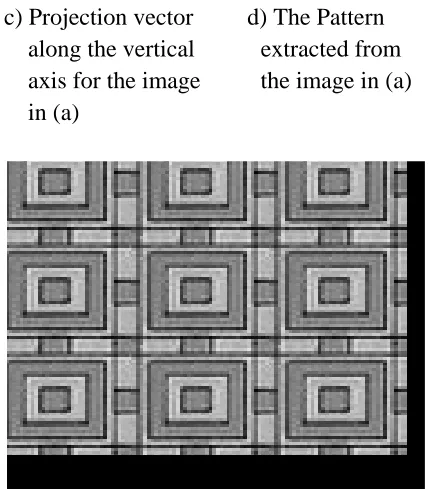
Another example of patterned fabric is shown in Fig 2. Again the ESPRIT can identify the repetitive pattern as shown in Figure 2(d) for the image in Figure 2(a). From these examples it is indicate that the ESPRIT method can effectively extract a repetitive patterned unit in the design or image of a patterned fabric. The patterned unit forms a defect free patterned fabric. When compared the extracted defect free image with a testing patterned fabric image, the differences can be highlighted in a constructed defect feature image. Any defects present in the tested image can then be identified by a trained classifier.
(a)An image of a (b) Projection vector defect-free along the horizontal
patterned fabric axis for the image in (a)
c) Projection vector d) The Pattern along the vertical extracted from axis for the image the image in (a) in (a)
(a) Image of a defect-free patterned fabric
(c) Projection vector along the vertical axis for the image in (a).
figure 2.(a),(b),(c),(d)
(b) Projection vector along the horizontal axis for the image in (a)
(d) The unit pattern extracted from the
image in (a)
III. DEFECTS DETECTING
After getting repetitive pattern which has extracted, gray-value of each pixel in the original image can be compared with the corresponding pixel in the pattern to conform if the pixel was part of a defect or not, In this report, each point was also compared with eight neighboring points of the pixel in the pattern for checking purpose in order to deal with the illumination change
problem . After computing the difference between each pixel in the image and all 8 corresponding pixels in the pattern, that pixel of the image was defined as a value which is found to be equal to the minimum absolute value of the 8 differences. By calculating the minimum absolute value for all pixels in the original image, all of the pixels in the original image can be classified as either a pixel in a flawed area or a pixel in a defect free area by a given threshold value. In this report, the threshold (T) for detecting the defects was chosen by using Equation no
5. i.e T - (I1 - I2 ) / 2
………(5)
Where I1 is the brightness of the point with the highest intensity in the regular pattern, and I2 is the brightness of the point with the lowest intensity in the regular pattern.
IV. CLASSIFICATION OF DEFECTS
For the classification of defect detection, Rough set theory is used as a classifier in this report. Which requires two phases a training phase and a testing phase.
The training phase involves the training samples which were first used to create a decision table to store the features of the fabric images. Then, the condition attributes were discredited for establishing classification rules. After this process, the significance of the attribute was determined for the condition attributes and the decision
table was reduced according to the significance of the attribute. The decision rules were then executed according to the rough membership function. In this way the training stage is completed. In the testing phase also it includes, the same discredited method used in the training step. First employed to discredited the attributes of the testing sample. Then the rules that are generated in the training step were used to match and classify the testing samples for the detection of type of defects.
In this report, 16 feature values are used of a flawed area identified to construct the condition attributes for the rough set classifier. These are flaw area, dispersion, aspect ratio, Euler number, maximum of gray value, minimum of gray value, mean of gray value, standard deviation of gray value, entropy of gray value, energy of the texture, contrast of the texture, homogeneity of the texture, first order moment invariant, second order moment invariant, third order moment invariant, and fourth order moment invariant. Such attributes were used for classifier training and testing process
V. RESULTS AND DISCUSSION
In this chapter the result and discussion is done according to the stepwise flow of the algorithm. The defect detection method for a patterned fabric using spectral estimation technique and rough set classifier is the demonstrated using some type of defects like oil warp, oil weft, missing pick, thin bar, and thick bar as taken as examples. Through entire regular pattern extraction and defect detection by using rough set classifier, the testing images were compared
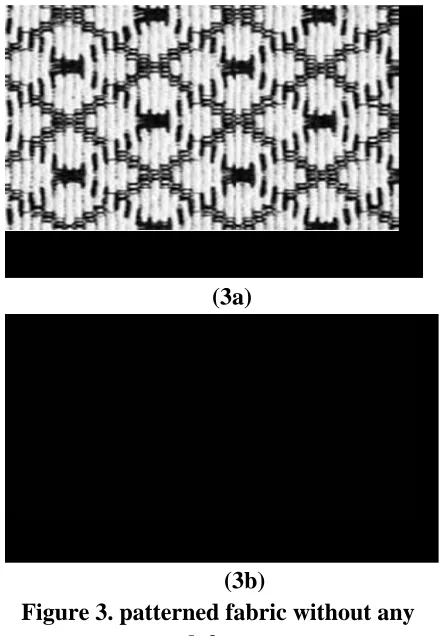
with its defect free images obtained by ESPRIT. To show the locations and shapes of possible defect areas within the testing fabric image A defect feature image was constructed. Figure 3 shows the result of defect feature image of a defect free patterned fabric. From Figure 3(b), it can be seen that no flaws are shown in constructed defect feature image , indicating that the tested patterned fabric is defect free, which satisfy exact with the conclusion of manual visual inspection to the fabric sample.
(3a)
(3b)
Figure 3. patterned fabric without any defects
Table1.OVERALL PERFORMANCE OF OUR PROPOSED
METHOD
Type of Defect Success Rate (%)
Oil warp 95.9
Oil wef 95.8
Missing pick 91.1
Thin bar 95.8
Thick bar 97.8
Average 95.3
(a)OIL WARP
(b)OIL WEFT
(c)MISSING PICK
(d)THIN BAR
(e)THICK BAR
Figure 4. Patterned fabric images, and the corresponding locations and shapes of the flawed areas Left testing image, Right: constructed image showing defects.
The total computing time for different types of defect was evaluated using a personal computer with Windows XP operating system . It took about 0.2 seconds to detect the flawed areas and classify the type of each flawed area, In other words, the detection speed was about 5 frames per second. When a current generation of computer, which is much faster than the tested one, is employed for an automated patterned fabric inspection system, the detection speed will be much faster than 5 frames per second. Overall, the success defect detection rate and computing time are comparable to some other methods reported for regular patterned fabric defect detection. Therefore the method reported in this paper is suitable for on-line real-time application.
VI. CONCLUSION
In many of the textile garments factories of countries like China and Bangladesh the defects of fabrics are detected manually. All the defected fabrics are classified using human organs there is no any technology used. But this method is very tiresome, slow, boring and frustrating causing dullness, mental and physical stress it involves observation, attention and experience to detect the defect correctly the fault occurrence. In this paper, a novel technique for visual defect analysis is provided. The repetitive unit of patterned
fabric is first estimated by ESPRIT algorithm. ESPRIT produces signal parameter estimates directly in terms of characteristic values. Then a subtraction and threshold method is used to detect and locate the position of the imperfect areas. Finally, the flawed areas are imported into a rough set classifier to classify the type of defects. The experimental results prove that the proposed technique can detect and classify the defects for the patterned fabrics effectively with an overall successful detection and classification rate of about 95% and a testing speed of about 5 images per second on a 1.7 GHz Intel i5 core processor computer.
REFERENCES
1. H. Y. T. Ngan, G. K. H. Pang, and N. H. C. Yung, "Automated fabric defect detection--A review," Image and Vision Computing, vol. 29, 2011, pp. 442-458.
2. H. Y. T. Ngan, G. K. H. Pang, S. P. Yung, and M. K. Ng, "Wavelet based methods on patterned fabric defect detection," Pattern Recognition, vol. 38, 2005, pp. 559-576.
3. H. Y. T. Ngan and G. K. H. Pang, "Novel method for patterned fabric inspection using Bollinger bands," Optical Engineering, vol. 45, 2006, pp. 087202-(1-15).
4. H. Y. T. Ngan, G. K. H. Pang, and N. H. C. Yung, "Motif based defect detection for patterned fabric,"
Pattern Recognition, vol. 41, 2008, pp. 1878-1894.
5. S. Mitra, M. Mitra, and B. B.
Chaudhuri, "A Rough-Set- Based Inference Engine for ECG
Classification," Instrumentation and Measurement, IEEE Transactions on, vol. 55, 2006, pp. 2198-2206.
6. R. Roy and T. Kailath, " ESPRIT-estimation of signal parameters via rotational invariance techniques," Acoustics, Speech and Signal Processing, IEEE Transactions on, vol. 37, 1989, pp. 984-995.
7. C.-F. J. Kuo, C.-T. M. Hsu, W.-H. Chen, and C.-H. Chiu,"Automatic detection system forprinted fabric defects," Textile Research Journal, vol. 82, April 1, 2012, pp. 591-601.
8. F. Tajeripour, E. Kabir, and A.
Sheikhi, "Fabric defect detection using modified local binary patterns," EURASIP J. Adv. Signal Process, vol. 2008, Article ID 783898 2008, pp. 1-12.
9. R. W. Swiniarski, and A. Skowron, "Rough set methods in feature selection and recognition," Pattern Recognition Letters, vol. 24, 2003, pp. 833-849
10. F. Tajeripour, E. Kabir, and A. Sheikhi, "Fabric defect detection using modified local binary patterns," EURASIP J. Adv. Signal Process, vol. 2008, Article ID 783898 2008, pp. 1-12.