Available online:http://internationaljournalofresearch.org/ P a g e | 380
Common Adverse Effects Due to Self-Medication
Mena Rabea Al-Ani; Najeeb Hassan; Zehra Edis; Samir Haj Bloukh & Moyad
Shahwan*
College of Pharmacy and Health Sciences, Ajman University of Science and Technology, Ajman, United
Arab Emirates
.*
Corresponding Author: [email protected]
Abstract
Background:
There is no device or organ of the body is protected from adverse effect of medications.
However, the skin, the liver, the gastrointestinal tract, nervous system and circulatory system are the
most vulnerable to adverse effects that are diagnosed
. People use medicines for prevention, cure,
diagnosis and management of diseases.
Objective: This study was carried out to identify the adverse effects of drugs used by the respondents and
symptoms as well as the reason of self-medication.
Materials and Methods: We conducted a cross-sectional survey in Ajman from March to June 2015. A
structured questionnaire was used for data collection. Data was analyzed using of Statistical Package for
Social Science (SPSS).
Results: Commonly used drugs were analgesic drugs. Common reported illnesses were pain and
respiratory symptoms. Saving time and money, previously resolved complains were the top two reported
factors for self-medication. The adverse effects reported with self-medication were vomiting, nausea and
diarrhea. The majority of students stops taking drugs and consulted the doctor or pharmacist when
adverse effect occurred.
Conclusion:
Medical professionals are required to report all adverse effects related to a specific form of
therapy.
Without consulting doctor - side effects can worsen when you stop taking the drugs.
Little is
known about the relation of adverse effects to self-use of medication.
KEY WORDS:
self-medication; medicines; adverse effects
INTRODUCTION
Globally, self-medication has been reported as
being on the rise, this is partly due to the fact that
people are increasingly taking responsibility for
their health. The reason for self-medication
included barriers to healthcare access, “lack of
time” and difficulties in securing a medical
consultation due to administrative delays [1].
Consequently patients with milder symptoms do
not need to see a doctor they can turn to the
pharmacist for advice and medication for their
ailment [2]. Many studies done on self-medication
detection conclude that it is a fairly common
practice, especially in economically deprived
communities.
This self-care has its positive and
negative aspects [3].
Available online:http://internationaljournalofresearch.org/ P a g e | 381
death. As patients with severe or acute unexpected
symptoms frequently present to emergency
departments (EDs), some epidemiological studies
of ADRs have been successfully conducted in this
setting, showing that approximately 10–17 % of
ED visits were related to an ADR [4].
Adverse drugs reaction due to
Self-medication
among university students in the United Arab
Emirates (UAE) has not been previously
extensively explored. The study aims to identify
the adverse effects of drugs used by the
respondents and symptoms as well as the reasons
of self-medication.
MATERIALS AND METHODS
Study setting and sample size
A cross-sectional study was conducted. Data
collection was done from March 2015 to June
2015.
The chosen sample size was 700, distributed to
medical and non-medical students, male and
female in Ajman University. The medical colleges
consist of pharmacy and dentistry college, while
the non-medical colleges consist of engineering,
business, media and law colleges.
Method of data collection
A total of 700 sample questionnaires were
distributed equally to medical and non-medical
students. Data on socio-demographic details (age,
gender, specialization and university year). The
second part of the questionnaire was designed
with the aim to assess the students' behavior
regarding the safety of self-medication products.
The evaluation was done using 18 items. Behavior
score for each participant was calculated and
summed together to give the total behavior score
of the study sample. The third part consisted of 4
questions to measure the students view on adverse
effects of medicines in the UAE.
Data analysis
All analyses were performed using SPSS version
20. Identification numbers were given for the
collected questionnaire for counting and
organizing purposes. All questions were coded
and then imported to SPSS for analysis.
RESULTS
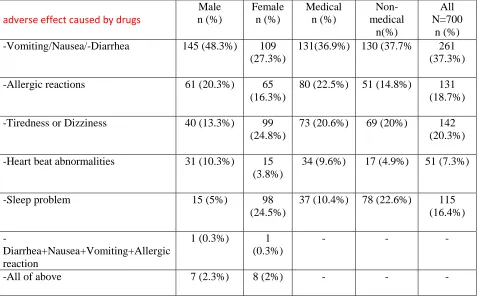
Availableonline:http://internationaljournalofresearch.org/ P a g e | 382 Table 1: Common adverse effects caused by self-medication among study participants.
DISCUSSION
Our study revealed that the most common drugs
used for the medical students who had used
self-medication over the past six months, were
analgesic drugs with a percentage of 76.1%, pain
(total 29.9%) and respiratory problem (total
23.1%) are most common illness where
self-medication is being used. Comparable results
obtained that analgesic drugs the most common
used medicine among students [14]. Our study
revealed that students (medical 38.6%,
non-medical 31.9%) use amoxicillin to treat
gastrointestinal symptoms (medical 7.6%, non-All N=700
n (%)
Non-medical
n(%) Medical
n (%) Female
n (%) Male
n (%) adverse effect caused by drugs
261 (37.3%) 130 (37.7%
131(36.9%) 109
(27.3%) 145 (48.3%)
-Diarrhea /
Nausea / -Vomiting
131 (18.7%) 51 (14.8%)
80 (22.5%) 65
(16.3%) 61 (20.3%)
-Allergic reactions
142 (20.3%) 69 (20%)
73 (20.6%) 99
(24.8%) 40 (13.3%)
-Tiredness or Dizziness
51 (7.3%) 17 (4.9%)
34 (9.6%) 15
(3.8%) 31 (10.3%)
-Heart beat abnormalities
115 (16.4%) 78 (22.6%)
37 (10.4%) 98
(24.5%) 15 (5%)
-Sleep problem
-1
(0.3%) 1 (0.3%)
-Diarrhea+Nausea+Vomiting+Allergic reaction
-8 (2%)
Availableonline:http://internationaljournalofresearch.org/ P a g e | 383 medical 11.3%) and urinary complaint (medical
11.3%, non-medical 13.9%). Comparable results
obtained that amoxicillin was the most
commonly self-medicated antibiotics [16]. The
mainfactors influencing the choice of antibiotics
were previous experience with the same illness
and advice from pharmacy staff. Diarrhea, sore
throat and common cold were the major reasons
for self- medication with antibiotics[17].
Our student’s total of 45.3% chooses
self-medication due to saving time and money, and
resolved complains previously (20.6% total). This
finding in parallel to another study, where
respondents found self-medication to be time
saving, economical, convenient and providing
quick relief in common illnesses [20].
Our study revealed that the most adverse effects
caused by self-medication, were vomiting, nausea
and diarrhea (total 37.3%). Another study found
that bleeding was the most frequently adverse
effect diagnosed, followed by neurologic and
psychiatric adverse effects [24]. In the same
study they also found that analgesics drugs were
significantly associated with adverse effects
related to self-medications. In a study conducted
in India, 50% of antibiotics used were associated
with development of adverse effects. The adverse
effects reported were: vomiting, hyperacidity and
gastrointestinal discomfort. Adverse effects
reported with analgesics use were: hyperacidity,
skin rashes and nausea [20]. Our study shows that
(total 48.7%) stop taking drugs when they have
adverse effects related to self-medication, (total
36.4%) consulted doctor or pharmacist, (total
8.4%) switched to another drugs, (total 6.4%)
continued to take drugs. In the literature there is
no previous study matching this question.
CONCLUSION
The most adverse effects caused by
self-medication, were vomiting, nausea and diarrhea.
Educating students about responsible
self-medication is very important to avoid risks and
increase benefits.
REFRENCES
[1]
Z. K. Ketis, Z. Hladnik and J. Kersnik," A cross sectional study of sex differences in self-medication practices among university students in Slovenia",US National Library of Medicine National Institutes of Health, vol. 35, no. 2, pp.329, 2011.[2]
Z. Vincze, B. Hankó, M. Kázmér, P.Kumli, Z. Hrágyel and A. Samu, "Self-reported medication and lifestyle adherence in Hungarian patients with Type 2 diabetes", springer link, vol. 29, no. 2, pp. 58-66, 2006.
[3]
P. W. Geissler, K. Nokes, R. J. Princeand R. A. Odhiambo, J. A. Hansen, J. H. Ouma, " Children and medicines: self-treatment of common illnesses among Luo schoolchildren in western Kenya", Social Science & Medicine, vol. 50, no. 12, pp. 1771-1783, 2000.
[4]
M. Mumtaz, S. J. Shah, H. Ahmad, R. B.Availableonline:http://internationaljournalofresearch.org/ P a g e | 384
[5]
H. James, S. S. Handu, K. A. Khaja andR. P. Sequeira, "Influence of medical training on self-medication by students", vol. 46, no. 1, pp. 9-23, 2008.
[6]
A. P. Martins, C. M. Ada , Z. Mendes ,M. A. Soares , P. Ferreira and A. Nogueira,
"Self-medication in a Portuguese urban
population: a prevalence study", US National Library of Medicine National Institutes of Health, vol. 11, no. 5, pp. 409, 2002.
[7]
E. Abahussain and P. J. Nicholls," Self-reported medication use among adolescents inKuwait", National Center for Biotechnology
Information, vol. 2, no. 1, pp. 199-209, 2005.
[8]
C. L. K. Lam, M. G. Catarivas1, C.Munro1 and I. J. Lauder, " Self-medication among
Hong Kong Chinese", Social Science &
Medicine, vol. 39, no. 12, pp. 1641-1647, 1994.
[9]
S. I. Sharif, O. H. M. Ibrahim, L. Mouslliand R. Waisi, " Evaluation of self-medication among pharmacy students", Science Publication, vol. 7, no. 4, pp. 135-140, 2012.
[10]
S. M. Abay and W. Amelo, " Assessment of Self-Medication Practices Among Medical, Pharmacy, and Health Science Students in Gondar University, Ethiopia", US National Library of Medicine National Institutes of Health, vol. 2, no. 3, pp. 306–310, 2010.[11]
H. Almalak, A. I. Albluwi , D. A. Alkhelb, H. M. Alsaleh, T. M. Khan, M. A. A. Hassali and H. Aljadhey,"Students’ attitude toward use of over the counter medicines during exams in Saudi Arabia", Saudi Pharmaceutical Journal, vol. 22, no. 2, pp. 107–112, 2014.[12]
S. N. Zafar , R. Syed , S. Waqar , A. J. Zubairi , T. Vaqar , M. Shaikh , W. Yousaf, S. Shahid and S. Saleem, " Self-medication amongst university students of Karachi: prevalence, knowledge and attitudes", US National Library ofMedicine National Institutes of Health, vol. 58, no. 4, pp. 214, 2008.
[13]
E. A. Faerber and D. H. Kreling "Content Analysis of False and MisleadingClaims in Television Advertising for
Prescription and Nonprescription Drugs", Journal of General Internal Medicine, vol. 29, no. 1, pp. 110-118, 2014.
[14]
M. ALBashtawy, A. M. Batiha, L. Tawalbeh, A. Tubaishat, M. AlAzzam,"Self-medication among school students", US National
Library of MedicineNational Institutes of Health, vol. 31, no. 2, pp. 110-116, 2014.
[15]
S. I. Sharif, O. H. M. Ibrahim, L. Mouslli and R. Waisi, " Evaluation of self-medication among pharmacy students", Science Publication, vol. 7, no. 4, pp. 135-140, 2012.[16]
O. Ehigiator, C. C. Azodo and E. E. Ehikhamenor, " Self-medication with antibioticsamong Nigerian Dental Students", African
Journals Online, vol. 16, no. 2, 2010.
[17]
A. Abasaeed, J. Vlcek, M. Abuelkhair and A. Kubena," Self-medication with antibiotics by the community of Abu Dhabi Emirate, United Arab Emirates", US National Library of Medicine National Institutes of Health, vol. 3, no. 7, pp. 491, 2009.[18]
S. G. Kumar, A. Ramalingam and K. Selvaraj, "Prevalence of self-medication practices and its associated factors in Urban Puducherry", Indianational institution of health, vol. 5 , no. 1, pp. 32–36, 2014.[19]
A. T. Eissa, "Knowledge, Attitudes and Practices towards Medication Use among Health Care Students in King Saud University", vol. 1, no. 2, pp. 34-42, 2013.Availableonline:http://internationaljournalofresearch.org/ P a g e | 385 students in south india", IJEIMS, vol. 1, no. 3, pp.
40-44, 1998.
[21]
L. G. Paulo and A. C. Zanini, "Qualitative approach to self-medication", Cadernos de Saúde Pública, vol. 20, no. 6, pp. 69 -75, 2004.[22]
M. A. Hassali, A. A. Shafie, H. Al-Qazaz, S. Palaian and V. Hariraj, "Self-medication practices among adult population attending community pharmacies in Malaysia: anexploratory study", International Journal of
Clinical Pharmacy, vol. 33, no. 1, pp. 794-799, 2011.
[23]
S. Banwat, C. Sariem, D. Shalkur, B. Nasara and M. Atuluku, " Medicines in PharmacyStudents Residence and Self-medication
Practices", Journal of Young Pharmacists, vol. 4, no. 2, pp. 23, 2012.
[24]
N. Asseray, F. Ballereau, B. T. Paviot, J.Bouget, N. Foucher and B. Renaud, "Frequency
and severity of adverse drug reactions due to self-medication: a cross-sectional multicentre survey
in emergency departments", United State Library