www.euacademic.org DRJI Value: 5.9 (B+)
Factors Affecting Procurement Performance in the
Case of Comet Properties Limited
TETTEH, GIDEON MANTE School of Management Science and Economics University of Electronics Science and Technology, China- UESTC Center for West African Studies of UESTC (CeWAS) ZIDDAH, PAUL KOJO School of Management Science and Economics University of Electronics Science and Technology, China- UESTC Center for West African Studies of UESTC (CeWAS) KAKRABA, EMMANUEL ERIC School of Computer Science and Economics University of Electronics Science and Technology, China- UESTC Center for West African Studies of UESTC (CeWAS) ESSEL, EDWINA OHENEASI School of Management Science and Economics University of Electronics Science and Technology, China- UESTC Center for West African Studies of UESTC (CeWAS)
Abstract
Pearson Correlation Coefficient indicated there is a positive relationship between procurement planning and procurement performance (r= 0.138). There is a positive relationship between staff competence and procurement performance (r=0.415). There is a positive relationship between procurement procedures and procurement performance (r=0.093). There is a strong positive relationship between resource allocation and procurement performance (r=0.714). Multiple regression analysis was also conducted to determine the influence of the independent variables (procurement planning, procurement procedure, staff competency and resource allocation) on dependent variable (procurement performance). Staff competence and resource allocation with (p < 0.05) where the most factors affecting procurement performance based on the findings. Based on ANOVA, with a significance value 0.000 which is less than 0.05 shows that the independent variables influence the dependent variable in comet properties limited. F critical value of (2.64) was recorder at 5% level of significance and an ANOVA of (13.075), which is greater than the F critical valve. This shows that the overall object of the study was achieved.
Key words: procurement performance, staff competency, procurement procedure and resource allocation on procurement.
1.0 INTRODUCTION
is important to give attention to some of the factors that affects the performance of the procurement function.
Internal and external factors affect the ability to achieve the procurement goals of firms. Issues like professionalism, staffing levels, budget resources, organizational structure whether centralized or decentralized, procurement regulations, rules, guidelines, and internal control policies, impacts directly on the performance of the procurement function and needs consideration (Kim et al, 2013). For the development of firms and countries, it is important to have an efficient procurement system and tangible commitments should be exerted to make the best possible use of the resources available (Kabaj, 2003).
Poor procurement performance cause financial losses, delay in meeting project time lines, budget overruns and not meeting customers specifications, due to delivery of poor-quality work materials, loss of value for money and inflated prices. Profitability of firms is decreased due to poor procurement performance (Juma, 2010). According to Migai (2010), in the private and public sectors, poor procurement performance is the problem for its slow growth and causes delays in delivery time and schedule, increase defects, and delivery of low-quality goods or no delivery at all at some point. In the public sector poor procurement performance has been a problem because of poor procurement procedures, incompetent staff, poor coordination of procurement activities, failure to embrace e-procurement, absence of quality assurance policies and proper regulations (Juma, 2010).
Activities of procurement usually suffer from negligence, improper coordination, lack of open competition, corruption and transparency. It is common to witness lack of trained and qualified procurement specialists who are competent to conduct and manage procurements in various firms. Inflexible and bureaucratic systems of procurement contribute to contract delays, increased costs and lack of fair competition, all of which affect the procurement process and performance negatively.
(Berger & Humphrey, 2007). According to Dale (2010), procurement is still regarded as supplement rather than essential to business operations in most organization. As a result, in the private sector this affects the level of resource allocation and investment to procurement function. The influence of certain factors on procurement performance has been in focus for years, together with their impact on the overall organizational efficiency. Poor procurement performance is usually due to incompetent staff, traditional procurement procedures and poor coordination of procurement activities and lack of proper regulations. Despite the fact that there are various studies that focus on procurement performance in other countries, it seems there is no known study that has been conducted on factors affecting procurement performance in real estate‟s industries of Ghana. This prompted the researcher to conduct the study at comet properties limited with a view to establish factors affecting procurement performance.
Based on the literature the following research question were formulated:
1. What is the effect of procurement planning on procurement performance in Comet Properties limited?
2. What is the effect of procurement procedures on procurement performance in Comet Properties limited?
3. What is the effect of staff competency on procurement performance in Comet Properties limited?
4. What are the effects of resource allocation on procurement performance in Comet Properties limited?
5. What kind of relationship exists between the factors and procurement performance in Comet Properties limited?
The objective of the study was to assess and examine factors affecting procurement performance in Comet Properties limited of Ghana.
2.0 LITERATURE REVIEW
2.1 Procurement
support activities (Giunipero et al. 2006; Hines, 2006;Porter 1998; Triantafillou (2007),Van, 2000). According to Mangan et al (2008), procurement is a process of identifying and obtaining goods and services. It includes sourcing, purchasing and covers all activities from identifying potential suppliers to delivery to the finial consumer.
Figure 1- Procurement Model, Source: (Van Weele, 2001; Harink, 2003).
2.2 Factors Affecting Procurement
The following factors affecting procurement performance were considered.
2.2.1 Procurement Planning
Procurement planning is the function through which organizations makes purchases of products and services from external suppliers (Burt et al, 2004). A procurement plan defines and documents the details of purchases from suppliers needed for a particular department. According to Basheka (2008), procurement planning is the major function that sets the stage for successive procurement activities. Likewise, James (2004) stated that the principles of planning can be implemented in an atmosphere of complete harmony. He further states that, as a function, procurement planning try to answer questions as to what one wants to procure; when to procure it; where to procure them from; when the resources be available; the methods of procurement to be used; how timely procurement or failure will affect the user of the items; the procuring and disposing entity; efficiency in the procurement process; and the people to be involved in the procurement.
Moreover based on Quentin (2003), procurement planning is important due to the following reasons: it helps to decide what to buy, when and from what sources; it allows planners to determine if expectations are realistic; particularly the expectations of the requesting entities, which usually expect their requirements met on short notice and over a shorter period than the application of the corresponding procurement method allows; it is an opportunity for all stakeholders involved in the processes to meet in order to discuss particular procurement requirements.
2.2.2 Staff Competency
Armstrong and Baron (1995) explain that competency is the application of knowledge and skills, performance delivery, and the behavior required to get things done very well. Besides competency indicates adequacy of knowledge and skills that enable someone to act in various situations (Aketch and Karanja, 2013). According to Russell (2004), absence of adequate knowledge in procurement matters, may end up with serious consequences including breaches of codes of conduct. According to Banda (2009), many organizations do not have staff with the right competence critical to good procurement process management. As a result, considerable and continuous investment is incurred in training and development (Sultana, 2012) and there is a need for extensive external training for human resources to be able to improve and contribute to the efficiency of organizations (Appiah, 2010).
greater emphasis for developing competence to adopt best practice more widely. According to Berger & Humphrey (2007), a procurement function that is carried out professionally is the core of delivery of any service on value for money principle.
Furthermore, Sultana (2012) stated that in order to sustain economic growth and effective performance, it is important to optimize the contribution of employees to the aims and goals of the organizations.
Therefore, competence can ensure that the benefits of new products and services are brought to the attention of the right person in the organization.
2.2.3 Procurement Procedures
Moncska et al (2010) stated that procedures provide guidance to staffs what to follow in the execution of activities put constraints on behavior and show how the procurement function should work to achieve strategic objectives. Organizations need standard procurement procedures which cover all aspects of the procurement cycle, including supplier selection, contract negotiations, order placement and payment (Ormand Jennifer, 2014). Procedural procurement ensures orderliness and efficiency in any procurement department. Baily et al (2005) discussed that public procurement procedures tend to be characterized by high levels of bureaucracy independent of order value; poor communications and focusing on unit price rather than long-term relations. Ineffective procurement procedures would end up with failure of the objectives of government policy. Burt et al. (2004) stated that every organization is expected to develop procedures to enable its personnel implement policies and plans; designed to meet objectives.
system, past experience and resources available. Without elaborate and effective procurement procedures, government policy objectives would fail to meet the desired objectives.
2.2.4 Resource Allocation
Resource allocation is the process of determining the best way to use available assets or resources in the execution of a given project. Companies attempt to allocate resources by minimizing costs and maximizing profits using strategic planning methods, operational guidelines and implement policies and procedures that move the business toward the achievement of its goals (Shantanu et al, 2012).
Resource allocation begins at strategic planning when a company formulates its vision and goals for the future. Most of the public entities lack clear accountability on how the resources provided impact on their performance therefore going against the fundamental principles of public procurement, Ouma Danis et al, (2014). Tangible resources are assets that can be seen and quantified such as production equipment, manufacturing plants, and formal reporting structures. Intangible resource includes assets that typically are rooted deeply in the firm‟s history and have accumulated over time (Michael and Hoskisson, 2007).
2.3 Procurement Performance
Smith and Conway (1993) identified seven key success factors which influence procurement, namely: a clear procurement strategy, effective management information and control systems, development of expertise, a role in corporate management, an entrepreneurial and proactive approach, co-ordination and focused efforts.
supplier selection. Similarly, Van (2006) stated that there is a link between procurement process, efficiency, effectiveness and performance. Performance is a key driver for competitiveness and for improvement of quality of services. Assessment of procurement performance helps organizations to reduce cost, enhance profitability, assured supplies, quality improvements and competitive advantage.
However, Batenburg and Versendaal (2006) noted that the use of inappropriate means can be a barrier to change and may lead to a deterioration of procurement operations. Migai (2010) also describes that a number of private sector organizations are losing out because of their failure to develop quality preventive and quality assurance models within the supply chain.
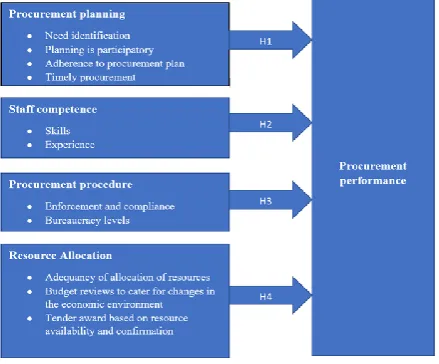
Based on the above literature review and by adopting from Triantafillou (2007), a research conceptual framework was designed
Independent variables Dependent variables
Figure 1: Conceptual framework
3.0 RESEARCH METHODOLOGY
(procurement planning, staff competency, procurement procedures and resource allocation) and the dependent variable (procurement performance).
3.1 Target population and Sampling technique
Top level managers, middle level managers and procurement staffs were relevant to the process, function and decision making of procurement function in Comet Properties Limited. These were the entire group and target group of the study. This group of interest consisted of 35 employees. Other employees were not related with procurement process at all, so they were irrelevant to the study. Accordingly, the sampling method was purposive on probability sampling technique.
3.2 Sources of Data and data collection tools
Primary data was collected using questionnaires targeting top level managers, middle level managers and low level managers as well as procurement staffs. A closed- ended questionnaire and Likert scale was used to measure the responses from the respondents. Secondary data included literature (journals, magazines, other past studies, books and other relevant documents) on major research about procurement performance in Africa and abroad.
3.3 Method of Data analysis and Presentation
4.0 RESULTS AND DISCUSSION
4.1 Reliability Analysis
The four (4) independent variables was tested for reliability. All the independent variable recorded a Cronbach‟s alpha statistics of more than 0.7, which means it reliable. The table below represents the reliability statistics for the independent variable tested.
Table 1: Reliability Test
Independent variables Cronbach's Alpha * Procurement planning 0.701
* Staff competence 0.810 * procurement procedure 0.710 * Resource allocation 0.877
4.2 Demographic information
4.2.1 Gender of the respondents
Regarding gender, 87.5% of the respondents were males while 12.5% of the respondents were females as shown in the table below. The procurement function is dominantly made by males‟ employees that constitute 87.5% of the staff whiles the female employees does only 12.5% of the procurement function.
Table 2: Gender of respondents
Gender Frequency Percentage Cumulative Percentage
Male 28 87.5 87.5
Female 4 12.5 100
Total 32 100
4.2.2 Academic qualification
Table 3: Education level of Respondents
Level of Education Frequency Percentage Cumulative Percentage
University 12 37.5 37.5
College 14 43.75 81.25
Secondary 6 18.75 100
Total 32 100
4.2.3 Job description of respondents
The study requested the respondent to indicate whether they are from management level or from procurement staff in the organization. From the study findings majority of the respondents 68.75% are middle level managers. Procurement staffs comprise 25% and top-level managers 6.25%. These findings depict that all the management levels and procurement staff in Comet properties limited were represented in this study as shown in the table below.
Table 4: Job description of respondent
Job Description Frequency Percentage Cumulative Percentage
Top level manager 2 6.25 6.25 Middle level manager 22 68.75 75.00 Procurement staff 8 25.00 100
Total 32 100
4.2.4 Work experience of respondents
Table 5: Work experience of respondents
Years of experience Frequency Percentage Cumulative Percentage
21 years and above 18 56.25 56.25
16 to 20 years 3 9.375 65.63
11 to 15 years 7 21.88 87.50
6 to 10 years 1 3.13 90.63
0 to 5 years 3 9.38 100.00
Total 32 100.00
4.3 Effect of procurement planning on procurement performance at Comet properties limited
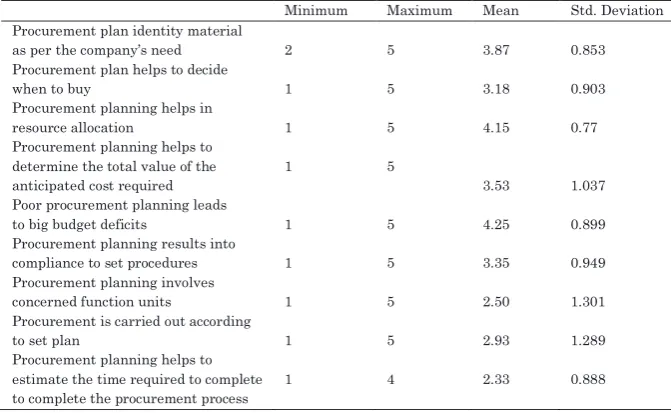
As observed from the table above, majority of the respondents agreed that procurement planning did not help to estimate the time required to complete the procurement process as shown by mean of 2.33. Respondents understood that procurement planning helps in resource allocation and also recognized that poor procurement planning leading to big budget deficits as shown by with mean of 4.15 and 4.25 respectively. Majority of the respondents further agreed that procurement was not carried out according proper procedure as shown by mean 2.93. Respondent also agreed that procurement planning did result into compliance to set procedures as shown by mean 3.35. Besides respondents answered that procurement plan did not involves concerned functional unit as shown by mean 2.5.
Table 6: Statement related to effect of procurement planning on procurement performance at Comet properties limited
Minimum Maximum Mean Std. Deviation
Procurement plan identity material
as per the company‟s need 2 5 3.87 0.853
Procurement plan helps to decide
when to buy 1 5 3.18 0.903
Procurement planning helps in
resource allocation 1 5 4.15 0.77
Procurement planning helps to
determine the total value of the 1 5
anticipated cost required 3.53 1.037
Poor procurement planning leads
to big budget deficits 1 5 4.25 0.899
Procurement planning results into
compliance to set procedures 1 5 3.35 0.949
Procurement planning involves
concerned function units 1 5 2.50 1.301
Procurement is carried out according
to set plan 1 5 2.93 1.289
Procurement planning helps to
estimate the time required to complete 1 4 2.33 0.888
4.3.1 Correlation Coefficient on the relationship between procurement planning and procurement performance:
The first research question sought to establish the effect of procurement planning on procurement performance in Comet properties limited. Pearson Correlation Coefficient was computed and tested. The study indicates there is a positive relationship between procurement planning and procurement performance (r = 0.138). The relationship was not however statistically significant.
Table 7: Relationship between procurement planning and procurement performance
Procurement Procurement
Performance Planning
Pearson correlation 1 0.138
Procurement performance sig. (2-tailed) 0.40
N 32
4.4 Effect of Staff competence on procurement performance at comet properties limited.
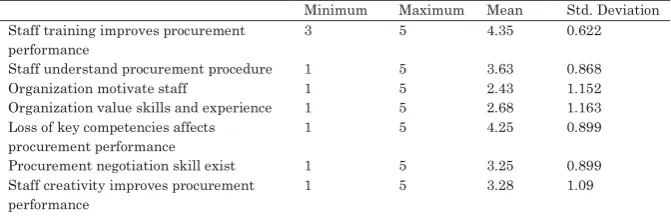
From the findings, majority of the respondents agreed that staff training improves procurement performance by a mean of 4.35. Respondents understood that loss of key competencies affects procurement performance by a mean of 4.25. Majority of the respondents further disagreed that the organization does motivate staff with a mean of 2.43 , organization does value skills and experience with a mean of 2.68, organization did deploy staff based on their skills with a mean of 2.95, as analytical skill exist with a mean of 2.85 and the ability to leverage interpersonal skills exist with a mean of 2.75.
Table 8: Statement related to effect of Staff competence on procurement performance at comet properties limited.
Minimum Maximum Mean Std. Deviation
Staff training improves procurement 3 5 4.35 0.622
performance
Staff understand procurement procedure 1 5 3.63 0.868
Organization motivate staff 1 5 2.43 1.152
Organization value skills and experience 1 5 2.68 1.163
Loss of key competencies affects 1 5 4.25 0.899
procurement performance
Procurement negotiation skill exist 1 5 3.25 0.899
Staff creativity improves procurement 1 5 3.28 1.09
Organization deploy staff based on their 1 5 2.95 1.30 skills
Analytical skill exists 1 5 2.85 0.975
The ability to leverage interpersonal skills 1 4 2.33 0.888
4.4.1 Correlation Coefficient on the relationship between staff competence and procurement performance:
The second research question sought to establish the role of staff competence in procurement performance in Comet properties limited. Pearson Correlation Coefficient computed and tested. The results indicate that there is a positive relationship between staff competence and procurement performance (r=0.415). It was found that the relationship is statistically significant at 1% level (p<0.008, <0.01).
Table 9: Correlation Coefficient on the relationship between staff competence and procurement performance
Procurement staff
Performance competence
Pearson correlation 1 0.415 Procurement performance sig. (2-tailed) 0.01
N 32
4.5 Effect of procurement procedures on procurement
performance at comet properties limited
Table 10: Statement related to effect of procurement procedures on procurement performance at comet properties limited
Minimum Maximum Mean Std. Deviation
Procurement procedure monitors 2 4 3.18 0.675
procurement process
Procurement procedure have caused 1 5 3.57 1.259
delay in decision making
Procurement procedure have caused 1 5 3.6 0.928
delays in service delivery
It is important that all are aware of 1 5 3.82 0.984
the set procurement procedure
Without procurement procedures it 2 5 4.10 0.87
would be difficult to come up with efficient procurement
Procurement procedure helps in 2 4 3.15 0.58
solving legal problems
Procurement performance is influences 1 3 2.45 0.639
by procurement procedure
Procurement procedure enhances 1 4 3.1 0.709
transparency
4.5.1 Correlation Coefficient on the relationship between procurement procedure and procurement performance:
The third research question sought to establish the effects of procurement procedures on procurement performance in comet properties limited. Pearson Correlation Coefficient computed and tested. The results as, shows that there is a positive relationship between procurement procedures and procurement performance (r=0 .093). However, the relationship was not statistically significant at 5% level (p=0.567, >0.01).
Table 10: Correlation Coefficient on the relationship between Procurement procedure and procurement performance
Procurement Procurement
Performance Procedure
Pearson correlation 1 0.093 Procurement performance sig. (2-tailed) 0.57
N 32
4.6 Effect of resource allocation on procurement performance at comet properties limited.
further disagreed that „Tender float based on resource availability and confirmation with a mean of 2.45‟, „tender award based on resource availability and confirmation with a mean of 2.85‟, and „competent staff is appointed with a mean of 2.33‟as shown in the table below.
Table 11: Statement related to effect of resource allocation on procurement performance at comet properties limited
Minimum Maximum Mean Std. Deviation Allocation of resource is 1 5 2.10 1.172 adequate
Budget reviews to cater for
change in the economic 1 5 2.10 1.033 environment
Tender float based on
resource availability and 1 4 2.45 0.986 confirmation
Tender award based on
resource availability and 1 5 2.85 1.001 confirmation
Competent staff is appointed 1 4 2.33 0.764
Valid
4.6.1 Correlation Coefficient on the relationship between resource allocation and procurement performance:
The fourth research question sought to establish how resource allocation influence procurement performance in comet properties limited. Pearson Correlation Coefficient computed and tested at 1% significant level. The results, indicates that there is a strong positive relationship between resource allocation and procurement performance (r=0.714). The researcher found the relationship to be statistically significant at 1% level (p=0.000, <0.01).
Table 12: Correlation Coefficient on the relationship between resource allocation and procurement performance
Procurement Resource
performance allocation
Pearson correlation 1 0.0714** Procurement performance Sig. (2-tailed) 0.000
4.7 Regression Analysis
The study conducted a multiple regression analysis to determine the relationship between independent variables and the dependent variable.
4.7.1 Coefficient of determination
The coefficient of determination clarifies the extent to which changes in the dependent variable can be explained by the change in the independent variables.
The four independent variables that were studied (procurement planning, staff competence, procurement procedure and resource allocation), explain 55.3% of the procurement performance as represented by the Adjusted R square. The R square was 0.599, and the adjusted R square was 0.553. Since the Adjusted R square was 0.553, there was evidence that the data used in analyzing the relationship between the independent variables and procurement performance was closely related.
Table: Model Summary, R square
Model R R Square Adjusted Std. Error of the
Square Estimate
1 0.774 0.599 0.553 0.522
4.7.2 ANOVA
Analysis of Variance (ANOVA) was used to establish whether there was difference between the independent variables and dependent variable (procurement performance). The significance value (p-value) 0.000 in the study is less than 0.05 thus the model is statistically significant in predicting how the independent variables influence the procurement performance in Comet properties. The F critical at 5% level of significance was 2.64. The F calculated from the ANOVA is 13.075, which is greater than the F critical (2.64). This shows that the overall model was significant.
Table 15: ANOVA
Model Sum of Squares df Mean Square F Sig Regression 14.243 4 3.561 13.075 0.000 1 Residual 9.532 35 0.272
The regression model was as follows:
Y= β0+ β1X1+β2X2+ β3X3+ β4X4+α Where:
Y is the dependent variable (Procurement performance), β0 is the regression coefficient/constant/Y-intercept, β1, β2, β3, β4 are the slopes of the regression equation, X1 is the Procurement planning
X2 is the Staff competence, X3 is the Procurement procedure X4 is the Resource allocation while
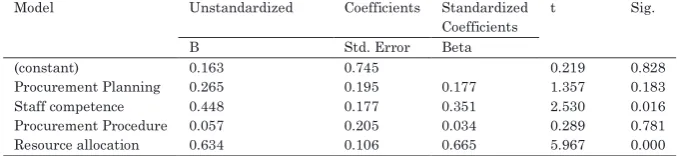
αis an error term at 95% confidence level. The regression was Y = 0.163 + 0.265X1 + 0.448X2 + 0.057X3 + 0.634X4
The above equation established that taking all factors into account (procurement planning, staff competency procurement procedures and resource allocation) constant at zero, procurement performance would be 0.163. The findings further indicate that taking all other independent variables constant, a unit increase in staff competence will lead to a 0.448 increase in procurement performance. The p–value was 0.016 which is less than 0.05 and thus the relationship was significant. It was also indicated in the study that a unit increase in resource allocation leads to a 0.634 increase in procurement performance. The p-value was 0.000 and thus the relationship was significant. The result from the study indicates that resource allocation contributed most to the procurement performance.
Table 16: Regression Analysis of Factors of procurement and procurement performance: Coefficienta
Model Unstandardized Coefficients Standardized t Sig.
Coefficients
B Std. Error Beta
(constant) 0.163 0.745 0.219 0.828
Procurement Planning 0.265 0.195 0.177 1.357 0.183
Staff competence 0.448 0.177 0.351 2.530 0.016
Procurement Procedure 0.057 0.205 0.034 0.289 0.781
5.0 CONCLUSION AND RECOMMENDATIONS
5.1 Conclusion
The study revealed that staff competence and resource allocation were the most related factors affecting procurement performance. Staff competence factor was measured in terms of training, motivation, procurement negotiation skills, creativity, interpersonal and analytical skills and deployment of staff based on their skills. Resource allocation factor was measured in terms of adequateness of resources, flexibility of budget allocation to fit changes in the economic environment, tender award and tender float based on resource availability and confirmation. The study indicated that a unit increase in the resource allocation would lead to a 0.634 increase in the scores of procurement performance. The study also found that a unit increase in the staff competence would lead to 0.448 increases in the scores of procurement performance. Pearson Correlation Coefficient computed and tested. A positive relationship was observed between procurement planning and procurement performance (r = 0.138). The relationship was not however statistically significant at 5% level (p > 0.05). Regarding the effect of staff competence on procurement performance, there is a positive relationship between staff competence and procurement performance (r=0.415). The relationship was statistically significant at 1% level (p=0.008, <0.01). Pearson Correlation Coefficient analysis on the effects of procurement procedures on procurement performance computed and tested there is a positive relationship (r=0.093). However, the relationship was not statistically significant at 5% level (p=0.567, > 0.05). The influence of resource allocation on procurement performance in comet was also observed. Pearson Correlation Coefficient computed and tested at 1% significance level indicated that there is a strong positive relationship (r=0.714) between resource allocation and procurement performance. The relationship was statistically significant at 1% level (p=0.000, <0.01).
used in analyzing the relationship between the independent factors and procurement performance was closely related.
The study conducted a multiple regression analysis so as to determine the influence of the independent variables on procurement performance. The significance level of staff competence and resource allocation were 0.016 and 0.00 respectively (p < 0.05). The two factors were the most related factors affecting procurement performance. Procurement planning with p = 0.183 and procurement procedure with p = 0.781 were the least related factors affecting procurement performance.
Analysis of Variance (ANOVA) was used to establish whether there was difference between the independent factors and procurement performance. The significance value 0.000 is less than 0.05 thus the model is statistically significant in predicting how the independent variables influence the procurement performance. The F critical at 5% level of significance was 2.64. The F calculated from the ANOVA table is 13.075, which is greater than the F critical (2.64). This shows that the overall model was significant. Moreover, the p-value in the study was 0.000 which was less than 0.05 thus the model was statistically significant in predicting how the independent variables influence procurement performance in Comet properties limited.
5.2 Recommendation
The recommendations made on the basis the findings:
1. Staff awareness through training should be carried out to achieve superior knowledge in entire procurement process in Comet properties limited.
2. The procurement department is advised to carry out periodic market surveys so that the information can be shared with pertinent departments in order to help them prepare procurement plan based on the existing market conditions.
3. It is recommended that adequate resource be allocated and the resource frequently reviewed to fit with the changing environment in order to make the procurement performance more effective and efficient
preparation of annual procurement plans be participatory, frequently reviewed so as to improve on the company‟s performance.
5. It is advisable that the company has to put in place to practice the procurement procedures in order to monitor the procurement process and improve procurement performance.
6. It is worthwhile that staffs be adequately trained and sensitized in order to boost the skills and competency levels required by staffs involved in the procurement process. The company would benefit if the management (at the top and middle level), support the procurement department by allocating more resources and encourage trainings to improve the skills and knowledge of the procurement staff.
5.3 Future Research Direction
The research observed four independent variables (planning, resource allocation, staff competency and procurement procedures) which according to the study contribute to 60 % of the variations in procurement performance at Comet properties limited. Further research is recommended to investigate the other factors that affect procurement performance. The study pursued the effects of four independent variables on procurement performance in Comet properties limited. Further research is recommended to ascertain whether these findings would be the same or different in other Real estate‟s companies in Ghana.
REFERENCES
1.Aketch, J., & Karanja, P. (2013), Factors Influencing Procurement Performance in Constituency Development Fund (CDF): Case of CDF Use in Makadara Constituency. International Journal of Social Science & Entrepreneurship, 1(2), 41-55.
4.Baily, P., Farmer, D., Jessop, D. & Jones, D. (2005), Purchasing Principles and Management, (9th Ed.). London: Prentice Hall.
5.Banda, E. (2009), Politics and Economic Consequences. (1st Ed). Washington D.C.: Center for Study of Responsive Law.
6.Basheka, B. C., & Mugabira, M. I. (2008), Measuring Professionalism Variables and their Implication to Procurement Outcomes in Uganda. The 3rd International Public Procurement Conference Proceedings.
7.Batenburg, R., & Versendaal, J. (2006), Alignment Matters-Improving business functions using the procurement alignment framework, Utrecht.
8.Berger, E. & Humphrey, N. (2007), Simple Buying Methods. (1st. Ed.), Nairobi: East Africa Education Publishers.
9.Burt, N. D., Dobler, D. W., & Starling, S. L. (2004). World Class Supply Management: The Key to Supply Chain Management (7th ed.). New York: McGraw Hill.
10.Choy KL, Lee WB. (2002), on the development of a case-based supplier management tool for multinational manufacturers. Measuring Business Excellence 2002; 6(1): pp.15–22, 2002
11.Dale, K. (2010), Measuring Service Quality. (1st Ed.) London: Pitman Publication. Information Research 7(1) 234-245.
12.Eriksson, P. E. Westerberg, M. (2011), Effects of cooperative procurement procedures on construction, project performance: A conceptual framework, International Journal of project Management, 29 (2011) 197–208.
13.Giunipero, L., Handfield, R.B. and Eltantawy, R. (2006), Supply Managements Evolution: key skill sets for the supply manager of the future”, International Journal of Operations and Production Management, Vol.26, No.7
14.Hines, T. (2006), Supply Chain Strategies: customer-driven and customer focused”, Butterworth-Heinemann
15.James, U. V. (2004), Public Policy and the African Environment: An Examination of the Theory and Practice of the Planning Process of the Continent (A.K. ed). Ashagte, England.
17.Juma, M. J. (2010), Lead from where you are: Quarterly PPO Bulletin (4)1. Nairobi: A publication of Non- Governmental Organizations Procurement Oversight Authority.
18.Kabaj, O. (2003). The Challenge of African Development. Oxford, UK: Oxford University Press.
19.Kim, M.K, K. K., Lopetcharat, K.K & M. A. Drake, (2013), Influence of packaging information on consumer liking of chocolate milk. Journal of Dairy Science, 96(8), 4843-4856,
20.Leenders, R. M., & Fearon, E. H. (2002). Purchasing and Supply Management, (12th Ed.). Chicago: McGraw-Hill Companies.
21.Mangan, Lawani, and Butcher, (2008), Global Logistics and Supply Chain Management, John Wiley and Sons, New Jersey
22.Martin C. Smith (2004), Modern Approach to Procurement Management, Pearson Education Ltd, Harlow Essex
23.Michael A. Hitt, R. Duane Ireland and Robert E. Hoskisson, (2007), strategy management, 7th Edition, Thompsom South Western.
24.Migai, J. (2010), Development Partners and Governing Non- Governmental Organizations Procurement in Kenya. (1st Ed.), Kenya: Macmillan Publishers.
25.Moncska, R. M., Handfield, R. B., Guinipero, L. C., & J. L. Patterson, (2010), 4th Ed. Purchasing and Supply Chain management.
26.Ombaka E. (2009), Management of medicines procurement in Developing countries. Accessed online at <http//health-care-procurement.com/ content/pdf/1689-2231-6- 8.pdf
27.Ouma Danis and Jennifer M. Kilonzo (2014), Resource allocation planning: Impact on public Sector Procurement Performance in Kenya; International Journal of Business and Social Science 5, 7(1). Physical testing of Textile, by B P Saville, 2000 Corporate Blvd, NW 28.Peter, H. A (2012), The Dynamics of Procurement Management, A Complexity Approach. 1st Edition.
29.Porter, M.E. (1998), Competitive advantage: Creating and sustaining superior performance. New York: Free Press.
30.Quentin W. Fleming (2003), project procurement management. Quality Books, Inc. First Edition, FMC Press, USA.
32.Saunders, M. (1997), Strategic Purchasing & Supply Chain Management, (7th Ed.). Harlow Essex: Pearson Education Ltd.
33.Shantanu et al, (2012), Designing Efficient Resource Procurement and allocation mechanisms; Faculty and Research Working Paper, INSEAD, the business school for the world.
34.Smith, R. & Conway, G. (1993). Organization of Procurement in Government Departments and their Agencies. London: HM Treasury Consultancy and Inspection Services Division.
35.Sollish, F., & Semanik, J. (2012), The procurement and supply mangers‟ desk reference (2nd Ed.). USA, New Jersey: Wiley & Sons. 36.Sultana, A. I. (2012), Impact of Training and Employee Performance. Inter-disciplinary Journal of Contemporary Research in Business, 4 (6) 646-696.
37.Triantafillou, P. (2007), Benchmarking in the Public Sector: A Critical Conceptual Framework. Public Administration Journal, 8(4), 17-32.
38.Van Weele, A. J. (2006), Purchasing & Supply Chain Management: Analysis, Strategy, Planning and Practice, (4th Ed.). Australia.