Western University Western University
Scholarship@Western
Scholarship@Western
Electronic Thesis and Dissertation Repository
3-13-2014 12:00 AM
High Multiplicity Strip Packing
High Multiplicity Strip Packing
Devin Price
The University of Western Ontario
Supervisor
Dr. Roberto Solis-Oba
The University of Western Ontario
Graduate Program in Computer Science
A thesis submitted in partial fulfillment of the requirements for the degree in Master of Science © Devin Price 2014
Follow this and additional works at: https://ir.lib.uwo.ca/etd
Part of the Theory and Algorithms Commons
Recommended Citation Recommended Citation
Price, Devin, "High Multiplicity Strip Packing" (2014). Electronic Thesis and Dissertation Repository. 1915.
https://ir.lib.uwo.ca/etd/1915
This Dissertation/Thesis is brought to you for free and open access by Scholarship@Western. It has been accepted for inclusion in Electronic Thesis and Dissertation Repository by an authorized administrator of
HIGH MULTIPLICITY STRIP PACKING
(Thesis format: Monograph)
by
Devin Price
Graduate Program in Computer Science
A thesis submitted in partial fulfillment
of the requirements for the degree of
Master of Science
The School of Graduate and Postdoctoral Studies
The University of Western Ontario
London, Ontario, Canada
c
Abstract
An instance of the two-dimensional strip packing problem is specified bynrectangular items, each having a width, 0 < wn ≤ 1, and height, 0 < hn ≤ 1. The objective is to place these
items into a strip of width 1, without rotations, such that they are nonoverlapping and the total height of the resulting packing is minimized. In this thesis, we consider the version of the two-dimensional strip packing problem where there is a constant number K of distinct rectangle sizes and present anOPT+K−1 polynomial-time approximation algorithm for it. This beats a previous algorithm with a worst case bound ofOPT+K; the time complexity of that algorithm was not known and here we show that it runs in polynomial time.
Keywords: strip packing, approximation algorithm, optimization
Contents
Certificate of Examination ii
Abstract iii
List of Figures v
1 Introduction 1
1.1 Applications and Related Problems . . . 2
1.2 Related Work . . . 6
1.3 High-Multiplicity Packing Problems . . . 7
1.4 Our Contributions . . . 8
2 Algorithms 10 2.1 Algorithm Overview . . . 10
2.2 Fractional Strip Packing . . . 13
2.3 The GLS Algorithm . . . 15
2.3.1 The Separation Oracle . . . 17
2.3.2 Solving the Dual Linear Program . . . 18
2.4 The Two-Type Strip Packing Problem . . . 19
2.5 TheK-Type Strip Packing Problem . . . 22
3 Conclusion 31 3.1 Open Questions and Future Work . . . 31
Bibliography 33
List of Figures
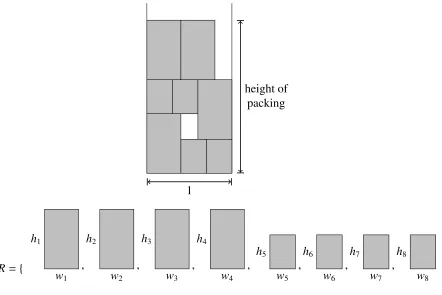
1.1 An instance of the two-dimensional strip packing problem with 8 rectangles. . . 5
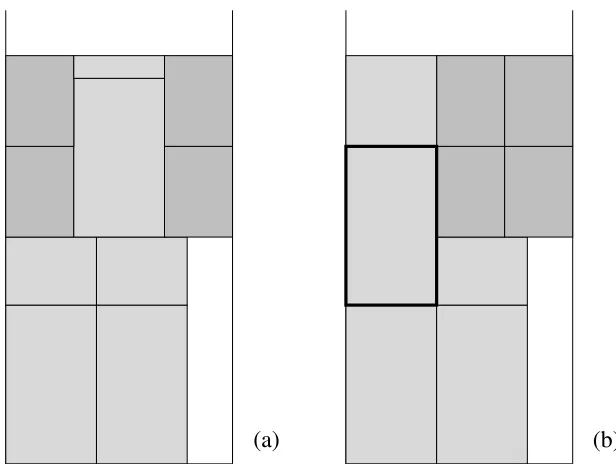
2.1 Two fractional solutions to the same problem. The horizontal ordering of the rectangles does not matter, both solutions have the same height. In Figure (b) the rectangle in bold does not need to be cut between packed configurations. . . 12 2.2 Before rounding, the area covered by rectangles intersecting the cutting line
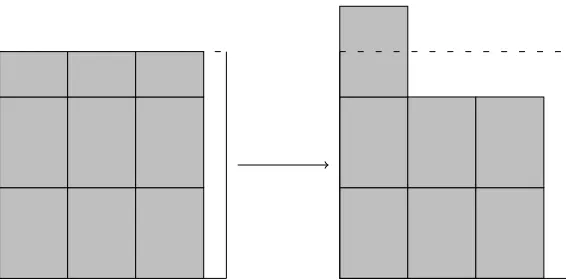
is equal to the area of 1.5 rectangles. If we round down this number, only one rectangle is packed. After rounding down, the total width of all rectangles intersecting the cutting line must decrease. . . 13 2.3 The fractional relaxation of the problem in Figure 1.1. Packed configurationC1
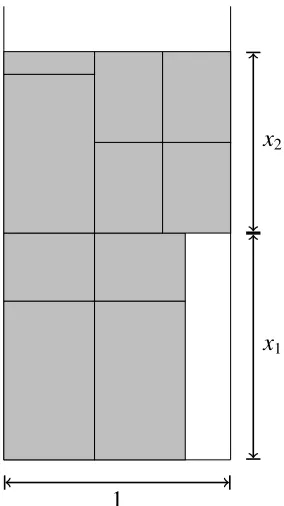
consists of two rectangles of typeT1 and zero rectangles of typeT2 and packed configurationC2consists of one rectangle of typeT1and two rectangles of type T2. . . 14 2.4 A packing of rectangles of 2 types. Note that there are three distinct sections
horizontally: outer sections which each consist exclusively of rectangles of one type, and a middle section where the lower packed configuration has rectangles of a different type than the upper packed configuration. . . 20 2.5 An example of an arrangement of three rectangle types in two packed
configu-rations. Rectangles that appear in both are placed to the left in sectionS1. In the remaining section,S2, no type appears in both packed configurations. . . 24 2.6 An example of sectionS2of a packed configurationCqafter “rounding down”.
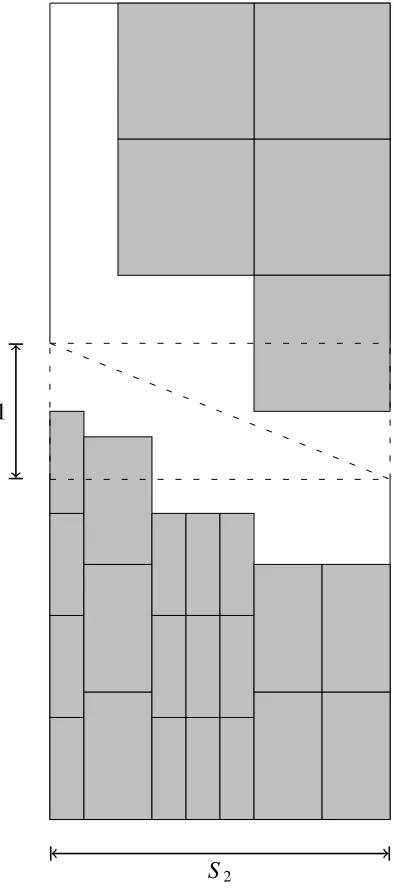
Because f1,q ≤ f2,q, type T1 is packed first. The dotted line represents the original fractional height of the packed configuration. Portions that do not increase in height are packed in the far right of the section so that portions of the packed configuration that increase in height are directly adjacent to one another. . . 26 2.7 All rectangles will fit in the depicted region after rounding. . . 27 2.8 After rounding, sectionS2 of packed configurationC2 is turned upside down
and placed above sectionS2 of packed configurationC1. Since the triangular regions fit together nicely, the total increase in height is at most 1 unit. . . 30
Chapter 1
Introduction
An instance of the two-dimensional strip packing problem (2DSPP) is specified by a set R
of n rectangles, each rectangle ri having width, 0 < wi ≤ 1, and height, 0 < hi ≤ 1. The
objective is to place these rectangles in a strip of width 1 such that they are nonoverlapping
and the total height of the resulting packing is minimized. We assume that rectangles have a
fixed orientation so their sides are parallel to the sides of the strip and they cannot be rotated.
Figure 1.1 shows an instance of the 2DSPP.
The 2DSPP is an optimization problem known to be NP-hard, which means that it is at
least as difficult to solve as any problem in the classNP. NPis the computational complexity
class consisting of problems for which feasibility of their solutions can be verified in
polyno-mial time. Currently, there is no known algorithm for anyNP-hard problem that runs in time
polynomial in the size of the input, and it is widely believed that no polynomial time algorithms
exist for these problems. Seminal work of Cook [5] proved that a polynomial time algorithm
for any NP-hard problem can be transformed into a polynomial time algorithm for any other
problem in the class NP-complete, so all these problems are equally “hard” from the point of
view of the existence of polynomial time algorithms for them. The class ofNP-hard problems
is larger than the class NP-complete, as everyNP-complete problem isNP-hard and belongs
to the classNP. The class Pincludes those problems which can be solved in polynomial time
2 Chapter1. Introduction
using deterministic algorithms. One of the most important questions in computer science is
whether or notP= NP. Assuming that the classesPandNPare not equal,NP-hard problems
cannot be solved in polynomial time by deterministic algorithms. Therefore, approximation
algorithms are widely used to deal with this class of problems as they can find near-optimal
solutions for NP-hard problems in polynomial time. This is not the same as heuristic-based
approaches; approximation algorithms are expected to have provable worst-case runtimes and
solution qualities, while for heuristics there is no guarantee on the quality of the solutions that
they produce and/or on their running times.
Approximation algorithms often approximate solutions within a constant factor of the
op-timum. Problems for which such algorithms exists belong to the complexity class APX. For
some APX problems, their solutions can be approximated within any constant factor greater
than 1 in polynomial time; such algorithms are referred to aspolynomial-time approximation
schemes(PTAS). Additionally, there exist problems inAPXfor which there is no PTAS; that is,
problems that can be approximated within some constant factor, but not every constant factor
larger than 1.
For decades geometric packing problems have been a widely studied field of research.
Many types of packing problems exist, including bin packing, rectangle packing, and strip
packing, among many others. In each of these problems, items with specified sizes and/or
weights need to be placed inside of one or more containers to optimize some objective function.
In this thesis we are interested in a version of the strip packing problem known as the
high-multiplicity strip packing problem, where the number of distinct rectangle sizes, or “types” of
rectangles, is fixed.
1.1
Applications and Related Problems
Packing problems have many real-world and theoretical applications. In this section we
1.1. Applications andRelatedProblems 3
problem. In the bin packing problem, we are given n items where the ith item has weight
wi ≤ 1. The objective is to place these items inside bins of unit capacity in such a way that as
few bins are used as possible. Bin packing has numerous applications, aside from the obvious
relation to packing actual boxes into containers.
Imagine a tour bus company was servicing many groups of tourists. Group members do
not want to be separated, but the bus company does not want to use more buses than necessary,
to maximize profit. Each bus can be considered a bin of capacity equal to its number of seats
and each group an item of weight equal to the number of tourists in the group. Solving the
corresponding bin packing problem will result in a solution that minimizes the number of buses
used while keeping groups unseparated on buses. Bin packing also has important implications
to 2DSPP. In fact, bin packing is equivalent to 2DSPP if all rectangles have equal height;
therefore, many techniques used in bin packing approximation naturally lend themselves to
strip packing as well.
Multiprocessor scheduling is closely related to packing problems. In the multiprocessor
scheduling problem, an input consists of a set of jobs each with a length or required
process-ing time. The task is to schedule these jobs on a number of machines such that all jobs are
completed in the minimum time. This problem is effectively a bin packing problem where
the number of bins is equal to the number of machines and the objective is to pack all items
into bins of minimum capacity. In 1978, Coffman et al. [3] presented an algorithm based on
bin-packing techniques for the multiprocessor scheduling problem with an approximation ratio
of 1.22. This algorithm improved on the previous best bound of 43. Hochbaum and Shmoys
presented a PTAS for this problem in 1988 [14].
Another famous geometric problem is the rectangle packing problem. In this problem there
is a single rectangular bin into which rectangles are to be placed. The goal is to pack rectangles
in the bin so that some objective function is optimized such as the number of rectangles packed
or their total area. The rectangle packing problem has applications, for example, in the effi
4 Chapter1. Introduction
problem, a PTAS was presented by Fishkin et al. [9] in 2005. This PTAS is based on “dual
ap-proximation” techniques, where “better” infeasible solutions are considered and converted to
suboptimal feasible solutions. In [9], the problem of solving the machine scheduling problem
is reduced to finding a dual approximation algorithm for the bin packing problem.
The strip packing problem is different from the rectangle packing problem in that the height
of the strip is not fixed, but minimized while ensuring that all rectangles are packed. One
ap-plication of the strip packing problem is static scheduling of parallel tasks. Consider a scenario
where there are parallel tasks that must be scheduled, each requiring a number of adjacent
processors and processor time. Each task in this problem corresponds to a rectangle in a strip
packing problem. The width of a rectangle is equal to the number of processors required by the
corresponding task and the height is equal to its required processor time. The width of the strip
is the number of processors available in the system. An optimal solution to this strip packing
problem will give an optimal solution to the original scheduling problem where the height of
the final packing corresponds to the total execution time for the tasks.
The knapsack problem is another class of packing problem. In the knapsack problem,
there is a single “bin” of given capacity, known as the knapsack, and items have weights and
values. The objective is to place items into the knapsack such that their total weight does not
exceed the knapsack’s capacity and the total value of the items in the knapsack is maximized.
Consider the situation where there is a set of tasks that must be completed before a deadline,
each having a time requirement and an expected profit if completed by the deadline. This is a
knapsack problem where a task corresponds to an item with weight and value equal to the time
required and expected profit for the task, respectively. The capacity of the knapsack represents
the deadline by which tasks must be completed. Solving this problem optimally would result
in the set of tasks that maximizes profit and can be completed before the deadline.
In practice the number of distinct rectangle sizes, or types, involved in a packing problem
is often small. When the number of types is constant, the corresponding problem becomes
1.1. Applications andRelatedProblems 5
1
height of packing
R={
w1 h1 , w2 h2 , w3 h3 , w4 h4 , w5 h5 , w6 h6 , w7 h7 , w8 h8 }
Figure 1.1: An instance of the two-dimensional strip packing problem with 8 rectangles.
calledhigh multiplicity packing problems. In such problems, it is not necessary to specify each
rectangle individually in the input. Rather, for each distinct type of rectangle the input includes
the dimensions of the type, as well as the number of rectangles of that type that must be packed.
At first sight it might seem that these problem may have simpler solutions than instances with
many rectangle types, however the input of such problems is very small and, therefore, it is
more difficult to compute a solution in time bounded by a small function of the size of the
input length.
All of the above packing problems can be generalized to higher dimensions. Rectangles,
bins, and strips may have depths in addition to widths and heights, drastically increasing the
6 Chapter1. Introduction
1.2
Related Work
The bin packing and two-dimensional strip packing problems have been extensively researched.
Since bin packing is equivalent to a strip packing problem where all items have equal height
and bin packing is NP-hard [6], then strip packing is alsoNP-hard. For this reason, research
on those problems has focused on approximation algorithms.
Let A(I) be the value of the solution produced by an approximation algorithm A and let
OPT(I) be the value of an optimal solution for an instanceI of some optimization problem.
The approximation ratio ofAis defined as the ratio OPTA(I()I) if I is a maximization problem and
A(I)
OPT(I) ifI is a minimization problem. For some problems there are approximation algorithms that produce solutions of valueA(I) satisfyingA(I) ≤C×OPT(I)+o(OPT(I)) for some value
C, where the o(OPT(I)) term grows at a much slower rate than OPT(I) as a function of the
length of the input I. The value of C is known as the asymptotic approximation ratio of A.
WhenC =1 the approximation algorithm is known as asymptotically exact.
A simple algorithm for two-dimensional strip packing is the first-fit decreasing height
(FFDH) algorithm. In this algorithm, rectangles are first sorted into order of non-increasing
height; the first rectangles packed are the tallest and the last are the shortest. The first rectangle
is placed at the bottom of the strip. This is the first “level” of the packing. Rectangles are
packed on this level until the next rectangle does not fit. At this point, a new level is created on
top of the tallest rectangle in the first level. Rectangles continue to be packed on the first level
where they fit, creating new levels as necessary, until all rectangles are packed. First-fit is one
of several algorithms in the class of “level-oriented” algorithms, which also includes next-fit
(where previous levels are not revisited) and best-fit (where rectangles are packed on the level
where they leave the least amount of empty space). FFDH was shown to have a solution quality
at worst 17
10OPT(I)+1 by Coffman et al. [4] Over time, this bound has improved to 5
3OPT +ǫ in Harren et al. [13], 43OPT +7181 in Golan [11], and 54OPT + 53
8 in Baker et al. [1]
Given an instance I of 2DSPP and a positive numberǫ, Kenyon and R´emila designed an
1.3. High-MultiplicityPackingProblems 7
time complexity of this algorithm is polynomial in both the number of rectangles and 1ǫ. The
algorithm is based on a linear programming relaxation of the problem that defines a fractional
version of 2DSPP, where rectangles can be split into pieces with horizontal cuts. In Kenyon and
R´emila’s algorithm, rectangles are classified by width as being either “thin” or “wide” based
on the value of ǫ. Wide rectangles are partitioned into groups and their widths are rounded
to define a simpler fractional problem which can be solved efficiently. Once this fractional
solution is obtained, any rectangles that are cut in the packing are simply “rounded up” such
that they recover their original size. Thin rectangles are added back into the packing afterwards,
utilizing the empty spaces left by the wide rectangles. Since 2DSPP isNP-hard, an asymptotic
PTAS is the best one can do in polynomial-time assumingP, NP.
1.3
High-Multiplicity Packing Problems
In the high-multiplicity version of the strip packing problem (HMSPP), or K-type problem,
there is a constant number K of rectangle types. Rectangles of the same type have the same
width and height. Note that the input for a high multiplicity packing problem can be represented
in a very compact manner. The input contains, for 1 ≤ i ≤ K: wi, the width of type i;hi, the
height of type i; andni, the number of items of type i. Hence, the input is specified by 3K
numbers, regardless of how many rectangles need to be packed.
The high-multiplicity bin packing problem has been studied by Filippi and Agnetis [8]
and they presented a polynomial-time, asymptotically exact algorithm. Given an inputI, their
algorithm produces outputs requiring at mostOPT(I)+K−2 bins. For the case whereK = 2,
an exact solution is obtained in time complexityO(logD) where D is the bin capacity. This
problem is also known as the cutting stock problem, and has been researched extensively. A
PTAS is known for this problem [19]. The best known approximation for the cutting stock
problem for a constant number of object lengths is anOPT +1 algorithm presented by Jansen
8 Chapter1. Introduction
Clifford and Posner in [2] investigated high-multiplicity parallel machine scheduling. In
that paper, several polynomial time algorithms are presented for such machine scheduling
prob-lems. In addition, they show thatNP-complete problems do not change complexity class when
switching from a general encoding to a high-multiplicity encoding.
In Hoque [15], the rectangle packing problem is studied for the case where only two types
of rectangles are packed. Hoque presents a PTAS for this problem and further claims the results
can be generalized to any constant number of rectangle types.
To the best of our knowledge, there is no previously published work on the high-multiplicity
strip packing problem (HMSPP).
1.4
Our Contributions
The 2DSPP is known to beNP-hard for an arbitrary number of distinct rectangle types.
How-ever, in practice there is often only a limited number of rectangle types. In this thesis we
examine a version of the two-dimensional strip packing problem where the number of distinct
rectangle types is constant.
The complexity of the high-multiplicity strip packing problem is unknown even for the case
when the number of rectangle types is 2. We do not even know if HMSPP belongs to the class
NP. Our main contribution is anOPT(I)+ K −1 polynomial-time approximation algorithm
for the high-multiplicity strip packing problem. This improves on a simple algorithm for the
problem which produces packings of height at mostOPT(I)+K in the worst case, but which
was not known to run in polynomial time. We show here that such an algorithm does run in
polynomial time. Although this may appear to be a small improvement, it is strong for small
values of K; for example when K = 2 a solution of height at most OPT(I)+ 1 is produced.
As we show, moving from a solution of valueOPT(I)+K to one of valueOPT(I)+K −1 is
not a trivial one, and it requires a significant amount of work. Furthermore, our bound almost
1.4. OurContributions 9
strip packing when all rectangles have equal height),OPT +K−2. IfOPT(I)≫ K, then the
difference in height between the approximation and the optimum is negligible, so our algorithm
is asymptotically exact.
The reduction of 2DSPP to HMSPP does not make the problem easier to approximate in
polynomial time. Because the problem can be represented using fewer bits, some techniques
that are polynomial-time for 2DSPP are not polynomial-time for HMSPP; for example, we
cannot make an individual decision for each rectangle.
Finally, although not all ideas in this thesis generalize to higher dimensions, several do.
These may be a first step towards better approximations for the high-multiplicity strip packing
problem of dimensiond≥ 3.
In Chapter 2, we discuss our algorithm for HMSPP. This section includes a basic, high-level
overview of the algorithm as well as an explanation of the fractional strip packing problem,
linear programming, and a polynomial time algorithm for solving the fractional strip
pack-ing problem where the number of rectangle types is constant uspack-ing a modified version of the
Gr¨otschel-Lov´asz-Schrijver algorithm. We also give a detailed description of our algorithm for
two rectangles types and for any constant number of rectangles types. Chapter 3 consists of
Chapter 2
Algorithms
The most obvious way to solve HMSPP is, perhaps, to consider all possible packings for the
rectangles and choose the best one. However, if there are many rectangles then the number
of possible packings is very large and thus solving the problem using this method is slow
and impractical. We wish to solve this problem with an algorithm with running time that is
polynomial in the length of the input; i.e. an algorithm that is guaranteed to reach a solution
and terminate in a number of steps that is a polynomial function of the length in bits of its
input. As mentioned above, it is not known if HMSPP is in the complexity classP, or even in
the classNP.
In this chapter we present a polynomial-time approximation algorithm for HMSPP that
produces a solution of height at most OPT(I) + K − 1, where OPT(I) is the height of an
optimal solution andK is the number of rectangle types.
2.1
Algorithm Overview
Solving the fractional relaxation of HMSPP, where rectangles may be cut into pieces using
horizontal cuts, is essential to our algorithm. This is typically solved using linear
program-ming. Since as early as 1961 in Gilmore and Gomory [10], this has been a common strategy.
The solution to the fractional problem is then converted into a solution to HMSPP. A solution
2.1. AlgorithmOverview 11
to the fractional problem consists of “configurations” and corresponding heights of each
con-figuration to be packed. A concon-figuration is a set of rectangles that fit together side-by-side in
the strip. In a fractional solution, rectangles conforming to some configurations are packed
upwards (as determined by solving a linear program) to certain heights where these rectangles
are then cut, so that the next configuration used will begin packing at exactly that height; see
Figure 2.1, where two configurations are packed.
In this thesis we use the word “configuration” to denote a set of rectangles of total width
at most 1 and “packed configuration” to denote a section of the strip where rectangles are
packed so that any horizontal line drawn across the section intersects the same multiset of
rectangle types (i.e., a section of the packing where rectangles are packed according to some
configuration).
There are several key ideas on which the main algorithm is built. First, rectangles can
be rearranged horizontally within the same packed configuration (see Figure 2.1); this is a
very useful property. When the number of distinct rectangle types is small relative to the total
number of rectangles, the rectangles will often not need to be cut when switching between
packed configurations in the fractional solution. If any two adjacent packed configurations
contain rectangles of the same type, some of the rectangles in the upper packed configuration
may be placed directly above rectangles of the same type in the lower packed configuration and
this avoids the need to cut them when switching packed configurations. Instead of cutting these
rectangles between the packed configurations, they can simply continue to be packed on top of
one another until reaching a point where the type of rectangle must change (see Figure 2.1 (b)).
As mentioned before, in the fractional relaxation we are allowed to split rectangles into
pieces using horizontal cuts. A simple way to convert a fractional solution of the strip packing
problem into an integral one is to round up every cut rectangle to its original height. This will
always result in trying to pack more rectangles than necessary. Therefore, in some parts of
the fractional packing it is always possible to “round down” the cut rectangles and discard the
12 Chapter2. Algorithms
(a) (b)
Figure 2.1: Two fractional solutions to the same problem. The horizontal ordering of the rectangles does not matter, both solutions have the same height. In Figure (b) the rectangle in bold does not need to be cut between packed configurations.
in detail in Sections 2.4 and 2.5.
Lastly, the change in height and width of the packing when rounding rectangles are
in-versely related. In fact, when combined with the previous assertion than we can “round down”
the heights of rectangles in some circumstances, this allows us to bound the width of rounded
rectangles as a function of the increase in height. Since the total area of the rectangles within
the packing cannot change when converting fractional rectangles to whole rectangles, regions
that contain rectangles that increase in height after becoming whole must become thinner (see
Figure 2.2).
We use these ideas to show that any two packed configurations can be arranged such that,
post-rounding, rectangles do not overlap and the height of the packing increases by at most one
unit. To show how this is done we first consider the case when there are only two rectangle
2.2. FractionalStripPacking 13
Figure 2.2: Before rounding, the area covered by rectangles intersecting the cutting line is equal to the area of 1.5 rectangles. If we round down this number, only one rectangle is packed. After rounding down, the total width of all rectangles intersecting the cutting line must decrease.
2.2
Fractional Strip Packing
Imagine that the requirements of HMSPP are relaxed so that rectangles may be sliced into
mul-tiple pieces with horizontal cuts. A solution to this “fractional” version of the two-dimensional
strip packing problem can be expressed using a vectorxof length equal to the total number of
configurations. As indicated above, a configuration is a multiset of rectangles whose widths
sum at most 1 and so they fit together side-by-side in the strip. Each element xj of the
vec-tor is a rational number representing the height of the corresponding configuration within the
solution; that is, each configurationCjis packed to a height ofxj (see Figure 2.3).
Recall thatni is the total number of rectangles of typeTi andhi is the height of rectangles
of typeTi. Letαi,jbe the number of rectangles of typeTi in configurationCj, and letxjdenote
the height to which configurationCj should be packed. The fractional strip packing problem
can be expressed as the following linear program:
Minimize: X
j
xj
Subject to: X
j
xjαi,j ≥ nihi, for each rectangle typeTi
xj ≥0
14 Chapter2. Algorithms
1
x1 x2
Figure 2.3: The fractional relaxation of the problem in Figure 1.1. Packed configuration C1 consists of two rectangles of typeT1 and zero rectangles of typeT2 and packed configuration C2consists of one rectangle of typeT1and two rectangles of typeT2.
In this section we present the first contribution of this paper, namely, a polynomial time
algorithm for the fraction strip packing problem when the number of rectangle types is constant.
The set of feasible solutions, i.e. solutions that satisfy the constraints 2.1, can be thought of
as a convex polytope of dimension equal to the number of variables in the linear program. A
polytope is a geometric object with flat sides (e.g., a polygon is a two-dimensional polytope).
This polytope is known as the feasible region. Each face of the polytope corresponds to a
constraint. The problem of solving a linear program is equivalent to finding a point within
the feasible region that optimizes the objective function. The vertices of the polytope are
known as basic feasible solutions. If a linear program has an optimal solution, then it has at
least one basic feasible solution that optimizes the objective function. It is known that in any
basic feasible solution, the number of nonzero variables is at most the lesser of the number
of constraints (excluding nonnegativity constraints) and the number of variables [17]. Thus,
2.3. TheGLS Algorithm 15
number of constraints. Therefore, the number of configurations used in a basic feasible solution
for (2.1) is at most the number of rectangle types,K.
Recall thatOPT(I) is the height of an optimal packing for instanceIof HMSPP. LetLIN(I)
denote an optimal solution to the fractional strip packing associated with I and AREA(I) =
P
rwrhrnr be the total area of all rectangles inI. Then is is not hard to see that
AREA(I)≤ LIN(I)≤ OPT(I).
The number of variables in linear program (2.1) is equal to the number of configurations,
which is at mostnK, and the number of constraints is determined by the number of rectangle types. Solving the linear program will yield an optimal solution for the fractional strip packing
problem. However, solving a linear program with many variables can be computationally too
expensive.
2.3
The GLS Algorithm
We wish to solve linear program (2.1) when the number of rectangle types is constant.
How-ever, it is not good enough to solve it in time polynomial in the number of rectangles because
this may be exponential in the number of bits needed to encode an instance of the problem.
In 2DSPP, each rectangle’s width and height are given individually in the input. However, in
HMSPP the input is much more compact; the problem contains only K widths, heights, and
numbers of rectangles.
The fractional strip packing problem is identical to the fractional bin packing problem; in
the latter problem a configuration is a set of items that fit together within a single bin and
the solution to the linear program will give us the fractional number of bins in which each
configuration should be packed. Therefore, we can borrow several techniques from Karmarkar
and Karp [18] to solve (2.1) in polynomial time.
ev-16 Chapter2. Algorithms
ery configuration. However, as mentioned above the number of configurations, and therefore
variables, is potentially very large which makes solving the problem difficult. Therefore, we
consider the dual linear program instead. Recall that every linear program has a dual linear
program and both have optimal solutions of the same value [17]. The dual linear program of
2.1 has a number of constraintsO(nK), but only a constant numberKof variables.
The dual program of (2.1) can be interpreted as having variablesvj representing the values
of some items j. The objective of this linear program is to maximize the total value of all items
and it is constrained such that values must be nonnegative and the total value of items within
any configuration must be at most 1. The dual program of (2.1) is the following:
Maximize: X
i
vini
Subject to: X
i
viαi,j ≤1, for each configurationCj
vi ≥ 0
(2.2)
Linear program (2.1) hasKconstraints andO(nK) variables. The dual (2.2) hasKvariables
andO(nK) constraints and it can be written in the form
maxcTv s.t.vTA≤1
v≥0
(2.3)
We use the Gr¨otschel-Lov´asz-Schrijver (GLS) algorithm [12], which is an iterative
algo-rithm based on the ellipsoid method, to solve the dual program (2.3). This algoalgo-rithm finds a
solution for (2.3) of value LIN(I) + h, where h is an additive tolerance that affects the
run-ning time of the algorithm. One important element of the algorithm is a “separation oracle”
which given a potential solutionzwithin the current iteration of the GLS algorithm determines
2.3. TheGLS Algorithm 17
z. For fractional strip packing, this oracle needs to find an optimal solution for the knapsack
problem.
2.3.1
The Separation Oracle
Recall that an instance of the knapsack problem consists of items with weights and values. The
goal is to pack items into a knapsack of fixed capacity such that items in the knapsack do not
exceed the capacity and their total value is maximized. Let sjbe the weight of item type j,vj
be the value of item type j, nj be the number of items of type j, andS be the capacity of the
knapsack. The knapsack problem can be expressed as the following integer program wherexj
is the number of items of type jto be placed in the knapsack:
Maximize: X
j
vjxj
Subject to: X
j
sjxj ≤S
xj ∈
n
0,1, ...,nj
o
(2.4)
Lenstra [20] proved that integer programming with a fixed number of variables can be
solved in polynomial time. An integer program defined bymconstraints involving numbers of
at mostbbits can be solved using Eisenbrand’s algorithm [7] in expected timeO(m+blogm)
when the number of variables is fixed and in timeO(b) when the number of constraints is also
fixed. Not only do knapsack problems have only one constraint, but for knapsack problems
arising from the GLS algorithm for HMSPP they also have at most a constant number K of
18 Chapter2. Algorithms
2.3.2
Solving the Dual Linear Program
If n ≥ 2 and K ≥ 2, then nK > K. Hence, since the number of variables in (2.3) is K, the largest set of linearly independent rows ofAhasK rows. Let Bbe aK ×K matrix formed by
K linearly independent rows ofA. Then a solution to the linear program
maxcTv s.t.vTB≤1
v≥0
(2.5)
is also a basic feasible solution (BFS) for (2.3) and in fact every basic feasible solution for (2.3)
is a solution for a linear program of the form (2.5).
By Lemma 2.1 of [22], if x = (x1,x2, . . . ,xK) is a BFS for (2.5) then each xi is a rational
number Ni
Di where the absolute value of Ni and Di is bounded by L = K!β
K−1, where β is the maximum value of any entry of B. Since β ≤ n, then L ≤ K!nK−1 < (nK)K−1 and b ≤ log(nK)K−1.
This means that if we choose the additive tolerance to be h = (nK)−K+1 then a solution for (2.5) of value at mostLIN(I)+hcomputed by the GLS algorithm must in fact have value
LIN(I), whereLIN(I) is the value of an optimal solution for (2.5). Therefore, a basic feasible
solution for (2.3) computed by the GLS algorithm with tolerance (nK)−K+1must be an optimal basic feasible solution for (2.3).
We can transform a solution for linear program (2.3) into a basic feasible solution for (2.1)
using the algorithm of Karmarkar and Karp with toleranceh=(nK)−K+1. Letabe the width of the thinnest rectangle. The complexity of Karmarkar and Karp’s algorithm is
O K8lnKlog2 (Kn)
K
a
!
+K2logK(Klogn+KlogK)
!
=O
K10logKlog2
Kn
a
+K3logKlogn
2.4. TheTwo-TypeStripPackingProblem 19
For the rest of the paper we assume that a basic feasible solution is known for (2.1) and it
consists of at mostKconfigurations stacked one on top of the other.
A naive algorithm for the high multiplicity strip packing problem would compute a basic
feasible solution for (2.1) and then simply round each fractional packed configuration up such
that any cut rectangles recover their full height. Based on the results of this section, such an
algorithm clearly runs in polynomial time and it computes a solution to HMSPP of height at
mostOPT(I)+K.
2.4
The Two-Type Strip Packing Problem
In this section we consider the high-multiplicity strip packing problem for K = 2. A basic
feasible solution to the linear program (2.1) for an instance of the two-type strip packing
prob-lem has a particular structure, as that (fractional) solution packs all rectangles using only two
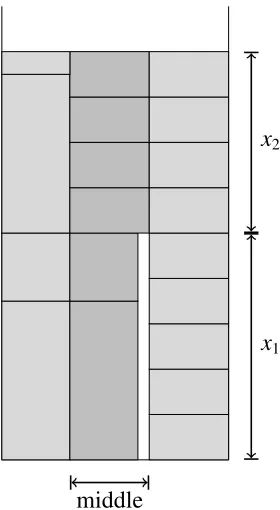
configurationsC1,C2as shown in Figure 2.4. These packed configurations can be divided into
three distinct sections horizontally. The outer two sections consist of rectangles of the same
type and, hence, they do not need to be cut when switching between configurations.
Rectan-gles in this part of the solution can be packed on top of each other until reaching the top of the
packing. The middle section occurs where there are two different types of rectangles and so the
rectangles in the lower packed configuration might need to be cut at the border of the packed
configurations. All rectangles in the upper packed configuration also might be cut at the top of
the packing.
The rectangles in the outer sections that appear at the top of the packing are simply rounded
up such that they are whole. This rounding increases the height of these outer sections by at
most 1 unit. In the middle section, the type of rectangles in the lower packed configuration is
not the same as the type of rectangles in the upper packed configuration. We cannot simply
round up rectangles at the borders of both packed configurations without increasing the height
20 Chapter2. Algorithms
middle
x1 x2
Figure 2.4: A packing of rectangles of 2 types. Note that there are three distinct sections horizontally: outer sections which each consist exclusively of rectangles of one type, and a middle section where the lower packed configuration has rectangles of a different type than the upper packed configuration.
intersect the cutting line at the top of packed configurationCj for j = 1,2. Assume without
loss of generality that the rectangles in the middle section of the lower packed configuration,
C1, are of typeT1 and the rectangles in the middle section of the upper packed configuration,
C2, are of typeT2.
The rectangles within the middle section that are cut in the fractional solution represent
some number, not necessarily integer, of rectangles; e.g. three rectangles cut at half their height
represent 1.5 rectangles of that type. Let this amount ben′jfor rectangles inMj. Obviously, we
cannot have fractional rectangles in the final solution to an HMSPP instance. Therefore, we
either round up or round down n′
j to an integer value and pack that many whole rectangles of
typeTj instead of the fractional rectangles inMj. In particular, if we round up rectangles inMj
we pack⌈n′
j⌉whole rectangles of typeTj and if we round them down we pack⌊n
′
j⌋.
2.4. TheTwo-TypeStripPackingProblem 21
rounded down for both types Tj.
Proof Letn′
jbe the number of rectangles represented by the cut rectangles in Mjando
′
jbe the
number of rectangles represented by the cut rectangles of typeTjin the rest of the packing. We
known′
j +o
′
j ≥ z, where zis a integer representing the number of whole rectangles needed to
replace all fractional ones. Therefore,⌊n′
j⌋+⌈o
′
j⌉ ≥ z.
Rounding down the middle section of both packed configurations allows us to pack the
rounded rectangles into a smaller space than if we were to round either or both up. This is
essential to the algorithm.
Let fjhj be the height of the fractional rectangles of typeTj that are cut and lie below the
cutting line located at the top of packed configurationCj. Imagine that the rectangles in M1 were removed from the packing. This would reduce the height of the middle section by f1h1.
Adding these fractional rectangles to the top of the packing (still in the middle section) would
then increase the height of the packing by the same amount. The total height of the section
does not change, the fractional rectangles are simply moved. We show that these fractional
rectangles can be made whole by rounding their heights in such a way that they do not increase
the height of the middle section by more than 1 unit.
We consider 2 cases:
Case 1. f1+ f2 >1. We round up the heights of the rectangles inMj tohjfor both types. This
increases the height of the packing in the middle section by at most
(1− f1)h1+(1− f2)h2 ≤1− f1+1− f2= 2−(f1+ f2)<1.
Case 2. f1+ f2 ≤ 1. Since the area of the fractional rectangles inMj is at most fjhjW, where
W is the width of the middle section and the numbern′
j was rounded down, the total area of
the rectangles of typeTj in Mj cannot be more than fjhjW. If the height of these fractional
rectangles is rounded up tohj their total width would be at most fjW. If we put the rounded
22 Chapter2. Algorithms
so they fit in the middle section and this packing of the rounded rectangles increases the height
of the middle section by at mostmax{h1,h2} ≤1.
Summarizing, after finding an optimal fractional packing, we round up the outer sections,
move rectangles cut in the middle section of C1 to the top of the middle section of C2, and
round down rectangles cut in the middle section as described above. Each of these steps can be
performed in constant time. Therefore, the worst-case runtime of this algorithm is dominated
by that of solving the fractional strip packing problem, which is
O
K10logKlog2
Kn
a
+K3logKlogn
,
as described in the previous section.
Theorem 2.4.2 Let OPT(I)be the height of an optimal solution for an instance I of the
two-type strip packing problem. There is a polynomial-time algorithm A which, given I, produces
a packing of I in a strip of width1and height A(I)such that:
A(I)≤OPT(I)+1.
2.5
The
K
-Type Strip Packing Problem
A basic feasible solution for linear program (2.1) for K types of rectangles uses at most K
configurations. As mentioned above, simply rounding each packed configuration up in the
fractional solution such that all rectangles are integral would increase the height of the packing
by at mostK. However, this is not the best one can do. In this section we present an algorithm
for theK-type strip packing problem that for any instanceI produces a packing forI of height
at mostOPT(I)+K−1.
Let a basic feasible solution for (2.1) withK types use configurationsC1,C2, . . . ,CK. Let
us consider a packingS where rectangles are packed according to configurationsCi and these
2.5. TheK-TypeStripPackingProblem 23
Lemma 2.5.1 Any two adjacent packed configurations Ci,Ci+1can have their rectangles
rear-ranged horizontally such that there is a contiguous section of the packed configurations where
rectangles of the same type line up between the packed configurations and hence they are not
cut at the boundary between Ciand Ci+1. In the remaining section of the packed configurations, no type of rectangle will appear in more than one packed configuration.
Proof For each typeTr, letmrbe the minimum of the number of rectangles of typeTracross
Ci (i.e., the number of rectangles packed side by side inCi) and the number of rectangles of
typeTracrossCi+1. In the left-most portion of each packed configuration, which we will call section S1, mr rectangles are packed across for each type Tr. The rest of the rectangles are
packed to the right of S1, in what we call section S2 (see Figure 2.5). Let tr,q be the total
number of rectangles of typeTracross packed configurationCqforq= i,i+1. The number of
rectangles of typeTrpacked across sectionS2of packed configurationCqistr,q−mr. Note that
for allr, in at least one of the packed configurationsCqthe value oftr,qwill be zero. Therefore,
no typeTr will appear in sectionS2of both packed configurations. Each type of rectangle may be cut several times in a fractional packing. Let ar,q be the
area of the rectangles of typeTr in packed configuration Cq that are cut. Recall that wr and
hr are the width and height of rectangle typeTr, respectively. Then,nr,q = ar,q
wrhr is the
(poten-tially fractional) number of rectangles of typeTrthat must be packed to cover the area of the
rectangles sliced by the cutting line in packed configurationCq. Even though this number may
be fractional, the total number of these rectangles in all cuts,nr = PiK=1nr,i, is integral for any
typeTr. When rectangles cut in packed configurationCqare rounded up, the cut rectangles are
replaced with⌈nr,q⌉whole rectangles. This will increase the height of the packed configuration
because whole rectangles will be taller than those which are cut.
Lemma 2.5.2 Define a segment as a set of rectangles of the same type that intersect the cutting
line within a section S2 of a packed configuration Cq. For all types Tr, at least one segment
24 Chapter2. Algorithms
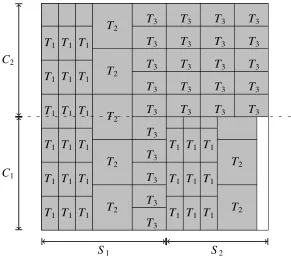
S1 S2
C1 C2
T1 T1 T1 T1 T1 T1 T1 T1 T1 T1 T1 T1 T1 T1 T1 T1 T1 T1
T2 T2 T2 T2 T2 T3 T3 T3 T3 T3 T3 T3 T3 T3 T3 T1 T1 T1 T1 T1 T1 T1 T1 T1 T2 T2 T3 T3 T3 T3 T3 T3 T3 T3 T3 T3 T3 T3 T3 T3 T3
Figure 2.5: An example of an arrangement of three rectangle types in two packed configura-tions. Rectangles that appear in both are placed to the left in section S1. In the remaining section,S2, no type appears in both packed configurations.
that segment while the number of rectangles of type Tr in the rest of the packing are rounded
up. The total number of rectangles of type Tr in the entire final packing will be nr.
Proof Letn′
r,q be the total (fractional) number of rectangles of typeTr cut at all cutting lines
except those cut at the top of sectionS2 of some packed configurationCq. Rounding up the
rectangles of type Tr in all packed configurations except those in sectionS2 of Cq will pack
at least ⌈n′r,c⌉rectangles. If we round down the rectangles of typeTr cut in section S2 ofCq,
then⌊nr,q⌋rectangles are packed in their place. Becausen′r,q+nr,qis integer, the amount gained
from rounding rectangles up will always be at least the decrease from rounding downnr,qand
thereforen′
r,q+nr,q ≤ ⌈n′r,q⌉+⌊nr,q⌋= nr, so the total number of whole rectangles of typeTrthat
are packed isnr.
Lemma 2.5.2 is a generalization of Lemma 2.4.1.
Consider two adjacent packed configurationsC1 andC2 whereC2 is directly on top ofC1
2.5. TheK-TypeStripPackingProblem 25
made whole and each increases in height by no more than 1 unit, increasing the total height of
the packing by no more thanK−2. The rectangles in the two chosen packed configurations are
arranged as described in Lemma 2.5.1 into sectionsS1andS2. Rectangles in sectionS1need
not be cut betweenC1andC2and rounding needs to be done only at the top ofC2. Additionally,
in the sectionS2where rectangles do not line up between packed configurations, let fr,qbe the
fraction of each rectangle cut of typeTrthat lies below the cutting line in packed configuration
Cq for q = 1,2 (so the pieces of rectangles of type Tr that were cut and appear at the top of
packed configurationCq all have height fr,qhr). LetS′2be the part ofS2where these fractional rectangles are packed.
The rectangles in section S2 of packed configurations C1 and C2 are sorted within that
section by nondecreasing values fr,1and fr,2, respectively. Following Lemma 2.5.2, the number of fractional rectangles in S′
2 may be rounded down since no type appears in both C1 andC2
of sectionS2. After this rounding we replace the fractional rectangles with whole ones. After
doing this, in some places within section S2 the height of the packing may exceed the
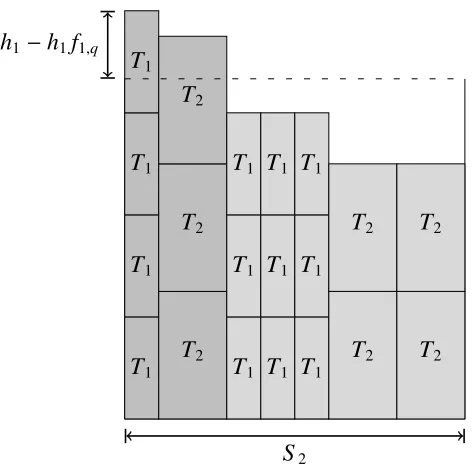
pre-rounding fractional height and in some other places it may have decreased (see Figure 2.6).
The portions of the packed configurations that have not increased in height are placed to the
right of sectionS2(see Figure 2.6).
Letωr,qbe the total width of all rectangles of typeTrin sectionS′2of packed configuration Cq and let ω′r,q be the total width of these rectangles after the rounding. Because the whole
rectangles packed in S′
2 after performing the rounding have total area less than or equal to
the total area occupied by the fractional rectangles, the total width of these whole rectangles
is at most fr,q times the total width of the fractional rectangles and, therefore, ω′r,q ≤ fr,qωr,q.
Furthermore, replacing fractional rectangles with whole ones will increase the height of the
packing by the difference between their fractional height and the height of rectangles of that
type:hr− fr,qhr ≤(1− fr,q)hr.
We argue that for both packed configurationsC1 andC2, all whole rectangles that replace
26 Chapter2. Algorithms
S2 h1−h1f1,q
T1 T1 T1 T1 T2 T2 T2 T1 T1 T1 T1 T1 T1 T1 T1 T1 T2 T2 T2 T2
Figure 2.6: An example of section S2 of a packed configurationCq after “rounding down”.
Because f1,q ≤ f2,q, typeT1 is packed first. The dotted line represents the original fractional height of the packed configuration. Portions that do not increase in height are packed in the far right of the section so that portions of the packed configuration that increase in height are directly adjacent to one another.
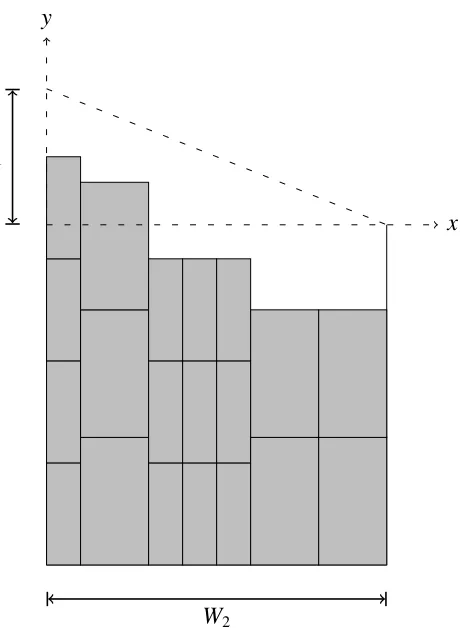
triangular regions directly on top of each packed configuration. These regions are right
tri-angles with bases of widthW2 equal to the width of section S2 and heights of 1 unit formed
by a line that intersects the upper-right corner of a packed configuration and a point one unit
above the left side of sectionS2 of the packed configuration (see Figure 2.7). Let us consider
packed configurationC1. LetT1,T2, . . . ,TC1 be the types of the rectangles in sectionS2ofC1 in nondecreasing order of fr,1value.
Assuming a coordinate system as shown in Figure 2.7, the equation of the line defining the
hypotenuse of the triangular region is y = 1− W1
2x. If the upper-right corner of a rectangle
ri fits within the triangular region, then the entire rectangle fits. For a typeTr, this point has
an xcoordinate xi equal towrplus the sum of the widths of all rectangles preceding it within
sectionS2and aycoordinateyi equal to its height,hr, minus fr,qhr. Thus, rectangleriis within
2.5. TheK-TypeStripPackingProblem 27
W2 1
x y
Figure 2.7: All rectangles will fit in the depicted region after rounding.
triangular region above packed configurationC1if and only if:
hr(1− fr,1)+ 1 W2
r−1
X
i=1
ω′i,1≤ 1.
Since the height of any rectangle is at most 1, the above condition holds if
1− fr,1+ 1 W2
r−1
X
i=1
ω′i,1 ≤1. Sinceω′r,1 ≤ fr,1ωr,1, the inequality is satisfied if
1− fr,1+ 1 W2
r−1
X
i=1
fi,1ωi,1≤ 1.
28 Chapter2. Algorithms
the inequality is true if
1− fr,1+ 1 W2
r−1
X
i=1
fr,1ωi,1 ≤1. Or equivalently,
1− fr,1+ fr,1 W2
r−1
X
i=1
ωi,1 ≤1.
The total width of rectangles within section S2 cannot exceed the width of section S2, so
Pr−1
i=1 ωi,1 ≤ W2. Hence, the above inequality holds true because 1− fr,1+ fr,1 ≤1.
Therefore, rectangles of all types will fit within the region when packed in this manner. The
same argument can be applied toC2.
Post-rounding, if one packed configuration is arranged upside down (as if it were turned
180◦) and placed above the other packed configuration, then the triangular regions will not
overlap and the total increase in height will be at most 1 (see Figure 2.8). SectionS1increases
in height by a most 1 unit andS2 increases by at most 1, so packed configurationsC1 andC2
together increase the height of the packing by at most 1 unit. The rest of the packed
configura-tions were rounded up and together they increase the height of the packing by at mostK −2.
Therefore, the total height of the final packing is at mostK−2+1= K−1.
Theorem 2.5.3 Let OPT(I) be the height of an optimal solution for an instance I of the
K-type strip packing problem. There is a polynomial-time algorithm A which, given I, produces
a packing of I in a strip of width1and height A(I)such that:
A(I) ≤OPT(I)+K−1.
Proof The algorithm described above computes a packing of the desired height, so we only
need to show that it runs in polynomial time. The first step of the algorithm is to compute a
2.5. TheK-TypeStripPackingProblem 29
Recall thatais the width of the thinnest rectangle; the time complexity of this algorithm is
dominated by the solution of the linear program, which requires
O
K10logKlog2
Kn
a
+K3logKlogn
time in the worst case. Once we have solved the linear program, we choose two packed
con-figurations and arrange their rectangles into sections S1 and S2 as described in the proof of
Lemma 2.5.1. This is done in constant time. Items in sectionS2are sorted, and because we are
sorting rational numbers, we can use radix sort which runs inO(cN) time wherecis the average
number of bits per item and N is the number of items to be sorted. In our algorithm, N ≤ K
which is constant. By Lemma 2.1 of [22] (see also Section 2.3.2),c≤ Klogn+KlogK. After
items are sorted, some rearrangement takes place, all in constant time. Therefore, the total
runtime of the algorithm in the worst case is
O
K10logKlog2
Kn
a
+K3logKlogn
.
30 Chapter2. Algorithms
S2 1
Chapter 3
Conclusion
In this thesis we considered the high-multiplicity strip packing problem. In this problem, we
are given an input I consisting of the width, height, and number of rectangles for each of K
rectangle types. HMSPP and related packing problems have many applications in diverse fields
including transportation, stock cutting, printing, and scheduling. We present an approximation
algorithm for HMSPP that produces a solution of height at most OPT(I) + K − 1 in time
OK10logKlog2Kn
a
+K3logKlogn, whereOPT(I) is the value of an optimal packing for
I, Kis the number of rectangle types,nis the total number of rectangles, andais the width of
the thinnest rectangle.
3.1
Open Questions and Future Work
Our results give way to many new questions. The complexity class for HMSPP is still not
known even for small values ofK. It is not even known if HMSPP is in the classNP. Assuming
the problem is not in classP, isOPT(I)+K−1 the best one can do in polynomial time? The
high-multiplicity bin packing problem is in classPwhenK =2 [21]. However, it is not known
if HMSPP can be solved exactly in polynomial time for any small values ofK ≥ 2.
High-multiplicity strip packing problems are not strictly limited to two dimensions. Our
algorithm is not trivially generalized to higher dimensions, however some of the key ideas
32 Chapter3. Conclusion
could be used. Particularly, three-dimensional fractional strip packing problems are not easily
represented as linear programs, a very necessary part of our algorithm.
In our algorithm, only two packed configurations are examined and rearranged after solving
the fractional problem. This is because Lemma 2.5.2 does not allow us to round down more
packed configurations. If the packed configurations were divided into pairs, each pair could be
arranged as described above such that each pair increased in height by only 1 unit assuming
some fractional rectangles were removed from the packed configurations and placed aside. If
there were a way to pack these leftover rectangles in a height less than K2 then the resulting algorithm would improve on theOPT(I)+K −1 algorithm we have presented in this thesis.
Bibliography
[1] Brenda S. Baker, Donna J. Brown, and Howard P. Katseff. A 54 algorithm for two-dimensional packing. Journal of Algorithms, 2(4):348–368, 1981.
[2] John J. Clifford and Marc E. Posner. Parallel machine scheduling with high multiplicity. Mathematical programming, 89(3):359–383, 2001.
[3] Edward G. Coffman, Jr, Michael R. Garey, and David S. Johnson. An application of bin-packing to multiprocessor scheduling. SIAM Journal on Computing, 7(1):1–17, 1978.
[4] Edward G. Coffman, Jr., Michael R. Garey, David S. Johnson, and Robert Endre Tar-jan. Performance bounds for level-oriented two-dimensional packing algorithms. SIAM Journal on Computing, 9(4):808–826, 1980.
[5] Stephen A. Cook. The complexity of theorem-proving procedures. InProceedings of the third annual ACM symposium on Theory of computing, pages 151–158. ACM, 1971.
[6] W. Fernandez De La Vega and George S. Lueker. Bin packing can be solved within 1+ε in linear time. Combinatorica, 1(4):349–355, 1981.
[7] Friedrich Eisenbrand. Fast integer programming in fixed dimension. Springer, 2003.
[8] Carlo Filippi and Alessandro Agnetis. An asymptotically exact algorithm for the high-multiplicity bin packing problem. Mathematical programming, 104(1):21–37, 2005.
[9] Aleksei V. Fishkin, Olga Gerber, Klaus Jansen, and Roberto Solis-Oba. Packing weighted rectangles into a square. In Joanna Jdrzejowicz and Andrzej Szepietowski, editors,
Math-ematical Foundations of Computer Science 2005, volume 3618 ofLecture Notes in
Com-puter Science, pages 352–363. Springer Berlin Heidelberg, 2005.
[10] Paul C. Gilmore and Ralph E. Gomory. A linear programming approach to the cutting-stock problem. Operations research, 9(6):849–859, 1961.
[11] Igal Golan. Performance bounds for orthogonal oriented two-dimensional packing algo-rithms.SIAM Journal on Computing, 10(3):571–582, 1981.
[12] Martin Gr¨otschel, L´aszl´o Lov´asz, and Alexander Schrijver. The ellipsoid method and its consequences in combinatorial optimization. Combinatorica, 1(2):169–197, 1981.
[13] Rolf Harren, Klaus Jansen, Lars Pr¨adel, and Rob Van Stee. A (5/3+ε)-approximation for strip packing. InAlgorithms and Data Structures, pages 475–487. Springer, 2011.
34 BIBLIOGRAPHY
[14] Dorit S. Hochbaum and David B. Shmoys. Using dual approximation algorithms for scheduling problems theoretical and practical results. Journal of the ACM (JACM), 34(1):144–162, 1987.
[15] Sheik Mamun-Ul Hoque. The 2-rectangle packing problem. Master’s thesis, The Univer-sity of Western Ontario, 2011.
[16] Klaus Jansen and Roberto Solis-Oba. AnOPT+1 algorithm for the cutting stock problem with constant number of object lengths. In Integer Programming and Combinatorial Optimization, pages 438–449. Springer, 2010.
[17] Howard Karloff. Linear programming. Springer, 2008.
[18] Narendra Karmarkar and Richard M. Karp. An efficient approximation scheme for the one-dimensional bin-packing problem. InFoundations of Computer Science, 1982. SFCS’08. 23rd Annual Symposium on, pages 312–320. IEEE, 1982.
[19] Claire Kenyon and Eric R´emila. A near-optimal solution to a two-dimensional cutting stock problem. Mathematics of Operations Research, 25(4):645–656, 2000.
[20] Hendrik W. Lenstra Jr. Integer programming with a fixed number of variables. Mathe-matics of operations research, pages 538–548, 1983.
[21] S. Thomas McCormick, Scott R. Smallwood, and Frits CR Spieksma. A polynomial algorithm for multiprocessor scheduling with two job lengths.Mathematics of Operations Research, 26(1):31–49, 2001.
Curriculum Vitae
Name: Devin Price
Post-Secondary Gardner-Webb University
Education and North Carolina
Degrees: 2010 - 2012 B.Sc.
University of Western Ontario London, ON
2012 - 2014 M.Sc.
Related Work Teaching Assistant
Experience: The University of Western Ontario
2012 - 2013