Dtmf Flag Age and Recognition Utilizing Successful Dft
(Goertzel Calculation) Method on Fpga
KASARLA MOUNIKA1, HUMA AFREEN2
1,2
Assistant professor © Dept of ECE
University College of Engineering and Technology, Mahatma Gandhi University, Nalgonda, Telangana, India.
ABSTRACT: - Double tone multi-recurrence (DTMF) is a flagging standard in telecom applications that produces two tones all the while for each key press. By utilizing proficient DTMF, this task partitioned into three stage's i.e. FFT, Split Goertzel Algorthim without Asset Sharing Methodology, and Split Goertzel Algorthim with Asset Sharing Methodology. In these three stages we investigate territory, timing and power. Initially stage is Quick Fourier Change (FFT). In FFT, recursive operation is rehashed N times. So that in FFT it requires more equipment, control and time. Second stage is spilt Goertzel Algorthim without Asset Sharing Methodology. For fast tone discovery third procedure i.e, Split Goertzel Algorithm with Asset Sharing Methodology is utilized. Here, it utilizes foreordained frequencies& extremely negligible arrangement of equipment, booked sources of info and yields are utilized at fitting clock edges. With the goal that it devours less zone and power. To identify DTMF location another kind of ZYBO board ZYNQ 7000 arrangement FPGA is utilized. Zynq is the mix of programming &hardware frameworks. For useful confirmation Tutor Designs Modelsim is utilized and for blend Xilinx ISE is utilized.
KEYWORDS: -DTMF, FFT, spilt Goertzel Algorthim without Resource Sharing Approach, spilt Goertzel Algorthim with Resource Sharing Approach., Xilinx ISE, FPGA, ZYNQ Platform.
I.
INTRODUCTION
DTMF telephone keypad generates a sinusoidal tone and it is a mixture of two frequencies i.e., row and column frequencies. The below figure shows that, how the frequencies are organized:
Fig.1 Keypad represents high &low frequencies:
The DTMF keypad speaks to like a 4×4 network, with every segment and each column speaks to as high and low frequencies. EX: In the event that we press a solitary key (as '2') will gives a sinusoidal tone for each of the two frequencies (1336 hertz (Hz) and 697 Hz). DTMF is for the most part used to
create for media transmission gear. DTMF is where keystrokes from the phone keypad are converted into double tone motions over the sound connection. FPGA'S are parallel handling gadgets and it is utilized to enhance the execution of frameworks.
International Journal of Research
Available at https://edupediapublications.org/journalsp-ISSN: 2348-6848 e-ISSN: 2348-795X Volume 02 Issue 05
May 2015
P a g e | 868 Fig 2: Zynq Architecture
Preparing Framework is a hard processor. It exists as a devoted and upgraded silicon component on the gadget. Hard processors can accomplish higher execution, for Zynq's ARM processor. Programmable rationale is a delicate processor like the Xilinx Miniaturized scale Blast, which is framed by consolidating components of the programmable
rationale texture. The execution of a delicate processor is in this way what might as well be called some other IP piece sent in the rationale texture of a FPGA. All in all, the upside of delicate processors is that the number and exact execution of processor cases is adaptable. At least one Smaller scale Burst delicate processors can be utilized inside the PL bit of the Zynq, to work in conjunction with the ARM processor.
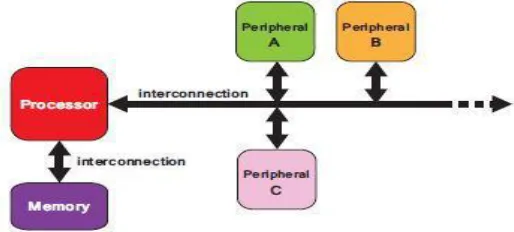
Fig.3 Hardware Architecture of Zynq
Processor acts as the focal component for equipment framework. Programming framework goes through processor. Peripherals are practical parts far from the processor. To accomplish less territory, low power, equipment improved arrangement we utilize Spilt Goertzel Calculation without RSA and Spilt Goertzel Algorthim with Asset Sharing Methodology (RSA).
For the most part this paper separated into three stages.
Stage I: In the principal stage, by utilizing Xilinx FFT center we can distinguish DTMF identification. The zone, timing and power comes about are dissected.
Stage II: In the second stage spilt Goertzel Algorthim without Asset Sharing Methodology is actualized. The range, timing and power comes about are broke down.
Stage III: In the third stage, spilt Goertzel Algorthim with Asset Sharing Methodology is examined and appropriate state machine based planning will be conveyed with constrained assets to execute split Goertzel calculation without RSA. The novel asset sharing based approach devours less power and still it can recognize productive DTMF tones.
Fig.4 General Module DTMF Detection
The above figure speaks to General module DTMF Recognition. It comprises of six modules, for example, 4x4 Hex key cushion (input), Double Tone Multi Recurrence test flag generator, Added substance white Gaussian clamor, Recurrence Identification piece, Extent or list estimator and Recurrence to digit look-into table.
Hex keypad is an outer segment and it go about as contribution to DTMF module.
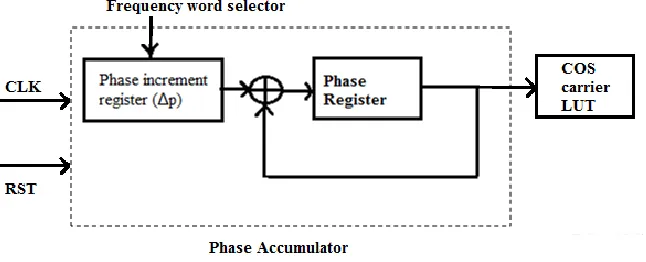
Recurrence Test Flag Generator square produces important transporter frequencies. FTSG is again separated into two sort's i.e, Recurrence Word Selector and Direct Advanced Synthesizer. FWS implies, it chooses recurrence as indicated by key squeezed.
Fig. 5 Frequency Word Selector
DDS perform digital to analog conversation so that output will be in the form of analog usually a sine wave and this analog waveform combines with additive Gaussian noise then the output will be in the form of noise bits. This output gives as input to FDM i.e., Frequency Detection Module. Output will be in the form of magnitude indices. So that we can calculate 1st & 2nd max indices.
Fig. 6 Direct Digital Synthesizer
Chipscope ILA is used to monitor any internal signal of design. Chipscope ICON provides a communication path between Chipscope ILA & JTAG.
III.
EXISTING PROBLEM
1. FFT- 128 core:
International Journal of Research
Available at https://edupediapublications.org/journalsp-ISSN: 2348-6848 e-ISSN: 2348-795X Volume 02 Issue 05
May 2015
P a g e | 870
Fig.7 Block Diagram with FFT-128 Core as Frequency Detection Module
IV.
PROPOSED SOLUTION
1. Spilt Goertzel Algorthim without Resource Sharing Approach.
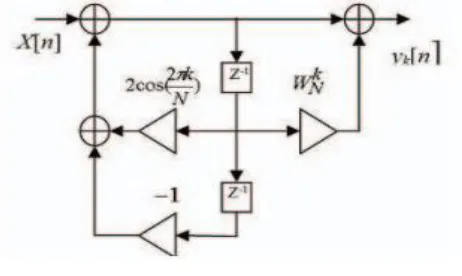
The spilt Goertzel Algorthim without Resource Sharing Approach is a DSP technique; it is used to identify the frequency components of a signal, and published by Dr. Gerald Goertzel in 1958. Here spilt Goertzel Algorthim without Resource Sharing Approach module is added instead of FDB in DTMF Detection General Module.
Fig.8 Spilt Goertzel Algorthim without Resource Sharing Approach as Frequency Detection Module
2. Spilt Goertzel Algorthim with Resource Sharing Approach.
Spilt Goertzel Algorthim with Resource Sharing Approach is an approach that, similar block of operations can assign. For example, +, to a common net list cell. Net list cells are be the resources; here net lists will be shared, so that it consumes less hardware. By using spilt Goertzel Algorthim without RSA we can implement spilt Goertzel Algorthim with RSA. In Goertzel algorithm all eight determined frequencies are appear, In spilt Goertzel Algorthim with RSA only 2 frequencies will used so that in spilt Goertzel Algorthim RSA consumes less hardware. The below figure shows spilt Goertzel Algorthim with Resource Sharing Approach.
V.
SIMULATION AND SYNHESIS RESULTS
The below Figures represent the Simulation results for FFT, Spilt Goertzel Algorthim without Resource Sharing Approach, Spilt Goertzel Algorthim with Resource Sharing Approach.
International Journal of Research
Available at https://edupediapublications.org/journalsp-ISSN: 2348-6848 e-ISSN: 2348-795X Volume 02 Issue 05
May 2015
P a g e | 872
Fig. 11 Simulation Results of Spilt Goertzel Algorthim without Resource Sharing Approach
Fig.12 Simulation Results of Spilt Goertzel Algorthim with Resource Sharing Approach.
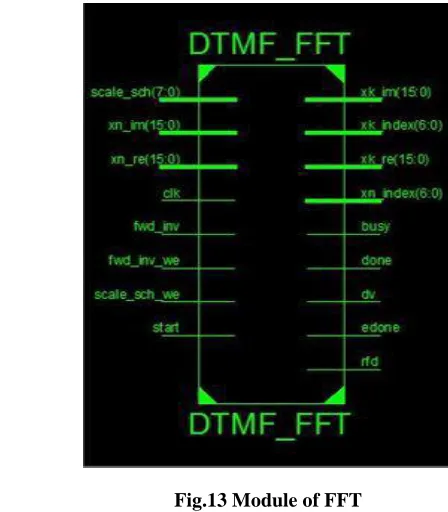
The Module, RTL Schematic, Device Utilization Summary are shown below by screenshots for FFT
Fig.14 RTL Schematic of FFT
International Journal of Research
Available at https://edupediapublications.org/journalsp-ISSN: 2348-6848 e-ISSN: 2348-795X Volume 02 Issue 05
May 2015
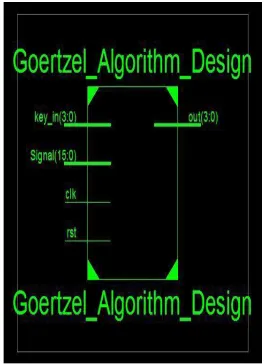
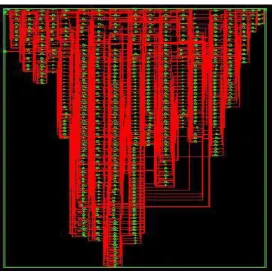
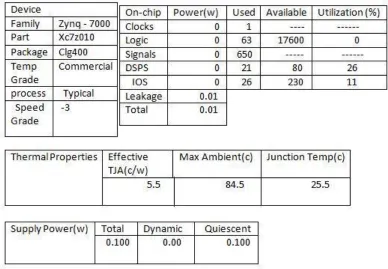
P a g e | 874 The below figures represent Module, RTL Schematic, Device Utilization Summary for Spilt Goertzel Algorthim without Resource Sharing Approach.
Fig.16 RTL Schematic of Spilt Goertzel Algorthim without Resource Sharing Approach.
International Journal of Research
Available at https://edupediapublications.org/journalsp-ISSN: 2348-6848 e-ISSN: 2348-795X Volume 02 Issue 05
May 2015
P a g e | 876 The below figures represent Module, RTL Schematic, Device Utilization Summary for Spilt Goertzel Algorthim with Resource Sharing Approach.
Table _3: Device Utilization Summary for Spilt Goertzel Algorthim with Resource Sharing Approach.
The below figure represents the Power Distribution for Spilt Goertzel Algorthim without Resource Sharing Approach., Spilt Goertzel
Algorthim with RSA.
Table_5: Power results for Spilt Goertzel Algorthim with Resource Sharing Approach.
International Journal of Research
Available at https://edupediapublications.org/journalsp-ISSN: 2348-6848 e-ISSN: 2348-795X Volume 02 Issue 05
May 2015
P a g e | 878
VI.
CONCLUSION
In this task, we identify DTMF based FPGA usage utilizing Spilt Goertzel Calculation with improved Asset Sharing Methodology. In the primary stage, by utilizing Xilinx FFT center we recognized DTMF recognition. The territory, timing and power comes about are dissected. The hindrance of the DFT system is that it requires every symphonious to be ascertained independently, which requires significantly more preparing power, hardware& memory. In the second stage the split Goertzel calculation without Asset Sharing Methodology examination is completed. In the following stage the split Goertzel calculation with Asset Sharing Methodology is contemplated and appropriate state Machine based booking will be conveyed with restricted assets to actualize split Goertzel calculation without Asset Sharing Methodology. To recognize DTMF identification another sort of ZYBO board ZYNQ 7000 arrangement FPGA is utilized. In FFT Add up to territory expended i.e; add up to doors utilized 2369, memory utilization 445818 kilo bytes and speed is 1.5ns. In FFT it devours more zone, control, speed. In Split Goertzel Algorthim without Asset Sharing Methodology; Add up to territory expended i.e; add up to entryways utilized 33, memory utilization 445818 kilo bytes and speed is 4.123ns. In Split Goertzel Algorthim with Asset Sharing Methodology; Add up to territory expended i.e; add up to doors utilized 20, memory utilization 445818 kilo bytes and speed is 4.123ns.In Part
Goertzel Algorthim with Asset sharing Methodology can recognize the approaching recurrence inside a ±1.5% balance go. This calculation does not check for flood issues. With the goal that it expends less territory, power& memory.
REFERENCES
[1] S Nagakishore Bhavanam, P. Siddaiah, P. Ramana Reddy “FPGA based efficient DTMF detection using Split Goertzel Algorithm with optimized Resource Sharing Approach” 11th International Conference 11th IEEE and IFIP International Conference on wireless and Optical communications Networks (WOCN2014), IEEE Xplore, IEEE Catalog Number: CFP12604-CDR, ISBN: 978-1-4799-3155-2 and ISSN: 2151- 7703. [2] Sonal Singhal , Piyush Kuchhal “Network on Chip for DTMF Decoder and TDM Switching in Telecommunication Network with HDL Environment” IEEE 2012, pp.1582-1588.
[3] Kamal Shaterian, Hossein gharaee “DTMF detection with Goertzel Algorithm using FPGA, a resource sharing approach” IEEE 2010, pp.196-199. [4] Zhang Xinyi ” The FPGA Implementation of Modified Goertzel Algorithm for DTMF Signal Detection” IEEE 2010, pp.4811-4815.
[6] S Nagakishore Bhavanam, P. Siddaiah, P. Ramana Reddy “FFT based DTMF detection by using Spartan 3E FPGA”. American International Journal of Research in Formal, Applied and Natural Sciences (AIJRFANS), Issue 7, Volume 1, pp. 01-06, June-August, 2014, ISSN (Print): 2328-3777, ISSN (Online): 2328-3785, ISSN (CD-ROM): 2328- 3793. [7] J. Nagi*, K. S. Yap, S. K. Tiong at al. “Intelligent Detection of DTMF Tones using a Hybrid Signal Processing Technique with Support Vector Machines”, IEEE 2008.
[8] Thierry Capitaine, Valery Bourny at. al “Signal processing algorithm on a low resource processor: DTMF strings identification on a DIL8 package microcontroller” IEEE 2008, pp.1050-1054.
[9] J. Nagi, S. K. Tiong, “Dual-tone Multifrequency Signal Detection using Support Vector Machines” IEEE 2008, pp.350-355.
[10] Li-Te Shen and Shaw-Hwa Hwang” A New Algorithm For DTMF Detection” IEEE 2009, pp.350-355.
KASARLA MOUNIKA
received her B.Tech in ECE in SRTST, Nalgonda in the
year 2008 and P.G.
Received in ECE in SRTST, Nalgonda in the year 2011. She is currently working as an assistant professor in ECE dept at University college of Engineering and
Technology, Mahatma
Gandhi University,
Nalgonda, Telangana, India. She has 5 years experience in teaching.
HUMA AFREEN received her B.Tech in ECE in
Nagarjuna college of
technology and science in the year 2012 and P.G. Received in ECE in Shadan
women’s college of
engineering and technology in the year 2014. She is currently working as an assistant professor in ECE dept at University college
of Engineering and
Technology, Mahatma
Gandhi University,
Nalgonda, Telangana,