Bacterial Concrete Using Fly Ash as Partial Replacement
K. SRIRAMYA
Research Scholar in M.TECH (Structures) Aurora’s Technological & Research Institute
Parvathapur(V), Ghatkesar(M), Ranga Reddy, Telangana
Email :-
[email protected]
L. APARNA
Assistant Professor, M.TECH (Environmental Engineering) Aurora’s Technological & Research Institute
Parvathapur(V), Ghatkesar(M), Ranga Reddy, Telangana
Email :- [email protected]
A BSTRA CT:-The target of this exploration work
is to decrease the cost of the construction.
Presently a days the industrial wastes are quickly
expanding more. To use such materials and
lessen such kind of waste in condition. The
concrete is supplanted by the GGBS and fly fiery
debris with microorganisms of 106 bacillus
pasteurii in M40 b lend. the GGBS and fly slag as
taken in the extents of 10% by weight of concrete.
Fro m this exploration the outcomes are
substantially more better as contrast with the
tradition concrete. The solid structures have
different solidness issues because of the
distinctive physiological conditions and it results
to unrecoverable harm to the structure and in the
end lessening in the quality of solid structure.
The primary exp lanation for the min imizing of
the strength and mechanical parts of cement is
the pore structure of cement. In the current years
MICCP (microbiologically induced calciu m
carbonate precipitation) by the microorganis ms
considered as a domain well d isposed strategy to
upgrade the properties of cement, likewise for the
repair of solid structure and to combine
distinctive development materials. This paper
shows a survey of various inquires about in the
current years on the utilization of bacterial
cement/bio-concrete for the upgrade in the
solidness, mechanical and perme ation parts of
cement. It contains thinks about on various
bacteria's, their detachment procedure, diverse
methodologies for expansion of microscopic
organisms in cement, their impacts on
compressive quality and water retention
properties of cement and furthermore the SEM
and XRD investigation of cement containing
Key Words: GGBS1, flyash2, Bacullius Pasteurii3, Compressive Strength4 and Spilt Tensile strength4 etc…
INTRODUCTION
Cement is the most broadly utilized
development material on the planet. It
frames real part in the development
business as it is shoddy, effortlessly
accessible and advantageous to cast.
Notwithstanding its distinctive qualities
in the development, it has numerous
restrictions as it is feeble in strain, has
constrained malleability and less
imperviousness to splitting and because
of forceful ecological specialists which
eventually diminish the life of the
structure which are constructed utilizing
these materials. The essential
explanation behind the breaking of
cement can be credited to porosity in
surface (infinitesimal level) of basic
individuals which permits dampness and
water to saturate the solid individuals
and subsequently, prompts to
consumption of steel fortifications. This
procedure of harm happens in the early
existence of the building structure and
furthermore amid its life time.
Engineered materials like epoxies are
utilized for remediation. Be that as it
may, they are not good, exorbitant,
decrease stylish appearance and need
steady upkeep. In this way bacterial
initiated Calcium Carbonate (Calcite)
precipitation has been proposed as an
option and condition amicable break
remediation and henceforth change of
quality of building materials.
A novel procedure is received in
re-interceding splits and crevices in
cement by using Microbiologically
Induced Calcite or Calcium Carbonate
(CaCO3) Precipitation (MICP) is a
system that goes under a more extensive
classification of science called
bio-mineralization. MICP is exceedingly
alluring on the grounds that the Calcite
precipitation prompted subsequently of
microbial exercises is without
contamination and normal. The
procedure can be utilized to enhance the
compressive quality and firmness of split
solid examples. Examine prompting to
microbial Calcium Carbonate
precipitation and its capacity to mend
prompted to numerous applications like
break remediation of solid, sand union,
reclamation of authentic landmarks and
other such applications. So it can be
characterize as the procedure can happen
inside or outside the microbial cell or
even some separation away inside the
solid. Regularly bacterial exercises
basically trigger an adjustment in
arrangement science that prompts to over
immersion and mineral precipitation.
Utilization of these Bio mineralogy ideas
in solid prompts to potential innovation
of new material called ―Bacterial
Concrete. There is developing
acknowledgment all through the world
that crude materials assets utilized as a
part of the creation of bond are limited
and non-renewable and should be
moderated for future eras. With the
target of achieving economical
development a solid pattern supporting
the expanded utilization of admixtures in
cement is rising all through the world.
The mineral admixtures are
fundamentally the waste results of
mechanical procedures, delivered to the
tune of a large number of tones whose
transfer is an awesome concern. Fiery
debris from coal based power plants is
one such waste which is liberally
accessible in the distinctive parts of India.
Cement can fill in as the most secure
home of fly fiery remains and has a huge
potential for its use. Fly fiery debris or
pummeled fuel cinder, a mechanical
misuse of coal based warm power plants,
comprises of finely partitioned round
particles of silicate glass adjusted with
aluminum and press and can be utilized
as a part of cement because of financial
and specialized points of interest. Fuse of
fly fiery remains brings about impressive
upgrades in solid properties. Fly cinder is
the most broadly utilized pozzolana on
the planet Fly powder, otherwise called
vent fiery debris is a repercussion from
coal based warm power plant. Inferable
from its pozzolanic properties, fly fiery
remains can be utilized as a swap for a
portion of the Portland bond substance of
cement Also, Fly cinder can add to the
solid's last quality and increment its
MATERIA LS OF SELF HEA LING CONCRETE
In the present examination program,
standard 3D squares (150x150x150mm),
standard pillars (100x100x500 mm),
standard chambers (150mm breadth,
tallness 300mm) were threw and tried for
finding the Compressive quality, Flexure
quality and Split Tensile quality
properties for bacterial solid, typical
concrete, bacterial cement with fly fiery
remains as fractional substitution to bond
and bacterial cement without fly powder.
The materials utilized as a part of this
test study are Cement, Fine total, Coarse
total, Water, Fly fiery debris, Bacillus
odeyssei.
Cement
Cement is a binder, a substance that sets
and hardens independently, and can bind
other materials together. The most
important factor considered for cement
grading is the average compressing
strength of the material in a given
particular amount of time over a
particular area in a particular
composition of the cement mortar
mixture.
The cement used for this research is 43
grade ordinary Portland cement (OPC).
The cement was uniform color i.e., grey
with a high greenish shade and was free
from any hard lumps. It was tested for its
physical properties as per IS
12269-1987 and their results are
presented in the given table.
Physical Properties of Ordinary Portland Cement
S No. Property Test Method Test result IS standard
1 Normal
consistency
Vicat apparatus (IS: 4031 part 4)
30% -
2 Specific
gravity
Sp. Gr bottle (IS 4031 part 4)
3.09 -
3 Initial setting
time
Vicat apparatus ( IS 4031 part4)
96 minutes Not less than 30 minutes
4 Final setting
time
Vicat apparatus ( IS 4031 part4)
207 minutes
Not greater than 600 minutes
Aggregate
Aggregates are utilized as a part of
cement for certain reason. Totals
ordinarily make up around 60 to 75
percent of volume of a solid blend. So
we can state that, a large portion of the
prerequisite of cement in its plastic state
is influenced by total properties and,
Gradation of total is one of them. The
size, shape and degree of the total
assume a vital part in accomplishing a
legitimate cement.
Fine Aggregate
The sand which goes through 4.75mm
strainer is said to be fine total. The
locally accessible clean sand is utilized
as fine total in the present investigation.
The sand is tried for strainer
investigation to decide the molecule
estimate dispersion in a specimen of total,
called degree. The other test to discover
physical properties like fineness test,
particular gravity and mass thickness test
have led. The above test have been
directed as per IS 2386-1963. The subtle
elements of test outcomes are appeared
in the given Tables.
Sieve Analysis of Fine Aggregate
S No. IS Sieve Size Weight Retained in (gms)
% of weight retained
Cumulative % Weight Retained
% Passing in each sieve
1 4.75 mm 4 0.4 0.4 99.6
2 2.36 mm 10 1 1.4 98.6
3 1.18 mm 108 14.4 15.8 84.5
4 600µ 362 36.2 49 51
5 300µ 398 39.8 91.8 8.2
6 150µ 78 7.8 99.6 0.4
Physical Properties of Fine Aggregate
Coarse Aggregate
The aggregates which retain on 4.75mm
sieve are coarse aggregate. Locally
available aggregate of size 20mm have
been used in the present experiment. It is
free from impurities such as dust, clay
particles and organic matter etc. For the
coarse aggregate the sieve analysis test
has conducted and also physical
properties of coarse aggregate were
investigated in accordance with IS 2386
-1963. The details of test results are
shown given in the given tables.
Sieve Analy sis Chart for Coarse Aggregat e
IS Sieves Size
Weight Retained (kg)
Cumulative Weight Retained
Cumulative % Weight
Retained
% Passing
20 2.240 2.240 45.22 54.78
10 2.170 4.410 89.03 10.97
4.75 0.440 4.850 97.92 2.08
Pan 0.103 4.53 _ 0
S No.
Property Test Method Test Results
1 Specific
gravity
Pycnometer
(IS-1986 part-3) 2.61
2
Bulk density
(kg/m3)
Loose Dense
(IS 2386-1986
part-3)
14.37 KN/m^3 16.04 KN/m^3
3 Fineness
modulus
Sieve analysis(IS
Phy sical Prop ert ies of Coarse Aggregat e
S No. Property Test Method Value
1
Fineness modulus
Sieve analysis
(IS 2386-1963 Part 2)
7.32
2
Specific gravity
Pycnometer
(IS 2386-1963 Part 3)
2.59
3
Bulk density
(kg/m3) Loose
Bulk density
(kg/m3 ) Dense
(IS 2386-1963 Part 3)
13.60KN/m^3 15.00KN/m^3
Water
Water that is suitable for drinking is
satisfactory for use in from concrete.
Water from lakes and streams that
contains marine life also usually is
suitable. When water is obtained from
sources mentioned above, no sampling is
necessary. When it is suspected that
water may contain sewage, mine water,
or wastes from industrial plants or
canneries, it should not be used in
concrete unless tests indicate that it is
satisfactory. Water from such sources
should be avoided since the quality of
the water. In the present experimental
program, portable water free from any
amount of oils, acids, alkalis, sugar, salts
and organic materials confirming to IS
456 – 2000 (1) is used for mixing and
curing of concrete.
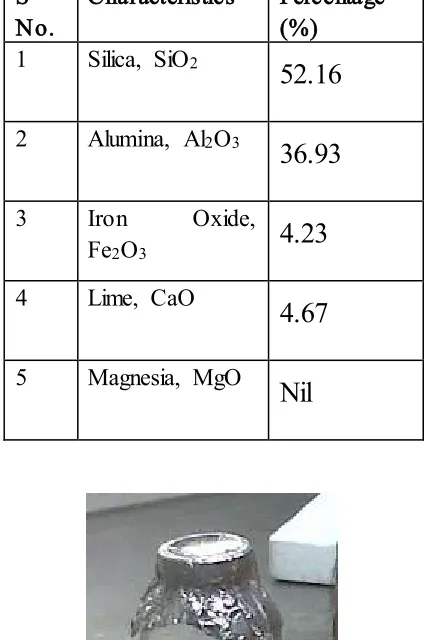
Fly Ash
Fly ashes are generally finer than cement
and consist mainly of glassy spherical
particles as well as residues of hematite
and magnetite, char, and some crystalline
phases formed during cooling Fly ash is
the best known, and one of the most
commonly used, pozzolanas in the world.
Physical Properties of Fly Ash are shown
in the given Table
T ypical Oxide Composition of Fly Ash
S No.
Characteristics Percentage
(%)
1 Silica, SiO2
52.16
2 Alumina, Al2O3
36.93
3 Iron Oxide,
Fe2O3
4.23
4 Lime, CaO
4.67
5 Magnesia, MgO
Nil
Figur e : Bacillus o dey ssei
Working of Bio Concrete
Self-mending cement is an item that will
naturally deliver limestone to recuperate
breaks that show up on the surface of
solid structures. Exceptionally chose
sorts of the microscopic organisms
family Bacillus, alongside a
calcium-based supplement known as
calcium lactate, and nitrogen and
phosphorus, are added to the elements of
self-mending operators can lie torpid
inside the solid for up to 200 years. In
any case, when a solid structure is
harmed and water begins to leak through
the splits that show up in the solid, the
spores of the microbes develop on
contact with the water and supplements.
Having been enacted, the
microorganisms begin to feast upon the
calcium lactate. As the microscopic
organisms encourages oxygen is
devoured and the dissolvable calcium
lactate is changed over to insoluble
limestone. The limestone hardens on the
split surface, subsequently fixing it up.
The utilization of oxygen amid the
bacterial change of calcium lactate to
limestone has an extra preferred
standpoint. Oxygen is a basic component
during the time spent consumption of
steel and when the bacterial action has
expended it all it builds the toughness of
steel strengthened solid developments.
The two self-recuperating operator parts
(the bacterial spores and the calcium
lactate-based supplements) are
acquainted with the solid inside
independent extended mud pellets 2-4
mm wide, which guarantee that the
specialists won't be initiated amid the
concrete blending process. Just when airs
out up the pellets and approaching water
carries the calcium lactate into contact
with the microscopic organisms do these
get to be distinctly actuated. Testing has
demonstrated that when water saturates
the solid, the microbes develop and
duplicate rapidly. They change over the
supplements into limestone inside seven
days in the research facility. Outside, in
lower temperatures, the procedure takes
a little while.
Bacterial Concrete with Fly Ash
Development of Bacterial solid utilizing
fly powder is another idea. In which
living life form or microbes called
"Bacillus odysseyi" is blended in water
with standard port land concrete
alongside fine total and coarse total. The
procedure look like simply like
development of typical cement aside
from the expansion of "Microbes" and
"fly cinder". It has ended up being
practical and proficient by utilization of
Fly Ash is a siliceous material acquired
from warm plants, is utilized as
fractional substitution of customary
Portland bond. Microbes moreover with
fly cinder are utilized to acquire
self-mending, workable, sturdy and solid
cement. Bacterial solid utilizing fly fiery
remains can be called as a "Savvy Bio
Material" for repairing concrete.
RESULTS AND DISCUSSIONS
Test Results on Fresh Concrete
The workability tests i.e., Slump flow
test, compaction factor test conducted on
concrete are shown in the given table 1
and table2
Table 1: slump test results S.
No.
% of fly ash added to cement as replacement
Bacillus odeyssei
cell/ml Slump
(mm)
1 10% 0 61
2 20% 0 59
3 10% 105 66
4 20% 105 62
5 0 105 65
From the tableit is clearly observed
that the concrete to which only fly ash is
added as replacement of 10%, 20%
without mixing bacteria bacillus
odeyssei is giving low results compared
to concrete to which fly ash is added as
replacement along with bacteria. Also
the concrete to which bacteria bacillus
odeyssei is mixed with 10% of fly ash
replacement is giving good result
compared to 20% fly ash replacement
with bacteria. Hence it can be said from
the above table that the results for slump
test is giving better for the concrete to
which fly ash is added 10% as partial
replacement along with bacteria bacillus
Figure 1: Slump test variation
From the Fig.5.1 the variation of slump
test has been shown. The bacterial
concrete with 10% of fly ash has got
high slump value compared to bacterial
concrete with 20% of fly ash, bacterial
concrete without fly ash and fly ash
based concrete.
Table 2: Compaction factor test results. S. No. % of fly ash added to
cement as replacement
Bacillus odeyssei cell/ml
Compaction factor (mm)
1 10% 0 0.786
2 20% 0 0.783
3 10% 105 0.876
4 20% 105 0.798
5 0 105 0.873
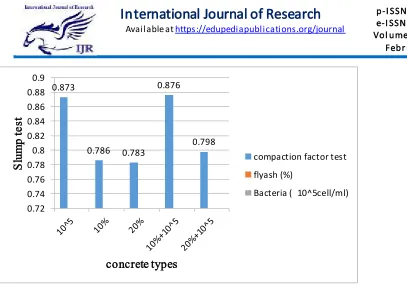
From the table 2, it can be said that the
compaction factor value for bacterial
concrete with 10% fly ash has got good
result compared to bacterial concrete
with 20% fly ash .The concrete with 10%
of fly ash has got increased compaction
value compared to concrete with 20% of
fly ash.
0.873
0.786 0.783
0.876
0.798
0.72 0.74 0.76 0.78 0.8 0.82 0.84 0.86 0.88 0.9
S
lum
p
te
st
concrete types
compaction factor test flyash (%)
Figure 2: variation of compaction factor test
The Fig.5.2 shows the variation of
compaction factor test conducted for
different concrete types. The bacterial
concrete with 10% of fly ash has got
increased value compared to bacterial
concrete with 20% of fly ash. The 10%
fly ash based concrete got high value
compared to 20% fly ash based concrete.
Test
Results
on
Hardened
Concrete
The strength test i.e., compressive
strength, split tensile strength and
flexural strength test results on hardened
concrete at the age of 7 days, 14 days
and 28 days of curing obtained for
Bacterial concrete without, bacterial
concrete with fly ash for 10% and 20%,
fly ash based concrete for 10% and 20%
and conventional concrete have
conducted and their results are shown
below in table 5.3, 5.4, 5.5 respectively.
The table 3 shows the test results
for compression test conducted for cubes
for 7, 14 and 28 days of curing. The
concrete to which fly ash is added as
replacement to cement for 10% has got
increased value compared to concrete to
which 20% of fly ash is added. The
bacterial concrete to which fly ash is
added for 10% has got increased value
compared to bacterial concrete to which
20% of fly ash is added. Bacterial
0.873
0.786 0.783
0.876
0.798
0.72 0.74 0.76 0.78 0.8 0.82 0.84 0.86 0.88 0.9
co
m
p
ac
tio
n
fa
ct
or
te
st
concrete types
compaction factor test flyash (%)
concrete without fly ash has got great
strength compared to bacterial concrete
with fly ash, fly ash based concrete and
conventional concrete.
T able 3: compressive strength test (N/mm2)
S. No.
Concrete type Bacterial concrete
( cell/ml)
7 days
14 days
28 days
1 Conventional
concrete
0 25 31.5 45.2
2 10% fly ash 0 25.25 32.2 45.30
3 20% fly ash 0 19.84 30.92 34.92
4 10% fly ash 105 30.05 35.2 49.85
5 20% fly ash 105 29.85 33.92 38.40
6 0% 105 36.25 34.76 49.06
The table 5.3 shows the test results for
compression test conducted for cubes for
7, 14 and 28 days of curing. The strength
for the concrete to which 10% of fly ash
has added is increased for compared to
conventional concrete at 7, 14 and 28
days. The strength is decreased for the
concrete type to which fly ash added for
20%. In similar way the strength for
concrete type to which fly ash added for
10% along with bacterial has achieved
good strength compared to fly ash
concrete without bacteria. Bacterial
concrete has achieved great strength
compared to bacterial concrete with fly
ash and fly ash based concrete.
Table4: split tensile test (N/mm2)
S. no.
Concrete type Bacteria concrete
( cell/ml)
7 days
14 days
28 days
1 Conventional
concrete
0 2.54 2.78 3.95
2 10% fly ash 0 3.20 3.43 4.02
3 20% fly ash 0 3.05 3.1 2.95
4 10% fly ash 105 3.95 4.06 4.11
5 20% fly ash 105 3.28 3.35 3.41
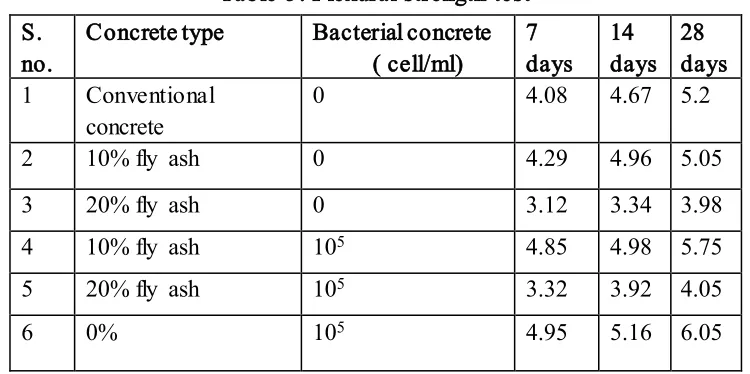
Table 5: Flexural strength test S.
no.
Concrete type Bacterial concrete
( cell/ml)
7 days
14 days
28 days
1 Conventional
concrete
0 4.08 4.67 5.2
2 10% fly ash 0 4.29 4.96 5.05
3 20% fly ash 0 3.12 3.34 3.98
4 10% fly ash 105 4.85 4.98 5.75
5 20% fly ash 105 3.32 3.92 4.05
6 0% 105 4.95 5.16 6.05
The table 4 shows the strength for split
tensile has increased for the bacterial
concrete to which 10% fly ash added as
replacement and decreased for 20% fly
ash for 7 days of curing, also the same
was observed for the 14, 28 days of
curing. The values have increased for the
bacterial concrete with fly ash added for
10% compared to bacterial concrete with
fly ash at 20%, bacterial concrete
without fly ash and conventional
concrete.
The table 5 shows the test
values conducted for flexural strength
test for 7, 14, and 28 days of curing .It
can be seen that Bacterial concrete with
fly ash at 10% has achieved greater
strength compared to conventional
concrete, bacterial concrete without fly
ash, and fly ash based concrete for 7,
Figure 3: variation of compressive strength for different concrete types
Figure 4: variation of tensile strength for different concrete types
Figur e 5 : v ar iat io n o f f lex ur al st r en gt h f o r dif f er en t co n cr et e t y p es.
25 25.25
19.84
29.85 26.25 30.05
31.5 32.2 30.92 35.2 33.93 34.76
41.2 45.3 34.92 49.85 38.4 49.06 0 10 20 30 40 50 60 conventional concrete concrete with 10% flyash concrete with 20% flyash concrete with 10% flyash + 10^5 cell/ml concrete with 20%flyash + 10^5 cell/ml bacterial concete 10^5 cell/ml C o m p re ss ive s tr engh tnof cub es in N /m m ^ 2
Bacterial concrete with flyash replacement
7days 14days 28days 2.54 3.2 3.05 3.95 3.28 4.16 2.78 3.43 3.1 4.06 3.35 4.98 3.95 4.02 2.95 4.11 3.41 5.2 0 1 2 3 4 5 6 conventional concrete concrete with 10% flyash concrete with 20% flyash concrete with 10% flyash + 10^5 cell/ml concrete with 20%flyash + 10^5 cell/ml bacterial concete 10^5 cell/ml T ens ile s tr engt h o f c yl ind er s in N /m m ^ 2
Bacterial concrete with flyash replacement
7days 14days 28days 4.08 4.29 3.12 4.85 3.32 4.95 4.67 4.96 3.34 4.98 3.92 5.16 5.2 5.05 3.98 5.75 4.05 6.05 0 1 2 3 4 5 6 7 conventional concrete concrete with 10% flyash concrete with 20% flyash concrete with 10% flyash + 10^5 cell/ml concrete with 20%flyash + 10^5 cell/ml bacterial concete 10^5 cell/ml F le xu ra l t es t o n b ea m s in N /m m ^ 2
Bacterial concrete with replacement of flyash
Fig3 shows the variation of compressive
strength with different concrete types at
7days, 14 days and 28 days respectively.
At 7days of curing the strength of
hardened concrete is been gradually
decreasing, at 14 days of curing the
strength has increased compared to 7
days, whereas at 28days of curing it
attains maximum strength and coincide
with the linear values.
Fig.4 shows the variation of Split
Tensile strength of concrete at 7days, 14
days and 28days. Here the value of
tensile strength is decreasing at 7days of
curing, strength has increased at 14 days
of curing, and the strength has increased
a lot more compared to 14 days curing at
28days of curing.
Fig.5 shows the flexural strength
of the specimen at 7days, 14 days and
28days of curing with different concrete
types. In this case the strength of the
casted specimen is low at 7days of
curing when compared to that of 14 days
and 28days of curing which clearly
indicates the Flexural strength of the
specimen.
It has been observed from the test
results that the results for bacterial
concrete with fly ash, bacterial
concrete without fly ash , fly ash
concrete and conventional concrete
types has exhibit good workability.
Workability characteristics i.e., slump
test, compaction factor test has
attained good result for the
concrete to which fly ash added to 10%
as partial replacement to cement along
with the mixing of bacteria bacillus
odeyssei.
It is observed that the, the
compressive strength for the bacterial
concrete with fly ash at 10% has
increased for 7, 14, and 28 days age of
concrete compared to bacterial
concrete with fly ash at 20%.
It is observed that bacterial concrete
with fly ash is achieved good
compressive strength compared to
bacterial concrete without fly ash at
both 10% and 20%, fly ash based
concrete and conventional concrete.
Also for the tensile strength test the
Bacterial concrete with fly ash at 10%
compared to bacterial concrete
without fly ash for 10%, 20% for 7,
14, 28 days ages of concrete.
Flexural test conducted have shown
that bacterial concrete with fly ash at
10% has received high strength
compared to bacterial concrete
without fly ash and bacterial concrete
without fly ash at 20% and
conventional concrete.
Therefore from the experimental
results, the compressive strength, split
tensile strength and flexural strength
increased for bacterial concrete with
fly ash for 10%.
Hence from the above all the results it
can be said that strength has increased
for the bacterial concrete, also
which act as self-healing concrete.
CONCLUSION
All the mixes used in this study exhibits
the good workability characteristics, in
accordance with the IS 12269-1987
specifications.Workability characteristics
i.e., slump test, compaction factor test
has attained good result for the concrete
to which fly ash added to 10% as partial
replacement to cement along with the
mixing of bacteria bacillus odeyssei. It is
observed that the, the compressive
strength for the bacterial concrete with
fly ash at 10% has increased for 7, 14,
and 28 days age of concrete compared to
bacterial concrete with fly ash at 20%. It
is observed that bacterial concrete is
achieved good compressive strength
compared to bacterial concrete with fly
ash and bacterial concrete without fly
ash at both 10% and 20%.
Also for the tensile strength test the
Bacterial concrete with fly ash at 10%
has got increased value compared to
bacterial concrete without fly ash at 20%
for 7, 14, 28 days ages of concrete.
Flexural test conducted have shown that
bacterial concrete has received high
strength compared to bacterial concrete
with fly ash and bacterial concrete
without fly ash at 10%, 20% .Therefore
from the experimental results, the
compressive strength, split tensile
strength and flexural strength increased
for only bacterial concrete. Hence from
the above all the results it can be said
bacterial concrete, also which act as
self-healing concrete.
The results show that the effect of
bacteria has really worked out as it is
giving great strength and as it is
eco-friendly it is a very good material
and is safe to use as it is totally harmless
to living beings. This concrete can be
used to prevent cracks and hence saving
the structure from corrosion of steel.
REFERENCES
1. Dhaarani, M., Prakesh, K., (2014),
“Durability study on HVFA based
bacterial concrete- A literature study”,
volume-3, September 2014.
2. Gavimath, C.C., Mali, B.M., Hooli,
V.R., Mallapur, J.D., Patil, A.B.,
Gaddi, D.P., Ternikar, C.R.,
Kavishankera, B.E., (2012),
“Potential application of bacteria to
improve the strength of cement
concrete”, volume-3, issue-1,PP
541-544.
3. Goyal, M., P. Krishna, (2015),
“Behaviour of Bacterial Concrete as
Self-Healing Material” Volume 5,
Issue 1, January 2015.
4. Gun-Cheol Lee, G.C., Yan, S.J.,
Joumg, J.H., Choi, J.G., Joe,
J.H.,(2011), “A fundamental study
on CO2 absorption efficiency of
cement motor mixed with
Photosyenthesis Bacteria”, PP
174-179.
5. Karma, V.V., George, R.P., Menaka,
M., Sharath, D., Mudali, U.K.,
Venkataramana, B., (2012), “Biofilm
formation and thermo-graphic
evaluation of fly ash concrete in sea
water”, volume-3, May 2012
6. Kashyap, A.M.N., Ramya, S.P.S.,
(2014), “An experimental study on
durability of concrete using fly ash
and GGBS for M30 grade concrete”,
volume-10, issue-11, September
2014, PP 1-5.
7. Kumar, J., Pushpa, Prabhakara, R.,
(2014), “Eco-Bricks by Microbial
Mineral Precipitation” Volume 2,
Number 1 (2014), pp.77-84
Kumar, J.B.G.., Prabhakara, R., Puchma,
H., (2013), “Effect of bacterial calcite
precipitation on compressive strength of
motor cubes”, volume-2, issue-3, June
K. Sriramya
Research Scholar in M.TECH
(Structures) Aurora’s Technological & Research Institute
Parvathapur(V), Ghatkesar(M), Ranga Reddy, Telangana
Email :- [email protected]
L. Aparna
Assistant Professor M. TECH
(Environmental Engineering) Aurora’s Technological & Research Institute
Parvathapur(V), Ghatkesar(M), Ranga Reddy, Telangana