A Study of Cross Layer Design compare with
Layer Design for MANET
1
Logesh. K, 2 Dr. Srinivasa Rao Madane .S
1 Research Scholar, Department of Computer Science, Anna University,
2 Principal, Adhi Parashakthi Engineering College, Kalavai,
Abstract - Mobile Ad – hoc networks (MANET) are becoming increasingly popular in wireless technology, especially for providing services in disaster area. Mobile users are looking forward to new technologies that allow them to communicate anytime, anywhere, and using any communication device. Mobile ad – hoc networks suffer from several performance limitations, especially related to excessive burden deriving from the layering approach for the TCP / IP protocol stack design. In fact, TCP / IP protocol stack originally designed for wired networks and it is not suitable for wireless and mobile ad hoc networks. In this paper, it focuses on cross layer network design which is especially for wireless and mobile ad hoc networks. The main objective is to how cross layer differ from layered design, cross layer design approaches, challenges of cross layer design and implementation of cross layer design based MANET. And also this article brief the readers an overview of cross layer concept while discussing different cross layer proposals given by researchers.
Keywords - Cross Layer Design, MANET, Routing Protocol, Wireless Communication.
1. Introduction
A mobile ad hoc network (MANET) is a collection of mobile nodes which does not required any infrastructure for communication. In MANET routing and resource management are done in a distributed manner in which all nodes coordinate to enable communication among them. This requires each node to be more intelligent so that, it can function both as a network host for transmitting and receiving data and as a network router for routing packets from other nodes. Applications of MANETs can be useful in many areas including disaster relief, tactical operations in military area, inter – vehicle communications, entertainment and emergency operations such as crowd control, search and rescue. The Characteristics of TCP / IP Protocol stack are high bandwidth, low delay, low packet loss probability, static routing and no mobility. Hence TCP / IP performs poorly in MANET. The main reasons
for poor performance are in the very nature of ad – hoc networks as follows:
a. Mobility
One of the main advance offered by mobile ad hoc networks are user terminal mobility, which allow user can access network while uninterrupted service. Traditionally, mobility management solutions resided within a single layer, with a logical division into network layer solutions and link layer solutions.
b. Media Access
Unlike cellular networks, there is a lack of global synchronization in ad hoc networks. Hence TDMA and FDMA are not suitable. And also many MAC protocols do not deal with host mobility. As such, the scheduling of frames for timely transmission to support QoS is difficult. In ad hoc networks, since the same media are shared by multiple mobile ad hoc nodes, access to the common channel must be made in a distributed fashion, through the presence of MAC protocol. The fact is nodes are dynamic, and it cannot rely on a centralized coordinator. The presence of mobility management, hidden and exposed terminals problems must be accounted while designing MAC protocol for ad hoc networks.
c. Routing
Due to mobility implies that link may be broken between source and destination. Distance Vector based routing is not designed for ad hoc networks, it is still applicable to packet radio networks since the rate of mobility is not high. Hence new routing protocols are needed.
d. Multicast
Some multicast protocol uses a broadcast – and – prune approach to build a multicast tree rooted at the source. Others use core nodes where the multicast tree originated. All such methods rely on the fact that routers are static; and once multicast tree is formed, tree node will not move. However, this is not the case in ad hoc networks due to nodes are dynamic.
e. TCP Performance
TCP is an end – to – end protocol designed to provide flow and congestion control in a network. TCP is unable to distinguish the presence of mobility and network congestion. Mobility by nodes in a connection can result in packet loss and long RTT (Round Trip Time). Hence some enhancements are needed to ensure that transport protocol performs properly without affecting end – to – end communication throughput.
1.1 Layered Design
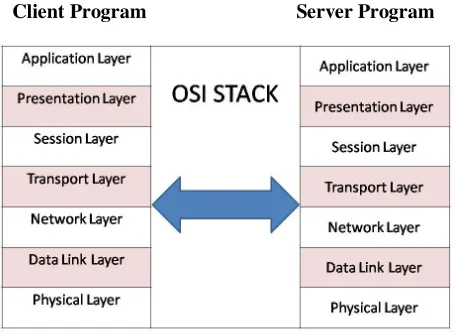
ISO / OSI model was developed to support standardization of network architectures using the layered model. The main concepts motivating layering are the following:
1. Each layer performs a subset of the required communication functions
2. Each layer relies on the next lower layer to perform more primitive functions
3. Each layer provides services to the next higher layer
4. Changes in one layer should not require changes in other layer
Such concepts were adoptable to reference protocol stack of seven layers, starting from physical layer up to application layer.
Client Program Server Program
Fig. 1 Layered Architecture
In order for layers to access the services provided by their lower layers, each layer is provided with a Service Access
Point (SAP). Through this SAP the higher layer can
access the services offered by its immediate lower layer. Hence the lower layer is a service provider and higher layer is a service user. A layer for its convenience, a data unit split into several data unit before sending it to next lower layer. Each such unit is termed as Protocol Data Unit.
A protocol at a given layer is implemented by an entity (software, hardware and firmware) which communicate with other entity implementing the same protocol by Protocol Data Units (PDUs).
The higher layer is no way to aware of services are actually implemented in lower layer. So implementation details and internal parameters are hidden to the remainder layers. Through this it enables “information- hiding” property.
Standardization of layered protocol stacks has enabled fast development of inter-operable systems, at the same time due to lack of coordination among layers, limited the performance of the overall architecture.
Physical Layer
In physical layer, interferences and fading are the major issues that results in bit error and packet losses. In wired network, it can ignore the probability of packet loss due to bit errors, but this is not applicable in MANET. TCP originally designed for wired networks, its congestion avoidance mechanism does not consider link error as a reason for packet errors or losses. Instead TCP faces packet losses caused by bit errors as congestion. This can significantly degrade the performance of TCP over MANET. When TCP unnecessarily invoke congestion control can causing reduction in throughput.
MAC Layer
At the MAC layer, the contention based medium access may induce delay and is not completely avoiding collisions causing packet losses if retransmission mechanisms are unable to clear the problem. Retransmission mechanism may increase the transmission delay and create jitter as the number of required retransmission varies. The contention and risk of collisions are much higher in MANET than wired network.
Network Layer
designed for wired networks. i.e., for TCP / IP Model. In MANET, the routing protocol’s delay in detecting topology changes may lead to link failure and risk of loops. And also end – to – end transmission will change as a result of changing paths between source and destination. If transmission time is increased too much, timeouts will occur on the TCP sender, cause unnecessary retransmission.
Route failure and route changes may impact TCP in several ways. Route failure can cause packet loss at intermediate nodes. These will be interpreted as congestion loss, a timeout event happen and TCP enters the slow start process as if congestion occurred. But really it is not due to congestion. Even routing protocol is able to re-route the packet without packet loss, out-of-order packet delivery can occur due to route changes.
Transport Layer
TCP is an end – to – end protocol. The performance and attribute of this layer is not known by its upper layer. However, any improvement in TCP performance in MANETs by tuning the TCP protocol will have to deal with senders that may not be aware of receiver or part of the router, is in a MANET.
2. Cross Layer Design
To overcome such limitations, a modification of the layering paradigm has been proposed, namely cross – layer design. The main aim of this approach is maintain the functionalities of associated to the original layers but coordination, interaction and joint optimization of protocols crossing different layers.
The following are the two approaches of cross layer design.
1. Evolutionary approach 2. Revolutionary approach
In evolutionary approach, extend existing layered structure in order to maintain compatibility and interaction among entities at different layers of the protocol stack.
In revolutionary approach, the performance will be evaluated at first and compatibility later. It increases cost and complexity.
Cross layer architecture is to be implemented in four different ways
1. interlayer signaling pipe 2. direct interlayer communication 3. central cross – layer plane
4. network – wide cross layer signaling
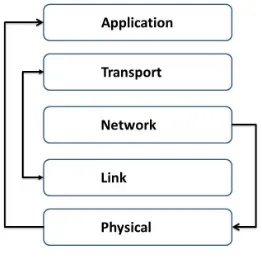
2.1. Interlayer Signaling Pipe
In this approach signaling pipe allows propagation of signaling message from layer to layer in bottom to top or top to bottom manner.
Fig. 2.1 Interlayer signaling pipe
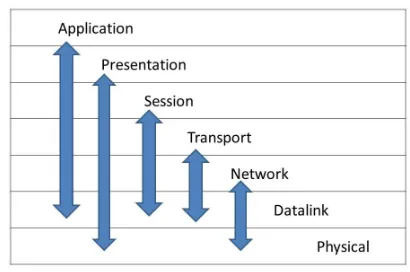
2.2. Direct interlayer communication
This method is advanced for interlayer signaling pipe by introducing signaling shortcuts. In this approach, without processing any adjacent layer, non – neighboring layer can communicate or exchange messages. Practically, direct interlayer communication between the layers means making the variables at one layer visible to the other layers at runtime. In strictly layered architecture, every layer manages its own variables, and its variables are hidden from other layers.
Fig. 2.2 Direct interlayer Communication
2.3. Central Cross – Layer Plane
layer, providing the service of storage and retrieval of information to all the layers. The main challenge here is the design of the interactions between the different layers and the shared database.
Fig. 2.3 Central Cross Layer Plane
2.4. Network Wide Cross Layer Signaling
2.4 Network wide Cross Layer Signaling
Cross Layer Design Proposals:
The layer architecture can be violated in the following basic ways:
1. Creating new interface
a. lower layer to higher layer communication b. higher layer to lower layer communication c. both way communication
2. Merging of two or more layers
the functionality of two layers might be merged so that the proposal architecture design for cross layer based mobile ad – hoc network.
3. Different Cross Layer Proposals
In [2] SAMAC protocol integrated with Cross layer protocol that consists of different communication functionalities that allow high utilization of sectored antenna in Wireless Sensor Networks. It is designed to achieve the following objectives: i. Enhance throughput and end to end delay of the sensor network by reusing capability of directional antennas. ii. High packet delivery ratio by minimizing channel contention and packet collisions in the shared wireless communication medium. iii. Extend sensor battery lifetime by minimizing transmission of data and reception power idle listening.
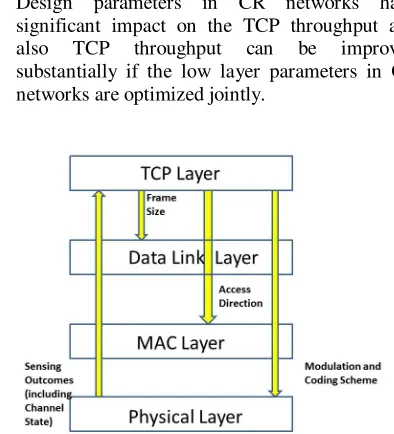
The authors [1] will take a cross layer design approach to optimize TCP throughput over CR (cognitive Radio) networks without modifying standard TCP. Some distinct features of the proposed scheme are as follows.
• Channel miss detection and channel estimation deviation to jointly optimize TCP throughput in CR networks.
• Design parameters in CR networks have significant impact on the TCP throughput and also TCP throughput can be improved substantially if the low layer parameters in CR networks are optimized jointly.
Fig. 3.1 Cross Layer Optimization for TCP flow over CR networks
The Authors used in [4] Explicit Cross – Layer Approach. It gives leader - based approach for address auto configuration in MANET, called Optimized Dynamic address Configuration Protocol (ODACP).
In [4], the QoS guarantee of ad hoc networks is a systematic problem that can be solved through QBDSR (QoS based DSR), which is DSR based Cross layer QoS design method for QoS transmission performance and demand of all the layers and to dynamically control or regulate the correlation algorithm for QoS guarantee of important business. Guarantee by which a unified cross layer monitor is attached outside each protocol layer in ad hoc network to monitor packet
In [9] the proposed protocol takes into account the effect of node blocking to leaverage large throughput gains. This protocol is cross layer based on antenna selection has been implemented for MIMO spatial multiplexing based on ad hoc networks.
In [5] authors suggested that the cross layer design is the suitable for next generation network which is merging of wired, wireless, internet and satellites networks. As per the author suggestion, the present cross layer models do not perform well on cost and efficiency. Hence, they introduced novel cross – layer design model and LIAP (Layers Information Abstraction Profile) model. In this
models, the non – neighboring layers easily communicate through signal and during transmission, status of each layer is stored in LIAP. This will help to retrieve the one layer status information by any other layer. The following ideas are considered during new novel cross layer scheme.
i. The functional separation of cross layer information abstraction / collection and processing.
ii. The scheme can be easily extended
iii. A light-weighted and standardized external signaling should be adopted
ECLAIR [8] can serve as a blueprint of cross layer feedback systems. The main design goal of ECLAIR is separate system for the cross layer feedback and that interface would interact with concern existing layer. ECLAIR consists of two components i.e., 1. Optimization and 2.Tuning Layers.
The optimization subsystem contains protocol optimizers that effectuate cross layer optimizations. It works like an engine of a cross layer system. The protocol optimizers interact with the existing stack through the tuning layers. ECLAIR provides Tuning layer for each layered protocol. Tuning layer provides the necessary APIs to the protocol optimizers (POs) for interacting with various layers and manipulating various data structures.
Limitations of ECLAIR
This architecture creates multiple interfaces. All interfaces interacts each other for monitoring and increasing the network performance. The result is high control overhead.
4. Challenges in Cross Layer Design
In this section will be discussing about challenges of cross layer network design which is very much useful for researchers. Here, this paper came across various design proposal and initial ideas on how to interact with one layer to another.
1. Using cross layer network design to improve network performance.
2. Interaction between network layer and physical layer to avoid / reduce data error.
3. Merging data link layer and physical layer to reduce control overhead
4. Designing a new interface which interact network layer and application layer
5. How to communicate non-adjacent layers each other
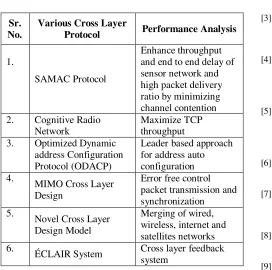
Table 1: Review Table
Sr. No.
Various Cross Layer
Protocol Performance Analysis
1.
SAMAC Protocol
Enhance throughput and end to end delay of sensor network and high packet delivery ratio by minimizing channel contention 2. Cognitive Radio
Network Maximize TCP throughput 3. Optimized Dynamic
address Configuration Protocol (ODACP)
Leader based approach for address auto configuration 4. MIMO Cross Layer
Design
Error free control packet transmission and synchronization 5. Novel Cross Layer
Design Model
Merging of wired, wireless, internet and satellites networks 6. ÉCLAIR System Cross layer feedback
system
5. Conclusion
In this paper first discuss about OSI Model Network architecture and its drawbacks for wireless mobile ad hoc networks. And it is decided that cross layer network design is suitable for wireless mobile ad hoc networks. A survey has done against various cross layer design proposals, its performance of the protocol stack and enhancement methodology. These surveys gives us the need for paradigm change from strictly layered protocol stacks to cross – layer design is clear from the benefits from cross layer design.
Future work may replace entire layered architecture completely. But it is not possible due to compatibility issue. Hence revolutionary approach is applicable. By leaving redundant part of layered structure and protocol will prove increase in network performance like optimization, efficient power utilization, delay in MANET.
References
[1] Changqing Luo, F. Richard Yu, Hong Ji, and Victor C.M. Leung. Cross – Layer Design for TCP Performance Improvement in Cognitive Radio Networks. IEEE transaction
[2] Emad Felemban, Serdar Vural, Robert Murawski, Eylem Ekici, Kangwoo Lee, YoungBag Moon, Sangjoon Park, SAMAC – a cross layer communication protocol for
sensor networks with sectored antennas. IEEE Transaction on Mobile Computing, Jan-2010
[3] I. F. Akyildiz, W.Y. Lee, M.C. Vuran and S. Mohanty, “Next Generation / Dynamic Spectrum access / Cognitive Radio wireless networks: A Survey, “ Computer Networks, vol. 50, no.13, pp2127-2159, 2006.
[4] Keming Du, Yilin CHANG, Bin Li. DSR – Based Cross – Layer QoS Design in Ad hoc Networks. 2010 International Conference on Communications and Intelligence Information Security DOI 10/.1109/ICCIIS.2010.31
[5] Li Zheqing, Fan Zhihui, Wang Hui. Research and Design on TCP Cross – Layer Enhancement Scheme in Next Generation Network. Natural Science Research Projects of Education Department of Henan Province(2009A520011).
[6] Nadir Shah, Depei Qian. Cross Layer Design for Merging of Unstructured P2P Networks over MANET. IEEE Transactions, 2010
[7] Q. Liu, s. Zhou, and G.B. Giannakis, “Cross Layer Combining of adaptive modulation and coding with truncated arq over wireless links”, IEEE Trans. Commun., Vol. 3, no. 5, pp. 1746-1755, Sep.2004. [8] Vijay T. Raisinghani, Sridhar Iyer, ECLAIR: An Efficient
Cross Layer Architecture For Wireless Protocol Stacks. World Wireless Cong., San Francisco, CA, May 2004. [9] Wei Fang Mao, Walla Hamouda, Iyad Dayoub. MIMO
Cross – Layer Design for Ad hoc Networks, IEEE Communication Society, IEEE Globecom 2010
[10] X. Wang, A.L. Toledo and B. Lu, “ A Cross Layer TCP modeling framework for MIMO wireless systems”, IEEE Trans. Wireless Commun., vol. 5, no. 4, pp. 920-929, 2006.
Authors Biography
K. Logesh obtained his Master’s degree in Computer Applications from University of Madras in 2001. Then he obtained his Master of Technology in Computer Science & Engineering from Dr. MGR Educational and Research Institute in 2007. Currently he is pursuing his Ph.D in Mobile Ad hoc networks at Anna University, Chennai. His research interests are cross layer networks, mobile ad hoc networks, sensor networks.
Dr. S. Srinivasa Rao Madane received BE(Electronics) from University Kuvempu in 1991, M.Tech(Electronics and Communications from Visvesvaraya Technological University in 2000. And Ph.D in Computer Science &
Engineering from Patna Technological
University in 2009. He is currently working as a Professor in Department of Electronics and Communication Engineering and Principal at Adhiparasakthi College of Engineering, Kalavai, Vellore District. His research interests are in digital electronics, embedded system, VLSI, Image Processing, Renewable Energy. He is a member of Indian Society for Technical Education (MISTE), Member of Institution of Electronics and Telecommunication Engineers (MIETE) and
Member of Institute of Electrical and Electronics