Algorithms for Efficient Duplicate Detection
D.SaiSree & N.Sirisha
PG Student, Dept. of MCA, QIS College of Engineering &Technology , VengamukkalaPalem. Assistant Prof, Dept. of MCA, QIS College of Engineering &Technology , VengamukkalaPalem.
ABSTRACT:
The presence of duplicate file is main data
quality concern in large databases. To
identification duplicates attribute resolution is
known as duplication detection. Duplicate
detection is process of detecting all cases of
multiple method of same real world entity. In
this paper propose new naive detection
algorithm using intelligent guesses which
records have a high possibility of representing
the same real-world entity, the search space is
reduced. An implement naive algorithm is used
as base line identification generates all possible
many objects is stored within the datasets. A
new e-mail abstraction scheme is proposed to
consider mail layout structure to display
e-mails. New security a Robust and Collaborative
Spam Detection System is used which possesses
if efficient near duplicate matching scheme and
a progressive update scheme. To maintain data
quality and schedule a duplicate detection for all
records is match a certain new process. Data
clean deleting deactivating or merging the
duplicates files by change detection method. The
proposed system identification for detection of
duplication data by using ranking methods.
Index Terms: Data cleaning, Record linkage,
Naive Bayes, HTML, Pay-As-You-Go, data
cleaning, dcs++.
1. INTRODUCTION
Today databases play an important role in IT
based economy. Number of industries and
systems depend on the efficiency of databases to
take total operations. The quality of the records
that are stored in the databases is significant cost
indications to a system the relies on information
to conduct business [1]. With this ever
increasing bulk of data, the data quality
problems Duplicate files detection is divided
into three steps. Candidate description, to decide
which objects is compared with each other [2]
And secondly duplicate definition, the criteria
based on which two duplicate candidates are in
reality duplicates. The duplicate detection
problem has two aspects: First, the multiple
representations are usually not the same but
contain differences, such as misspellings,
changed addresses, or missing values. This
makes it difficult to detect these duplicates.
Second, duplicate detection is a very expensive
operation, as it requires the comparison of every
complex similarity calculate. The paper
proposes the Parallel Duplicate Detection with
Map reduce concept [3]. The adaptive
techniques improve the efficiency in detecting
the duplication but these techniques cannot bear
up to the level of progressive techniques. The
Progressive techniques could process larger
dataset in short span of time and the quality of
data is also good comparatively [5]. The
Progressive duplicate detection makes it
different from the traditional approach by
yielding more complex results during the early
termination [4] . The algorithms of duplicate
detection also computes the duplicates at an
almost constant frequency but the progressive
algorithms increase the overall time as it finds
out the duplicates at the early stage itself. The
candidate keys in the record pairs that are
identical have to be first found out. the next
stage of spam detection research should focus on
dealing with cunning spams which evolve
naturally and continuously. In this paper, a novel
e-mail abstraction scheme is proposed which
considers mail layout structure to represent
e-mails[6]. A procedure to generate the e-mail
abstraction using HTML content in e-mail is
presented, which can more effectively capture
the near-duplicate phenomenon of spams.
Moreover, a complete spam detection system is
designed, which possesses an efficient
near-duplicate matching scheme and a progressive
update scheme. The progressive update scheme
enables system to keep the most up-to-date
information for near-duplicate detection [7].
2. RELATED WORK
Many research on duplicate detection [8] also
named as entity resolution gives different
methods for pair selection and duplicate
detection of the records. One of the most
important algorithms in this area are Blocking
[9] and sorted neighborhood method
(SNM).Blocking methods divides the data
records into disjoint subsets, while windowing
methods, in specific the Sorted Neighborhood
Method, slide a window over the sorted records
and compare records within each window. And
we had an algorithm called Sorted Blocks [10]
in several variants, which generalizes both the
approaches. A challenge for Sorted Blocks is in
finding the right configuration settings, as it has
more parameters than the other two approaches.
A merit of Sorted Blocks compared to the Sorted
Neighborhood Method is the variable partition
size instead of a fixed size window. This let
more comparisons if different records have same
values, but requires lesser comparisons if only a
few records are similar. In Record matching [12]
algorithms the existence of duplicate records
constitutes a problem which is becoming
increasingly alarming in networked
environments, as the size of individual databases
developed for this purpose. The integrity of
bibliographic databases are maintained with the
algorithms of record matching. The similar
records could never be matched at any stage
despite matching the bibliographic descriptions.
The progressive techniques like pay-as-you-go
[11] algorithms were used for integration on
large scale datasets. In pay-asyou-go, we
theoretically order the candidate pairs by the
chances of a match. The ER algorithms are used
for performing this.Entity resolution (ER) is the
problem of identifying which records in a
database refer to the same entity. For real-time
applications ER processing takes longer than a
certain amount of time.The progress of ER can
be maximised using hints that give information
on records that are likely to refer to the same
real-world entity. A hint can be represented in
various formats and ER uses this information as
a guideline for which records are computed first
[13]
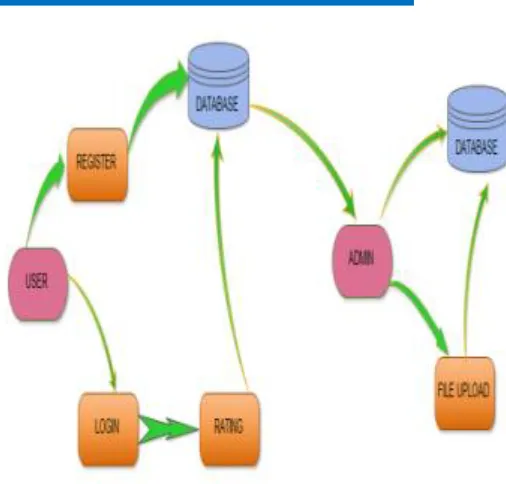
Figure1. Detection of Duplicate Datasets
3. PROGRESSIVE SORTED
NEIGHBOURHOOD METHOD
The process of duplicate detection is the method
of identifying multiple representations of same
real world entities. Today, duplicate detection
methods need to process very larger datasets in
very shorter time: maintaining the quality of a
dataset becomes increasingly difficult. One
existing system for finding duplicates includes
Fig 2: Duplicates the two progressive algorithm
a window. The perception is that data records
that are close in the sorted order are more likely
to be duplicates than records that are far apart,
because they are already alike with respect to
their sorting key.
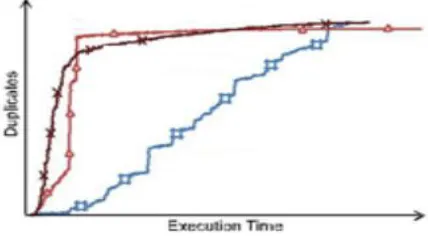
The PSNM algorithm differs by dynamically
changing the execution order of the comparisons
based on look-ahead results. Progressive
blocking (PB) algorithm [14] is another method
for duplicate detection. It is a blocking algorithm
instead of windowing method. Progressive
blocking (PB) is an approach that initiates upon
an equidistant blocking technique and the
successive enlargement of blocks. Even though
the progressive algorithms and the snm method
give faster results it may not find accurate
number of duplicates for large datasets. So this
disadvantage can be solved by using the
proposed algorithm.
Fig 3: Comparison of duplicates found by psnm
4. PROPOSED SYSTEM
To overcome the problem of serial duplicate
detection this work proposes an efficient and
flexible detection scheme that supports both
Progressive duplicate detection with map reduce
and parallel duplicate detection. The proposed
system is based on Map Reduce Algorithm.
A. Training Dataset:- In this Process user give
the input data to the proposed system. Here
training dataset loaded from company database
or inserting from user
B. Data Preprocessing:-Data preprocessing is a
data mining technique that involves
inconsistent, and/or lacking in certain behaviors
or trends, and is likely to contain many errors
C. Data Separation: In this process we separate
the large amount of data large data cannot be fit
in to main memory so it is divided into different
parts each part is called as cluster
D. Duplicate Detection: In this process we
detect the duplicate records from cluster
The most important task is duplicate detection.
The process of identifying multiple
representation is generally named as duplicate
detection. Generally, a particular user may rate
the product two or more times. This multiple
representation is named as duplication. The
process of duplicate detection generally
comprises three steps such as pair-selection, pair
wise comparison and clustering. Here the
efficiency of duplicate detection is improved by
the concurrent approach. The detection and
elimination of duplication is done concurrently
[16].
Figure 4.Detetion of duplicate datasets using
algorithm
A. The System Model Codes
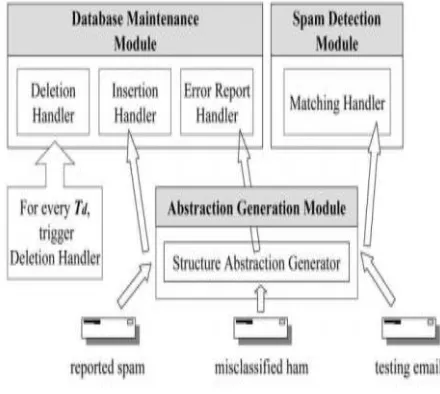
The system model of the algorithmic form is
outlined starting to do the spam detection,
Cosdes collects feedback spams for time Tm in
advance to construct an initial database. Three
major modules, Abstraction Generation Module,
Database Maintenance Module, and Spam
Detection Module, are included in Cosdes. With
regard to Abstraction Generation Module, each
e-mail is converted to an e-mail abstraction by
Structure Abstraction Generator with procedure
SAG. Three types of action handlers, Deletion
Handler, Insertion Handler, and Error Report
Handler, are involved in Database Maintenance
Detection Module takes charge of determining
results.
Fig. 5. System model of Cosdes.
There are three types of e-mails, reported spam,
testing email, and misclassified ham, required to
be dealt with by Cosdes. When receiving a
reported spam, Insertion Handler adds the e-mail
abstraction of this spam into the database except
that the reputation score of this reporter is too
low.
Spammers are finding ways to trick people into
thinking their unsolicited junk messages are
worth the time you spend reading them. A list of
the top five ways to tell if an email is spam is as
follows [17]. These rules can help you when
spam slips through the protection of your Spam
filter.
• Look at the Email Address
• Look at the Content
• If it asks for personnel Information
• Look at the Greeting
B. PROGRESSIVE METHOD WITH
ADAPTIVE WINDOW
We propose a new method which is a
combination of progressive sorted neighborhood
method and data count strategy (dcs++). And
this method helps to overcome some of the
demerits of this algorithm. In this system
window enlargement process is not used as in
the progressive sorted neighborhood method
instead uses sorting, partitioning and other
methods but it uses the windowing and
partitioning concept of dcs++. Here the main
concept used is the partitioning and distance
calculation thus finding the duplicates. The
whole data record is partitioned into different
partitions of same size and duplicate detection is
done with the partitions. Thus it takes slighter
more time than the progressive sorted
neighborhood method but yields better results by
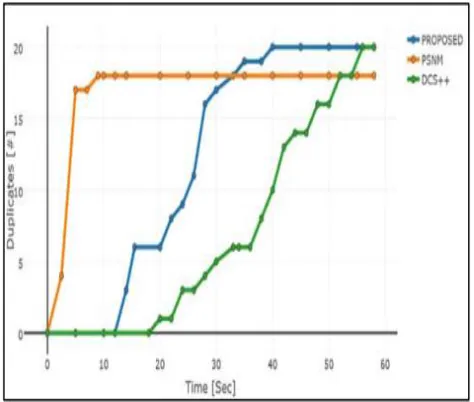
detecting more number of duplicates. And when
compared to dcs++, the processing speed of the
proposed system is less thus overcoming the
disadvantage. Even though compared to psnm it
gives more duplicates and take less time than the
and this issue can be solved by using map reduce
technique to this algorithm as it is done with
snm to provide parallel sorted neighborhood
method[18].
5. RESULT EVALUATION
Detection of duplication was very arduous in the
beginning. Later on many algorithms were
proposed to detect the duplication, but each algorithm had its‘ own drawbacks. At each
stage, certain technologies were used with
advancement at each stages. In this paper, the
advancement brought was to detect the
duplication concurrently along with several
other operations. The graph indicates the
improvement of performance in detecting the
duplication over a period of time drastically.
Figure 6: Performance evaluation for detection
of duplication
6. CONCLUSION AND FUTURE
WORK
This paper introduces an algorithm that is used
for detecting duplication concurrently. This
algorithm increase the efficiency of duplicate
detection for situations with limited execution
time; they dynamically change the ranking of
comparison candidates based on intermediate
results to execute promising comparisons first
and less promising comparisons later. The
specific procedure SAG is proposed to generate
the e-mail abstraction using HTML content in
email, and this newly-devised abstraction can
more effectively capture the near-duplicate
phenomenon of spasm. In future work, we want
to connect our progressive duplicate detection
using adaptive window algorithm with scalable
methods for duplicate detection to provide
results even faster. a complete spam detection
system Cosdes has been designed to efficiently
process the near-duplicate matching and to
progressively update the known spam database.
7. REFERENCES
[1] S. E. Whang, D. Marmaros, and H. Garcia-Molina, “Pay-as-you-go entity resolution,” IEEE
Trans. Knowl. Data Eng., vol. 25, no. 5, pp.
1111–1124, May 2012.
[2] U. Draisbach, F. Naumann, S. Szott and O. Wonneberg, “Adaptive Windows for Duplicate
Detection”, Proceedings of the IEEE 28th
International Conference on Data Engineering,
Arlington, Virginia, USA, (2012) April 1-5
[3] M. A. Hernández and S. J. Stolfo,
merge/purge problem,” Data Mining and
Knowledge Discovery, vol. 2, no. 1, 1998
[4] Progressive Duplicate Detection‖, Thorsten
Papenbrock, Arvid Heise, and Felix Naumann,
IEEE Transactions on Knowledge and Data
Engineering,May 2015.
[5] Efficient and Effective Duplicate Detection
Evaluating Multiple Data using Genetic
Algorithm, Dr.M.Mayilvaganan, M.Saipriyanka,
Sep 2015
[6] M. Siva kumar reddy & Krishna Sagar. “Improved Near duplicate matching scheme for
e-mail spam Detection” International Journal of
Internet Computing ISSN No: 2231 – 6965,
VOL- 1, ISS- 4 2012 29
[7] S. Sarafijanovic, S. Perez, and J.-Y.L. Boudec, “Resolving FP-TP Conflict in
Digest-Based Collaborative Spam Detection by Use of Negative Selection Algorithm,” Proc. Fifth
Conf. Email and Anti-Spam (CEAS), 2008.
[8] K. Elmagarmid, P. G. Ipeirotis, and V. S. Verykios, “Duplicate record detection: A survey,” IEEE Trans. Knowl. Data Eng., vol. 19,
no. 1, pp. 1–16, Jan. 2007.
[9] H. B. Newcombe and J. M. Kennedy, “Record linkage: Making maximum use of the
discriminating power of identifying
information,” Commun. ACM, vol. 5, no. 11,
[10] U. Draisbach and F. Naumann, “A
generalization of blocking and windowing algorithms for duplicate detection,” in Proc. Int.
Conf. Data Knowl. Eng., 2011, pp. 18–24.
[11]. J. Madhavan, S. R. Jeffery, S. Cohen, X. Dong, D. Ko, C. Yu, and A. Halevy,
―Web-scale data integration: You can only afford to pay as you go,‖ in Proc. Conf. Innovative Data
Syst. Res., 2007
[12]. R. Baxter, P. Christen, and T. Churches, ―A comparison of fast blocking methods for record linkage,‖ in Proceedings of the ACM
SIGKDD Workshop on Data Cleaning, Record
Linkage, and Object Consolidation, 2003, pp.
25–27.
[13]. S. E. Whang, D. Marmaros, and H. Garcia-Molina, ―Pay-as-you-go entity resolution,‖
IEEE Trans. Knowl. Data Eng., vol. 25, no. 5,
May 2012.
[14] Thorsten Papenbrock, ArvidHeise, and
Felix Naumann, “Progressive Duplicate
Detection,” IEEE Transactions on Knowledge
and data engineering, vol. 27, no. 5, May 2015.
[15]. O. Hassanzadeh, F. Chiang, H. C. Lee, and
R. J. Miller, ―Framework for evaluating clustering algorithms in duplicate detection,‖
Proc. Very Large Databases Endowment, vol. 2,
[16]. L. Gu and R. Baxter, ―Adaptive filtering for efficient record linkage,‖ in Proceedings of
the SIAM International Conference on Data
Mining, 2004, pp. 477–481.
[17] E. Damiani, S.D.C. di Vimercati, S. Paraboschi, and P. Samarati, “P2P-Based Collaborative Spam Detection and Filtering,” Proc. Fourth IEEE Int’l Conf. Peer-to-Peer
Computing, pp. 176-183, 2004.
[18] L. Kolb, A. Thor, and E. Rahm, “Parallel
sorted neighborhood blocking with
MapReduce,” in Proc. Conf. Datenbanksysteme in B€uro, Technik und Wissenschaft, 2011.
AUTHORS:
D.SaiSree is currently pursuing her MCA in MCA Department, QIS college of
Engineering & Technology,
VengamukkalaPalem , A.P. She received her
Bachelor of Computer Applications from ANU.
N.Sirisha was completed her MSC. Presently
she is working as an Assistant Professor in MCA Department, QIS College Of Engineering&Technology,
VengamukkalaPalm. Her research includes