1
The concept of IR
• It is a relatively long-term association between two or more people
• This association may be based on emotions like love and liking, regular business
3
• Healthy and unhealthy relationship
• Research on IR focuses on those
relationships that are close, intimate
and interdependent (i.e., the behavior
of each affects the outcomes of the
other)
• Close relationship is always related to
love, trust, commitment, caring,
5
• Majority of work on relationship has focused on taking the pulse of the relationship (the assessment of
interrelated but distinct concepts, such as quality, stability, happiness and
Types of Relationship
• IR take place in a great variety of
contexts, such as family, friends,
marriage, work, clubs and
7
• Interpersonal relationships include kinship and family relations in which people
become associated by genetics or consanguinity.
• Relationships can also be established by marriage, such as husband, wife, father-in-law, mother-in-father-in-law, uncle by marriage, or aunt by marriage.
• They may be formal long-term
relationships recognized by law and
9
• They may also be informal long-term
relationships such as loving relationships or romantic relationships with or without living together.
• Friendships consist of mutual liking, trust, respect, and often even love and
unconditional acceptance. They usually imply the discovery or establishment of similarities or common ground between
11
• Internet friendships and
pen-pals may take place at
a considerable physical
• Brotherhood and sisterhood can refer to
individuals united in a common cause or having a common interest, which may involve formal membership in a club, organization, association,
13
• Partners or co-workers in a
• Soulmates are individuals intimately drawn to one another through a favorable
meeting of minds and who find mutual acceptance and understanding with one another.
• Soulmates may feel themselves bonded together for a lifetime and hence may
15
• Platonic love is an affectionate
relationship into which the sexual
element does not enter, especially in
cases where one might easily
RELATIONSHIP PROCESS
• COGNITIVE PROCESS
• AFFECTIVE PROCESS
17
COGNITIVE PROCESS
• All relationships begin with two
people who are strangers to each
other
• Impression formation of strangers is
of great consequence for
• Our mind begins processing clues to
the stranger’s nature (e.g. person’s
appearance)
19
• Knowing another person
– How we come to know another person can be viewed as the process by which
we learn to accurately predict how that person
•
Expectancies
–The beliefs we hold about the
probable behavior of other people
and the probable occurrence of
other future events
21
• Social expectancies vary along 4
dimensions
1. Certainty
- the subjective level of probability
associated with the occurrence of the future event
2. Accessibility
3. Explicitness
- refers to whether or not the individual is
consciously aware of holding the expectancy
4. Importance
-refers to the extent to which the expectancy
23
Consciousness and the Mind’s
Activities
• The principal mission of cognitive psychology is to understand the
psychological structure of the human mind and the processes by which it operates.
• William James (1890) characterized
consciousness as the “ultimate mystery” for psychologists to solve.
• Cognitive psychologists now know that
intuition, gut feelings, chemistry and vibes are manifestations of the workings of the extraordinary efficient and powerful human mind
25
Processing Social Information
• Dual Process theories
–How we process, store, and
access information about other
people
Automatic/Associate Mode
Controlled/Rule-based Mode
• Unintentional •Intentional • Uncontrollable • Controllable • Inaccessible to
awareness
versus • Accessible to awareness • Efficient (requires little
attention)
• Effortful (requires attention)
• Accesses long term memory system
• Accesses long-term and short-term
27
Automatic/Associative Information
Processing and Regularities in the Social Environment
3 memory systems
SHORT-TERM
Holds the objects in system long enough to “work”
on them
SENSORY
To register and briefly retain
incoming information from the sense
LONG-TERM MEMORY
• Long-term memory is also called as associative memory system (Smith & Decoster, 2000)
29
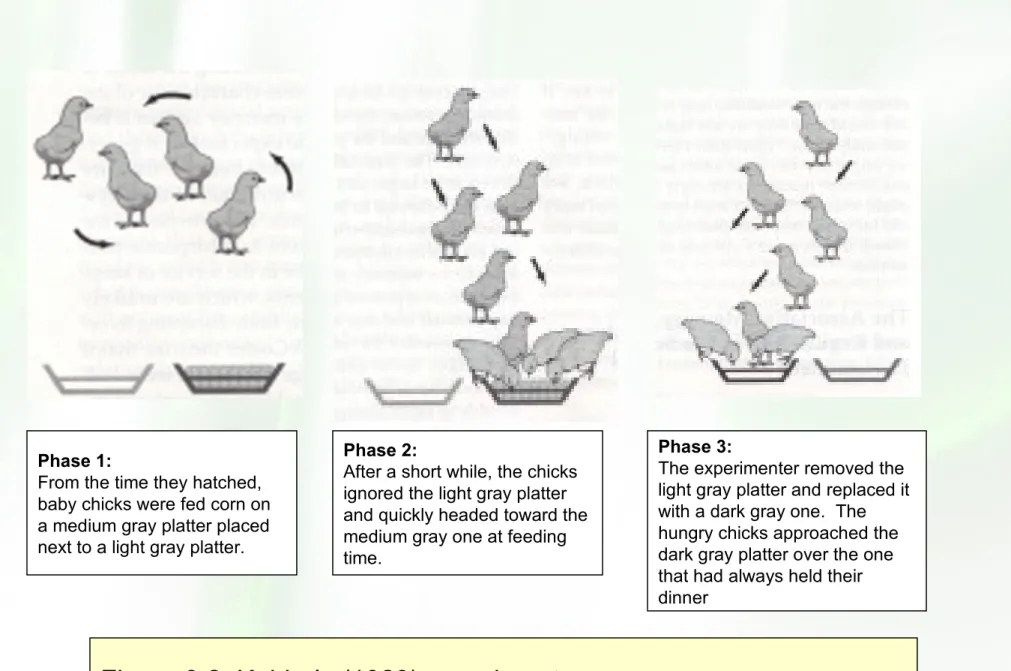
Phase 1:
From the time they hatched, baby chicks were fed corn on a medium gray platter placed next to a light gray platter.
Phase 2:
After a short while, the chicks ignored the light gray platter and quickly headed toward the medium gray one at feeding time.
Phase 3:
The experimenter removed the light gray platter and replaced it with a dark gray one. The hungry chicks approached the dark gray platter over the one that had always held their dinner
Controlled/Rule Based Information
• It is associated with conscious decision-making and problem solving.
31
• Fast-learning memory system
– Integrate the slow learning, short term, long-term and associative memory
system
• Dual process theorists of social cognition believed that we use the more demanding and effortful controlled/rule based
processing under two conditions:
1. When we are highly motivated to make accurate predictions about another’s behavior 2. When we have time to engage in
33
FIRST IMPRESSIONS AND RELATIONSHIP
• The first impressions are critical to the relationship for at least 2 reasons:
1. Will determine whether there will be subsequent interactions
AFFECTIVE PROCESS
• Emotions effect the relationships with others
• Emotions
– Feelings that generally have both
35
BASIC EMOTIONS
37
The Function of Emotions
• Preparing us for action
– A link between events in our environment and our responses
• Shaping our future behavior
The Function of Emotions
• Helping us to interact more effectively with others
– Act as a signal to observe, allowing
39
THEORY OF EMOTIONS
• James-Lange theory of emotion
• Cannon-Bard theory of emotion
• Schachter- Singer theory of
James-Lange theory of emotion
• James and Lange proposed that we experience emotions as a results of physiological changes that produce specific sensations.
• In turn, these sensations are interpreted by the brain as particular kinds of
41 Emotional Stimulus Physiological Arousal Experienced Emotion
Figure 3.3 : James-Lange theory of emotion: The emotional stimulus (e.g., hearing footsteps behind you in a dark alley)
Cannon-Bard theory of emotion
• The major trust of the theory is to rejectthe view that physiological arousal alone leads to the perception of emotion.
• Instead, the theory assumes that both physiological arousal and the emotional experience are produced simultaneously by the same nerve stimulus, which
43 Emotional Stimulus Physiological Arousal Experienced Emotion Figure 3.4:
Cannon-Bard theory of emotion: The emotional stimulus (e.g., hearing
footsteps behind you in a dark alley) activates the thalamus. The thalamus
sends 2 messages at the same time: 1 message to the cortex, which produces an experience emotion (e.g., fear), and 1 message to the hypothalamus
Schachter- Singer theory of emotion
• Focus on the role of cognition
• They proposed that emotion has 2 components which are physiological arousal and cognitive label
• The cognitive label is like the channel
45
Emotional Stimulus
Physiological
Arousal Cognitive Label
Experienced Emotion
Figure 3.5: Schacter-Singer theory of emotion.
DISPOSITIONAL INFLUENCES
• Certain dispositional properties (e.g.,
47
• The interaction between 2 persons is influenced by their properties and
situation
Interaction = f (Situation, properties
of A, properties of B)
Maleness and Femaleness
• The attributes of maleness and
femaleness – both biological sex and
psychological gender are associated
with a variety of relational
49
• Examples:
– Emphatic Accuracy : women > men – Coping behavior : women≠men
– Self-Disclosure and Intimacy : women≠men
Theoretical Explanations for Sex Differences
• Two general categories
1. Social factors
– Sex differences in social behavior because of social learning and
socialization
2. Biological or genetic influences
– Differential male and female biology,
51
• Personality traits, chronic affective states, needs or motives, and interpersonal belief systems also seem to play a role in
BEHAVIOR
• Broadly defined as covert responses
and overt responses that are
observable and measurable
53
• Human behavior is influenced by
• Behavior doesn’t automatically or
inevitably follow internal
processes such as thought and
feelings
55
• One important type of meaning
links an action to goal
• A goal is an idea of some
desired future state
• A goal tells you how to pursue
and uphold your values
• A person’s goals reflect the influence
of both inner processes and cultural
factors
• Culture sets out a variety of possible
goals, and people choose among
57