Exact Traveling Wave Solution for Nonlinear Fractional
Partial Differential Equation Arising in Soliton using the
exp (
−𝝋(𝝃))
-Expansion Method
Emad H. M. Zahran
Department of Mathematical and Physical Engineering, University of Benha, College of Engineering Shubra, Egypt
ABSTRACT
The exp((−𝜑(𝜉))-expansion method is used as the first time to investigate the wave solution of a nonlinear the space-time nonlinear fractional PKP equation, the space-time nonlinear fractional SRLW equation, the space-time nonlinear fractional STO equation and the space-time nonlinear fractional KPP equation. The proposed method also can be used for many other nonlinear evolution equations.
Keywords
The exp ((−𝜑(𝜉))-expansion method; The space-time nonlinear fractional PKP equation; The space-time nonlinear fractional SRLW equation; The space-time nonlinear fractional STO equation; The space-time nonlinear fractional KPP equation; Traveling wave solutions; Solitary wave solutions; Kink-antikink shaped.
AMS Subject Classifications
35A05, 35A20, 65K99, 65Z05, 76R50, 70K701.
INTRODUCTION
The nonlinear partial differential equations of mathematical physics are major subjects in physical science [1]. Exact solutions for these equations play an important role in many phenomena in physics such as fluid mechanics, hydrodynamics, Optics, Plasma physics and so on. Recently many new approaches for finding these solutions have been proposed, for example, tanh - seen method [2]-[4], extended tanh - method [5]-[7], sine - cosine method [8]-[10], homogeneous balance method [11, 12],F-expansion method [13]-[15], exp-function method [16, 17], trigonometric function series method [18], (𝐺
′
𝐺)— expansion method [19]-[22], Jacobi elliptic function method [23]-[26] and so on.
The objective of this article is to apply The exp((−𝜑(𝜉))-expansion method for finding the exact traveling wave solution of the time nonlinear fractional PKP equation, the space-time nonlinear fractional SRLW equation, the space-space-time nonlinear fractional STO equation and the space-time nonlinear fractional KPP equation mathematical physics.
The rest of this paper is organized as follows: In Section 2, we give the description of The exp((−𝜑(𝜉))-expansion method In Section 3, we use this method to find the exact solutions of the nonlinear evolution equations pointed out above. In Section 4, conclusions are given.
2.
DESCRIPTION OF METHOD
Suppose that we have the following nonlinear fractional partial differential equation:
𝑓(𝑢, 𝐷𝑡𝛼, 𝐷𝓍𝛼𝑢, … . ) = 0, 0 < 𝛼 ≤ 1, (2.1)
where 𝐷𝑡𝛼𝑢, 𝐷𝒳𝛼𝑢 are the modified Riemann-Liouville derivatives, and F is a polynomial in u(x, t) and its partial fractional derivatives, in which the highest order derivatives and the nonlinear terms are involved. In the following we give the main steps of this method.
Step 1. Using the nonlinear fractional complex transformation 𝑢 𝓍, 𝑡 = 𝑢 𝜉 , 𝜉 = 𝐾𝓍
𝛼
Γ(1 + 𝛼)+ 𝑐𝑡𝛼 Γ(1 + 𝛼)+ 𝜉0 where k, c, 𝜉0 are constants with k, c ≠ 0, to reduce Eq.(2.1) to the following ordinary differential equation (ODE) with integer order:
𝑃(𝑢, 𝑢′, 𝑢′′, 𝑢′′′ ,….)= 0, (2.2) where P is a polynomial in u(𝜉) and its total derivatives,while ' = 𝑑
′
𝑑𝜉.
Step 2. Suppose that the solution of ODE(2.2) can be expressed by a polynomial in exp (−𝜑(𝜉))
as follows
𝑢(𝜉) = 𝑎𝑚(𝑒𝓍𝑝 −𝜑 𝜉 )𝑚+ ⋯, 𝑎𝑚 ≠ 0, (2.3) where 𝜑 𝜉 satisfies the ODE in the form
𝜑′(𝜉) = 𝑒𝓍𝑝(−𝜑 𝜉 + 𝜇𝑒𝓍𝑝(𝜑 𝜉 + 𝜆 (2.4) the solutions of ODE (2.4) are
i. when 𝜆2 - 4𝜇 > 0, 𝜇 ≠ 0,
𝜑(𝜉) = 𝑙𝑛
− 𝜆2−4𝜇 𝑡𝑎𝑛 ℎ 𝜆2−4𝜇 (𝜉+𝐶1
2 −𝜆
2𝜇 (2.5)
ii. when λ2 - 4μ > 0, μ = 0,
𝜑(𝜉) = 𝑙𝑛 𝑒𝑥𝑝 𝜆 𝜉+𝐶𝜆 1 −1 (2.6) iii. when λ2 - 4μ = 0, μ ≠ 0, λ ≠ 0,
𝜑(𝜉) = 𝑙𝑛 2(𝜆 𝜉 +𝐶𝜆2(𝜉+𝐶1 +21) (2.7) iv. when λ2 - 4μ = 0, μ = 0, λ = 0,
𝜑 𝜉 = 𝑙𝑛 𝜉 + 𝐶1 , (2.8)
v. when λ2 - 4μ < 0,
𝜑 𝜉 = 𝑙𝑛
4𝜇 −𝜆2 𝑡𝑎𝑛 4𝜇 −𝜆2(𝜉+𝐶1
2 −𝜆
where am, ...., 𝜆, n are constants to be determined later,
Step 3. Substitute Eq.(2.3) along Eq.(2.4) into Eq.(2.2) and collecting all the terms of the same power exp (-m𝜑(𝜉)), 𝑚 = 0, 1, 2, 3, .... and equating them to zero, we obtain a system of algebraic equations, which can be solved by Maple or Mathematica to get the values of ai.
Step 4. Substituting these values and the solutions of Eq.(2.4) into Eq.(2.2) we obtain the exact solutions of Eq.(2.2).
3.
APPLICATION
In this section we construct the exact solutions of the following four nonlinear fractional PDEs using the proposed method of Sec. 2 as following
3.1-Example 1: The Space-Time Nonlinear
Fractional PKP Equation
This equation is well-known [27] and has the form: 1
4𝐷𝑥4𝛼𝑢 + 3
2𝐷𝑥𝛼𝑢𝐷𝑥2𝛼𝑢 + 3
4𝐷𝑦2𝛼𝑢 + 𝐷𝑡𝛼(𝐷𝑡𝛼𝑢) = 0 (3.1)
where 0 < 𝛼 < 1. Eq.(3.1) has been investigated in [27] using the fractional sub-equation method. Let us now solve Eq.(3.1) using the proposed method of Sec. 2. To this end, we use the nonlinear fractional complex transformation u(x,y,t) = u(𝜉),
𝜉 = 𝑘1𝑥𝛼 Γ(1 + 𝛼)+
𝑘2𝑦𝛼 Γ(1 + 𝛼)+
𝑐𝑡𝛼
Γ(1 + 𝛼)+ 𝜉0,
where k1,k2,c, 𝜉o are constants, to reduce Eq.(3.1) to the following ODE with integer order:
𝑘14𝑢′′′ + 3𝑘13𝑢′2+ (3𝑘22+ 4𝑐𝑘1)𝑢′= 0. (3.2) Balancing u'" with u'2 ⇒ N + 3 = 2 (N + 1) ⇒ N = 1.
Consequently, Eq.(3.2) has the formal solutions:
u = a0 + a1exp(-𝜑(𝜉)), (3.3)
where a0, a1 are constants to be determined later, such that, a1 ≠ 0. It is easy to see that
𝑢′′ = 2 𝑎1 (𝑒𝜙 𝜉 )3+ 2
𝑎1𝑢 𝑒𝜙 𝜉 + 3
𝑎1𝜆
(𝑒𝜙 𝜉 )2+ 𝑎1𝜆𝜇 + 𝑎1𝜆2
𝑒𝜙 𝜉 (3.4) Substituting (3.3) along (3.4) into (3.2), collecting all the terms of the same order exp (-𝑖𝜑(𝜉)),
i = 0,l, 2,.. and setting each coefficient to zero, we have the following set of algebraic equation:
−6𝑘14𝑎1+ 3𝑘13𝑎12= 0,
(3.5) −12𝑘14𝑎1𝜆 + 6𝑘13𝑎12𝜆 = 0,
(3.6)
−𝑘14 8𝛼1𝜇 + 7𝛼1𝜆2 + 3𝑘13𝑎12 𝜆2+ 2𝜇 − 𝛼1(3𝑘22+ 4𝑐𝑘1) =
0, (3.7)
−𝑘14 8𝛼1𝜇𝜆 + 7𝛼1𝜆3 + 6𝑘13𝑎12𝜆𝜇 − 𝜆𝛼1(3𝑘22+ 4𝑐𝑘1) = 0,
(3.8) −𝑘14 𝛼1𝜇𝜆2+ 2𝛼1𝜇2 + 3𝑘13𝑎12𝜇2− 𝜇𝛼1(3𝑘22+ 4𝑐𝑘1) = 0,
(3.9) On solving these algebraic equation with aid of Maple or Mathematica we have
𝑎0= 𝑎0, , 𝑎1= 2𝑘1, 𝑐 =4𝑘1
4𝜇 − 𝑘14𝜆2− 3𝑘22 4𝑘1
So that the solution of Eq.(3.2)
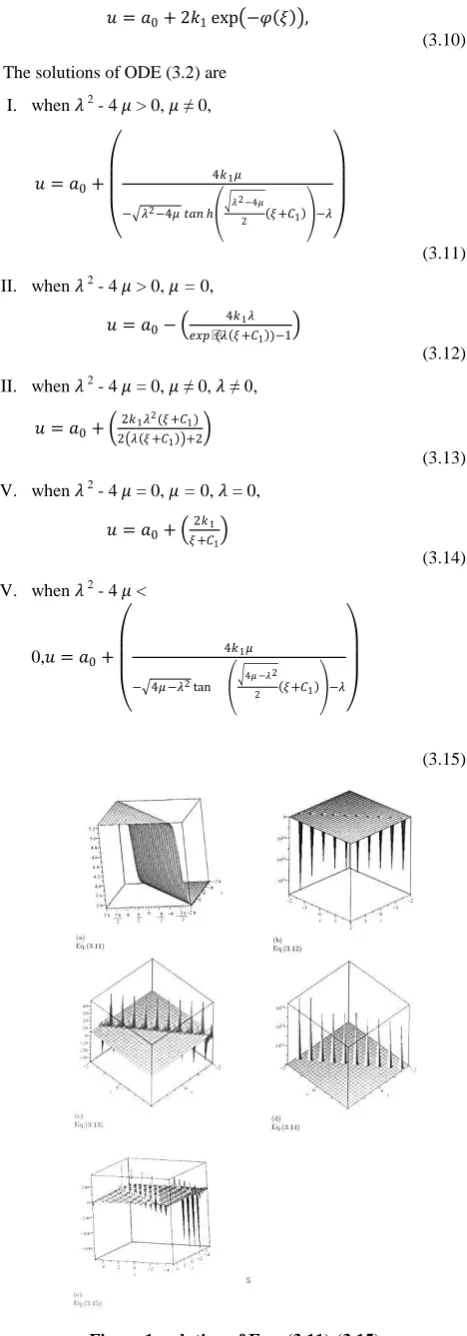
𝑢 = 𝑎0+ 2𝑘1exp −𝜑 𝜉 ,
(3.10) The solutions of ODE (3.2) are
I. when 𝜆 2 - 4 𝜇 > 0, 𝜇 ≠ 0,
𝑢 = 𝑎0+ 4𝑘1𝜇
− 𝜆2−4𝜇 𝑡𝑎𝑛 ℎ 𝜆2−4𝜇 2 𝜉+𝐶1 −𝜆
(3.11) II. when 𝜆 2 - 4 𝜇 > 0, 𝜇 = 0,
𝑢 = 𝑎0− 𝑒𝑥𝑝 (𝜆 𝜉+𝐶4𝑘1𝜆 1 )−1
(3.12) III. when 𝜆 2 - 4 𝜇 = 0, 𝜇 ≠ 0, 𝜆 ≠ 0,
𝑢 = 𝑎0+ 2𝑘1𝜆2(𝜉+𝐶1) 2 𝜆 𝜉 +𝐶1 +2
(3.13) IV. when 𝜆 2 - 4 𝜇 = 0, 𝜇 = 0, 𝜆 = 0,
𝑢 = 𝑎0+ 𝜉+𝐶2𝑘1 1
(3.14) V. when 𝜆 2 - 4 𝜇 <
0,𝑢 = 𝑎0+ 4𝑘1𝜇 − 4𝜇 −𝜆2tan 4𝜇 −𝜆2
2 𝜉+𝐶1 −𝜆
[image:2.595.308.542.86.755.2](3.15)
3.2- Example 2: The Space-Time Nonlinear
Fractional SRLW Equation
This equation is well-known [27] and has the form:
𝐷𝑡2𝛼𝑢 + 𝐷𝑥2𝛼𝑢 + 𝑢𝐷𝑡𝛼 𝐷𝑥𝛼𝑢 + 𝐷𝑡𝛼𝑢𝐷𝑡𝛼𝑢 + 𝐷𝑡2𝛼(𝐷𝑥2𝛼𝑢) = 0, (3.16) where 0 < a ≤ I. Eq.(3.16) has been investigated in [27] using the fractional sub-equation method. Let us now solve Eq.(3.16) using the proposed method of Sec. 2. To this end, we use the nonlinear fractional complex transformation u(x,y,t) = u(𝜉),
𝜉 = 𝑘𝑥𝛼 Γ(1 + 𝛼)+
𝑐𝑡𝛼 Γ(1 + 𝛼)+ 𝜉0,
where k,c, 𝜉o are constants, to reduce Eq.(3.16) to the following ODE with integer order:
𝑘2𝑐2𝑢′′ + 𝑘2+ 𝑐2 𝑢 +𝑘𝑐
2 𝑢2= 0. (3.17)
Balancing u" with u2 ⇒ N + 2 = 2N ⇒ N = 2. Consequently, Eq.(3.17) has the formal solutions:
𝑈 = 𝑎0+ 𝑎1exp(−𝜑 𝜉 + 𝑎2exp −2𝜑 𝜉 , (3.18) where ao, a1,a2 are constants to be determined later, such that, a2 ≠ 0. It is easy to see that
𝑢′′ = 2 𝑎1 𝑒𝜙 𝜉 3+ 2
𝑎1𝜇 𝑒𝜙 𝜉 + 3
𝑎1𝜆
𝑒𝜙 𝜉 2+ 𝑎1𝜆𝜇 + 𝑎1𝜆2 𝑒𝜙 𝜉 + 6 𝑎2
𝑒𝜙 𝜉 4+ 8 𝑎2𝜇 𝑒𝜙 𝜉 2
+10 𝑎2𝜆
(𝑒𝜙 𝜉 )3+ 𝑎2𝜇2+ 6 𝑎2𝜇𝜆 𝑒𝜙 𝜉 + 4
𝑎2𝜆2
(𝑒𝜙 𝜉 )2 (3.19)
Substituting (3.18) along (3.19) into (3.17), collecting all the terms of the same order exp(-𝑖𝜑(𝜉))
, i = 0, 1, 2, .. and setting each coefficient to zero, we have the following set of algebraic equation:
6 k2c2 a 2 +
1
2kc a22 = 0, (3.20) 𝑘2𝑐2 2𝑎1+ 10𝑎
2𝜆 + 𝑘𝑐 𝑎1 𝑎2= 0, (3.21)
𝑘2𝑐2 8𝑎2𝜇 + 3𝑎1𝜆 + 4𝑎2𝜆2 +1 2𝑘𝑐 𝑎1
2+ 2𝑎0𝑎2 + 𝑎2(𝑘2+ 𝑐2) = 0, (3.22)
𝑘2𝑐2 2𝑎1𝜇 + 𝑎1𝜆2+ 6𝑎2𝜆𝜇 + 𝑘𝑐 𝑎0𝑎1+ 𝑎1(𝑘2+ 𝑐2) = 0, (3.23) 𝑘2𝑐2𝑎1𝜆𝜇 + 2𝑘2𝑐2 𝑎2𝜇2+1
2𝑘𝑐 𝑎0
2+ 𝑎0(𝑘2+ 𝑐2) = 0,
(3.24) On solving these algebraic equation with aid of Maple or Mathematica we have
𝑎0=𝑐 𝑘+
𝑘
𝑐− 3𝑘𝑐𝜆2, , 𝑎1= −12𝑘𝑐𝜆, 𝑎2= −12𝑘𝑐, So that the solution of Eq.(3.2)
𝑢 = 𝑐 𝑘+
𝑘 𝑐− 3𝑘𝑐𝜆
2− 12𝑘𝑐𝜆 𝑒𝑥𝑝 −𝜑 𝜉 − 12𝑘𝑐 𝑒𝑥𝑝 −2𝜑 𝜉 ,
(3.25) the solutions of ODE (3.2) are
i. when 𝜆 2 - 4𝜇 > 0, 𝜇 ≠ 0,
𝑢 =𝑐
𝑘+ 𝑘 𝑐− 3𝑘𝑐𝜆2
− 3𝑘𝑐 2𝜇
− 𝜆2− 4𝜇 𝑡𝑎𝑛ℎ 𝜆2−4𝜇
2 (𝜉 + 𝐶1) − 𝜆
−12𝑘𝑐 2𝜇
− 𝜆2−4𝜇 𝑡𝑎𝑛 ℎ 𝜆2−4𝜇 2 (𝜉+𝐶1 −𝜆
2
, (3.26)
ii. when 𝜆 2 - 4𝜇 > 0, 𝜇 = 0,
𝑢 = 𝑐
𝑘+ 𝑘 𝑐− 3𝑘𝑐𝜆
2− 3𝑘𝑐 𝜆
𝑒𝑥𝑝 (𝜆 𝜉+𝐶1 −1 − 12𝑘𝑐 𝜆 𝑒𝑥𝑝 (𝜆 𝜉+𝐶1 −1
2
(3.27) iii. when 𝜆 2 - 4𝜇 = 0, 𝜇 ≠ 0, 𝜆 ≠ 0,
𝑢 = 𝑐
𝑘+ 𝑘 𝑐− 3𝑘𝑐𝜆
2− 3𝑘𝑐 𝜆2(𝜉+𝐶1)
2 𝜆 𝜉+𝐶1 +2 − 12𝑘𝑐 𝜆2(𝜉+𝐶
1) 2 𝜆 𝜉+𝐶1 +2
2
(3.28) iv. when 𝜆 2 - 4𝜇 = 0, 𝜇 = 0, 𝜆 = 0,
𝑢 =𝑘𝑐+𝑘𝑐− 3𝑘𝑐𝜆2−3𝑘𝑐𝜆 𝜉+𝐶1−
12𝑘𝑐 𝜉+𝐶1
2
, (3.29) when 𝜆 2 - 4𝜇 < 0,
𝑢 =𝑐
𝑘+ 𝑘 𝑐− 3𝑘𝑐𝜆2
− 3𝑘𝑐𝜆 2𝜇
4𝜇 − 𝜆2𝑡𝑎𝑛 4𝜇 − 𝜆2
2 (𝜉 + 𝐶1) − 𝜆
−12𝑘𝑐 2𝜇
4𝜇 −𝜆2𝑡𝑎𝑛 4𝜇 −𝜆2 2 (𝜉+𝐶1 −𝜆
2
3.3
-Example 3: The Space-Time Nonlinear
Fractional STO Equation
This equation is well-known [28] and has the form: 𝐷𝑡𝛼𝑢 + 3𝛽 𝐷𝑥𝛼𝑢 2+ 3𝛽𝑢2𝐷𝑥𝛼𝑢 + 3𝛽𝑢𝐷𝑥2𝛼𝑢
+ 𝛽𝐷𝑥2𝛼𝑢 = 0,
(3.31) where 0 < a ≤ 1. Eq.(3.31) has been investigated in [28] using the fractional sub-equation method. Let us now solve Eq.(3.31) using the proposed method of Sec. 2. To this end, we use the nonlinear fractional complex transformation u(x,y,t) = u(𝜉),
𝜉 = 𝑘𝑥
𝛼
Γ(1 + 𝛼)+ 𝑐𝑡𝛼 Γ(1 + 𝛼)+ 𝜉0,
where k,c,£o are constants, to reduce Eq.(3.31) to the following ODE with integer order:
𝑐𝑢 + 3𝛽𝑘2𝑢𝑢′+ 𝛽𝑘𝑢3+ 𝛽𝑘3𝑢′′ = 0,
(3.32) Balancing u" with u3 ⟹ N + 2 = 3N ⟹ N = I. Consequently, Eq.(3.32) has the formal solutions:
𝑢 = 𝑎0+ 𝑎1exp −𝜑 𝜉 ,
(3.33) where a0,a1 are constants to be determined later, such that, a1 ≠ 0. It is easy to see that
u′′ = 2 𝑎1 𝑒𝜙 (𝜉)3+ 2
𝑎1𝜇 𝑒𝜙 (𝜉)+ 3
𝑎1𝜆
𝑒𝜙 (𝜉)2+ 𝑎1𝜆𝜇 + 𝑎1𝜆2 𝑒𝜙 𝜉 ,
(3.34) Substituting (3.33) along (3.34) into (3.32), collecting all the terms of the same order
, i = 0,1,2,.. and setting each coefficient to zero, we have the following set of algebraic equation:
2𝛽𝑘3𝑎1+ 𝛽𝑘𝑎13− 3𝛽𝑘2𝑎12= 0,
(3.35) 3𝛽𝑘3𝜆𝑎
1+ 3𝛽𝑘𝑎0𝑎12− 3𝛽𝑘2𝑎0𝑎1− 3𝛽𝑘2𝜆𝑎12= 0, (3.36) 𝛽𝑘3𝜆2𝑎
1+ 2𝛽𝑘3𝜇𝑎1− 3𝛽𝑘𝑎02𝑎1− 3𝛽𝑘2𝜆𝑎0𝑎1− 3𝛽𝑘2𝜇𝑎12+ 𝑎1𝑐 = 0, (3.37) 𝛽𝑘3𝑎
1𝜆𝜇 + 𝛽𝑘𝑎03− 3𝛽𝑘2𝑎0𝑎1𝜇 + 𝑎0𝑐 = 0, (3.38) On solving these algebraic equation with aid of Maple or Mathematical we have
𝑎0= 𝜆𝑘, 𝑎1= 2𝑘,
So that the solution of Eq.(3.2)
𝑢 = 𝜆𝑘 + 2𝑘 𝑒𝑥𝑝 −𝜑 𝜉 ,
(3.39) the solutions of ODE (3.2) are
i. when 𝜆2− 4𝜇 > 0, 𝜇 ≠ 0,
𝑢 = 𝜆𝑘 + 4𝑘𝜇
− 𝜆2−4𝜇 𝑡𝑎𝑛 ℎ 𝜆2−4𝜇
2 (𝜉+𝐶1) −𝜆
(3.40)
ii. when 𝜆2− 4𝜇 > 0, 𝜇 = 0, 𝑢 = 𝜆𝑘 − 𝑒𝑥𝑝 𝜆 𝜉 +𝐶4𝑘𝜆
1 −1 , (3.41)
iii. when 𝜆2− 4𝜇 = 0, 𝜇 ≠ 0, 𝜆 ≠ 0, 𝑢 = 𝜆𝑘 + − 2𝜆2(𝜉+𝐶1)
2 𝜆 𝜉+𝐶1 +2 ,
(3.42) iv. when λ2− 4μ = 0, μ = 0, λ = 0,
𝑢 = 𝜆𝑘 +𝜉+𝐶2 1,
(3.43) v. when λ2− 4μ < 0,
𝑢 = 𝜆𝑘 + 4𝜇
4𝜇 −𝜆2𝑡𝑎𝑛 4𝜇 −𝜆2
2 (𝜉+𝐶1) −𝜆
(3.44)
3.4-Example 4: The Space-Time Nonlinear
Fractional KPP Equation
This equation is well-known [29] and has the form: 𝐷𝑡𝛼𝑢 − 𝐷𝑥2𝛼𝑢 + 𝜇1𝑢 + 𝛾𝑢2+ 𝛿𝑢3= 0,
(3.45) where 0 < a < 1. Eq.(3.45) has been investigated in [29] using the fractional sub-equation method. Let us now solve Eq.(3.45) using the proposed method of Sec. 2. To this end, we use the nonlinear fractional complex transformation u(x,y,t) = u(𝜉),
𝜉 = 𝑘𝑥𝛼 Γ(1 + 𝛼)+
𝑐𝑡𝛼
Γ(1 + 𝛼)+ 𝜉0,
where k,c, 𝜉o are constants, To reduce Eq.(3.16) to the following ODE with integer order:
𝑘2𝑐2𝑢′′+ 𝑘2+ 𝑐2 𝑢 +𝑘𝑐 2 𝑢
2= 0.
Balancing u" with u3 ⟹ 𝑁 + 2 = 3𝑁 ⟹ 𝑁 = 1. Consequently, Eq.(3.17) has the formal
solutions:
𝑢 = 𝑎0+ 𝑎1exp(−𝜑 𝜉 ).
(3.47) where ao, a1 are constants to be determined later, such that, a1 ≠ 0. It is easy to see that
𝑢′′ = 2 𝑎1 (𝑒𝜙 𝜉 )3+ 2
𝑎1𝜇 𝑒𝜙 𝜉 + 3
𝑎1𝜆
(𝑒𝜙 𝜉 )2+ 𝑎1𝜆𝜇 + 𝑎1𝜆2 𝑒𝜙 𝜉 .
(3.48) Substituting (3.47) along (3.48) into (3.46), collecting all the terms of the same order exp(-i𝜑(𝜉))
, i = 0,1,2,.. and setting each coefficient to zero, we have the following set of algebraic equation:
𝛿𝑎13− 2𝑘2𝑎1= 0.
(3.49) 3𝛿𝑎0𝑎12+ 𝛾𝑎12− 3𝑘2𝜆𝑎1− 𝑐𝑎1= 0.
(3.50) 3𝛿𝑎02𝑎1+ 2𝛾𝑎0𝑎1+ 𝜇𝑎1− 𝑘2𝜆2𝑎1− 2𝑘2𝜇𝑎1− 𝑐𝜆𝑎1= 0.
(3.51) 𝛿𝑎03+ 𝛾𝑎02+ 𝜇1𝑎0− 𝑘2𝜆𝜇𝑎1− 𝑐𝜇𝑎1= 0.
(3.52) On solving these algebraic equation with aid of Maple or Mathematica we have
𝑎0= 𝜆𝑎1
2 −
𝛾
2𝛿, 𝑎1= −2𝑐
𝛾 ,
So that the solution of Eq.(3.46) 𝑢 =𝜆𝑎1
2 − 𝛾 2𝛿−
2𝑐
𝛾exp −𝜑 𝜉 ,
(3.52) the solutions of ODE (3.46) are
i.when 𝜆2− 4𝜇 > 0, 𝜇 ≠ 0,
𝑢 =𝜆𝑎1 2 −
𝛾 2𝛿−
−2𝑐 𝛾
𝜇
− 𝜆2−4𝜇 𝑡𝑎𝑛 ℎ 𝜆2−4𝜇
2 (𝜉+𝐶1) −𝜆
(3.54) ii.when 𝜆2− 4𝜇 > 0, 𝜇 = 0,
𝑢 =𝜆𝑎1 2 −
𝛾 2𝛿−
−2𝑐 𝛾
2𝜆 exp 𝜆 𝜉+𝐶1 −1 ,
(3.55) iii.when 𝜆2− 4𝜇 = 0, 𝜇 ≠ 0, 𝜆 ≠ 0,
𝑢 =𝜆𝑎1 2 −
𝛾 2𝛿−
2𝑐 𝛾
2𝜆2(𝜉+𝐶 1) 2 𝜆 𝜉+𝐶1 +2 ,
(3.56) iv.when 𝜆2− 4𝜇 = 0, 𝜇 = 0, 𝜆 = 0,
𝑢 =𝜆𝑎1 2 +
−2𝑐 𝛾
𝛾 2𝛿+
2 𝜉+𝐶1,
(3.57) v.when λ2− 4μ < 0,
𝑢 =𝜆𝑎1 2 −
𝛾 2𝛿−
2𝑐 𝛾
𝜇
4𝜇 −𝜆2𝑡𝑎𝑛 4𝜇 −𝜆2
2 (𝜉+𝐶1) −𝜆
(3.58)
4.
CONCLUSION
We establish exact solutions for the space-time nonlinear fractional PKP equation, the space-time nonlinear fractional SRLW equation, the space-time nonlinear fractional STO equation and the space-time nonlinear fractional KPP equation with the expansion method. The exp(-𝜑(𝜉))-expansion method has been successfully used to find the exact traveling wave solutions of some nonlinear evolution equations. As an application, the traveling wave solutions the space-time nonlinear fractional PKP equation, the space-time nonlinear fractional SRLW equation, the space-time nonlinear fractional STO equation and the space-time nonlinear fractional KPP equation , which have been constructed using The exp(-𝜑(𝜉))-expansion method. Let us compare between our results obtained in the present article with the well-known results obtained by other authors using different methods as follows: Our results of the time nonlinear fractional PKP equation, the space-time nonlinear fractional SRLW equation, the space-space-time nonlinear fractional STO equation and the space-time nonlinear fractional KPP equation , are new and different from those obtained in [27]-[29]. It can be concluded that this method is reliable and propose a variety of exact solutions NPDEs. The performance of this method is effective and can be applied to many other nonlinear evolution equations.
5.
REFERENCES
[1] M. J. Ablowitz, H. Segur, Solitions and Inverse Scattering Transform, SIAM, Philadelphia 1981.
[2] W. Malfliet, Solitary wave solutions of nonlinear wave equation, Am. J. Phys., 60 (1992) 650-654.
[4] A. M. Wazwaz, The tanh method for travelling wave solutions of nonlinear equations, Appl. Math. Comput., 154 (2004) 714-723.
[5] S. A. EL-Wakil, M.A.Abdou, New exact travelling wave solutions using modified extented tanh-function method, Chaos Solitons Fractals, 31 (2007) 840-852.
[6] E. Fan, Extended tanh-function method and its applications to nonlinear equations, Phys. Lett. A 277 (2000) 212-218. [7] A. M. Wazwaz, The extended tanh method for abundant
solitary wave solutions of nonlinear wave equations, Appl. Math. Comput., 187 (2007) 1131-1142.
[8] A. M. Wazwaz, Exact solutions to the double sinh-Gordon equation by the tanh method and a variable separated ODE. method, Comput. Math. Appl., 50 (2005) 1685-1696.
[9] A. M. Wazwaz, A sine-cosine method for handling nonlinear wave equations, Math. Comput. Modelling, 40 (2004) 499-508.
[10] C. Yan, A simple transformation for nonlinear waves, Phys. Lett. A 224 (1996) 77-84.
[11] Emad. H.M. Zahran and mostafa M. A. Khater. The modified simple equation method and its applications for solving some nonlinear evolutions equations in mathematical physics. Jokull journal- Vol. 64. Issue 5 - May 2014.
[13] M. A. Abdou, The extended F-expansion method and its application for a class of nonlinear evolution equations, Chaos Solitons Fractals, 31 (2007) 95-104.
[14] Y. J. Ren, H. Q. Zhang, A generalized F-expansion method to find abundant families of Ja-cobi elliptic function solutions of the (2+l)-dimensional Nizhnik-Novikov-Veselov equation, Chaos Solitons Fractals, 27 (2006) 959-979.
[15] J. L. Zhang, M. L. Wang, Y. M. Wang, Z. D. Fang, The improved F-expansion method and its applications, Phys.Lett.A 350 (2006) 103-109.
[16] J. H. He, X. H. Wu, Exp-function method for nonlinear wave equations, Chaos Solitons Fractals 30 (2006) 700-708.
[17] H. Aininikhad, H. Moosaei, M. Hajipour, Exact solutions for nonlinear partial differential equations via Exp-function method, Numer. Methods Partial Differ. Equations, 26 (2009) 1427-1433.
[18] Z. Y. Zhang, New exact traveling wave solutions for the
nonlinear Klein-Gordon equation, Turk. J. Phys., 32 (2008) 235-240.
[19] M. L. Wang, J. L. Zhang, X. Z. Li, The (𝐺 ,
𝐺)- expansion method and travelling wave solutions of nonlinear evolutions equations in mathematical physics, Phys. Lett. A 372 (2008) 417-423.
[20] Emad H. M. Zahran and Mostafa M. A. Khater, Exact solutions to some nonlinear evolution equations by using (G'/G)-expansion method, Jokull journal- Vol. 64. Issue 5 - May 2014.
[21] E. M. E. Zayed and K. A. Gepreel, The (𝐺 ,
𝐺)- expansion method for finding traveling wave solutions of nonlinear partial differential equations in mathematical physics, J. Math. Phys., 50 (2009) 013502-013513.
[22] E. M. E. Zayed, The (𝐺𝐺,)- expansion method and its applications to some nonlinear evolution equations in mathematical physics, J. Appl. Math. Computing, 30 (2009) 89-103.
[23] C. Q. Dai , J. F. Zhang, Jacobian elliptic function method for nonlinear differential difference equations, Chaos Solutions Fractals, 27 (2006) 1042-1049.
[24] Emad H. M. Zahran and Mostafa M. A. Khater, Exact Traveling Wave Solutions for the System of Shallow Water Wave Equations and Modified Liouville Equation Using Extended Jacobian Elliptic Function Expansion Method. American Journal of Computational Mathematics (AJCM) Vol.4 No.5 2014.
[25] S. Liu, Z. Fu, Q.Zhao, Jacobi elliptic function expansion method and periodic wave solutions of nonlinear wave equations, Phys. Lett. A 289 (2001) 69-74.
[26] X. Q. Zhao, H.Y.Zhi, H.Q.Zhang, Improved Jacobi-function method with symbolic computation to construct new double-periodic solutions for the generalized Ito system, Chaos Solitons Fractals, 28 (2006) 112-126. [27] M. Aguero, M. Najera and M. Carrillo, Non classic
solitonic structures in DNA's vibrational dynamics, Int. J. Modern Phys. B, 22(2008), 2571-2582.
[28] G. Gaeta, Results and limitations of the soliton theory of DNA transcription, J. Biol. Phys., 24(1999), 81-96. G. Gaeta, C.Reiss, M.peyrard and T. Dauxois, Simple models of nonlinear DNA