© 2014, IJCSMC All Rights Reserved
444
Available Online at www.ijcsmc.comInternational Journal of Computer Science and Mobile Computing
A Monthly Journal of Computer Science and Information Technology
ISSN 2320–088X
IJCSMC, Vol. 3, Issue. 6, June 2014, pg.444 – 450
RESEARCH ARTICLE
A Zone Based Route Estimation in Integrated
Vehicular Network
Ashu
Student, M.Tech
Deptt. Of Computer Sc. & App., HCTM
Kaithal, Haryana.
Dr. Arun Jain
Asstt. Professor
Deptt. Of Computer Sc. & App., HCTM
Kaithal, Haryana.
Priyanka
Student, M.Tech
Deptt. Of Computer Sc. & App., HCTM
Kaithal, Haryana.
Er. Anish Soni
Asstt. Professor
Deptt. Of Computer Sc. & App., HCTM
Kaithal, Haryana.
Abstract— Vehicular Area Network is one of the critical public area networks that combine the functioning of
the mobile and sensor network. This network is based on scenario based constraint setting. In this work an
effective zone based analysis approach is suggested for route generation in City Scenario. The paper has setup
the communication between the V2I and I2I to identify the effective route over the network. The presented
work is also effective for route estimation in congested network as well as in accidental situations. The paper
has presented the associated approach.
© 2014, IJCSMC All Rights Reserved
445
I. INTRODUCTION
VANET is one of the most intelligent communication network defined under energy constraints. The main characteristic of this network is scenario based mobility and the vehicle oriented communication. This kind of network is analyzed under different optimization vectors such as safety, route optimization, throughput estimation etc. There are number of dedicated protocols under the network generation and communication such as GPSR, DSDV etc. These protocols are defined under the mobility and dynamic nature of nodes with node position analysis and the node inclusion analysis. These two properties increase the communication criticality over the network. This network type is defined under fixed and dynamic nature of network. The network communication is controlled by fixed base stations or the road side units (RSU). As the vehicles are moving over the network in fixed scenario specification then the constraints associated with this communication includes the route identification under different parameters including the network strength analysis as well as associated challenges. This kind of network includes the pre-analysis on nodes movement so that the vehicle tracking will be done effectively over the network. The basic constraints of VANET communication are shown in figure 1.
Figure 1 : VANET Constraints
The constraint defined in figure 1 contribute in each network communication activity such as route identification, handoff etc. VANET is most dynamic communication network in which nodes enter to the system for a small interval and the speed of the nodes is very high because of this there is the requirement of a fast analytical approach that perform the analysis on multiple parameters. These parameters include the positional parameters such as speed and direction. A predictive analysis approach is required to analyze the position or localization of nodes so that effective handoff will be obtained. The direction aspect is quite important, because if two base stations are having a node coverage then the base station, in direction of which node is moving is more effective. Because over the distance, the signal will become stronger. The base station load is the parameter to decide the network capability. A base station with heavy traffic cannot provide effective handoff.
In VANET, the handoff can be controlled by different kind of network devices such as a cluster head, base station or the RSU. The decision of the responsible component is based on the type of communication scenario. A network type with group mobility performs the handoff over the cluster whereas in city scenario like network base station can be considered. Another factor reliable handoff process is the authenticated communication. If the key sharing authentication is defined in such case before the handoff process, authentication is required to apply.
In this paper, an effective Routing mechanism is defined for vehicular area network. The approach has used the communication and positional parameters for effective route identification. In this section, an introduction to vehicular area network and network challenge is defined. In section II, the work defined by earlier researchers is discussed. In section III, the proposed VANET communication architecture is presented. In section IV, the results obtained from the work are discussed. In section IV, the results obtained from the work are presented. In section V, conclusion obtained from the work is presented.
Speed Direction Load
Network
Type Authentication Speed
© 2014, IJCSMC All Rights Reserved
446
II. POSITIONBASEDROUTING
The dynamic and highly mobile nature of VANET, where nodes behave very rapid and changes its location frequently demands such routing method that can deal with the environment of such network. These demands tend the researchers to use positions of nodes in order to provide successful communication from source to destination. Such method in which geographical positions of nodes are used to perform data routing from source to destination is called position based routing. Position based routing assumes that each node have knowledge about its physical/ geographic position by GPS or by some other position determining services. In it each node also has the knowledge of source, destination and other neighboring nodes. As compared to topology based routing, position based routing uses the additional information of each participating node to applicable in VANET, that additional information is gathered through GPS. Position based routing provides hop-by-hop communication to vehicular networks. Unlike topology based routing, position based routing does not require any route maintenance. The route determined only when there is a need for forwarding packet. Another advantage of position based routing is that it contains information of source, destination and their neighboring nodes. The aforementioned characteristics makes position based routing suitable for VANET. Several routing protocols have been proposed by many researchers that uses nodes position information for routing decisions. Although these routing protocols are most suitable for the vehicular communication but these protocols still have some challenges.
A) Challenges
Position-based routing bases forwarding decisions on position information. Thus, there are several requirements on the availability of position information:
Position based routing requires position-awareness of all participating nodes, e.g., through a GPS receiver on each node. It is assumed that each node is aware of the positions of its direct neighbors: each node periodically sends out beacon messages that indicate the current position of the node1. In order to send a packet to a destination node, a sending node also requires information on the current geographic position of the destination in order to include it in the packet header and to make the routing decision. A packet could not be forwarded if the node does not have a connection to a neighbor that is geographically closer to the destination than itself, a problem that is also known as local maximum. GPSR implements two operation modes: greedy forwarding and perimeter routing for recovery from local maximum.
III. GPSR PROTOCOL
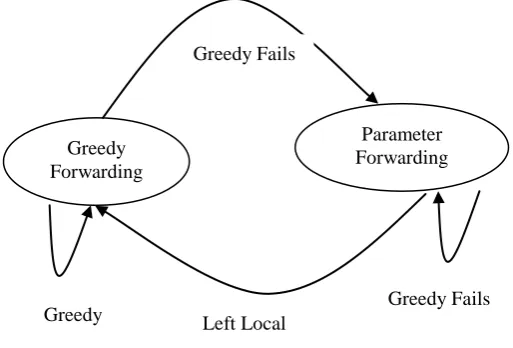
Greedy Perimeter Stateless Routing (GPSR) [1] is one of the best examples of position based routing. GPSR uses closest neighbor’s information of destination in order to forward packet. This method is also known as greedy forwarding. In GPSR each node has knowledge of its current physical position and also the neighboring nodes. The knowledge about node positions provides better routing and also provides knowledge about the destination. On the other hand neighboring nodes also assists to make forwarding decisions more correctly without the interference of topology information. All information about nodes position gathered through GPS devices. GPSR protocol normally devised in to two groups:
Figure 2 : GPSR Working Greedy
Forwarding
Parameter Forwarding
Greedy Works
Greedy Fails Left Local
© 2014, IJCSMC All Rights Reserved
447
Greedy forwarding: This is used to send data to the closest nodes to destination. Perimeter forwarding: This is used to such regions where there is no closer node to destination. In other words we
can say it is used where greedy forwarding fails.
A) Greedy Forwarding
In this forwarding strategy data packets know the physical position of their destination. As the originator knows the position of its destination node so the greedy regions/hops are selected to forward the packets to the nodes that are closer to their destination. This process repeats until the packet successfully delivered to desired destination. Nearest neighbor’s physical position is gathered by utilizing beaconing algorithms or simple beacons. When a neighboring node forwards packet to closer region to destination, the forwarding node receive a beacon message that contain IP address and position information. Then it updates its information in the location table. If forwarding node does not receive beacon from its neighboring node within a specific time period, it assumes that either neighbor fails to forward packet to region closer to destination or neighbor’s is not in its radio range. So it removes its entry from location table.
IV. RESEARCH METHODOLOGY
In this present work, a zone based network analysis approach is presented to identify effective route in vehicular adhoc network. In this work, the main consideration is given to V2I and I2I communication where the infrastructure devices are presented in the form of RSU or the base stations. These RSU devices take the update from the vehicular nodes present in the range. As the information is collected, the I2I communication is performed for route generation.
The presented work is defined in two main stages. In first stage, the low level analysis is performed. This analysis is performed by the RSUs for their internal communication. This kind of analysis is defined on vehicular nodes and collects the communication information. Each RSU itself defines a zone under which the communication will be performed with traffic update. The information updation is performed under the communication rate analysis, loss rate analysis and delay analysis. Once the traffic update is collected, the next work is to perform the route generation based on RSU analysis. These RSU performs the inter-communication to generate the effective routes under zone based analysis.
© 2014, IJCSMC All Rights Reserved
448
Figure 2 : Flow of WorkIn this present work, we have defined a two level parametric decision to perform effective route generation in VANET network. Each of the vehicles in this network is having the zone specification under the particular RSU. The first level parametric decision is performed on vehicles on the basis of the vehicle type, speed etc. Based on these parameters the traffic update on each RSU is performed. Once the traffic information is updated, wait for the route request is performed. As some vehicular node send the route request to particular RSU, the RSU is activated and the route identification is performed. The route identification is performed under inter-RSU communication. This communication is performed under the communication information analysis and traffic information analysis on each RSU. Based on this high level analysis, the effective route will be identified.
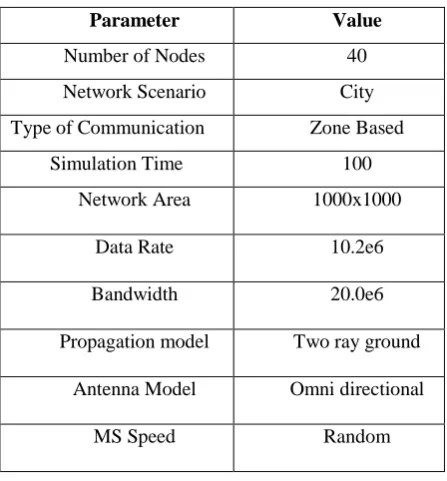
In this present work, zone based routing is defined for VANET network. The work includes the positional and communication parameter analysis. The is implemented in NS2 network. The simulation parameters considered in this work are shown in figure 1.
Set the communication parameters for each node
Set the RSU under coverage Range Specification
Perform Low level analysis for Vehicle Node Analysis within RSU Coverage Setup the Network under City Scenario with
2-Lane
Perform Vehicle Request on Nearest RSU for route generation
RSU will perform the route request on Next RSUs for Route identification
Generate the Effective Route under Zone based Traffic Analysis
Update the route information to Vehicle
© 2014, IJCSMC All Rights Reserved
449
Table 1 : Simulation ParametersParameter Value
Number of Nodes 40
Network Scenario City
Type of Communication Zone Based
Simulation Time 100
Network Area 1000x1000
Data Rate 10.2e6
Bandwidth 20.0e6
Propagation model Two ray ground
Antenna Model Omni directional
MS Speed Random
V.
CONCLUSIONIn this paper, a zone based analysis approach is defined for effective route generation in vehicular network. The work is based on positional and communication parameters. The paper has presented a two stage analysis model for route generation in vehicular network.
REFERENCES
[1] B. Karp and H.T. Kung, "GPSR: Greedy perimeter stateless routing for wireless networks," in Proceedings of the ACM/IEEE International Conference on Mobile Computing and Networking (MobiCom), 2000.
[2] D.B. Johnson and D.A. Maltz ,”Dynamic source routing in ad hoc wireless networks”. In Mobile Computing, T. Imielinski and H. Korth, Eds. Kluwer Academic Publishers, 1996, ch. 5, pp. 153–181.
[3] KARP, B. Geographic routing for wireless networks. Presentation at AFOSR MURI ACTCOMM Research
Review Meeting, Oct. 1998.
[4] Lochert, C., Mauve, M., Füßler, H., and Hartenstein, H., “Geographic routing in city scenarios” SIGMOBILE Mob. Comput. Commun. Rev. 9, 1 (Jan. 2005), pp. 69-72.
[5] Karp, B., Geographic Routing for Wireless Networks, Ph.D. Dissertation, Harvard University, Cambridge, MA, October, 2000.
[6] M. Jerbi, S. M. Senouci, T. Rasheed., “Towards Efficient Geographic Routing in Urban Vehicular Networks,” Vehicular Technology, IEEE Transactions on, vol. 58, no. 9, 2009, pp. 5048-5059.
[7] C.Lochert, H. Hartenstein, J.Tian, D. Herrmann, H. Fu1Bler, and M. Mauve, "A routing strategy for vehicular ad hoc networks in city environments,” in proceedings of IEEE Intelligent Vehicles Symposium (IV2003).
[8] H. Fu1Bler, M. Mauve, H. Hartenstein, M. Kasemann, and D. Vollmer, "Location based routing for vehicular ad-hoc networks," ACM SIGMOBILE Mobile Computing and Communications Review (MC2R), vol. 7, no. 1,Jan. 2003, pp. 47-49.
[9] Tee, C.A.T.H.; Lee, A.C.R., “Survey of position based routing for Inter Vehicle Communication system”,
Distributed Framework and Applications, 2008. DFmA 2008. First International Conference on, Oct. 2008, pp.174-182, 21-22.
[10] M. Mauve, A. Widmer, and H. Hartenstein, “A survey on position-based routing in mobile ad hoc networks,”
© 2014, IJCSMC All Rights Reserved
450
[11] Takano, A.; Okada, H.; Mase, K., “Performance Comparison of a Position-Based Routing Protocol for VANET”, Mobile Adhoc and Sensor Systems, 2007. MASS 2007. IEEE Internatonal Conference, Oct.2007, pp.1-6.
[12] Liu, B.-S. Lee, B.-C. Seet, C.H. Foh, K.J. Wong, and K.-K. Lee, "A routing strategy for metropolis vehicular communications," in International Conference on Information Networking (ICOIN), pp. 134-143, 2004.
[13] R.A. Santos, A. Edwards, R. Edwards, and L. Seed, "Performance evaluation of routing protocols in vehicular ad hoc networks," The Intemational Joumal of Ad Hoc and Ubiquitous Computing, vol. 1, no. 1/2, 2005, pp. 80-91.