Measuring progress of collaborative action
in a community health effort
Vicki L. Collie-Akers,
1Stephen B. Fawcett,
1and Jerry A. Schultz
1Local actions that promote health and address its social determinants have a common vision: people working to-gether to improve conditions for health and wellbeing for all (1). Optimal ef-forts deal with both the intermediary determinants, such as health behaviors and environmental conditions, and the broader social determinants of health (SDH), such as income inequality and socioeconomic position (2, 3).
More-over, the SDH conceptual framework for action (4), developed by the World Health Organization (WHO), suggests three “mechanisms” by which health inequities are produced: (a) different- ial exposure to health promoting/ damaging factors, e.g., access to healthy foods, opportunities for physical activ-ity, and living conditions; (b) differential vulnerability/capabilities, e.g., educa-tion, income, and socioeconomic posi-tion; and (c) differential consequences, e.g., quality of health services deter-mined by socioeconomic position. Com-ponents pivotal to progress in SDH
are: com-munity empowerment, col-laborative action through multisectoral partnerships, and systematic methods for measuring progress and making adjustments.
Community empowerment
Empowering communities to take ac-tion is fundamental to improving and ensuring conditions for health and health equity (5); it drives the process by which individuals act collectively to gain greater influence and control over SDH and the quality of life in the community Objective. To measure the progress made by the collaborative actions of multisectorial partners in a community health effort using a systematic method to document and evaluate community/system changes over time.
Methods. This was a community-based participatory research project engaging community partners of the Latino Health for All Coalition, which based on the Health for All model, addresses health inequity in a low-income neighborhood in Kansas City, Kansas, United States of America. Guided by three research questions regarding the extent to which the Coalition catalyzed change, intensity of change, and how to visually display change, data were collected on community/system changes implemented by the community partners from 2009–2012. These changes were characterized and rated according to intensity (event duration, population reach, and strategy) and by other categories, such as social determinant of health mechanism and sector.
Results. During the 4-year study period, the Coalition implemented 64 community/system changes. These changes were aligned with the Coalition’s primary goals of healthy nutrition, physical activity, and access to health screenings. Community/system efforts improved over time, becoming longer in duration and reaching more of the population.
Conclusions. Although evidence of its predictive validity awaits further research, this method for documenting and characterizing community/system changes enables community partners to see progress made by their health initiatives.
Health promotion; equity in health; evaluation; community-based participatory research; United States.
abstract
Key words
Collie-Akers VL, Fawcett SB, Schultz JA. Measuring progress of collaborative action in a community health effort. Rev Panam Salud Publica. 2013;34(6):422-8.
Suggested citation
1 Work Group for Community Health and
Develop-ment, University of Kansas, Lawrence, Kansas, United States of America. Send correspondence to Vicki L. Collie-Akers, e-mail: [email protected]
(1, 6). Empowerment can be seen when individuals and groups communicate their needs and concerns, engage in de-cisionmaking, and bring about changes in communities and systems to address identified concerns. Despite the impor-tance of community empowerment and social participation for health promo-tion, there are relatively few systematic methods for measuring whether this process leads to change.
Collaborative action
Collaborative action for population health and health equity (7) requires comprehensive and coordinated ap-proaches to address both the interme-diary determinants (e.g., environmen-tal changes that make healthy nutrition and physical activity more likely) and the broader social determinants (e.g., policies that address differential expo-sures, vulnerabilities, and opportuni-ties). These must be addressed through multiple sectors (e.g., health, education, government) and at multiple ecological levels (i.e., individuals, organizations, communities, and broader systems). In a participatory research/evaluation con-text, it is critical to communicate progress made along the way to enable systematic reflection and adjustments by commu-nity partners. Evaluating the effects of collaborative action at the community level requires a systematic method for documenting changes in communities/ systems and characterizing their contri-bution to health promotion goals and SDH.
Measuring progress
Evaluating the progress of local health promotion efforts requires the ability to measure discrete community and environmental changes in multiple sectors and at various levels; and to characterize their attributes, such as duration and reach, that may be re-lated to their long-term contribution to population health and its social de-terminants. In community-based par-ticipatory research, scientific and com-munity partners must be able to review progress along the way; for instance, the amount and type (intensity) of com-munity/system changes (e.g., policies, programs, environmental conditions) being created and implemented by co-alition members over time.
However, collaborative action poses measurement challenges for document-ing and characterizdocument-ing what was done to achieve intended collective impact (8). This can be resolved by a shared measurement system that can be used to help integrate and align efforts and to hold accountable a diverse set of partners working toward a common purpose. A shared monitoring and eval-uation system can help partners docu-ment, characterize, and systematically reflect on their activities regarding, for instance, the number and type of new or modified community programs, poli-cies, and practices aimed at community-established goals.
The present study describes a partici-patory research and evaluation process for measuring the progress made through collaborative action by documenting the number and scope of community/ system changes carried out by a community-led effort in a low-income neighborhood in the United States, the Latino Health for All Coalition. The study uses intensity scores—rating the duration, the breadth or reach, and strength of and strategy employed by interventions—to charac-terize progress made through the collab-orative action of multiple partners from a variety of sectors.
MATERIALS AND METHODS
Context
The Latino Health for All Coalition (the Coalition) was formed in 2008 as a collaborative partnership with a mis-sion of reducing risk for cardiovascu-lar disease and diabetes by promoting healthy eating, active living, and access to health services. The Coalition has several named behavioral and health objectives: (a) to increase fruit and veg-etable consumption; (b) to increase en-gagement in regular physical activity; (c) to decrease levels of obesity; and (d) to increase blood pressure, choles-terol, and hemoglobin A1C checks. A Community Advisory Board (CAB) was established in 2010 to guide the Coali-tion. It consisted of at least 10 commu-nity members, either Latino or represent-ing local Latino-servrepresent-ing organizations (its composition has varied since, but is always at least 80% Latino). The CAB meets every other month to make deci-sions, such as which mini-grants will be dispersed to implement the Coalition’s
priority strategies. The Coalition’s re-search partners focus on providing tech-nical support to implement the CAB’s guidance and to measure progress made by the Coalition’s efforts.
The priority area for the Latin Health for All Coalition is a low-income neigh-borhood within the Kansas City met-ropolitan area in the state of Kansas, located in the central plains of the United States. At the time of the study, the neighborhood had a population of nearly 23 370 (9), of which approximately 6 480 was Latino—many recent immigrants from Mexico.
Health for All model. The Coalitions fol-lows the Health for All model, described partially in Figure 1 and elsewhere in greater detail (10). This model outlines a process whereby different sectors en-gage in: (a) collaborative planning and capacity building; (b) implementing community and systems changes; and (c) achieving the intended result of en-vironmental changes and improved health. As a backbone organization, the Coalition and its university part-ners provide technical assistance and other support for full implementation of the model’s components: (a) establish-ment of an organizational structure (e.g., action committees for each goal area); (b) development of an action plan con-sisting of community-determined strate-gies; (c) mobilization of the community and stimulation of collaborative action; (d) distribution of grant resources through mini-grants to support activi-ties; and (e) a documentation and feed-back system to monitor progress and make adjustments.
Study design
Community-based participatory re-search (CBPR) was the approach used to guide implementation of this research and action project. The study is ongo-ing, but the data presented here are from 2009–2012. Consistent with CBPR principles (11), community members and research partners at the University of Kansas shared responsibility for the overall study’s implementation, includ-ing prioritizinclud-ing activities, designinclud-ing data collection and documentation activities, analyzing data, and disseminating les-sons learned. The primary mechanism through which this occurred was the Coalition’s CAB.
The study was reviewed and ap-proved by the Human Subjects Commit-tee at the University of Kansas (Kansas City, Kansas, United States).
Data collection
The study measured progress primar-ily by examining community and system changes, defined as new and modified programs, policies, and practices, and environmental changes that were facili-tated by coalition partners and related to the Coalition’s mission and goals. In this participatory research project, scientific and community coalition partners ex-plored the following questions:
1. To what extent did collaborative ac-tion bring about a community/system change related to the Coalition’s mis-sion (stated previously)?
2. What was intensity (defined below) of the community/system change? 3. How can the progress be visually
displayed?
Each community/system change— an intermediate outcome—was docu-mented using an online system (12). Research partners entered data from re-ports submitted by community partners. Reports included descriptive
informa-tion about the activities and accomplish-ments facilitated by partners and the number of people reached or engaged in the activity. First, each discrete activity documented on behalf of the Coalition was scored for whether it was a com-munity or a system change. Second, each change was characterized by im-portant dimensions, such as duration, estimated reach, and type of change-strategy employed. Research staff used a codebook (13) that included definitions and scoring instructions to determine whether the documented activity was to be scored as an instance of commu-nity/system change or another type of activity. Another staff member indepen-dently coded a sample of activities to ensure data quality through measures of inter-observer agreement regarding assignment of coding. Throughout the study period, inter-observer agreement was 96%; this is consistent with high levels of reliability seen in other stud-ies using this method for community measurement.
Coding the changes. All documented com-munity and system changes were character-ized by dimensions related to:
• Intensity (i.e., duration, reach, and strategy; further explanation follows)
• Type of SDH mechanism (i.e., dif-ferential exposure, vulnerability, or consequences)
• Other attributes (e.g., sector and eco-logical level at which implemented) Intensity. To characterize intensity, each community/system change was coded ac-cording to three specific dimensions: • Duration (i.e., a one-time event,
occur-ring more than once, or ongoing) • Reach (i.e., what proportion—high,
medium, or low—of the total priority population experienced the change) • Strategy (i.e., provided information
and enhanced skills; enhanced ser-vices and support; modified access, barriers, and opportunities; changed consequences; and modified policies and broader conditions).
Each category was assigned a numeri-cal value based on the relative strength for the attribute. Table 1 describes the cat-egories and assigned values for weight-ing the potential impact of a particular community/system change. The values across all three domains were summed to create a single intensity score (∑ Du-ration value + Reach value + Strategy = Intensity value). Using this approach, the score could range from 0.3 (weakest and potentially of least influence on longer-term outcomes) to 3.0 (strongest and po-tentially of most influence). Using the formula, intensity scores were calculated for each documented community/system change, and these scores were summed for all documented community/system changes occurring in a given year of the collaborative effort.
Strategy. In addition, each community/ system change was coded according to the strategy it employed to address the social determinant. Drawing from the WHO con-ceptual framework for SDH (4), the strate-gies were coded as either:
• Modifying exposures to health dam-aging/health promoting factors; • Reducing vulnerabilities/enhancing
capabilities; or
• Modifying the social, economic, and health consequences.
Using descriptions provided by the WHO conceptual framework, research staff coded all entries according to these 1. Establish an organizational
structure with action committees 2. Action plan of determined strategies
3. Community mobilizer to stimulate involvement and action 4. Distribution of grant resources through the use of mini-grant funding allocations
5. Documentation and feedback on community/system change and other evidence of progress
a. Collaborative planning and capacity building b. Targeted action and intervention c. Community and system changes d. Widespread behavior change e. Improving community health outcomes Implementing critical elements of the
Health for All Model
FIGURE 1. Health for All Model implemented by Latino Health for All Coalition, Kansas City, Kansas, United States
SDH strategy definitions to determine the frequency with which each was used. Other attributes that were coded include setting or sector, geographic location, and socioecological level addressed.
RESULTS
The data showed that from 1 January 2009–31 December 2012, Coalition mem-bers and partners had implemented a total of 64 distinct community/system
changes. Responses to the three partici-patory research questions follow:
1. Extent to which collaborative action brought about mission-related changes
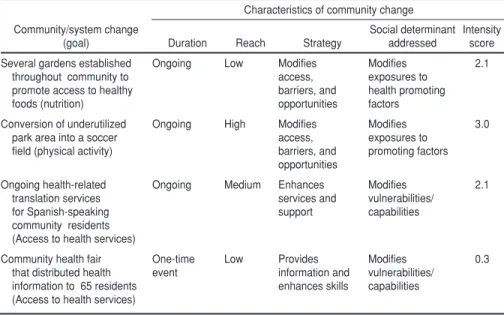
Table 2 shows several examples of community/system changes, organized by primary goal, type of characterization, and intensity score (using the method described in the table). More than 30 or-ganizations or individuals led the
imple-mentation of these 64 activities on behalf of the Coalition. The community/system changes were implemented in multiple settings, including health care organiza-tions, faith-based organizaorganiza-tions, social services providers, schools, neighbor-hoods, and other settings.
2. Intensity of community/system changes Across all 64 community/system changes, the mean intensity score was 0.975, with the full range of scores being observed—from 0.3 to 3.0. Two commu-nity/system changes from Table 2 are used below to demonstrate how actual intensity scores were computed:
• Community health fair that distrib-uted health information to 65 resi-dents. This was a one-day event (0.1) in which information was provided (0.1) and a low-percentage of the pop-ulation was reached (0.1) for a total intensity score of 0.3.
• Unused space was converted into a soccer field. This was an ongoing ef-fort (1.0) using a strong intervention for environmental change (1.0) with a potentially high reach (1.0) for a total intensity score of 3.0.
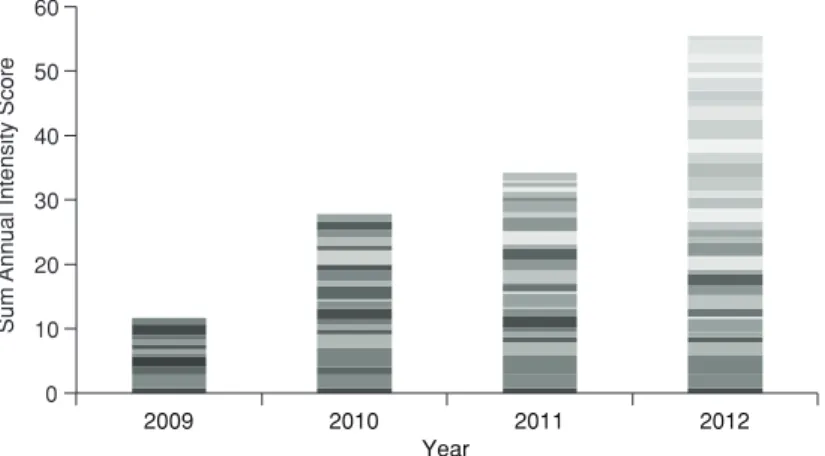
The annual mean intensity scores in-creased as the Coalition matured, from a mean score of 1.06 in 2009 to 1.58 in 2012. This reflected a shift to community/ system changes of somewhat longer duration, greater reach, and increased strength of change strategy.
3. Visual display of progress
Figure 2 is a graphic display of the resulting information on the unfolding of community/system change over time (number of changes and intensity). Each community/system change is displayed as a different shade. The stacked bars reflect the composite annual intensity scores for all of the community/system changes in place during that calendar year. Each row within the stack is an in-dividual community/system change. The width of each row reflects the intensity score for that community/system change. Wider rows reflect higher intensity scores (e.g., an ongoing environmental or pol-icy change), while narrower rows reflect lower intensity scores (e.g., a one-day training event). The sum of the intensity
TABLE 1. Characterization and weighting of domains used to rate the “intensity” of a community or system change brought about by collaborative action in a community health effort, Kansas City, Kansas, United States, 2009–2012
Dimension
Scoring rubric
(0 = lowest intensity to 1 = highest intensity) Rationale Duration High (1.0): Ongoing (i.e., occurring throughout the
year of the project/study period)
Medium (0.55): Occurring more than once during the given year
Low (0.1): One-time event
Emerging evidence and expert consensus suggest that community/ system changes that are sustained are more likely to affect behavior change and population-level outcome. Reach High (1.0): 21% or more of the population to be
exposed to the change
Medium (0.55): 6%–20% of the population to be exposed to the change
Low (0.1): 0%–5% of the population to be exposed to the change
Emerging evidence and expert consensus suggest that exposure to community/system changes is important to affect outcomes.
Strategy High (1.0): Modifies policies and systems; changes consequences (e.g., incentives, enforcement); modifies access, opportunities, and barriers Medium (0.55): Enhances services and support Low (0.1): Provides information and improves skills
Emerging evidence and expert consensus suggest that community/ system changes addressing policy and access/opportunity are more likely to achieve outcomes.
TABLE 2. Illustrative community changes and related scoring, Kansas City, Kansas, United States, 2009–2012
Community/system change (goal)
Characteristics of community change Duration Reach Strategy
Social determinant addressed
Intensity score Several gardens established
throughout community to promote access to healthy foods (nutrition)
Ongoing Low Modifies access, barriers, and opportunities Modifies exposures to health promoting factors 2.1 Conversion of underutilized park area into a soccer field (physical activity)
Ongoing High Modifies access, barriers, and opportunities Modifies exposures to promoting factors 3.0 Ongoing health-related translation services for Spanish-speaking community residents (Access to health services)
Ongoing Medium Enhances services and support Modifies vulnerabilities/ capabilities 2.1
Community health fair that distributed health information to 65 residents (Access to health services)
One-time
event Low Provides information and enhances skills
Modifies vulnerabilities/ capabilities
score for each year reflects the new and ongoing community/systems changes; ongoing changes are included every year, whereas one-time events are only in-cluded in the year in which they occur.
DISCUSSION
During its first 4 years of collabora-tive action, the Latino Health for All Coalition fostered 64 community/sys-tem changes in this low-income Latino community. This participatory research study illustrates use of a systematic method for documenting and charac-terizing the intensity of an intermedi-ate outcome of collaborative action—the number and extent of changes brought about in the community over time. This measurement approach has high utility in a participatory research context: it shows progress along the way, thereby prompting systematic reflection and ad-justments by members of the commu-nity-led coalition.
This method of community measure-ment has several advantages. First, sys-tematic documentation of community/ systems change—the intended interme-diate outcome of collective action—can help hold groups accountable for prog-ress in changing conditions that affect population health and health equity. Second, characterization of commu-nity changes and associated intensity scoring—using attributes of duration, reach, and strength of intervention com-mended in other studies (14)—can help differentiate environmental changes that may have different levels of influence on
ultimate longer-term outcomes. Third, visual display of progress can facilitate community participation in systematic reflection on progress in collaborative action, making it easier for community partners to see what is happening, make sense of it, and make needed adjust-ments to the effort. Fourth, the cost of doing such documentation is modest. Community members contribute time by reporting activities; and research/evalu-ation staff spend time documenting and characterizing activities and calculating intensity scores—an estimated total of 2 hours per month. Finally, this measure-ment approach—a type of monitoring and evaluation system—has implica-tions for documenting the results of multisectoral action across the Region of the Americas. This documentation approach can be useful in capturing efforts to ensure health in all policies, whether in different sectors of the same community, or in multiple ministries at broader levels.
Community empowerment is a cen-tral value in local action to promote health and health equity. At the 7th Global Conference on Health Promo-tion (15), held in Nairobi, Kenya, in 2009, health promotion colleagues from around the world identified recommen-dations to enhance community empow-erment and control of health promo-tion initiatives (6), including several reflected in this case study. First, the Call to Action called for community health efforts to listen to and start with the voices and aspirations of the com-munity in planning and action. During
action planning, the members of the Latino Health for All Coalition deter-mined the community/system changes to be sought and who would do what to bring them about. Second, participants sought to ensure meaningful and equitable participation and control in decisionmak-ing and agenda settdecisionmak-ing (15). All decisions regarding the allocation of resources for the intervention were determined by the Community Advisory Board, which included members of socially-excluded groups. Third, the group recommended gathering empirical evidence about how communities create conditions for improved health and health equity (15). This study of collaborative action helps to expand the evidence base regarding the dose (num-ber and kind) of community/system changes brought about to promote health and address its determinants.
Study limitations
Since documentation relies on report-ing by community partners and review of documents, some data on commu-nity/system changes may be missing or inaccurate. Although community and research partners reviewed data for completeness, it is possible that in-formation was still missing. Second, the current formula used for developing individual intensity scores has received limited testing for validity. Although its three dimensions used in characterizing intensity—duration, reach, and strat-egy—represent dimensions reported in the literature, future research is needed to test its validity. It is possible that 0 10 20 30 40 50 60 2009 2010 2011 2012 Sum
Annual Intensity Scor
e
Year
FIGURE 2. Visual display of the “collective impact” of the Latino Health for All Coalition; layering of all community changes by year and relative individual impact (intensity) score, with wider rows representing greater intensity, Kansas City, Kansas, United States, 2009–2012
1. World Health Organization. Health promo-tion glossary. Geneva: WHO; 1998.
2. World Health Organization Commision on Social Determinants of Health. Closing the gap in a generation: Healthy equity through action on the social determinants of health. Geneva: WHO; 2008.
3. Marmot M, Allen J, Goldblatt P, Boyce T, McNeish D, Grady M, et al. Fair society, healthy lives: Strategic review of health in-equalities in England post-2010. London: Marmot Review; 2010.
4. Solar O, Irwin A. A conceptual frame-work for action on social determinants of health. Geneva: World Health Organization; 2010.
5. Marmot M. Harveian Oration: Health in an unequal world. Lancet. 2006;368 (9552):2081– 94.
6. Fawcett S, Abeykoon P, Arora M, Dobe M, Galloway-Gilliam L, Liburd L, et al. Con-structing an action agenda for community empowerment at the 7th Global Conference on Health Promotion in Nairobi. Global Health. 2010;17(4):52–6.
7. Fawcett S, Schultz J, Watson-Thompson J, Fox M, Bremby R. Building multisectoral
partner-ships for population health and health equity. Prev Chronic Dis. 2010;7(6):A118.
8. Kania J, Kramer M. Collective impact. Stan-ford Social Innovation Review. 2011;1(9):36– 41.
9. United States Census Bureau. American Fact-finder. Available from: http://factfinder2. census.gov Accessed on 12 February 2013. 10. Fawcett SB, Collie-Akers VL, Schultz JA,
Cupertino AC. Community-Based Participa-tory Research within the Latino Health for All Coalition. Prev Interv Community. 2013; 41(3):142–154.
11. Israel B, Schulz, A., Parker, E., Becker, A. Re-view of community-based research: assessing partnership approaches to improve public health. Annu Rev Public Health. 1998;19:173– 202.
12. Fawcett SB, Schultz JA. Using the Commu-nity Tool Box’s Online Documentation Sys-tem to support participatory evaluation of community health initiatives. In: Minkler M, Wallerstein N, eds. Community-based par-ticipatory research for health: from process to outcomes. San Francisco: Jossey-Bass; 2008. 13. Work Group for Community Health and
Development, University of Kansas. Online
Documentation and Support System Code-book. Lawrence: University of Kansas, 2009. 14. Glasgow RE, Vogt TM, Boles SM.
Evaluat-ing the public health impact of health promo-tion intervenpromo-tions: the RE-AIM framework. Am J Public Health. 1999; 89(9):1322–7. 15. World Health Organization. The Nairobi Call
to Action. Proceedings of the 7th Global Con-ference on Health Promotion. Geneva: WHO; 2009.
16. Fawcett SB, Boothroyd R, Schultz JA, Francisco VT, Carson V, Bremby R. Building capacity for participatory evaluation within community initiatives. J Prev Interv Commu-nity. 2003;26(2):21–36.
17. Fawcett SB, Paine-Andrews A, Francisco VT, Schultz J, Richter KP, Berkley-Patton J, et al. Evaluating community initiatives for health and development. WHO Reg Publ Eur Ser. 2001;(92):241–70.
Manuscript received on 1 April 2013. Revised version accepted for publication on 26 September 2013.
REFERENCES
other dimensions may also be importantto the ultimate impact of a change; or, that identified aspects may have dif-ferential effect. Preliminary data for the Latino Health for All Coalition sug-gest that increased intensity scores are associated with improved population health outcomes (i.e., residents report-ing higher fruit and vegetable intake and engagement in physical activity). However, these findings may be limited to the special conditions of this par-ticular collaborative partnership. More research is required to better understand the validity of this method for estimating progress and the ultimate impact of col-laborative action.
Conclusions
This report illustrates the potential for systematically measuring progress made through collaborative action. Data regarding the unfolding community/ system changes (and their intensity) en-ables a visualization of the progress of collaborative action. By characterizing each documented change according to specific mechanisms and strategies, clar-ity is gained around how collaborative action is addressing priority goals and social determinants. In this participatory
evaluation study, local people, including those most affected by health disparities, were engaged in systematically reflecting on: (a) What is it that we are seeing (e.g., in patterns of change; distribution among mechanisms of social determinants, sec-tors, and goals)?; (b) What does it mean (e.g., what is associated with increased/ decreased rates of change or distribu-tions)?; and, (c) What are the implications for improvement (e.g., how can leader-ship be enhanced to bring about other needed changes) (16)? Future research is needed to help understand the appli-cability of this participatory research ap-proach to examining the ultimate impact of collaborative action in other contexts and at the level of broader systems.
Collaborative efforts to improve popu-lation health and health equity rarely use a single component intervention; instead, a combination of programs, policies, and environmental changes are facilitated over time by multiple partners across multiple settings and levels. Sys-tematic measurement of the number and intensity of community/system changes (an intermediate outcome) helps capture the dynamic and unfolding interven-tions resulting from social participation in collaborative action (17). Measure-ment approaches for examining the
ef-fects of collaborative action can help de-tect progress in addressing intermediary and broader social determinants. Such participatory research methods enhance the understanding of collaborative ac-tion as a development process, that is, the gradual unfolding of changing con-ditions to promote health and address its social determinants.
Acknowledgements. The authors would like to acknowledge the im-portant contributions of the Latino Health for All Coalition’s Community Advisory Board (Kansas City, Kansas, United States), the Coalition’s member-ship, Ana Paula Cupertino, and Monica Mendez.
Financing. Research and collabora-tive action with the Coalition were sup-ported by a grant (NIH51190) from the National Institute on Minority Health and Health Disparities, part of the Na-tional Institutes of Health (Bethesda, Maryland, United States), to the Uni-versity of Kansas for the purpose of testing a previously explored approach to collaborative action, the Health for All model.
Objetivo. Medir el progreso alcanzado por las actividades de colaboración de los socios multisectoriales en una iniciativa de salud comunitaria mediante el empleo de un método sistemático para verificar y evaluar los cambios en la comunidad y los sistemas con el transcurso del tiempo.
Métodos. Se trata de un proyecto comunitario de investigación participativa en el que colaboraron los socios comunitarios de la Coalición Salud para Todos los Latinos, que, con base en el modelo de Salud para Todos, aborda las desigualdades en materia de salud en un vecindario de bajos ingresos de Kansas City, en el estado de Kansas (Estados Unidos). Adoptando como guía tres preguntas de investigación referentes a en qué medida la Coalición catalizó los cambios, qué intensidad alcanzaron y cómo mostrarlos gráficamente, se recogieron datos sobre los cambios en la comunidad y los sistemas introducidos por los socios comunitarios del 2009 al 2012. Estos cambios se describieron y evaluaron según su intensidad (la duración del acontecimiento, el porcentaje de población expuesta y la estrategia) y según otras categorías, tales como el mecanismo implicado como determinante social de la salud y el sector afectado. Resultados. Durante el período de estudio de cuatro años, la Coalición había intro-ducido 64 cambios en la comunidad y los sistemas. Estos cambios estaban alineados con las principales metas de la Coalición: nutrición sana, ejercicio físico y acceso a los tamizajes de salud. Las iniciativas de la comunidad y los sistemas mejoraron con el transcurso del tiempo, eran más duraderas y llegaban a una parte más importante de la población.
Conclusiones. Aunque se requieren investigaciones adicionales para establecer datos probatorios de su validez predictiva, este método para verificar y caracterizar los cambios en la comunidad y los sistemas permite a los socios comunitarios obser-var el progreso alcanzado por sus iniciativas en pro de la de salud.
Promoción de la salud; equidad en salud; evaluación; investigación participativa basada en la comunidad; Estados Unidos.
resumen