
Models & Searches of CPT Violation: a personal, very partial, list
Nick E. Mavromatos1,
1King’s College London, Department of Physics, Theoretical Particle Physics and Cosmology Group,
Strand London WC2R 2LS, UK.
Abstract.In this talk, first I motivate theoretically, and then I review the phenomenology of, some models entailing CPT Violation (CPTV). The latter is argued to be responsi-ble for the observed matter-antimatter asymmetry in the Cosmos, and may owe its ori-gin to either Lorentz-violating background geometries, whose effects are strong in early epochs of the Universe but very weak today, being temperature dependent in general, or to an ill-defined CPT generator in some quantum gravity models entailing decoherence of quantum matter as a result of quantum degrees of freedom in the gravity sector that are inaccessible to the low-energy observers. In particular, for the latter category of CPTV, I argue that entangled states of neutral mesons (Kaons or B-systems), of central relevance to KLOE-2 experiment, can provide smoking-gun sensitive tests or even falsify some of these models. If CPT is ill-defined one may also encounter violations of the spin-statistics theorem, with possible consequences for the Pauli Exclusion Principle, which I only briefly touch upon.
1 Introduction and Motivation
Invariance of a relativistic (i.e. Lorentz Invariant), local and unitary field theory Lagrangian under the combined transformations of Charge Conjugation (C), Parity (spatial reflexions, (P)) and reversal in Time (T), at any order, is guaranteed by the corresponding celebrated theorem [1]. This has impor-tant implications for the equality of masses and the absolute values of the various quantum numbers that characterise particles and antiparticles, and the equal amounts of matter and antimatter when they were created in the beginning of the Universe’s evolution. On the other hand, today, there is an overwhelming dominance of matter over antimatter in the Cosmos, which calls for an explanation. Assuming the validity of the CPT theorem, A. Sakharov [2] has suggested that the observed matter-antimatter asymmetry in the Universe today is the result ofout of thermal equilibriumprocesses in the early universe that violate C, CP and Baryon number (B) symmetries. The out of equilibrium assump-tion is a crucial one so that any asymmetry generated by the violaassump-tion of C , B and CP symmetries in the expanding Universe is not washed out but remains to the current epoch, thereby explaining the observed dominance of matter over antimatter today.
Although all of Sakharov conditions are met qualitatively by the Standard Model (SM) of Particle Physics, unfortunately they are not valid quantitatively, meaning that the amount of CP violation within the SM is some ten orders of magnitude smaller than the required one to produce the observable
matter-antimatter asymmetry [3]. According to observations, the abundance of baryons over that of antibaryons is of order [4]
Y∆B= nB−nB¯
nγ
=(6.1±0.3)×10−10 (1)
for temperaturesT 1 GeV, wherenBis the number density of baryons,nB¯ is the number density of antibaryons andnγ is the density of photons (proportional to the entropy densitysof the Universe). This number was determined with accurate measurements of the Cosmic Microwave Background (CMB) radiation [5]. Out of equilibrium processes that generate a baryon asymmetry in the Universe are called collectivelyBaryogenesis[6]. Similarly, the generation of an asymmetry between leptons. and antileptons is known asLeptogenesis[7], and is expected to be of the same order of magnitude asY∆B. Since the amount of CP violation in the SM is not sufficient to produce (1), one should look
for models beyond the standard model that contain new sources of CP violation, that can be tuned so as to produce sufficient Baryogenesis and Leptogenesis. There is a plethora of such models in the current literature, ranging from supersymmetric theories, to theories with extra dimensions of space, including strings. There is no experimental evidence as yet for the realisation of such extended models in Nature.
Interesting models [8, 9] of Baryon asymmetry in the Universe involve a two stage process, dur-ing which one generates first a lepton asymmetry in the early Universe, by appropriate CP-violatdur-ing non-equilibrium processes in the early Universe, which is then communicated to the baryon sector, at temperatures lower than those of the electroweak phase transition (T 100 GeV), by means of Baryon-minus-Lepton-(B-L)-number-conserving sphaleron processes within the SM sector of the the-ory. In this important scenario of Leptogenesis as the path to Baryogenesis, pioneered by Fukugita and Yanagida [8, 9], the lepton abundance is produced by the decay of heavy right-handed Majo-rana neutrinos (and so represents physics beyond the Standard Model (BSM)). The difference in the branching ratios of the channels of production of leptons and antileptons is equal to the imaginary part of the interference term of tree-level and one-loop diagrams for the decay processes. For the inter-ference to generate a non-zero CP violating phase, at least two generations of right-handed neutrinos are needed [7, 8]. In fact, at least two right-handed neutrinos arealsorequired in the see-saw mecha-nism [10] for the generation of light neutrino masses, as necessitated by the observed phenomena of neutrino flavour oscillations among the light neutrinos [11], which require at least two of the active neutrinos to have a mass. The model of Fukugita and Yanagida, therefore, connects an explanation of leptogenesis with the see-saw mechanism of light neutrino masses observed in Nature. The model thus represents an economical extension of SM, since, at least for the purpose of generating baryon asymmetry it does not require other particles apart from the massive right-handed neutrinos.
In the framework of ref. [8], the right handed neutrinos are very massive, and thus have decayed today, leaving no other trace apart from the see-saw type masses of the active neutrinos. Shaposhnikov and collaborators [12] have also made a proposal for a Minimal extension of the SM, termedνMS M, involving three generations of right-handed neutrinos, whose masses though are much lower than the corresponding ones in the model of [8]. In fact, in theνMSM the two heavier neutrinos are almost degenerate, with masses of orderO(1) GeV, while the lightest of the right-handed neutrinos may have masses of order of a few keV, and has a life time longer than the age of the Universe. In this sense, the model can provide a natural candidate for dark matter (DM)1. The relatively light masses of the right-handed neutrinos in theνMSM makes the Baryogenesis process in this model rather complicated [14], 1In this respect, we mention that an O(50) keV right-handed neutrino DM can play an important role in explaining galactic
matter-antimatter asymmetry [3]. According to observations, the abundance of baryons over that of antibaryons is of order [4]
Y∆B=
nB−nB¯
nγ
=(6.1±0.3)×10−10 (1)
for temperaturesT 1 GeV, wherenBis the number density of baryons,nB¯ is the number density of antibaryons andnγ is the density of photons (proportional to the entropy density sof the Universe). This number was determined with accurate measurements of the Cosmic Microwave Background (CMB) radiation [5]. Out of equilibrium processes that generate a baryon asymmetry in the Universe are called collectivelyBaryogenesis[6]. Similarly, the generation of an asymmetry between leptons. and antileptons is known asLeptogenesis[7], and is expected to be of the same order of magnitude asY∆B. Since the amount of CP violation in the SM is not sufficient to produce (1), one should look
for models beyond the standard model that contain new sources of CP violation, that can be tuned so as to produce sufficient Baryogenesis and Leptogenesis. There is a plethora of such models in the current literature, ranging from supersymmetric theories, to theories with extra dimensions of space, including strings. There is no experimental evidence as yet for the realisation of such extended models in Nature.
Interesting models [8, 9] of Baryon asymmetry in the Universe involve a two stage process, dur-ing which one generates first a lepton asymmetry in the early Universe, by appropriate CP-violatdur-ing non-equilibrium processes in the early Universe, which is then communicated to the baryon sector, at temperatures lower than those of the electroweak phase transition (T 100 GeV), by means of Baryon-minus-Lepton-(B-L)-number-conserving sphaleron processes within the SM sector of the the-ory. In this important scenario of Leptogenesis as the path to Baryogenesis, pioneered by Fukugita and Yanagida [8, 9], the lepton abundance is produced by the decay of heavy right-handed Majo-rana neutrinos (and so represents physics beyond the Standard Model (BSM)). The difference in the branching ratios of the channels of production of leptons and antileptons is equal to the imaginary part of the interference term of tree-level and one-loop diagrams for the decay processes. For the inter-ference to generate a non-zero CP violating phase, at least two generations of right-handed neutrinos are needed [7, 8]. In fact, at least two right-handed neutrinos arealsorequired in the see-saw mecha-nism [10] for the generation of light neutrino masses, as necessitated by the observed phenomena of neutrino flavour oscillations among the light neutrinos [11], which require at least two of the active neutrinos to have a mass. The model of Fukugita and Yanagida, therefore, connects an explanation of leptogenesis with the see-saw mechanism of light neutrino masses observed in Nature. The model thus represents an economical extension of SM, since, at least for the purpose of generating baryon asymmetry it does not require other particles apart from the massive right-handed neutrinos.
In the framework of ref. [8], the right handed neutrinos are very massive, and thus have decayed today, leaving no other trace apart from the see-saw type masses of the active neutrinos. Shaposhnikov and collaborators [12] have also made a proposal for a Minimal extension of the SM, termedνMS M, involving three generations of right-handed neutrinos, whose masses though are much lower than the corresponding ones in the model of [8]. In fact, in theνMSM the two heavier neutrinos are almost degenerate, with masses of orderO(1) GeV, while the lightest of the right-handed neutrinos may have masses of order of a few keV, and has a life time longer than the age of the Universe. In this sense, the model can provide a natural candidate for dark matter (DM)1. The relatively light masses of the right-handed neutrinos in theνMSM makes the Baryogenesis process in this model rather complicated [14], 1In this respect, we mention that an O(50) keV right-handed neutrino DM can play an important role in explaining galactic
structures and thus resolving some of the tensions betweenΛCDM model and observations at small (galactic) scales, especially if appropriate self-interactions among the keV-right-handed neutrinos are introduced [13]. The coincidence in the range of the allowed right-handed neutrino DM mass obtained in this approach, based on purely astrophysical reasons at galactic scales, with the one of theνMSM, induced by particle physics and DM cosmology reasons, is intriguing.
and certainly dissociated from the Leptogenesis path of [8]. From our point of view in this work we shall focus our attention to the model of [8], but taking into account the coupling of the fermions in the model to the gravitational background; this will have interesting consequences.
However, we shall not simply consider the Robertson-Walker Universe. Indeed, an alternative approach to baryon asymmetry, which avoids altogether the Sakharov condition on out of equilibrium processes, is the one in which from the beginning, the Universe has a matter-antimatter asymmetry, as a result ofviolationsof the CPT symmetry. Keeping locality and unitarity intact, violation of Lorentz symmetry seems the most plausible possibility for evading the CPT theorem, and in fact this lead to a sort of anti-CPT theorem by Greenberg [15], claiming that the assumption of Lorentz symmetry plays somehow a more fundamental rôle than the other assumptions of the CPT theorem, with the conclu-sion that CPT violationimpliesnecessarily a violation of Lorentz invariance. However, in his proof, Greenberg did assume the existence of a well-defined scattering transfer matrix, and in this sense his anti-CPT theorem is equivalent to the original one on CPT symmetry. Explicit counter examples to these claims, where violations of CPT occur in a Lorentz invariant way,e.g. in some non-local theories, have been provided [16]. Moreover there are Lorentz-invariant models with intrinsic deco-herence [17], and it is well known that the presence of decodeco-herence may lead [18] to an ill-defined nature of the CPT operator in the effective theory, obtained after tracing over the appropriate environ-mental degrees of freedom. Nevertheless, in our discussions in this talk, we shall restrict ourselves to spontaneous violation of Lorentz symmetry implying CPT Violation either through background ge-ometries or through decoherence induced by a quantum gravity Lorentz-violating environment. In the latter case, the environmentally-induced intrinsic CPT violation may lead to interesting and unique effects in entangled states of mesons (ω-effect [19]), which we shall review at the end of talk.
The structure of the talk is the following: In section 2 we shall motivate CPT Violation (CPTV) theoretically, by considering early universe models, inspired from string theory, in which (a cosmic-temperature dependent) CPTV may generate the observed matter-antimatter asymmetry in the cosmos in relatively simple models. These are much simpler than current extensions of the Standard Mod-els, where such asymmetry requires new sources of CP violation. In section 3 we shall discuss the present-day phneomenology of CPTV by concentrating on models inspired by the cosmologies dis-cussed in the previous section. We discuss stringent bounds onboth, geometrically-induced CPTV, due to Lorentz Violating backgrounds, within the local effective field theory framework of the Stan-dard Model Extension (SME) [20] (subsection 3.1), and decoherence-induced CPTV, in which the generator of the CPT transformations is ill-defined, due to information loss carried by inaccessible (to a low-energy observer) degrees of freedom of quantum gravity. This latter type of CPTV lies beyond the effective local field theory framework, and leads to characteristic evidence in entangled quantum states of neutral mesons (ω-effect, subsection 3.2). Finally, instead of conclusions, in section 4, we discuss how the latter type of CPTV, may lead to (small) spin-statistics violations.
2 CPT Violation in Stringy Universes
We commence our discussion on Baryon asymmetry generation by consideringspontaneous viola-tionsof Lorentz symmetry, which in turn induce CPT violation2. Such violations can be provided
2For early pioneering works on matter-antimatter asymmetry generated by CPT Violating backgrounds within the SME
framework we refer the reader to [21]. In that work, it was argued that, under certain circumstances, certain CPT violating terms within an SME effective Lagrangian [20] can produce large baryon asymmetry, at Grand Unified temperatures, which is eventually diluted to the current value by sphaleron processes within the SM sector. An alternative source of CPT Violating interactions that could lead to matter-antimatter asymmetry is the coupling of the baryon (or B-L) number (anomalous) current to scalar curvatureRof space-time through a CP violating interaction LagrangianL, that could occur,e.g. within some Supergravity theories [22, 23]:L=M12
d4x√−g∂µRJµ, whereM
by the background geometry, for instance within the context of string-inspired models [25, 26], by the field strength of the spin-one antisymmetric tensor Kalb-Ramond field,Hµνρ=∂[µBνρ], which is totally antisymmetric in its three indices, and under certain circumstances is constant in a given frame (to be identified with the co-moving frame of the observer in an expanding Universe framework).
Hµνρplays the rôle of a constant totally antisymmetric torsion background field, which couples to fermions via an axialγµγ5coupling. In four space-time dimensions,H
µνρ∝µνρσ∂σb, whereb(x) is a Kalb-Ramond pseudoscalar (axion-like) field. In cosmological modelsb(x)=b(t) is only a function of the cosmic timet.
The constant torsion background coupling with the axial fermions implies that we should study the following model of the right-handed heavy neutrinos [26]:
L=iN∂N/ −m2(NcN+NNc)−NBγ/ 5N−Y
kLkφN˜ +h.c. , (2)
whereNis the heavy right-handed Majorana field, satisfying the Majorana conditionNc =N, with
the superscriptcdenoting Dirac’s charge conjugation, andLkis the lepton SU(2) left-handed doublet
field of the SM, withka generation index. The adjoint of the Higgs field is defined by the relation ˜
φi=εi jφj. Due to our constant H-torsion situation, the axial vector background isBµ=bδ˙ 0µ, where the overdot denotes derivative with respect to the cosmic timet. This is understood in what follows. For our purposes, we shall restrict ourselves [26] toonly one generationof right-handed neutrinos3. Notice that the model has a portal of communication of the right-handed neutrino sector with the SM sector via the Yukawa interactions with couplingsYk. We do not specify the mechanism for
generating a massmfor the heavy right-handed neutrino. The massmis determined self consistently by the requirement of the model generating sufficient leprogenesis [26].
The total lepton number asymmetry generated in this model by the tree-level decays N →
+φ(−φ) at an appropriately calculated freeze-out temperature TD, in the presence of a constant
axial backgroundB00, is estimated to be [26]:
∆LTOT =(2r−1)nN= 2ΩB
0
Ω2+(B0)2nN 2B0
m nN, Ω≡
(B0)2+m2. (3)
wherenNis the density of right-handed neutrinosN. The high-temperature expansion ofnNyields for
smallB0TDm[26]
nN(TD)=e−βm
m
2πβ 3
2
+O(B20)
TTD 0
.023m3. (4)
The lepton asymmetry∆LTOT
nγ , wherenγis the photon density, is expected to be of the same order of magnitude of the baryon asymmetry (1), given that in scenarios of baryogenesis via leptogenesis we are adopting here, the asymmetry in the lepton sector is communicated to the baryon sector via Baryon (B) and Lepton (L) number violating, B-L conserving, sphaleron processes in the SM sector [3]. On making the approximationTDm, retaining only first order terms inBm0, and recalling that the photon
number density is [28]nγ 2ζ(3)π2 T30.24T3, we obtain: B0
m 5·10−8, at T =TDm∼100 TeV. (5)
the current associated withB−L(Lbeing the lepton number). Recently some potential problems with such models have been pointed out in [24], regarding instabilities of theories with such interactions.
3This will be sufficient for leptogenesis in our model, but of course in such a case one should consider alternative ways [27]
to seesaw mechanism [10] in order to give masses to the active light neutrinos of the SM sector (that are parts of the doublet
Lk). In case one requires a seesaw type mass generation for neutrinos, then at least two right-handed neutrino generations are
by the background geometry, for instance within the context of string-inspired models [25, 26], by the field strength of the spin-one antisymmetric tensor Kalb-Ramond field,Hµνρ=∂[µBνρ], which is totally antisymmetric in its three indices, and under certain circumstances is constant in a given frame (to be identified with the co-moving frame of the observer in an expanding Universe framework).
Hµνρ plays the rôle of a constant totally antisymmetric torsion background field, which couples to fermions via an axialγµγ5coupling. In four space-time dimensions,H
µνρ∝µνρσ∂σb, whereb(x) is a Kalb-Ramond pseudoscalar (axion-like) field. In cosmological modelsb(x)=b(t) is only a function of the cosmic timet.
The constant torsion background coupling with the axial fermions implies that we should study the following model of the right-handed heavy neutrinos [26]:
L=iN∂N/ −m2(NcN+NNc)−NBγ/ 5N−Y
kLkφN˜ +h.c. , (2)
whereN is the heavy right-handed Majorana field, satisfying the Majorana conditionNc = N, with
the superscriptcdenoting Dirac’s charge conjugation, andLkis the lepton SU(2) left-handed doublet
field of the SM, withka generation index. The adjoint of the Higgs field is defined by the relation ˜
φi=εi jφj. Due to our constant H-torsion situation, the axial vector background isBµ=bδ˙ 0µ, where the overdot denotes derivative with respect to the cosmic timet. This is understood in what follows. For our purposes, we shall restrict ourselves [26] toonly one generationof right-handed neutrinos3. Notice that the model has a portal of communication of the right-handed neutrino sector with the SM sector via the Yukawa interactions with couplingsYk. We do not specify the mechanism for
generating a massmfor the heavy right-handed neutrino. The massmis determined self consistently by the requirement of the model generating sufficient leprogenesis [26].
The total lepton number asymmetry generated in this model by the tree-level decays N →
+φ(−φ) at an appropriately calculated freeze-out temperature TD, in the presence of a constant
axial backgroundB00, is estimated to be [26]:
∆LTOT =(2r−1)nN= 2ΩB
0
Ω2+(B0)2nN 2B0
m nN, Ω≡
(B0)2+m2. (3)
wherenNis the density of right-handed neutrinosN. The high-temperature expansion ofnNyields for
smallB0TDm[26]
nN(TD)=e−βm
m
2πβ 3
2
+O(B20)
TTD 0
.023m3. (4)
The lepton asymmetry ∆LTOT
nγ , wherenγis the photon density, is expected to be of the same order of magnitude of the baryon asymmetry (1), given that in scenarios of baryogenesis via leptogenesis we are adopting here, the asymmetry in the lepton sector is communicated to the baryon sector via Baryon (B) and Lepton (L) number violating, B-L conserving, sphaleron processes in the SM sector [3]. On making the approximationTDm, retaining only first order terms inBm0, and recalling that the photon
number density is [28]nγ 2ζ(3)π2 T30.24T3, we obtain: B0
m 5·10−8, at T =TDm∼100 TeV. (5)
the current associated withB−L(Lbeing the lepton number). Recently some potential problems with such models have been pointed out in [24], regarding instabilities of theories with such interactions.
3This will be sufficient for leptogenesis in our model, but of course in such a case one should consider alternative ways [27]
to seesaw mechanism [10] in order to give masses to the active light neutrinos of the SM sector (that are parts of the doublet
Lk). In case one requires a seesaw type mass generation for neutrinos, then at least two right-handed neutrino generations are
needed. In such a case, there are extra sources of CP violation, which contribute to the lepton asymmetry [8].
If other mechanisms contributed to the lepton asymmetry in the universe, or the Yukawa couplings assume smaller values, the minimum value ofB0would be smaller than the one given here.
In [26] the (constant) backgroundB0is assumed to undergo a phase transition at temperatures near
TD=100 TeV, such that
B0=c0T3, c0>0, for T TD. (6)
The parameterc0 is a phenomenological, and can be constrained by requiring that B0 today must be at most equal to the experimental upper bounds [29] of theb0 (temporal) axial Lorentz and CPT violating coefficient of the Standard Model Extension [20]. Taking into account that the temperature of the Universe today (from the CMB measurements) isTCMB =2.725 K=0.2348 meV, we obtain from (6) and (5) [26]c0 =1 MeV(100 TeV)−3 =10−42meV−2.implying a current value ofB0of order
B0 today=O
10−44meV, (7)
way too small for any experimental detection [29]. Moreover, in this case, the value ofB0 at Big-Bang-Nucleosynthesis (BBN) temperature of a few MeV [28],B0(T =T
BBN)10−18 MeV, is also very small, so there are negligible effects of the background on the formation of the material elements. However, in general, the critical temperature at which the phase transition for the demise of the back-groundB0occurs could be significantly lower than the decoupling temperature for the right handed neutrinos,TD; applying the experimental upper bounds on the magnitude of the background H-torsion
fieldB0today, then, we can constrain the parameterc0in the cooling law (6).
A different scenario for CPT-induced baryon asymmetry was discussed in [30], which is based on string Universe models with bulk D-brane defects [31]. In these models our world is a (compactified) brane Universe, with three large spatial dimensions, propagating in a higher-dimensional space bulk punctured by (inhomogeneous in general) populations of D-particle “effectively” point-like defects4. The interesting feature of this second class of models is that there is an intrinsic CPT violation in such cases, due to unobserved (by a low-energy observer) degrees of freedom associated with the recoil of the D-brane defects on the brane Universe during their interaction with string matter. In these models, CPT violation is primarily associated with anω-type effect [19], and there are different dispersion relations between particles and antiparticles as they propagate in the “medium” of D-brane defects [30], which can lead to matter-antimatter asymmetry already in thermal equilibrium.
Indeed, ifu denotes the recoil velocity vector (parallel to the brane world’s longitudinal
direc-tions), one may parameterise the momentum transfer during the scattering of a particle excitation off a D-particle defect by the fraction parameter of the incident momentumr, which is in turn assumed stochastic, that is
ui= Mgs
s∆pi→gsri
pi
Ms (no sum over i), ri=0, rirj= ∆
2δ
i j. (8)
where · · · denotes a statistical average over D-particle populations (as well as average over quantum fluctuations of D-particles) [30].∆is a phenomenological parameter to be bound by experi-ment.
The D-foam is predominantly transparent to electrically charged matter, on account of electric charge conservation. Hence, from the SM elementary constituents of matter on the brane, mainly neutrinos and photons are interactlng dominantly with the D-particles (but in general, neutral com-posite particles, such as neutral mesons, are also assumed to undergo non-trivial interactions with the 4In phenomenologically relevant type IIB string theories, the D-“particles” are themselves compactified branes wrapped
around circles of small radii [32], so that, from the point of view of a low-energy (with respect to the string mass scaleMs)
D-foam medium, although their quark substructure may suppress them, when compared to those of neutrinos and photons. Lacking, at present, a complete theory of D-foam-matter interactions, the lat-ter can only be studied phenomenologically). As shown in [30], the dispersion relation of the (active or right-handed) neutrino particles, of massm, viewed as appropriate excitations of the open mat-ter string, are modified due toboththe metric distortion of space-time, as a result of the recoil of the D-particle, and the capture/splitting/re-emission process of the matter string by the D-particle (cf. (8)):
Eν =
p2+m2
ν
1+ g 2
s
2M2
s
∆2p2
−2gMs
s∆
2p2
Eν =
p2+m2
ν
1+ g 2
s
2M2
s
∆2p2
+ gs 2Ms∆
2p2, (9)
whereE>0 is the (positive) energy of the antiparticle excitation. The first terms on the right-hand-side of these equations are due to the propagation of neutrinos in recoil-distorted space-time geometry, while the second terms are due to the capture process of a particle by the D-particle defect.
There can thus belocalCPTV in the sense that the effective dispersion relation between neutri-nos and antineutrineutri-nos are different in D-foam backgrounds. This difference induces a difference be-tween neutrino and antineutrino phase-space distribution functions, which in turn generates a matter-antimatter lepton asymmetry in the relevant densities
n−n=gd.o.f.
d3p
(2π)3 [f(E)−f(E)], (10) wheregd.o.f.denotes the number of degrees of freedom (d.o.f.) of relativistic neutrinos and f(E) is the Fermi-Dirac distribution. The lepton asymmetry can be calculated from the integrated difference (9), for∆2 <1, but, in contrast to conventional point-like field theory models, where the upper limit of momentum integration can be extended to∞, in D-foam models, due to (8), this is extended up to the value for which the D-particle recoil velocity approaches the (upper-limiting) value of the speed of lightin vacuo, c=1 in our units, i.e. pmax ≡ |p|max = gMs
s√∆2, wherer is the stochastic variable satisfying (8). The resulting integrals in (10) then become:
∆nν=
gd.o.f. 2π2 T
3
Ms Tgs√∆2
0 du˜
1
1+eu˜−u˜2gs∆
2T 2Ms
− 1
1+eu˜+u˜2gs∆
2T 2Ms
gdπ.o2.f.T4 ∆2gs
Ms (11)
The lepton asymmetry resulting from (11) freezes out at temperatureTdand is given by:
∆L(T <Td)= ∆nν
s =
2∆2gsTd
Ms . (12)
From (12), we observe that for a freeze-out temperature or order Td ∼ 1015 GeV in, say, Grand
Unified Models, communicating the lepton asymmetry to baryon asymmetry via B-L preserving GUT interactions, the phenomenological value∆L∼10−10is attained for
Ms
gs ∼10
25∆2GeV. (13)
For∆2 ∼ 10−6 a Planck size D-particle mass Ms/gs ∼ 1019 GeV is required so that the D-foam
D-foam medium, although their quark substructure may suppress them, when compared to those of neutrinos and photons. Lacking, at present, a complete theory of D-foam-matter interactions, the lat-ter can only be studied phenomenologically). As shown in [30], the dispersion relation of the (active or right-handed) neutrino particles, of massm, viewed as appropriate excitations of the open mat-ter string, are modified due toboththe metric distortion of space-time, as a result of the recoil of the D-particle, and the capture/splitting/re-emission process of the matter string by the D-particle (cf. (8)):
Eν =
p2+m2
ν
1+ g 2
s
2M2
s
∆2p2
−2gMs
s∆
2p2
Eν =
p2+m2
ν
1+ g 2
s
2M2
s
∆2p2
+ gs 2Ms∆
2p2, (9)
whereE >0 is the (positive) energy of the antiparticle excitation. The first terms on the right-hand-side of these equations are due to the propagation of neutrinos in recoil-distorted space-time geometry, while the second terms are due to the capture process of a particle by the D-particle defect.
There can thus belocalCPTV in the sense that the effective dispersion relation between neutri-nos and antineutrineutri-nos are different in D-foam backgrounds. This difference induces a difference be-tween neutrino and antineutrino phase-space distribution functions, which in turn generates a matter-antimatter lepton asymmetry in the relevant densities
n−n=gd.o.f.
d3p
(2π)3 [f(E)−f(E)], (10) wheregd.o.f.denotes the number of degrees of freedom (d.o.f.) of relativistic neutrinos and f(E) is the Fermi-Dirac distribution. The lepton asymmetry can be calculated from the integrated difference (9), for∆2 <1, but, in contrast to conventional point-like field theory models, where the upper limit of momentum integration can be extended to∞, in D-foam models, due to (8), this is extended up to the value for which the D-particle recoil velocity approaches the (upper-limiting) value of the speed of lightin vacuo, c=1 in our units, i.e. pmax ≡ |p|max = gMs
s√∆2, wherer is the stochastic variable satisfying (8). The resulting integrals in (10) then become:
∆nν=
gd.o.f. 2π2 T
3
Ms Tgs√∆2
0 du˜
1
1+eu˜−u˜2gs∆
2T 2Ms
− 1
1+eu˜+u˜2gs∆
2T 2Ms
gdπ.o2.f.T4 ∆2gs
Ms (11)
The lepton asymmetry resulting from (11) freezes out at temperatureTdand is given by:
∆L(T <Td)= ∆nν
s =
2∆2gsTd
Ms . (12)
From (12), we observe that for a freeze-out temperature or order Td ∼ 1015 GeV in, say, Grand
Unified Models, communicating the lepton asymmetry to baryon asymmetry via B-L preserving GUT interactions, the phenomenological value∆L∼10−10is attained for
Ms
gs ∼10
25∆2GeV. (13)
For∆2 ∼ 10−6 a Planck size D-particle mass Ms/gs ∼ 1019 GeV is required so that the D-foam
provides the physically observed Lepton and, thus, Baryon Asymmetry. For the unnaturally small ∆2 < 10−21 one arrives at Ms/gs ∼ 10 TeV. For∆2 ∼ O(1) transplanckian D-particle masses are
required. We should stress that the above conclusions were based on specific assumptions on the freeze-out temperature.
An important remark is in order at this point. In case of right-handed Majorana neutrinos, which we discussed in the beginning of this section in connection with the model of [26], we note that they are their own antiparticles, and hence the effects of D-foam in inducing asymmetries in thermal equi-librium (10) between particles and antiparticles due to different dispersion relations do not concern them, but refer to light neutrinos that have a Dirac component in seesaw scenarios. Such asymmetries could co-exist with the mechanism of leptogenesis of [26], reviewed above, which however we would consider as the dominant one. In such models, the D-particle bulk foam could provide a way [26] for inducing the phase transition at a given era of the Universe, e.g. shortly after the decoupling of the right-handed neutrino species, that leads to the temperature-driven demise of the axial CPTV backgroundB0(6), so that, in the current epoch, the value ofB0is consistent with the stringent phe-nomenological bounds [29] and also with the BBN constraints.
An inducedω-effect. In addition to producing matter-antimatter asymmetries, the model of [30]
entails an interestingω-effect, due to decoherence associated with recoil degrees of freedom inac-cessible by a low-energy observer. Indeed, consider the case of an (unnormalised) initial entangled quantum state |iis given by
|ψ=|k,↑(1)|−k,↓(2)− |k,↓(1)|−k,↑(2)+ξ|k,↑(1)|−k,↑(2)+ξ|k,↓(1)|−k,↓(2) (14)
whereML
→−
k=|k,↑in an actual situation may represent a neutral meson (KaonK0orB0meson)
and we have taken the momentum→−k to have only a non-zero componentk in the x-direction for brevity and concreteness; superscripts label the two separated detectors of the collinear meson pair,ξ
andξare complex constants and we have left the state|ψunnormalised.
The effect of space-time foam on the initial entangled state of two neutral mesons, say, has been estimated in [30] by applying non-degenerate perturbation theory to the states|k,↑(i),|k,↓(i),i=1,2,
where the perturbation is associated with appropriate gravitational dressing of the states, due to the distortion of space-time as a result of recoil of the space-time defect, allowing for flip of the quantum numbers↑,↓(viewed as “flavour”), during the interaction of the states with the D-particle. Assuming that the gravitationally perturbed states are still the momentum eigenstates, the dominant features of a possibleω-effect can be seen from a termHI in the single-particle interaction hamiltonian [30]
HI =−(r1σ1+r2σ2)k, withσa, a=1,2, the corresponding Pauli matrices, (15)
which is the leading order contribution in the small stochastic parametersri1 that satisfy (cf. 8),
ri=0,
rirj
= ∆iδi j, i,j=1,2. (16)
where we allowed for anisotropic momentum transfers in general, depending on the (left or right) directioni = 1,2 of the neutral mesons after the decay of the initial particle in meson factories. In
(16) we consider explicitly quantum averages, but statistical averages over D-particle populations should also be understood on top of the former.
In first order in perturbation theory the “gravitational dressing” of|k,↓(i)leads to a state:
k(i),↓(i)
QG=k
(i),↓(i)+k(i),↑(i)α(i), α(i)= (
i)↑,k(i)H
Ik(i),↓
(i)
and correspondingly fork(i),↑(i)the dressed state is obtained from (17) by exchanging|↓ ↔ |↑and
α(i)→β(ii)where
β(i) =
(i)↓,k(i)H
Ik(i),↑
(i)
E1−E2 (18)
Here the quantitiesEi =(m2i +k2)1/2denote the energy eigenvalues, andi=1 is associated with the up state andi =2 with the down state. With this in mind the totally antisymmetric “gravitationally-dressed” state can be expressed in terms of the unperturbed single-particle states as:
|k,↑(1)QG|−k,↓QG(2) − |k,↓(1)QG|−k,↑(2)QG =|k,↑(1)|−k,↓(2)− |k,↓(1)|−k,↑(2)
+|k,↓(1)|−k,↓(2)β(1)−β(2)+|k,↑(1)|−k,↑(2)α(2)−α(1)
+β(1)α(2)|k,↓(1)|−k,↑(2)−α(1)β(2)|k,↑(1)|−k,↓(2) (19)
It should be noted that forri∝δi1the generatedω-like effect corresponds to the caseξ=ξin (14) sinceα(i) =−β(i), while theω-effect of [19], specific to neutral mesons, corresponds tori∝δi2(and the generation ofξ=−ξ) sinceα(i) =β(i).In the density matrix these cases can be distinguished by the off-diagonal terms. These two cases are physically very different. In the case ofΦ-factories [33], the former corresponds to non-definite strangeness in the initial state of the neutral Kaons (seen explicitly when written in terms ofK0−K0), and hence strangeness nonconservation in the initial decay of the Φ-meson, while the latter conserves this quantum number. We remind the reader that in a stochastic quantum-gravity situation, strangeness, or, in that matter, the appropriate quantum number in the case of other neutral mesons, is not necessarily conserved, and this is reflected in the above-described general parametrisation of the interaction Hamiltonian (15) in “flavour” space.
We next remark that on averaging the density matrix over the random variablesri, we observe that
only terms of order|ω|2will survive, with the order of|ω|2being|ω|2 =O(E 1
1−E2)(↓,k|HI|k,↑)
2=
O ∆2k2
(E1−E2)2
∼ ∆2k2
(m1−m2)2 for the physically interesting case in which the momenta are of order of the rest
energies (i.e. masses of the constituent states). The variance∆2 (and also∆1) is of the order of the square of the momentum transfer during the scattering of the single particle state offa space-time-foam defect (cf. (9)),i.e. ∆2 =g2s ∆2k2
M2
s ,whereMs/gsthe D-particle defect rest mass (withMsthe string
mass scale, andgs<1 the (perturbative) string coupling). As already mentioned, the parameter∆2is
at present a phenomenological parameter, which is proportional to the probability of interaction of the string matter with the D-particles, and therefore the total cross section of such processes. It cannot be further determined due to the lack (at present) of a complete theory of (string/brane) quantum gravity. Thus, we arrive at the following estimate of the order ofωin this model of foam [30]:
|ω|2 ∼g2s ∆
2k4
M2
and correspondingly fork(i),↑(i)the dressed state is obtained from (17) by exchanging|↓ ↔ |↑and
α(i)→β(ii)where
β(i) =
(i)↓,k(i)H
Ik(i),↑
(i)
E1−E2 (18)
Here the quantitiesEi =(m2i +k2)1/2denote the energy eigenvalues, andi=1 is associated with the up state andi =2 with the down state. With this in mind the totally antisymmetric “gravitationally-dressed” state can be expressed in terms of the unperturbed single-particle states as:
|k,↑(1)QG|−k,↓QG(2) − |k,↓(1)QG|−k,↑(2)QG=|k,↑(1)|−k,↓(2)− |k,↓(1)|−k,↑(2)
+|k,↓(1)|−k,↓(2)β(1)−β(2)+|k,↑(1)|−k,↑(2)α(2)−α(1)
+β(1)α(2)|k,↓(1)|−k,↑(2)−α(1)β(2)|k,↑(1)|−k,↓(2) (19)
It should be noted that forri∝δi1the generatedω-like effect corresponds to the caseξ=ξin (14) sinceα(i)=−β(i), while theω-effect of [19], specific to neutral mesons, corresponds tori∝δi2(and the generation ofξ=−ξ) sinceα(i) =β(i).In the density matrix these cases can be distinguished by the off-diagonal terms. These two cases are physically very different. In the case ofΦ-factories [33], the former corresponds to non-definite strangeness in the initial state of the neutral Kaons (seen explicitly when written in terms ofK0−K0), and hence strangeness nonconservation in the initial decay of the Φ-meson, while the latter conserves this quantum number. We remind the reader that in a stochastic quantum-gravity situation, strangeness, or, in that matter, the appropriate quantum number in the case of other neutral mesons, is not necessarily conserved, and this is reflected in the above-described general parametrisation of the interaction Hamiltonian (15) in “flavour” space.
We next remark that on averaging the density matrix over the random variablesri, we observe that
only terms of order|ω|2will survive, with the order of|ω|2being|ω|2 =O(E 1
1−E2)(↓,k|HI|k,↑)
2=
O ∆2k2
(E1−E2)2
∼ ∆2k2
(m1−m2)2 for the physically interesting case in which the momenta are of order of the rest
energies (i.e. masses of the constituent states). The variance∆2 (and also∆1) is of the order of the square of the momentum transfer during the scattering of the single particle state offa space-time-foam defect (cf. (9)),i.e. ∆2 =g2s ∆2k2
M2
s ,whereMs/gsthe D-particle defect rest mass (withMs the string
mass scale, andgs<1 the (perturbative) string coupling). As already mentioned, the parameter∆2is
at present a phenomenological parameter, which is proportional to the probability of interaction of the string matter with the D-particles, and therefore the total cross section of such processes. It cannot be further determined due to the lack (at present) of a complete theory of (string/brane) quantum gravity. Thus, we arrive at the following estimate of the order ofωin this model of foam [30]:
|ω|2∼g2s ∆
2k4
M2
s(m1−m2)2 . (20) In the case of neutral mesons, which (ignoring other quantum numbers, such as strangeness or beuaty) are treated as identical bosons, if the CPT operator was well defined as a quantum mechanical oper-ator, one should haveξ=ξ=0 [34]. On the other hand, in case of quantum gravity environments, entailing loss of information for a low-energy observer, as is the case of the D-foam quantum fluctu-ations degrees of freedom, discussed above, the quantum generator of the CPT transformfluctu-ations may not be well-defined for the low-energy observer [18], which, in the case of neutral mesons, implies an initial entangled state (14) (cf. also (19)) with a non-trivial butsmallcontaminationξ=ξ=ω0, withω = |ω|eiΩ a complex parameter, so that the antiparticle state is perturbatively defined, but
the Einstein-Podoskly-Rosen (EPR) correlations associated with the decay products of the initial en-tangled state (14) get modified. This is theω-effect [19], whose phenomenology will be discussed in the next section. The reader should notice that the explicitω-effect discussed in this section is Lorentz-violating, depending on the magnitude of spatial momenta of the entangled states, as a result of its origin, due to spatial recoil-velocity degrees of freedom of the D-particles, violating Lorentz symmetrylocallyin space and time [31].
3 Current Phenomenology of CPT Violation
In this section we shall discuss some aspects of the current era phenomenology of the two types of CPT Violation (CPTV) motivated by early Universe matter-antimatter asymmetry generation in the previous section. The first type of CPTV (subsection 3.1, below) is induced by Lorentz violating backgrounds, which can be studied within the framework of effective field theories, and in particular the Standard Model Extension (SME) [20] parametrization. The other CPTV type (subsection 3.2, below) goes beyond local effective field theories, and is linked to situations of environmental deco-herence in which the CPT operator is not well-defined, leading toω-type modifications [19] of the Einstein-Podolsky-Rosen (EPR) correlators of entangled boson (specifically, meson) states in appro-priate meson factories (Φ-factories [33] orB-factories [35]).
3.1 CPT Violation within Standard Model Extension Framework
Let us commence our discussion with the phenomenology of CPTV within the SME framework [20]. There is a phethora of precision tests which are tabularted and regularly updated in ref. [29], where we refer the interested reader for details. For our purposes here we shall only concentrate on bounds of the axial background Lorentz and CPT Violating coefficientbµin the notation of [20, 29], and in particular its temporal component, which coincides with our axial background vectorB0in (2). The first few terms in the fermion sector of the SME read [20, 29]:
LS ME 1
2iψΓν∂νψ−ψMψ ,
M ≡ m+aµγµ+bµγ5γµ+1 2H
µνσ
µν, σµν =1
4[γµ, γν],
Γν ≡ γν+cµνγµ+dµνγ5γµ+eν+i fνγ5+12gλµνσλµ, . (21)
For our purposes we note that the terms proportional toaµ and bµ violate both Lorentz and CPT symmetries, unlike thecµν,dµν andHµν terms that violate only Lorentz symmetries. Analogous ob-servations can be made for the various terms inside theΓµstructure of (21). The main assumption behind the form of such operators is that an unknown physics at high energy scales could lead to a spontaneous breaking of Lorentz invariance by giving an expectation value to certain tensorial fields, which are not in the Standard Model (SM) spectrum. The interaction of these fields with operators composed from the SM fields, which are fully Lorentz-symmetric before the spontaneous breaking, will manifest itself as effective Lorentz-Violating (LV) terms, which below the scale of the LV con-densation would have the schematic form: O.SM
be used in order to impose stringent constraints on the relevant SME coefficients [29], that range from searches for forbidden atomic transitions in precision experiments and studies of low-energy antipro-tonic atoms and antimatter factories, to high-energy cosmic rays, nuclear spin precession and atomic and nuclear Electric Dipole Moments (EDM) measurements, as well as data on neutrino oscillations. In the following we shall discuss some phenomenological consequences of some of the above coeffi -cients, especially in the context of neutral mesons, forbidden transitions in (anti)hydrogen molecules or atomic dipole moment measurements. Then we shall scale the appropriate bounds onbµback in time, in the context of our CPTV stringy Universe of section 2, in order to see whether (some of) our leptogenesis scenarios discussed above can be falsified.
We commence with SME tests in antiprotonic atoms [37], in particular antihydrogen (H) [38]. Motivated by the theoretical microscopic models of section 2, I shall restrict myself to constraining thebµcoefficients of the SME (21) using spectroscopy, in particular looking for forbidden transitions,
e.g. 1s → 2s. Within H spectrocopic measurements, the presence of abµ coefficient in the SME (21) leads to the relevant transition of the electron in the H atom. The sensitivity of the tests depend crucially whether the atoms are free or trapped in an external magnetic field. In the case of free H (and H), the frequency shift of the 1s-2s transition is a higher-loop quantum effect in the SME/ Quantum-Electrodynamics (QED) lagrangian, and thus the effect is suppressed by the square of the fine structure constant,α2:δ1s−2sνH −α2be3/8π,i.e.the pertinent sensitivity of such experiments would be about
five orders of magnitude smaller compared to tests involving the corresponding transitions in trapped H and H. However, in the latter tests, the corresponding frequency shifts are proportional to the differencebe3−b3p of the third spatial component of bµ between electrons (e) and protons(p) (in a frame where the direction of the external magnetic field is along thezaxis). In view of the universal character ofBµvectors due to background space-time geometries discussed in section 2, for this model the above difference would vanish. To cover ourselves against such cases, it is therefore imperative to either measure the sum of the coefficientsbeµ,p, or isolate them experimentally. The former can be achieved by examining hyperfine structure transitions in atomic (anti)matter. Indeed, within 1s transitions of H or H, one can determine the relevant energy shifts induced bybµ[37]:
∆Ha→b(bµe+bµp)/π+. . . (22)
where the. . . denote contributions from the rest of the SME coefficients (21), which are not written explicitly here. Hyperfine transitions within the 1S level of H can be measured with accuracies ex-ceeding 1 mHz in masers. So transitions of this type in trapped H and H are interesting candidates for performing tests of Lorentz or CPT symmetry, although to achieve resolutions of 1 mHz in trapped antihydrogen does not seem feasible in the foreseeable future.
Another possibility would be to measure [37] radio-frequency transitions between states within the triplet of hyperfine levels in H and H, in particular the so called|d1 → |c1transition at external magnetic fields of order B0.65 Tesla. The corresponding frequency shifts depend solely onb3p:
∆Hc→d −b3p/π, ∆Hc→d+b3p/π (23)
where we took into account that under the action of CPT operation, which exchanges H and H, the coefficient of theb3p changes sign. Thus, comparison of the above spectroscopic measurement be-tween trapped H and H would yield immediately a bound (or a measurement!) onb3p. If a frequency resolution of 1 mHz could be attained (which at present is far from being plausible), then, one could obtained|b3p| ≤ 10−27 GeV. Still such bounds are about four orders of magnitude smaller that the ones coming from masers. We also note that, although, clock-comparison experiments are able to re-solve spectral lines to about 1µHz, nevertheless, isolatingbpi is very complicated due to the complex
be used in order to impose stringent constraints on the relevant SME coefficients [29], that range from searches for forbidden atomic transitions in precision experiments and studies of low-energy antipro-tonic atoms and antimatter factories, to high-energy cosmic rays, nuclear spin precession and atomic and nuclear Electric Dipole Moments (EDM) measurements, as well as data on neutrino oscillations. In the following we shall discuss some phenomenological consequences of some of the above coeffi -cients, especially in the context of neutral mesons, forbidden transitions in (anti)hydrogen molecules or atomic dipole moment measurements. Then we shall scale the appropriate bounds onbµback in time, in the context of our CPTV stringy Universe of section 2, in order to see whether (some of) our leptogenesis scenarios discussed above can be falsified.
We commence with SME tests in antiprotonic atoms [37], in particular antihydrogen (H) [38]. Motivated by the theoretical microscopic models of section 2, I shall restrict myself to constraining thebµcoefficients of the SME (21) using spectroscopy, in particular looking for forbidden transitions,
e.g. 1s → 2s. Within H spectrocopic measurements, the presence of abµcoefficient in the SME (21) leads to the relevant transition of the electron in the H atom. The sensitivity of the tests depend crucially whether the atoms are free or trapped in an external magnetic field. In the case of free H (and H), the frequency shift of the 1s-2s transition is a higher-loop quantum effect in the SME/ Quantum-Electrodynamics (QED) lagrangian, and thus the effect is suppressed by the square of the fine structure constant,α2:δ1s−2sνH −α2be3/8π,i.e.the pertinent sensitivity of such experiments would be about
five orders of magnitude smaller compared to tests involving the corresponding transitions in trapped H and H. However, in the latter tests, the corresponding frequency shifts are proportional to the difference be3 −b3p of the third spatial component of bµ between electrons (e) and protons(p) (in a frame where the direction of the external magnetic field is along thezaxis). In view of the universal character ofBµvectors due to background space-time geometries discussed in section 2, for this model the above difference would vanish. To cover ourselves against such cases, it is therefore imperative to either measure the sum of the coefficientsbeµ,p, or isolate them experimentally. The former can be achieved by examining hyperfine structure transitions in atomic (anti)matter. Indeed, within 1s transitions of H or H, one can determine the relevant energy shifts induced bybµ[37]:
∆aH→b(bµe+bµp)/π+. . . (22)
where the. . . denote contributions from the rest of the SME coefficients (21), which are not written explicitly here. Hyperfine transitions within the 1S level of H can be measured with accuracies ex-ceeding 1 mHz in masers. So transitions of this type in trapped H and H are interesting candidates for performing tests of Lorentz or CPT symmetry, although to achieve resolutions of 1 mHz in trapped antihydrogen does not seem feasible in the foreseeable future.
Another possibility would be to measure [37] radio-frequency transitions between states within the triplet of hyperfine levels in H and H, in particular the so called|d1 → |c1transition at external magnetic fields of order B0.65 Tesla. The corresponding frequency shifts depend solely onb3p:
∆Hc→d −b3p/π, ∆Hc→d+b3p/π (23)
where we took into account that under the action of CPT operation, which exchanges H and H, the coefficient of theb3p changes sign. Thus, comparison of the above spectroscopic measurement be-tween trapped H and H would yield immediately a bound (or a measurement!) onb3p. If a frequency resolution of 1 mHz could be attained (which at present is far from being plausible), then, one could obtained |b3p| ≤ 10−27 GeV. Still such bounds are about four orders of magnitude smaller that the ones coming from masers. We also note that, although, clock-comparison experiments are able to re-solve spectral lines to about 1µHz, nevertheless, isolatingbipis very complicated due to the complex
structure of the nuclei involved.
The above experiments are sensitive only to spatial components of Lorentz-violating couplings. Sensitivity to timelike couplings,b0, would require appropriate boosts. On the other hand, in the context of the model (2) of section 2, such experiments can bound the combinationsγv3B0, wherev is the current-era relative velocity of us (as local observers) with respect to the CMB (or Friedmann-Robertson-Walker) frame. Currently, we can quote the following bounds onbµcoefficients for elec-trons [29]:
b0≤0.02 eV, |b| ≤10−21eV. (24) It should be mentioned that the stringent limits on|b| have been obtained in measurements using
torsion pendulum containing macroscopic numbers of polarised electrons [39]. New interactions, such as the above-mentioned Lorentz- and CPT-violating ones are then searched for (and bounded) by looking at the corresponding effects on the electron spin. Such tests may also be performed in man-made antihydorgen [38] or other anti-atoms, with the aim of providing direct comparison of CPT properties and thus tests of CPT invariance.
Next we describe the situation governing the constraints on the relevant dimension-5 terms of the SME lagrangian coming from EDM. These are generically found to be of order [36]≤ 10−25ecm. The overall expression for the total EDM, due to the CP Violating conventional QED terms and the CPT Violating terms due to the presence of an appropriate Lorentz-violating background vectornµ, is obtained from the effective Lagrangian
LEDM=−i12dCPψ σµνFµν(A)ψ+dCPTψ γµγ5Fµν(A)nνψ , (25)
whereFµν is the Maxwell field strength. The currently null result on the neutron dipole moment imposes the constraintdCP+dCPT = 0. The lagrangian (25) should be completed with theaµ and
bµ SME terms (21), as well as the appropriate dimension-5 operators from the QED sector of the SME [36]:
L5=
fermion species
cµψγλF
λµψ+dµψγλγ5Fλµψ+gµψγλF˜λµψ+fµψγλγ5F˜λµψ
, (26)
where ˜Fµνis the dual of the Maxwell tensor. The various terms in (26) have different transformation properties under the action of the discrete symmetries C, P and T, which, together with the correspond-ing terms of (21), are indicated in the table of fig. 1, on the assumption that the vector backgrounds are time-like and invariant under C,P and T reflections [36]. Experimentally [40], one can disentangle CP-odd from CPT-odd operators, because of different suppression scales. Specifically, the former re-quire helicity flip and are thus represented by dimenion-six operators in the SME effective lagrangian, with suppression by the CP breaking scale of order 1/Λ2CP. Such operators imply spin precession in a magnetic field relative to the direction ofB×v. On the other hand, the CPT-odd operators are of dimension 5, as they do not require helicity flip,e.g. in the quark sector such operators are of the formqR(L)γνγ5Fν µqR(L), andqLγνγ5Fν µa τaqL, whereτa,a=1,2,3 are the SU(2) generators of the weak interaction standard model group, andFµνandFµνa are the U(1) and SU(2) gauge field strengths respectively. These operators are suppressed linearly by the CPT-breaking scale, 1/ΛCPT.
EDMs have been bounded with high precision in several occasions [40]: (i)neutrons, with the bounddn < 3×10⁻²⁶e cm ,(ii)diamagnetic atoms (such as Hg, Xe, ...), for which the corresponding
EDMs are induced by the EDMs of the valence nucleons (for the case of mercury EDM, one has the (approximate) relation: dHg −5×10⁻⁴dn +0.1dp ∼ −5×10⁻⁴dn, which implies that a
Figure 1.Tranformation properties of the various terms in (26) under the action of the discrete symmetries C, P and T. A+(−) indicates an even (odd) function. From ref. [36].
In general, theoretical estimates of dimension-three operators induced by multiloop CP violating corrections in the standard model, imply the following bounds of the SME coefficients in (21) [40]
aµ,bµ∼ dµ10−20−10−18GeV2, (27)
providing sensitivity todµ ≤ 10−12 GeV−1 and thusΛCPT ∼ 1011−1012GeV, if one takes into account the current bounds onbµ[29] (cf. (24)).
Higher LV background tensors, e.g. terms in SME effective lagrangian of the form
Dµνρeγργ5e Fµν, can also be bounded experimentally with high accuracy, by looking [40] for correc-tions to the spin precession frequency of the formDi[0k]+Dk[0i]E
iBk, which changes sign under
the reversal of the electric fieldEi. The relative signal changes during the day as a result of the change
of the Laboratory orientation relative to the tensor background. We also mention the interesting sug-gestion of ref. [41] on further tests of CPT symmetry due to the CPT-odd axial vector background
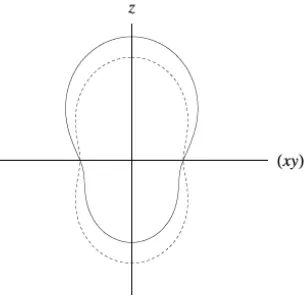
bµ, which has been of interest to us in section 2. According to this work, within the framework of LV extended electrodynamics, the Dirac equation for a bound electron in an external electromagnetic field has been considered, assuming the interaction with the background fieldbµ. A Foldy-Wouthysen quasi-relativistic (1/c)-series expansion (truncated to order 1/c2) has been applied to obtain an ef-fective Hamiltonian for the hydrogen atom and through this the relativistic Dirac eigenstates in a spherically-symmetric potential to second order inb0. Theb0-induced CPT-odd corrections to the electromagnetic dipole moment operators of a bound electron have been calculated. Such corrections contribute to the anapole moment of the atomic orbital and may cause a specific asymmetry of the angular distribution of the radiation of a hydrogen atom, in particular the 2p1/2,1/2 → 1s1/2,−1/2(cf. fig. 2). The non-observation currently of such asymmetries leads to bounds of the magnitude of|b0|:
|b0| ≤ 2×10⁻⁸m
ec2 10−11GeV, which are consistent with the general bounds (24) for the SME
coefficientbµfor electrons [29].
Figure 1.Tranformation properties of the various terms in (26) under the action of the discrete symmetries C, P and T. A+(−) indicates an even (odd) function. From ref. [36].
In general, theoretical estimates of dimension-three operators induced by multiloop CP violating corrections in the standard model, imply the following bounds of the SME coefficients in (21) [40]
aµ,bµ∼ dµ10−20−10−18GeV2, (27)
providing sensitivity todµ ≤ 10−12 GeV−1 and thusΛCPT ∼ 1011 −1012GeV, if one takes into account the current bounds onbµ[29] (cf. (24)).
Higher LV background tensors, e.g. terms in SME effective lagrangian of the form
Dµνρeγργ5e Fµν, can also be bounded experimentally with high accuracy, by looking [40] for correc-tions to the spin precession frequency of the formDi[0k]+Dk[0i]E
iBk, which changes sign under
the reversal of the electric fieldEi. The relative signal changes during the day as a result of the change
of the Laboratory orientation relative to the tensor background. We also mention the interesting sug-gestion of ref. [41] on further tests of CPT symmetry due to the CPT-odd axial vector background
bµ, which has been of interest to us in section 2. According to this work, within the framework of LV extended electrodynamics, the Dirac equation for a bound electron in an external electromagnetic field has been considered, assuming the interaction with the background fieldbµ. A Foldy-Wouthysen quasi-relativistic (1/c)-series expansion (truncated to order 1/c2) has been applied to obtain an ef-fective Hamiltonian for the hydrogen atom and through this the relativistic Dirac eigenstates in a spherically-symmetric potential to second order inb0. Theb0-induced CPT-odd corrections to the electromagnetic dipole moment operators of a bound electron have been calculated. Such corrections contribute to the anapole moment of the atomic orbital and may cause a specific asymmetry of the angular distribution of the radiation of a hydrogen atom, in particular the 2p1/2,1/2 → 1s1/2,−1/2(cf. fig. 2). The non-observation currently of such asymmetries leads to bounds of the magnitude of|b0|:
|b0| ≤ 2×10⁻⁸m
ec2 10−11GeV, which are consistent with the general bounds (24) for the SME
coefficientbµfor electrons [29].
Finally we mention that, further tests of CPT invariance can be made by direct measurements of particle antiparticle mass and charge differences, which we are not going to discuss here. However, in the spirit of our cosmological model discussed in section 2, we do mention that, if the observed
Figure 2.Anglular distribution for spontaneous radiation for the atomic transition 2p1/2,1/2 → 1s1/2,−1/2 in the presence of a CPT-odd SME axial background vectorbµ. The dashed line indicates the standard electrodynamics
bµ=0 case. From ref. [41].
matter/antimatter asymmetry were due to a mass difference between particle and antiparticles, then, one may make the reasonable assumption that baryogenesis could be due to mass differences between quarks and antiquarks [42]. The latter nay depend linearly with temperature,mq(T)∼gT, as a
conse-quence of known high-temperature properties of Quantum Chromodynamics (QCD). Furthermore, it is reasonable (although not strictly necessary) to assume that the quantk-antiquark differences today are bound by the current bound on proton-antiproton mass difference, which is of order 7×10⁻¹⁰ GeV, as provided in 2011 by the ASACUSA Collaboration [38]. Scaling back in temperature such differences, up to the respective decoupling temperature of the quarks, lead to baryon asymmetries that are much smaller than the observed one [42].
In this sense the model of [25] can still survive, given that, even if aB0 < 0.02 eV is observed today, according to the current SME limits, the Universe may have undergone such a (or series of) phase transition atT ∼109GeV towards a smaller (or zero) H-torsion background. This is an (crude) example of how one can use current SME bounds to fit early universe cosmologies. In a similar spirit, the model of [26] on leptogenesis through CPT and CP violating decays of heavy right-handed neutrinos, discussed in section 2, based on the Lagrangian (2), with the assumption that the critical temperature of the phase transition that triggers the demise of the axial backgroundB0is of the same order as the decoupling temperature of right-handed neutrinos,TD ∼100 TeV (5), lies comfortably

![Figure 3. A characteristic case of the intensity| I(∆t) (vertical axis) as a function of ∆t (horizontal axis), withω| = 0 (solid line) vs I(∆t) (dashed line) with |ω| = |η+−|, Ω = φ+− − 0.16π, for definiteness [19].](https://thumb-us.123doks.com/thumbv2/123dok_us/8067237.1345128/16.482.166.320.79.177/figure-characteristic-intensity-vertical-function-horizontal-dashed-deniteness.webp)
