ESTIMATION OF RELIABILITY OF ESSAY TESTS
IN PUBLIC EXAMINATIONS
by
LAW DING CHUNG
A thesis submitted in fulfilment of the requirements for
ABSTRACT
Essay test is an indispensable part of public examinations. However, there does not seem to exist a general method that can be used to estimate its reliability in the routine operation of the examination. The aim of present research is to develop a general model to study the reliability of essay tests due to between-marker inconsistencies, within-between-marker inconsistencies and question choice. The model is making use of multilevel analysis, since data from essay tests naturally fall into a three-level hierarchy: questions within candidates and candidates within markers. For cases where only one score is available for each candidate, the three-level model would degenerate into a two-level model.
Analyses using the two-level model and three-level model have been performed to illustrate how between-marker inconsistencies, factors affecting between-marker inconsistencies, within-marker systematic inconsistencies during marking period, and inconsistencies due to question choice can be analysed. By performing a common factor analysis on the covariance matrix of question scores, taking the factor score of the most dominant factor to be the true score, the reliability due to question choice and between-marker variability can be estimated.
question scores of 7,844 candidates marked by 18 markers. Parameters are estimated using iterative generalised least square. All the analyses reported in this study achieved convergence within a reasonably short time, using the software ML3E running on a personal computer, showing that the model is practicable in
ACKNOWLEDGMENT
I am very grateful to my supervisor Prof Harvey Goldstein for introducing me to the fascinating world of applying multilevel models in educational studies. He has always been very patient in explaining the details of the model and enlightened me with each new development in the area. At every stage of my research, he has been guiding me through his suggestions and critical comments of my work.
I would also like to thank the Hong Kong Examinations Authority for granting an one-year full-time study leave to start the research and for permission to use the data set in the study. I am particularly grateful to my colleagues in the Development Section and the Systems and Statistics Section of the Authority for their support in preparing the necessary information for the research. I am very indebted to Tim Wyatt who gave valuable comments in reading through the manuscript.
CONTENTS
ABSTRACT 2
ACKNOWLEDGMENT
CONTENTS 5
LIST OF TABLES
LIST OF FIGURES 12
CHAPTER 1 INTRODUCTION 14
CHAPTER 2 BACKGROUND OF STUDY
2.1 Introduction 17
2.2 Nature of public examinations 18
2.3 Influence of public examinations on education 24
2.4 Essay tests in public examinations 26
2.5 Use of reliability studies in public examinations 33
2.6 Public examinations in Hong Kong 34
CHAPTER 3 LITERATURE REVIEW
3.1 Introduction 38
3.2 Classical test theory 39
3.3 General methods for estimating reliability 46
3.4 Many concepts of reliability 51
3.5 Generalizability theory 56
3.6 Reliability estimation by factor analysis 63
3.7 Marker reliability 69
3.8 Reliability due to question choice 77
3.9 Item response models 82
3.10 Summary 83
CHAPTER 4 THE MODEL
4.1 The assumptions 85
4.2 Multilevel structure of data set 88
4.3 The two-level model 89
4.4 The three-level model 91
4.5 Assumptions in question choice 97
4.6 Summary 99
CHAPTER 5 THE SAMPLE
5.1 Introduction 100
5.3 The candidates and the markers 115
5.4 Question combinations 122
5.4 Variables at the candidate level 126
5.6 Summary 127
CHAPTER 6 TWO-LEVEL MODELS
6.1 Introduction 128
6.2 The variance component model 129
6.3 Analysis of between-marker variations 134
6.4 Analysis of within-marker variations 144
6.5 Analysis taking variables of both levels 173
6.6 Summary 177
CHAPTER 7 THREE-LEVEL MODELS
7.1 Introduction 179
7.2 Estimates of parameters 179
7.3 Factor structure of question scores 181
7.4 Estimation of reliability 191
7.5 Summary 193
CHAPTER 8 CONCLUSION
8.1 Introduction 194
8.3 Empirical results from the study 197
8.4 Advantages over traditional methods 199
8.5 Limitation and further research 201
8.6 Summary 204
BIBLIOGRAPHY 205
APPENDIX
The 1985 Hong Kong Advanced Level Examination
LIST OF TABLES
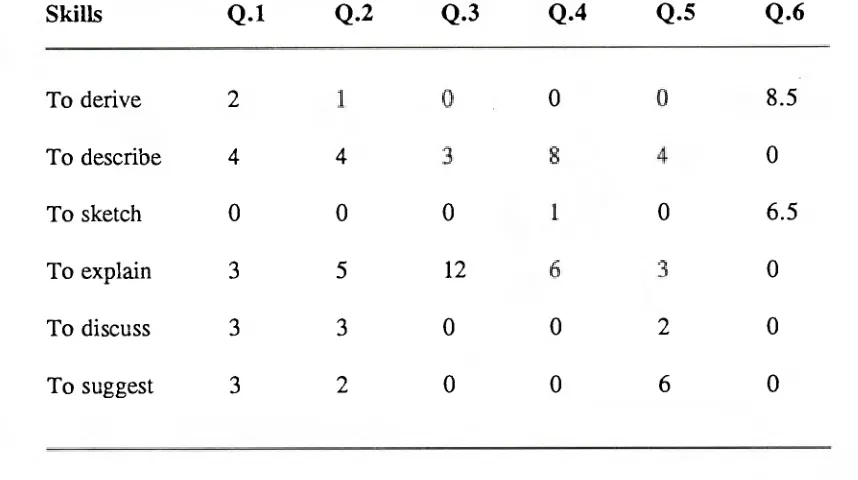
5.1 Breakdown of tasks of each question 103
5.2 Percentage attempt, mean mark and standard deviation
of each question 104
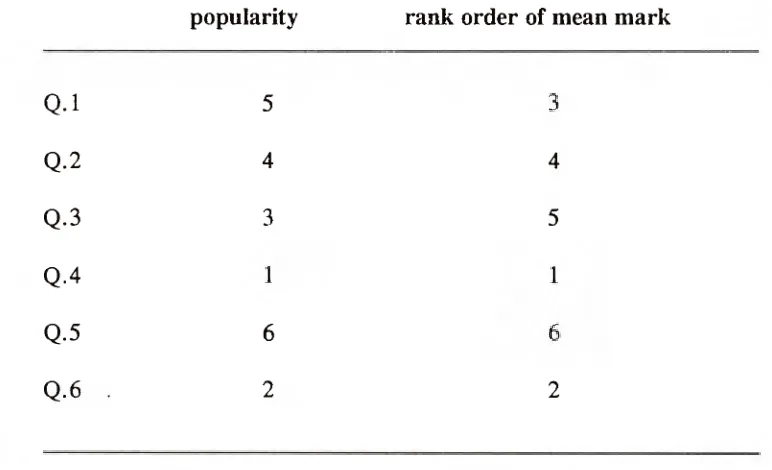
5.3 Rank order of popularity and mean mark 104
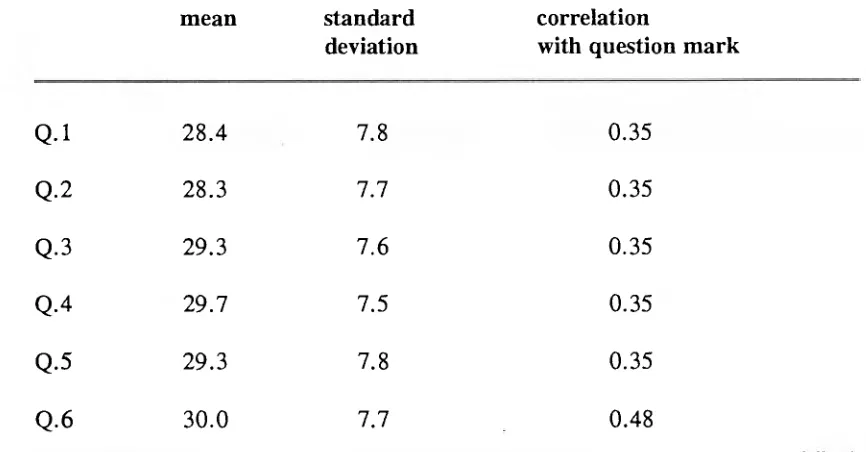
5.4 Mean, standard deviation and correlation with multiple-choice
paper score for those attempting each question 107 5.5 Scores of Paper IIA and multiple-choice paper of candidates
marked by each marker 117
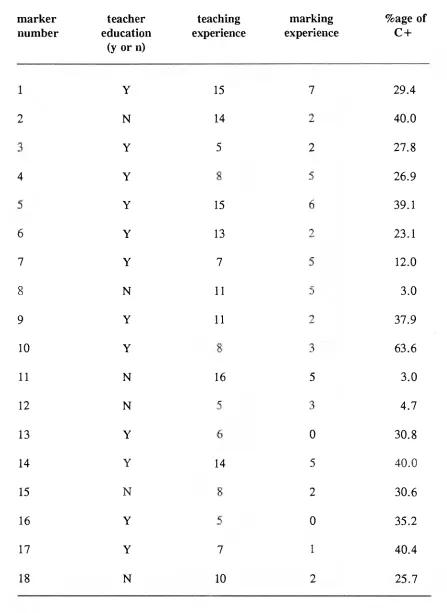
5.6 Marker characteristics 120
5.7 Correlations between marker-level explanatory variables 121 5.8 Means and variances of question scores in the reduced data set 123 5.9 Frequency and mean paper score for each combination
of questions 124
6.1 Variance component model 132
6.2 Variance component model(excluding 0 marks) 133 6.3 Scores related to teacher-training, teaching experience,
marking experience and calibre of students taught 136
6.4 Scores related to teacher-training 140
6.6 Scores related to marking experience 142 6.7 Scores related to calibre of students taught 143
6.8 Scores related to serial number 147
6.9 Paper score: OLS coefficients of separate regressions of scores
on serial number for candidates marked by each marker 166 6.10 Scores related to serial number (random at marker level) 167 6.11 Paper score: predicted intercepts and slopes 168 6.12 Scores related to serial number and (serial number)2 171 6.13 Maximum/minimum estimated scores and the estimated score
for the 400th script (deviated from the first script) 172 6.14 Scores related to serial number and (serial number)2
(random at marker level) 175
6.15 Scores related to teaching experience, serial number and
(serial number x teaching experience) 176
7.1 Estimates of means and covariances of the three-level model 180
7.2 Correlation matrix of question scores 182
7.3 Principal component analysis of covariances of question scores 182 7.4 Factor loading and communality (fitting one common factor) 183 7.5 Factor loading and communality (fitting two common factors) 186
7.6 Factor loading after varimax rotation 186
7.9 Mean and standard deviation of factor score for candidates
taking each combination of questions 189
7.10 Mean and standard deviation of factor scores for candidates
LIST OF FIGURES
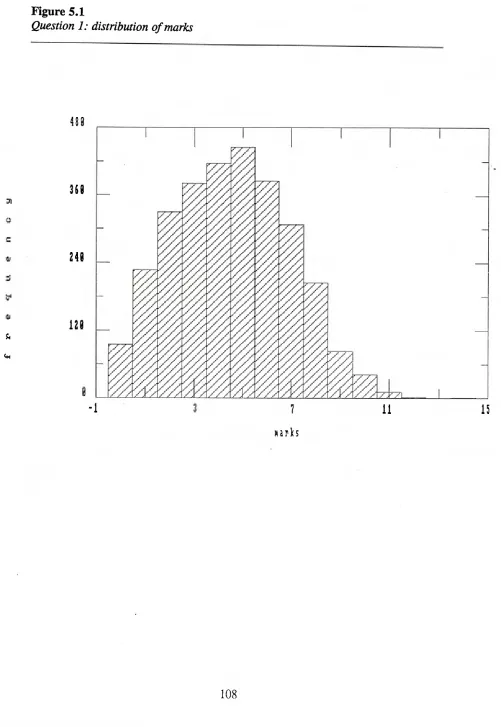
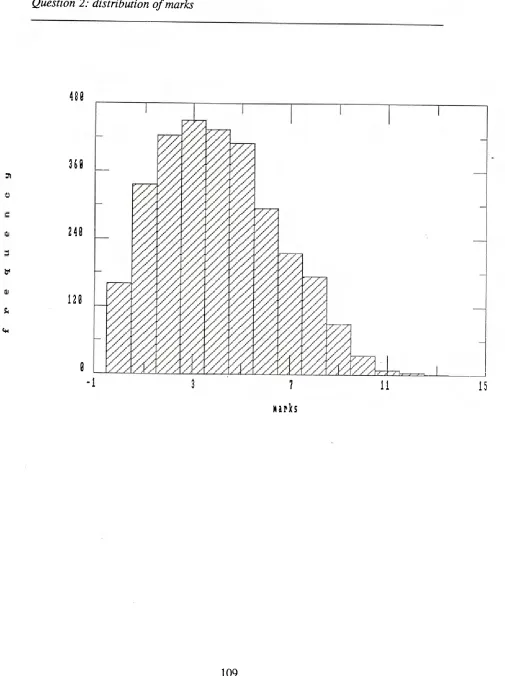
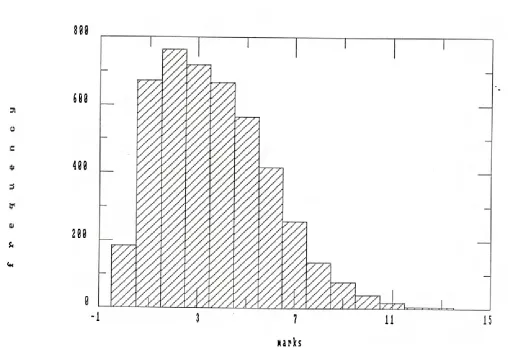
5.1 Question 1: distribution of marks 108
5.2 Question 2: distribution of marks 109
5.3 Question 3: distribution of marks 110
5.4 Question 4: distribution of marks 111
5.5 Question 5: distribution of marks 112
5.6 Question 6: distribution of marks 113
5.7 Distribution of paper scores 114
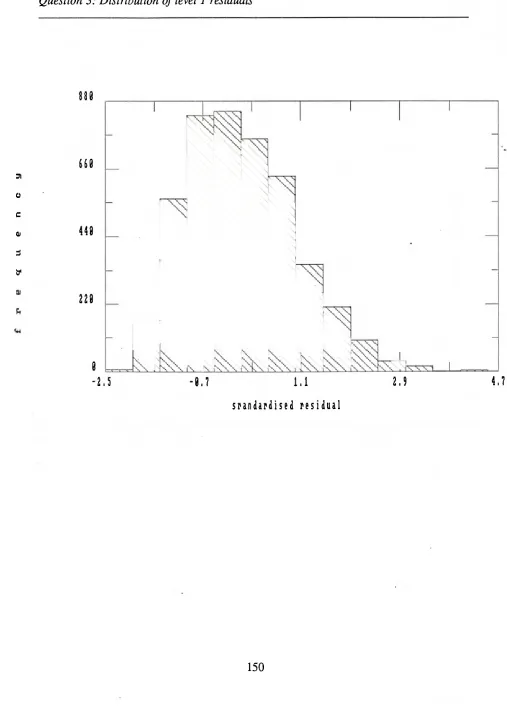
6.1 Question 1: distribution of level 1 residuals 148 6.2 Question 2: distribution of level 1 residuals 149 6.3 Question 3: distribution of level 1 residuals 150 6.4 Question 4: distribution of level 1 residuals 151 6.5 Question 5: distribution of level 1 residuals 152 6.6 Question 6: distribution of level 1 residuals 153 6.7 Question 6: distribution of level 1 residuals 154
6.8 Question 1: level 1 residual plot 155
6.9 Question 2: level 1 residual plot 156
6.10 Question 3: level 1 residual plot 157
6.11 Question 4: level 1 residual plot 158
6.13 Question 6: level 1 residual plot 160
6.14 Paper score: level 1 residual plot 161
6.15 Paper score: level 2 residual plot 162
CHAPTER 1 INTRODUCTION
Public examinations existed long before the introduction of modern educational measurement and were perhaps the only formal educational tests at that time. However, the theory of educational testing was not developed based on experiences from public examinations. Instead, its development was more associated with that of psychological tests. As a result, the theory was based on assumptions that would only hold true under very restrictive and simplistic conditions. Only with such constraints can mathematical expressions for reliability and validity be derived. One of the consequences is that the test theory is more applicable to objective tests, which usually assess a relatively narrow range of abilities and skills.
subjectively marked and candidates are allowed to have choice in questions. In order to justify the use of essay tests, we must demonstrate that these inconsistencies can be controlled at a reasonably low level. What is needed is a method in which reliability of essay tests can be estimated as an ongoing process in the administration of public examinations.
Examination boards are certainly concerned about the reliability of their papers. Procedures have been taken to minimise such inconsistencies during the administration of the examinations. Maintaining high reliability is vital in keeping the credibility of the award. However, we shall see in Chapter 3 that relatively little research has been conducted on the estimation of reliability of essay tests. In these studies, reliability is estimated piece-meal and there does not exist a general method in which errors from different sources can be estimated at the same time. Many examination boards did conduct studies to estimate the reliability of essay tests and some of these studies were published. However, most of these studies were based on special samples of examiners and candidates and the method cannot be used routinely in most examinations.
The objective of this study is to develop a general method that can be used to estimate the reliability of essay tests. It is hoped that such a method can be used operationally in public examinations and can give estimates of the errors due to
c. question choice.
The method should be sufficiently general to study ,gif the effect of each of the sources of error as well as to give an estimate of reliability assuming the existence of all of them.
CHAPTER 2 BACKGROUND OF THE STUDY
2.1 INTRODUCTION
In this chapter, we shall see that public examinations are in many ways different from classroom tests and 'standardised tests'. Looking back into history, we shall see that public examinations were introduced for the purpose of social selection. Because of their influence on the life-chances of examinees, they inevitably have tremendous effects on the teaching and learning in schools. We shall also see why essay tests are still indispensable parts of the examination, because there are skills that cannot be tested by multiple-choice items. While admitting that there are elements of subjectiveness in essay tests, we shall see that 'objective' tests such as multiple-choice
can
tests Gookl be quite subjective too.
2.2 NATURE OF PUBLIC EXAMINATION
The nature of public examinations can best be understood through briefly tracing their origin. The first public examination in history was the Chinese Civil Examination that took place around 622 AD in the Teng Dynasty (Teng, 1967). It was the time when the Li Family took over the rule of China Proper after defeating other warlords and rebels. In setting up a new empire, many young officials were needed at different levels. Until then, new recruits had to be selected from sons and relatives of nobles and mandarins in court. In other cases, they were recruited from graduates of royal schools or through recommendations from local officials. However, the number of eligible young men available from such sources was quite small. Moreover, these practices had the adverse effect of developing close rings around those who were recruited from the same source. The Emperor at that time established a system of Civil Examinations to attract young scholars from all over China to fill the various posts in the court. The policy, among other measures, did help to strengthen the central government and China experienced one of her most prosperous periods in history. This system had been used until the end of the nineteenth century and had been a strong weapon by the ruling class to preserve social stability in China.
this period of rapid growth of industry and commerce, the increasing demands for skilled men could not be met by patronage and apprenticeship alone. It was a period of shifting from apprenticeship to institutional training and transfer of power from the wealthy to the able (Montgomery, 1978). Public examinations were used as a convenient means to link educational institutions to other social institutions so that the qualified and able could be selected. Since the Second World War, there has been a vast expansion in education, especially at the primary and secondary levels, in most countries. Universal education has become a symbol of modernisation. As a result, the growth in the number of school-leavers at the primary and secondary level has led to a greater competition for places in higher education. Some forms of selection process have to be employed. Public examinations are often used as a politically and socially convenient means for this selection process. Mathews remarked:
"A powerful argument for the use of examinations as the main instrument for sorting students is that they are egalitarian: they are said to be the same for everybody whether they are be socially advantaged or disadvantaged; it matters not whether the candidates come the upper or lower class, inner city comprehensive or independent boarding-school; the questions are the same, the marking is the same. There appears to be no danger of favouritism either to individuals or institutions. To the extent that they are available to all and that assessment is impersonal, examinations can be said to provide equality of opportunity."
(Mathews, 1985, p. 20)
parents as compared with those of the lower class (see for example, Hargreaves, 1982). However, this selection process, to the public at large, is compatible with the philosophy of meritocracy and personal freedom of choice of capitalist society.
Another reason for the appeal of public examinations is that the results are easy to interpret. In many selection decisions, it is very difficult to compare school-based reports from hundreds of individual schools. Public examinations are expected to produce reliable and standardised assessments and the results can be easily interpreted
61
by admission officers of universities or employers. They are usually very willing to rely on public examination results for selection purposes, at least during the first screening.
a. Assessment by External Bodies based on an External Syllabus
Users of examinations are remarkably conservative and are unwilling to devote time or effort to 'unproven' qualifications. Examinations based entirely on continuous assessment or course work are more likely to be doubted than those based on formal examination papers (Eggleston, 1984). Moreover, from a technical point of view, the moderation of results assessed by different schools to the same standard is a difficult, if not impossible, job (Kingdon, 1981). Therefore, in essence, public examinations are still assessments in which teachers as classroom practitioners are not centrally involved. Although teachers may mark examination scripts, they generally do so as agents of the examination board.
b. Certification
After the examination, each student receives a statement of result. This document is trusted by the public to be an objective evaluation of the level of attainment that the student has achieved. In this way, he or she acquires a certain 'currency'. Brereton made a distinction between an examination and a test by the following:
"In almost every kind of examination some reward is offered either directly or indirectly; it is this reward which encourages the candidate to perform his task 'as well as possible' "
(Brereton, 1969, p.34)
"Tests have been developed as measuring instruments, pure and simple ....The person undergoing a test is a passive agent .... An 'exam', on the other hand, involves a striving to achieve. The examinee knows when he is to perform his task; he prepares for it; he tries to do well; he minds how well he does."
It is through this certificate that his or her achievement in the years of study in school is recognised. Of course, other statements of results such as school records or profiles may also serve as a certification of achievements. However, it is generally believed that the recognition obtained from other forms of assessment is much less than that from a public examination. So, it can be seen that public examinations exist for the purpose of social selection rather than for the of schools. Simply from an evaluation point of view or from an educational point of view, tests and examinations conducted in schools could be better means of assessment. Basically, it is not that schools need these public examinations, but the educational structure and social structure need them. When no selection is required, the existence of public examinations would not be justified.
c. The abilities tested in public examinations are complex in nature
Although public examinations are mainly used for selection purposes, they are different from other selection tests in that they serve a multiplicity of purposes. For example, the results of the Advanced Level Physics examination are used for selection of undergraduates for many different faculties and selection of trainees for many trades. They can also be used simply as indications of general academic ability. As such, they are tests trying to assess the overall attainment of students in a particular area over a number of years of schooling. The content and ability tested are much
2.3 INFLUENCE OF PUBLIC EXAMINATIONS ON EDUCATION
Since public examinations provide certification recognised by the public and lyas considerable influence on the life-chances of examinees, they inevitably motivate students to study what is covered in the syllabus. Probably everyone would agree that this motivation is 'extrinsic' in nature. Whether this extrinsic motivation is beneficial to students is a matter of opinion. Dore (1976) thought that extrinsic motivations would prohibit the development of intrinsic motivations. Little (1984), however, thought that extrinsic motivations might be a necessary though not sufficient condition for other kinds of motivations to develop. For many students, an interest in a subject and a concern for examinations could go hand in hand. Unger (1984) pointed out that, from the experience of the Cultural Revolution in China in 1966-1976, the removal of public examinations and other extrinsic motivations might lead to a high degree of demoralisation. It seems that whether people like it or not, for most teachers and students, public examinations are, to a certain extent, dictating what should be learned and how it is to be learnt.
become the dominating ideology in China for more than a thousand years. Although the Imperial government had never exerted any control on what the schools should teach in China, children all over China had to learn the Four Books and other classics in Confucism as prescribed in the Chinese Civil Examination. In Britain, the classroom used to be a 'secret garden' of the teacher, and schools had the right to decide what should be taught to the students. In recent years, the government has been exerting more control on what should be learned in schools by its influence on public examinations through the National Curriculum. This is reinforced by requiring schools to publish public examination results in the 1988 Education Act.
Undoubtedly, there are some limitations on what public examinations can assess. Public examinations put more emphasis on the outcome rather than the process of education. Because of the time and other constraints, many valuable abilities that students should acquire at school cannot be assessed. However, assuming that selection is still necessary and public examinations are still inevitable, what can best be done is to ensure that examinations do test desirable abilities. Thus it must be kept in mind that a public examination is not simply just another test. In the consideration of their contents and formats, the educational implications must be seriously considered.
2.4 ESSAY TESTS IN PUBLIC EXAMINATIONS
According to Stalnaker, "the most significant features of essay questions are the freedom of response allowed the examinee and the fact that not only can no single answer be listed as correct and complete, and given to clerk to check, but even an expert cannot usually classify a response as categorically right or wrong. Rather, there are different degrees of quality or merit which can be recognised." (Stalnaker, 1951, p.495)
different. However, the technical issues in reliability estimation for these questions are very similar. Thus in the present study, a broad definition of essay tests is adopted. All open-ended questions are considered to be essay questions.
Essay tests differ from 'objective' tests (the most common type being the multiple-choice tests) in the following ways:
a. Essay tests require the examinees to construct a response from their knowledge and the cues are embedded in the question. Objective tests usually require the examinees to recognise the correct answer from a number of alternatives.
b. In an essay test, examinees usually have to provide the steps in arriving at the answer to a question. In this way, they have to elaborate what and why they think to be correct, whereas in an objective test, examinees do not have to, nor have the chance, to indicate how the answer is arrived at.
,s
c. Since there more than one acceptable answer to a question, expert judgement is required in the marking of scripts. In objective tests, answers can be machine-read or marked by anybody given the key.
(see, for example, Coffman, 1971; Sax, 1989). The arguments against the use of essay tests (for the objective tests) are as follows:
a. Given the same length of testing time, more questions can be asked in an objective test, as compared with an essay test. Thus, objective tests are thought to have higher reliability.
b. Essay tests involve subjective judgement by markers. There may be inconsistencies in marking standard among different markers and at different instances of the same marker. This is particularly notable for topics where there are no straight-forward 'yes' or 'no' answers.
c. With the advent of techniques in test construction, nearly all abilities tested by essay tests can now be handled by objective tests. Essay tests are expensive to operate and there is no point in using essay tests, especially in large scale testing.
in an objective test is usually greater than that in a similar essay test. If it is agreed that both reading and writing are both basic communication skills and should be acquired in schools, it cannot be argued that objective tests must have a higher content validity.
On the other hand, in the real world situation, people are more often required to express their opinions and defend themselves with reasons rather than to choose one among a few given options. Those who argue for objective tests having a higher predictive validity are taking a narrow view that the reliability of a paper increases with its number of questions. However, even from the measurement point of view, when we say that a test of 40 items is more reliable and hence more valid than another test of 20 items, we have assumed that all these items are equivalent or at least similar in nature. There is no straightforward way to compare the reliability of two tests with questions of different nature. For example, it is difficult to compare the reliability and validity of a composition paper that consists of only one question with another multiple-choice test on language usage with 100 items.
subjects where objective tests are least appropriate. Here, there is also an element of subjectivity in how examiners predetermine the options and the key of a question. For example, historians may have different views on which is the principal cause of a historical event. The assessment of the history attainment of students should not be based on whether they can choose the option as decided by the examiner but should be based on how they can substantiate their conclusions with sound reasoning. In essay tests, students have the chance to defend and elaborate their views. The subjectivity of markers can be reduced by giving detailed instructions and sufficient training to the markers. But there does not seem a way to avoid the subjectiveness in objective tests.
Even in topics like mathematics and science, there are areas where essay tests cannot be replaced by objective tests entirely. Hoffman (1962) and La Faye (1966) showed that all options in some mathematics multiple-choice items could be correct and the test might penalise creative students.
in awarding marks for compositions. Markers are likely to put different weights on the various skills when rating essay tests. It is understandable that there would be variations in the marks given to a script if they do not have an agreed guideline. It is not surprising to find that the correlations of marks between markers for the same set of scripts are not very high. However, discrepancies between markers would be greatly reduced if some measures are taken to ensure markers follow a common standard. In most public examinations nowadays, there are common marking schemes, briefing sessions for markers, and random checks by chief examiners. Inter-marker
wu ct, 4-ve L reliabilities are expected to be much higher than those reported in the studies taken place in the early days.
errors in meaning or structure, thus requiring both declarative and procedural knowledge. Birenbaum and Tatsuoka (1987) compared the response patterns of
eks
equivalent tests given in open-ended and multiple-choice format found that the open- ended format gave significantly more information on students' misconceptions with
Q.,r) n elt
respect to the given subject matter. Befiftet, Rock and Wang (1991) studied the equivalence of free-response and multiple-choice items in the College Board's Advanced Placement Computer Science Test. While the study could not label the multiple-choice and free-response formats as measuring substantially different constructs, answers from free-response questions provided a trace of the examinee's solution process that could not be provided by multiple-choice items.
2.5 USE OF RELIABILITY STUDIES IN PUBLIC EXAM: NATIONS
More than twenty years ago, Skurnik and Nuttall (1968) appealed to examination boards to publish estimates of reliability and standard errors of measurement. But so far it seems that there is not a single examination board publishing examination results with such information, although results are typically expressed in grades rather than scores indicating that some allowances must be made in the interpretation. One of the reasons could be due to the complexity of the concept of reliability itself, which we
6
shall discuss in depth in Chapter 3. Probably, the most important reason c-eulfl be that reliability has been playing a different role in public examinations, as compared with its use with other standardised tests. As has been discussed earlier in this chapter, a grade awarded to a student is in fact a kind of 'currency', the value of which is more or less fixed and absolute. It is analogous to gold dealers producing gold nuggets guaranteeing a certain weight at a certain percentage of pure gold. For users, the value of a piece of gold nugget is fixed and absolute. This nugget is equivalent in value as another piece of gold nugget with the same rating produced by another authorised dealer. It would be very confusing and misleading if transactions of gold nuggets are
C vs.
the results are reasonably reliable. If the grades awarded by a particular board are found to be unreliable, there would be a danger that the awards given by the board would lose credibility. Thus reliability is used by examination boards as a means of quality control rather than giving a confidence interval for the users. The boards would not only be interested in the value of the estimate, but also the sources of errors so that measures can be taken to keep errors under control.
2.6 PUBLIC EXAMINATIONS IN HONG KONG
years: the Hong Kong Certificate of Education Examination and the Hong Kong Advanced Level Examination. The grades of the Hong Kong Certificate of Education Examination and the Hong Kong Advanced Level Examination are recognised by the University of London GCE Board as equivalent to its grades at Ordinary Level and Advanced Level respectively. In 1977, the Hong Kong Examinations Authority was established by the Ordinance of Hong Kong to be the only statutory public body responsible for public examinations. Its governing body consists of representatives of the relevant government departments, the Universities, other post-secondary institutions, commerce and industries and teachers and heads of secondary schools.
2.7 SUMMARY
In this chapter, we have briefly discussed the nature of public examinations and how they differ from other standardised tests or classroom tests. Since they serve the purpose of certifying the attainment of students, they invariably have tremendous influence on the learning and teaching in schools. Public examinations have been criticised for promoting rote-learning (see for example, Burgess and Adams, 1980). Thus, essay tests requiring demonstration of higher order skills have been widely used so as to reflect, as far as possible, the abilities that students should acquire at schools.
CHAPTER 3 LITERATURE REVIEW
3.1 INTRODUCTION
In this chapter, we shall review the literature relevant to the present study. The notion
of reliability of educational and psychological tests originated from the corresponding
concept in physical measurements. However, the constructs measured in educational
tests, especially essay tests, are usually more complex in nature than the entities
measured in the physical sciences and the models handling the estimation of reliability
tend to be more complicated. There has been considerable development in the theory
of reliability since its introduction at the beginning of the century. The progress in the
past ninety years has shown that efforts have been made to develop models that can
reflect the conditions in which educational tests have taken place. However, most of
them were developed as general models, often found to be more suitable for objective
tests. Relatively few of these studies were addressing specifically the problems in essay
tests, and they were mostly based on, or modified from, those methods designed for
objective tests. Thus in this chapter, considerable coverage is given to the discussion of
the various general models since the turn of the century. The models specifically designed
for essay tests are also reviewed. From these, experience can be drawn for building our
3.2 CLASSICAL TEST THEORY
In any study involving empirical data, there must be errors randomly deviating from the true value which is intended to be measured. The simplest model relating the true value to the observed value x is:
X-T , (3.1)
where 6 is assumed to be the error term randomly distributed about zero. However, as only x is observable, it would be impossible to decompose x into the two unobservable values ti and e with a single measurement. In the physical sciences, it is possible to estimate the error variance by repeated measurements on the object, in which case the replicative variance is equal to the variance of the observed values:
var(x1t) = var(e), (3.2)
since ti is a constant for that object (see, for example Topping, 1955).
However, this notion of measuring precision by repeated measurements on an object cannot be directly applicable to psychological or educational measurements. In physical measurements, the object under investigation can generally be treated as a passive agent. It is assumed that the property to be studied would not be substantially
fluctuations of readings by the observer and change of environment in which the observations are taking place. In psychological or educational measurements, on the other hand, the one being measured is an active agent. The examinees may be affected during the measuring process. For example, they may have learned through the tests, or may be less motivated and hence perform less well when repeating the same exercise. Moreover, the objects being measured may be subject to changes that are part of a long-term growth or trend. Thus, it would not be possible to administer a particular test to a particular person too many times, a number large enough to give a meaningful estimate of the true score and of the error variance.
Thus, in psychological or educational measurements, methods to estimate reliability have to be developed through modelling the relationship between the 'true' and observed scores in a population. Such models were first introduced in 1904 by Spearman. He showed that the correlation between two tests was attenuated by taking into account the 'accidental errors of measurements' (Spearman, 1904a). This theory, later referred as Classical Test Theory, was further developed by Spearman (1910), Brown (1910), Kuder and Richardson (1937), Rulon (1939), Guttman (1945), Cronbach (1947, 1951) and others. Elaborations of Classical Test Theory can be seen in Gulliksen (1950) or Lord and Novick (1968).
X
ft =ti t + £
'
(3.3)where 'C. and e are the true score and the corresponding error score respectively. Here, the true score of a particular examinee i is usually defined as the expectation of repeated, independent measurements:
ti t = Ei(X u), (3.4)
with
= 0 . (3.5)
In this way, the true score is not defined as the 'intrinsic true value' of a particular construct, but rather as the expectation of hypothetical measurements under certain conditions specified by the investigator.
In Classical Test Theory, the repeated measurements using the same test or equivalent tests are called parallel tests. Two tests Xj and Xj, are said to be parallel if
[1] They have the same true score for each of the examinees:
[2] They have the same observed variance:
var()c) = var(Xj.). (3.7)
The purpose of Classical Test Theory is to estimate the error variance by the observed score variance over a population of examinees, making use of certain assumptions. Hence we see that this value is population-specific and the relevant population may change and always needs to be defined. Hereafter in this section, we shall take expectation to be over the specified population of examinees.
Let Xj, 7; and Ei be random variables of the observed score, true score and error score on examinee j in the population of examinees.
In Classical Test Theory, the following assumptions have been made:
[1] The observed score can be expressed as the sum of the true score and the error score:
X.=T.+E.
J J J (3.8)
[2] The expected value of errors over the population of examinees is zero:
[3] The error score is uncorrelated with the true score:
cov (TrEi ) = 0 (3.10)
[4] The error score is uncorrelated with the true score of a parallel test:
coy (Tf Ej,) = 0 . (3.11)
[5] The error scores of two parallel tests are uncorrelated:
cov ) = 0 (3.12)
The reliability of a test is defined as:
yar(Ti) R =
yar (Xi) (3.13)
and is thus population-specific. The estimates of reliability of a test may be much higher if it is conducted in a heterogenous sample as compared with a homogenous sample (Levy, 1973).
ti = Rx,(1-R)gx. (3.14)
Furthermore, assuming bivariate normality, for a given observed score, the 95% confidence limits of the true score can be constructed as:
ti
-1.96ae s
T Si+1.96 a e '
(3.15)where
ae
is called the residual standard deviation from the regression of Ton X. Ge is found to be:a c = axVR(1-R) , (3.16)
where ax is the standard deviation of the observed score (details see for example, de Gruijter and van der Kamp, 1984).
By taking the variance on both sides of (3.8), we have
var(X) = var(T.+E.) = var(T) + var(E
'
.) (3.17)
J J J J .1
since coy ( Tr Ei) =
0.
ply,
_
cov (XJ,Xj)
l
ivar(Xj)var(Xj.)
cov (Ti, Ej , 7://, E
'
p)
= by (3.8)
varc9
var(T)
—
,
by (3.6), (3.10), (3.11)var(X)
= R
_I .
(3.18)It might be possible to define reliability in terms of correlation between parallel tests as in (3.18), from which (3.13) can be derived. But, in this way, the reliability of a test has to be defined in terms of another test which is rather unsatisfactory (Cureton,1958). For a given test, different assumptions in the construction of the parallel tests would result in different estimates of reliability (see criticism of Gulliksen model of parallel test by Guttman (1953)). Moreover, as we shall see, (3.13) would give a more general definition for models involving errors from more than one source.
It is found that the assumption of parallel tests is too strong to be practicable when two equivalent tests are administered. Useful results can be derived with weaker assumptions. The following are two commonly-used models of equivalence:
1. Fssentially tan-equivalent test. (Novick and Lewis, 1967) Two tests Xi,, and Xj, are said to be essentially tau-equivalent if Tj = a + Ti,, and
var()e) = var(Xj,), (3.19)
for some constant a.
2. Cong,cneric Tests' (Joreskog, 1971) Two tests Xj and X. are said to congeneric if
= a + bT + and X. = a' + b'T +
for some constants a, a', b, b'.
(3.20)
Both models have to satisfy the assumptions of independence of errors Ej and E,,.
3.3 GENERAI, METHODS FOR ESTIMATING RELIABILITY
are applicable to essay tests after some modifications. Elaborations of the methods can be found in each edition of Educational Measurement published by the American Council on Education (Thorndike, 1951; Stanley, 1971; Feldt and Brennan, 1988). In this section, only some of the commonly-used methods based on Classical Test Theory and its extensions are listed. We shall see in the next section that these methods make different assumptions in defining the error term and thus give different meanings to reliability.
a. Test-retest
b. Alternate-form
Here, alternate forms are constructed to be taken by the examinees. The correlation between these two tests is taken to be the estimate of the reliability of the forms.
c. Split-half
If it is not possible to give two separate administrations of tests to the examinees, the test is divided into two equivalent halves. One common procedure is to group the odd items into one test and the even items to the other. A better split may be obtained by matched pairs of items (matching in item difficulty or measuring the same construct), each allocated to one of the two halves (see Gulliksen, 1950). The reliability R of the test can be estimated using the Spearman-Brown Formula (Spearman, 1910; Brown, 1910):
R
2r
1 + r (3.21)
where r is the correlation between the two halves.
Flanagan (quoted by Rulon, 1939) gave the following formula for two halves which are essentially tau-equivalent:
O X 2 + O X2 2 ), 1 R = —4r = 2(1
2 2
ox ox
(3.22)
test and o 2 , x2 2 are the variances of the two halves.
It may not be convenient to divide the tests into two equal halves (for example, if there are an odd number of items), Raju (1970) showed that the reliability of the tests of two splits with k1 and k2 items respectively is equal to :
x,x2
2' /1A2 °x
(3.23)
where X = , and
p
is the correlation between the two halves. 1k,
X = k,
k142 2 k1-42 xix2
Kristof (1974) generalised (3.23) to cases for any splits of congeneric halves.
d. Cronhach's alpha
One of the arguments against using split halves is that different splits would give different estimates of reliability. Kuder and Richardson (1939) derived a number of formulae for estimating the reliability of a test of n items scored dichotomously (0 or 1). The most oft-used is the KR20:
Epi(1-p)
R = ( n )(1 ) ,
n-1 2
ox
(3.24)
Cronbach (1951) generalised KR20 to cases of items or sub-tests not necessarily dichotomous and termed it alpha:
,n
v, 2 ax axi
-1
) ))ox
2 (3.25)
where ox 2 is the variance of the i-th item.
Cronbach showed that alpha is equivalent to the mean reliability of all possible splits in the sense of Flanagan. It is equal to the reliability if the assumptions of essentially tau-equivalence are satisfied.
Raju (1977) generalised Cronbach's alpha for
n
sub-tests with k1 , k2 kn items. The reliability is equal to:ax
2 E a 2xi
R (3.26)
(1-E
A,)(3x2'
where Xi = ki l(k1+ k2+ kn) .
e. Instntmental variable method
y = PT+U
= 13
(x
- c)+u
= 13x+(u-13e) (3.27)
As x is correlated with the residual u'= u-
p
e , when regressing y on x, the ordinary least squares estimator b is not a consistent estimator of p . A consistent estimator is given by bIR, where R is the reliability of x. By premultiplying the regressed equation by an instrumental variable z, the (3.27) becomeszy = frzx
zu
(3.28)the regression coefficient bn, would be a consistent estimate of Pi (see, for example, Johnston, 1974). Ecob and Goldstein (1983) showed that the reliability can be estimated by the ratio of the ordinary least squares estimator b in (3.27) and the instrumental variable regression estimator
bn,
in (3.28).3.4 MANY CONCEPTS OF RELIABILITY
construction of the hypothetical equivalent tests give rise to different definitions of the true score, thus resulting in different estimates of reliability. For example, consider an observed score x of a candidate in a paper from a Physics examination. If ti is intended to be the ability of the candidate on the day of the examination, then the hypothetical replicates of the observation have to be taken for different papers of equivalent content and difficulty on the day. The day-to-day fluctuation of the candidate would be taken to be the variation of the true score. The source of errors would be due to the choice of paper. However, if it is the intention of the examination to measure the ability of the candidate in that particular paper within a certain span of time around the examination date, the hypothetical replicates would be carried out with the same paper at different times within that period and the day-to-day fluctuation would be considered to be a major source of error. If the aim of the examination is to measure the ability of the candidate in Physics as described in the syllabus within that period, the replications would be carried out using different papers set according to the requirements of the syllabus at different time instances during that period. For each of the above cases, we have different estimates of reliability under different assumptions of true scores.
Thorndike (1951) categorised the various sources of variations in measurements as following:
d. Temporary and specific characteristics of the individual,
e. Systematic or chance errors affecting the administration of the test or the appraisal of the test performance, and
f. Variations not otherwise accounted for (e.g. chance).
Which of these variations should be included as part of the error variance is decided by the investigator.
eiL
CI6 kC
The methods listed in Section 3.3 actually have different assumptions in the sources of error. In the test-retest reliability, only day-to-day fluctuations are assumed to be errors and hence the estimated reliability is a measure of stability, since only one form of the tests is used. In the alternate-form reliability, both variations in the choice of forms and day-to-day fluctuations are modelled as sources of error. Both split-half reliability and Cronbach alpha are methods involving only one administration of the test, and are thus unable to include day-to-day fluctuations as a source of error. Often these methods are termed internal methods (Ecob and Goldstein, 1983) or measures of internal consistency. Conceptually, there are some differences between split-half reliability and Cronbach alpha. In the split-half method, it is only required that the two halves have the same factorial structure while alpha applies only to fwmoriei homogenous tests (in other words, for tests of items measuring the 'same thing') (Cureton, 1958).
tr
them with different names. Cattell (1964), for example, suggested to -call the measurement of consistency across occasions as reliability, those across different tests, sub-tests or items as homogeneity and that across different groups of examinees as transferability. However, as there are numerous combinations of variations that can be modelled as errors, it would be impossible to categorise these into a few groups without confusion.
The Standard for Educational and Psychological Tests and Manual by American Educational Research Association (AERA), American Psychological Association (APA), & National Council on Measurement in Education (NCME) stated that:
"Reliability coefficient is a generic term. Different reliability coefficients and estimates of components of measurement can be based on various types of evidence; each type suggests a different meaning."
(AERA, APA, NCME, 1985)
The manual further cautioned test developers and users to discriminate between the different types of reliability:
"Each method of estimating a reliability that is reported should be defined clearly and expressed in terms of variance components, coefficients, standard errors of measurement, percentages of correct decisions, or equivalent statistics. The conditions under which the reliability estimate and the situations to which the reliability was obtained and the situations to which it may be applicable should be explained clearly
Coefficients based on internal analysis should not be interpreted as substitutes for alternate-form reliability or estimates of stability over time unless other evidence supports that interpretation in a particular context."
There are differences in opinion on whether it would be desirable to have high internal consistency. Most standard texts consider internal consistency to be one of the measures of reliability and should thus be as large as possible (see for example Ebel 1972; P416). Cattell (1964) considered that homogeneity should be low or high depending on purpose and structure. He pointed out:
"(a) If the items in two tests have the same mean correlation with their factor criterion (of validity), then the less homogenous test will have a higher validity as a whole. (b) There is probability that high homogeneity is being achieved in many current tests by causing items to share what are really specific factors, over and above the general personality or ability factor which they claim to measure. (c) A high "inbred," homogeneous test would be expected to show poorer transferability or hardiness across subculture, age range, etc. "
(Cattell, 1964)
Thorndike (1964) also agreed that "in order to maximise prediction of socially useful events, it may be advantageous to sacrifice a little precision in order to give a greater amount of scope".
involves more than one domain. For example, a Mathematics paper may have items on Algebra and Geometry; and may be testing both problem-solving and computational skills. It would not be appropriate to narrow down the scope of the test for the sake of achieving high internal consistency.
3.5 GENERALIZABELITY THEORY
Cronbach et. al. (1963) first proposed their generalizability theory in 1963. Further developments and elaboration were made by Gleser et. al. (1965), Cronbach et. al. (1972), Cronbach (1976), Brennan and Kane (1979), Brennan (1983) and others. A review of generalizability theory from 1973 to 1980 was made by Shavelson and Webb (1981). Generalizability theory has its own set of concepts and terminology. Here we shall outline only a few features related to the concept of reliability.
for a pxi design ( person p by test form i), where all persons are given all of the tests, the observed score
pt of a particular person on a particular form can be modelled as:
X
i = II (grand mean)
P
+ µp - I-I (person effect)
+ Ri - R (form effect)
+ XII( - Rp - Ili + 11, (residual) (3.29)
This can be extended to more complex models incorporating additional sources of variation. For example, if the tests are repeated on two more occasions, an additional term on the occasion effect and possibly another on the interactions of the effects can be incorporated in the design.
and validity becomes the problem of the extent to which an observed score can be taken as the universe score. This concept of generalizability does not require the assumptions made about individual means, variances and covariances of individual items as in Classical Test Theory. In this sense, generalizability theory is claimed to be a liberation from Classical Test Theory (Cronbach et.
al.
,1963).Kaiser and Caffrey (1965) and Kaiser and Michael (1975) showed that Cronbach alpha is the estimate of the square of the correlation between the observed scores and the universe scores under the assumption:
Cis = C. C fic st (3.30)
except when all the items in
is are identical.
Cronbach and his associates used analysis of variance in the estimation of the variance components of the various effects. Actually, analysis of variance has been used by Hoyt (1941), Ebel (1951), Pilliner (1952), Burt (1955) and some others in their methods of estimating reliability. Assuming all of the items in (3.29) are randomly distributed, we have:
02 (pi) 02(p) (person component)
02(i) (form component)
e) (residual) (3.31)
The residual variance a2(pi,e) is the actually the sum of the components of interaction of the person effect and the form effect and the residual. But, as the two variances are confounded in practice and cannot be separated, a single residual component has to be estimated in the model. Estimation for such models can be handled by methods proposed by Cronfield and Tukey (1956). An undated summary of methods of estimation of variance components can be found in Searle, Casella and McCulloch (1992). For (3.31), in the balanced case, we can derive simple moment estimates:
82(p) = (MSp - MSres )Ini
a2 (pi, c) = MSres
(3.32)where
MSp
,MS1
andMSres
are the mean square of the person effect, form effect and the residual in the analysis of variance respectively; andnp
andni
are the number of persons and forms respectively.Generalizability theory distinguishes a D study from a G study. The G study collects data for the estimation of variance components for a particular procedure. In the D study, the decision-maker defines the universe of generalisation and specifies the interpretation of a measurement. The decision-maker can use the same test score in different ways. Some may use the observed score as an estimate of a person's universe score (absolute decision); or he/she may be interested in the individual differences (comparative decision); or the observed score may be used as a regression estimate of the universe score. There may be a different error associated with each application and interpretation of the observed score.
Suppose that someone takes a random sample of
ni
items from the p xi
design and decisions are made based on the average of the items. The design is denoted byp xl.
For comparative decision in the pxl design , the error is
81
,/ = (Xi,/ -PI)
(Rp (3.33)0,
0 2 ( ) 02
•
n. (3.34)
Analogous to the reliability in the Classical Test Theory, a coefficient of generalizability can be defined as the ratio of the universe score variance to the expected observed score variance. The universe score variance is the person component of variance a2 (p) and the expected observed score variance in this case is:
E
02(x)) = EiEp(xpi _ 102 = 02 (p) + 02 (8 ) (3.35)The coefficient of generalizability is then:
E( p2 ) o2CP)
0
20)) + 02(8)
(3.36)
hence we have unbalanced designs. The estimation on models with unbalanced designs in analysis of variance is problematic and the coefficients in the expected mean squares equations are algebraically and computationally complex.
Loevinger (1965), when commenting on domain sampling theory, pointed out that the argument in domain sampling theory is circular if the domain is defined in terms of the observed scores. She queried whether an investigator could decide whether two measurements were from the same domain and said that items from a test are not typically randomly drawn. Rozeboom (1978) also opined that domain validity provided no information about the domain, since it is strictly a function of the number of items. He further argued that domains are likely to be multidimensional while generalizability theory only deals with the largest common factor. Thorndike (1964) remarked that:
"As soon as we try to conceptualise a test score as a sample from some universe, we are brought face to face with the very knotty problem of defining the universe from which we are sampling
The universe is considerably restricted, hard to define and the sampling for it is hardly to be considered random."
(Thorndike, 1964)
universe scores) may be monotonic increasing and converge to 1.0 with increasing number of variables (here tests) incorporated for single-factor models, two investigators assuming different domains in mind may have different limits for the factor scores (here universe scores) each with additional variables according to his/her schema.
As we have seen, the advantage of generalizability theory is that it "forces the investigator to specify to what universe the test is being referred when a certain reliability is claimed for it" (Keats, 1976). However, because of the complexity of its procedures and terminology, together with the instability of its estimates, while the theory gives a useful conceptual model in the interpretation of reliability, it is not easily
•
put into practical use. In fact, many of the concepts can be modelled as particular cases of other procedures using multilevel models (Goldstein and Wood, 1989; Rasbash and Goldstein, 1994) to be discussed in the next chapter.
3.6 RELIABILITY ESTIMATION BY FACTOR ANALYSIS
tkAi IA^ kr, •1,1
Consider a set of
n
congeneric testsX
i = [Li+ + El., (3.37)
where 't is the true score and the ei is the error score. Without loss of generality, let E(T)=0 . The true score and the error scores are unobservable. The covariance matrix of xi has n(n+1)/2 elements and with the usual assumptions of
coy
(c , c ,) = 0 , for i # i', and coy (ti 1, = 0 , there are 2n parameters of Xi andyar(e)
to be estimated.For
ns
3 , estimations can be carried out by approaches by Raju (1977) and Kristof (1974). However, for n>3 , the number of unknown>is less than the number of known elements, in which case estimates must be made using the factor analytic model.Factor analytic modelsand Classical Test Theory were both developed by Spearman (1904a; 1904b) at the beginning of the century. The factor analytic model attempts to explain the correlation matrix of a set of variables in terms of a small number of underlying unobservable or latent factors. Here,
n
observable or manifest variables xi,x2,...,xn whose means, without loss of generality, can be assumed to be zero, are postulated to be a linear function of a number of n unobserved or latent common factors4,6,...,fp
and an error term e . Thus,xi = A,fj, + E i ,
Jr
or, in matrix form, the vector of observed scores x = (xix2...xn)' can be expressed as
x = Af
(3.39) •where e = (e1 e2 ... e n )/ is the vector of error terms and
A
is the matrix of TL1_regressed coefficients of the variable
x
on factor f .A
is called factor loading matrix. It is further assumed that the E i 's are uncorrelated with each other and with each of the common factors. Assuming, without loss of generality, the factors have zero means and unit variance and the error terms have zero means, the covariance matrix of the observed variables E can be expressed as:E = AAA'
,
(3.40)where
'P
is the diagonal matrix containing the variances of e p e2,...,en and the 4 is the correlation matrix of the factors. In particular, if the factors are taken to be340
orthogonal to each other, 4) is an identity matrix and equation (x39) becomes
E =AA'
(3.41)all (3.42)
j-1
The first part 1. is called the commonality and represents the part of the variance shared with the other variables via the common factors. The second part lira is the specific variance accounting for the part of the variance not shared by the other variables.
Comparing the model represented by equation (3.38) with Classical Test Theory, the true score T can be modelled as:
T. =
Y J (3.43)
1
It is noted that the model is not restricted to cases where only one common factor is assumed (see discussion by LaForge (1965)).
Cronbach (1951) discussed the effect of the general factor (that is shared by all items) and group factors (that are shared by some of the items) on alpha by considering their share of variance on the test variances although he did not estimate the communality shown in equation (3.38). Mahmoud (1955) analyzed two sets of four equivalent tests administered on two different occasions and factorised into a general factor, a factor due to test type and a factor on occasions.
(3.44) 0xx
where W u is the specific variance of the i-th item and a is the variance of the test. Corresponding formulae for assuming more than one common factor can also be derived.
Maximum likelihood estimates for
A
and'11
were derived by Lawley (1940). Assuming a multivariate normal distribution of the vector test score x, standard errors of the estimates can be obtained. Joreskog (1967) introduced an efficient iterative algorithm and Joreskog and Sorbom (1988) developed a computer program making the estimation feasible.Joreskog (1971) discussed the statistical analysis on the set of congeneric tests and showed that the maximum likelihood estimate of the reliability for the i-th test is
13i )12 +
i Tit
(3.45)
For a linear combination of the items with vector of weights a' = (a p a2,...,a n) on the vector of tests x' = (x1,x2,...x), the reliability of the linear combination of tests would be
fa
/D2
P -
`
(a'X)2 + a'Wa
By constraining i=A 2 =fin , the model would be reduced to the tau-equivalent model discussed by Novick and Lewis (1967) and p would be equal to alpha. If we furthermore put wii.-4122...—qinn , the model would be the model for parallel tests.
Attempts have also been made using principal component analysis to estimate reliability. Principal component analysis tries to extract a number of components from a battery of tests. Each component is a linear combination of the observed scores. The first component is extracted so that it would best explain the total variance of the tests. The second component is the component uncorrelated with the first and best explain c the remaining variances and so on. Armor (1974) used principal component analysis to construct a weighted sum of the scores. The reliability of this weighted sum (which he called theta) is as follows:
1 0 ( )(1- ),
n-1 X i (3.47)
3.7 MARKER RELIABILITY
We have discussed some general models for the estimation of reliability. These models are of course applicable to essay tests. For example, the stability of the candidates can be estimated by test-retest reliability. The internal consistency of a test can be tested by Cronbach's alpha if essentially tau-equivalence of the questions in the test can be assumed. However, essay tests have two additional sources of errors to be handled: that due to subjective judgment by the markers and that due to question choice. In this section, we shall discuss models related to marker variations. The errors due to question choice will be discussed in the following section.
that marks tended to be over-adjusted. Another source of inter-marker error is that markers may have different criteria of good performance. A script being awarded a high mark by *marker may be given a low mark by another marker. If there are only two markers, the reliability can be estimated by the correlation of the scores allocated by the two markers. The reliability associated with intra-marker errors is called intra- marker or intra-rater reliability. It can be estimated by the correlation of scores given
en,N
by the same marker in two marking occasions.
their placement of Fail, Pass or Credit changed when the scripts were marked after 12- 19 months by the same marker and the average correlation was found to be 0.44.
However, it must be pointed out that the report aimed at finding out inconsistencies of marking. The guidelines given to markers (which might be typical of that time) were rather crude. There was no marking scheme and the markers were not trained. As we have discussed in Chapter 2, the reliability of an essay test depends very much on the control of marking criteria. Nowadays, most examination boards have standard procedures in the monitoring of marking. Inter-marker and intra-marker inconsistencies are expected to be much smaller. Moreover, from a technical point of view, a major drawback of the study is that scripts of very similar marks had been used. These might not be a representative sample of scripts in the examinations. As we have seen earlier, reliability is population-specific. The estimate could be unexpectedly low simply because a heterogeneous sample had been taken.
0.90).
For more than two markers, Ebel (1951) proposed to estimate inter-marker reliabilities by intraclass correlations. He separated the variance of the observed scores into three components, attributable to pupils, markers, and errors. He distinguished between the cases in which the average rating of all markers was taken to be the true score and the cases in which individual rating of a marker was taken as the true score. The former referred to the case where the average rating given by a number of markers was taken to be the score of the pupil, while in the latter case, the script was rated by only one marker in the examination and the study, with more than one marker, was carried out only as an experiment to estimate the reliability. The reliability of individual ratings for k markers rating the same set of scripts can be calculated as
M
(3.48)
r1
=M-- (k- 1)M
where NI
-
was the mean square for persons andM
was the mean square errors in the analysis of variance of the observed scores. The reliability of the average ratings could be calculated asM-- M
rk
M-
(3.49)rk =
1
+kr1
(3.50)
which is analogous to the Spearman-Brown formula. It must be noted that the inter-marker reliability estimated using the average score of the inter-markers in an experiment should not be used as an estimate of the reliability for an individual rating. Otherwise the estimate would be an overestimate. One advantage of this approach was that the inter-marker variance might or might not be included in the mean square for error according to whether the difference of severity between markers was interpreted as a source of error. Ebel also proposed a formula for an incomplete design where some cases were missing.
Further developments in using intraclass correlation were made by Maxwell and Pilliner (1968), Stanley (1962) and others. Shrout and Fleiss (1979) gave a comprehensive overview of the different models of using intraclass correlation in the estimation of marker reliability. They classified all cases for scripts of n pupils rated by k markers into six categories. In the consideration of choosing the appropriate form of intraclass correlation, researchers have to make the following three decisions:
(a) Is the one-way or two-way analysis of variance appropriate for the analysis?
(b) Are the differences between the markers mean scores relevant to the reliability of interest?
(c) Is the unit of analysis an individual rating or the mean rating?
sample selected from a population of raters and cases where the targets were fixed or a sample from a population of targets, thus arriving at fixed, random or mixed models based on different assumptions.
For essays being rated by a number of markers, the situation is the same as estimated the true score from a number of observed scores. In this context, the factor analytical model, as we have discussed earlier in Section 3.6, provides a useful framework for reliability studies. de Gruijter (1980), Blok (1985) and O'Grady and Medoff (1991) used a maximum likelihood confirmatory factor-analytic approach in the estimation of rater reliability. O'Grady and Medoff extended the framework of Joreskog (1971) to the analysis of inter-rater reliability under different assumptions. Consider the score yy of the i-th essay rated by the j-th marker,
yo.
= Pti +e u , (3.51)where
ti
represents the true score of the i-th essay and cis the error term. Differentmodels of parallel, essentially tau-equivalent and congeneric markers can be constructed under different assumptions id- [iv Piand