Lucky Microseconds: A Timing Attack on Amazon’s
s2n
Implementation of TLS
Martin R. Albrecht? and Kenneth G. Paterson??
Information Security Group
Royal Holloway, University of London, Egham, Surrey TW20 0EX, UK {martin.albrecht, kenny.paterson}@rhul.ac.uk
Abstract. s2n is an implementation of the TLS protocol that was released in late June 2015 by Amazon. It is implemented in around 6,000 lines of C99 code. By comparison, OpenSSL needs around 70,000 lines of code to implement the protocol. At the time of its release, Amazon announced thats2n had undergone three external security evaluations and penetration tests. We show that, despite this,s2n — as initially released — was vulnerable to a timing attack in the case of CBC-mode ciphersuites, which could be extended to complete plaintext recovery in some settings. Our attack has two components. The first part is a novel variant of the Lucky 13 attack that works even though protections against Lucky 13 were implemented ins2n. The second part deals with the randomised delays that were put in place in s2n as an additional countermeasure to Lucky 13. Our work highlights the challenges of protecting implementations against sophisticated timing attacks. It also illustrates that standard code audits are insufficient to uncover all cryptographic attack vectors.
Keywords TLS, CBC-mode encryption, timing attack, plaintext recovery, Lucky 13, s2n.
1 Introduction
In late June 2015, Amazon announced a new implementation of TLS (and SSLv3), called
s2n [Lab15,Sch15]. A particular feature of s2n is its small code-base: while s2n relies on
OpenSSL or any of its forks for low-level cryptographic processing the core of the TLS protocol
implementation is written in around 6,000 lines of C99. This is intended to make s2n easier
to audit. Indeed, Amazon also announced that s2n had undergone three external security
evaluations and penetration tests prior to release. No details of these audits appear to be in the public domain at the time of writing. Given the recent travails of SSL/TLS in general and
the OpenSSL implementation in particular,s2n generated significant interest in the security
community and technical press.1
We show that s2n — as initially released — was vulnerable to a timing attack on its
implementation of CBC-mode ciphersuites. Specifically, we show that the two levels of
pro-tection offered against the Lucky 13 attack [AP13] in s2n at the time of first release were
imperfect, and that a novel variant of the Lucky 13 attack could be mounted againsts2n.
The attack is particularly powerful in the web setting, where an attack involving malicious client-side Javascript (as per BEAST, POODLE [MDK14] and Lucky 13) results in the com-plete recovery of HTTP session cookies, and user credentials such as BasicAuth passwords.
?
This author’s research supported by EPSRC grant EP/L018543/1. ??
This author’s research supported by EPSRC grants EP/L018543/1 and EP/M013472/1, and a research pro-gramme funded by Huawei Technologies and delivered through the Institute for Cyber Security Innovation at Royal Holloway, University of London.
1 See for example
In this setting, an adversary runs malicious JavaScript in a victim’s browser and addition-ally performs a Person-in-the-Middle attack. We note, though, that many modern browsers prefer TLS 1.2 AEAD cipher suites avoiding CBC-mode, making them immune to the attack
described in this work if the sever also supports TLS 1.2 cipher suites ass2n does. The issues
identified in this work have since been addressed ins2n, partly in response to this work, and
current versions are no longer vulnerable to the attacks described in this work.
We stress that the problem we identify ins2ndoes not arise from reusing OpenSSL’s crypto
code, but rather from s2n’s own attempt to protect itself against the Lucky 13 attack when
processing incoming TLS records. It does this in two steps: (1) using additional cryptographic operations, to equalise the running time of the record processing; and (2) introducing random waiting periods in case of an error such as a MAC failure.
Step (1) involves calls to a function s2n_hmac_update, which in turn makes hash
com-pression function calls to, for example, OpenSSL or LibreSSL. The designers of s2n chose
to draw a line above which to start their implementation, roughly aligned at the boundary between low-level crypto functions and the protocol itself. The first part of our attack is focused at the lowest level above that line. Specifically, we show that the desired additional
cryptographic operations may not be carried out as anticipated: while s2n always fed the
same number of bytes to s2n_hmac_update, to defeat timing attacks, this need not result
in the same number of compression function calls of the underlying hash function. Indeed
this latter number may vary depending on the padding length byte which controls after how
many bytes s2n_hmac_digest is called, this call producing a digest over all data submitted
so far. We can also arrange that subsequent calls to s2n_hmac_update do not trigger any
compression function calls at all. This has the effect of removing the timing equalisation and reopening the window for an attack in the style of Lucky 13.
The second part of our attack is focussed on step (2), the random waiting periods
in-troduced in s2n as an additional protection against timing attacks. The authors of [AP13]
showed that adding random delays as a countermeasure to Lucky 13 would be ineffective if
the maximum delay was too small. Thes2n code had a maximum waiting period that is
enor-mous relative to the processing time for a TLS record, 10s compared to around 1µs, putting
the attack techniques of [AP13] well out of contention. However, the initial release of s2n
used timing delays generated by calls tosleep and usleep, giving them a granularity much
greater than the timing differences arising from the failure to equalise the running time in step (1). Consequently, at a high level, we were able to bypass step (2) by “mod-ing out” the
timing delays provided bysleep and usleep. However, the reality is slightly more complex
than this simple description would suggest, because those functions do not provide delays that
are exact multiples of 1µs but instead themselves have distributions that need to be taken
into account in our statistical analysis. Weaknesses in random delays as countermeasures to timing side-channels have been point out before, cf. [CK10]. In contrast to previous work, though, here the source of timing differences was not close enough to uniform, allowing our analysis of the low-level code to “leak through” the random timing delays, despite them being very large.
Our attack illustrates that protecting TLS’s CBC construction against attacks in the style of Lucky 13 is hard (cf. [AIES15]). It also shows that standard code audits may be insufficient to uncover all cryptographic attack vectors.
lines of new code were required to implement it, and it is arguable whether the code would be understandable by all but a few crypto-expert developers. It is worth noting that the countermeasure against Lucky 13 in OpenSSL does not respect the separation adopted in
the s2n design, i.e. it avoids higher-level interfaces to HMAC but makes hash compression
function calls directly on manually constructed blocks.2Thes2n code was patched to prevent
our attacks using a different strategy, (mostly) maintaining the above-mentioned separation.
At a high-level, the first step of our attacks exploits that s2n counted bytes submitted to
HMAC instead of compression function calls. In response, s2n now counts the number of
compression function calls. Furthermore, the second s2n countermeasure was strengthened
by switching from using usleepto using nanosleep.
1.1 Disclosure and Remediation
We notified Amazon of the issue in step (1) of their countermeasures, in s2n_verify_cbc
in s2n on 5th July 2015. Subsequently and in response, this function was revised to address
the issue reported. This issue in itself does not constitute a successful attack because s2n
also implemented step (2), the randomised waiting period, as was pointed out to us by the
developers of s2n. This countermeasure has since been strengthened by switching to the use
of nanosleep to implement randomised wait periods. This transition was already planned
by the developers of s2n prior to learning about our work, but the change was accelerated
in response to it. Our work shows that the switch to using nanosleep was a good decision
because this step prevents the attacks described in this work.3
1.2 Lucky 13 Remedies in other Libraries
As mentioned above OpenSSL prevents the Lucky 13 attack in 500 lines of code which achieves fully constant time/memory access [Lan13]. GnuTLS does not completely eliminate all poten-tial sources of timing differences, but makes sure the number of compression function calls is constant and other major sources of timing differences are eliminated. As reported in [Mav13] this results in timing differences in the tens of nanonseconds, likely too small to be exploited in practice. In contrast, GoTLS as of now does not implement any countermeasure to Lucky 13. However, a patch is currently under review to equalise the number of compression function calls regardless of padding value [VF15]. This fix does not promise constant time/memory
access. Botan does not implement any countermeasure to Lucky 13.4 WolfSSL implements
the recommended countermeasures to Lucky 13 from [AP13].5
2 The TLS Record Protocol and s2n
The main component of TLS of interest here is the Record Protocol, which uses symmetric key cryptography (block ciphers, stream ciphers and MAC algorithms) in combination with sequence numbers to build a secure channel for transporting application-layer data. In SSL and
2 See [Lan13] for a detailed description of the patch. 3
We also note that the first fix was still vulnerable to a timing attack in step (1), as reported in [ABBD15]. This further highlights the delicacy of protecting against timing side-channel attacks and that the move towards usingnanosleepwas a good decision.
4
https://github.com/randombit/botan/blob/master/src/lib/tls/tls_record.cpp#L398
5
versions of TLS prior to TLS 1.2, the only encryption option uses a MAC-Encode-Encrypt (MEE) construction. Here, the plaintext data to be transported is first passed through a MAC algorithm (along with a group of 13 header bytes) to create a MAC tag. The supported MAC algorithms are all HMAC-based, with MD5, SHA-1 and SHA-256 being typical hash algorithms. Then an encoding step takes place. For the RC4 stream cipher, this just involves concatenation of the plaintext and the MAC tag, while for CBC-mode encryption (the other possible option), the plaintext, MAC tag, and some encryption padding of a specified format are concatenated. In the encryption step, the encoded plaintext is encrypted with the selected cipher. In the case where CBC-mode is selected, the block cipher is DES, 3DES or AES
(with DES being deprecated in TLS 1.2). Thes2n implementation supports 3DES and AES.
Following [PRS11], we refer to this MEE construction as MEE-TLS-CBC.
The MEE construction used in the TLS has been the source of many security issues and attacks [Vau02,CHVV03,Moe04,PRS11,AP12,AP13]. These all stem from how the padding that is required in MEE-TLS-CBC is handled during decryption, specifically the fact that the
padding is addedafter the MAC has been computed and so forms unauthenticated data in the
encoded plaintext. This long sequence of attacks shows that handling padding arising during decryption processing is a delicate and complex issue for MEE-TLS-CBC. It, along with the
attacks on RC4 in TLS [ABP+13], has been an important spur in the TLS community’s
push to using TLS 1.2 and its Authenticated Encryption modes. AES-GCM is now widely supported in implementations. However, the MEE construction is still in widespread use, as highlighted by the fact that Amazon chose to support it in its minimal TLS implementation
s2n.
2.1 MEE-TLS-CBC
We now explain the core encryption process for MEE-TLS-CBC in more detail.
Data to be protected by TLS is received from the application and may be fragmented and
compressed before further processing. An individual record R (viewed as a byte sequence of
length at least zero) is then processed as follows. The sender maintains an 8-byte sequence
numberSQNwhich is incremented for each record sent, and forms a 5-byte fieldHDRconsisting
of a 2-byte version field, a 1-byte type field, and a 2-byte length field. The sender then
calculates a MAC over the bytes SQN||HDR||R; letT denote the resulting MAC tag. Note that
exactly 13 bytes of data are prepended to the record R here before the MAC is computed.
The size of the MAC tag is 16 bytes (HMAC-MD5), 20 bytes (HMAC-SHA-1), or 32 bytes
(HMAC-SHA-256). We lettdenote this size in bytes.
The record is then encoded to create the plaintext P by settingP =R||T||pad. Herepad
is a sequence of padding bytes chosen such that the length of P in bytes is a multiple of b,
wherebis the block-size of the selected block cipher (sob= 8 for 3DES andb= 16 for AES).
In all versions of TLS, the padding must consist of p+ 1 copies of some byte value p, where
0≤p≤255. In particular, at least one byte of padding must always be added. The padding
may extend over multiple blocks, and receivers must support the removal of such extended padding. In SSL the padding format is not so strictly specified: it is only required that the last byte of padding must indicate the total number of additional padding bytes. The attack
ons2n that we present works irrespective of whether the padding format follows the SSL or
the TLS specification.
In the encryption step, the encoded recordP is encrypted using CBC-mode of the selected
TLS 1.0 and SSL use a chained IV; our attack works for either option. Thus, the ciphertext blocks are computed as:
Cj =EKe(Pj⊕Cj−1)
wherePi are the blocks ofP,C0 is the IV, andKeis the key for the block cipher E. For TLS
(and SSL), the ciphertext data transmitted over the wire then has the form:
HDR||C
whereC is the concatenation of the blocks Ci (including or excluding the IV depending on
the particular SSL or TLS version). Note that the sequence number is not transmitted as part of the message.
Simplistically, the decryption process reverses this sequence of steps: first the ciphertext is decrypted block by block to recover the plaintext blocks:
Pj =DKe(Cj)⊕Cj−1,
whereDdenotes the decryption algorithm of the block cipher. Then the padding is removed,
and finally, the MAC is checked, with the check including the header information and a version of the sequence number that is maintained at the receiver.
However, in order to avoid a variety of known attacks, these operations must be performed without leaking any information about what the composition of the plaintext blocks is in terms of message, MAC field and padding, and indeed whether the format is even valid. The difficulties and dangers inherent in this are explained at length in [AP13].
For TLS, any error arising during decryption should be treated as fatal, meaning an encrypted error message is sent to the sender and the session terminated with all keys and other cryptographic material being disposed of.
2.2 Details of HMAC
As mentioned above, TLS exclusively uses the HMAC algorithm [KBC97], with HMAC-MD5,
HMAC-SHA-1, and HMAC-SHA-256 being supported in TLS 1.2.6 To compute the MAC tag
T for a messageM with key Ka, HMAC applies the specified hash algorithmH twice, in an
iterated fashion:
T =H((Ka⊕opad)||H((Ka⊕ipad)||M)).
Here opad and ipad are specific 64-byte values, and the key Ka is zero-padded to bring it
up to 64 bytes before the XOR operations are performed. All the hash functions H used in
TLS have an iterated structure, processing messages in chunks of 64 bytes (512 bits) using a compression function, with the output of each compression step being chained into the next step. Also, for all relevant hash functions used in TLS, an 8-byte length field followed
by padding of a specified byte format are appended to the message M to be hashed. The
padding is at least 1 byte in length and extends the data to a (56 mod 64)-byte boundary. In combination, these features mean that HMAC implementations for MD5, SHA-1 and
SHA-256 have a distinctive timing profile. Messages M of length up to 55 bytes can be
encoded into a single 64-byte block, meaning that the first, inner hash operation in HMAC
6
is done in 2 compression function evaluations, with 2 more being required for the outer hash
operation, for a total of 4 compression function evaluations. MessagesM containing from 56
up to 64 + 55 = 119 bytes can be encoded in two 64-byte blocks, meaning that the inner hash is done in 3 compression function evaluations, with 2 more being required for the outer operation, for a total of 5. In general, an extra compression function evaluation is needed for each additional 64 bytes of message data. A single compression function evaluation takes
typically a few hundred clock cycles.7
Implementations typically implement HMAC via an “IUF” interface, meaning that the computation is first initialised (I), then the computation is updated (U) as many times as are needed with each update involving the buffering and/or hashing of further message bytes. When the complete message has been processed, a finalisation (F) step is performed.
In s2n, OpenSSL or any of its forks is used to implement HMAC. The initialisation step
s2n_hmac_initcarries out a compression function call on the 64-byte stringKa⊕ipad. The
update steps2n_hmac_updateinvolves buffering of message bytes and calls to the compression
function on buffered 64-byte chunks of message. Note that no compression function call will
be made until at least 64 bytes have been buffered. The finalisation step s2n_hmac_digest
consists of adding the length encoding and padding, performing final compression function calls to compute the inner hash and then performing the outer hash operation (itself involving 2 compression function evaluations).
2.3 HMAC Computations after Decryption in s2n
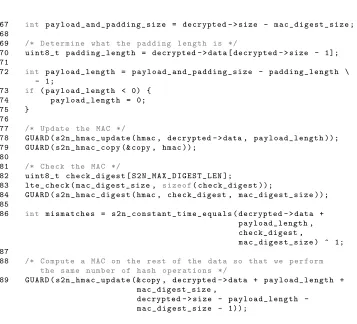
The s2n implementation uses the code in Figure 1 to check the MAC on a record in the
functions2n_verify_cbc. This code is followed by a constant-time padding check that need
not concern us here (except to note that the fact that it is constant time helps our attack, since it enables us to isolate timing differences coming from this code fragment). In Figure 1, the
content of bufferdecrypted->datais the plaintext after CBC-mode decryption. The header
SQN||HDR of 13 bytes is dealt with by the calling function.
Notice how the code first computes, using the last byte of the plaintext, a value for
padding_length, the presumed length of padding that should be removed (excluding the pad
length byte). Arithmetic is then performed to find payload_length, the presumed length
of the remaining payload over which the HMAC computation is to be done. The actual HMAC computation is performed via an initialise call (not shown), and then the code in
line 78 (update via the function s2n_hmac_update) and line 84 (finalise via the function
s2n_hmac_digest). Line 86 compares the computed HMAC value with that contained in the
plaintext, and sets a flagmismatches if they do not match as expected.
Line 79 copies the HMAC state to a dummy state, so that line 89 can perform a dummy
s2n_hmac_update computation on data from the plaintext buffer. This attempts to ensure that the number of hash computations carried out is the same, irrespective of the amount of padding that should be removed. This is in an effort to remove the timing channel exploited in the Lucky 13 attack. The number of bytes over which the update is performed is equal todecrypted->size - payload_length - mac_digest_size - 1, which is one less than the
number of bytes in the plaintext buffer excluding the 13 bytes ofSQN||HDR, the message, and
the MAC value. Recall, however, that this update operation may not actually result in any compression function computations being carried out. What happens depends on exactly how
many bytes are already sitting unprocessed in the internal buffer and how many are added to it in the call.
67 int p a y l o a d _ a n d _ p a d d i n g _ s i z e = d e c r y p t e d - > s i z e - m a c _ d i g e s t _ s i z e ; 68
69 /* D e t e r m i n e w h a t the p a d d i n g l e n g t h is */
70 u i n t 8 _ t p a d d i n g _ l e n g t h = d e c r y p t e d - > d a t a [ d e c r y p t e d - > s i z e - 1]; 71
72 int p a y l o a d _ l e n g t h = p a y l o a d _ a n d _ p a d d i n g _ s i z e - p a d d i n g _ l e n g t h \ - 1;
73 if ( p a y l o a d _ l e n g t h < 0) { 74 p a y l o a d _ l e n g t h = 0;
75 }
76
77 /* U p d a t e the MAC */
78 G U A R D ( s 2 n _ h m a c _ u p d a t e ( hmac , d e c r y p t e d - > data , p a y l o a d _ l e n g t h )); 79 G U A R D ( s 2 n _ h m a c _ c o p y (& copy , h m a c ));
80
81 /* C h e c k the MAC */
82 u i n t 8 _ t c h e c k _ d i g e s t [ S 2 N _ M A X _ D I G E S T _ L E N ];
83 l t e _ c h e c k ( m a c _ d i g e s t _ s i z e , s i z e o f( c h e c k _ d i g e s t ));
84 G U A R D ( s 2 n _ h m a c _ d i g e s t ( hmac , c h e c k _ d i g e s t , m a c _ d i g e s t _ s i z e )); 85
86 int m i s m a t c h e s = s 2 n _ c o n s t a n t _ t i m e _ e q u a l s ( d e c r y p t e d - > d a t a + p a y l o a d _ l e n g t h , c h e c k _ d i g e s t ,
m a c _ d i g e s t _ s i z e ) ^ 1; 87
88 /* C o m p u t e a MAC on the r e s t of the d a t a so t h a t we p e r f o r m the s a m e n u m b e r of h a s h o p e r a t i o n s */
89 G U A R D ( s 2 n _ h m a c _ u p d a t e (& copy , d e c r y p t e d - > d a t a + p a y l o a d _ l e n g t h + m a c _ d i g e s t _ s i z e ,
d e c r y p t e d > s i z e p a y l o a d _ l e n g t h -m a c _ d i g e s t _ s i z e - 1 ) ) ;
Fig. 1.Excerpt froms2n verify cbc,s2n’s code for checking the MAC on a TLS record
2.4 Randomised Waiting Period
In order to additionally protect against attacks exploiting timing side-channels, s2n
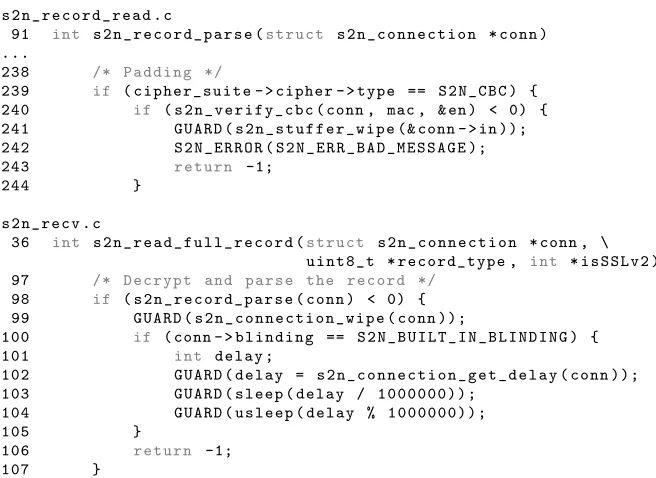
imple-ments the following countermeasure: whenever an error occurs, the implementation waits for a random period of time before sending an error message. We reproduce the relevant code excerpts in Figure 2; at a high level, when a MAC failure occurs, the following steps are taken:
– All available data is erased. Depending on the amount of buffered data, the time this takes
may vary.
– All connection data is wiped, which may also introduce a timing difference.
– A random integer x between 1,000 and 10,001,000 is requested. Since rejection sampling
is used to generatex, this might also introduce some timing variation.
– This random integer is then fed tousleepandsleepcalls (after the appropriate scaling),
causing a random delay of at leastx µs.
We note that this countermeasure, which is activated by default, is designed as an API mode which can in principle be disabled. This is to support implementations which
s 2 n _ r e c o r d _ r e a d . c
91 int s 2 n _ r e c o r d _ p a r s e (s t r u c t s 2 n _ c o n n e c t i o n * c o n n ) ...
238 /* P a d d i n g */
239 if ( c i p h e r _ s u i t e - > cipher - > t y p e == S 2 N _ C B C ) { 240 if ( s 2 n _ v e r i f y _ c b c ( conn , mac , & en ) < 0) { 241 G U A R D ( s 2 n _ s t u f f e r _ w i p e (& conn - > in )); 242 S 2 N _ E R R O R ( S 2 N _ E R R _ B A D _ M E S S A G E );
243 r e t u r n -1;
244 }
s 2 n _ r e c v . c
36 int s 2 n _ r e a d _ f u l l _ r e c o r d (s t r u c t s 2 n _ c o n n e c t i o n * conn , \ u i n t 8 _ t * r e c o r d _ t y p e , int * i s S S L v 2 ) 97 /* D e c r y p t and p a r s e the r e c o r d */
98 if ( s 2 n _ r e c o r d _ p a r s e ( c o n n ) < 0) { 99 G U A R D ( s 2 n _ c o n n e c t i o n _ w i p e ( c o n n ));
100 if ( conn - > b l i n d i n g == S 2 N _ B U I L T _ I N _ B L I N D I N G ) {
101 int d e l a y ;
102 G U A R D ( d e l a y = s 2 n _ c o n n e c t i o n _ g e t _ d e l a y ( c o n n )); 103 G U A R D ( s l e e p ( d e l a y / 1 0 0 0 0 0 0 ) ) ;
104 G U A R D ( u s l e e p ( d e l a y % 1 0 0 0 0 0 0 ) ) ;
105 }
106 r e t u r n -1;
107 }
Fig. 2.Excerpts froms2n_record_read.cands2n_recv.c,s2n’s code for adding a random waiting period
S2N_BUILT_IN_BLINDING then none of the countermeasure code is run.8 Since this counter-measure introduces a delay of up to 10s in case of an error, it might be tempting for some
application developers to disable it. However, note that the s2n documentation strongly
ad-vises against disabling this counter measure without replacing it by an equivalent one on the application level.
3 The Attack without the Random Waiting Period Countermeasure
We first describe our variant of the Lucky 13 attack againsts2n assuming the random waiting
period countermeasure is not present. We show how to deal with this additional countermea-sure in Section 4.
For simplicity of presentation, in what follows, we assume the CBC-mode IVs are explicit
(as in TLS 1.1 and 1.2). We also assume thatb= 16 (so our block cipher is AES). It is easy
to construct variants of our attacks for implicit IVs and for b = 8. The MAC algorithm is
HMAC-H where H is either MD5, SHA-1 or SHA-256. We focus at first on the case where
the MAC algorithm is HMAC-SHA-256, so that t= 32. We explain below how the attack can
be adapted tot= 16 and t= 20 (HMAC-MD5 and HMAC-SHA-1, respectively).
LetC∗ be any ciphertext block whose corresponding plaintext P∗ the attacker wishes to
recover. Let C0 denote the ciphertext block precedingC∗. Note thatC0 may be the IV or the
last block of the preceding ciphertext if C∗ is the first block of a ciphertext. We have:
P∗=DKe(C
∗)⊕C0.
Let ∆ be an arbitrary block of 16 bytes and consider the decryption of a ciphertext
Catt(∆) of the form
Catt(∆) =HDR||C0||C1||C2||C3||C0⊕∆||C∗
consisting of a header field HDR containing an appropriate value in the length field, an IV
block, and 5 non-IV blocks. The IV block and the first 3 non-IV blocks are arbitrary, the
penultimate blockC4 =C0⊕∆is an XOR-masked version ofC0and the last block isC5=C∗.
The corresponding 80-byte plaintext isP =P1||P2||P3||P4||P5 in which
P5=DKe(C ∗
)⊕(C0⊕∆)
=P∗⊕∆.
Notice that P5 is closely related to the unknown, target plaintext block P∗. Notice also
that, via line 67 of the code in Figure 1, the variable payload_and_padding_size is set to
80−32 = 48 (recall that the 13-byte stringSQN||HDRwas fed to HMAC by the calling function
and is buffered but otherwise unprocessed at this point). We now consider 2 distinct cases:
1. SupposeP5ends with a byte value from the set{0x00, . . . ,0x04}. In this case, the code sets
padding_lengthto be at most 4 and then, at line 72,payload_lengthis set to a value that
is at least 48−4−1 = 43 (and at most 47). This means that when the HMAC computation
is performed in lines 78 (update) and 84 (finalise), the internal buffer contains at least 56 bytes (because 13 bytes were already buffered by the calling function) and exactly 5 calls to the compression function will be made, including one call that initialises HMAC and 2 that finalises it. The time equalising code at line 89 adds between 0 and 4 bytes to the internal buffer, which still holds the previous message bytes. However, because of the short length of our chosen ciphertext, the buffer ends up being exactly 60 bytes in size. This number
is obtained by considering the 13 bytes of SQN||HDR, thepayload_length bytes added to
the buffer at line 78 and the decrypted->size- payload_length - mac_digest_size
-1 bytes added to the buffer at line 89. Combining these, one arrives at there being -12 +
decrypted->size - mac_digest_size bytes in the buffer. This evaluates to 60 for the
particular values in the attack. Notably, this number is independent of payload_length
andpadding_length. The call at line 89 is to the update function rather than the finalise function, so at least 64 bytes would be needed in the buffer to cause any compression function computations to be performed at this point. Thus no compression function call
is made as a consequence of the call tos2n_hmac_updateat line 89.
2. SupposeP5ends with a byte value from the set{0x05, . . . ,0xff}. In this case, the code sets
padding_lengthto be at least 5 and then, at line 72,payload_lengthis set to a value that
is at most 48−5−1 = 42 (and at least 0). This means that when the HMAC computation
is performed in lines 78 (update) and 84 (finalise), the internal buffer contains at most 55 bytes and exactly 4 calls to the compression function will be made (again, including the initialisation and finalisation calls). The time equalising code at line 89 will again result in no additional calls to the compression function being made, as the internal buffer is again too small at exactly 60 bytes in size (recall that the buffer size is independent of
payload_length andpadding_length).
Based on this case analysis, a timing difference will arise in HMAC processing of the
attack ciphertext Catt(∆), according to whether the last byte ofP5=P∗⊕∆is from the set
time of an error message at the man-in-the-middle attacker who injects the attack ciphertext. The difference is of the same size as that observed in the plaintext recovery attack presented in [AP13], a few hundred clock cycles on a modern processor. Of course, as in [AP13], this time difference would be affected by noise arising from network jitter, but it is sufficiently big to enable it to be detected. Furthermore, if the attacker can arrange to be co-resident with the victim in a cloud environment, a realistic prospect as shown by a line of work culminating in [VZRS15], the attacker can perform a Person-in-the-Middle attack and observe the usage of resources on the server by being co-resident.
As was the case in [AP13], the attack can be iterated as often as is desired and with
different values of∆, provided the same plaintext is repeated at a predictable location across
multiple sessions. The attack as presented already takes care of the complication that each
trial will involve a different key in a different TLS session; onlyP∗ needs to be constant for
it to work.
By carefully exploring the timing behaviour for different values in the last byte of∆(each
value being tried sufficiently often so as to minimise the effect of noise), the attacker can
deduce the value of the last byte ofP∗. For example, the attacker can try every value in the
6 most significant bits in the last byte of ∆to identify a value ∆∗ for which the time taken
is relatively high. This indicates that the last byte ofP∗⊕∆∗ is in the set{0x00, . . . ,0x04};
a more refined analysis can then be carried out on the 3 least significant bits of the last byte
of∆∗ to identify the exact value of the last byte ofP∗. The worst case cost of this version of
the attack is 64 + 8 = 72 trials (multiplied by a factor corresponding to the number of trials
per∆needed to remove noise).
The attack cost can be reduced further by using initially longer ciphertexts, because the
peculiar characteristics of thes2n code mean that this choice results in there being a greater
number of values for (the last byte of)∆that result in a higher processing time; the precise
value of the last byte ofP∗can then be pinned down by using progressively shorter ciphertexts.
We omit the details of this enhancement.
3.1 Extending to Full Plaintext Recovery
In the web setting, with HTTP session cookies as the target, the attack extends in a straight-forward manner to full plaintext recovery using by-now-standard techniques involving mali-cious client-side Javascript and careful HTTP message padding. A good explanation of how
this is achieved can be found in [MDK14] describing the POODLE attack on TLS.BasicAuth
passwords also form a good target; see [GPdM15] for details.
3.2 Variants for HMAC-MD5 and HMAC-SHA-1
Assume b= 16 (as in AES) and consider the case of HMAC-MD5. Then, because t= 16 in
this case, andtis still a multiple ofb, the attack described above works perfectly, except that
we need to use a ciphertext having 4 non-IV blocks instead of 5. The attack also works for
b= 8 for both HMAC-MD5 and HMAC-SHA-256 by doubling the number of non-IV blocks
used.
For HMAC-SHA-1, we have t= 20. Assume b = 16 (AES). Then a similar case analysis
as above shows that using a ciphertext with 4 blocks result in a slow execution time if and
only if the last plaintext blockP4 ends with0x00. This leads to a plaintext recovery attack
requiring, in the worst case, 256 trials per byte. The attack adapts to theb= 8 case by again
4 Defeating the Random Wait Period Countermeasure
As described in Section 2.4, s2n implemented a second countermeasure against attacks
ex-ploiting timing channels. In this section, we show how it could be defeated.
4.1 Characterising the Timing Delays
To start off, we notice that at the price of increasing the number of samples by a factor of
roughly ten, we can assume that sleep at line 103 in the code in Figure 2 is called with
parameter zero, by rejecting in an attack any sample where the overall time is more than 1s.
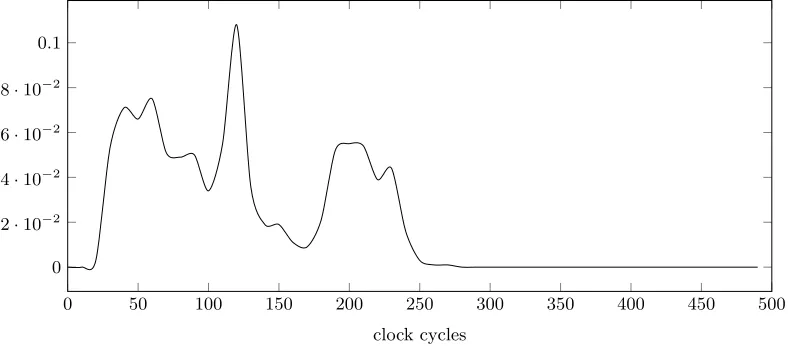
This removes one potential source of randomness. As shown in Figure 3, calling sleep(0)
has a rather stable timing profile.
0 50 100 150 200 250 300 350 400 450 500
0 2·10−2 4·10−2 6·10−2 8·10−2 0.1
clock cycles
Fig. 3.Distribution of clock ticks for callingsleep(0)on Intel(R) Xeon(R) CPU E5-2667 v2 @ 3.30GHz.
Next, we consider calls tousleepwith a random delay as a source of timing randomness.
For this, note that usleep has a granularity of 1µs. On our main test machine, which is
clocked at 3.3Ghz, this translates to 3,300 clock cycles.9 From this, we might expect that
if we take our timings modulo the clock ticks per µs (namely, 3,300 on our test machine),
we could filter out all the additional noise contributed by theusleep(delay)call. However,
usleep(delay) does not guarantee to return afterexactly delay µs, or even to return after
an exact number of µs. Instead, it merely guarantees that it will return afterat least delay
µs have elapsed. Indeed, on a typical UNIX system, waking up a process from sleep can take
an unpredictable amount of time depending on global the state of the OS.
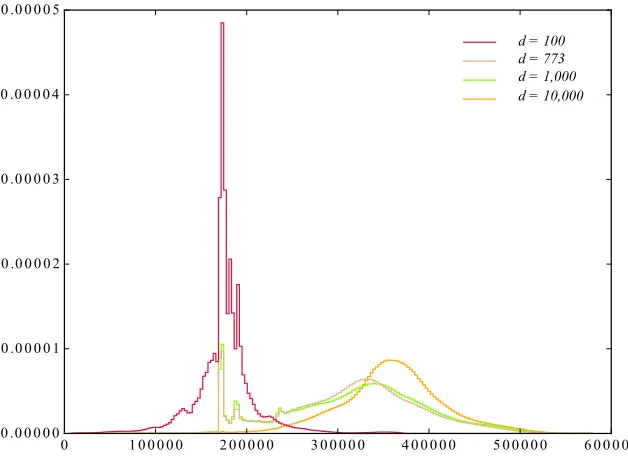
However, despite this,usleepdoes show exploitable non-uniform behaviour on the systems
we tested. Figures 4 and 5 illustrate this behaviour. Figure 4 shows raw timings (in clock
cycles) for usleep(d), normalised to remove the minimum possible delay, namely 3,300·d
clock cycles. Figure 5 shows the distribution of timings (in clock cycles) forusleep(delay)
withdelayuniformly random in an interval [0, d), but now taken modulo 3,300. Both figures
9
are generated from data captured on our main test machine. They exhibit the non-uniformity
needed to bypass the random waiting period countermeasure ins2n.
0 1 0 0 0 0 0 2 0 0 0 0 0 3 0 0 0 0 0 4 0 0 0 0 0 5 0 0 0 0 0 6 0 0 0 0 0 0 .0 0 0 0 0
0 .0 0 0 0 1 0 .0 0 0 0 2 0 .0 0 0 0 3 0 .0 0 0 0 4 0 .0 0 0 0 5
d = 100 d = 773 d = 1,000 d = 10,000
Fig. 4.Distribution ofusleep(d)−3,300·d(in clock cycles) on Intel(R) Xeon(R) CPU E5-2667 v2 @ 3.30GHz. Probability on theyaxis.
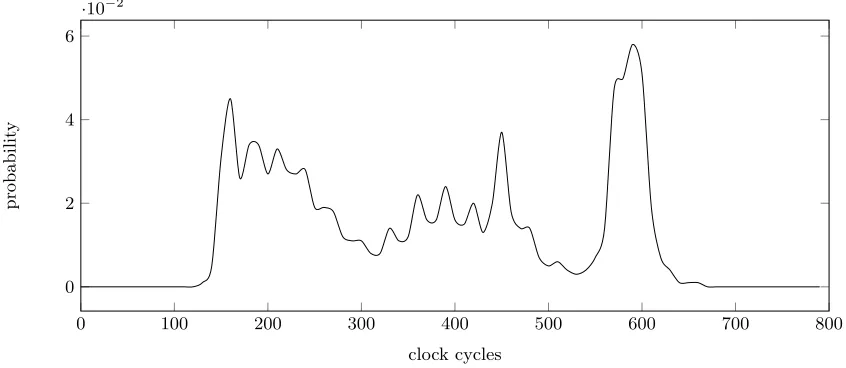
Figures 6 and 7 show that, like the call tousleep, the calls to the functionss2n_stuffer_wipe
and s2n_public_random also do not produce timing profiles which are uniform modulo 1µs (3,300 clock cycles).
However, it is not enough to simply characterise the timing profile of the calls tousleep;
rather it is necessary to study the distribution of the running time of the entire random timing delay code in Figure 2, in combination with the code for checking the MAC on a TLS record in
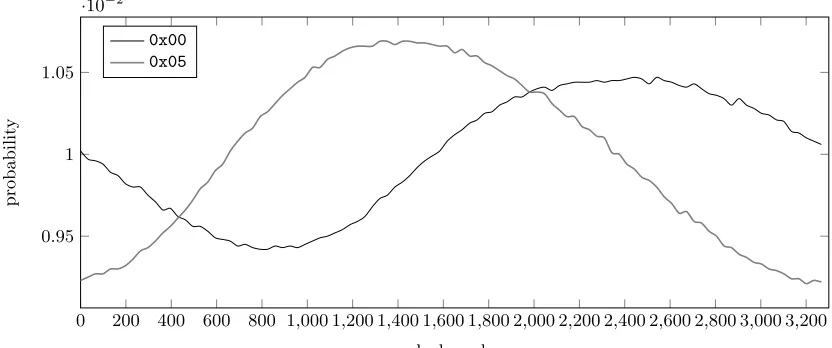
Figure 1, for different values of the mask∆in the attack in Section 3. Figure 8 brings different
sources of timing difference together and shows that the timing distributions (modulo 3,300) that are obtained for different mask values are indeed still rather easily distinguishable. The
figure is for samples with the maximum delay restricted to 100,000µs instead of 10s. We
stress that this is a synthetic benchmark for studying the behaviour of the various sources of timing randomness and does not necessarily represent actual behaviour. See Section 5 for
experiments with the actuals2n implementation of these countermeasures.
4.2 Distinguishing Attack
Having characterised the timing behaviour of the s2n code, as exemplified in Figure 8, we
are now in a position to describe a statistical attack recovering plaintext bytes and its perfor-mance. In fact, the approach is completely standard: given the preceding analysis, we expect
0 200 400 600 800 1,000 1,200 1,400 1,600 1,800 2,000 2,200 2,400 2,600 2,800 3,000 3,200 0.6
0.8 1 1.2 1.4
·10−2
clock cycles
probabilit
y
d= 103 d= 104 d= 105
Fig. 5.Distribution of clock ticks modulo 3,300 forusleep(delay)withdelayuniformly random in [0, d), on Intel(R) Xeon(R) CPU E5-2667 v2 @ 3.30GHz.
0 100 200 300 400 500 600 700 800
0 2 4 6
·10−2
clock cycles
probabilit
y
Fig. 6. Distribution of clock ticks for calling s2n_stuffer_wipe on Intel(R) Xeon(R) CPU E5-2667 v2 @ 3.30GHz.
classes depending on the value of the last byte ofP∗⊕∆, one classH ={0x00, . . . ,0x04}, the
other classL={0x05, . . . ,0xff}; if the observed distributions for all values inL(resp.H) are
close to each other but the Kullback-Leibler (KL) divergence between distributions from L
andH is large (and equal toD, say), then, applying standard statistical machinery, we know
that we will require about 1/Dsamples to distinguish samples from the two distributions. As
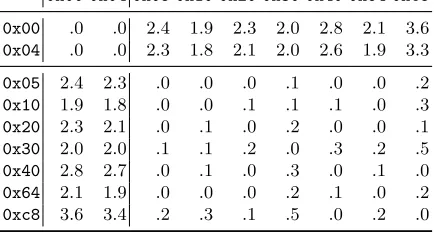
Tables 1 and 2 demonstrate, the requirements on KL divergence for values in L and H are
indeed satisfied, even for relatively large values for the maximum delay.
For example, assuming for the sake of argument that no additional noise is introduced by
network jitter or other sources, we would be able to distinguish the value0x00 from 0xc8in
the last byte ofP∗⊕∆with 1/(3.6/1,000)≈280 TLS sessions if the maximum delay were
re-stricted to 100,000µs. Using rejection sampling, i.e. discarding all samples with a delay greater
0 200 400 600 800 1,000 1,200 1,400 1,600 1,800 2,000 2,200 2,400 2,600 2,800 3,000 3,200 0
1 2 3 4·10
−2
clock cycles
probabilit
y
Fig. 7. Distribution of clock ticks modulo 3300 for calling s2n_public_random on Intel(R) Xeon(R) CPU E5-2667 v2 @ 3.30GHz.
0x00 0x04 0x05 0x10 0x20 0x30 0x40 0x64 0xc8
0x00 .0 .7 14.1 15.1 17.7 13.2 18.4 17.4 17.6
0x04 .7 .0 15.4 16.8 19.5 15.3 20.0 18.9 19.3
0x05 14.0 15.3 .0 .1 .2 .3 .3 .2 .2
0x10 15.0 16.6 .1 .0 .1 .2 .2 .1 .1
0x20 17.4 19.2 .2 .1 .0 .5 .0 .0 .0
0x30 13.0 15.1 .3 .2 .5 .0 .7 .5 .5
0x40 18.2 19.7 .3 .2 .0 .7 .0 .0 .0
0x64 17.2 18.7 .2 .1 .0 .5 .0 .0 .0
0xc8 17.4 19.0 .2 .1 .0 .5 .0 .0 .0
Table 1. KL divergence multiplied by 1,000 of time distributions in clock cycles modulo 3,300 with the maximum delay limited to 1,000µs on Intel(R) Xeon(R) CPU E5-2667 v2 @ 3.30GHz.
0x00 0x04 0x05 0x10 0x20 0x30 0x40 0x64 0xc8
0x00 .0 .0 2.4 1.9 2.3 2.0 2.8 2.1 3.6
0x04 .0 .0 2.3 1.8 2.1 2.0 2.6 1.9 3.3
0x05 2.4 2.3 .0 .0 .0 .1 .0 .0 .2
0x10 1.9 1.8 .0 .0 .1 .1 .1 .0 .3
0x20 2.3 2.1 .0 .1 .0 .2 .0 .0 .1
0x30 2.0 2.0 .1 .1 .2 .0 .3 .2 .5
0x40 2.8 2.7 .0 .1 .0 .3 .0 .1 .0
0x64 2.1 1.9 .0 .0 .0 .2 .1 .0 .2
0xc8 3.6 3.4 .2 .3 .1 .5 .0 .2 .0
Table 2.KL divergence (scaled by 1,000 for readability) of time distributions in clock cycles modulo 3,300 with the maximum delay limited to 100,000µs on Intel(R) Xeon(R) CPU E5-2667 v2 @ 3.30GHz.
10s), this increases to roughly 28,000 TLS sessions for a successful distinguishing attack. We
0 200 400 600 800 1,000 1,200 1,400 1,600 1,800 2,000 2,200 2,400 2,600 2,800 3,000 3,200 0.95
1 1.05
·10−2
clock cycles
probabilit
y
0x00 0x05
Fig. 8.Distribution of clock ticks modulo 3,300 for timing signals on Intel(R) Xeon(R) CPU E5-2667 v2 @ 3.30GHz with the maximum delay restricted tod= 100,000.
actual implementation and because the surrounding code and network jitter will introduce additional noise.
4.3 Plaintext Recovery Attack
We can extend this distinguishing attack to a plaintext recovery attack in the following (standard) way. We assume that in a characterisation step, we have obtained, for possible
value x of the last byte in block P5, a histogram of the timing distribution modulo 1µs for
ciphertexts Catt(∆) of the form used in the attack. We assume these timings are distributed
into B equal-sized bins, and so the empirical probability of each bin px,b for 0 ≤b < B can
be calculated. (In fact, since we expect that timing behaviours for the classes H and L are
similar, it is sufficient to sample for two values x, one from each class.)
Now, in the actual attack, for each value δ of the last byte of ∆, we obtain N samples
for ciphertexts Catt(∆) for which the timing delay is at most 100,000µs. This then requires
a total of about 256·100·N TLS sessions. We bin these into B bins as above, letting nδ,b
denote the number of values in binbfor last byte valueδ. Now for each candidate value yfor
the last byte ofP∗, we compute the log likelihood for the candidate, using the formula:
LL(y) = X
δ∈{0x00,...,0xFF}
nδ,b·log(pδ⊕y,b).
We then output as the preferred candidate for the last plaintext byte the valuey∗ having the
highest value ofLL(y) amongst all candidates.
We omit the detailed analysis of the performance of this attack, pausing only to note that it will require more samples than the distinguishing attack because the underlying statistical problem is to now separate one correct candidate from 255 wrong candidates, and this is more demanding than the basic distinguishing problem.
To wrap up, we note that nanosleep, which is now used in s2n to add a random time
Byte value Cycles Byte value Cycles Byte value Cycles
0x00 2251.96 0x05 1746.49 . . . .
0x01 2354.57 0x06 1747.65 0xfc 1640.79
0x02 2252.07 0x07 1705.62 0xfd 1634.61
0x03 2135.11 0x08 1808.73 0xfe 1648.70
0x04 2130.02 0x09 1806.50 0xff 1634.64
Table 3.Timing of functions2n verify cbc(in cycles) withH= SHA-256 for different values of last byte in thedecryptedbuffer, each cycle count averaged over 28 trials.
Byte value Cycles Byte value Cycles Byte value Cycles
0x00 1333.99 0x05 1095.01 . . . .
0x01 1174.29 0x06 1092.68 0xfc 1062.37
0x02 1178.52 0x07 1065.08 0xfd 1035.48
0x03 1156.56 0x08 1102.31 0xfe 1035.15
0x04 1140.14 0x09 1101.04 0xff 1036.02
Table 4.Timing of functions2n verify cbc(in cycles) with H = SHA-1 for different values of last byte in thedecryptedbuffer, each cycle count averaged over 210trials.
5 Proof of Concept
We confirmed thats2n does indeed behave as expected using the following two experiments.
For the first experiment, we setup as2n_blobbuffer of length 93 and filled it with random
data. Then, we assigned all possible padding length values0x00 to0xff by overwriting the
last byte of the buffer and timed how long the function s2n_verify_cbc took to return. As
expected, the padding length values between0x00and0x04resulted in timings about 500–550
cycles longer than all other values. The timing difference was clear and stable. Some sample data is shown in Tables 3 and 4. We note that at present we cannot explain the variation within the second and third columns of those tables.
For the second experiment, we ran the attack against the actual s2n implementation
instead of running a synthetic benchmark. That is, we timed the execution of s2n_recv
under the attack described in Section 3. However, to speed up execution we patcheds2n to
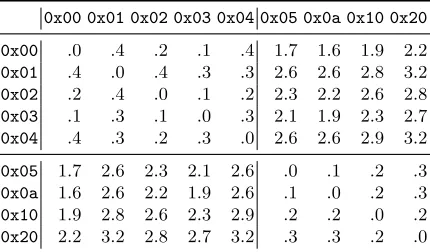
only sample random delays up to 10,000µs. As highlighted in Table 5, this, too, shows marked
non-uniform timing behaviour modulo 1µs.
We did not adjust our proof-of-concept code to realise a full plaintext recovery attack,
because (a) s2n has since been patched in response to this work and because (b) the cost
is somewhat dependent on the target machine and operating system. We note, though, that an attack can establish the characteristics of a target machine by establishing genuine TLS sessions (where, hence, padding bytes are known) but with some random bits flipped.
The complete source codes for our experiments (which borrow heavily from thes2n test
suite) are available athttps://bitbucket.org/malb/research-snippets.
6 Discussion
Our attack successfully overcomes both levels of defence against timing attacks that were
0x00 0x01 0x02 0x03 0x04 0x05 0x0a 0x10 0x20
0x00 .0 .4 .2 .1 .4 1.7 1.6 1.9 2.2
0x01 .4 .0 .4 .3 .3 2.6 2.6 2.8 3.2
0x02 .2 .4 .0 .1 .2 2.3 2.2 2.6 2.8
0x03 .1 .3 .1 .0 .3 2.1 1.9 2.3 2.7
0x04 .4 .3 .2 .3 .0 2.6 2.6 2.9 3.2
0x05 1.7 2.6 2.3 2.1 2.6 .0 .1 .2 .3
0x0a 1.6 2.6 2.2 1.9 2.6 .1 .0 .2 .3
0x10 1.9 2.8 2.6 2.3 2.9 .2 .2 .0 .2
0x20 2.2 3.2 2.8 2.7 3.2 .3 .3 .2 .0
Table 5.KL divergence observed the full attack against actuals2n implementation (scaled by 105 for read-ability) using 224samples on Intel(R) Xeon(R) CPU E5-2667 v2 @ 3.30GHz.
attempt to equalise the code’s running time and the second level being the use of a random wait interval in the event of an error such as a MAC failure.
Fundamentally, the first level could be bypassed because s2n counted bytes going into
s2n_hmac_updateinstead of computing the number of compression function calls that need to
be performed as suggested in [AP13]. A call tos2n_hmac_updatein itself will not necessarily
trigger a compression function call if insufficient data for such a call is provided. A call to
s2n_hmac_digest, however, will pad the data and trigger several compression function calls, the number also depending on the data already submitted at the time of the call. We note that in OpenSSL this issue is avoided by effectively re-implementing HMAC in the function
ssl3_cbc_digest_record, i.e. by performing lower-level cryptographic operations within the
protocol layer. In contrast, s2n is specifically aimed at separating those layers. In response
to this work,s2n now sensibly counts the number of compression function calls performed,
somewhat maintaining this separation.
The second level could be bypassed because, while the randomised wait periods were large, they were not sufficiently random to completely mask the timing signal remaining from the first step of our attack. Note that the analysis in [AP13] of the effectiveness of random delays in preventing the Lucky 13 attack assumed the delays were uniformly distributed; under this assumption, their analysis shows that the count measure is not effective unless the maximum delay is rather large. What the second step of our attack shows is that, even if the maximum delay is very large, non-uniformity in the distribution of the delay can be exploited. In short, it is vital to carefully study any source of timing delay to ensure it is of an appropriate quality when using it for this kind of protection.
Our experiments indicate that the distribution of nanonsleep as implemented on Linux
is sufficiently close to uniform to thwart the attack described in this work. We note, however, that this puts a high security burden on this function which is not designed for this purpose.
In particular,nanosleep(2)states (emphasis added): “nanosleep() suspends the execution of
the calling thread until eitherat least the time specified in *req has elapsed, or the delivery
of a signal that triggers the invocation of a handler in the calling thread or that terminates the process.”
Acknowledgement
We would like to thank Colm MacCarthaigh and the rest of the s2n development team for
pointing out the randomised waiting countermeasure and for helpful discussions on an earlier draft of this work.
References
[ABBD15] Jos´e Bacelar Almeida, Manuel Barbosa, Gilles Barthe, and Fran¸cois Dupressoir. Verifiable
side-channel security of cryptographic implementations: constant-time MEE-CBC. IACR Cryptology
ePrint Archive, 2015:1241, 2015.
[ABP+13] Nadhem J. AlFardan, Daniel J. Bernstein, Kenneth G. Paterson, Bertram Poettering, and Jacob C. N. Schuldt. On the Security of RC4 in TLS. In Samuel T. King, editor,Proceedings of the 22nd USENIX Security Symposium, pages 305–320, Washington D.C., USA, August 2013. USENIX.
[AIES15] Gorka Irazoqui Apecechea, Mehmet Sinan Inci, Thomas Eisenbarth, and Berk Sunar. Lucky 13
strikes back. In Feng Bao, Steven Miller, Jianying Zhou, and Gail-Joon Ahn, editors,Proceedings of the 10th ACM Symposium on Information, Computer and Communications Security, ASIA CCS ’15, Singapore, April 14-17, 2015, pages 85–96. ACM, 2015.
[AP12] Nadhem AlFardan and Kenneth G. Paterson. Plaintext-recovery attacks against Datagram TLS.
InNetwork and Distributed System Security Symposium (NDSS 2012), 2012.
[AP13] Nadhem AlFardan and Kenneth G. Paterson. Lucky Thirteen: Breaking the TLS and DTLS Record
Protocols. In Robin Sommer, editor, Proceedings of the 2013 IEEE Symposium on Security and
Privacy (S&P 2013), pages 526–540, San Diego, CA, USA, May 2013. IEEE Press.
[CHVV03] Brice Canvel, Alain P. Hiltgen, Serge Vaudenay, and Martin Vuagnoux. Password Interception in
a SSL/TLS Channel. In Dan Boneh, editor,CRYPTO, volume 2729 ofLecture Notes in Computer
Science, pages 583–599. Springer, 2003.
[CK10] Jean-S´ebastien Coron and Ilya Kizhvatov. Analysis and improvement of the random delay counter-measure of CHES 2009. In Stefan Mangard and Fran¸cois-Xavier Standaert, editors,Cryptographic Hardware and Embedded Systems, CHES 2010, 12th International Workshop, Santa Barbara, CA, USA, August 17-20, 2010. Proceedings, volume 6225 ofLecture Notes in Computer Science, pages 95–109. Springer, 2010.
[GPdM15] Christina Garman, Kenneth G. Paterson, and Thyla Van der Merwe. Attacks only get better: Password recovery attacks against RC4 in TLS. In Jaeyeon Jung and Thorsten Holz, editors,24th USENIX Security Symposium, USENIX Security 15, Washington, D.C., USA, August 12-14, 2015., pages 113–128. USENIX Association, 2015.
[KBC97] H. Krawczyk, M. Bellare, and R. Canetti. HMAC: Keyed-Hashing for Message Authentication.
RFC 2104 (Informational), February 1997.
[Lab15] Amazon Web Services Labs. s2n : an implementation of the TLS/SSL protocols. https://github.
com/awslabs/s2n, 2015.
[Lan13] Adam Langley. Lucky thirteen attack on TLS CBC. https://www.imperialviolet.org/2013/02/
04/luckythirteen.html, February 2013.
[Mav13] Nikos Mavrogiannopoulos. Time is money (in CBC ciphersuites).http://nmav.gnutls.org/2013/
02/time-is-money-for-cbc-ciphersuites.html, February 2013.
[MDK14] Bodo M¨oller, Thai Duong, and Krzysztof Kotowicz. This POODLE bites: Exploiting the SSL 3.0
fallback, September 2014.
[Moe04] Bodo Moeller. Security of CBC ciphersuites in SSL/TLS: Problems and countermeasures.
Unpub-lished manuscript, May 2004. http://www.openssl.org/~bodo/tls-cbc.txt.
[PRS11] Kenneth G. Paterson, Thomas Ristenpart, and Thomas Shrimpton. Tag size does matter:
At-tacks and proofs for the TLS record protocol. In Dong Hoon Lee and Xiaoyun Wang, editors, ASIACRYPT, volume 7073 ofLecture Notes in Computer Science, pages 372–389. Springer, 2011.
[Sch15] Stephen Schmidt. Introducing s2n, a new open source TLS implementation. https:
//blogs.aws.amazon.com/security/post/TxCKZM94ST1S6Y/Introducing-s2n-a-New-Open-Source-TLS-Implementation, June 2015.
[Vau02] Serge Vaudenay. Security Flaws Induced by CBC Padding - Applications to SSL, IPSEC, WTLS
[VF15] Filippo Valsorda and Brad Fitzpatrick. crypto/tls: implement countermeasures against CBC
padding oracles. https://go-review.googlesource.com/#/c/18130/, December 2015.
Supplementary Material
# i n c l u d e " s2n / api / s2n . h " # i n c l u d e " s2n / tls / s 2 n _ r e c o r d . h " # i n c l u d e " s2n / u t i l s / s 2 n _ r a n d o m . h "
# d e f i n e T R I A L S (1 UL < <10)
# i n c l u d e < s t r i n g . h > # i n c l u d e < sys / t i m e . h > # i n c l u d e < u n i s t d . h >
i n l i n e s t a t i c u i n t 6 4 _ t r d t s c (){ u n s i g n e d int bot , top ;
_ _ a s m _ _ _ _ v o l a t i l e _ _ (" r d t s c " : " = a " ( bot ) , " = d " ( top )); r e t u r n (( u i n t 6 4 _ t ) top < < 32) | bot ;
}
int m a i n (int argc , c h a r * a r g v []) { s t r u c t s 2 n _ c o n n e c t i o n * c o n n ;
u i n t 8 _ t m a c _ k e y [] = " s a m p l e mac key ";
if ( a r g c != 3){
f p r i n t f ( stderr , " P l e a s e p r o v i d e n u m b e r of b y t e s and e i t h e r ’ s h a 1 ’ , ’ s h a 2 5 6 ’ or ’ md5 ’.\ n "); e x i t ( -1);
}
c o n s t l o n g l e n g t h = a t o l ( a r g v [ 1 ] ) ; s 2 n _ h m a c _ a l g o r i t h m m a c _ a l g ; if ( s t r c m p ( a r g v [2] ," s h a 1 ") = = 0 )
m a c _ a l g = S 2 N _ H M A C _ S H A 1 ;
e l s e if ( s t r c m p ( a r g v [2] ," s h a 2 5 6 ") = = 0 ) m a c _ a l g = S 2 N _ H M A C _ S H A 2 5 6 ;
e l s e if ( s t r c m p ( a r g v [2] ," md5 ") = = 0 ) m a c _ a l g = S 2 N _ H M A C _ M D 5 ;
e l s e {
f p r i n t f ( stderr , " P l e a s e e i t h e r ’ s h a 1 ’ , ’ s h a 2 5 6 ’ or ’ md5 ’ , as s e c o n d p a r a m e t e r .\ n "); e x i t ( -1);
}
u i n t 8 _ t r a n d o m _ d a t a [ l e n g t h ]; s t r u c t s 2 n _ h m a c _ s t a t e c h e c k _ m a c ; u i n t 6 4 _ t t i m e s [ 2 5 6 ] ;
s 2 n _ i n i t ();
c o n n = s 2 n _ c o n n e c t i o n _ n e w ( S 2 N _ S E R V E R ); conn - > a c t u a l _ p r o t o c o l _ v e r s i o n = S 2 N _ T L S 1 2 ;
s t r u c t s 2 n _ b l o b d e c r y p t e d = { . d a t a = r a n d o m _ d a t a , . s i z e = s i z e o f( r a n d o m _ d a t a ) }; s 2 n _ g e t _ u r a n d o m _ d a t a (& d e c r y p t e d );
for( u i n t 1 6 _ t p a d d i n g _ l e n g t h = 0; p a d d i n g _ l e n g t h < 2 5 6 ; p a d d i n g _ l e n g t h ++) { t i m e s [ p a d d i n g _ l e n g t h ] = 0;
}
for( u i n t 3 2 _ t i =0; i < T R I A L S ; i ++) {
for( u i n t 1 6 _ t p a d d i n g _ l e n g t h = 0; p a d d i n g _ l e n g t h < 2 5 6 ; p a d d i n g _ l e n g t h ++) { s 2 n _ h m a c _ i n i t (& c h e c k _ m a c , mac_alg , mac_key , s i z e o f( m a c _ k e y ));
d e c r y p t e d . d a t a [ d e c r y p t e d . size -1] = ( u i n t 8 _ t ) p a d d i n g _ l e n g t h ; # if 1
u i n t 6 4 _ t t = r d t s c ();
s 2 n _ v e r i f y _ c b c ( conn , & c h e c k _ m a c , & d e c r y p t e d ); # e l s e
/* h a r d c o d e the r e l e v a n t s t e p s to c o n f i r m w h e r e t i m e d i f f e r e n c e c o m e s f r o m */ u i n t 8 _ t p a d d i n g _ l e n g t h = d e c r y p t e d . d a t a [ d e c r y p t e d . s i z e - 1];
int p a y l o a d _ a n d _ p a d d i n g _ s i z e = d e c r y p t e d . s i z e - 32;
int p a y l o a d _ l e n g t h = p a y l o a d _ a n d _ p a d d i n g _ s i z e - p a d d i n g _ l e n g t h - 1; if ( p a y l o a d _ l e n g t h < 0) {
p a y l o a d _ l e n g t h = 0; }
/* U p d a t e the MAC */ s t r u c t s 2 n _ h m a c _ s t a t e c o p y ;
s 2 n _ h m a c _ u p d a t e (& c h e c k _ m a c , d e c r y p t e d . data , p a y l o a d _ l e n g t h ); s 2 n _ h m a c _ c o p y (& copy , & c h e c k _ m a c );
/* C h e c k the MAC */
u i n t 8 _ t c h e c k _ d i g e s t [ S 2 N _ M A X _ D I G E S T _ L E N ]; s 2 n _ h m a c _ d i g e s t (& c h e c k _ m a c , c h e c k _ d i g e s t , 3 2 ) ; u i n t 6 4 _ t t = r d t s c ();
s 2 n _ h m a c _ u p d a t e (& copy , d e c r y p t e d . d a t a + p a y l o a d _ l e n g t h + 32 , d e c r y p t e d . s i z e - p a y l o a d _ l e n g t h - 32 - 1); # e n d i f
t i m e s [ p a d d i n g _ l e n g t h ] += r d t s c () - t ; s 2 n _ h m a c _ r e s e t (& c h e c k _ m a c );
d o u b l e min = 1 0 0 0 0 0 0 0 0 0 0 0 0 . 0 ; d o u b l e max = 0;
for( u i n t 1 6 _ t p a d d i n g _ l e n g t h = 0; p a d d i n g _ l e n g t h < 2 5 6 ; p a d d i n g _ l e n g t h ++) { if ( t i m e s [ p a d d i n g _ l e n g t h ]/(d o u b l e) T R I A L S > max )
max = t i m e s [ p a d d i n g _ l e n g t h ]/(d o u b l e) T R I A L S ; e l s e if ( t i m e s [ p a d d i n g _ l e n g t h ]/(d o u b l e) T R I A L S < min )
min = t i m e s [ p a d d i n g _ l e n g t h ]/(d o u b l e) T R I A L S ; }
p r i n t f (" min : % f , max : % f \ n ", min , max );
for( u i n t 1 6 _ t p a d d i n g _ l e n g t h = 0; p a d d i n g _ l e n g t h < 2 5 6 ; p a d d i n g _ l e n g t h ++) { p r i n t f (" p a d d i n g _ l e n g t h : 0 x %02 x , t i m e : % 8 . 2 f \ n ",
p a d d i n g _ l e n g t h , t i m e s [ p a d d i n g _ l e n g t h ]/(d o u b l e) T R I A L S ); }
s 2 n _ c o n n e c t i o n _ f r e e ( c o n n ); s 2 n _ c l e a n u p ();
/* *
How to run :
$ t i m e t a s k s e t - c 0 -15 p a r a l l e l - - gnu - j 500 - - d e l a y 0.1 \
./ s2n - time - random - d e l a y - p 100 - t 17 - d 1 0 0 0 0 - n ::: ‘ seq - w 0 2047 ‘
- ‘ time ‘ o v e r a l l t i m e
- ‘ t a s t s e t - c 0 -15 ‘ to r e s t r i c t to 16 c o r e s
- ‘ p a r a l l e l - - gnu - j 500 - - d e l a y 0.1 ‘ run 500 e x p e r i m e n t s in p a r a l l e l , s t a r t t h e n w i t h a d e l a y of 0.1 s e c o n d s of e a c h o t h e r
- ‘./ s2n - time - random - d e l a y - p 100 - t 17 - d 1 0 0 0 0 -n ‘ run for p a d d i n g _ l e n g t h 100 , run 2 ^ 1 7 trials , max d e l a y 10000 , w i t h p r e f i x - n
- ‘::: ‘ seq - w 0 2047 ‘ ‘ run 2 0 4 8 e x p e r i m e n t s */
# i n c l u d e " s2n / api / s2n . h " # i n c l u d e " s2n / tls / s 2 n _ r e c o r d . h " # i n c l u d e " s2n / u t i l s / s 2 n _ r a n d o m . h " # d e f i n e D E F A U L T _ N T R I A L S ( 2 0 ) # d e f i n e D E F A U L T _ P A D D I N G _ L E N G T H 0 x00 # d e f i n e D E F A U L T _ D E L A Y 1 0 0 0
# d e f i n e D E F A U L T _ P O S T I F X " 00 " # d e f i n e D E F A U L T _ M O D 3 3 0 0
# i n c l u d e < m a t h . h > # i n c l u d e < s t r i n g . h > # i n c l u d e < sys / t i m e . h > # i n c l u d e < u n i s t d . h > # i n c l u d e <f l o a t. h >
s t a t i c i n l i n e v o i d p r i n t _ h e l p _ a n d _ e x i t (c o n s t c h a r * n a m e ) {
p r i n t f (" # # # # # # # # # # # # # # # # # # # # # # # # # # # # # # # # # # # # # # # # # # # # # # # # # # # # # # # # # # # # # # # # # # # # \ n "); p r i n t f (" % s \ n ", n a m e );
p r i n t f (" # # # # # # # # # # # # # # # # # # # # # # # # # # # # # # # # # # # # # # # # # # # # # # # # # # # # # # # # # # # # # # # # # # # # \ n "); p r i n t f (" - t log of the n u m b e r of t r i a l s to do > 1 ( d e f a u l t : % d )\ n ", D E F A U L T _ N T R I A L S ); p r i n t f (" - p p a d d i n g v a l u e to t e s t ( d e f a u l t : 0 x %02 x )\ n ", D E F A U L T _ P A D D I N G _ L E N G T H ); p r i n t f (" - d m a x i m u m d e l a y a d d e d ( d e f a u l t : % d ) ", D E F A U L T _ D E L A Y );
p r i n t f (" - m mod ( d e f a u l t : % d ) ", D E F A U L T _ M O D ); p r i n t f (" - n f i l e n a m e p o s t f i x ( d e f a u l t : \ " 0 0 \ " ) "); a b o r t ();
}
s t r u c t _ c m d l i n e _ p a r a m s _ s t r u c t { i n t 3 2 _ t n t r i a l s ;
u i n t 8 _ t p a d d i n g _ l e n g t h ; u i n t 3 2 _ t d e l a y ; u i n t 3 2 _ t mod ; c o n s t c h a r * p o s t f i x ; };
t y p e d e f s t r u c t _ c m d l i n e _ p a r a m s _ s t r u c t c m d l i n e _ p a r a m s _ t [ 1 ] ;
s t a t i c i n l i n e v o i d p a r s e _ c m d l i n e ( c m d l i n e _ p a r a m s _ t params , int argc , c h a r * a r g v [] , c o n s t c h a r * n a m e ) { params - > n t r i a l s = D E F A U L T _ N T R I A L S ;
params - > p a d d i n g _ l e n g t h = D E F A U L T _ P A D D I N G _ L E N G T H ; params - > d e l a y = D E F A U L T _ D E L A Y ;
params - > p o s t f i x = D E F A U L T _ P O S T I F X ; params - > mod = D E F A U L T _ M O D ;
int c ;
w h i l e (( c = g e t o p t ( argc , argv , " t : p : d : n : m : ")) != -1) { s w i t c h( c ) {
c a s e ’ p ’:
params - > p a d d i n g _ l e n g t h = ( u i n t 8 _ t ) a t o i ( o p t a r g ); b r e a k;
c a s e ’ t ’:
params - > n t r i a l s = a t o i ( o p t a r g ); b r e a k;
c a s e ’ d ’:
params - > d e l a y = a t o i ( o p t a r g ); b r e a k;
c a s e ’ n ’:
params - > p o s t f i x = o p t a r g ; b r e a k;
c a s e ’ m ’:
params - > mod = a t o i ( o p t a r g ); b r e a k;
c a s e ’ : ’: /* w i t h o u t o p e r a n d */ p r i n t _ h e l p _ a n d _ e x i t ( n a m e ); c a s e ’ ? ’:
p r i n t _ h e l p _ a n d _ e x i t ( n a m e ); }
}
p r i n t _ h e l p _ a n d _ e x i t ( n a m e ); }
s t a t i c i n l i n e u i n t 6 4 _ t r d t s c (){ u n s i g n e d int bot , top ;
_ _ a s m _ _ _ _ v o l a t i l e _ _ (" r d t s c " : " = a " ( bot ) , " = d " ( top )); r e t u r n (( u i n t 6 4 _ t ) top < < 32) | bot ;
}
s t a t i c i n l i n e v o i d p r i n t _ p r o g r e s s ( i n t 3 2 _ t count , i n t 3 2 _ t total , d o u b l e a c c _ v r f y , d o u b l e a c c _ w i p e , d o u b l e a c c _ r a n d , d o u b l e a c c _ s l e p , d o u b l e a c c _ u s l p ,
i n t 3 2 _ t a c c _ c o u n t ) {
p r i n t f (" \ r d o n e : % 6 . 2 f %% , log (# s a m p l e s ): % 6 . 2 f , _ v r f y : % 8 . 3 f , _ w i p e : % 8 . 3 f , _ r a n d : % 8 . 3 f , _ s l e p : % 8 . 3 f , _ u s l e p : % 8 . 3 f ", 1 0 0 * ( (d o u b l e) c o u n t ) / ( (d o u b l e) t o t a l ) ,
l o g 2 ( c o u n t ) ,
a c c _ v r f y / a c c _ c o u n t , a c c _ w i p e / a c c _ c o u n t , a c c _ r a n d / a c c _ c o u n t , a c c _ s l e p / a c c _ c o u n t , a c c _ u s l p / a c c _ c o u n t );
f f l u s h ( 0 ) ; }
int m a i n (int argc , c h a r * a r g v []) { s 2 n _ i n i t ();
c o n s t u i n t 8 _ t m a c _ k e y [] = " s a m p l e mac key ";
c m d l i n e _ p a r a m s _ t p a r a m s ;
p a r s e _ c m d l i n e ( params , argc , argv , " R a n d o m D e l a y T e s t ");
p r i n t f (" p a d d i n g l e n g t h : 0 x %02 x , # t r i a l s : 1 < <% d , max d e l a y : % d , mod % d , p o s t f i x : % s \ n ", params - > p a d d i n g _ l e n g t h , params - > ntrials , params - > delay , params - > mod , params - > p o s t f i x ); /* We are h a r d c o d i n g SHA - 2 5 6 h e r e */
c o n s t l o n g l e n g t h = 8 0 + 1 3 ;
c o n s t s 2 n _ h m a c _ a l g o r i t h m m a c _ a l g = S 2 N _ H M A C _ S H A 2 5 6 ;
u i n t 8 _ t r a n d o m _ d a t a [ l e n g t h ]; s t r u c t s 2 n _ h m a c _ s t a t e c h e c k _ m a c ;
s t r u c t s 2 n _ c o n n e c t i o n * c o n n = s 2 n _ c o n n e c t i o n _ n e w ( S 2 N _ S E R V E R ); conn - > a c t u a l _ p r o t o c o l _ v e r s i o n = S 2 N _ T L S 1 2 ;
s t r u c t s 2 n _ b l o b d e c r y p t e d = { . d a t a = r a n d o m _ d a t a , . s i z e = s i z e o f( r a n d o m _ d a t a ) }; s 2 n _ g e t _ u r a n d o m _ d a t a (& d e c r y p t e d );
c h a r fn [ 2 5 6 ] ;
s n p r i n t f ( fn , 256 , " 0 x %02 x -% d -% d -% d -% s . txt ",
params - > p a d d i n g _ l e n g t h , params - > ntrials , params - > delay , params - > mod , params - > p o s t f i x ); F I L E * fh = f o p e n ( fn ," w ");
d o u b l e a c c _ v r f y = 0; d o u b l e a c c _ w i p e = 0; d o u b l e a c c _ r a n d = 0; d o u b l e a c c _ s l e p = 0; d o u b l e a c c _ u s l p = 0; i n t 3 2 _ t a c c _ c o u n t = 0;
c o n s t u i n t 6 4 _ t n t r i a l s = (1 ULL ) < < params - > n t r i a l s ; for( s i z e _ t i =0; i < n t r i a l s ; i ++) {
s 2 n _ h m a c _ i n i t (& c h e c k _ m a c , mac_alg , mac_key , s i z e o f( m a c _ k e y )); d e c r y p t e d . d a t a [ d e c r y p t e d . size -1] = params - > p a d d i n g _ l e n g t h ;
if( i % ( ( 1 ULL ) < <10) == 0)
p r i n t _ p r o g r e s s ( i +1 , ntrials , a c c _ v r f y , a c c _ w i p e , a c c _ r a n d , a c c _ s l e p , a c c _ u s l p , a c c _ c o u n t );
c o n s t u i n t 6 4 _ t t _ s t a r t = r d t s c ();
s 2 n _ v e r i f y _ c b c ( conn , & c h e c k _ m a c , & d e c r y p t e d ); c o n s t u i n t 6 4 _ t t0 = r d t s c ();
s 2 n _ s t u f f e r _ w i p e (& conn - > in ); c o n s t u i n t 6 4 _ t t1 = r d t s c ();
/* int d e l a y = s 2 n _ p u b l i c _ r a n d o m ( 1 0 0 0 + 1 0 0 0 0 0 0 0 ) ; */ int d e l a y = s 2 n _ p u b l i c _ r a n d o m ( params - > d e l a y ); c o n s t u i n t 6 4 _ t t2 = r d t s c ();
s l e e p ( d e l a y / 1 0 0 0 0 0 0 ) ; c o n s t u i n t 6 4 _ t t3 = r d t s c (); u s l e e p ( d e l a y % 1 0 0 0 0 0 0 ) ; c o n s t u i n t 6 4 _ t t4 = r d t s c ();
c o n s t u i n t 6 4 _ t t _ v r f y = t0 - t _ s t a r t ; c o n s t u i n t 6 4 _ t t _ w i p e = t1 - t _ s t a r t ; c o n s t u i n t 6 4 _ t t _ r a n d = t2 - t _ s t a r t ; c o n s t u i n t 6 4 _ t t _ s l e p = t3 - t _ s t a r t ; c o n s t u i n t 6 4 _ t t _ u s l p = t4 - t _ s t a r t ; c o n s t u i n t 6 4 _ t t _ t o t l = t _ u s l p ;
if ( t _ t o t l < ( params - > d e l a y * params - > mod ) / 2 ) { a c c _ v r f y += ( t _ v r f y % params - > mod );
a c c _ r a n d += ( t _ r a n d % params - > mod ); a c c _ s l e p += ( t _ s l e p % params - > mod ); a c c _ u s l p += ( t _ u s l p % params - > mod ); a c c _ c o u n t += 1;
}
f p r i n t f ( fh , " % lu % lu % lu % lu % lu % lu % lu \ n ",
t_totl , t_vrfy , t_wipe , t_rand , t_slep , t_uslp , t _ t o t l % params - > mod );
s 2 n _ h m a c _ r e s e t (& c h e c k _ m a c ); }
p r i n t _ p r o g r e s s ( ntrials , ntrials , a c c _ v r f y , a c c _ w i p e , a c c _ r a n d , a c c _ s l e p , a c c _ u s l p , a c c _ c o u n t ); p r i n t f (" \ n ");
f p r i n t f ( fh , " \ n "); f c l o s e ( fh );
s 2 n _ c o n n e c t i o n _ f r e e ( c o n n ); s 2 n _ c l e a n u p ();
/* *
b a s e d off s 2 n _ s e l f _ t a l k _ t e s t . c */
# i n c l u d e < a s s e r t . h > # i n c l u d e < sys / w a i t . h > # i n c l u d e < u n i s t d . h > # i n c l u d e < s t d i n t . h > # i n c l u d e < s t d l i b . h > # i n c l u d e < s t r i n g . h > # i n c l u d e < sys / t y p e s . h > # i n c l u d e < sys / s t a t . h > # i n c l u d e < u n i s t d . h > # i n c l u d e < m a t h . h > # i n c l u d e < z l i b . h >
# i n c l u d e " s2n / api / s2n . h "
# i n c l u d e " s2n / tls / s 2 n _ c o n n e c t i o n . h " # i n c l u d e " s2n / tls / s 2 n _ h a n d s h a k e . h " # i n c l u d e " s2n / tls / s 2 n _ c o n f i g . h " # i n c l u d e " s2n / c r y p t o / s 2 n _ c i p h e r . h " # i n c l u d e " s2n / tls / s 2 n _ c i p h e r _ s u i t e s . h "
# d e f i n e D E F A U L T _ N T R I A L S 15 # d e f i n e D E F A U L T _ P O S T I F X " 00 " # d e f i n e D E F A U L T _ M O D 3 3 0 0 # d e f i n e D E F A U L T _ D I R " . " # d e f i n e D E F A U L T _ B L I N D 0 # d e f i n e D E F A U L T _ J O B S 1
// H A C K t h i s m u s t m a t c h s2n s o u r c e # d e f i n e S 2 N _ M A X _ D E L A Y 1 0 0 0 0
s t a t i c i n l i n e v o i d p r i n t _ h e l p _ a n d _ e x i t (c o n s t c h a r * n a m e ) {
p r i n t f (" # # # # # # # # # # # # # # # # # # # # # # # # # # # # # # # # # # # # # # # # # # # # # # # # # # # # # # # # # # # # # # # # # # # # \ n "); p r i n t f (" % s \ n ", n a m e );
p r i n t f (" # # # # # # # # # # # # # # # # # # # # # # # # # # # # # # # # # # # # # # # # # # # # # # # # # # # # # # # # # # # # # # # # # # # # \ n "); p r i n t f (" - t log of the n u m b e r of t r i a l s to do > 1 ( d e f a u l t : % d )\ n ", D E F A U L T _ N T R I A L S ); p r i n t f (" - m mod ( d e f a u l t : % d )\ n ", D E F A U L T _ M O D );
p r i n t f (" - b e n a b l e b l i n d i n g ( o p t i o n a l )\ n ");
p r i n t f (" - d o u t p u t d i r e c t o r y ( d e f a u l t : \"% s \ " ) \ n ", D E F A U L T _ D I R ); p r i n t f (" - j n u m b e r of p a r a l l e l j o b s ( d e f a u l t : \"% d \ " ) \ n ", D E F A U L T _ J O B S ); a b o r t ();
}
s t r u c t _ c m d l i n e _ p a r a m s _ s t r u c t { i n t 3 2 _ t n t r i a l s ;
u i n t 3 2 _ t mod ; i n t 8 _ t b l i n d ; u i n t 1 6 _ t j o b s ; c o n s t c h a r * d i r e c t o r y ; };
t y p e d e f s t r u c t _ c m d l i n e _ p a r a m s _ s t r u c t c m d l i n e _ p a r a m s _ t [ 1 ] ;
s t a t i c i n l i n e v o i d p a r s e _ c m d l i n e ( c m d l i n e _ p a r a m s _ t params ,
int argc , c h a r * a r g v [] , c o n s t c h a r * n a m e ) { params - > n t r i a l s = D E F A U L T _ N T R I A L S ;
params - > mod = D E F A U L T _ M O D ; params - > d i r e c t o r y = D E F A U L T _ D I R ; params - > b l i n d = D E F A U L T _ B L I N D ; params - > j o b s = D E F A U L T _ J O B S ;
int c ;
w h i l e (( c = g e t o p t ( argc , argv , " t : m : d : bj : ")) != -1) { s w i t c h( c ) {
c a s e ’ t ’:
params - > n t r i a l s = a t o i ( o p t a r g ); b r e a k;
c a s e ’ j ’:
params - > j o b s = a t o i ( o p t a r g ); b r e a k;
c a s e ’ d ’:
params - > d i r e c t o r y = o p t a r g ; b r e a k;
c a s e ’ m ’:
params - > mod = a t o i ( o p t a r g ); b r e a k;
c a s e ’ b ’:
params - > b l i n d = 1; b r e a k;
c a s e ’ : ’: /* w i t h o u t o p e r a n d */ p r i n t _ h e l p _ a n d _ e x i t ( n a m e ); c a s e ’ ? ’:
p r i n t _ h e l p _ a n d _ e x i t ( n a m e ); }
}