Available Online atwww.ijcsmc.com
International Journal of Computer Science and Mobile Computing
A Monthly Journal of Computer Science and Information Technology
ISSN 2320–088X
IMPACT FACTOR: 6.017
IJCSMC, Vol. 6, Issue. 7, July 2017, pg.214 – 219
Picture Dictionary: Mobile Learning
Application using Multimedia Components
Suhailah Mohd Yusof1, Fatin Farhana Abd Wahab2, Norlizawati Md Tahir3, Phaveena Primsuwan4
¹Department of Computer Science, Universiti Teknologi MARA, Kedah, Malaysia ²Department of Computer Science, Universiti Teknologi MARA, Kedah, Malaysia ³Department of Language Studies, Universiti Teknologi MARA, Kedah, Malaysia
4Department of Language Studies, Universiti Teknologi MARA, Kedah, Malaysia
1 [email protected]; 2 [email protected]; 3 [email protected]; 4 [email protected]
Abstract— In the era of urbanization, children tend to use smartphone as their learning process. In drawing attention for the kids’ interest in learning, many learning application have been developed for them to learn at anywhere and anytime. The kids have capability in learning many languages since their brain can accept the learning module easily. The main purpose of this paper is to developed mobile picture dictionary application by applying some multimedia components. Malay Language is used as the major language for the mobile application since this application is only focus on local kids and others who which to learn Malay language. So, this paper focuses on the clarification to help children in learning basic words from many languages. The proposed model consists of many interesting images that can attract kid’s attention during their learning session. Hence, this paper applies several multimedia features such as text, images and audio to make learning more interesting and exciting. Hence, this paper focuses on providing mobile learning for kids to further improve their knowledge in learning words.
Keywords— Mobile learning, Picture dictionary, Kids, Multimedia, Smartphone.
I. INTRODUCTION
Dictionary is a book or resource in which it gives us the equivalent words in different language. But for the kids, they managed to learn more towards picture dictionary. Kids are more attract to learn from the picture rather than writing. But nowadays, kids are more interest towards mobile learning since it is more eye-catching and attractive to them.
Mobile learning application is best viewed as mediating tools in the learning process. From that, many of developers are interested to build application in android smartphone since there is approximately 1.3 million of users are activated everyday [1], [2]. Through observation, most of the existing mobile application provides picture dictionary application using English Language. However, Malay language is used in the proposed model since it is a national language and to attract kids to learn words easily.
Towards interactive mobile learning, some multimedia features such as text, images and audio are used in the proposed application. By using these multimedia components, kids can attract to learn and hence, increase their learning effectiveness.
II. PRELIMINARIES
A. Modern learning
Education today has evolved tremendously. Relying on face-to-face meet up and turning to books for information are not enough. What we know about learning has increased dramatically. With the advancement of technology, the Education system around the world has also advanced. These changes happen due to the fact that the learning behaviour of people nowadays is not what they used to be. People these days are valued by time and speed. Most of them appreciate the fact that they are able to get the information they need, at the point of need. For example, google search is used widely, especially through mobile phones, not matter where or when the learners need the new information.
B. Mobile Learning Application
Mobile learning is a trend now. Its significance has grown over the past decade making it a popular learning medium in many parts of the world. Mobile learning application is considered as the next generation of learning that is based on mobile devices [3]. The most significance difference between mobile learning and other types of learning activity is that learners are assumed to be continually on the move where ideas are gained from one location and applied in another [4]. In relation to this, mobile learning applications are applied to ease the learning process. These applications can be preloaded or downloaded from the network [5]. Learners get to learn and improve themselves by using all these mobile learning applications.
C. Picture Dictionary for Kids
Vocabulary knowledge is crucial especially for young kids in order for them to be able to comprehend and express themselves well particularly in learning a language. Certain strategies using technology could enhance kids’ interests in words when they read and view words and meanings through digital and media context [6]. The use of picture dictionary in mobile phones is one of the strategies that promise effective approach in kids’ language learning. Many researchers agree that picture dictionaries are vital resources for everyday words. Due to the elaborated pictures provided in picture dictionaries, it aids kids to process the information more extensively and thus grasp the definitions of words [7]. Moreover, the different purpose and age group targeted in using the dictionary provides strong foundation for the development of beginners’ language survival skills [8].
D. Multimedia Components
In the era of a new millennium, more and more approaches in leaning that are directed towards learner-centered approach emerged supported with the new media technologies. Learning instructions that incorporate media technologies will require both instructors and learners to use multimedia components to be the medium. Multimedia components could include text, images, video and audio [2]. Online materials, video clips, power point presentations, video lectures, online forum discussion and many others are categorized as using multimedia components [9]. The use of multimedia components has brought positive changes in education and caters to the current needs of students. Furthermore, the flexibility in learning and communicating as well as expanding learning experience are achieved by making good use of multimedia components and features [10].
E. Related works on Existing Application
In general, most of picture dictionary applications available online is in English language, but for the proposed application, Malay language is used for kids to learn words. TABLE I shows the summary of existing application.
TABLEI
COMPARATIVE BASED ON LANGUAGE IN EXISTING APPLICATIONS Languages of Audio
Malay English Mandarin Arabic Hindi Korean Japanese
Multilingual Picture Dictionary X ✓ ✓ X X ✓ ✓
Kamus Bergambar Bahasa Melayu – Bahasa
Arab X X X ✓ X X X
Talking Photo Dictionary X ✓ X X X X X
English Picture Dictionary version One X ✓ X X X X X
English Picture Dictionary version Two X ✓ X X X X X
English Picture Dictionary version Ten X ✓ X X X X X
Learn English Kids Languages Application X ✓ X X X X X
English For Kids Application X ✓ X X X X X
Audio Dictionary English Application X ✓ X X X X X
Kids English to Hindi Words Application X X X X ✓ X X
III.THE PROPOSED APPLICATION
F. Overview of Application Module
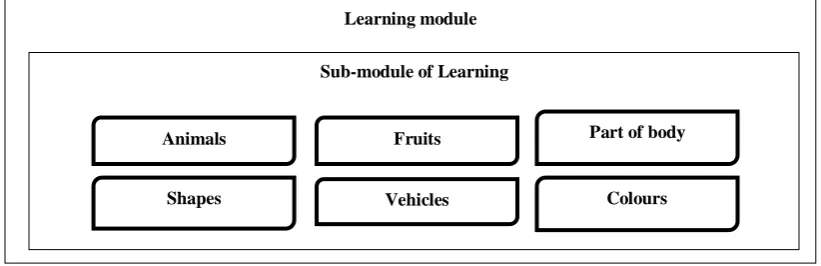
The main application module of the proposed application is learning module. From that, there is six sub learning module. This module can boost kids learning process and expose them to learn and know basic words in four languages which are Malay, English, Mandarin and Arabic. Fig. 1 shows the division of learning module.
Fig. 1 Overview of main application module
G. Design and Implementation
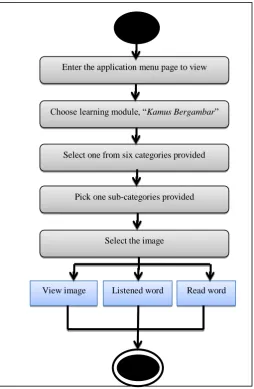
The application is developed using Java programming language and Eclipse Android System Development Kit (SDK) as development tool. Fig. 2 shows shows the activity diagram for learning module. The activity starts when the user enters the menu page which has “Kamus Bergambar”. Then the user can choose the category that provided in the learning module or “Kamus Bergambar” which are animals, fruits, shapes, colours, vehicles and parts of body. When one category is selected, the user needs to select another sub-category. For the example, if the user has choose animal category, there are three sub-categories provided which are animal in farm, animal in the jungle and animal in the sea. After user has selected the sub-category, user can view the images and select the image that user wants to learn. Since the image has viewed by the user, user can handle two activities such as listen the words and read the words or texts given in different languages. Fig. 3 shows use-case diagram for proposed application. The use-case scenario is as follows:
Akif is 5 years old. His parents downloaded the proposed application for him to learn the words in many languages from the picture dictionary. After installing session, he opens the application by tap on the menu icon. He can view and selects the learning module “Kamus bergambar” button. In the same time, he can choose any
one from six categories learning provided. If he is interested to learn about the animal, he then selects animal button and sub-category will appeared. He chooses jungle category or “Hutan” button, and then he can view
some of the images of animal that live in jungle. He selects one of the images which are monkey. Since the proposed application is in Malay Language, it will display as “Monyet”. Below of the Malay Language, there is
English word. Below of it, he can also see the button for Mandarin and followed by Arabic language word. He can listen to the word and also can read the word from the screen that comes from four languages. He can listen to the “Monyet” words from English, Mandarin and Arabic from the same screen by tap on the buttons provided.
H. Results
This section presents the prototype result of the proposed application. Fig. 4 shows the main module of the application. The button displays “Kamus bergambar” that refer to learning module. The user can view to
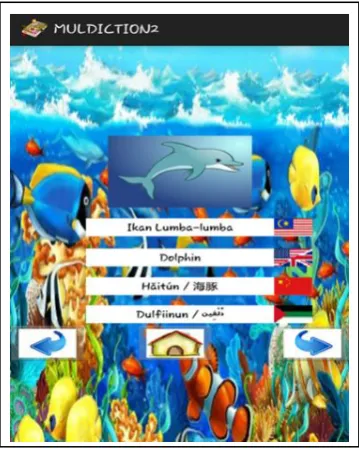
other pages which consist of six categories of learning module. Fig. 5 shows the categories of learning module that consist of six categories which include animals, fruits, vehicles, parts of body, colours, and shapes. When user selected one of the images, the layout with image, text, and sounds from four languages is displayed. Figure 6 shows the interface example of one sea animal. There are four buttons and on top of the button display the word with four different languages: Malay, English, Mandarin and Arabic. When user clicks on the button, the audio sound for the word can be heard.
Learning module
Sub-module of Learning
Animals Fruits
Shapes Vehicles Colours
Fig. 2 Activity diagram for learning module
Learning module Enter the application menu page to view
Choose learning module, “Kamus Bergambar”
Select one from six categories provided
Pick one sub-categories provided
Select the image
Listened word Read word
View image
USER Listen word
Select image View categories
View images View menu
Fig. 4 Interface of main module
Fig. 5 Interface of learning module categories
IV.CONCLUSIONS
This paper proposes an application of multilingual picture dictionary that can be learned among mobile device users, especially kids. The implementation of multimedia components which are text, image and audio for learning purposes is achieved. This shows that the proposed solution can be applied in mobile education environment. However, the proposed solution is only catered for kids learning basic words. For future implementation, game based learning can be applied to evaluate kid’s memorization and understanding. In brief, the proposed solution can give extra learning tool for kids to learn at anywhere and anytime.
R
EFERENCES
[1] “How Smartphones are on the Verge of taking.” [Online] NY Daily News (Mar. 22, 2013), sec. Lifestyle. Available:http://www.nydailynews.com/lifestyle/smartphones-world-article-1.1295927
[2] S. M. Yusof, S. N. S. Shalan, S. Almuddin, P. Primsuwan, N. M. Tahir, and R. A. Ghani, “A-grammar: Mobile learning foundation of Arabic grammar language with multimedia aided approach,” International Symposium on Mathematical Sciences and Computing Research (iSMSC), 2015.
[3] M. Sharples, “Disruptive devices: mobile technology for conversational learning,” International Journal of Continuing Engineering Education and Lifelong Learning, vol. 12, no. 5/6, p. 504, 2002.
[4] M. Sharlpes, J. Taylor and G. Vavoula, “Towards a Theory of Mobile Learning”, The Sage handbook of elearning research (pp. 221–247). London: Sage.
[5] M. Ally, M. Samaka, L. Ismai, and J. Impagliazzo, “Use of Mobile Learning Apps in Workplace Learning,” Bulletin of the IEEE Technical Committee on Learning Technology, vol. 15, no. 4, pp. 6–9, Oct. 2013.
[6] B. Dalton and D. L. Grisham, “eVoc Strategies: 10 Ways to Use Technology to Build Vocabulary,” The Reading Teacher, vol. 64, no. 5, pp. 306-317, Feb. 2011.
[7] E. Wood, M. Pressley, J.E. Turnure and R.Walton, “Enriching Children’s Recall of Picture-dictionary Definitions with Interrogation and Elaborated Pictures,” Educational Technology Research and Development, vol. 35, no. 1, pp. 43-52, 1987.
[8] K. Chujo and C. Nishigaki, “Creating e-Learning Material to Teach Essential Vocabulary for Young EFL Learners,” An Interactive Workshop on Language e-Learning, pp. 35-44, 2004.
[9] Y.M.T. Eva and M.F.C. Henry, “Transformation of Conventional DL Courses into BL Courses: Use of Multimedia and ID Strategies,” 28th Annual Conference Asian Association of Open Universities Advancing Open and Distance Learning: Research and Practices, 2014.
[10] S.K.S. Cheung, “A Case Study on the Students’ Attitude and Acceptance of Mobile Learning,” Technology in Education. Transforming Educational Practices with Technology: Communications in Computer and Information Science, vol. 494, 2015.
BIOGRAPHIES
1Suhailah Mohd Yusof is a lecturer under Department of Computer Science and Mathematics at Universiti Teknologi MARA, Kedah, Malaysia. Her field of interest is mobile computing and learning, artificial intelligence, algorithms and database.
2
Fatin Farhana Abd Wahab is a graduate of Bachelor of Science (Hons.) in Netcentric Computing at Universiti Teknologi MARA, Kedah, Malaysia. Her field of interest is mobile computing.
3
Norlizawati Md Tahir is a lecturer under Department of Language Studies at Universiti Teknologi MARA, Kedah, Malaysia. Her field of interest is language education and sociolinguistic.
3