Verifiable Computation
Seung Geol Choi1?, Jonathan Katz2, Ranjit Kumaresan3∗, and Carlos Cid4 1
Department of Computer Science, Columbia University [email protected]
2
Department of Computer Science, University of Maryland [email protected]
3
Department of Computer Science, Technion [email protected]
4
Royal Holloway, University of London [email protected]
Abstract. Gennaro et al. (Crypto 2010) introduced the notion of non-interactive verifiable computation, which allows a computationally weak client to outsource the computation of a function f on a series of in-putsx(1), . . .to a more powerful but untrusted server. Following a pre-processing phase (that is carried out only once), the client sends some representation of its current inputx(i) to the server; the server returns an answer that allows the client to recover the correct result f(x(i)), accompanied by a proof of correctness that ensures the client does not accept an incorrect result. The crucial property is that the work done by the client in preparing its input and verifying the server’s proof is less than the time required for the client to computefon its own.
We extend this notion to themulti-client setting, wheren computation-ally weak clients wish to outsource to an untrusted server the compu-tation of a function f over a series of joint inputs (x(1)1 , . . . , x
(1)
n ), . . .
without interacting with each other. We present a construction for this setting by combining the scheme of Gennaro et al. with a primitive called proxy oblivious transfer.
1
Introduction
There are many instances in which it is desirable to outsource computation from a relatively weak computational device (a client) to a more powerful entity or collection of entities (servers). Notable examples include:
– Distributed-computing projects (e.g., SETI@Home or distributed.net), in which idle processing time on thousands of computers is harnessed to solve a computational problem.
?
– Cloud computing, where individuals or businesses can purchase computing power as a service when it is needed to solve some difficult task.
– Outsourcing computationally intensive operations from weak mobile devices (e.g., smartphones, sensors) to a back-end server or some other third party. In each of the above scenarios, there may be an incentive for the server to try to cheat and return an incorrect result to the client. This may be related to the nature of the computation being performed — e.g., if the server wants to convince the client of a particular result because it will have beneficial conse-quences for the server — or may simply be due to the server’s desire to minimize the use of its own computational resources. Errors can also occur due to faulty algorithm implementation or system failures. In all these cases, the client needs some guarantee that the answer returned from the server is correct.
This problem ofverifiable (outsourced) computation has attracted many re-searchers, and various protocols have been proposed (see Section 1.3). Recently, Gennaro et al. [13] formalized the problem ofnon-interactive verifiable compu-tation in which there is only one round of interaction between the client and the server each time a computation is performed. Specifically, fix some function f
that the client wants to compute. Following a pre-processing phase (that is car-ried out only once), the client can then repeatedly request the server to compute
f on inputsx(1), . . .of its choice via the following steps:
Input preparation: In time periodi, the client processes its current inputx(i) to obtain some representation of this input, which it sends to the server. Output computation: The server computes a response that encodes the
cor-rect answerf(x(i)) along with a proof that it was computed correctly. Output verification: The client recovers f(x(i)) from the response provided
by the server, and verifies the proof that this result is correct.
The above is only interesting if the input-preparation and output-verification stages require less time (in total) than the time required for the client to com-putef by itself. (The time required for pre-processing is ignored, as it is assumed to be amortized over several evaluations off.) Less crucial, but still important, is that the time required for the output-computation phase should not be much larger than the time required to compute f (otherwise the cost to the server may be too burdensome). Gennaro et al. construct a non-interactive verifiable-computation scheme based on Yao’s garbled-circuit protocol [25] and any fully homomorphic encryption scheme.
1.1 Our Results
The scheme presented in [13] is inherently single-client. There are, however, scenarios in which it would be desirable to extend this functionality to the
(semi-honest) clients wish to outsource the computation of some functionf over a series ofjointinputs (x(1)1 , . . . , x(1)n ), . . .to an untrusted server.
A trivial solution to the problem would be for the last n−1 clients to send their inputs to the first client, who can then run a single-client verifiable-computation scheme and forward the result (assuming verification succeeded) to the other clients. This suffers from several drawbacks:
– This solution requires the clients to communicate with each other. There may be scenarios (e.g., sensors spread across a large geographical region) where clients can all communicate with a central server but are unable to communicate directly with each other.1
– This solution achieves noprivacy since the first client sees the inputs of all the other clients.
Addressing the first drawback, we consider onlynon-interactive protocols in which each client communicates only with the server. A definition of soundness in the non-interactive setting is subtle, since without some additional assumptions (1) there is no way for one client to distinguish another legitimate client from a cheating server who tries to provide its own input xi, and (2) there is nothing that “binds” the input of one client at one time period to the input of another client at that same time period (and thus the server could potentially “mix-and-match” the first-period input of the first client with the second-period input of the second client). We address these issues by assuming that (1) there is a public-key infrastructure (PKI), such that all clients have public keys known to each other, and (2) all clients maintain a counter indicating how many times they have interacted with the server (or, equivalently, there is some global notion of time). These assumptions are reasonable and (essentially) necessary to prevent the difficulties mentioned above.
Addressing the second drawback, we also define a notion of privacy of the clients’ input from each other that we require any solution to satisfy. This is in addition to privacy of the clients’ inputs from the server, as in [13].
In addition to defining the model, we also show a construction of a protocol for non-interactive, multi-client verifiable computation. We give an overview of our construction in the following section.
1.2 Overview of Our Scheme
Our construction is a generalization of the single-client solution by Gennaro et al., so we begin with a brief description of their scheme.
and sends it to the server. Later, in the online phase, Alice computes input-wire keys for the garbled circuit that correspond to her actual inputx, and sends these keys to the server. The server evaluates the garbled circuit using the input-wire keys provided by Alice to obtain the output keys of the garbled circuit; if the server behaves honestly, these output keys correspond to the correct outputf(x). The server returns these output keys to Alice, who then checks if the key received from the server on each output wire is a legitimate output key (i.e., one of the two possibilities) for that wire. If so, then Alice determines the actual output based on the keys received from the server. Loosely speaking, verifiability of this scheme follows from the fact that evaluation of a garbled circuit on input-wire keys corresponding to an input xdoes not reveal information about any output-wire keys other than those that correspond tof(x). (See also [3].)
The scheme described above works only for a single evaluation off. To ac-commodate multiple evaluations of f, Gennaro et al. propose the use of fully homomorphic encryption (FHE) in the following way. The pre-processing step is the same as before. However, in the online phase, Alice generates a fresh pub-lic/private key pair for an FHE scheme each time she wants the server to evalu-atef. She then encrypts the input-wire keys that correspond to her input using this public key, and sends these encryptions (along with the public key) to the server. Using the homomorphic properties of the encryption scheme, the server now runs the previous scheme to obtainencryptionsof the output-wire keys cor-responding to the correct output. The server returns the resulting ciphertexts to Alice, who decrypts them and then verifies the result as before. Security of this scheme follows from the soundness of the one-time scheme described earlier and semantic security of the FHE scheme.
Multi-client verifiable computation.In the rest of the overview, we discuss how to adapt the solution of Gennaro et al. to the multi-client setting. In our discussion, we consider the case where only the first client gets output. (The more general case is handled by simply having the clients run several executions of the scheme in parallel, with each client playing the role of the first in one execution.) We discuss the case of two clients here for simplicity, but our solution extends naturally to the general case.
Suppose two clients Alice and Bob want to outsource a computation to a server. Applying a similar idea as before, say Alice creates a garbled circuit which it sends to the server in the pre-processing phase. During the online phase, Alice will be able to compute and send to the server input-wire keys that correspond to her input. However, it is unclear how the server can obtain the input-wire keys corresponding to Bob’s input. Recall that we are interested in anon-interactive
solution and Alice does not know the input of Bob; moreover, Alice cannot send two input-wire keys for any wire to the server or else soundness is violated.
We overcome this difficulty using a gadget called proxy oblivious transfer
non-interactive proxy-OT schemes. We show a construction of a non-non-interactive proxy OT from any non-interactive key-exchange protocol.
Coming back to the multi-client verifiable-computation scheme described ear-lier, we can use proxy OT to enable the server to learn the appropriate input-wire label for each wire that corresponds to Bob’s input. In more detail, let (we0,we1) denote the keys for input-wirewin the garbled circuit that was created by Alice in the pre-processing phase. Alice acts as the sender with inputs (we0,we1) in a proxy OT protocol, and Bob acts as the chooser with his actual input bit b
for that wire. The server is the proxy, and obtains outputweb. The server learns nothing about we1−b and so, informally, soundness is preserved. The rest of the protocol proceeds in the same way as the single-client protocol. The extension to accommodate multiple evaluations of f is done using fully homomorphic en-cryption as described earlier.
A generic approach to multi-client outsourcing.It is not hard to see that our techniques can be applied to any single-client, non-interactive, verifiable-computation scheme that is projective in the following (informal) sense: the input-preparation stage generates a vector of pairs (w1,0, w1,1), . . . ,(w`,0, w`,1), and the client sendsw1,x1, . . . , w`,x` to the server.
1.3 Related Work
The problems of outsourcing and verifiable computation have been extensively studied. Works such as [9, 16, 17] have focused on outsourcing expensive crypto-graphic operations (e.g., modular exponentiations, one-way function inversion) to semi-trusted devices. Verifiable computation has been the focus of a long line of research starting from works on interactive proofs [2, 15], and efficient argu-ment systems [19, 21, 20]. In particular, Micali’s work [21] gives a solution for non-interactive verifiable computation in the random oracle model. Goldwasser, Kalai, and Rothblum [14] give an interactive protocol to verify certain computa-tions efficiently; their solution can be made non-interactive for a restricted class of functions.
Gennaro et al. [13] formally defined the notion of non-interactive verifiable computation for general functions and gave a construction achieving this no-tion. Subsequent schemes for non-interactive verifiable computation of general functions include [10, 1]. Other works have focused on improving the efficiency of schemes for verifiable computation of specific functions [5, 24, 12, 23], or in slightly different models [7, 8, 11, 6]. To the best of our knowledge, our work is the first (in any setting) to consider verifiable computation for the case where multiple parties provide input. Kamara et al. [18] discuss the case of multi-client verifiable computation in the context of work on server-aided multi-party com-putation, but leave finding a solution as an open problem.
2
Multi-Client Verifiable Computation
n clients that wish to evaluate a function f multiple times. Without loss of generality, we assume that each client Pj contributes an `-bit input and that the output length of f is `, that is, we have f : {0,1}n`→{0,1}`. We abuse notation and let f also denote the representation of the function within some computational model (e.g., as a boolean circuit). Letx(i)j denote clientPj’s input in the ith execution. For simplicity, we assume that only one client (the first) learns the output; however, we can provide all clients with output by simply running anMVCscheme in parallelntimes (at the cost of increasing the clients’ computation by at most a factor ofn).
Syntax.Ann-partyMVC scheme consists of the following algorithms:
– (pkj, skj)←KeyGen(1κ, j). Each clientPj will run thiskey generation
algo-rithmKeyGenand obtain a public/private key pair (pkj, skj). Let
−→
pk denote the vector (pk1, . . . , pkn) of the public keys of all the clients.
– (φ, ξ)←EnFunc(1κ, f). The clientP1that is supposed to receive the output will run this function-encoding algorithm EnFunc with a representation of the target functionf. The algorithm outputs an encoded functionφand the corresponding decoding secretξ. The encoded function will be sent to the server. The decoding secret is kept private by the client.
– (χ(i)1 , τ(i))←EnInput 1 i,
− →
pk, sk1, ξ, x (i) 1
.When outsourcing theith computa-tion to the server, the first clientP1 will run this input-encoding algorithm
EnInput1with time periodi, the public keys−pk→, its secret keysk1, the secret
ξfor the encoded function, and its inputx(i)1 . The output of this algorithm is an encoded input χ(i)1 , which will be sent to the server, and the input decoding secretτ(i)which will be kept private by the client.
– χ(i)j ←EnInputj i,
−→
pk, skj, x (i) j
. When outsourcing the ith computation to the server, each clientPj (withj6= 1) will run thisinput-encoding algorithm
EnInputj with time period i, the public keys−pk→, its secret keyskj, and its inputx(i)j . The output of this algorithm is an encoded inputχ(i)j , which will be sent to the server. We letχ(i)denote the vector (χ(i)
1 , . . . , χ (i)
n ) of encoded inputs from the clients.
– ω(i)←Compute(i,pk, φ,→− χ(i)).Given the public keys−pk→, the encoded function
φ, and the encoded inputs χ(i), this computation algorithm computes an encoded outputω(i).
– y(i)∪ {⊥} ←Verify(i, ξ, τ(i), ω(i)).The first clientP
1runs thisverification
al-gorithmwith the decoding secrets (ξ, τ(i)), and the encoded outputω(i). The algorithm outputs either a valuey(i)(that is supposed to bef(x(i)1 , . . . , x(i)n )), or⊥indicating that the server attempted to cheat.
defined naturally, that is, the key generation, function encoding, and input en-coding algorithms allow the computation algorithm to output an encoded output that will successfully pass the verification algorithm.
2.1 Soundness
Intuitively, a verifiable computation scheme is sound if a malicious server cannot convince the honest clients to accept an incorrect output. In our definition, the adversary is given oracle access to generate multiple input encodings.
Definition 1 (Soundness). For a multi-client verifiable-computation scheme MVC, consider the following experiment with respect to an adversarial serverA:
Experiment ExpsoundA [MVC, f, κ, n]
Forj= 1, . . . , n:
(pkj, skj)←KeyGen(1κ, j), (φ, ξ)←EnFunc(1κ, f).
Initialize counter i:= 0
ω∗← AIN(·)(−pk, φ→ );
y∗← Verify(i, ξ, τ(i), ω∗);
If y∗6∈ {⊥, f(x(i)1 , . . . , x(i)n )},
output1; Else output0;
OracleIN(x1, . . . , xn):
i:=i+ 1;
Record(x(i)1 , . . . , x(i)n ) := (x1, . . . , xn). (χ(i)1 , τ(i))←EnInput
1 i,
−→
pk, sk1, ξ, x (i) 1
Forj= 2, . . . , n:
χ(i)j ←EnInputj i,−pk, sk→ j, x (i) j
.
Output(χ(i)1 , . . . , χ(i)n ).
A multi-client verifiable computation scheme MVC is sound if for any n =
poly(κ), any functionf, and any PPT adversaryA, there is a negligible function
negl such that:
Pr[ExpsoundA [MVC, f, κ, n] = 1]≤negl(κ).
Selective aborts. OurMVC construction described in Section 5 inherits the “selective abort” issue from the single-client scheme of Gennaro et al. [13]; that is, the server may be able to violate soundness if it can send ill-formed responses to the first client and see when that client rejects. In our definition we deal with this issue as in [13] by assuming that the adversary cannot tell when the client rejects. In practice, this issue could be dealt with by having the first client refuse to interact with the server after receiving a single faulty response.
prove adaptive security. Similarly, we reduce the adaptive security of our scheme to adaptive authenticity (aut!) of the underlying garbling scheme. Alternately, we can prove non-adaptive soundness based on standard assumptions.
2.2 Privacy
We consider two notions of privacy.
Privacy against the first client.In our schemes, clients other than the first client clearly do not learn anything about each others’ inputs. We define the requirement that the first client not learn anything (beyond the output of the function), either. Namely, given any input vectors x0 = (x1, x2, . . . , xn) and x1= (x1, x02, . . . , x0n) withf(x1, x2, . . . , xn) =f(x1, x02, . . . , x0n), the view of the first client when running an execution of the protocol with clients holding inputs x0should be indistinguishable from the view of the first client when running an execution with clients holding inputsx1.
Privacy against the server.Next, we considerprivacy against the server; that is, the encoded inputs from two distinct inputs should be indistinguishable to the server.
Definition 2 (Privacy against the server).For a multi-client verifiable com-putation schemeMVC, consider the following experiment with respect to a state-ful adversarial serverA:
Experiment ExpprivA [MVC, f, κ, n, b]:
(pkj, skj)←KeyGen(1κ, j), for j= 1, . . . , n. (φ, ξ)←EnFunc(1κ, f).
Initialize counteri:= 0 ((x0
1, . . . , x0n),(x11, . . . , x1n))← AIN(·)(
−→
pk, φ); Run(χ(i)1 , . . . , χ(i)n )← IN(xb1, . . . , xbn);
Output AIN(·)(χ(i) 1 , . . . , χ
(i) n );
We define the advantage of an adversaryAin the experiment above as:
AdvprivA (MVC, f, κ, n) =
Pr[ExpprivA [MVC, f, κ, n,0] = 1]
−Pr[ExpprivA [MVC, f, κ, n,1] = 1]
MVC is private against the server if for any n =poly(κ), any function f, and any PPT adversaryA, there is a negligible functionnegl such that:
AdvprivA (MVC, f, κ, n)≤negl(κ).
3
Building Blocks for
MVC
3.1 (Projective) Garbling Schemes
since it allows us to abstract the exact properties we need. For completeness, we present their definition below.
A garbling scheme [4] is a five-tuple of algorithms G = (Gb,En,De,Ev,ev) with the following properties:
– y:=ev(f, x). Here, f is a bit string that represents a certain function map-ping an`-bit input to anm-bit output. (We require that`andmbe extracted from f in time linear in |f|.) For example,f may be a circuit description encoded as detailed in [4]. Hereafer, we abuse the notation and letf also de-note the function thatf represents. Given the descriptionf andx∈ {0,1}`
as input,ev(f, x) returnsf(x). A garbling scheme is called acircuit garbling schemeifev=evcirc is the canonical circuit-evaluation function.
– (F, e, d)←Gb(1κ, f). Given the descriptionf as input,Gboutputs a garbled functionF along with an encoding functioneand a decoding functiond. – X := En(e, x). Given an encoding function e and x ∈ {0,1}` as input, En
maps x to a garbled input X. Our scheme will use a projective garbling scheme, i.e., the string e encodes a list of tokens, one pair for each bit in
x∈ {0,1}`. Formally, for all f ∈ {0,1}∗, κ∈
N, i∈ [`], x, x0 ∈ {0,1}` s.t.
xi=x0i, it holds that
Pr
(F, e, d)←Gb(1κ, f), (X1, . . . , X`) :=En(e, x), (X10, . . . , X`0) :=En(e, x0)
: Xi=Xi0
= 1.
For a projective garbling schemeG, it is possible to define an additional deter-ministic algorithmEnproj. Let (X10, . . . , X`0) :=En(e,0
`), and (X1
1, . . . , X`1) :=
En(e,1`). The output Enproj(e, b, i) is defined as Xib. We refer to Enproj as the projection algorithm.
– Y :=Ev(F, X). Given a garbled functionF and a garbled inputX as input,
Evobtains the garbled outputY.
– y := De(d, Y). Given a decoding function d and a garbled output Y, De
mapsY to a final outputy.
Note that all algorithms except Gbare deterministic. A garbling scheme must satisfy the following:
1. Lengthcondition:|F|,e, andddepend only onκ,`,m, and |f|. 2. Correctnesscondition: for all f ∈ {0,1}∗, κ∈
N, x∈ {0,1}`, it holds that
Pr[(F, e, d)←Gb(1κ, f) : De(d,Ev(F,En(e, x))) =ev(f, x)] = 1.
3. Non-degeneracy condition: e and d depends only on κ, `, m, |f|, and the random coins ofGb.
Authenticity.We will employ a garbling scheme that satisfies theauthenticity
notions of authenticity are possible depending on whether the adversary chooses the inputxadaptively (i.e., whether it sees the garbled functionF before choos-ingx). We adopt the adaptive definition given in [3] because we want ourMVC
scheme to achieve adaptive soundness; alternately, we could use a non-adaptive definition of authenticity and achieve non-adaptive soundness.
Definition 3. For a garbling scheme G = (Gb,En,De,Ev,ev) consider the fol-lowing experiment with respect to an adversaryA.
Experiment ExpAut!G A [κ]:
f← A(1κ).
(F, e, d)←Gb(1κ, f).
x← A(1κ, F).
X :=En(e, x).
Y ← A(1κ, F, X).
If De(d, Y)6=⊥andY 6=Ev(F, X), output 1, else 0.
A garbling schemeGsatisfies the authenticity property if for any PPT adversary A, there is a negligible functionnegl such that
Pr[ExpAutA !G[κ] = 1]≤negl(κ).
3.2 Fully Homomorphic Encryption
In a (compact) fully-homomorphic encryption scheme FHE= (Fgen,Fenc,Fdec,
Feval), the first three algorithms form a semantically secure public-key encryp-tion scheme. Moreover, Feval takes a circuit C and a tuple of ciphertexts and outputs a ciphertext that decrypts to the result of applyingCto the plaintexts; here, the length of the output ciphertext should be independent of the size of the circuitC. We will treatFHEas a black box.
4
Non-Interactive Proxy OT
In this section, we introduce a new primitive callednon-interactive proxy obliv-ious transfer (POT), which is a variant and generalization of proxy OT of the notion defined by Naor et al. [22]. In a POTprotocol there are three parties: a sender, a chooser, and a proxy. Thesenderholds input (x0, x1), and thechooser holds choice bitb. At the end of the protocol, theproxylearnsxb(but notx1−b); the sender and chooser learn nothing. Our definition requires the scheme to be non-interactive, so we omit the term ‘non-interactive’ from now on.
Syntax.A proxy OT consists of the following sets of algorithms:
– (pkS, skS)←SetupS(1κ). The sender runs this one-time setup algorithm to generate a public/private key pair (pkS, skS).
– (pkC, skC)←SetupC(1κ). The chooser runs this one-time setup algorithm to generate a public/private key pair (pkC, skC).
– α←Snd(i, pkC, skS, x0, x1). In the ith POT execution the sender, holding input x0, x1 ∈ {0,1}κ, runs this algorithm to generate a single encoded messageαto be sent to the proxy. We refer toαas the sender message. – β←Chs(i, pkS, skC, b). In theith POTprotocol, the chooser, holding input
b∈ {0,1}, runs this algorithm to generate a single encoded messageβ to be sent to the server. We refer toβ as the chooser message.
– y:=Prx(i, pkS, pkC, α, β). In theithPOTprotocol, the proxy runs this algo-rithm using the sender messageαand the chooser messageβ, and computes the valuey=xb.
A proxy OT is correct if the sender algorithmSndand chooser algorithmChs
produce values that allow the proxy to compute one of two sender inputs based on the chooser’s selection bit.
Sender privacy. A proxy OT is sender private if the proxy learns only the value of the sender input that corresponds to the chooser’s input bit. To serve our purpose, we define sender privacy over multiple executions. We stress that a
singlesetup by each party is sufficient to run multiple executions (this is essential for our MVC construction).
Definition 4 (Sender Privacy). For a proxy OT (SetupS,SetupC,Snd,Chs,
Prx), consider the following experiments with respect to an adversarial proxyA. The adversary is given oracle access to obtain arbitrary proxy OT transcripts.
ExperimentExps-privA [POT, κ, n, e]:
(pkS, skS)←SetupS(1κ).
Forj= 1, . . . , n:
(pkC,j, skC,j)←SetupC(1κ).
Output APOTe(·)(pk
S, pkC,1, . . . , pkC,n).
OraclePOTe(i, j, x0, x1, b, x0):
If (˜i,˜j,x˜0,x˜1,˜b,x˜0)withi= ˜i
was queried before, output⊥ and terminate.
If e= 0, sety0:=x0,y1:=x1.
Else set yb:=xb,y1−b:=x0.
α←Snd(i, pkC,j, skS, y0, y1).
β←Chs(i, pkS, skC,j, b).
Output (α, β).
Note that the sender messages α generated from oracle POT0 (resp., POT1)
would encode the sender’s input xb andx1−b (resp., xb andx0). We define the
advantage of an adversary Ain the experiment above as:
Advs-privA (POT, κ, n) =
Pr[Exps-privA [POT, κ, n,0] = 1]
−Pr[Exps-privA [POT, κ, n,1] = 1]
A proxy OT(SetupS,SetupC,Snd,Chs,Prx)is sender private, if for any n=
poly(κ)and any PPT adversary A, there is a negligible functionnegl such that:
Chooser privacy. A proxy OT is chooser private if the proxy learns no infor-mation about the chooser’s input bit. To serve our purpose, we define chooser privacy over multiple executions.
Definition 5 (Chooser Privacy). For a proxy OT (SetupS,SetupC,Snd,Chs,
Prx), consider the following experiments with respect to an adversarial proxyA. Experiment Expc-privA [POT, κ, n, e]:
(pkS, skS)←SetupS(1κ).
Forj= 1, . . . , n:
(pkC,j, skC,j)←SetupC(1κ).
Output ACHSe(·)(pk
S, pkC,1, . . . , pkC,n).
OracleCHSe(i, j, b0, b1):
If(˜i,˜j,˜b0,˜b1) withi= ˜i
was queried before, output⊥ and terminate.
β←Chs(i, pkS, skC,j, be).
Outputβ.
We define the advantage of an adversaryA in the experiment above as:
Advc-privA (POT, κ, n) =
Pr[Expc-privA [POT, κ, n,0] = 1]
−Pr[Expc-privA [POT, κ, n,1] = 1]
A proxy OT(SetupS,SetupC,Snd,Chs,Prx)ischooser private, if for anyn=
poly(κ)and any PPT adversaryA, there is a negligible function neglsuch that:
Advc-privA (POT, κ, n)≤negl(κ).
4.1 Proxy OT from Non-Interactive Key Exchange
Non-interactive key exchange.A non-interactive key-exchange (NIKE) pro-tocol allows two parties to generate a shared key based on their respective public keys (and without any direct interaction). That is, let KEA1,KEB2 be the algo-rithms used by the two parties to generate their public/private keys. (pka, ska) and (pkb, skb), respectively. Then there are algorithms KEA2 and KEB2 such that KEA2(pkb, ska) = KEB2(pka, skb). An example is given by static/static Diffie-Hellman key exchange.
Regarding the security of NIKE, to the view of a passive eavesdropper the distribution of the key shared by the two parties should be indistinguishable from a uniform key.
Definition 6 (Security of NIKE). A NIKE (KEA1,KEA2,KEB1,KEB2) is
secure if for any PPTA, it holds that |p1−p2|is negligible in κ, where
p1= Pr
(pka, ska)←KEA1(1κ); (pkb, skb)←KEB1(1κ)
: A(pka, pkb,KEA2(pkb, ska)) = 1
p2= Pr
(pka, ska)←KEA1(1κ); (pkb, skb)←KEB1(1κ);
r← {0,1}κ
: A(pka, pkb, r) = 1
Proxy OT from NIKE We define a protocol for proxy OT below. The main idea is that the sender and the chooser share randomness in the setup stage by using the key-exchange protocol. Then, using the shared randomness (which is unknown to the proxy), both parties can simply use a one-time pad encryption to transfer their inputs. LetPrf be a pseudorandom function.
– (pkS, skS)←SetupS(1κ). Run a key exchange protocol on Alice’s part, that is, (pka, ska)←KEA1(1κ). SetpkS :=pka andskS:=ska.
– (pkC, skC)←SetupC(1κ). Run a key exchange protocol on Bob’s part, that is, (pkb, skb)←KEB1(1κ). SetpkC:=pkb andskC:=skb.
– α←Snd(i, pkC, skS, x0, x1). Let k be the output from the key exchange protocol, i.e., k := KEA2(pkC, skS). Compute (z0, z1, π) := Prfk(i) where
|z0|=|z1|=κandπ∈ {0,1}. Then, setα:= (α0, α1), where
απ=z0⊕x0, α1⊕π=z1⊕x1.
– β←Chs(i, pkS, skC, b). Letkbe the output from the key exchange protocol, i.e.,k:=KEB2(pkS, skC). Compute (z0, z1, π) :=Prfk(i) where|z0|=|z1|=
κandπ∈ {0,1}. Then, reveal only the part associated with the choice bit
b. That is,β:= (b⊕π, zb)
– y := Prx(i, pkS, pkC, α, β). Parse α as (α0, α1), and β as (b0, z0). Compute
y:=αb0⊕z0.
It is easy to see that the scheme satisfies the correctness property. Sender privacy over a single execution easily follows from the fact that the outputs from the key exchange and the pseudorandom function look random. Sender privacy over multiple pairs can also be shown with a hybrid argument. The scheme also hides the choice bit of the chooser from the proxy.
5
Construction of
MVC
In this section, we present our construction forMVC. Our scheme uses proxy OT to extend the single-client scheme of Gennaro et al. [13] (see Section 1.2 for the overview of the scheme). In the pre-processing stage, the keys for proxy OT are set up, and the first clientP1, who will receive the function output, generates a garbled functionF and gives it the server. Now delegating computation on input (x1, . . . , xn), where the clientPj holdsxj∈ {0,1}
`
, is performed as follows: 1. For eachj∈[n] and k∈[`], do the following in parallel:
(a) ClientP1 computes the following pair for the potential garbled input.
Xjk0 :=Enproj(e,0,(j−1)`+k), Xjk1 :=Enproj(e,1,(j−1)`+k) (b) A proxy OT protocol is executed in which clientP1 plays as the sender
with (X0
jk, Xjk1) as input, and the clientPj plays as the chooser with the
Protocol 1
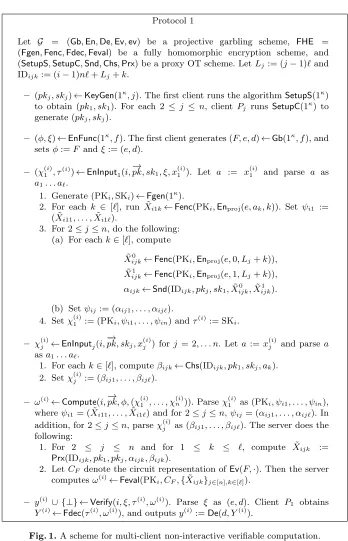
Let G = (Gb,En,De,Ev,ev) be a projective garbling scheme, FHE = (Fgen,Fenc,Fdec,Feval) be a fully homomorphic encryption scheme, and (SetupS,SetupC,Snd,Chs,Prx) be a proxy OT scheme. LetLj:= (j−1)`and
IDijk:= (i−1)n`+Lj+k.
– (pkj, skj)←KeyGen(1κ, j). The first client runs the algorithmSetupS(1κ)
to obtain (pk1, sk1). For each 2 ≤ j ≤ n, client Pj runs SetupC(1κ) to
generate (pkj, skj).
– (φ, ξ)←EnFunc(1κ, f).The first client generates (F, e, d)←Gb(1κ, f), and setsφ:=F andξ:= (e, d).
– (χ(1i), τ(i))←EnInput 1(i,
− →
pk, sk1, ξ, x (i)
1 ). Let a := x (i)
1 and parse a as
a1. . . a`.
1. Generate (PKi,SKi)←Fgen(1κ).
2. For each k ∈ [`], run ˜Xi1k←Fenc(PKi,Enproj(e, ak, k)). Set ψi1 := ( ˜Xi11, . . . ,X˜i1`).
3. For 2≤j≤n, do the following: (a) For eachk∈[`], compute
˜
Xijk0 ←Fenc(PKi,Enproj(e,0, Lj+k)),
˜
Xijk1 ←Fenc(PKi,Enproj(e,1, Lj+k)), αijk←Snd(IDijk, pkj, sk1,X˜ijk0 ,X˜ijk1 ).
(b) Setψij:= (αij1, . . . , αij`).
4. Setχ(1i):= (PKi, ψi1, . . . , ψin) andτ(i):= SKi. – χ(ji)←EnInputj(i,
−→
pk, skj, x(ji)) for j= 2, . . . n. Let a:=x
(i)
j and parsea
asa1. . . a`.
1. For eachk∈[`], computeβijk←Chs(IDijk, pk1, skj, ak).
2. Setχ(ji):= (βij1, . . . , βij`). – ω(i)←Compute(i,−pk, φ,→ (χ(i)
1 , . . . , χ (i)
n )). Parseχ
(i)
1 as (PKi, ψi1, . . . , ψin),
whereψi1 = ( ˜Xi11, . . . ,X˜i1`) and for 2≤j≤n,ψij= (αij1, . . . , αij`). In
addition, for 2≤j≤n, parseχj(i) as (βij1, . . . , βij`). The server does the
following:
1. For 2 ≤ j ≤ n and for 1 ≤ k ≤ `, compute X˜ijk := Prx(IDijk, pk1, pkj, αijk, βijk).
2. Let CF denote the circuit representation ofEv(F,·). Then the server
computesω(i)←Feval(PK
i, CF,{X˜ijk}j∈[n],k∈[`]).
– y(i) ∪ {⊥} ←Verify(i, ξ, τ(i), ω(i)). Parse ξ as (e, d). Client P1 obtains
Y(i)←Fdec(τ(i), ω(i)), and outputsy(i):=De(d, Y(i)).
2. Using the outputs from the proxy OT protocols, the server evaluates the garbled functionF and sends the corresponding garbled outputY toP1. 3. ClientP1decodes Y to obtain the actual outputy.
The above scheme allows delegating the computation one-time; intuitively, the sender privacy of the underlying proxy OT makes the server learn the garbled inputs only for the actual inputsof all clients. Multiple inputs can be handled using fully-homomorphic encryption as with the single-client case. The detailed protocol (called Protocol 1) is described in Figure 1.
Correctness and non-triviality. Correctness of our scheme follows from the correctness of the garbling scheme, the correctness of the fully homomorphic encryption scheme, and the correctness of the proxy OT. Non-triviality of our scheme follows from the fact that (1) the time required (by client P1) for com-putingEnproj,Fenc, andSndisO(poly(κ)|x(i)|), and is independent of the circuit size off, and (2) the time required (by all clientsPjfor 2≤j≤n) for computing
ChsisO(poly(κ)|x(i)|), and is independent of the circuit size off.
Soundness.At a high level, the soundness of Protocol 1 follows from the sender security of proxy OT, the semantic security ofFHE, and the authenticity property of the garbling schemeG.
Theorem 1. Suppose G = (Gb,En,De,Ev,ev) be a projective garbling scheme satisfying the authenticity property,FHE is a semantically secure FHE scheme, and(SetupS,SetupC,Snd,Chs,Prx)is a proxy OT scheme that is sender private.
Then Protocol 1 is a soundMVC scheme.
A proof is given in the following section.
Privacy. It is easy to see that Protocol 1 is private against the first client, since the output ofComputealgorithm is basically the encryption of the garbled output. For privacy against the server, we need a proxy OT that hides the chooser’s input as well.
Theorem 2. Suppose thatFHEis a semantically secure fully homomorphic en-cryption scheme, and that (SetupS,SetupC,Snd,Chs,Prx)is a proxy OT scheme that is chooser private. Then Protocol 1 is private against the server.
5.1 Proof of Theorem 1
Suppose there exists an adversary A that breaks the soundness of Protocol 1 with respect to a function f.
Hybrid 0.Letpbe an upper bound on the number of queriesAmakes. Consider the following experiment that is slightly different fromExpsoundA [MVC, f, κ, n]:
Experiment Expr-soundA [MVC, f, κ, n]:
Initialize counteri:= 0 Chooser←[p].
(i∗, ω∗)← AIN(·)(−pk, φ→ );
Ifi∗6=r, output 0 and terminate.
y∗← Verify(i∗, ξ, τ(i∗), ω∗);
Ify∗6=⊥andy∗6=f(x(i1∗), . . . , x(in∗)), output 1; Else output 0;
Sinceris chosen uniformly at random,Awould succeed in the above exper-iment with non-negligble probability (i.e., Pr[ExpsoundA [MVC, f, κ, n] = 1]/p). Hybrid 1. In this hybrid, the oracle queries IN(x(i)1 , . . . , x(i)n ) are handled by the following instead of setting χ(i)1 ←EnInput1 i,
−→
pk, sk1, ξ, x (i) 1
– Run (χ(i)1 , τ(i))←EnInput01(i,
−→
pk, sk1, ξ,(x (i) 1 , . . . , x
(i) n )).
At a high level,EnInput01 is identical to EnInput1 except it sets the inputs to the sender algorithm Sndof the proxy OT as follows: For all input bits,Snd
obtains the correct token corresponding to the actual input bit, and a zero string in place of the token corresponding to the other bit. The explicit description of
EnInput01is found in Figure 2.
(χ(1i), τ (i)
)←EnInput01(i,
−→
pk, sk1, ξ,(x(1i), . . . , x (i)
n ))
Letaj:=x
(i)
j forj∈[n], and parseaj asaj1. . . aj`.
1. Generate (PKi,SKi)←Fgen(1κ).
2. For each k ∈ [`], run ˜Xi1k←Fenc(PKi,Enproj(e, a1k, k)). Set ψi1 := ( ˜Xi11, . . . ,X˜i1`).
3. For 2≤j≤n, do the following: (a) For eachk∈[`], compute
b:=ajk, X˜ijkb ←Fenc(PKi,Enproj(e, b, Lj+k)), X˜
1−b ijk := 0
|Xbijk|
,
αijk←Snd(`i+Lj+k, pkj, sk1,X˜ijk0 ,X˜
1
ijk).
(b) Setψij:= (αij1, . . . , αij`).
4. Setχ(1i):= (PKi, ψi1, . . . , ψin) andτ(i):= SKi.
Fig. 2.Description ofEnInput01
while invoking the oraclePOT with queries (i, j,X˜0
ijk,X˜ijk1 , x (i) jk,0
|X˜0
ijk|) to gen-erate the sender messages of the proxy OT, wherex(i)jk is thekthbit ofx(i)j , and forb∈ {0,1}, the value ˜Xijkb is the output fromFenc(PKi,Enproj(e, b, Lj+k)). Hybrid 2.In this hybrid, the oracle queriesIN(x(i)1 , . . . , x(i)n ) are handled using the following instead of runningχ(i)1 ←EnInput01 i,
− →
pk, sk1, ξ, x (i) 1
1. Ifi=r, run (χ(i)1 , τ(i))←EnInput01(i,
−→
pk, sk1, ξ,(x (i) 1 , . . . , x
(i) n )); Otherwise, (χ(i)1 , τ(i))←EnInput00
1(i,
−→
pk, sk1,(x (i) 1 , . . . , x
(i) n )) ;
At a high level,EnInput001 is identical toEnInput01 except it replaces the token values to zero strings. The explicit description ofEnInput001 is found in Figure 3.
(χ(1i), τ (i)
)←EnInput001(i,
− →
pk, sk1,(x(1i), . . . , x (i)
n )
Let aj := x(ji) for j ∈ [n], and parse aj as aj1. . . aj`. Let λ be the output
length of theEnprojalgorithm. 1. Generate (PKi,SKi)←Fgen(1κ).
2. For each k ∈ [`], compute X˜i1k←Fenc(PKi,0λ) . Set ψi1 := ( ˜Xi11, . . . ,X˜i1`).
3. For 2≤j≤n, do the following: (a) For eachk∈[`], compute
b:=ajk, X˜ijkb ←Fenc(PKi,0λ), X˜
1−b ijk := 0
|Xijkb |
,
αijk←Snd(`i+Lj+k, pkj, sk1,X˜ijk0 ,X˜
1
ijk).
(b) Setψij:= (αij1, . . . , αij`).
4. Setχ(1i):= (PKi, ψi1, . . . , ψin) andτ(i):= SKi.
Fig. 3.Description ofEnInput001
Indistinguishability between Hybrid 1 and Hybrid 2 can be shown with a simple hybrid argument where indistinguishability between two adjacent hybrids holds from the semantic security of the underlying FHE scheme.
Final Step. As a final step, we reduce the security to the authenticity of the underlying garbling scheme. In particular, using the adversaryAthat succeeds in Hybrid 2 with non-negligible probability, we construct an adversary B that breaks the authenticity of the underlying garbling scheme.Bworks as follows:
1. Run (pkj, skj)←KeyGen(1κ, j), forj= 1, . . . , n.
2. Letpbe the upper bound on the number of queries that Amakes, and chooser←[p].
3. Run (i∗, ω∗)← AIN(·)(−pk, φ→ ) while handling the queryIN(x(i) 1 , . . . , x
(i) n ) as follows:
(a) For the input encoding of the first party, ifi=r, thenBsends (x(i)1 , . . . , x(i)n ) to the challenger and receives the corresponding tokens (X1, . . . , Xn`). Using these tokens, B perfectly simulates
EnInput01(i,−pk, sk→ 1, ξ,(x (i) 1 , . . . , x
(i)
n )) by replacingEnproj(e,·, k0)s withXk0s. Otherwise, runEnInput001(i,
−→
pk, sk1,(x (i) 1 , . . . , x
(i) n )). (b) Forj= 2, . . . , n, runχ(i)j ←EnInput i, j,−pk, sk→ j, x
(i) j
.
4. Ifi∗ =r, the adversaryBrunsY∗←Fdec(SKi∗, ω∗) and outputsY∗ to the challenger. Otherwise, it outputs⊥.
The above simulation is perfect.
We show thatB breaks the authenticity of the underlying garbling scheme with non-negligible probability. Let Succ be the event that A succeeds in Hy-brid 2, that is,Y∗ is a valid encoded output but different fromEv(F, Xr), where
X(r) is the encoded input forx(r). This implies that Pr[ExpAut!G
B = 1]≥Pr[Succ].
Since by assumption,G satisfies the authenticity property, we conclude that Pr[Succ] must be negligible in κ, contradiction. This concludes the proof of soundness of Protocol 1.
Acknowledgments.We thank the referees for their helpful feedback. This work was supported by the US Army Research Laboratory and the UK Ministry of Defence under Agreement Number W911NF-06-3-0001. The first author was also supported in part by the Intelligence Advanced Research Project Activ-ity (IARPA) via DoI/NBC contract #D11PC20194. The views and conclusions contained here are those of the authors and should not be interpreted as rep-resenting the official policies, expressed or implied, of the US Army Research Laboratory, the US Government, IARPA, DoI/NBC, the UK Ministry of De-fence, or the UK Government. The US and UK Governments are authorized to reproduce and distribute reprints for Government purposes notwithstanding any copyright notation herein.
References
1. Benny Applebaum, Yuval Ishai, and Eyal Kushilevitz. From secrecy to sound-ness: Efficient verification via secure computation. In 37th Intl. Colloquium on Automata, Languages, and Programming (ICALP), volume 6198 ofLNCS, pages 152–163. Springer, 2010.
3. Mihir Bellare, Viet Tung Hoang, and Phillip Rogaway. Adaptively secure garbling with applications to one-time programs and secure outsourcing. In Advances in Cryptology — Asiacrypt 2012, LNCS, pages 134–153. Springer, 2012.
4. Mihir Bellare, Viet Tung Hoang, and Phillip Rogaway. Foundations of garbled circuits. In 19th ACM Conf. on Computer and Communications Security (CCS), pages 784–796. ACM Press, 2012.
5. Siavosh Benabbas, Rosario Gennaro, and Yevgeniy Vahlis. Verifiable delegation of computation over large datasets. In Advances in Cryptology — Crypto 2011, volume 6841 ofLNCS, pages 111–131. Springer, 2011.
6. Nir Bitanksy, Ran Canetti, Alessandro Chiesa, and Eran Tromer. Recursive com-position and bootstrapping for SNARKs and proof-carrying data. Available at http://eprint.iacr.org/2012/095.
7. Ran Canetti, Ben Riva, and Guy Rothblum. Practical delegation of computation using multiple servers. In 18th ACM Conf. on Computer and Communications Security (CCS), pages 445–454. ACM Press, 2011.
8. Ran Canetti, Ben Riva, and Guy Rothblum. Two protocols for delegation of computation. In Information Theoretic Security — ICITS 2012, volume 7412 of LNCS, pages 37–61. Springer, 2012.
9. David Chaum and Torben P. Pedersen. Wallet databases with observers. In Ernest F. Brickell, editor, Advances in Cryptology — Crypto ’92, volume 740 of LNCS, pages 89–105. Springer, 1993.
10. Kai-Min Chung, Yael Kalai, and Salil P. Vadhan. Improved delegation of com-putation using fully homomorphic encryption. In Advances in Cryptology — Crypto 2010, volume 6223 ofLNCS, pages 483–501. Springer, 2010.
11. Graham Cormode, Michael Mitzenmacher, and Justin Thaler. Practical verified computation with streaming interactive proofs. InProc. 3rd Innovations in Theo-retical Computer Science Conference (ITCS), pages 90–112. ACM, 2012.
12. Dario Fiore and Rosario Gennaro. Publicly verifiable delegation of large polynomi-als and matrix computations, with applications. In19th ACM Conf. on Computer and Communications Security (CCS), pages 501–512. ACM Press, 2012.
13. Rosario Gennaro, Craig Gentry, and Bryan Parno. Non-interactive verifiable com-puting: Outsourcing computation to untrusted workers. InAdvances in Cryptology — Crypto 2010, volume 6223 ofLNCS, pages 465–482. Springer, 2010.
14. Shafi Goldwasser, Yael Tauman Kalai, and Guy N. Rothblum. Delegating compu-tation: Interactive proofs for muggles. In40th Annual ACM Symposium on Theory of Computing (STOC), pages 113–122. ACM Press, 2008.
15. Shafi Goldwasser, Silvio Micali, and Charles Rackoff. The knowledge complexity of interactive proof systems. SIAM Journal on Computing, 18(1):186–208, 1989. 16. Philippe Golle and Ilya Mironov. Uncheatable distributed computations. In David
Naccache, editor,Cryptographers’ Track — RSA 2001, volume 2020 ofLNCS, pages 425–440. Springer, April 2001.
17. Susan Hohenberger and Anna Lysyanskaya. How to securely outsource crypto-graphic computations. In Joe Kilian, editor,2nd Theory of Cryptography Confer-ence — TCC 2005, volume 3378 ofLNCS, pages 264–282. Springer, 2005. 18. Seny Kamara, Payman Mohassel, and Mariana Raykova. Outsourcing multi-party
computation. Available athttp://eprint.iacr.org/2011/272.
19. Joe Kilian. A note on efficient zero-knowledge proofs and arguments. In 24th Annual ACM Symposium on Theory of Computing (STOC), pages 723–732. ACM Press, 1992.
21. Silvio Micali. Computationally sound proofs. SIAM Journal on Computing, 30(4):1253–1298, 2000.
22. Moni Naor, Benny Pinkas, and Reuban Sumner. Privacy preserving auctions and mechanism design. InACM Conf. Electronic Commerce, pages 129–139, 1999. 23. Charalampos Papamanthou, Elaine Shi, and Roberto Tamassia.
Sig-natures of correct computation. TCC 2013, to appear. Available at http://eprint.iacr.org/2011/587.
24. Bryan Parno, Mariana Raykova, and Vinod Vaikuntanathan. How to delegate and verify in public: Verifiable computation from attribute-based encryption. In 9th Theory of Cryptography Conference — TCC 2012, volume 7194 of LNCS, pages 422–439. Springer, 2012.