1. AES seems weak. 2. Linear time secure cryptography
Warren D. Smith
∗[email protected]
June 8, 2007
Abstract — We describe a new simple but more power-ful form of linear cryptanalysis. It appears to break AES (and undoubtably other cryptosystems too, e.g. SKIP-JACK). The break is “nonconstructive,” i.e. we make it plausible (e.g. prove it in certain approximate probabilis-tic models) that a small algorithm for quickly determining AES-256 keys from plaintext-ciphertext pairs exists – but without constructing the algorithm. The attack’s runtime is comparable to performing 64w encryptions where w is the (unknown) minimum Hamming weight in certain bi-nary linear error-correcting codes (BLECCs) associated with AES-256. Ifw <43then our attack is faster than ex-haustive key search; probably w <10. (Also there should be ciphertext-only attacks if the plaintext is natural En-glish.)
Even if this break breaks due to the underlying models in-adequately approximating the real world, we explain how AES still could contain “trapdoors” which would make cryptanalysis unexpectedly easy for anybody who knew the trapdoor. If AES’s designers had inserted such a trap-door, it could be very easy for them to convince us of that. But if none exist, then it is probably infeasibly difficult for them to convince us ofthat.
We then discuss how to use the theory of BLECCs to build cryptosystems provably
1. not containing trapdoors of this sort,
2. secure against our strengthened form of linear crypt-analysis,
3. secure against “differential” cryptanalysis, 4. secure against D.J.Bernstein’s timing attack. Using this technique we prove a fundamental theorem: it is possible to thus-encrypt n bits with security 2cn, via an circuit Qn containing ≤ cn two-input logic gates and operating in ≤clogn gate-delays, where the three cs de-note (possibly different) positive constants andQnis con-structible in polynomial(n)time. At the end we give tables of useful binary codes.
A cryptosystem has “security level S” if the fastest low-memory cracking algorithm with success probability≥ 2/3 performs work roughly equivalent to S encryptions. (Of course, there is a high-memory cracking algorithm, which is simply a giant lookup table of the key for every
plaintext-ciphertext pair. It would run almost instantaneously.) Any secret key cipher with aK-bit key can be cracked by exhaus-tive key search by performing≈2K encryptions. It is a usual design aim to try to make the security level attain this 2K upper bound.
1
DES and AES, their demise, and
the demise of privacy generally
DES and its successor AES were the product of cryptosystem-design competitions (1974, 2001) sponsored and judged by the US Government and as such are the two most famous cryp-tosystems.
DES’s obvious weakness was its short (56 bit) secret-key length. That made it vulnerable to brute force key search. Indeed, a DES-cracking engine was built by the Electronic Frontier Foundation in 1998 for under $250,000; it typically cracks DES in under 1 day.
DES also was shown by M.Matsui to be theoretically vul-nerable to linear cryptanalysis. Matsui [49] argued that DES would be breakable by anybody with access to 245
ran-dom plaintext-ciphertext pairs. Matsui then confirmed [50] his theory by implementing and successfully running his at-tack. The bulk of the time consumption in Matsui’s attack was simply producing the plaintext-ciphertext pairs; actually processing them to determine key bits consumed only 20% of the time. Reduced-round versions of DES are attackable faster. Roughly, the number of pairs required grows exponen-tially with the number of rounds, i.e. please raise it to the powerf, 0< f <1, if we are attacking a DES version with only a fractionf of the usual number of rounds. 1
After DES’s deficiencies become too obvious,AESwas thrust upon us. AES was designed by Joan Daemen and Vincent Rijmen [19] and in 2001 won a multiyear international cryp-tosystem design competition run by the USA’s NIST (Na-tional Standards Institute). It is an elegant and fast design. And Daemen and Rijmen were aware of linear cryptanalysis and specifically designed AES’s Sbox to resist it.
However, they were not aware (and neither were the
evalua-∗Non-electronic mail to: 21 Shore Oaks Drive, Stony Brook NY 11790. 1
Later, Knudsen & Mathiassen [45] showed that by usingchosen plaintexts aimed at the specifics of DES’s first round, Matsui’s attack could be sped up by a factor of≈4, and, e.g. an attack using 242
ciphertexts arising from chosen plaintexts would determine 12 bits of the key with success probability≈86%. (At that point the remaining 44 key bits could be determined using a much smaller search; the EFF’s DES-cracker could do that in under a minute.) Junod [39] also explored refinements of Matsui’s attack, finding 241
DES evaluations would suffice to find the whole DES key with success-probability 85%, and 239
with probability>50%. He confirmed this by cracking DES 21 times.
2
Smith typeset 19:27 8 Jun 2007 AES bust
tors at NIST2) of the fact that every cryptosystem involving
table-lookupSboxes is vulnerable totiming attacksbased on data-dependent cache-miss slowdown behavior for lookup tables, exhibited by modern computers. Daniel J. Bernstein [4] in 2005 successfully mounted an attack on “open AES” software included in “SSL.” The software ran on a remote computer with a fixed key, which Bernstein interacted with solely by sending it plaintexts, and getting back ciphertexts with timestamps. His attack, which he described as “embar-rassingly simple,” successfully determined the AES key in 1 day based on 2×10⁸ plaintext-ciphertext-time triples.3
As AES-defenders have observed, this is not really a flaw in the AES as an abstract algorithm, but rather in its imple-mentation. AES could still be made safe against Bernstein’s attack if it were implemented in correctly-designed hardware. However, as Bernstein explains [4], it is extremely difficult or impossible to implement AES on commonly available com-puters to be both (1) fast and (2) immune to this kind of at-tack, and (3) even if you do, it could be very hard to be sure that you have, and some person or compiler innocently “opti-mizing the code” could destroy security, and hence Bernstein concludes (and I agree) that for any cryptosystem purport-ing to the great generality and applicability that AES does, this is unacceptable! Sadly, almost every cryptosystem so far designed has Sboxes.
But we shall show that AES also has genuine algorithm weaknesses that have nothing to do with timing or imple-mentation. First of all we shall argue that AES’s supposed resistance to linear cryptanalysis is a myth.
In§2 &§3 we’ll outline an attack on AES-256 which plausi-bly will deduce its key from a number of plaintext-ciphertext pairs well below the claimed security level of 2256. We actually
have several claims.
1. We give an analytic method which makes it plausible that a low-memory cracking algorithm exists, which will (with high probability) determine AES keys (or merely reduce the size of the key space by some power of 2) from random plaintext-ciphertext pairs (“pc pairs”) and the work and number of pairs required is far smaller than AES-256’s alleged security level 2256.
2. Note: we do not actually write down this cracking al-gorithm, and do not know what it is. We merely argue nonconstructively that it probably exists. Our analysis (for the first time?) makes it clear that there are really two kinds of security level for cryptosystems – security against nonconstructive cracks and security against ex-plicit cracks.
3. Next, even if the above argument is somehow wrong, we still can argue that AES and cryptosystems like it could contain a “trapdoor” intentionally inserted by their de-signers. (Actually, the above argument can be regarded as making it plausible that such a trapdoor exists that is unintentionally present. But now we are consider-ing insertconsider-ing one intentionally.) If so, then anybody aware of this trapdoor could carry out a much faster-than-expected attack against AES. This attack would
be fully explicit.
The two heuristic assumptions about AES needed to make our cryptanalyses work are
1. The nonlinearities inside AES’s Sboxes behave enough like independent random bits.
2. The “codes of the code” for AES (these are certain bi-nary linear error correcting codes that may be associ-ated with secret-key cryptosystems,§10) behave enough like independently selected random binary linear codes.
There is considerable experimental evidence from many work-ers for many cryptosystems (and also we give some theoretical understanding of why this is true) indicating the validity of assumption #1. But assumption #2 is far less clear.
Recently press reports and lawsuits by the EFF [22] have ex-posed the fact that theUS governmenthas mounted a mas-sive wiretapping and databasing effort to get a copy of every email from anybody to anybody and store it forever. Ob-viously, then, it is willing and able to muster huge attack resources.
A second possible problem with AES – albeit currently no-body really knows how to wield this one effectively (and nei-ther do I) – is the fact that its byte-to-byte Sbox (its sole source of nonlinearity over GF2) is just (aside from some lin-ear transformations) the field-inversion map in GF(28). That means every operation AES does, is a field operation in the finite field GF(28). That means it is subject to algebraic attacks.
It would have seemed superior to deny the cryptanalyst the power of field operations and algebraic thinking. For exam-ple, the RSA public key cryptosystem is crackable by any-body who can factor large integers, and very sophisticated subexponential-in-N-time algorithms (quadratic sieve, num-ber field sieve, etc) have been developed for prime factor-ization ofN-digit integers. These algorithms are inherently based on the fact that integers are a ring and the integers modulo primes form afield. Hence, public key cryptosystems based on elliptic curvegroups [9] seem superior [46]. Because groups offer the cryptanalyst far less to work with than fields, nobody has yet found a way to break these systems in any-thing below exponential time.
The possibility of algebraic attacks on AES was considered by Schroeppel et al [23]. While admitting they had no ef-fective attack, they demonstrated that the effect (and also the backwards-direction effect) ofRAES rounds could be ex-pressed as a continued-fraction-like expression with R decks and 32R terms. In particular (which they did not point out), their formula shows the following. Suppose you somehow know all bytes of the AES (expanded) key except one. To crack AES, then, you could try all 256 possibilities for the missing byte. If AES were well-designed, we would hope there were no faster way than such exhaustive trial to de-termine the missing byte. But – is there a faster way? For 2-round AES, setting the 1-round forward formula equal to
3
the 1-round backward-direction formula shows that the miss-ing byte is the solution of a quartic polynomial equation, and hence is obtainable using the quartic formula without any search.4 This, while not a break of full AES, would seem
to suffice to demonstrate at least some kind of suspicion of algebraic weakness.
AES’s current status. In view of both (a) Bernstein’s tim-ing attack, (b) our nonconstructive argument for a cracktim-ing algorithm, (c) the possibility of a “‘trapdoor,” we believe that
1. AES should be abandoned
2. cryptosystems provably immune to these attacks should be investigated, and
3. our argument for crack-existence, since it is nonrigor-ous5, should be investigated more carefully.
2
Linear Cryptanalysis Simplified
Consult the figure. Any cryptosystem (e.g. AES) of the sort we are interested in cryptanalysing here may be written as a “circuit” made of “wires,” “XOR gates” (see figure a), and nonlinear multi-input, multi-output “Sboxes.” The “input” bits are the key and plaintext, and the output bits are the ciphertext.
Now, as in figure (c), each Sbox may be replaced by its best linear approximating circuit (which is made purely of wires, XOR gates, and “constant 1s”) plus “noise gates” (figure b) attached to the outputs..
Here by “best approximation” we mean, among all Boolean GF2-linear functions of the inputs, find the one which agrees with each output at the most possible input configurations. Put it there, and then add a “noise gate” to that output. “Noise gates” are 1-input, 1-output gates which, with some
probability p (which is smaller, the better the approxima-tion was) perform an inversionx→ ¬x, but with probability 1−p just transmit the input unaltered. Actually, for this to be an equivalent circuit, these inversion decisions have to be nonrandom and in fact are governed by some nonlinear function of the Sbox inputs (or outputs). However, the ap-proximate probabilistic model is to model all the noise gates as actually making independent random decisions. That is a good model because cryptosystems are generally intentionally designed to “look random.”
Anyway, you can either make this approximation, or not (i.e. be exact). Either way is fine with us for the moment. We shall
be able to retain exactness all the way until the final cryptan-alytic step.6 If you want to be approximate, thenlabel each
noise gate with its characteristic probability valuep. In fact it will be more convenient not to deal withp, but rather with theunbalance defined by u=|1−2p|. Note 0 ≤p <1/2 and 0< u≤1. If you want to be exact, thenlabel each noise gate with a description of exactly what nonlinear function of what bits tell it when to invert.
Reversibility lemma. It isartificial to regard XOR gates as having two “inputs” and one “output.” In fact all 3 wires are equivalent; any two of them determine the other’s logical state and according to the same function in all cases. Also, is similarly is artificial to regard noise gates as having an “in-put” and an “output.” Again both wires are equivalent and the thing is reversible.
Noise gate mobility lemma. If you slide a noise gate along a wire, through an XOR or other noise gate, and continue along the wire (either wire is fine, if we go through an XOR gate7) continuing as far as we want, then the new circuit will
be entirely equivalent to the old one. (For an example, see fig-ure e. The top noise gate has slid down to the bottom right, and whether it now is above or below the second gate, does not matter.)
We also remark (although this is not needed for attacking AES) that we also can slide XOR gates along wires and through each other in various ways.
Noise gate unbalance lemma.The unbalance of each noise gate will be at least 2−nassuming all Sboxes have≤2ninput bits (by Rothaus [61], or as in part 6 of our MM theorem in §6). Specific Sboxes may involve even-more-unbalanced noise gates that this (worse Sbox designs have largeruand lead to easier-to-crack cryptosystems) but every noise gate will be at least this unbalanced.
Piling-up lemma: Consider the scenario of figure (f), with nnoise-gates in succession along a wire.
1. If the noise-gate inversion decisions are modeled as sta-tistically independent, then the net effect is the same as asinglenoise gate with unbalanceU =u1u2u3· · ·un which is the product of the individual unbalances. (And again 0< P <1/2.)
2. But if two noise-gate inversion decisions perhaps are dependent in a positively-correlated manner, then this product is anlower bound: U≥u1u2u3· · ·un.
3. To get at least constant confidence you know any par-ticular key bit, it suffices to performU−2 experiments
(if that bit is attached to an unbalance-Unoise gate and you only see the noise-corrupted bit each experiemnt).
4
Warning: The quartic formula was designed to work over the complex field and will not necessarily work over finite fields because the square and cube roots it asks for, may not exist. (And indeed, polynomial equations over finite fields do not necessarily have solutions, albeit in our cases a solution must exist.) However, square and fourth roots of GF(28
)-elements always exist and for random field elements, cube roots exist with probability>1/3. So it will work with decent probability.
5
It is not possible to prove secret-key cryptosystem security without first proving P6=NP. In the other direction, it currently usually is not possible to prove cryptanalyses will be successful without making heuristic probabilistic assumptions about the cryptosystem, which strictly speaking are false. The present paper does not escape from either of these shackles.
6
Actually, exactness could be retained even then too, but at that point you apparently won’t be able to do much useful unless you make an approximation. It may, however, be possible to retain exactness on justsome noise gates but treating the rest probabilistically, thus improving over a pure-approximate approach. That might be a good focus for future research.
7
Smith typeset 19:27 8 Jun 2007 AES bust
Proof. The third claim is standard. To prove the first claim, we first prove it for n = 2. The probability the circuit in figure (f) yields a “1” at its output is
1/2−U/2 =P≡(1−p2)p1+ (1−p1)p2= (1)
= (1/2−u2/2)(1/2 +u1/2) + (1/2 +u1/2)(1/2−u2/2) =
= 1/2−u1u2/2.
Forn >2 the proof is by induction. Now consider the case of dependence. If the two gates are “positively correlated,” i.e. one inverting makes it more likely that the other does, then the same derivation as above still works except that the “=” sign which we have written≡is replaced by “<.”
Q.E.D.
This lemma was stated by Matsui. Our only new contribu-tion is the middle claim which largely explains why it is that any real-world departures from the crude model of exact inde-pendence, tend tohelp the cryptanalyst. If the cryptosystem uses byte-to-byte Sboxes which permute their 256 inputs (and AES does) then a noise-gate deciding to invert one Sbox out-put tends to make it more likely some other output’s noise gate will also invert (if the best-linear approximating map is invertible, i.e. 1-to-1, there has to be another flip or we’ll destroy bijectiveness). So case 2 of the lemma tends to ap-ply and linear cryptanalysis ought to work better versus AES than the naive probabilistic model says.
We are now ready to explainlinear cryptanalysis, Our ver-sion of it, which now makes a connection to the theory of linear error correcting codes [47], is this.
Linear cryptanalysis (the algorithm), and the “code of the code”:
1. Write down the equivalent circuit of the cryptosystem. 2. Replace all nonlinear Sboxes by their equivalent circuits [best linear approx followed by or preceded by noise gates] as in figure (c). The linear circuits all are to be written in terms of XOR gates and constant 1s only. 3. Use noise-gate mobility to slide all the noise gates along the wires until they reach key-bit inputs. (Note: the topology of the wire-interconnections may make this impossible for some cryptosystems, at least without enormous duplication requirements caused by “sliding through T-junctions” as in footnote 7; but it istrivially possible for the AES cryptosystem, since each noise gate (we locate them at the Sboxinputs) only needs to slide though a single XOR gate to reach a key-bit, at which point each and every bit of the [extended] key will talk to a totally-GF2-linear circuit through exactly one noise gate.)
4. We may now use reversibility to regard the plaintext and ciphertext bits as the “inputs” and the key bits as “out-puts.” If the number of key bits is less than or equal to the number of plaintext bits then (in general) the values of the key bits (albeit polluted by noise) will thus be de-termined. We then just do this over and over again with different random plaintext-ciphertext pairs each time to average out the noise and determine the key bits with confidence.
5. However, if the number of key bits is large enough then they willnot actually be determined by the plain-text and cipherplain-text (underdetermined system, more un-knowns than equations). But each pc-pair (for ann-bit plaintext) will always give a set of n GF2-linear equa-tions satisfied by the set of noise-corrupted-key-bits. We shall describe how to handle that below.
To fix notation, say one of thosenlinear equations is
(K1⊕R1)⊕(K5⊕R5)⊕(K7⊕R7) =X (2)
where Kj is the jth key-bit, Rj is the “random noise” bit from the noise-gate attached toKj (which really is not ran-dom at all), and X ∈ {0,1} is the known right hand side for that equation. The characteristic vector of this equa-tion is 1000101 (since the 1s are in posiequa-tions 1,5,7). These characteristic vectors generate (by taking GF2-linear combi-nations) a binary linear code (“the code of the code”). By taking the correct linear combinations (i.e. by performing the correct row-operations on our equations8) we can
gener-ateminimum-weight words in this code, i.e. we can replace our equations by equations that each involve only w terms (Kj +Rj) where w is this code’s minimum Hamming
dis-tance. For example, the sample equation we just wrote has weightw= 3. Note that the code of the code depends purely on the circuit-structure of the cryptosystem (using whatever linear approximation schemes we chose) and is independent of the particular plaintext and ciphertext we have (that only affects the right hand sides of the linear equations).9
Now we may repeatedly do this with different random plaintext-ciphertext pairs each time to average out the noise and determine our min-weight GF2-linear combinations of key bits with confidence. This constitutes gaining m bits of in-formation about the key, which reduces the cardinality of key space by a factor of 2m, if the cryptosystem’s circuit has m
linearly-independent min-weight equations.
By the piling-up lemma (after moving allwof theRjs to the right hand sides of our min-weight equations) the numberTof plaintext-ciphertext pairs you need to gain at least constant confidence of getting any particular linear-combo’s Boolean value right, is
T =U−2w (3)
where U is the unbalance of each noise gate and w is the weight (number of key-bits involved in) that linear combina-tion.
That formula was under the assumption, as in AES, that each key-bit is attached to exactly one noise-gate with unbalance valueU (and all these unbalances are the same). Actually, more generally, the unbalances on each bit wouldnot neces-sarily all be equal, in which case we would instead want to find minimumweighted weightcodewords, i.e. which min-imizeQ
Uj−2 where the Ujs are the unbalances of their bits. Then
T =YUj−2 (4)
8
It is crucial here to note that the “random”Rjbits cancel out,Rj⊕Rj= 0, because they actually arenot random.
9
pc-pairs would suffice.
More simply, the cryptanalyst could just ignore such bounds and just keep monitoring the mean and standard deviation of his bit estimates as they update, and just stop once he feels confident enough he really knows the bits (or when he independently verifies that he now knows the key). That way he is not depending on approximate probabilistic models, but instead on experiment.
Finally, let us explain the fact that one can also mount a ciphertext-only attack on a cryptosystem this way if the plaintexts are natural English text: there are certain Boolean functions (and hence by Rothaus’s approximation theorem, also GF2-linear functions) of natural English text which are naturally unbalanced. For example spaces and the letter “e” are very common, “q” is followed by “u” almost always, etc. Attach such “English detector circuits” to your cryptosystem-circuit’s “plaintext input bits” and set the detector outputs to be 1 (really 1⊕noise of course). Now the plaintext bits are no longer “inputs” of the circuit; the only inputs are now the ci-phertext bits and 1s, and we can run the usual attack entirely easily. And these attacks all are entirely friendly with special purpose hardware.
3
Cracking AES (and easier if
con-tains trapdoor)
We’ve now seen thatthe complexity of breaking a cryptosys-tem using linear cryptanalysis depends crucially and in an exponential manner upon the minimum Hamming distancew of the “code of the code.”
But finding – or even merely approximating – the minimum Hamming distance of binary linear codes is, in general, an enormously difficult task. (It is known [52] that even approx-imating the minimum distance to within a constant factor is not in RP unless RP=NP; and they also have hardness reults even for finding worse-than-constant-factor approximations.) However, it is trivially easy to create a binary linear code which has amazingly low Hamming distance. Upon then pre-senting that code (in the form of a random generator matrix) to somebody else, they would quite likely experience extreme difficulty in trying to find the small-weight words which you already know.
Let us now consider AES-256’s binary code. AES-256 has 14 rounds encrypting a 128-bit chunk of data. Each round XORs 128 key bits with the current data bits, then runs the 16 data bytes through bytewide Sboxes, then performs some GF2-linear operations. (Plus, at the end, there is a final XORing.) The Sbox thus occurs 224 = 14×16 times in the full AES-256 encryption circuit. This Sbox can be regarded as an 8-bit to 8-bit GF2-linear transformation preceded by 8 “noise gates” that describe its nonlinearity. By taking the right GF2-linear transformation, these noise gates can be made to have unbal-ance U = 1/8. So AES-256 can be regarded as having an associated [1920,128, w] linear code (where 1920 = 15×128). Anybody who knew the min-weight codewords in AES’s code could crack AES (or at least reduce the size of its keyspace
by a power-of-2 factor) with≈64wplaintext-ciphertext pairs, wherewis the weight.
The crucial question iswhat isw? We shall discuss three ways to estimatew:
1. An upper bound onwcan be deduced from the “linear programming bound” for error correcting codes. Using an approximate (since asymptotic) form of that bound, we find w.790. Obviously, if the AES-256 code’s w really is close to that, then AES-256 would be highly secure against our attack.
2. Under the approximate assumption that the AES-256 code behaves like a random code with its parameters, then we can estimate w≈670. Again, if the AES-256 code’swreally is close to that, then AES-256 would be highly secure against our attack.
3. The above two estimates have been pretending there is only one “code of the code.” Actually, the cryptana-lyst’s freedom to choose any from an enormous number of combinations of linear-approximations to Sbox out-puts means that there are an enormous number of dif-ferent AES-256 codes. What matters is the worst one, i.e. the code which has the least w. We discuss how to estimatethat, and the indications are thatwleast≈1
is very small indeed, which would imply very efficient ways to crack AES-256.
3.1
Linear programming upper bound on
w
Theasymptoticform of the linear programming bound for bi-nary [n, k, d] error correcting codes (often called the “MRRW bound” [51]10) is the upper bound in the following. It is
valid for all binary codes including nonlinear ones. (The lower bound is the asymptotic form of the Gilbert-Varshamov lower bound and is valid for themax-dbinary linear code.)
1−H2(d
n). k
n.0≤umin≤1−d/n1+G(u
2)
−G(u2+2d nu+2
d n) (5)
where H2(p) def
= −plog2(p)−(1−p) log2(1−p) (6)
and G(y)def= H2(
1−√1−y
2 ) (7)
For the AES-256 code,n= 1920,k= 128, and we findd.790. If AES’s code’s min-distance w really achieves this upper bound on d, then AES would be very secure against linear cryptanalysis.
3.2
The behavior of random codes
However, since AES’s designers never explicitly discussed this issue (and plausibly were unaware of this whole line of thought) it seems more probable that the min-distance of a random code with these parameters, is closer to the truth.11
In that case our initial guess atwwould be slightly below the Gilbert-Varshamov bound.
10
The simpler “Elias bound” (Theorem 5.2.12 of [70] and theorem 34 in chapter 17.7 of [47]) isk/n.1 =H2(1/2−
p
(1/2−d/n)/2). It yields w.873.
11
Smith typeset 19:27 8 Jun 2007 AES bust
The Gilbert-Varshamov bound [72][47] argues that the best (d-maximizing) among a large number of random [n, k,?] codes must have minimum distance at leastdprovided
d−2
X
i=0
n
i
≤2n−k (8)
and withn= 1920,k= 128 this inequality is satisfied when d= 677 but not when d= 678. (The crossover point, to one decimal, isd= 677.5.)
We point out the following reasons why, a priori, we expect wsomewhatbelow the GV bound.
1. The Gilbert-Varshamov argument lower-bounds the mini-mum distance of thebestof a large set of random linear codes. The typical member of this set will have smaller minimum distance than an extreme member. E.g. if we ask the com-puter to explore random general linear [62,30,?], [93,30,?], and [124,30,?] codes, then we find the empirical distributions of minimum distances in tables 3.1-3.3.
d= 4 5 6 7 8 9 10 11
# 0 0 3 19 58 20 0 0
Figure 3.1. The empirical distribution of minimum distances d found in a sample of 100 random [62,30, d] linear codes. The Gilbert-Varshamov formula assures the existence of a [62,30,10] code but not [62,30,11]. As you can see, the GV bound (which is 10.02 to two decimal places) underes-timates the true best-possible minimum distance (≥ 12 ac-cording to the table [26] of linear code records) – as it must – butoverestimates thetypical minimum distance (7.95) for a random code, and indeed in these experiments the random code never reached the GV bound in 100 trials. N
d= 14 15 16 17 18 19 20 21
# 0 1 4 32 48 15 0 0
Figure 3.2. The empirical distribution of minimum distances d found in a sample of 100 random [93,30, d] linear codes. The Gilbert-Varshamov formula assures the existence of a [93,30,19] code but not [93,30,20]. The GV bound (which is 19.7 to one decimal) underestimates the true best-possible minimum distance (≥ 24) – as it must – but overestimates thetypical minimum distance (17.7) for a random code, and indeed in these experiments the random code never exceeded the GV bound in 100 trials. N
d= 24 25 26 27 28 29 30 31 32
# 0 2 8 7 22 40 13 0 0
Figure 3.3. The empirical distribution of minimum distances d found in a sample of 100 random [124,30, d] linear codes. The GV bound is 30.8; the best currently known code with these parameters has distance 36; and the mean min-distance empirically is 28.5. N
2. Pierce [57] showed that asymptotically for large random codes, a probability-fraction tending to 100% of the codes have minimum distance within a factor of 1 +ǫ of the GV bound, for anyǫ >0.
3. At present, despite 50 years of research by an entire com-munity and an immense number of clever code-constructions, nobody has been able to construct (or nonconstructively prove the existence of) any nonzero- and nonfull-rate family of bi-nary codes which asymptotically beats the Gilbert-Varshamov distance bound arising from random codes by a factor≥1 +ǫ for anyǫ >0.
4. Finally, remember that really, we are not interested in the min-weight codeword in the AES-256 code (where weight is number of 1-bits in the codeword), but rather we want to minimize the “weighted weight.” Because the AES-256 en-cryption algorithm simply XORs in the final 128 key bits lin-early without running them through a nonlinear Sbox, the weights on the final 128 coordinates (which is 1/15 of the coordinates, fractionally) really should be zero because these key bits have no noise-gates attached to them. Hence typi-cally the weighted weight of a codeword will be about 14/15 of its ordinary weight.
3.3
The worst among a large number of
ran-dom codes
The best (or nonbest, but still good) GF2-linear approxima-tion to a nonlinear Boolean funcapproxima-tion usually is not unique, and indeed, according to my computer, foreach of the 510 nonconstant Boolean functions F of AES’s Sbox’s 8 output bits, there are exactly 5 different GF2-linear functions of its 8 input bits which agree with F in 144 out of the 256 cases (thisp= 144/256 = 9/16 corresponds to unbalanceU = 1/8; and the same statement is true with the words “input” and “output” swapped everywhere in this sentence). Further, if we are willing to accept slightly worse linear approximations which agree in only 142/256 cases, then the number “5” grows to “21.”
This gives the cryptanalyst tremendous freedom of choice about which linear approximations to use. Since each Sbox has 8 output bits and there are 224 Sboxes, there are 51792≈
24161 different ways the cryptanalyst could replace those
224×8 = 1792 bits by their best-possible linear approxima-tions – and if he were willing to employ slightly-suboptimal linear approximations, 211792≈27871ways.
Hence there is not just one “code of the code.” Really, AES-256 leads to an enormous number, of order 24161 or much
more, of binary codes – and what matters when discussing AES-256’s security level against our nonconstructive crack, is theworst (w-minimizing) among them. Note that 24161, and
indeed its square root also, both are immensely larger than 21920.
This makes it seem very plausible that the min-weight in the worst AES-256 code is very small, of order 1. A theorem which supports that is:
THEOREM: Suppose when you sample kz random n-bit words, the expected number of them having weight≤ d, is ≥2. Then the worst (w-minimizing) amongz random [n, k] binary linear codes, will (with at least constant probability) have min-distancew≤2d.
The proof is trivial. (This theorem is probably very weak,12
12
but suffices for our purposes because ourz is so enormous.) So, at least under the crude approximation of the AES-256 codes as independent random codes, we expect w ≈ 1 and AES-256 should be extremely easy for God’s low-memory cracking algorithm to crack.
We warn the reader that this crude approximationis crude. (E.g. the AES-codes have similar “macro-structure” and thus are not at all “sampled independently.”) However, this has to be regarded as the natural first stab at making such an esti-mate, and the fact that it leads to such enormous apparent weakness for AES is certainly troubling.
3.4
One more easy security estimate
AES-256 has 256 key bits and 128 plaintext (and 128 cipher-text) bits. Suppose you wished to predict one key bit from the 256 plaintext and ciphertext bits. Assuming the predic-tion error (for a random GF2-linear predictor) behaved like a random bit, we would expect unbalance of order 2−128. For
thebest, i.e. most-biased, among the 2257possible GF2-linear
functions of the 256 bits, we would expect13substantially
bet-ter performance > 2−124. Therefore, just trivially
predict-ing each key bit uspredict-ing the best GF2-linear predictors would suffice to determine any given key bit with constant confi-dence (and in expectation, a constant fraction of the key bits would become known) in equivalent work to doing 2248
en-cryptions. This trivial argument is quite convincing to me (independently of everything else in this paper) that AES-256 has security level against nonconstructive cracking below the advertised 2256 level.14 This is not a matter of the poor
design of the AES-256 algorithm, it is merely a matter of a poor choice of parameters (key size and plaintext size) – this argument would apply against essentiallyany encryption al-gorithm with those parameters. An alternative interpretation is that the notion that security 2K ought to be achieveable for a K-bit key is overconfident. We now see that notion is essentiallynever correct versus nonconstructive cracking.
3.5
How nonconstructive is this?
The simple high-memory cracking algorithm – a giant lookup table of all key-plaintext-ciphertext triples – may be written down withO(22K) encryptions worth of work for a cryptosys-tem withN-bit plaintext andK-bit keys where we employK bits of plaintext to determine the key reasonably uniquely. For AES-256 that isO(2512). There are 22K table entries. If this algorithm were available, cracking AES would just be-come a single table lookup. However, if bits could be stored 1 bit per atom with atoms packed at the densities available on Earth (i.e. 1 bit per cubic Angstrom), then the table’s 2520
bits would require a sphere over 1025 lightyears in diameter
and any “single table tookup” would take far longer than the age of the universe.
To write down our low-memory AES-256 cracking algorithm, it suffices to do 2640Pw
j=0 1920
j
operations. To explain that,
we could compute, using all 2128 possible plaintexts, and
all 2256 possible keys, for all 2257 possible GF2-linear
func-tionsA of the 256 plaintext and ciphertext bits, and for all
Pw j=0
1920
j
possible weight≤ w GF2-linear combinationsB of the 1920 bits of the extended key, the correlation between AandB. We then remember the most important correlations (e.g. with greatest absolute value). If 1≤w ≤15 where w is an (unknown to me) suitable upper bound on the mini-mum weight of the words in the worst of AES-256’s “codes of the code,” then this takes 2660 to 2765 bit-operations. Once
the crack-algorithm (i.e. the output of the preceding proce-dure) were available, then cracking AES would take about 64w encryptions worth of subsequent work. The storage re-quirements are tiny.
3.6
Now get paranoid
Suppose AES-256’s designers had evilly arranged matters so that some “code of the code” (known to them) unexpectedly, contained a remarkably low-weight word (known to them), with say,w.10. That would constitute atrapdoorenabling cracking it with much smaller effort 64w. If w = 10, they could crack AES with 6410 = 260 pc-pairs. If w = 7 then
AES-256 would be as easy to crack as the cited attacks on DES (only 242 pc-pairs needed)!
This could be the case even if the random codes approxima-tion underlying our crude analysis in§3.3 was invalid.
3.7
Expanded key versus not – would this
really crack AES?
When I said above AES would be “cracked,” I meant, more precisely, that a cryptanalyst could discover a high-confidence GF2-linear relation among the 1920 bits of AES’s expanded key. But could we determine the entire key in work≪2256?
The answer is yes if enough codes of the code have enough low weight words which are linearly independent enough. In our original attack aimed at getting 128 linear relations, we could have usedanotherset of linear approximations to AES’s Sboxes. That would be a parallel and somewhat-independent attack of the same sort.
So we could use a second set of approximations to mount a second attack aimed at finding a second set of 128 linear re-lations. And a third set could be used to derive a third set of 128 linear relations. And so on. If 15 such 128-relation sets were found (or more for safety margin) then we’d end up with enough linear relations – provided enough of them turned out to be independent – to simply solve for the en-tire extended key by solving a 1920-dimensional system of GF2-linear equations (that would take minutes at most on a contemporary computer).
Whether this works depends on how often the minimum Ham-ming distances of the associated linear codes are small enough often enough (and I have no idea what these min-distances are; the whole attack is predicated on somebody knowing
13
The greatest among 2257
independent samples of a standard normal random variable will be about 19, and 19×2−128
>2−124
.
14
Smith typeset 19:27 8 Jun 2007 AES bust
what they are15), and how independent the obtained linear
relations turn out to be. If this could all be done with say 30 times the work needed for the original 128-relation attack, withw= 15 it would be 30·290≈295 work.
Note that the estimate in §3.3 is so strong that it predicts an enormous number of “codes of the AES code” exist with tiny minweights, so from its point of view, at least, we do not expect any trouble.
4
What now?
Obviously,§2’s strengthened form of linear cryptanalysis will attack a wide variety of secret key cryptosystems, not just AES-256, and will quite often raise the worry that there might exist some intentionally or unintentionally inserted “trap-door.” I currently see no feasible way for AES’s designers to disprove the existence of this kind of trapdoor. And Bern-stein’s cache-timing attack [4] seems applicable against es-sentially any system that employs Sboxes. That’s a lot of territory.
In short,almost every secret key cryptosystem yet proposed is now busted or at least suspect. We need to design new kinds of cryptosystems immune to both kinds of attack.
To get immunity to Bernstein’s timing attack, the obvious fix is to get rid of Sboxes. But, more generally, we also have to get rid of all input-dependent branches, and all operations that are known to take time that varies depending on their data. (For example, on many processors, multiplication, di-vision and/or cyclic shifting by data-dependent amounts take data-dependent runtime, with, e.g. multiplication by −1, 0, 1, or 2 being faster than a general multiplication, or cyclic shift by 0 slots being faster than a general shift.) Bernstein [3] therefore invented salsa20, an encryption routine which followed the lead of Helix [24], TEA [62][75], and SHA-1 [64] by employing only +,−,∧,∨,⊕,¬, and cyclic bitshifts by data-independent amounts. However, it isn’t that easy:
1. SHA-1 has been broken: there is an approach to find collisions in only 263operations as opposed to alleged
se-curity level 280(and indeed explicit collisions have been
produced for SHA-1’s predecessor SHA-0, Rivest’s MD5 hash function, and SHA-1 reduced from 80 to 64 rounds) [74][68][20]. This is despite the fact that SHA-1 endured a multiyear “certification” process.16
2. I recommend jettisoning + and −from the operation-repertoire because it seems plausible to me that on some processors (perhaps future ones), these operations will take data-dependent runtime (e.g. faster to compute x+ 0 thanx+y). It is known that adding twoN-bit numbers necessarily consumes order logN runtime in a circuit model, which is inferior to wordwide bitwise ∧ and∨and⊕, which consume onlyO(1) parallel time. 3. I do not like Bernstein’s decision to employ salsa20as
a pseudorandom number generator, i.e. to encrypt data by XORing it with pseudorandom bits forming an arti-ficial “one time pad.” One time pads are not secure if
they are used twice, and Bernstein’s approach makes it too likely that a naive user might do that.
To get immunity to §2’s strengthened form of linear crypt-analysis and trapdoor-construction, there are several obvious approaches... but again, a second look reveals that it isn’t so easy:
1. Wire your cryptosystem in such a way that noise-gate “sliding” is impeded by lots of “T-junctions.” The trou-ble is... there can be ways to slide past T-junctions anyway (see footnote 7) by modifying the circuit; and how are you going to prove thatnoequivalent circuit is vulnerable? And even if you cannot slide, that does not necessarily imply that (a new form of) linear cryptanal-ysis cannot still be used. And finally, it seems just as easy to add more nonlinear components to a system as to add more T-junctions, so why not do that instead? 2. Design your cryptosystem’s Sboxes to be poorly
approx-imable by linear functions, so that all noise gates have very small unbalances. I see nothing wrong with this idea, but we need a theory of how to build good Sboxes from the small repertoire of allowable primitives – we’ll develop one in §6 – and this idea alone does not give you as much security as you would like.
3. Wire your cryptosystem in such a way that the “code of the code” has large minimum Hamming distance. The trouble is... there are many possible “codes of the code” arising from different linear-approximation schemes and “sliding” decisions – and how do we assure that they all have large minimum distances? Again, a theory is needed, and is provided in§6-7.
Not surprisingly, both of these theories will rest heavily on the theory of binary linear error correcting codes [47].
5
Some useful gadgets
We shall largely operate on data (plaintext and key) via word-wide⊕,∨,∧,¬and cyclic bitshift (by data-independent dis-tances) operations. These were chosen because they have con-stant runtime. We need to build useful gizmos out of these. The unique (up to GF2-linear transformations) nonlinear Boolean function oftwo input bits is AND(x, y) =x∧y. If you want a balanced nonlinear Boolean function (i.e. its output is equally likely to be 1 or 0 with random input) then we need to usethree input bits. The “Fredkin gate” (well, up to GF2-linear transformations) is
Fred(x, y, z) = (x∧z)⊕(y∨z) (9)
The “majority function” is
Maj(x, y, z) = (x∧y)∨(y∧z)∨(x∧z) = (x∧y)∨(z∧(x∨y)). (10) These are (up to GF2-linear transformations of the 3 inputs and complementation of the 1 output, and ignoring GF2-linear combinations ofz with a Boolean function ofx, y) the
15
Computing them would be a large computation, but it need only be done once to provide the foundation for an arbitrary number of future attacks on AES – and this “foundation” is entirely storable in a small number of bits. This work in any event is irrelevant because we here are only claiming that a low-space AES-cracking algorithmexists, and for that claim it does not matter how hard it is todeterminethat algorithm.
16
only two 3-input nonlinear Boolean functions with output 1-probability exactly equal to 50% [36].
LEMMA [Basic functions]. All three of these gates are predictable by GF2-linear predictors with correctness probability= 3/4, i.e. unbalance= 1/2, and that is best pos-sible. For all three, every linear predictor more accurate than a coin toss gets exactly 3/4 correctness rate. Further, any linear approximant that agrees with Fred (ditto for Maj) on more than 50% of the input configurations, has balanced er-ror, that is, when the predictor is wrong, it is equally likely to be a 0 → 1 error as a 1→ 0 error. All these claims are invariant under invertible GF2-linear transformations.
Proof. In all three cases, justxis a 3/4-predictor. Exhaus-tive search shows no linear approximant does better than 3/4 (in all three cases) and verifies the balanced error claim for Fred and Maj. There are exactly four better-than-a-coin-toss linear predictors for Fred(x, y, z), namely x, y, x⊕z, and y⊕z; and also exactly four such predictors, namelyx, y, z, andx⊕y⊕z, for Maj(x, y, z); and also exactly 4 predictors, namelyx, y, 0, and x⊕y, forx∧y. All achieve correctness fraction 3/4, i.e. unbalance= 1/2.
Q.E.D.
REMARK [“Differentials”]. The two-input logic gates x∧yandx∨yare “immune to differential analysis”in the sense that, if the 2-bit input word is XORed with some nonzero two bit word ∆, the effect on the output bit is utterly unpre-dictable from ∆, i.e. it has exactly 50% probability of flipping (assuming all 4 input configurations are equally likely). But that property is not enjoyed by Fred, Maj, and GF2-linear functions such as x⊕y: changing all three Maj inputs is guaranteed to flip the output, while changing bothxandy is guaranteed to flip Fred(x, y, z) and not flipx⊕y.
REMARK [Fred versus Maj]. Fred is preferable over Maj because it is easier to compute (3 operations versus 4). How-ever, Fred has the disadvantage for some purposes that, if the z input bit is held fixed, Fred(x, y, z) is a linear function of the other two inputs.17
Here is a useful way to compute an arbitrary GF2-linear functionof many bits. Suppose the bits you are interested in are the bits in wordsr1,r2,...,rk at which the masksm1,
m2,...,mk respectively have 1 bits. We want to compute F, the XOR of all these bits. Proceed thus. First compute
x= (r1∧m1)⊕(r2∧m2)⊕ · · · ⊕(rk∧mk) (11)
and then perform
forn= 1 to log2W dox←ROT(x,2n−1)⊕x;od;
(we assume each word isW bits long andW is a power of 2). The final binary wordxwill consist ofW copies of the same bit, and that bit is the desired valueF.
6
How to build highly nonlinear
Sboxes from constant-time
primi-tives
The maximization problem confronting us is: how to design Sbox functions with maximum resistance to the attacks we’ve mentioned, but which are as simple and fast as possible and use only the few and proud constant-time primitive operations we listed to open§5.
In this section we shall show how to construct Sboxes with provably high nonlinearity (small unbalance) from binary lin-ear error correcting codes. Of particular interest are “cyclic,” “extended cyclic,” and “multicyclic” codes, because they lead
tofast Sboxes on computers that have “barrel shifter” hard-ware, and often with no loss of quality because often the best known code parameters happen to be achievable by codes of these types.
6.1
General construction
To construct an Sbox which inputs 2n or 3n bits, and out-puts k bits (1 ≤ k < n) such that every nonconstant GF2-linear function of these k outputs has unbalance U with 0 ≤ U ≤ 2−d, with respect to any GF2-linear combination of the inputs, proceed as follows.
1. Compute n “intermediate bits” by taking the AND and/or OR of pairs of input bits (or Fredkins and/or Majs of triples of input bits, if there are 3ninputs). 2. Compute k GF2-linear combinations of these n bits,
namely the ones specified by the rows of ak×nBoolean “generator matrix” for an [n, k, d] binary linear code. 3. These will be thekSbox outputs.
This construction (using ANDing at the first stage) runs in n+ (d−1)kbit operations, each a 2-input logic gate, if each row of the generator matrix achieves the minumum weightd (otherwise somewhat more logic gates will be required). These gates may be arranged so that the number of gate-delays be-tween any input and any output is≤1 +⌈log2(d)⌉.
Why this works. Observe that any nonconstant GF2-linear function of thek output bits is a GF2-linear combination of thenintermediate bitswith weight (number of bits involved) always at leastd. Each intermediate bit has unbalance= 1/2, and all intermediate bits are independent, which in view of §2’s piling up lemma forces unbalance≤2−d.
Q.E.D.
REMARK [“Differentials”]. This construction (assuming we employ AND or OR gates at the initial layer) is “immune to differential analysis” in the sense that, if the 2n-bit input word is XORed with some nonzero 2n-bit word ∆, the effect on thek output bits is utterly unpredictable from ∆, i.e. all 2k possibilities are exactly equally likely for the output XOR-difference.18
REMARK [“Avalanching” and the dual code].If a ran-dom generator matrix for the code is used, then this Sbox will usually do≈n+kn/2 bit-operations, and changing a single
17
It is important not to employ nonlinearity only in a bilinear way, e.g. such that for a fixed key the ciphertext is a GF2-linear function of the plaintext. Such a cryptosystem would be trivial to break.
18
Smith typeset 19:27 8 Jun 2007 AES bust
input bit will with probability 1/2 cause usually≈k/2 of the koutput bits to change, but with probability 1/2 will change nothing. (The “probability 1/2” is the probability that the intermediate bit changes, assuming all the other input bits are random.) If a low-weight generator matrix is used then we save work (only≈n+dkbit-operations) but at the cost of reducing the avalanching: now changing a single input bit will with probability 1/2 cause usually≈dk/(2n) of thekoutput bits to change. For some kinds of computation-method, e.g. if based onwordwide operations (not bit by bit), this work-savings actually does not exist in which case the former choice is preferable. However, when the work savingsdoes exist it is best to grab it because you’ll get more avalanching with less work by using the cheaper Sbox a few more times.
The word “usually” in the last paragraph is unfortunate; we would prefer guarantees. That can be got by using a form of the generator matrix which has at leastBone-bits in each column; then changing a single intermediate bit always will change at least B output bits. That kind of guarantee of-ten happens effortlessly if we are using, e.g, double-circulant generator matrices. Further, if we change < d⊥
intermedi-ate bits, whered⊥ is the minimum Hamming distance of the
dual code (§10), then no matter which such intermediate-bit-subset is selected, the output will always change. For this reason it is desirable to choose codeswhose distance and dual distance both are large. That happens effortlessly if we use a “formally self dual” rate-1/2 code, for example any “nonsingular pure double circulant” code.
6.2
Linear time secure encryption theorem
THEOREM [Linear time secure encryption].Choose an ǫ >0. DefineCm to be the least positive root of H2(Cm) = 1/mwhereH2(x) from EQ 6 is the binary entropy
function;
C2= 0.1100278644. . ., C3= 0.061490470. . ., and
C4= 0.04169269. . . (12)
Then there exists an infinite set S of numbers n, such that there is an Sbox with 4n input bits and n output bits such that every nonconstant GF2-linear function of these n out-puts has unbalanceU with 0≤U ≤2−d with respect to any GF2-linear combination of the inputs, whered≥(2C−ǫ)n. The setsS, constantsC, and amounts of computation needed to use these Sboxes are:
1. We may takeS ={all large-enough multiples of 4}, and C =C2 and then if at least some self-dual codes from
[48] may be generated by words of asymptotically mini-mum weight, then the computation takes≤(2C2+ǫ)n2
bit operations; without needing any assumption about weights,n2+O(n) bit operations suffice.
2. We may takeS ={all sufficiently large Artin primes}, and C = C2 and then a circuit exists that
imple-ments the Sbox using T(n) bit-operations where T(n) is bounded forn <100 and for largernwe may bound T(n) via a recurrenceT(n) =O(nlogn)T(log2n).
3. We may take S ={all sufficiently large numbers}, and C = C2 and then under the assumption that matrix
products (in GF2 arithmetic) ofO(n) different matrices that each differ from the identity matrix inO(1) entries, yield some 2n×2nmatrix “random enough” so that its lower half generates a code obeying Pierce’s theorem [57], thenO(n) bit-operations suffice for an Sbox use. 4. We may take S = {a certain sequence with bounded
gap lengths}, andC = C3/6 (actually, more strongly,
one may take C = 0.015) and then a polynomial-time constructible family of circuits for all these Sboxes ex-ists. Each circuit implements its Sbox using≤κn bit-operations for some constantκ.
If we instead ask for Sboxes with 8n input bits then this is still true (now with C = C2
5/540) but also we
can make the maximum signal-delay for a bit to pass through all the logic gates in the circuit be O(logn). Also for Sboxes with 8n input bits we can get S = {(2m−1)2m}
m=1,...,∞ withC=C1/2 with double
cir-culantcodes, with polynomial(n) expected construction time. These circuits can be implemented with signal-delayO(logn), or withO(T(n)) total logic gates.
We may use this Sbox R times successively (as we will de-scribe in§7) to build anR-round cryptosystem,R≥5 (recom-mend19R≥10), which encrypts 5nbits using a (4nR+6n)-bit
enlarged key and achieves security level≥22d against linear cryptanalytic attacks.
PROOF. Before we begin the proof, we first summarize some known existence results for rate-1/2 binary linear codes. Pierce [57] following Gilbert and Varshamov, showed that for all sufficiently large n, a random [2n, n] binary linear code has minimum Hamming distancedsatisfyingC2−ǫ < d/n <
C2+ǫ for any fixed ǫ >0 with probability→1 as n → ∞.
MacWilliams, Sloane, and Thompson [48][55] showed that for all sufficiently large n, a [8n,4n, d] doubly-even self-dual bi-nary linear code exists with C2 −ǫ ≤ d/(8n) ≤ ǫ+ 1/6.
Chen, Peterson, and Weldon [14] showed that if n is an “Artin prime” (i.e. prime such that 2 is a generator of the multiplicative group of integers mod n) then a random doubly-nonsingular double circulantbinary linear [2n, n] code achievesd/n≥C2−ǫwith probability→1. This latter result
suffers from the slight flaw that it is a famous open problem in number theory whether there are an infinite number of Artin primes. For practical purposes this flaw is irrelevant because, e.g. 100-digit Artin primes may readily be produced, but for those who care, similar results but not depending on any number-theoretic conjectures were produced by Kasami [41] and Chepyzhov [17]. All of the above werenonconstructive ex-istence results – i.e. the algorithms they imply for construct-ing and verifyconstruct-ing the codes that these theorems assure exist in great multitudes, are computationallyexpensive. Construc-tive existence results – withcheapcode-constructions and ver-ifications – were found by Sipser and Spielman [65] by using “expander codes.” For example, theorem 19 of [65], special-ized to the rate-1/2 case, states that there exists a polynomial-time constructible infinite family of [2n, n, d] “expander” codes whereC2
4−ǫ < d/(2n). An improved version of their ideas by
Barg & Zemor [2] gives (their theorem 14 specialized to rate-1/2) the same result but now withd/(2n)>0.026 (over ten times larger!). Justesen in a famous 1972 paper [40] showed
19
that [4n, n, d] double-circulant codes (but note the 2n×4n double-circulant generator matrix has only half of full rank) exist for eachnof formn= (2m−1)2mwithd/(4n)≥C
2/2,
and the generator matrix is constructible in expected time polynomial inn.
Finally, Guruswami & Indyk [33] found (a weakened form of their theorem 5 specialized to the rate-1/2 case) that there ex-ists a polynomial-time constructible infinite family of [2n, n, d] binary codes, each of which can be encoded and decoded20in
O(n) steps, whereC3/6−ǫ < d/(2n).
Spielman also gave [66] linear-time encoding algorithms (how-ever, these are instead for [4n, n, d] codes with d/(4n) ≥ C2
5/2160; these codes also form an polynomial time
con-structible infinite family) which may be implemented in par-allel in O(logn) stages still with only O(n) bit operations total.
The theorem then follows from using the above facts about codes in our above Sbox construction, with the following notes:
1. Multiplying a binaryn-bit vector by a Boolean circulant matrix may be done using FFTs or other fast circular convolution algorithms in O(nlogn) arithmetic opera-tions on O(logn)-bit-long numbers. (These “numbers” can be complex with arithmetic being approximate but carried out with enough decimal places that the answer at the end comes out right, or elements of a suitable fi-nite field with exact arithmetic.) These multiplications in turn may be done using fast convolution algorithms. 2. The linear-time encoding algorithms of [33] (or of the earlier [66]) consist of a sequence of matrix-vector mul-tiplications using bit-vectors and Boolean matrices. We start with ann-bit vector and end with a 2n-bit vector. Because the matrices only differ from the identity ma-trix on sparse sets, the total number of bit-operations in all these matrix-vector multiplications is O(n). The net effect is equivalent to a single matrix-vector multi-plication of a 2n×nBoolean (product) matrixM by a n-bit vector, albeit just doing that directly would take superlinear time. For our purposes in constructing an Sbox, we are not interested in encoding (and especially not interested in decoding21). What we want is to
mul-tiplyMT by a 2n-bit vector to get ann-bit output vec-tor. But this may be accomplished by multiplying the vector successively by all the individual matrices in the product definingM, albeit taking the factors in reverse order and transposed.
3. For the parallel log-time claim we need that the num-ber of multiplicand matrices is O(logn) and that each matrix-vector multiplication may be done in O(1) par-allel time because the number of nonzero entries in each row and column is bounded.
The proof of the final claim about cryptosystems (not just about Sboxes) will be deferred to§7.
Q.E.D.
This theorem seems the final word at least as far as asymp-totic behavior is concerned and aside from the precise values of the constants – obviously linear time is best possible, secu-rity 2O(n)is then best possible, and logarithmic parallel time
also is best possible for any Boolean circuit made of 2-input logic gates whose output depends on allnof its inputs. However, real-world cryptographers are highly concerned aboutnonasymptotic behavior for highly specific input sizes, and they care about keeping constant factorssmall, and pro-gramming it on real machines whereupon what matters is not the number ofbit-operations, but rather the number of ma-chine instructions. Most computers can perform word-wide Boolean operations and cyclic shifting of entire words in a single instruction, for, e.g. 32-bit-wide words. That leads us to consider...
6.3
Cyclic codes and their friends
Let us now consider cyclic, extended cyclic, and multicyclic binary linear codes. A set ofn-bit words is a “cyclic code” if every cyclic shift of every codeword is also a codeword. There is an elegant theory [47][56][18][42][16] which unfortu-nately has never been stated entirely in one place, that makes it possible to find the best cyclic codes much more quickly than a naive exhaustive search. To recapitulate its essen-tials, codewords correspond to their “generator polynomials” (e.g. 011001 ↔ x+x2 +x5), and cyclic shifting of an
n-bit codeword corresponds to multiplying its polynomial by x moduloxn−1 mod 2. A cyclic linear code is an “ideal” of polynomials moduloxn−1 mod 2 and may be proven to consist exactly of multiples of asingle“generator polynomial” (“principal ideal”). Then the dimensionk of the cyclic code generated by P(x) is k ≥ n−deg(P) with equality for the minimum-degree generator. To find all equivalence classes of cyclic codes with n bits it suffices to investigate only the generators that arefactors (mod 2) ofxn−1 (a tremendous reduction of the search space). Further, it is possible to avoid needing to factor this polynomial by using the theorem that every length-ncyclic code is generated by22exactly one
idem-potent polynomial p(x), i.e. one obeyingp2 =p mod 2, and
the theorem that every idempotent is of the form P j∈Sxj where the setS is closed under modn multiplication by 2. All possible such subsetsS of {0,1,2, . . . , n−1} are readily exhaustively enumerated and they are in 1-to-1 correspon-dence with the idempotents and hence with the cyclic codes. Further, given a generator it is possible to find a good lower bound (the “BCH bound” [47][56][60]) on the min-distance of the cyclic code that it generates. The BCH bound may be evaluated very quickly from the roots in GF(2m), where m >1 is chosen so that n divides 2m−1, of the generator 20
Actually their decoding claim only pertains to errors with few-enough erroneous bits – we cannot decode efficiently out to the full code-distance, only to the “design distance” – but that shall be irrelevant for us.
21
The fact that Spielman et al have efficient decoding algorithms, improving versus naive exponential-time decoding algorithms, is irrelevant to us. All we need is their fastencoding algorithms. Much earlier work – in the 1970s – by Dobrushin et al showed the existence of good code families with linear time encoders.
22
Adding or multiplying two idempotent polynomials mod 2 yields another.
23
Smith typeset 19:27 8 Jun 2007 AES bust
polynomial.23
It is also possible to find low-weight codewords (i.e. good up-per bounds) more quickly than a naive exhaustive search (see the lemma in [18]). Using these techniques, every binary lin-ear code record that arises from a length-n cyclic code with n ≤ 130 has been found [13][58][63], although the reader is warned that (irritatingly) these authors did not provide the codes in fully explicit form and it often is not trivial24to get them.
A particularly useful kind of cyclic code for us are the “binary narrow sense BCH codes” (BNSBCH) [47][56][60]. These are length-ncyclic codes (n≥3 odd) specifically designed to have a large BCH lower boundℓ(which, it turns out automatically without loss of generalityalso is odd) on their minimum dis-tance. Letm >1 be the minimum integer such that 2m−1 is divisible byn. Letwbe a primitive root of unity in the finite field GF(2m) with 2melements i.e. zu6= 1 if 1≤u <2m−1 but zu = 1 if u = 2m−1. See [76][77] for tables of prim-itive roots. Then y = z(2m−1)/n
is a primitive nth root of unity. Then the polynomialp(x) whose roots are yk2j
fork odd with 1≤k≤ℓ−2 and integerj≥0 (note: this set is not intended to contain any repeated roots; so please eliminate all duplicates before using it) automatically has coefficients in GF(2m) which in fact, magically, lie in GF(2). This
poly-nomial generates the BNSBCH code of odd length n, dimen-sion n−deg(p), and odd “designed distance”ℓ. BCH codes are rather annoying to construct due because you need to do polynomial arithmetic over, and have primitive elements for, (sometimes large) finite fields. Fortunately
1. The most important BNSBCH codes are the ones with length n = 2m−1 (called “primitive” BCH codes) for which the finite field is the smallest and the construc-tion task is the easiest. Table 9.1 of [56] gives primitive BNSBCH code parameters (with designed distances; no generators are given) for allm≤10.
2. A large table of BNSBCH codes will be available elec-tronically with the electronic version of this paper.25
The “extension” of a linear [n, k, d] code with d odd is the [n+ 1, k, d+ 1] code that arises by adding an overall parity check bit.
A set ofn-bit words is a “quasicyclic code with skips” if every cyclic shift bys steps of every codeword is also a codeword. For our purposes, quasicyclic codes are best reinterpreted as “multicyclic codes” withsdifferent cycles. We shall be partic-ularly interested in “multicirculant” codes whosek×n gener-ator matrix consists ofn/k≥2 differentk×kcirculant ma-trices, and we shall be particularly interested in the “multiply nonsingular” case when all of these circulants are invertible over GF2.
6.4
Sboxes from extended cyclic codes
Because most (all?) computers have even wordlengths while cyclic codes with even wordlengths are poor, it is best to focus onextended cyclic codes.26
A good Sbox which inputs twoW-bit wordsA,Band outputs kbits may be built from an [n, k, d] cyclic code withn=W−1 odd, 1≤k < n, as follows. First, compute intermediate bits viay = A∧B where ∧ denotes wordwide bitwise ANDing. (One may also employ OR, or with three input wordsA,B,C one could employ Fred or Maj, and it is permissible to XOR ywith any constant word before using it.) Letb be theWth bit ofy. Then compute27
M =y⊕ROT′(y, g1)⊕ROT′(y, g2)⊕ · · · ⊕ROT′(y, gj) (13)
Here ROT′(s, v) denotes the result of cyclically shifting the
W −1 bits of s by v spots in a cycle of length W −1 (the prime indicates theexclusion of theWth bitb) and thegs are integer constants arising as the exponents in the generator polynomial
1 +xg1+xg2+· · ·+xgj (14)
of the cyclic code moduloxn−1, where j is even. Now the koutput bits are the firstk bits ofM, after each is XORed withb.
This Sbox will achieve unbalanceU = 2−d−1.
EXAMPLE. Take the [255,71,59] cyclic BCH code (gen-erator in our table 9.2), which [43][1] actually has distance 61. Extend it with a parity bit to yield a [256,71,62] code. That yields a 512-input 71-output Sbox with all unbalances U≤2−62. It contains 4587 logic gates assuming a min-weight
generator exists.28 There are ≤7 gate delays between each
input and each output. Also this Sbox may be implemented in software doing W gate operations at once on a machine with W-bit-wide words. The first 64 outputs of this Sbox (only need 4709 logic gates for that) can be used R times successively (as we will describe in§7) to build anR-round cryptosystem,R ≥ 9 (recommend R ≥ 18), which encrypts 576 bits using a (512R+ 640)-bit enlarged key and achieving security level≥2124against linear cryptanalytic attacks.
EXAMPLE. Take the [255,65,63] Tjhai-Tomlinson cyclic code [69] (generator in our table 9.2). Extend it with a parity bit to yield a [256,65,64] code. That yields a 512-input 65-output Sbox with all unbalancesU ≤2−64. Ignore one of the
outputs so we only have a 64-output Sbox. Then it contains 4288 logic gates assuming a min-weight generator exists and then there are≤7 gate delays between each input and each output. Also this Sbox may be implemented in software do-ingW gate operations at once on a machine withW-bit-wide words. The first 64 outputs of this Sbox can be usedRtimes successively (as we will describe in§7) to build anR-round cryptosystem,R ≥ 9 (recommend R ≥ 18), which encrypts 576 bits using a (512R+ 640)-bit enlarged key and achieving security level≥2128against linear cryptanalytic attacks.
would result if they were used.
24
The work needed is tiny compared to the work these authors did, but generally too large to do without a computer, and it’s a lot of programming.
25
http://math.temple.edu/∼wds/homepage/works.html#100.
26
One could also consider “shortened” and “punctured” cyclic codes. For example, the [257,241,114] cyclic 16th
-power residue code (generator polynomial=x16
+x13
+x12
+x10
+x8
+x6
+x4
+x3
+ 1) has a dual which is a [257,16,114] cyclic code. From it we get [256,16,113] and [256,15,114] codes.
27
⊕denotes wordwide XOR.
28
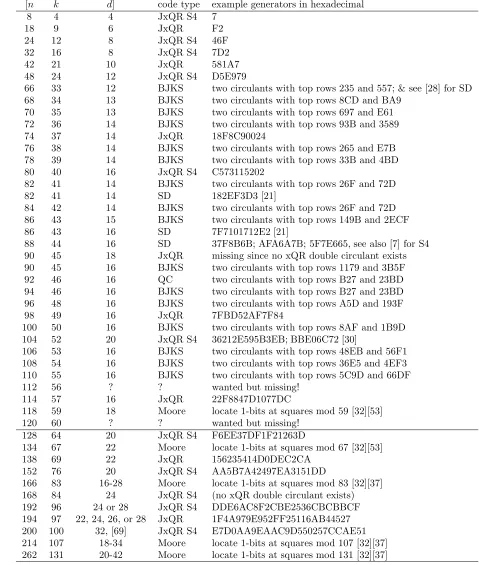
![Figure 9.1. Cyclic codes with wordlengthWhen n = 2m − 1. n ≤ 127 we give the exact distance for the best of all cyclic codes, from [13][58][63]](https://thumb-us.123doks.com/thumbv2/123dok_us/1855966.1240985/17.612.158.459.24.573/figure-cyclic-codes-wordlengthwhen-exact-distance-cyclic-codes.webp)

![Figure 9.3. Largest possible min-distancethe author. Essentially the same exhaustive search was also performed independently by Gulliver & Ostergard [31] with thewhether it ever hurts;unique up to isomorphism [31]](https://thumb-us.123doks.com/thumbv2/123dok_us/1855966.1240985/19.612.94.524.33.408/distancethe-essentially-exhaustive-performed-independently-ostergard-thewhether-isomorphism.webp)