Effect of water on morphological development in seedlings
of three range grasses: Root branching patterns
DOUGLAS A. JOHNSON AND LUCRECIA AGUIRRE
Abstract
Root morphology is important for successful seedling estab- lishment and survival on semiarid rangelands. This study was conducted to determine the response of early seedling root mor- phological development of ‘Hycrest’ [Agropyron desertorum (Fisch. ex Link) Schult. X A. cristatunr (L.) Gaert.], ‘Whitmar’ (Pseudoroegnetiu spicuta (Pursh) Liive], and cheatgrass (Bromus tectorum L.) to water. A greenhouse line-source sprinkler system provided a gradient of water application (77,66,37, and 5 ml/day). Root morphology was examined at 15, 30, and 45 days after seedling emergence. Order of branching of roots associated with the first foliar node was greater in cheatgrass than in Hycrest or Whitmar at all water applications and dates. Length of the primary root, length of the second group of seminal roots, and length of the first group of adventitious roots were similar in cheatgrass and Hycrest. Root branching for the 3 species decreased as less water was applied, except for cheatgrass irrigated with 5 ml/day. The ability of cheatgrass seedlings to grow with little water was related to their greater order of branching of seminal roots, branching density on the main axis, and length of lateral roots and external- external links. The greater root branching densities, lateral root lengths, and external-external link lengths enabled Hycrest seed- lings to grow better than Whitmar seedlings with little water. These root morphological characteristics may prove useful in improving seedling establishment of perennial range grasses.
Key Words: Hycrest, crested wheatgrass, Agropyron desertorum X A. cristatum, bluebunch wheatgrass, Pseudoroegneria spiccta, cheatgrass, Bromus tectorum, seedling establishment, root mor- phology, root topology
Low water availability in arid or semiarid regions severely limits seed germination, seedling establishment, and maintenance of per- ennial grasses (McAlister 1944, Hassanyar and Wilson 1979). The capacity for root development is especially critical for early growth and survival of seedlings under limited water (Hassanyar and Wilson 1978). The ability of roots to rapidly elongate allows root growth to advance beyond the soil drying front so that the seedling can avoid desiccation (Harris and Wilson 1970). The response of germinating seeds to drought has been extensively studied, but the influence of drought and other environmental factors on seedling root morphology has received limited attention (Aguirre and Johnson 1991b).
Root system morphology varies considerably among species, among individuals within a species, and even within individual root systems (Russell 1977). Although root branching pattern is genetically determined, environmental factors modify root mor- phological characteristics (Zobel 1975, Torrey and Clarkson 1975, Russell 1977). The structural organization of a root system influ- ences a plant’s ability to capture water and nutrients from the soil (Caldwell and Richards 1986). Because the architecture of root systems markedly influences root function, root architecture may be the result of natural selection (Fitter 1987). Consequently, iden-
Authors are plant physiologist, USDA-AR& Forage and Range Research, Utah State University, Logan 84322-6300 and former research assistant, Dept. Range Science, Utah State University, Logan 84322-5230.
Cooperative investigations of the USDA-ARS and the Utah Agricultural Experi- ment Station. Journal Paper 4006.
Manuscript accepted 3 January 1991.
JOURNAL OF RANGE MANAGEMENT 44(4), July 1991
tification of the relationship between root architecture and func- tion is critical.
The architecture of a root system consists of several measurable variables. The one with the most influence on overall root structure is topology or root branching structure (Fitter 1982). Fitter (1985, 1986) classified the branching structure of roots according to topology using a basipetal ordering system based on an external link (the segment between a meristem and a branch junction) and an internal link (the segment between 2 junctions) (Fig. 1). This topological approach defines magnitude as the number of external
R
Fig. 1. Diagram of a grass seedling depicting the terminology for defining root branching structure [after Fitter (19gS)]: main internal-internal link (MII), lateral internal-internal link (LII), external-internal link (EI), external-external link (EE), and lateral root (LR). Root axes are identi- tied using the technique of Klepper et al. (1984) with R for primary root, node -2 for roots associated with scutellar node, node -1 for roots associated with the epiblrst node, and node 1 for the first group of adventitious roots.
links, altitude as the longest individual pathlength, and external pathlength as the sum of all paths to external links. Fitter (1986) observed 2 different root structural patterns, a herringbone-like pattern and a dichotomous pattern. Root systems of Gramineae species typically have a herringbone-like pattern with a high pro- portion of external-internal links. The herringbone-like pattern was hypothesized to favor a greater exploration of the soil resource in a vertical plane (soil depth), while a dichotomous pattern hypo- thetically would favor the exploration of the soil in a horizontal plane.
Cheatgrass (Bromus tectorum L.) is an introduced annual grass that invaded and now dominates many rangelands in the Inter- mountain Region of the western U.S. (Mack 1981, Young et al.
Table 1. Significance levels for the sources of variation for various plant characteristics in split-split-plot ANOVA for cheatgrass, Hycrest, and Whitmar harvested at 3 dates and grown under 4 levels of irrigation using a greenhouse iine-source sprinkler system. Order of branching is abbreviated OB.
Primary root Seminal roots (-2)
Source df Length OB Length OB
Reps (N 3 ns ns ns ns
Water (W) 3 nv nv nv nv
Error a 9
Species (S) 2 ns ** ** **
ws 6 ns ns ns ns
Error b 24
Dates (D) 2 l * ** ** **
WD 6 ns ns ns *
SD 4 ns ns ns ns
WSD 12 ns * ** **
Error c 72
***significant at the 0.05 and 0.01 levels, respectively; ns = not significant and nv = not valid.
Seminal roots (-1) Adventitious roots
Length OB Length OB
ns ns ns ns
nv nv nv nv
** ** ** **
ns ns ns ns
** ** ** **
ns ns * **
** * ** **
ns * ns ns
used to successfully compete with cheatgrass. ‘Hycrest’, a promis- ing hybrid between 2 crested wheatgrass species [Agropyron deser- torum (Fisch. ex Link) Schult. X A. cristatum (L.) Gaert.], has seedling characteristics that may enable it to compete with cheat- grass (Asay et al. 1985). In a seedling competition experiment (Buman et al. 1988), Hycrest exhibited similar shoot and root dry weight, leaf area, and maximum root length as cheatgrass. Buman and Abernethy (1988) found that Hycrest and cheatgrass have similar temperature requirements for germination, which also could help Hycrest compete with cheatgrass seedlings.
This study determined how water influenced early seedling root morphological development of cheatgrass, bluebunch wheatgrass, and Hycrest.
Materials and Methods
Seeds of Hycrest, Whitmar, and cheatgrass (obtained from a site near Pullman, Wash.) were germinated on moist blotter paper and placed in an incubator at 25’ C with a 12-h photoperiod. When primary root length reached approximately 2 mm, 5 germinated seeds were transplanted per 20-cm X 20-cm plastic pot containing 8 kg of sterilized sandy loam soil and watered to field capacity. Seedlings were grown on greenhouse benches for 2 weeks and did not receive additional water during this period. Greenhouse air temperatures were maintained between 26 to 33O C. After the second leaf appeared on the main stem, pots were thinned to 1 seedling per pot. The pots then were positioned under a greenhouse line-source sprinkler system (Johnson et al. 1982), and watering was initiated.
Water application amounts provided by the line-source sprinkler
system on a greenhouse groundbed provided a gradient from high (directly below the spray nozzle in the center of groundbed) to low water application rates (toward the edges of the groundbed). Four pots were placed from 1 edge of the groundbed to the center of the sprinkler system. Empty pots with plugged drain holes were placed in rows across the groundbed to periodically measure water appli- cation. From the center to the outer edges of the groundbed, 77,66, 37, and 5 ml of water were applied per pot per day, resulting in average soil water potentials of -0.02, -0.04, -0.06, and -0.9 MPa, respectively, as measured periodically throughout the experiment by thermocouple psychrometry. Besides the daily water irrigation, 50 ml of full-strength Hoagland nutrient solution was supplied to the pots at 24, 3 1, and 38 days after emergence.
Entire seedlings were harvested at 31, 38, and 45 days after emergence. At each harvesting date, root systems were washed free of soil and individual seminal and adventitious root axes were identified under a microscope using 10x to 50x magnification. Root development was quantified according to the technique of Klepper et al. (1984), as described by Aguirre and Johnson (1991 b). Although the root classification system of Klepper et al. (1984) uses a naming system that identifies roots by their relationship to spe- cific nodes rather than designating roots as seminal or adventitious roots, in this paper we also indicate roots by these more traditional names for relating to earlier literature. However, it should be recognized that these traditional names are subject to various definitions and misinterpretation, as discussed by Klepper et al. (1984).
The geometric characteristics of root branching (Fitter 1986) were evaluated at the last (45 d) harvest. Two of the most highly
Table 2. The effect of water application and species on primary rootfength and order of branching (OB), length and OB of the second group of semhmi roots (node -l), length and OB of the first group of seminal roots (node -2), and length and OB of adventitious roots evaluated at 45 days after emergence.
Water application (ml/day) 5 37 66 77 Species Whitmar Hycrest Cheatgrass
Primary root
Length OB
(cm)
34’ 2.0
27 2.0
25 2.1
23 2.1
27ar i.9a
26a 2.lb
28a 2.lb
First group of seminal roots
Length OB
Second group of seminal roots
Length OB
First group of adventitious roots
Length OB
(cm)
23.4 1.4 19.5 1.7 21.3 1.8 22.6 1.8
20.la i7.8a 27.lb
i.6a
I .6ab 1.9b
(cm)
23.5 1.0
27.3 1.1
26.4 1.2
29.8 1.4
18.7a 30.6b 30.9b 0.9a 1.6b 1.3b (cm)
5.9 0.2
10.9 0.3
14.8 0.5
17.8 0.5
5.9a 13.7b 17.5b O.la 0.4b 0.6c
‘According to Hanks et al. (1980), the statistical test for the effect of water application is not valid because the amount of water applied is systematical rather than random. *Means followed by the same letter are not significantly different (P<O.OS) by LSD.
branched seminal root axes from each plant were selected and placed on a transparent film. The root system was distributed over the film using dissecting needles, and the root axes were placed on black paper to enhance visibility of root branching pattern prior to photocopying. Branching structures were measured from the pho- tocopies using an opistometer and included: length of lateral roots, length of main internal-internal links, length of lateral internal- internal links, length of external-external links, length of external- internal links, and magnitude and altitude values.
A split-plot analysis of variance with 4 replications and with water application as main plots, species as subplots, and dates as sub-subplots was used to determine the effects of water applica- tion, species, harvesting dates, and their interactions on shoot and root characteristics following the precautions discussed by Hanks et al. (1980) for analyzing line-source sprinkler experiments. Water application was considered a fixed variable, and species and dates were randomly assigned to each water application treatment. Main effects and interactions were considered significant if
P<O.OS.
Results
Statistically sign&ant (X0.05) differences were detected among the 3 species and among the 3 sampling dates for length and order of branching for the first group of seminal roots (node -2), second group of seminal roots (node -I), and first group of adventitious roots (node 1) (Table 1). Primary root length varied significantly among dates, but not among species. The water by species interac- tion (WS) was not significant for any of these 8 rooting characteris- tics. The water by date interaction (WD) was significant for order of branching of the first group of seminal roots and for both length and order of branching of adventitious roots, mainly because these characteristics generally increased with days after emergence except at the 5 ml/day water application. The species by date interaction (SD) was not significant for length and order of branch- ing of the primary root and the first group of seminal roots, but was significant for the second group of seminal roots and adventitious roots where either cheatgrass or Hycrest outdistanced Whitmar with time. The water by species by date interaction (WSD) was statistically significant for the following root morphological char- acteristics: order of branching of the primary root, length and order of branching of the first group of seminal roots, and order of branching of the second group of seminal roots.
Order of branching of the first group of seminal roots, length and order of branching of the second group of seminal roots, and length and order of branching of the first group of adventitious roots generally increased and primary root length decreased as more water was applied (Table 2). Seedlings of cheatgrass and Hycrest had similar length and order of branching of the primary root, order of branching of the first group of seminal roots, length and order of branching of the second group of seminal roots, and length of the first group of adventitious roots. Cheatgrass seedlings had greater length of the first group of seminal roots and degree of branching for the first group of adventitious roots than Hycrest seedlings. Root growth in Hycrest seedlings exceeded that in Whitmar seedlings in all characteristics except primary root length, and length and order of branching of the first group of seminal roots.
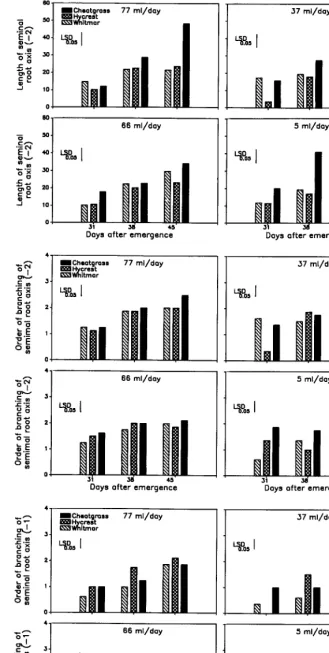
When seedlings received 77 ml of water daily (Fig. 2), the first group of seminal root axis (node -2) 38 and 45 days after emer- gence was longer in cheatgrass seedlings than in Hycrest and Whitmar seedlings. When 66 ml of water were applied, the seminal root axes of cheatgrass seedlings were longer at 31 and 45 days after
1 Mention of a trademark, proprietary product, or vendor does not constitute guaran- tee or warranty of the product by the U.S. Department of Agriculture and Utah State University, and does not imply approval to the exclusion of other products or vendors that also may be suitable.
emergence than those of Hycrest seedlings (Fig. 2). When seedlings received 37 ml/ day, the first group of seminal root axes was longer in seedlings of Whitmar and cheatgrass than Hycrest seedlings
at
31 days, but was longest in cheatgrass seedlings 38 days after emergence. At 37 ml/day, root lengths of Hycrest and Whitmar seedlings were similar at 38 days after emergence. At 45 days after emergence, root lengths of all species were similar at 37 ml/ day. At 5 ml/day, the first group of seminal root axes was longer in cheatgrass seedlings than those of Hycrest and Whitmar at all harvest dates.At 77 ml/day, significant differences among species were not detected in order of branching for the first group of seminal roots (node -2) until the last harvest, when cheatgrass seedlings exhi- bited a greater order of branching than seedlings of the perennial grasses (Fig. 2). At 66 ml/day, order of branching was greater in Hycrest and cheatgrass seedlings than in Whitmar seedlings, except at the last harvest, when the order of branching in Whitmar and cheatgrass seedlings exceeded that of Hycrest seedlings. At 37 ml/day, order of branching at the first harvest was greater in Whitmar and cheatgrass seedlings than Hycrest seedlings. At the second harvest, Hycrest seedlings had a greater order of branching than seedlings of Whitmar and cheatgrass, and cheatgrass had a greater order of branching than either Hycrest or Whitmar seed- lings at the last harvest. At 5 ml/day, cheatgrass seedlings had a greater order of branching than the 2 perennial grasses at the first and second harvests. By the last harvest seedlings of Hycrest and cheatgrass were equal and had a greater order of branching of seminal roots than Whitmar seedlings.
At 77 ml/day, seedlings of Hycrest and cheatgrass had a greater order of branching of the second group of seminal roots (node -1) than Whitmar seedlings at both the first and second harvest (Fig. 2). At the second harvest Hycrest seedlings had a greater order of branching than seedlings of Whitmar and cheatgrass. At the third harvest cheatgrass and Whitmar seedlings were equal, but less than Hycrest seedlings. At 66 ml/day, Hycrest and cheatgrass seedlings had a greater order of branching than Whitmar seedlings at the first harvest, and at the last harvest Hycrest seedlings had a greater order of branching than seedlings of cheatgrass and Whitmar. At 37 ml/ day, significant differences were observed only at the first and second harvest. At 5 ml/day, order of branching was signifi- cantly greater in Hycrest and cheatgrass than Whitmar at the first and second harvest, but no significant differences were detected on the last harvest.
The 3-way interaction involving water treatment, species, and harvest date was not significant for length and order of branching of the first group of adventitious roots (Table 1). These adventi- tious root characteristics were greater for cheatgrass seedlings and were followed by seedlings of Hycrest and Whitmar at all water treatments.
The ANOVA for root branching structure indicated that the interaction between species and water treatments (SW) was signifi- cant for length of laterals (P<O.Ol), length of external-external links
(P<O.Ol),
magnitude (P<O.O5), and altitude (P<O,O5). The species by water interaction was not significant (m.05) for length of main internal-internal links, length of lateral internal-internal links, length of external-internal links, and number of extemal- internal links.86 ml/day 5 ml/day
Days after emergence Days after emergence
5 ml/day
Days after emergence Days after emergence
Days after emergence Days after emerge&i
Fig. 2. Seedling root characteristics for cheatgrass, Hycrest, and Whitmar in relation to days after seedling emergence at 4 water application rates (77,66, 37, and 5 ml/day). The -2 designation in parentheses on the vertical axis of a figure refers to roots associated with the scutellar node and -1 refers to roots associated with the epiblrst node. Length of seminal root axis is in cm. Each bar represents the mean of 4 seedlings.
35
1
m Cheatgrass 30 IE! Hycrest
0 Whitmar
25
1
35
30
25
20
15
10
5
0
Fig. 3. Values of magnttude (number of exterior Ii&s) and altitude (long- est individual pathlength) for cheatgrass, Hycrest, and Whitmar in r&- tion to 4 watering treatments. Each bar represents the mean of 4 seedlings.
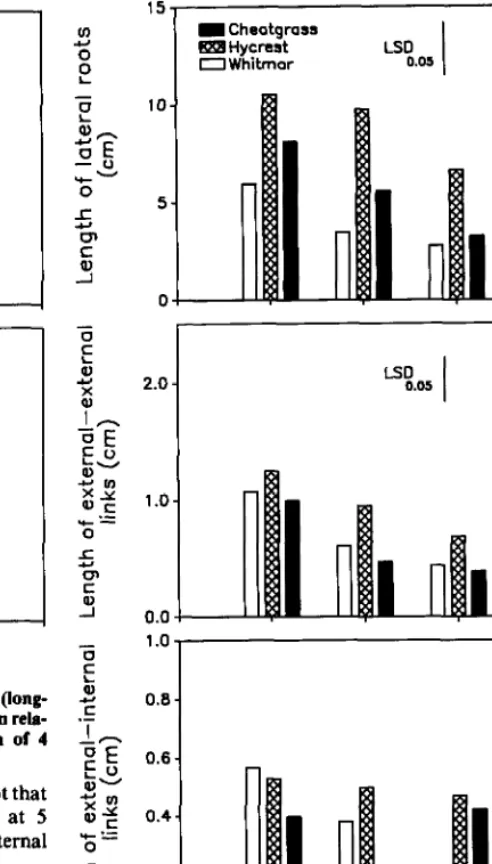
external links became shorter as less water was applied, except that length of external-external links in cheatgrass increased at 5 ml/ day (Fig. 4). Species did not differ in length of external-internal links and length of internal-internal links.
Discussion
Hassanyar and Wilson (1978) stated that species whose root apices were not drought tolerant or had little or no inherent capac- ity for seminal lateral root development were most susceptible to drought injury. They observed that the seminal lateral roots of seedlings of crested wheatgrass [Agropyron desertorum (Fisch. ex Link) Schult.] were longer than those of Russian wildrye [Psathy- rostuchysjuncea (Fischer) Nevski]. Temporary water stress delayed seminal root initiation of bluegrama [ Boutelouagracilis (Willd. ex H.B.K.) Lag. ex Griffiths] (Hyder et al. 1971). In the present study, cheatgrass had a greater number and order of branching of seminal roots and initiated adventitious roots earlier than the perennial grasses at all water applications. These characteristics are coupled with the ability of cheatgrass seedlings to elongate adventitious roots at colder temperatures than Hycrest and Whitmar (Aguirre and Johnson 1991a). In addition, Svejcar (1990) showed that cheatgrass was more efficient (per unit of biomass) in producing root length than seedlings of A. desertorum cv. Nordan.
Root branching patterns help understand resource acquisition by roots. Fitter (1986) found that root systems of Gramineae species generally have a high proportion of external-internal links, a pattern resembling a herringbone design. Branching frequency influences the form of root systems and is, in turn, influenced by the environment (Fitter 1982). Barley (Hordeum vulgare L.) sup- plied with nitrate had up to 10 laterals/cm of main root axis, whereas barley in nitrate-free zones had 5 to 6 laterals/cm or
15
10
5
0
2.0
1.0
0.c I-
I-i-
m Cheatgrass m Hycrest 0 Whitmar
0.6
0.6
0.4
0.2
0.0
Fig. 4. Length of lateral roots, length of external-external links, and length of external-internal links for roots of cheatgrass, Hycrest, and Whitmar in relation to 4 water application rates (5,37,66, and 77 ml/day) at 45 days. Each bar represents the mean of 4 seedlings.
internal link lengths of 1 to
2
mm (Hackett 1972). Crossett et al. (1975) observed that internal links of 2 to 3 mm were typical for barley. Fitter (1986) found that internal links were 3 to 9 mm long in Trlyolium pratense L., and they were not affected by watering rate. In the present study, although it was not possible to statisti- cally test the effects of water level, water treatment did not tend to affect internal link lengths of Whitmar, Hycrest, and cheatgrass. Cheatgrass had the shortest internal-internal links (2 mm), whichresulted in a branching density of 5 laterals/cm; Hycrest had internal-internal links of 3.6 mm, which represented a branching density of 4 laterals/cm; and Whitmar had the longest intemal- internal links, which represented a branching density of 2 laterals/ cm.
Fitter (1986) observed that external-internal links were consid- erably shorter than external-external links, particularly in dry soil. This would be expected because external-internal links enhance exploitation of a given volume of soil, whereas external-external links generally enhance exploration of new soil. In the present
study, external-external links were longer than those of extemal- internal links at all water levels, which indicates that these grasses allocate more resources for exploration of the soil profile.
The considerable growth of cheatgrass seedlings when little water was applied was associated with a greater branching density on the main axis and longer laterals and external-external links. The more vigorous seedling growth of Hycrest was associated with its greater root branching densities, longer laterals, and longer external-internal links than Whitmar. In general, both strategies of root development (exploration and exploitation) occurred in seed- lings receiving 5 ml/day. Cheatgrass had the longest lateral roots and externalexternal links, which indicates that it utilizes rapid root growth to explore new soil in advance of the drying front. On the other hand, Hycrest tended to intensify its exploitation of the same soil volume by utilizing longer external-internal links.
The differences in root morphological development and rooting geometry found in our study undoubtedly contribute to the ulti- mate success or failure of these range grasses on rangelands. Although studies of seedling root morphology are tedious and time-consuming, they illucidate important adaptive mechanisms that confer a competitive advantage in water-limited range envi- ronments. This information will serve as a basis for identifying root morphological characteristics that may be useful in improving seedling establishment of perennial range grasses.
Literature Cited
A&me,
L., and D.A. Johnson. 19911. Influence of temperature and cheatgrass competition on seedling development of two bunchgrasses. J. Range Manage. 44:347-354.Agufrn, L., and D.A. Johnson. 1991b. Root morphological development in relation to shoot growth in seedlings of four range grasses. J. Range Manage. 44~341-346.
Asay, K.H., D.R. Dewey, F.B. Gomm,D.A. Johnson,and J.R. Carlson. 1985. Registration of ‘Hycrest’crested wheatgrass. Crop Sci. 25:368-369.
Buman, R.A., and R.H. Abemethy. 1988. Temperature requirements for
mountain rye, ‘Hycrest’crested wheatgrass, and downy brome germina- tion. J. Range Manage. 41:35-39.
Buman, R.A., S.B. Monsen, and R.H. Abernethy. 1988. Seedling competi- tion between mountain rye, ‘Hycrest’ crested wheatgrass, and downy brome. J. Range Manage. 41:30-34.
Caldwell, M.M., and J.H. Richards. 1986. Competing root systems: mor- phology and models of absorption. p. 251-273. In:T.J. Givnish (ed.). On the economy of plant form and function. Cambridge Univ. Press. Crossett, R.N., D.J. Campbell, and H.E. Stewart. 1975. Compensatory
growth in cereal root systems. Plant and Soil 42:673-683.
Fitter, A.H. 1982. Morphomettic analysis of root systems: application of the technique and influence of soil fertility on root system development in two herbaceous species. Plant, Cell and Environment. 5:313-322. Fitter, A.H. 1985. Functional significance of root morphology and root
system architecture. p. 87-106. In: A.H. Fitter, D.J. Read, D. Atkinson, and M.B. Usher (eds.). Ecological interactions in soil. Spec. Pub. British Ecol. Sot., No. 4. Blackwell Sci. Pub]., Oxford.
Fitter, A.H. 1986. The topology and geometry of plant root systems: influence of watering rate on root system topology in Trifoliumpratense. Ann. Bot. 58:91-101.
Fitter, A.H. 1987. An architectural approach to the comparative ecology of plant root systems. New Phytol. 106 (Suppl.), 61-77.
Hackett, C. 1972. A method of applying nutrients locally to roots under controlled conditions, and some morphological effects of locally applied nitrate on the branching of wheat roots. Austr. J. Biol. Sci. 25: 1169-l 180. Hanks, R.J., D.V. Slsson, R.L. Hurst, and K.C. Hubbard. 1980. Statistical analysis of results from irrigation experiments using the line-source sprinkler system. Soil Sci. Sot. Amer. J. 44~886-888.
Harris, GA., and A.M. Wilson. 1970. Competition for moisture among seedlings of annual and perennial grasses as influenced by root elonga- tion at low temperature. Ecology 51:530-534.
Hassanyar, A.S., and A.M. Wilson. 1978. Drought tolerance of seminal lateral root apices in crested wheatgrass and Russian wildrye. J. Range Manage. 3 1:254-258.
Hassanyar, A.S., and A.M. Wilson. 1979. Tolerance of desiccation in germinating seeds of crested wheatgrass and Russian wildrye. Agron. J. 71~783-786.
Hyder, D.N., A.C. Everson, and R.E. Bement. 1971. Seedling morphology
and seeding failures with blue grama. J. Range Manage. 24287-292. Johnson, D.A., M.D. Rumbaugh, L.S. Willardson, K.H. Asay, D.N.
Rinehart, and M.R. Aurasteh. 1982. A greenhouse line-source sprinkler system for evaluating plant response to a water application gradient. Crop. Sci. 22441-444.
Klepper, B., R.K. Belford, and R.W. Rickman. 1984. Root and shoot development in winter wheat. Agron. J. 76~117-122.
Mack, R.N. 1981. Invasion of Bromus tecforum L. into western North America: an ecological chronicle. Agro-Ecosystems 7: 145-165. McAlister, D.F. 1944. Determination of soil drought resistance in grass
seedlings. J. Amer. Sot. Agron. 36324-336.
Russell, R.S. 1977. Plant root systems: their function and interaction with the soil. McGraw-Hill Book Co., London.
Svejcar, T. 1990. Root length, leaf area, and biomass of crested wheatgrass and cheatgrass seedlings. J. Range Manage. 453446448.
Torrey, J.G., and D.T. Clarkson (eds). 1975. The development and func- tion of roots. Academic Press, New York.
Young, J.A., R.A. Evans,R.E. Eckert, Jr.,andB.L. Kay. 1987.Cheatgrass. Rangelands 9:266-270.
Zobel, R.W. 1975. The genetics of root development. p. 261-275. In: J.G. Torrey and D.T. Clarkson (eds.). The development and function of roots. Academic Press, New York.
![Fig. 1. Diagram of a grass seedling depicting the terminology for defining root branching structure [after Fitter (19gS)]: main internal-internal link (MII), lateral internal-internal link (LII), external-internal link (EI), external-external link (EE), an](https://thumb-us.123doks.com/thumbv2/123dok_us/1852131.1240401/1.615.272.526.147.426/seedling-depicting-terminology-defining-branching-structure-internal-internal.webp)