R E S E A R C H
Open Access
Distributed stochastic power control in ad hoc
networks: a nonconvex optimization case
Lei Yang
1*, Yalin E Sagduyu
2, Junshan Zhang
1and Jason H Li
2Abstract
Signal-to-interference-plus-noise-based power allocation in wireless ad hoc networks is inherently a nonconvex optimization problem because of the global coupling induced by the co-channel interference. To tackle this challenge, we first show that the globally optimal point lies on the boundary of the feasible region. This property is utilized to transform the utility maximization problem into an equivalent max–min problem with more structure. By using extended duality theory, penalty multipliers are introduced for penalizing the constraint violations, and the minimum weighted utility maximization problem is then decomposed into subproblems for individual users to devise a distributed stochastic power control algorithm, where each user stochastically adjusts its target utility to improve the total utility by simulated annealing (SA). The proposed distributed power control algorithm can guarantee global optimality at the cost of slower convergence due to SA involved in the global optimization. The geometric cooling scheme with suitable choice of penalty parameters is then used to improve the convergence rate. Next, by
integrating the stochastic power control approach with the back-pressure algorithm, we develop a joint scheduling and power allocation policy to stabilize the queueing systems under random packet traffic. Finally, we generalize the above distributed power control algorithms to multicast communications, and show their global optimality for multicast traffic.
Keywords: Distributed power control, Nonconvex optimization, Extended duality theory, Simulated annealing, Queue stability, Unicast communications, Multicast communications
Introduction
The broadcast nature of wireless transmissions makes wireless networks susceptible to interference, which dete-riorates quality of service (QoS) provisioning. Power con-trol is considered as a promising technique to mitigate interference. One primary objective of power control is to maximize the system utility that can achieve a variety of fairness objectives among users [1-4]. However, maxi-mizing the system utility, under the physical interference model, often involves nonconvex optimization and it is known to be NP-hard, due to the complicated coupling among users through mutual interference effects [5].
Due to the nonconvex nature of the power control prob-lem, it is challenging to find the globally optimal power allocation in a distributed manner. Notably, the authors of
*Correspondence: [email protected]
1School of ECEE, Arizona State University, Tempe, AZ 85287, USA Full list of author information is available at the end of the article
[6-9] devised distributed power control algorithms to find power allocations that can only satisfy the local optimality conditions, but global optimality could not be guaran-teed in general, except for some special convexifiable cases (e.g., with strictly increasing log-concave utility func-tions). Another thread of work applied game-theoretic approaches to power control by treating it as a non-cooperative game among transmitters [10,11]. However, distributed solutions that converge to a Nash equilibrium may be suboptimal in terms of maximizing the total sys-tem utility. Different from these approaches, the authors of [12] transformed the power control problem into a DC (difference of convex functions) optimization prob-lem [13]. Then, the global optimal solution can be solved in a centralized manner with the branch-and-bound algo-rithm. Recent study [14] proposed a globally optimal power control scheme, named MAPEL, by exploiting the monotonic nature of the underlying optimization prob-lem. However, the complexity and the centralized nature
of MAPEL hinder its applicability in practical scenarios, and thus it can be treated rather as a benchmark for performance evaluation in distributed networks.
To find the globally optimal power allocation in a distributed setting, recent study [15] has proposed the SEER algorithm based on Gibbs sampling [16], which can approach the globally optimal solution in an asymptotic sense when the control parameter in Gibbs sampling tends to infinity. Notably, for each iteration in the SEER algo-rithm, each user utilizes Gibbs sampling to compute its transition probability distribution for updating its trans-mission power, where the requirement for message pass-ing and computpass-ing the transition probability distribution in each iteration can be demanding when applied to ad hoc communications without centralized control.
A challenging task in distributed power control in ad hoc networks is to reduce the amount of message pass-ing while preservpass-ing the global optimality. To tackle this challenge, we first show that the globally optimal point lies on the boundary of the feasible region. This property is utilized to transform the utility maximization problem into an equivalent max–min problem with more struc-ture, which can be solved by combining recent advances in extended duality theory (EDT) [17] with simulated annealing (SA) [18]. Compared with the classical dual-ity theory with nonzero dualdual-ity gap for nonconvex opti-mization problems, EDT can guarantee zero duality gap between the primal and dual problems by utilizing non-linear Lagrangian functions. This property allows for
solv-ing the nonconvex problem by its extended dual while
preserving the global optimality with distributed imple-mentation. Furthermore, as will be shown in Section “Power control for unicast communications”, for the sub-problem of each individual user, the extended dual can then be solved through stochastic search with SA. In particular, we first transform the original utility maxi-mization problem into an equivalent max–min problem. This step is based on the key observation that in the case with continuous and strictly increasing utility functions,
the globally optimal solution is always on the boundary
of the feasible (utility) region. Then, appealing to EDT and SA, we develop a distributed stochastic power con-trol (DSPC) algorithm that stochastically searches for the optimal power allocation in the neighborhood of the fea-sible region’s boundary, instead of bouncing around in the entire feasible region.
Specifically, we first show that DSPC can achieve the global optimality in the underlying nonconvex optimiza-tion problem, although the convergence rate can be slow (but this is clearly due to the slow convergence nature of SA with logarithmic cooling schedule). Then, to improve the convergence rate of DSPC, we propose an enhanced DSPC (EDSPC) algorithm that employs the geometric cooling schedule [19] and performs a careful selection
of penalty parameters. As a benchmark for performance evaluation, we also develop a centralized algorithm to search for the globally optimal solution over simplices that cover the feasible region. The performance gain is further verified by comparing our distributed algorithms with MAPEL [14], SEER [15], and ADP [6] algorithms. Worth noting is that the proposed DSPC and EDSPC algorithms do not require any knowledge of channel gains, which is typically needed in existing algorithms, and instead they need only the standard feedback of signal-to-interference-plus-noise (SINR) for adaptation.
Next, we integrate the proposed distributed power con-trol approach with the back-pressure algorithm [20] and devise a joint scheduling and power allocation policy for improving the queue stability in the presence of dynamic packet arrivals and departures. This policy fits into the dynamic back-pressure and resource allocation frame-work and enables distributed utility maximization under stochastic packet traffic [21,22]. Then, we generalize the study to consider multicast communications, where a sin-gle transmission may simultaneously deliver packets to multiple recipients [23,24]. Specifically, we extend DSPC and EDSPC algorithms to multicast communications with distributed implementation, and show that these algo-rithms can also achieve the global optimality in terms of jointly maximizing the minimum rates on bottleneck links in different multicast groups.
The rest of the article is organized as follows. In the following section, we first introduce the system model, establish the equivalence between the utility maximiza-tion problem and its max–min form, and then develop both centralized and distributed algorithms for the max– min problem. Next, building on these power control algo-rithms, we develop in Section “Joint scheduling and power control for stability of queueing systems” a joint schedul-ing and power allocation policy to stabilize queueschedul-ing sys-tems. The generalization to multicast communications is presented in Section “Power control for multicast com-munications”. We conclude the article in “Conclusion” Section.
Power control for unicast communications System model
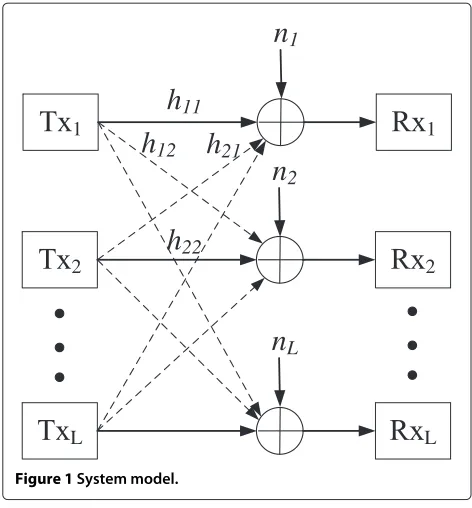
We consider an ad hoc wireless network with a setL =
{1,. . .,L} of links, where the channel is
interference-limited, and all L links treat interference as noise, as
1 1
2 2
L L
n
1n
2n
Lh
11h
12h
22h
21Figure 1System model.
γl(p)= hllpl nl+
k=l hklpk
, (1)
wherep = (p1,. . .,pL)is a vector of the users’ transmis-sion powers andnlis the noise power. Accordingly, thelth user receives the utilityUl(γl), whereUl(·)is continuous and strictly increasing. We assume that each userl’s utility is zero whenγl =0, i.e.,Ul(0)=0. For ease of reference, the key notation of this article is listed in Table 1.b
Table 1 Summary of the notations and definitions
Notation Definition
L Set of links
L Total number of links
hlk Channel gain from linkl’s transmitter to linkk’s receiver
H Link gain matrix
pl(in vectorp) Transmission power of linkl
nl(in vectorn) Noise power for linkl
γl SINR of linkl
γl(·) SINR function of linkl
Ul(·) Utility function of linkl
xl(in vectorx) Ratio of linkl’s utility to the total network utility
rl(in vectorr) Transmission rate of linkl
rl(·) Transmission rate function of linkl
α,β Penalty multipliers
Network utility maximization
We seek to find the optimal power allocationp∗that max-imizes the overall system utility subject to the individual power constraints, given by the following optimization problemc:
maximize
l∈LUl
(γl(p))
subject to 0≤pl≤Pmaxl ,∀l∈L variables {p}.
(2)
In general, (2) is a nonconvex optimization problem.d In particular, if the utility function is the Shannon rate achievable over Gaussian flat fading channels, namely
Ul(γl(p)) = wllog(1+γl(p)), wherewl > 0 is a weight associated with userl, (2) boils down to the weighted sum rate maximization problem, which is known to be non-convex and NP-hard [5]. Note that the weights in (2) can serve as the fairness measures [25] for different scenar-ios. In particular, in queueing systems, packet queues for arrival rates within the stability region can be stabilized by solving this weighted sum rate maximization prob-lem, where the instantaneous queue lengths are chosen as the weights. In Section “Joint scheduling and power control for stability of queueing systems”, we will discuss how to stabilize the packet queues by integrating our dis-tributed power control algorithms with the back-pressure algorithm.
LetF denote the feasible utility region, where for each pointU = (U1,. . .,UL)in F, there exists a power vec-torpsuch thatUl = Ul(γl(p))for alll ∈ L. The feasible utility regionFis nonconvex, and in general, finding the globally optimal solution to (2) inFis challenging. In the following example, we illustrate the geometry ofFfor the utility functionUl(γl(p))=wllog(1+γl(p))and evaluate the solutions to (2) given by some existing power control approaches discussed in Section “Introduction”.
Example.For the case with two links, Figure 2 illustrates the nonconvex feasible utility regionF for different sys-tem parameters. We compare the performance of the existing approaches [3,6,14,15] in Table 2.
Remarks.The solutions to (2) given by the authors of [3,6,14] are either distributed but suboptimal or optimal but centralized. In particular, Chiang et al. [3] solve (2) by using geometric programming (GP) under the high-SINR assumption, which yields a suboptimal solution to (2) when this assumption does not hold (e.g., this is the case in the example above). The ADP algorithm [6] can
guarantee only local optimalitye in a distributed
0 1 2 3 4 5
Figure 2The feasible utility regionF.Case (I): the channel gains are given byh11=0.73,h12=0.04,h21=0.03, andh22=0.89, and the maximum power arePmax
1 =20,Pmax2 =100; Case (II): the channel gains are given byh11=0.30,h12=0.50,h21=0.03, and
h22=0.80, and the maximum power arePmax1 =1,Pmax2 =2. In both cases, the noise power is 0.1 for each link, and the weights are w1=0.57,w2=0.43.
the SEER algorithm [15] can guarantee global optimality in a distributed manner but message passing needed in each iteration can be demanding, i.e., each link needs the knowledge of the channel gains, the receiver SINR and the signal power of all the other links. It is worth noting that the performance of SEER hinges heavily on the control parameter that can be challenging to choose on the fly.
From network utility maximization to minimum weighted utility maximization
In order to devise low-complexity distributed algorithms that can guarantee global optimality, we first study the basic properties for the solutions to (2), before transform-ing (2) into a more structured max–min problem.
Lemma 1.The optimal solution to (2) is on the boundary of the feasible utility regionF.
Table 2 The performance of the existing approaches for Case I and II
Approach Case I Case II
Power Sum rate Power Sum rate
GP [20, 7.68] 3.02 [1, 0.61] 0.98
ADP [20, 6.46] 3.10 [1, 2] 1.16
MAPEL [20, 6.79] 3.10 [0, 2] 1.22
SEER [20, 6.90] 3.10 [0, 2] 1.22
Proof. Let U∗ denote a globally optimal solution to (2)
overF, andγ∗denote the corresponding SINR that
sup-portsU∗. SinceUl(·)is continuous and strictly increasing, proving thatU∗is on the boundary ofF is equivalent to
showing thatγ∗is on the boundary of the feasible SINR
region. Suppose thatγ∗is not on the boundary of the fea-sible SINR region, which indicates that there exists some pointγˆ such thatγˆl ≥ γl∗for alll ∈ Landγˆl > γl∗ for
somel ∈ L. SinceUl(·)for anyl ∈ Lis strictly increas-ing in γl, we have Ul(γˆl) ≥ Ul(γl∗) for all l ∈ L and Ul(γˆl) > Ul(γl∗)for somel ∈ L, which contradicts the
fact thatγ∗is a globally optimal solution. Hence, Lemma 1 follows.
Based on Lemma 1, if we can characterize the boundary ofF, then it is possible to solve (2) efficiently. Thus moti-vated, we first establish, by introducing a “contribution weight” for each user, the equivalence between (2) and the minimum weighted utility maximization problem.
Lemma 2.Problem (2) is equivalent to the following minimum weighted utility maximization:
xl . Therefore, (4) can be treated as the
hypograph form of (3), i.e., (4) and (3) are equivalent [26], thereby concluding the proof.
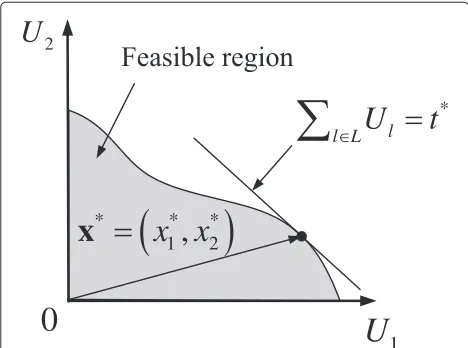
optimalx∗, given which we can efficiently obtain a globally optimal solution, i.e., the tangent point of the hyperplane andF, as illustrated in Figure 3. Intuitively speaking, x represents a search direction. Once we find the best search directionx∗,p∗ can be obtained efficiently by searching along the direction ofx∗. Actually, for givenx, (3) is quasi-convex.fBy introducing an auxiliary variablet, we obtain the following equivalent formulation:
maximize t
subject to Ul−1(txl)(nl+ k=l
hklpk)≤hllpl
0≤pl ≤Pmaxl ,∀l∈L, 0≤t variables {p,t},
(5)
which can be solved in polynomial time through binary
search ont [26]. However, the optimal search direction
x∗ is difficult to find due to the nonconvex nature of the
problem. In the following section, we study how to find the globally optimal search directionx∗.
Centralized versus distributed algorithms
In this section, we study algorithms achieving global opti-mality for (3). First, we propose a centralized algorithm for (3), which will serve as a benchmark for performance comparison. Then, by using EDT and SA, we propose a distributed algorithm, DSPC, for the problem (3). Build-ing on this, we propose an EDSPC algorithm to improve the convergence rate of DSPC.
A centralized algorithm
Based on Lemmas 1 and 2, we develop a centralized algo-rithm (Algoalgo-rithm 1) to solve the max–min optimization problem (3) under consideration. Roughly speaking, by dividing the simplexS= {x|l∈Lxl=1, 0≤xl ≤1,∀l∈
L}into many small simplices, the algorithm can find the
optimal point on the boundary ofF. Figure 4 illustrates
0
2U
1
U
* ll L
U
t
* * *
1
,
2x x
x
Figure 3An illustration of the max–min problem for the case with two links.
If
S
c
v
S
1
S
S
2
Figure 4An illustration of the simplex cutting for the case with three links.
how the simplex cutting is performed for the case with three links. Compared with the MAPEL algorithm [14], Algorithm 1 directly computes the points on the bound-ary, instead of constructing a series of polyblocks to approximate the boundary of the feasible region.
Algorithm 1
Initialization: Choose the approximation factor > 0,
and construct the initial simplex S with the vertex set
V = {v1,. . .,vL}, where vl = el and el is the lth unit coordinate vector. Letvc = 1Ll∈Lvlbe the center ofS. Computep∗by solving (5) at the point x = vc. Denote
δ(S)=maxv∈V|vc−v|as the diameter ofS. Repeat
1. Divide each simplexSiby usingbisection method, which chooses the midpoint of one of the longest edges of the simplexSi, i.e.,vm= 21(vr+vs), where vrandvsare the end points of a longest edge of the simplex. In this case, the simplexSiis subdivided into two simplicesSi1andSi2.
2. For each new simplexSij, compute the diameter
δ(Sij)andp∗by solving (5) atxgiven by the center point of the simplex.
3. Find the current best solution to (3) and the maximal diameterδmin these new subdivided simplices.
Untilδm< .
Proposition 1.Algorithm 1 converges monotonically to the globally optimal solution to (3) as the approximation factorapproaches zero.
Letd()denote the maximum distance between the opti-mal solutionx∗and the center point of the simplex that
contains x∗. Obviously, d() is bounded by δm. Since
δm decreases with the decreasing of , therefore d()
decreases monotonically with the decreasing of, i.e., the solution given by Algorithm 1 monotonically converges
to x∗. As approaches zero, Algorithm 1 exhaustively
searches every point in the simplexS, thereby concluding the proof.
Remarks. Algorithm 1 can be used to obtain an-optimal solution with |x−x∗| ≤ . That is to say, by
control-ling , one can strike a balance between the optimality
and the computation time. Since finding the globally opti-mal solution requires centralized implementation, Algo-rithm 1 will be used only as a benchmark for performance evaluation of distributed algorithms.
DSPC algorithm
Next, we devise a DSPC algorithm based on EDT [17] and SA [18]. Compared to the classical duality theory with nonzero duality gap for nonconvex optimization prob-lems, EDT can guarantee zero duality gap between the pri-mal and dual problems by utilizing nonlinear Lagrangian functions. This property allows for solving the nonconvex
problem by itsextended dualwhile preserving the global
optimality in distributed implementation. To this end, we first introduce auxiliary variables and use EDT to trans-form (3) with the auxiliary variables into an unconstrained problem. Then, we solve the unconstrained problem by
using the SA mechanism. Specifically, we define tl =
Ul(γl(p))
xl and rewrite (3) as
minimize −min
Next, we use EDT to write the Lagrangian function for (6) as
the penalty multipliers for penalizing the constraint vio-lations. Based on EDT [17], there exist finiteα∗ ≥ 0 and
βl∗ ≥ 0, for alll ∈ L, such that, for anyα > α∗ and
βl > βl∗, ∀l ∈ L, the solution to (7) is the same as (6).
Note that (7) does not include the constraints ofpl,xl, and tl for each user, and there will be no constraint violation when each user updates these variables locally. Therefore, the minimization of (7) with respect to the primal vari-ables (p,x, andt) can be carried out individually by each user in a distributed fashion.
The next key step is to perform a stochastic local search by each user based on SA. Lettl,xl, andpldenote the pri-mal values of the lth user, andtl andxl denote the new values randomly chosen by thelth user. Accordingly,tlxl
can be treated as a new target utility for thelth user. To achieve this target utility, thelth user updatesplby
pl =min
where γl is the current SINR measured at thelth user’s receiver. Note that (8) does not need any information of channel gains, except the feedback of SINR γl. Since (8) corresponds to the distributed power control algo-rithm of standard form as described in [27],git converges geometrically fast to the target utility. Thus, we assume
that each user l updates pl at a faster time-scale than
tl and xl such that pl always converges before the next update of tl and xl. Next, we use SA to update tl and
xl in a stochastic operation. By using the analogy with
annealing in metallurgy, SA was proposed in [18] to mimic the behavior of the microscopic constituents in heating and controlled cooling of a material. By allow-ing occasional uphill moves, SA is able to escape from
the local optimal points. In particular, let denote
the difference between L(pl,xl,tl|p−l,x−l,t−l,α,β) and L(pl,xl,tl|p−l,x−l,t−l,α,β), where y−l is the vector y without thelth user’s variable. If≥ 0, i.e.,tl,xlandpl
reduce Lagrangian (7), then they are accepted with prob-ability 1; otherwise, they are accepted with probprob-ability
expT, whereT is a control parameter and sometimes
it is called temperature. Note that, as T decreases, the
acceptance of uphill move becomes less and less probable, and therefore a fine-grained search is needed. It has been
shown that, asT approaches 0 according to alogarithmic
cooling schedule, SA converges to a globally optimal point [16,19]. To computelocally by each userl, userlneeds to broadcast the terms tl, xl and βl(tlxl − Ul(γl(p)))+, whenever any of these terms changes.
continue to transmit at maximum power [1]. If some tar-get utility is not feasible asTtends to 0, based on EDT, the current values ofαandβdo not satisfyα > α∗orβl> βl∗ for alll∈L. Therefore, each userlalso needs to updateα
andβl. In particular, if any constraint is violated,αandβl are updated as follows:
α ← α+σ|
l∈L xl−1|,
βl ← βl+ l(tlxl−Ul(γl))+, ∀l∈L, (9) whereσ and lare used to control the rate of updatingα andβl. A detailed description of DSPC algorithm is given in Algorithm 2.
Remarks:
(1) In Algorithm 2, each user randomly picks
tl∈[Ulmax,Utotmax], whereUlmaxdenotes the maximum utility of the userl when the user l transmits at the maximum power while the other users do not transmit, andUtotmax=l∈LUlmax. Note thatUlmaxcan be computed by each user locally. Further, we assume that each user broadcastsUlmax
before running the algorithm so thatUtotmaxis also known by each user.
(2) In practice, after initialization,αandβlincrease in proportion to the violation of the corresponding constraint, which may lead to excessively large penalty values. Since it is beneficial to periodically scale down the penalty values to ease the
unconstrained optimization,αandβlare scaled down by multiplying with a random value (it can be chosen between 0.7 and 0.95 according to [17]), if the penalty decrease condition is satisfied, i.e., the maximum violation of constraints is not decreased after consecutively running Step 1 in Algorithm 2 several times, e.g., five times in [17].
(3) In Algorithm 2, each user requires the knowledge ofT and time epochs{τ1,τ2,. . .}to updatetlandxl, which can be determined and informed to each user offline.
Algorithm 2 DSPC
Initialization: Choose >0. Letα =0,βl =0,∀l ∈L,
and randomly choosep,xandt.
Step 1: update primal variables
Set T = T0, and select a sequence of time epochs
{τ1,τ2,. . .}in continuous time. Repeat for each userl
1. Randomly picktl∈[Ulmax,Utotmax]andxl ∈[ 0, 1], and
updateplaccording to (8).
2. Keep sensing the change ofβl(tlxl−Ul(γl(p)))+ broadcast by other users.
3. Compute, and accepttl,xl, andplwith probability 1, if≥0, or with probabilityexp(T), otherwise. 4. Broadcasttlandxl, iftlandxlare updated. 5. For each time epochτi, updateT=T0/log(i+1).
UntilT< .
Step 2: update penalty variables For each userl,
1. Updateαandβlaccording to (9), and scale downα andβl, if the penalty decrease condition is satisfied. 2. Go to Step 1 until no constraint is violated.
Proposition 2.The DSPC algorithm (Algorithm 2) con-verges almost surely to a globally optimal solution to (3), as temperature T in SA decreases to zero.
Proof.To show that Algorithm 2 converges almost surely to a globally optimal solution to (3), we only need to show that when α > α∗ and βl > βl∗ for all l ∈ L, Algo-rithm 2 can converge almost surely to a globally optimal solution to (6), since (3) is equivalent to (6), and if the solution does not satisfy the constraints of (6),α andβl will increase in proportion to the violation of the corre-sponding constraint. Since Algorithm 2 uses SA with the logarithmic cooling schedule, based on [16,19] it can con-verge almost surely to a globally optimal solution to (7), which is also a globally optimal solution to (6) based on EDT whenα > α∗andβl > βl∗for alll∈ L[17]. Hence, Proposition 2 follows.
Remarks.The DSPC algorithm can guarantee global
optimality in a distributed manner without the need of channel information. In particular, it needs the informa-tion oftl andxl, and can adapt to channel variations by utilizing the SINR feedback. However, the convergence rate of DSPC is slow due to the use of logarithmic cooling schedule.
EDSPC algorithm
It can be seen from Algorithm 2 that it is critical to
find the optimal penalty variablesαandβfor computing
(7). Moreover, a logarithmic cooling schedule is used to ensure convergence to a global optimum. To improve the convergence rate, we propose next an EDSPC algorithm by empirically choosing the initial penalty valuesα0and β0and employing ageometric cooling schedule[18], which reduces the temperatureTin SA byT =ξT, 0< ξ <1, at each time epoch. Compared with the logarithmic
cool-ing schedule, T converges to 0 much faster under the
We note that although EDSPC converges much faster than DSPC, it may yield only near-optimal solutions. Based on EDT, we chooseα0> α∗andβ0l > βl∗, ∀l∈L, to satisfy the optimality conditions for penalty variables. Obviously, by choosing largeα0andβ0l, these conditions can be always satisfied. Nevertheless, very large penalties introduce heavy costs for constraint violations such that EDSPC may end up with a feasible but suboptimal solu-tion. Therefore, the selection of initial penalty values plays a critical role in the performance of EDSPC and deserves more attention in future work. In practice, we can choose the initial penalties based on the maximum value of the constraint that is associated with each of the penalty vari-ables. This choice performs well in the simulations. For example, we can choose β0l = Ulmax for the constraint
tlxl≤Ul(γl(p)).
Algorithm 3 EDSPC
Initialization: Choose > 0. Let α = α0, βl = β0l, ∀l∈L, and randomly choosep,xandt.
Set T = T0, and select a sequence of time epochs
{τ1,τ2,. . .}in continuous time. Repeat for each userl
1. Randomly picktl∈[Ulmax,Utotmax]andxl∈[ 0, 1], and
updateplaccording to (8).
2. Keep sensing the change ofβl(tlxl−Ul(γl(p)))+ broadcast by other users.
3. Compute, and accepttl,xl, andplwith probability 1, if≥0, or with probabilityexp(T), otherwise. 4. Broadcasttlandxl, iftlandxlare updated. 5. For each time epochτi, updateT =ξT.
UntilT < .
Performance evaluation
In this section, we evaluate the utility and convergence
performance of Algorithms 2 and 3 (DSPChand EDSPC).
We consider a wireless network with six links randomly
distributed on a 10-by-10 m2 square area. The channel
gainshlk are equal todlk−4, wheredlk represents the dis-tance between the transmitter of userland the receiver of userk. We assumeUl(γl(p)) = log(1+γl(p)),Pmaxl = 1 andnl = 10−4for alll ∈ L, and consider one randomly generated realization of channel gains given by
H=
⎡ ⎢ ⎢ ⎢ ⎢ ⎢ ⎢ ⎣
0.3318 0.0049 0.0141 0.0021 0.0016 0.0007 0.0031 0.9554 0.0063 0.0140 0.0012 0.0025 0.0155 0.0042 0.6166 0.0046 0.0108 0.0018 0.0017 0.2188 0.0340 0.6754 0.0062 0.0215 0.0020 0.0017 0.2216 0.0042 0.2955 0.0028 0.0007 0.0079 0.0254 0.2553 0.0404 0.3025
⎤ ⎥ ⎥ ⎥ ⎥ ⎥ ⎥ ⎦
.
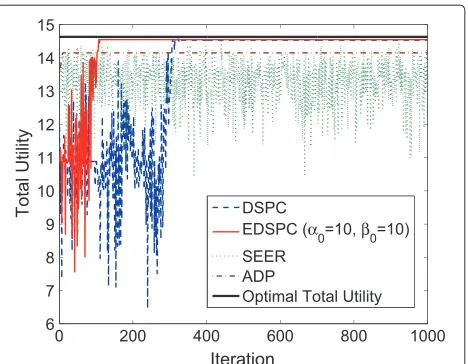
Figure 5 shows how the total utility in the EDSPC algo-rithm converges over time, when we choose all the initial
Figure 5Convergence performance of DSPC, EDSPC, SEER, and ADP.
penalty values equal to 10. Also, we chooseξ =0.9,ρ=1,
and = 1, and use Algorithm 1 as a benchmark to
eval-uate the optimal performance. As shown in Figure 5, the EDSPC algorithm approaches the optimal utility, when the initial penalty values are carefully chosen. Moreover, the convergence rate of the EDSPC algorithm is much faster than DSPC, since DSPC continues updating the penalty values even after the optimal solution is found for the current penalty values. Figure 6 illustrates the average performance (with confidence interval) of DSPC, EDSPC, SEER, and ADP under 100 random initializations, with the same system parameters as used in Figure 5. As shown in Figure 6, both DSPC and EDSPC are robust against the variations of initial values.
Figures 5 and 6 compare the proposed algorithms with the SEER and ADP. As mentioned in Section “Introduc-tion”, ADP can only guarantee local optimality. There-fore, for nonconvex problems (e.g., in this example), ADP may converge to a suboptimal solution. As noted in [15], the performance of SEER heavily hinges on the control parameter that can be challenging to choose in online
DSPC EDSPC SEER ADP
0 5 10 15 20
Total Utility
operation. In contrast, DSPC can approach the glob-ally optimal solution regardless of the initial parameter selection, but the convergence rate may be slower. Fur-thermore, EDSPC improves the convergence rate, but in this case the initial penalty values would impact how close it can approach the optimal point. In terms of message passing, our algorithms do not require individual links to know the channel gains (including its own channel gain), the receiver SINR of the other links and the signal power of the other links, which are all needed in the SEER algorithm.
Joint scheduling and power control for stability of queueing systems
In Section “Power control for unicast communications”, we studied the distributed power allocation, by using DSPC and EDSPC, for utility maximization in the sat-urated case with uninterrupted packet traffic. In this section, we generalize the study by considering a queue-ing system with dynamic packet arrivals and departures. Specifically, we develop a joint scheduling and power allo-cation policy to stabilize packet queues by integrating our power control algorithms with the celebrated back-pressure algorithm [20].
Stability region and throughput optimal power allocation policy
Consider the same wireless network model withL links
as in Section “Power control for unicast communications”.
We assume that there are S classes of users in the
sys-tem, and that the traffic brought by users of classsfollows {Asl(t)}∞t=1, which arei.i.d.sequences of random variables for alll =1,. . .,Lands =1,. . .,S, whereAsl(t)denotes
the amount of traffic generated by users of class s that
enters the link l in slot t. We assume that the second
moments of the arrival process{Asl(t)}∞t=1are finite. Let
QsT(l)(t) andQsR(l)(t) denote the current backlog in the queue of classsin slotton the transmitter and receiver sides of link l, respectively. The queue length QsT(l)(t)
evolves over time as
QsT(l)(t+1)=max(QsT(l)(t)−rsl(t), 0)+Asl(t)
+
{m|T(l)=R(m),m∈L}
rsm(t), (10)
wherersl(t)denotes the transmission rate of linklfor users of classs. The third term in (10) denotes the traffic from the other links. The queue length process {QsT(l)(t)}∞t=1
forms a Markov chain.
Letψs denote the first moment of {Asl(t)}∞t=1, i.e., the load brought by users of classs. As is standard [20,21,28], the stability region is defined as follows.
Definition 1.The stability region is the closure of the set of all{ψs}Ss=1for which there exists some feasible power allocation policy under which the system is stable, i.e., = p∈P(p), where(p) = {{ψs}Ss=1|
S
s=1Eslψs < rl(p),∀l}, P denotes the set of feasible power allocation, rl(p) denotes the rate of link l under power allocationp, and Esl=1is the indicator that the path of users of class s uses link l, and Esl=0, otherwise.
For the sake of comparison, the throughput regioniFof the corresponding saturated case is defined as the set of all feasible link rates, i.e.,F = {r|rl = rl(p),p ∈ P}. In
general, the throughput regionF may be different from
the stability region, except for some special cases (e.g., in slotted ALOHA systems the throughput region and the stability region are the same [29] for two links and in a multiple-access channel the information theoretic capac-ity region is equivalent to its stabilcapac-ity region under specific feedback assumptions [30]).
The queueing system is stable if the arrival rates of packet queues are less than the service rates such that the queue lengths do not grow to infinity [31]. In order to stabilize packet queues, it is critical to find the optimal scheduling and power allocation policy that maximizes the weighted sum rate given by (11). By integrating our power control algorithms with the back-pressure algo-rithm, we propose a joint scheduling and power allocation policy presented in Algorithm 4 to stabilize the queueing system.
Proposition 3.The joint scheduling and power allocation policy (Algorithm 4) can stabilize the system such that
lim supt→∞1ttτ−=10l,sE{Qsl(τ )} < ∞, when the traffic load{ψs}Ss=1is strictly interior to the stability region, i.e., there exists some >0such that{ψs+}Ss=1∈.
The proof is similar to that in [21,32], and is omitted for brevity.
Note that Algorithm 4 can be viewed as a dynamic back-pressure and resource allocation policy [32], crafted towards solving the weighted sum rate maximization problem (11). Specifically, by using the DSPC algorithm, Algorithm 4 can be implemented distributively to find the globally optimal resource allocation. We should caution that EDSPC can be applied to improve the convergence rate of Stage 2 in Algorithm 4 but it may render a subop-timal schedule (i.e., it can not stabilize all possible{ψs}Ss=1
within), due to the fact that EDSPC may not always find
the global optimal power allocation.
Algorithm 4 Joint scheduling and power allocation policy Stage 1: For each linkl, select a link weight according to wl(t) = max
s=1,...,SD s
l(t), where the difference of queue lengths of class sisDsl(t) = max(QsT(l)(t)−QsR(l)(t), 0), if the receiver of linkl is not the destination of classs’s traffic, andDsl(t)=QsT(l), otherwise.
Stage 2: Compute the optimal power allocation p∗ in
each slott by solving the following problem with DSPC
algorithm
p∗=arg max p
L
l=1
wl(t)rl(p). (11)
Thus, the transmission rate of linklin slottis given by
rl(p∗)=log(1+γl(p∗)). Stage 3:Lets∗l =arg max
s=1,...,SDsl(t)denote the class sched-uled in slott; if multiple classes satisfy this condition, then
s∗l is randomly chosen as one of these classes. Then, sched-ule these classes according to the solution given by Stage 2.
Performance evaluation
In this section, we present numerical results to illustrate the use of Algorithm 4 for stabilizing a queueing system. We consider a one-hop network (i.e.,E= {Esl}is the iden-tity matrix) with two users (classes), where the channel gains areh11 =0.3,h12=0.5,h21 =0.03, andh22= 0.8, and the noise power is 0.1 for each link. The maximum transmission power is set to 1 and 2 for links 1 and 2, respectively. Besides, we assume that the users of classs
arrive at the network according to a Poisson process with rateλs, and that the size of packet batch for users of class s follows an exponential distribution with meanνs. The load brought by users of classsis thenψs=λsνs. Figure 7
Figure 7Comparison of the stability region and the throughput region.
shows the stability region and compares it with the
throughput regionFof the corresponding saturated case.
The stability region follows from the union of link rates that are conditioned on whether the other link is back-logged or not [29,30]. First, we derive the stability region for the given power allocation. Then, we vary power allo-cation in the feasible region, and by taking the envelope of these regions, we obtain the overall stability region shown in Figure 7. However, different from the previous cases, where the throughput region is the same as the stability region, e.g., in a slotted ALOHA system with two links [29] and in a multiple-access channel [30], the
through-put region F under the SINR model is strictly smaller
than the stability region (due to the underlying noncon-vex optimization problem), as observed from Figure 7, which is the convex hull ofF, i.e.,Co(F), achievable by timesharing across different transmission modes.j
Then, we vary the arrival rateλand the average batch
sizeν to change the traffic intensityψ = λν. Assuming
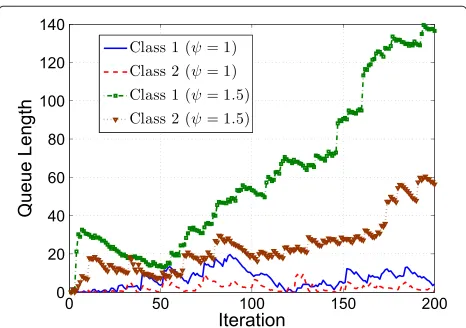
that the arrival rate and the average batch size of each user are the same, we compare in Figure 8 the sample paths
of each user’s queue length forψ = 1 (λ = 1,ν = 1)
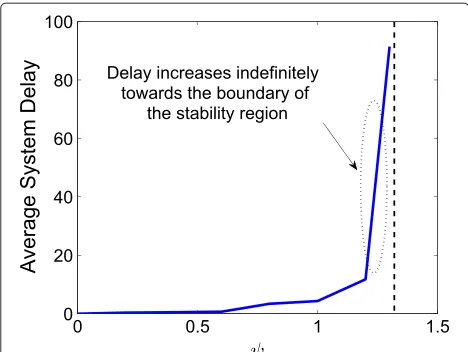
with ψ = 1.5 (λ = 1.5, ν = 1). Whenψ = 1, which
falls in the stability region shown in Figure 7, the system is stabilized by using Algorithm 4. On the other hand, the
system becomes unstable whenψ =1.5, which is outside
the stability region. Figure 9 illustrates the average delay of the system as a function of the arrival rates. The delay is finite for small loads and grows unbounded when the loads are outside the stability region.
Power control for multicast communications Due to wireless multicast advantage [23], multicasting enables efficient data delivery to multiple recipients with a single transmission. In this section, we extend the DSPC
Figure 9Average delay of the system versus system loads .
algorithms in Section “Power control for unicast commu-nications” to support multicast communications.
System model
Beyond the model described in Section “Power control for unicast communications”, we consider that each user
lhas one transmitter and a setMlof receivers. The
cor-responding transmission rate, rl, is determined by the
bottleneck link among these transmitter–receiver pairs, i.e.,rl= min
m∈Mlrlm, whererlmdenotes the link rate between the transmitter of userland its receiverm, and it is calcu-lated from the Shannon rate log(1+γlm(p))for Gaussian, flat fading channels. Here, we do not consider the general broadcast capacity region but rather focus on maximizing the bottleneck link rates.
Network utility maximization
We seek to find the optimal power allocation p∗ that
maximizes the overall system utility subject to the power constraints in multicast communications, as follows:
maximize
l∈L Ul(rl)
subject to rl= min
m∈Mlrlm,∀l∈L
rlm=log(1+γlm(p)),∀l∈L,m∈Ml 0≤pl ≤Pmaxl ,∀l∈L
variables {p,{rl},{rlm}}.
(12)
Similar to (2), (12) is nonconvex due to the complicated interference coupling between individual links. Different from the techniques used in Section “Power control for
unicast communications”, we relaxrl = min
m∈Mlrlm in (12) asrl ≤ log(1+γlm(p)),∀l ∈ L,m ∈ Ml, in order to
devise distributed algorithms solving (12). Thus, (12) can be rewritten as
maximize
l∈L Ul(rl)
subject to rl≤log(1+γlm(p)),∀l∈L,m∈Ml 0≤pl≤Pmaxl ,∀l∈L
variables {p,r}.
(13)
Distributed global optimization algorithms
We develop next distributed algorithms that can find the globally optimal solutions to (13) based on EDT and SA. To this end, we first rewrite the optimization problem (13) as
minimize −
l∈L Ul(rl)
subject to rl ≤log(1+γlm(p)),∀l∈L,m∈Ml 0≤pl≤Pmaxl ,∀l∈L
variables {p,r}.
(14)
Next, we use EDT to write the Lagrangian function for (14) as
L(p,r,{αlm})= −
l∈L Ul(rl)
+
l∈L,m∈Ml
αlm(rl−log(1+γlm(p)))+, (15)
where αlm ∈ Rare the penalty multipliers. From EDT,
there exist finiteαlm∗ ≥0 for alll∈L,m∈Mlsuch that, for anyαlm> α∗lm,∀l∈L,m∈Ml, the solution to (15) is the same as (14) [17]. Note that (15) does not include the constraint ofpl for each user. Therefore, there will be no constraint violation when each user updates the transmis-sion power locally, while minimizing (15) in a distributed operation.
As in Section “Power control for unicast communica-tions”, the key step is to let each user perform a local stochastic search based on SA. Letrl andpl denote the primal values of thelth user, andrldenote the new value randomly chosen by thelth user, which is treated as a new target transmission rate for thelth user. Different from the unicast communications case, thelth user updatesplby
pl=min
⎛ ⎝ er
l−1
min m∈Mlγlm
pl,Pmaxl ⎞
⎠, (16)
whereγlm is the current SINR measured at the receiver
mof user l. Note that (16) does not need any
γlmfrom the intended receivers. Since (16) is in standard form as described in [27], it converges geometrically fast to the target transmission rate. The steps to updaterland
αlm are similar to DSPC Algorithm 2 in Section “Power
control for unicast communications”. Note that the tar-get transmission raterlmay not be feasible, i.e., the target utility cannot be achieved even though the user trans-mits at the maximum power. In this case, it can be shown that the power of those users with feasible target trans-mission rates will converge to a feasible solution, whereas the other users that cannot achieve the target transmis-sion rate will continue to transmit at maximum power [1]. A detailed description of DSPC algorithm for multicast communications is presented in Algorithm 5.
Remarks. In Algorithm 5, each user randomly picksrl ∈
[ 0,rlmax], whererlmax = min m∈Mlr
max
lm , andrmaxlm is the
max-imum link rate between the transmitter of the userland
its receiverm, when the userltransmits at the maximum power while the other users do not transmit.
Proposition 4. The DSPC algorithm for multicast com-munications (Algorithm 5) converges almost surely to a globally optimal solution to (13), as temperature T in SA approaches zero.
Proof. The proof is based on EDT and SA arguments, and follows similar steps used in the proof of Proposition 2, and it is omitted here for brevity.
To improve the convergence rate, we also propose an enhanced algorithm for Algorithm 5 by empirically choos-ing the initial penalty values and employchoos-ing a geometric cooling schedule. The resulting algorithm is given in Algo-rithm 6. Similar to the unicast case, AlgoAlgo-rithms 5 and 6 do not need any knowledge of channel information (or the bottleneck link) and they are dynamically updated by the SINR feedback from the intended receivers.
Algorithm 5 DSPC for multicast communications
Initialization: Choose >0. Letαlm = 0,∀l ∈ L,m ∈
Mland randomly chooserandp.
Step 1: update primal variables
Set T = T0, and select a sequence of time epochs
{τ1,τ2,. . .}in continuous time. Repeat for each userl
1. Randomly pickrl∈[ 0,rmaxl ], and updateplaccording to (16).
2. Keep sensing the change of
m∈Mlαlm(rl−log(1+γlm(p)))
+broadcast by other
users.
3. Letbe the difference betweenL(p,rl|r−l,{αlm}) andL(p,rl|r−l,{αlm}), and acceptrlandplwith probability 1, if≥0, or with probabilityexp(T), otherwise.
4. BroadcastUl(rl), ifrlis accepted.
5. For each time epochτi, updateT =T0/log(i+1).
UntilT < .
Step 2: update penalty variables For each userl,
1. Updateαlm←αlm+ lm(rl−log(1+γlm(p)))+, and scale downαlm, if the condition of penalty decrease is satisfied.
2. Go to Step 1 until no constraint is violated.
Algorithm 6 EDSPC for multicast communications
Initialization: Choose >0. Letαlm=αlm0 ,∀l∈L,m∈
Mland randomly chooserandp.
Set T = T0, and select a sequence of time epochs
{τ1,τ2,. . .}in continuous time.
Repeat for each userl
1. Randomly pickrl∈[ 0,rmaxl ], and updateplaccording to (16).
2. Keep sensing the change of
m∈Ml
αlm(rl−log(1+γlm(p)))+broadcast by other users.
3. Letbe the difference betweenL(p,rl|r−l,{αlm}) andL(p,rl|r−l,{αlm}), and acceptrlandplwith probability 1, if≥0, or with probabilityexp(T), otherwise.
4. BroadcastUl(rl), ifrlis accepted. 5. For each time epochτi, updateT =ξT.
UntilT < .
Performance evaluation
In this section, we evaluate the performance of Algo-rithms 5 and 6 for multicast communications. We con-sider a wireless network with four transmitters and each transmitter has two receivers. These transmitters and
receivers are randomly placed on a 10-by-10 m2 square
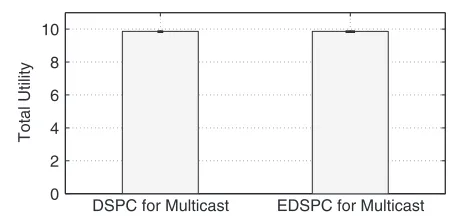
area. The channel gainshlm are equal tod−lm4, wheredlm represents the distance between the transmitterland the receiverm. The channel gainshlmare equal tod−lm4, where dlmrepresents the distance between the transmitterland the receiver m. We assumeUl(rl) = rl,Pmaxl = 1, and nlm=10−4for alll∈Landm∈Ml. Figure 10 illustrates the fast convergence performance of Algorithms 5 and 6
in multicast communications.k Besides, we examine the
0 100 200 300 400 500 2
4 6 8 10
Iteration
Total Utility
DSPC for Multicast EDSPC for Multicast
Figure 10Convergence performance of DSPC and EDSPC for multicast communications, whereα0lm=20,∀l∈L,m∈Ml.
the case shown in Figure 10. As illustrated in Figure 11, both Algorithms 5 and 6 are robust against the initial value variations.
Conclusion
We studied the distributed power control problem of optimizing the system utility as a function of the achiev-able rates in wireless ad hoc networks. Based on the observation that the global optimum lies on the bound-ary of the feasible region for unicast communications, we focused on the equivalent but more structured prob-lem in the form of maximizing the minimum weighted utility. Appealing to EDT, we decomposed the minimum weighted utility maximization problem into subproblems by using penalty multipliers for constraint violations. We then proposed a DSPC algorithm to seek a globally opti-mal solution, where each user stochastically announces its target utility to improve the total system utility via SA. In spite of the nonconvexity of the underlying problem, the DSPC algorithm can guarantee global optimality, but only with a slow convergence rate. Therefore, we proposed an EDSPC to improve the convergence rate with geomet-ric cooling schedule in SA. We then compared DSPC and
DSPC for Multicast EDSPC for Multicast 0
2 4 6 8 10
Total Utility
Figure 11Comparison of average performance (with confidence interval) of DSPC and EDSPC for multicast.
EDSPC with the existing power control algorithms and verified the optimality and complexity reduction.
Next, we proposed the joint scheduling and power allocation policy for queueing systems by integrating our distributed power control algorithms with the back-pressure algorithm. The stability region was evaluated, which is shown to be strictly greater than the throughput region in the corresponding saturated case. Beyond uni-cast communications, we generalized our power control algorithms to multicast communications by jointly maxi-mizing the minimum rates on bottleneck links in different multicast groups. Our DSPC approach guarantees global optimality without the need of channel information, while reducing the computation complexity, in general systems with unicast and multicast communications, and applies to both backlogged and random traffic patterns.
Endnotes
a We use the terms “user” and “link” interchangeably
throughout the article.
bWe use bold symbols (e.g.,p) to denote vectors and
cal-ligraphic symbols (e.g.,L) to denote sets.
cThe QoS constraint for each link can be incorporated in
(2), and the proposed algorithms in the following section can easily be adapted to this case at the cost of added nota-tional complexity.
dFor some special utility functionsU
l(·), (2) can be trans-formed into a convex problem [3]. In this article, we focus on the nonconvex case that cannot be transformed to a convex problem by change of variables.
e The local optimal solution found by ADP matches the
globally optimal solution only in one of the cases that are illustrated in Table 2.
f By definition, a functionf : Rn → Ris quasi-convex,
if its domaindomf and all its sublevel sets Sc = {x ∈ domf|f(x)≤c}, forc∈R, are convex [26].
g A power control algorithm is of standard form, if the
interference function (the effective interference each link must overcome) is positive, monotonic and scalable in power allocation [27].
hThe geometric cooling schedule is employed to
acceler-ate the convergence racceler-ate of DSPC in the simulation. DSPC updates penalty values until they satisfy the threshold-based optimality condition.
i Note that the feasible utility region F defined in
Section “Power control for unicast communications” is the throughput region, when the utility function is the same as the rate function.
j The transmission mode is defined as the transmission
rate pair within the throughput regionF.
k The other existing algorithms have specifically been
Competing interests
The authors declare that they have no competing interests.
Acknowledgements
This study was supported in part by the DoD MURI Project FA9550-09-1-0643 and the AFOSR grants FA9550-10-C-0026 and FA9550-11-C-0006.
Author details
1School of ECEE, Arizona State University, Tempe, AZ 85287, USA.2Intelligent
Automation, Inc., Rockville, MD 20855, USA.
Received: 15 February 2012 Accepted: 4 July 2012 Published: 24 July 2012
References
1. M Chiang, P Hande, T Lan, CW Tan, Power control in wireless cellular networks. Found. Trends Netw.2(4), 381–553 (2008)
2. D Julian, M Chiang, D O’Neill, S Boyd, Qos and fairness constrained convex optimization of resource allocation for wireless cellular and ad hoc networks. inProc. IEEE INFOCOM,vol. 2 (New York, USA, 2002), pp. 477–486 3. M Chiang, CW Tan, D Palomar, D O’Neill, D Julian, Power control by
geometric programming. IEEE Trans. Wirel. Commun.1(7), 2640–2651 (2007)
4. M Xiao, NB Shroff, EKP Chong, A utility-based power control scheme in wireless cellular systems. IEEE/ACM Trans. Netw.11(2), 210–221 (2003) 5. Z-Q Luo, S Zhang, Dynamic spectrum management: complexity and
duality. IEEE J. Sel. Topics Signal Process.2(1), 57–73 (2008) 6. J Huang, R Berry, M Honig, Distributed interference compensation for
wireless networks. IEEE J. Sel. Areas Commun.24(5), 1074–1084 (2006) 7. P Hande, S Rangan, M Chiang, X Wu, Distributed uplink power control for
optimal SIR assignment in celluar data networks. IEEE/ACM Trans. Netw.
16(6), 1420–1433 (2008)
8. J Papandriopoulos, S Dey, J Evans, Optimal and distributed protocols for cross-layer design of physical and transport layers in MANETs. IEEE/ACM Trans. Netw.16(6), 1392–1405 (2008)
9. J Papandriopoulos, JS Evans, SCALE: a low-complexity distributed protocol for spectrum balancing in multiuser DSL networks. IEEE Trans. Inf. Theory.55(8), 3711–3724 (2009)
10. CU Saraydar, NB Mandayam, DJ Goodman, Efficient power control via pricing in wireless data networks. IEEE Trans. Commun.50(2), 291–303 (2002)
11. T Alpcan, T Basar, R Srikant, E Altman, Wirel. Netw.8(6), 659–670 (2002) 12. Y Xu, T Le-Ngoc, S Panigrahi, Global concave minimization for optimal
spectrum balancing in multi-user DSL networks. IEEE Trans. Signal Process.56(7), 2875–2885 (2008)
13. R Horst, H Tuy,Global Optimization—Deterministic Approaches(Springer, New York, 2006)
14. L Qian, YJ Zhang, J Huang, MAPEL: achieving global optimality for a non-convex power control problem. IEEE Trans. Wirel. Commun.8(3), 1553–1563 (2009)
15. L Qian, YJ Zhang, M Chiang, Globally optimal distributed power control for nonconcave utility maximization. inProc. IEEE GLOBECOM(Miami, USA, 2010), pp. 1–6
16. S Geman, D Geman, Stochastic relaxation, Gibbs distributions, and the Bayesian restoration of images. IEEE Trans. Pattern Anal. Mach. Intell.6(6), 721–741 (1984)
17. Y Chen, M Chen, Extended duality for nonlinear programming. Comput. Optim. Appl.47(1), 33–59 (2010)
18. S Kirkpatrick, CD Gelatt, JMP Vecchi, Optimization by simulated annealing. Science.220(4598), 671–680 (1983)
19. B Hajek, Cooling schedules for optimal annealing. Math. Oper. Res.13(2), 311–329 (1988)
20. L Tassiulas, A Ephremides, Stability properties of constrained queueing systems and scheduling policies for maximum throughput in multihop radio networks. IEEE Trans. Autom. Control.37(12), 1936–1948 (1992) 21. MJ Neely, E Modiano, CE Rohrs, Dynamic power allocation and routing for
time varying wireless networks. IEEE J. Sel. Areas Commun.23(1), 89–103 (2005)
22. H-W Lee, E Modiano, LB Le, Distributed throughput maximization in wireless networks via random power allocation. IEEE Trans. Mob. Comput.
11(4), 577–590 (2011)
23. JE Wieselthier, GD Nguyen, A Ephremides, On construction of energy-efficient broadcast and multicast trees in wireless networks. in Proc. IEEE INFOCOM,vol. 2 (Tel Aviv, Israel, 2000), pp. 585–594 24. K Wang, CF Chiasserini, JG Proakis, RR Rao, Joint scheduling and power
control supporting multicasting in wireless ad hoc networks.4(4), 532–546 (2006). Ad Hoc Netw
25. J Mo, J Walrand, Fair end-to-end window-based congestion control. IEEE/ACM Trans. Netw.8(5), 556–567 (2000)
26. S Boyd, L Vandenberghe,Convex Optimization(Cambridge University Press, Cambridge, UK, 2004)
27. RD Yates, A framework for uplink power control in cellular radio systems. IEEE J. Sel. Areas Commun.13(7), 1341–1347 (1995)
28. X Lin, NB Shroff, R Srikant, On the connection-level stability of congestion-controlled communication networks. IEEE Trans. Inf. Theory.
54(5), 2317–2338 (2008)
29. R Rao, A Ephremides, On the stability of interacting queues in a multiple-access system. IEEE Trans. Inf. Theory.34(5), 918–930 (1988) 30. A ParandehGheibi, M Medard, A Ozdaglar, A Eryilmaz, Information theory
vs. queueing theory for resource allocation in multiple access channels. in Proc. IEEE Pers. Ind. Mob. Radio Commun(Nice, France, 2008), pp. 1–5 31. R Loynes, The stability of a queue with non-interdependent inter-arrival
and service times. Proc. Camb. Philos. Soc.58, 497–520 (1962) 32. L Georgiadis, MJ Neely, L Tassiulas, Resource allocation and cross-layer
control in wireless networks. Found. Trends Netw.1(1), 1–149 (2006) 33. P Chaporkar, S Sarkar, Stable scheduling policies for maximizing
throughput in generalized constrained queueing systems. IEEE Trans. Autom. Control.53(8), 1913–1931 (2008)
34. Y Yi, J Zhang, M Chiang, Delay and effective throughput of wireless scheduling in heavy traffic regimes: vacation model for complexity. in Proc. ACM Mobihoc(New York, USA, 2009), pp. 55–64
doi:10.1186/1687-1499-2012-231
Cite this article as:Yanget al.:Distributed stochastic power control in ad hoc networks: a nonconvex optimization case.EURASIP Journal on Wireless Communications and Networking20122012:231.
Submit your manuscript to a
journal and benefi t from:
7Convenient online submission 7Rigorous peer review
7Immediate publication on acceptance 7Open access: articles freely available online 7High visibility within the fi eld
7Retaining the copyright to your article