R E S E A R C H
Open Access
Time domain equalization method for
TS-OFDM signal under higher mobile
environments
Pongsathorn Reangsuntea
1*†, Pisit Boonsrimuang
2, Kazuo Mori
1and Hideo Kobayashi
1†Abstract
In higher time-varying fading channels, the signal quality of orthogonal frequency division multiplexing (OFDM) technique would be degraded relatively due to the occurrence of inter-carrier interference (ICI). To solve this problem, this paper firstly proposes a new design of time domain training sequence (TS) in the estimation of channel impulse response (CIR) for the TS-OFDM signal which can reduce the leakage of power spectrum density (PSD) at the outside of OFDM allocated frequency bandwidth with keeping higher CIR estimation accuracy. Secondly, this paper proposes a time domain equalization (TDE) method which can achieve better bit error rate (BER) performance with keeping lower computation complexity even in higher time-varying fading channels. The salient feature of the proposed TDE method is to employ a partial differentiation for the time domain CIR matrix for solving the maximum likelihood (ML) equation in which the time domain CIR matrix becomes a symmetric banded matrix. From this feature, a
low-complexity parallel block inverse matrix algorithm can be employed in the calculation of inverse matrix in keeping the same accuracy as that of the direct inverse matrix calculation. This paper presents various computer simulation results to demonstrate the effectiveness of the proposed TDE method for the TS-OFDM signal as compared with conventional frequency domain equalization (FDE) methods under higher mobile environments.
Keywords: TS-OFDM, Time domain equalization (TDE), Inter-carrier interference (ICI), Time-varying fading channels
1 Introduction
Orthogonal frequency division multiplexing (OFDM) has been employed as an efficient transmission tech-nique in various wireless communications systems which require the reliable high data rate communications in the frequency-selective multipath fading channels [1]. Up to today, OFDM has been adopted as the standard transmis-sion technique in the digital audio broadcasting (DAB), digital video broadcasting (DVB), wireless local area net-work (WLAN), and the fourth-generation (4G) cellular systems [2]. The salient feature of OFDM technique is to employ the guard interval (GI) for avoiding the inter-symbol interference (ISI) with keeping the orthogonal-ity among OFDM subcarriers even in multipath fading channels. To realize the property of this function, the
*Correspondence: [email protected] †Equal contributor
1Department of Systems Engineering, Graduate School of Engineering, Mie
University, 514-8507 Mie, Japan
Full list of author information is available at the end of the article
cyclic prefix OFDM (CP-OFDM), zero padding OFDM (ZP-OFDM), and time domain training sequence inserted OFDM (TS-OFDM) techniques were proposed in the transmission of OFDM signal [3]. The CP-OFDM employs the cyclic prefix (CP) as the role of GI to avoid the ISI. The ZP-OFDM employs the zero padding between OFDM data symbols as the GI which enables the reduc-tion of transmission power. The TS-OFDM employs the pre-designed time domain training sequence such as a pseudo-noise (PN) sequence [4] or Chu sequence [5] as the GI besides being used in the channel estimation.
In the OFDM signal under the static or lower mobile environments, the channel impulse response (CIR) can be assumed to be the time-invariant within one OFDM sym-bol period. From this fact, the simple frequency domain equalization (FDE) method with one-tap filter can be used to compensate the distortion of multipath fading. However, the CIR is no more constant even within one OFDM symbol period in higher time-varying fading chan-nels which are experienced by the users on the high speed
trains or vehicles. In higher time-varying fading chan-nels, the orthogonality among OFDM subcarriers is no more satisfied which leads to the fatal degradation of bit error rate (BER) performance due to the occurrence of inevitable inter-carrier interference (ICI) caused by the higher Doppler frequency spread [6].
To solve the above problem, many frequency domain equalization methods were proposed to mitigate the ICI in higher time-varying channels [7–14]. These methods are designated as the frequency domain equalization (FDE) in which the equalization processing for the mitigation of ICI is conducted in the frequency domain. In [7, 8], the ICI self-cancellation methods were proposed to mitigate ICI at the cost of degradation in the transmission data rate. In [9], the FDE method with the minimum mean square error (MMSE-FDE) and successive interference cancella-tion (SIC) equalizacancella-tion methods were proposed for the CP-OFDM signal. These methods are required to employ the direct inverse matrix calculation for the channel fre-quency response (CFR) matrix in solving the simultane-ous equations. However, the computation complexity for the inverse matrix calculation required at every symbol is relatively higher which leads to a serious problem in the implementation of practical receiver. To solve this prob-lem, [10] proposed a low-complexity MMSE-FDE method for CP-OFDM signal with the parallel block inverse matrix algorithm in the calculation of inverse matrix [15]. In this method, the full elements of CFR matrix is approximated by a banded matrix so as to enable the employment of parallel block inverse matrix algorithm. However, the BER performance would be degraded in higher time-varying fading channels due to the approximation for the full elements of CFR matrix by the banded matrix. In [11], the fast sub-optimal FAST-MMSE-FDE method was pro-posed for the ZP-OFDM signal under the assumption of perfect channel knowledge. Although this method can achieve lower complexity by assuming the linear changing of CIR within one OFDM symbol period, it has a difficulty to estimate the CFR matrix precisely by using the pilot subcarriers in the frequency domain because the received pilot subcarriers are also affected by the ICI in higher time-varying fading channels [12].
To solve the above problem on the CFR estimation by using the pilot subcarriers for the CP-OFDM and ZP-OFDM signals in higher time-varying fading chan-nels, a PN time domain sequence is employed as the TS in the estimation of CFR as well as the role of GI for the TS-OFDM signal [13]. In [13], since an over-lap and add frequency domain equalization (OLA-FDE) method is employed, the property of circular convolu-tion is no more satisfied in higher time-varying fading channels which leads to the fatal degradation of BER per-formance. In [14], the low-complexity OLA-MMSE-FDE and the FAST-MMSE-FDE methods were proposed for
the TS-OFDM signal. These methods enable the con-siderable reduction of computation complexity by using the Maclaurin’s expansion approximation technique in the calculation of inverse matrix under the assumption that the CIR is changing linearly within one symbol period. However, the approximation of linear changing of CIR is no more effective in higher time-varying fading channels which leads to the degradation of BER performance.
The employment of TS-OFDM signal with the time domain PN or Chu sequence can achieve higher CFR esti-mation accuracy than the CP-OFDM and ZP-OFDM sig-nals of using the pilot subcarriers in higher time-varying fading channels. However, the employment of PN or Chu sequence as the TS would cause the undesirable leakage of power spectrum density (PSD) at the outside of the allo-cated OFDM frequency bandwidth. Because the occupied frequency bandwidth of TS signal would be much wider than the allocated OFDM frequency bandwidth when the TS signal is employed so as to keep the good property of autocorrelation for the PN or Chu sequences which leads to the serious adjacent channel interference prob-lem to other systems [16]. Furthermore, when the same data pattern of PN or Chu sequence is added at every data symbol over one frame, higher power spurious compo-nents would occur at the outside of the allocated OFDM frequency bandwidth due to the repetition of same data pattern of TS signal in the time domain. The leakage of PSD at the outside of OFDM allocated bandwidth would cause the difficulty in the design of transmitter so as to meet the spectral mask requirement for the adjacent chan-nel interference. From this fact, the leakage of PSD must be suppressed when using the TS-OFDM signal.
calculation [15]. These are completely different features from the conventional FDE methods of which CFR matrix is the full elements of matrix. The proposed TDE method can also obtain the frequency diversity gain at the fading deep dips [17] which enables to achieve better BER perfor-mance than the conventional FDE methods of using the CFR matrix as referred above [7–14].
The remainder of this paper is organized as follows. Section 2 firstly proposes a new design of TS signal for the CIR estimation method and secondly proposes the TDE method with the parallel block inverse matrix algo-rithm for the TS-OFDM signal. Section 3 evaluates the overall computation complexity for the proposed TDE method as compared with the various conventional FDE methods. Section 4 presents various computer simulation results to verify the effectiveness of the proposed TDE method for the TS-OFDM signal as compared with var-ious conventional FDE methods for both the CP-OFDM and TS-OFDM signals. Finally, Section 5 draws some conclusions.
2 Proposal of CIR estimation and time domain
equalization methods
This section presents the system model for the pro-posed TDE method and proposes a new design of TS signal by using a time domain triangular window function for the TS-OFDM signal so as to reduce the leakage of PSD. This section also proposes the TDE method of using a low-complexity parallel block inverse matrix algorithm which can achieve better BER perfor-mance than the conventional FDE methods with keeping
lower complexity even in higher time-varying fading channels.
2.1 Proposed TS-OFDM system model
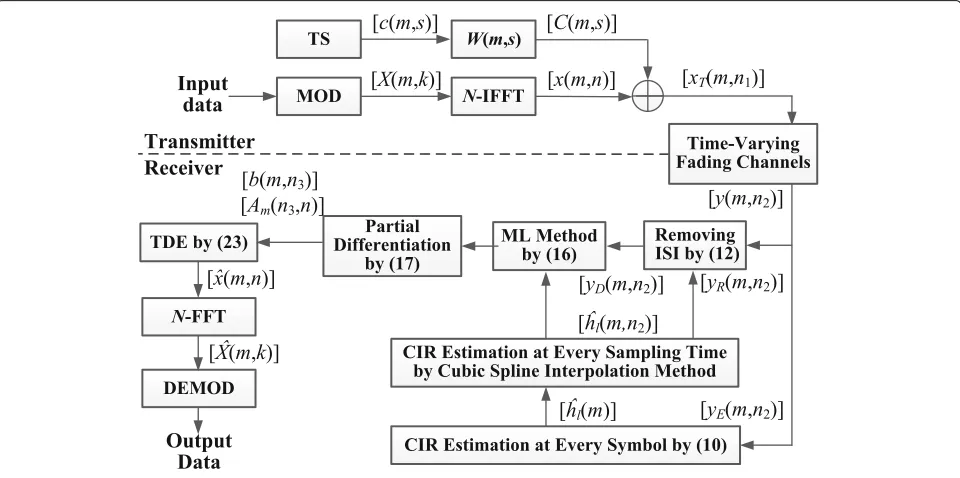
Figure 1 shows the structure of transceiver for the pro-posed TDE method for the TS-OFDM signal. At the transmitter, the input data information is modulated by the phase shift keying (QPSK) or quadrature-amplitude modulation (QAM) method in the frequency domain. The modulated signalX(m,k)at thekth subcar-rier of themth symbol is converted to the time domain signal by N-point inverse fast Fourier transform (IFFT) which can be given by
x(m,n)= √1 N
N−1
k=0
X(m,k)ej2πNnk,
0≤n≤N−1 (1)
where x(m,n) is the transmitted time domain OFDM signal at thenth time sample ofmth symbol.
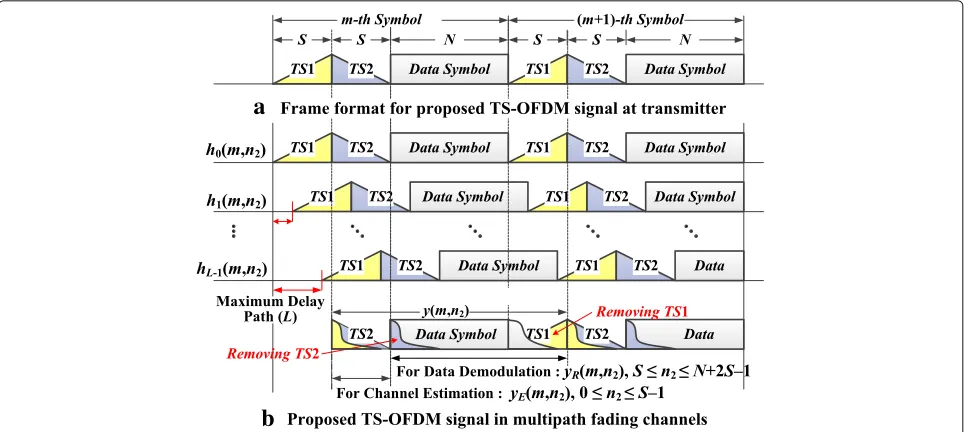
Figure 2a shows the frame format for the proposed TS-OFDM signal with the time domain triangular window function. In the proposed frame format, the time domains TS1 and TS2 with the length of S samples are inserted at the start of every data symbol in which the length of Sshould be taken longer than the number of delay paths (L) occurring in the multipath fading channels. The time domain TS would be used in the estimation of CIR at every sampling time and also used as the role of GI to avoid the inter-symbol interference (ISI).
b
a
Fig. 2Structure of frame format for TS-OFDM signal at transmitter and receiver.aFrame format for proposed TS-OFDM signal at transmitter. bProposed TS-OFDM signal in multipath fading channels
The leakage of power spectrum density (PSD) for the TS-OFDM signal would occur due to the repetition of the same data pattern of TS signal over one frame and also due to the discontinuities at both ends of TS signal in the time domain. To reduce the leakage of PSD due to the rep-etition of the same data pattern of TS signal, this paper employs a different data pattern of TS signal for each data symbol over one frame as shown in Fig. 2a. The different data patterns of TS signals over one frame are generated by using some part of time domain OFDM signal of which occupied bandwidth even when employing some part of OFDM signal is basically the same as that using the time domain OFDM signal. The different data patterns of TS signals which can achieve higher CIR estimation accuracy in the multipath fading channels are selected by using the computer simulation results. In the computer simulations, the TS data patterns having higher CIR estimation accu-racy are selected by changing the randomly generated data patterns of OFDM symbols which are independent from the data pattern of transmission information data sym-bols. It should be noted that the selected data patterns of TS signals can achieve higher CIR estimation accu-racy even when these TS signals are added at the start of random information data symbols. In the implementa-tion of practical systems, all system parameters including the number of data symbols in one frame are known in advance. From this fact, it is possible to prepare the required number of TS data patterns in advance which can achieve higher CIR estimation accuracy by using the computer simulation results.
As for the discontinuities at the both ends of TS signal in the time domain, this paper employs the time domain triangular window function for the TS signal as the wave-form shaping. The window function is commonly used in the digital processing to reduce the leakage of PSD. The triangular window function is one of window func-tions such as the Hamming, Hann (raised cosine) and Blackman windows. It is well known that these window functions can improve the leakage of PSD by shaping the time domain signal by taking zero at both ends of signal of which various window functions are discussed theoretically in [18]. In this paper, we employ the tri-angular window function for the TS signal because of its simpler waveform. By using the proposed TS sig-nals having the different data patterns over one frame in conjunction with the time domain triangular win-dow function, the leakage of PSD could be suppressed relatively.
In this paper, the data pattern for the proposed TS1 and TS2 signals at themth symbol employs the same pattern which is represented byc(m,s). Furthermore, the TS1 and TS2 signals at themth data symbol are multiplied by the time domain triangular window function ofW(s)to sup-press the leakage of PSD as shown in Fig. 1. The time domain triangular window functionW(s)with the length of 2Ssamples is given by
W(s)=
(s+1)/S, 0≤s≤S−1
The proposed TS1 and TS2 signals at the mth data symbol after multiplyingW(s)can be expressed by
C(m,s)= OFDM data symbol which is represented by
xT(m,n1)= the length of N + 2S samples. Assuming that the syn-chronization of symbol timing at the receiver is perfect, the received time domain OFDM signal y(m,n2) at the
n2th sampling time ofmth symbol after passing through the multipath fading channels as shown in Fig. 2b can be expressed by
mth data symbol for thelth delay path occurred in the actual time-varying fading channels,z(m,n2)is the addi-tive white Gaussian noise (AWGN) with the variance of σ2, andLis the number of delay paths. As shown in Figs. 1 and 2b, the received signal y(m,n2) can be divided into two parts which consist of the observation period for the CIR estimation yE(m,n2) with the length of S samples and for the data demodulation periodyR(m,n2)with the length ofP=N+S−1 samples, respectively.
2.2 Proposed CIR estimation method at every sampling time
The received time domain TS2 signalyE(m,n2)which is used in the estimation of CIR at every symbol can be expressed by dow function given in (3). Here, it should be noted that
the CIR is assumed to be constant during the short time period of TS1 and TS2 even in higher time-varying fad-ing channels. Assumfad-inghˆl(m)is the unknown parameter
for the CIR at themth symbol, the expected received time domain TS2 signalyˆE(m,n2)can be given by known at the receiver and the number of delay paths to be estimated is assumed bySof which length is taken by longer than the number of delay pathsLbecause the actual number of delay pathsLis unknown at the receiver. The unknown parameter of CIRhˆl(m)at themth symbol can
be estimated by solving the following maximum likelihood (ML) equation under the constraint for minimizing the difference between the actual received TS signalyE(m,n2) in (6) and the expected received TS signalyˆE(m,n2)in (7)
By using a simple solution of (8) when assuming yE(m,n2) = ˆyE(m,n2), the ML equation in (8) can be represented by the following simultaneous equations.
yE(m,n2)
S×1=[d2(m,n2−l)]S×S[hˆl(m)]S×1 (9) The unknown parameter of CIRhˆl(m)at themth symbol can be solved by the following matrix calculation of using the inverse matrix of [d2(m,n2−l)]S×S. where [·]−1represents the matrix inversion. Since all ele-ments of [d2(m,n2−l)] given in (3) are known at the receiver, the inverse matrix in (10) can be calculated in advance for all different data patterns of TS signals inserted over one frame which enables the considerable reduction of computation complexity in the estimation of CIR at every symbol.
By using the estimatedhˆl(m)at every symbol, the CIR at
2.3 Proposed time domain equalization method
Considering the observation period for the data demod-ulationyR(m,n2) as shown in Fig. 2b, the received time domain data signal can be given by
yR(m,n2)= sampling time in the actual time-varying fading channels. From Fig. 2b, it can be observed that the received signal in (11) includes the ISI fromd2(m,s)(TS2 of current sym-bol) andd1(m+1,s)(TS1 of next symbol). By using the estimated CIR hˆl(m,n2) at every sampling time and the known data pattern of TS1 and TS2 with the time domain triangular window function given in (3), the ISI from the time domain TS at the both ends of data symbol can be removed by using the following equation.
yD(m,n2)=
In the derivation of (12), the following relationships are used. nal after removing the ISI from the TS. The received time domain signalyD(m,n2)over the observation period withP (= N+S−1) samples which includes the time domain data symbol and TS1 after removing the ISI can be used in the proposed TDE. By using the observation period of P samples including the TS signal, the pro-posed TDE method can achieve the frequency diversity gain at the fading deep dips [13] which could achieve bet-ter BER performance than the conventional FDE methods with the observation period ofNsamples both under the quasi-static and higher mobile environments [17].
When the transmitted time domain data signalxˆ(m,n) is assumed as the unknown parameters, the expected received signal yˆD(m,n2) without the ISI which cor-responds to the actual received signal in (12) can be expressed by
The unknown parameter of time domain data sig-nal xˆ(m,n) which corresponds to the transmitted time domain data given in (1) can be estimated by solving the following ML equation under the constraint for min-imizing the difference between the actual received sig-nal yD(m,n2) in (12) and the expected received signal
The ML equation in (16) can be transformed to the simultaneous equations by taking the partial differentia-tion for the unknown parameters xˆ∗(m,n3),(0 ≤ n3 ≤
where (·)∗ represents the conjugate complex. By using (17), the ML equation in (16) can be expressed by the following simultaneous equations withN unknown time domain data information of [xˆ(m,n)].
[b(m,n3)]N×1=[Am(n3,n)]N×N
ˆ
where [b(m,n3)] and [Am(n3,n)] are the received time domain signal and the CIR matrix both after the partial differentiation, respectively, which are given by
[b(m,n3)]N×1=
where(·)His the Hermitian transposition. In the deviation of (19) and (20), the following relationships are used.
n3=n2−S−l in ∂ˆ From (23), the proposed TDE method is required for the inverse matrix calculation which leads relatively higher computation complexity with the order ofO[N3]. To solve this problem, this paper proposes a low-complexity TDE method by using the good property of time domain CIR matrix [Am(n3,n)] given after the partial differentiation.
index of themth symbol is omitted for brevity. From (24), it can be seen that the matrix is the banded matrix with the upper and lower bandwidth (Q1) of length(S− 1)
whose non-zero entries are confined to a diagonal bands. Also the lower band matrix with the index of(j,i)below the diagonal terms is the Hermitian transpose of upper band matrix with index of(i,j). From these features, the CIR matrix [Am(n3,n)] after the partial differentiation becomes the symmetric banded matrix with the block size of(S×S). From this fact, it is possible to employ the low-complexity parallel block inverse matrix algorithm [15] for solving (23). This feature of time domain CIR matrix for the proposed TDE method is completely different from the frequency domain CFR matrix for the conventional FDE methods of which CFR matrix is the full elements of matrix [3, 7–12, 14]. Here it should be noted that although the CFR matrix of the conventional MMSE-FDE method for the CP-OFDM signal is not the banded matrix, it is possible to employ the parallel block inverse matrix algo-rithm by assuming that the elements in the CFR matrix both at the lower and upper sides of diagonal bands are small enough [10]. However, this assumption would be no more effective in higher time-varying fading chan-nels because the elements both at the lower and upper sides of diagonal bands in the CFR matrix are unable to be approximated as the negligible quantity. This means that the conventional MMSE-FDE method with the paral-lel block inverse matrix algorithm in [10] can achieve the reduction of computation complexity at the cost of con-siderable BER degradation in higher time-varying fading channels.
In [15], the parallel block inverse matrix algorithm is proposed for the symmetric banded matrix which can cal-culate the inverse matrix as the same accuracy as that for the direct inverse matrix calculation with much lower computation complexity. The key idea of this algorithm is to construct the small hierarchy of Schur complement blocks and then extracting the inverse matrix of diagonal hierarchy of Schur complement blocks. In (24), the size of small hierarchy of Schur complement blocks is equal to the length of TS (= S). By using this algorithm, the inverse matrix of (24) can be calculated perfectly with the same accuracy as that for the direct inverse matrix cal-culation. The order of computation complexity required in the calculation of inverse matrix for the banded matrix [Am(n3,n)] with the size of(N×N) can be reduced to
O[3NS2] by employing the parallel block inverse matrix algorithm. This complexity is much smaller than that for the direct inverse matrix calculation which requires the complexityO[N3]. The overall computation complexities for the proposed TDE and conventional FDE methods are evaluated in Section 3.
3 Evaluation of computation complexity
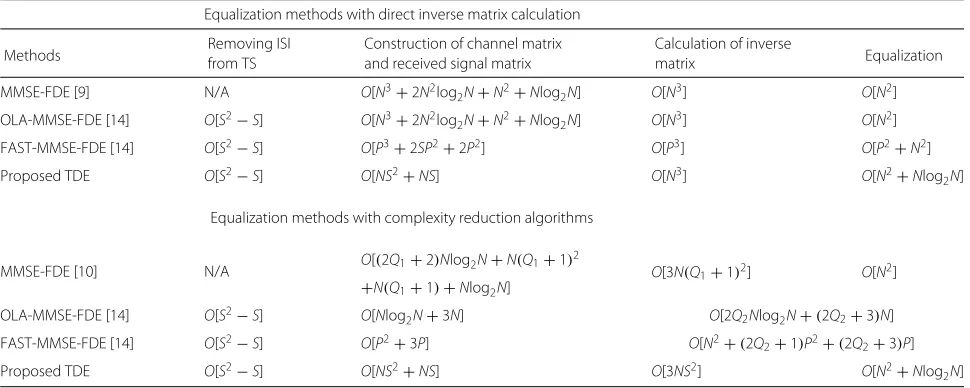
This section evaluates the computation complexity for the proposed TDE method. Table 1 shows the order of com-plexities for the proposed TDE method when using the direct inverse matrix calculation and the low-complexity parallel block inverse matrix algorithm. In the table, the conventional MMSE-FDE method for the CP-OFDM [9, 10], the OLA-MMSE-FDE method for the TS-OFDM, and the FAST-MMSE-FDE method for the TS-OFDM [14] are also shown for the purpose of comparisons with the proposed TDE method.
In the proposed TDE method for the TS-OFDM with the parallel block inverse matrix algorithm, the removal of ISI incurred both ends of data symbol from the TS given in (12) requires the complexityO[S2−S]. The construction of the time domain received signal [b(m,n3)] and the CIR matrix [Am(n3,n)] with the partial differentiation given in (19) and (20) require the complexityO[NS] andO[NS2], respectively. The parallel block inverse matrix algorithm for the symmetric banded matrix [Am(n3,n)] given in (24) requires the complexityO[3NS2] [15]. The multiplication of [Am(n3,n)]−1 and [b(m,n3)] matrixes which corre-sponds to the time domain equalization to obtain the time domain signal [xˆ(m,n)] in (23) requires the complexity O[N2]. Finally,N-point FFT to [xˆ(m,n)] for obtaining the frequency domain data information [Xˆ(m,k)] requires the complexityO[Nlog2N].
In the conventional MMSE-FDE method for the CP-OFDM [10], the CFR matrix is approximated by the banded matrix with the block size (Q1 + 1) × (Q1 + 1), where Q1 is the lower and upper bandwidth of approximated CFR banded matrix. The construction of the approximated banded CFR matrix with the upper
and lower bandwidth of Q1 and the received frequency domain signal matrix including oneN-point FFT require the complexityO[(2Q1+2)Nlog2N+N(Q1+1)2+N(Q1+ 1)+Nlog2N]. The parallel block inverse matrix algorithm for the approximated CFR banded matrix with the band-width of Q1 requires the complexity O
3N(Q1+1)2
. Finally, the frequency domain equalization for obtain-ing the frequency domain data information requires the complexityON2.
In the conventional OLA-MMSE-FDE and FAST-MMSE-FDE methods for the TS-OFDM signals, the Maclaurin’s expansion algorithm is employed for the approximation of inverse matrix calculation [14]. The construction of CFR matrix and the received frequency domain signal matrix for the conventional OLA-MMSE-FDE and FAST-MMSE-OLA-MMSE-FDE methods require the com-plexity O[Nlog2N + 3N] and O[P2 + 3P], respectively. In [14], the order of total complexity both for the inverse matrix calculation with the order of Maclaurin’s expan-sion ofQ2and the equalization in the frequency domain are given by O[2Q2Nlog2N + (2Q2 + 3)N] for the OLA-MMSE-FDE method and O[N2+ (2Q2+ 1)P2 + (2Q2+3)P] for the FAST-MMSE-FDE method, respec-tively. Here it should be noted that the order of com-plexities forN-points FFT (where N is the power of 2) and P-points DFT (where P is not the power of 2) are given byO[N] andO[P], respectively, in [14]. How-ever, these complexities are given by O[Nlog2N] and O[P2], respectively, in this paper. By using Table 1, the comparisons of overall computation complexities between the conventional FDE and proposed TDE meth-ods when assuming the actual parameters are evaluated in Section 4.
Table 1Order of computation complexity for proposed TDE and conventional FDE methods
Equalization methods with direct inverse matrix calculation
Methods Removing ISIfrom TS Construction of channel matrixand received signal matrix Calculation of inversematrix Equalization
MMSE-FDE [9] N/A O[N3+2N2log2N+N2+Nlog2N] O[N3] O[N2]
OLA-MMSE-FDE [14] O[S2−S] O[N3+2N2log2N+N2+Nlog2N] O[N3] O[N2]
FAST-MMSE-FDE [14] O[S2−S] O[P3+2SP2+2P2] O[P3] O[P2+N2]
Proposed TDE O[S2−S] O[NS2+NS] O[N3] O[N2+Nlog2N]
Equalization methods with complexity reduction algorithms
MMSE-FDE [10] N/A O[(2Q1+2)Nlog2N+N(Q1+1)
2
O[3N(Q1+1)2] O[N2] +N(Q1+1)+Nlog2N]
OLA-MMSE-FDE [14] O[S2−S] O[Nlog
2N+3N] O[2Q2Nlog2N+(2Q2+3)N]
FAST-MMSE-FDE [14] O[S2−S] O[P2+3P] O[N2+(2Q
2+1)P2+(2Q2+3)P]
Proposed TDE O[S2−S] O[NS2+NS] O[3NS2] O[N2+Nlog
4 Performance evaluations
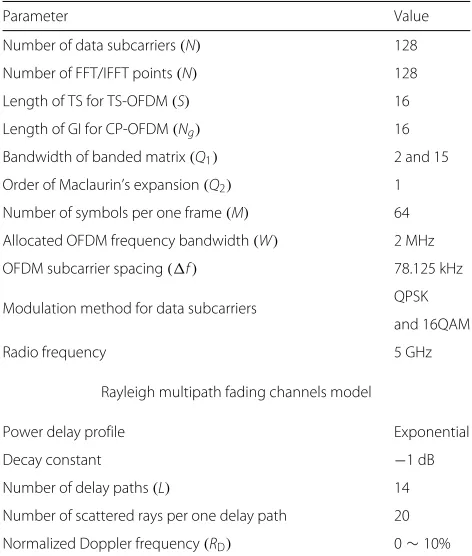
In this section, various computer simulation results are presented for the proposed TDE method as comparing with various conventional FDE methods both for the CP-OFDM and TS-CP-OFDM signals. The simulation parame-ters to be used in the following evaluations are listed in Table 2. In the conventional MMSE-FDE with the parallel block inverse matrix algorithm for the CP-OFDM signal, the CFR matrix is approximated by the banded matrix with the lower and upper bandwidth ofQ1 = 2 as used in [10] and Q1 = 15 which is the same bandwidth for the proposed TDE method with the symmetric banded matrix. In the conventional FDE with the OLA-MMSE-FDE and FAST-MMSE-OLA-MMSE-FDE methods for the TS-OFDM signals, the order of Maclaurin’s expansion in the calcula-tion of inverse matrix is set toQ2=1 as using in [14]. The Rayleigh multipath fading channel is assumed by Jake’s Doppler spectrum model with an exponential power delay profile having the power decay constant−1 dB and the length of delay pathL = 14. The length of TS both for the proposed and conventional TS-OFDM signals is taken by S = 16 so as to be longer than the length of delay path L = 14. In the following evaluations, the normal-ized Doppler frequencyRD = fdmax/f (%)is employed as the measure of mobile environments in whichfdmaxis the maximum Doppler frequency andf is the OFDM subcarrier spacing.
Table 2Simulation parameters
Parameter Value
Number of data subcarriers(N) 128
Number of FFT/IFFT points(N) 128
Length of TS for TS-OFDM(S) 16
Length of GI for CP-OFDM(Ng) 16
Bandwidth of banded matrix(Q1) 2 and 15
Order of Maclaurin’s expansion(Q2) 1
Number of symbols per one frame(M) 64
Allocated OFDM frequency bandwidth(W) 2 MHz
OFDM subcarrier spacing(f) 78.125 kHz
Modulation method for data subcarriers QPSK
and 16QAM
Radio frequency 5 GHz
Rayleigh multipath fading channels model
Power delay profile Exponential
Decay constant −1 dB
Number of delay paths(L) 14
Number of scattered rays per one delay path 20
Normalized Doppler frequency(RD) 0∼10%
Figure 3 shows the comparison of power spectrum den-sity (PSD) at the output of transmitter for the conventional CP-OFDM, the TS-OFDM with the PN sequence, and the proposed TS-OFDM with the new design of TS sig-nal when the modulation method for data subcarriers is QPSK and the oversampling ratio of OFDM transmission signal is taken by four times. From the figure, it can be seen that the PSD for the conventional TS-OFDM with the PN sequence has higher leakage of PSD at the outside of allocated OFDM frequency bandwidth. This is the rea-son that the same data pattern of PN sequence is used for all data symbols over one frame and the time domain PN sequence itself has wider frequency bandwidth as com-pared with that for the conventional CP-OFDM signal. While the PSD for the proposed TS-OFDM of using dif-ferent patterns of TS signals with the triangular window function shows almost the same PSD as that for the con-ventional CP-OFDM signal. From the figure, it can be concluded that the proposed TS-OFDM with the new design of TS signal can be used in the CIR estimation with keeping lower leakage of PSD at the outside of allocated OFDM frequency bandwidth.
Figure 4 shows the CIR estimation accuracy at every sampling time both for the conventional TS-OFDM with the PN sequence and the proposed TS-OFDM with the new design of TS signal when changing the normalized Doppler frequency(RD) and C/N. The CIR estimation accuracy is evaluated by the normalized mean square error (NMSE). Here it should be noted that the estimated CIR at every sampling time is obtained by using the cubic interpolation method for the estimated CIR at every sym-bol. From the figure, it can be observed that the accuracy of estimated CIR at every sampling time for the proposed
Fig. 4CIR estimation accuracy (NMSE) for proposed and conventional TS-OFDM when changing normalized Doppler frequencyRDandC/N
TS signal is almost the same performance as that for the PN sequence. From Figs. 3 and 4, it can be concluded that the estimated CIR of using the proposed new design of TS signal can be used in the removing of ISI by using (12) and the construction of both the received time domain signal matrix [b(m,n3)] and the time domain CIR matrix [Am(n3,n)] by using (19) and (20) precisely with keeping lower leakage of PSD at the outside of OFDM allocated bandwidth even in higher time-varying fading channels.
Figure 5 shows the BER performances of the proposed TDE method for the TS-OFDM signal with the parallel block inverse matrix algorithm when changing the nor-malized Doppler frequency(RD). The modulation method
Fig. 5BER performances versus the normalized Doppler frequencyRD
for proposed TDE and conventional FDE methods with low-complexity reduction algorithms when the modulation method is QPSK andC/N
is 35 dB
is QPSK and theC/Nis 35 dB. In the figure, the conven-tional MMSE-FDE for CP-OFDM of using the approxi-mated banded matrix with the lower and upper bandwidth of Q1 = 2 and Q1 = 15 [10], and the OLA-MMSE-FDE and FAST-MMSE-OLA-MMSE-FDE methods for TS-OFDM with the Maclaurin’s expansion order ofQ2 = 1 [14] are also shown as the purpose of comparisons with the proposed TDE method. In the conventional MMSE-FDE for the CP-OFDM signal, the scattered pilot subcarriers in the frequency domain are usually employed in the estimation of CFR matrix. However, the estimation accuracy of CFR matrix by using the scattered pilot subcarriers would be degraded due to the occurrence of ICI for the received pilot subcarriers in higher time-varying fading channels [12]. From this fact, this paper assumes that the CIR esti-mated by the proposed TS-OFDM signal is employed in the construction of CFR matrix even for the conven-tional MMSE-FDE method for the CP-OFDM signal so as to compare the BER performance with the proposed TDE method fairly under the assumption of same channel estimation accuracy. From the figure, it can be observed that the proposed TDE method for the TS-OFDM sig-nal with the parallel block inverse matrix algorithm shows much better BER performance than the conventional OLA-MMSE-FDE and FAST-MMSE-FDE methods with the Maclaurin’s expansion method [14], and MMSE-FDE method [10] even when the banded matrix is approxi-mated byQ1 = 15. These are the reasons that the chan-nel frequency matrix for the conventional MMSE-FDE method is generated by using the approximated banded matrix and for the OLA-MMSE and FAST-MMSE meth-ods are generated assuming the linear approximation of CIR in the time-varying fading channels. These approxi-mation and assumption would lead to the inevitable error in the calculation of inverse matrix especially in higher time-varying fading channels. Here it should be noted that the BER performance of proposed TDE method with the parallel block inverse matrix algorithm shows the same BER performance as that for using the direct inverse matrix calculation as explained in the sub-section 2.3 of Section 2.
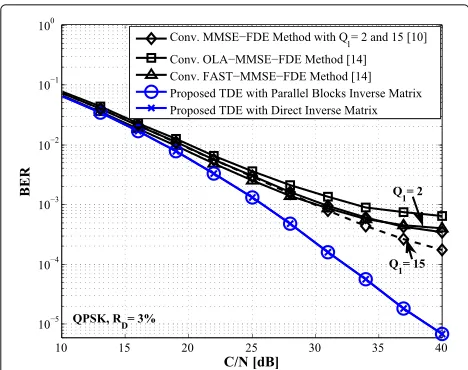
Fig. 6BER performances versusC/Nfor proposed TDE and conventional FDE methods with low-complexity reduction algorithms when the modulation method is QPSK andRDis 3%
Maclaurin’s expansion order ofQ2=1 [14] are also shown as the purpose of comparisons with the proposed TDE method. From Figs. 6 and 7, it can be observed that the proposed method shows much better BER performance than the conventional methods under both lower and higher mobile environments. However, the conventional methods show better BER performance only under lower mobile environments because of employing the approxi-mation in the construction of CFR matrix so as to reduce the computation complexity. The proposed TDE method also shows better BER performance than the conventional MMSE-FDE method even when the banded matrix is approximated byQ1=15 which corresponds to the same computation complexity as the proposed TDE method.
Fig. 7BER performances versusC/Nfor proposed TDE and conventional FDE methods with low-complexity reduction algorithms when the modulation method is QPSK andRDis 10%
Figure 8 shows the BER performances versusC/N for the proposed TDE method when the modulation method is 16QAM and the normalized Doppler frequencyRD is 6% which correspond to the vehicle speed at 200 km/h. From the figure, it can be concluded that the proposed TDE method with the low-complexity parallel block inverse matrix algorithm can achieve much better BER performance than the conventional FDE methods of using the complexity reduction methods even when employing higher efficient modulation method of 16QAM.
Figure 9 shows the overall computation complexities for the conventional FDE methods and proposed TDE method when changing the number of FFT/IFFT points (N). The overall computation complexities include the processing loads for the removing of ISI from the TS, con-struction of channel matrix, calculation of inverse matrix, and equalizations in the frequency and time domains as shown in Table 1. In the complexity evaluations, the lower and upper bandwidth employed in the approximation of banded CFR matrix for the conventional MMSE-FDE are evaluated by Q1 = 2 as using in [10] and Q1 = 15 which corresponds to the same bandwidth as that for the proposed TDE with the parallel block inverse matrix algo-rithm. From the figure, it can be observed that the overall complexities for all methods of using the direct inverse matrix calculation are much higher than that for using the complexity reduction methods especially as increasingN. WhenNis 128, the order of complexity for the conven-tional MMSE-FDE with the parallel block inverse matrix algorithm with Q1 = 15 and the FAST-MMSE-FDE of using the Maclaurin’s expansion method with Q2 = 1 [14] are almost the same complexity as that for the pro-posed TDE method. However, the order of complexity for the conventional MMSE-FDE with Q1 = 2 and the
Fig. 9Comparisons of overall computation complexities for proposed TDE and conventional FDE methods when changingN
OLA-MMSE-FDE with Q2 = 1 are lower than
the proposed TDE with the parallel block inverse matrix algorithm. However, these computation complex-ity reductions for the conventional methods can achieve at the cost of considerable degradation of BER performances as shown in Figs. 5, 6, 7 and 8.
From these results, it can be concluded that the pro-posed TDE method with the parallel block inverse matrix algorithm can achieve much better BER performance than the conventional FDE methods of using the complexity reduction methods with the allowable increase of compu-tation complexity.
5 Conclusions
This paper proposed the time domain equalization (TDE) method for the TS-OFDM signal in higher time-varying fading channels. The salient features of the proposed method are to employ the new design of TS signal in the estimation of CIR at every sampling time and the time domain equalization method of using the paral-lel block inverse matrix algorithm. To demonstrate the effectiveness of the proposed TDE method, this paper conducted various computer simulations. From the sim-ulation results, this paper confirmed that the proposed TS signal can achieve lower leakage of power spectrum density at the outside of allocated OFDM frequency band-width with keeping higher CIR estimation accuracy. This paper also concluded that the proposed TDE method with the parallel block inverse matrix algorithm can achieve much better BER performance than the conventional FDE methods of using the complexity reduction methods with allowable increase of computation complexity in higher time-varying fading channels.
Acknowledgements
The authors would like to thank to the Japanese Government
(Monbukagakusho: MEXT) Scholarships who has supported this research.
Competing interests
The authors declare that they have no competing interests.
Received: 24 March 2016 Accepted: 7 December 2016
References
1. YG Li, GL Stuber,Orthogonal Frequency Division Multiplexing for Wireless Communications. (Springer, Georgia, 2006)
2. JG Proakis, M Salehi,Digital Communications, 5th ed. (McGrawHill, New York, 2008)
3. F Hlawatsch, G Matz,Wireless Communications Over Rapidly Time-Varying Channels. (Academic Press, Vienna, 2011)
4. M Liu, M Crussiere, J Helard, A novel data-aided channel estimation with reduced complexity for TDS-OFDM systems. IEEE Trans. Broadcast.58(2), 247–260 (2012)
5. T Yamamoto, F Adachi, Training sequence inserted OFDM transmission with MMSE-FDE. IEICE Trans. Commun.E97-B(2), 476–483 (2014) 6. HC Wu, Analysis and characterization of intercarrier and interblock
interferences for wireless mobile OFDM systems. IEEE Trans. Broadcast. 52(2), 203–210 (2006)
7. Y Zhao, SG Haggman, Intercarrier interference self-cancellation scheme for OFDM mobile communication systems. IEEE Trans. Commun.49(7), 1185–1191 (2001)
8. MX Chang, A novel algorithm of inter-subchannel interference selfcancellation for OFDM systems. IEEE Trans. Wireless Commun.6(8), 2881–2893 (2007)
9. YS Choi, PJ Volts, FA Cassara, On channel estimation and detection for multicarrier signals in fast and selective Rayleigh fading channels. IEEE Trans. Commun.49(8), 1375–1387 (2001)
10. L Rugini, P Banelli, G Leus, Simple equalization of time-varying channels for OFDM. IEEE Comm. Lett.9, 619–621 (2005)
11. D Shimbo, N Maeda, H Mishima, J Ido, inProceedings of IEEE 78th Vehicular Technology Conference (VTC-Fall). Inter-carrier interference compensation for zero padding OFDM (VTC, Las Vegas, 2013), pp. 1–5
12. BK Engiz, C Kurnaz, H Sezgin, inProceedings of 8th Wireless and Mobile Computing, Networking and Communications (WiMob). Performance analysis of pilot arrangement for OFDM systems over time varying frequency selective channels (WiMob, Barcelona, 2012), pp. 113–117 13. J Fu, CY Pan, ZX Yang, L Yang, Low-complexity equalization for
TDS-OFDM systems over doubly selective channels. IEEE Trans. Broadcast. 51(3), 401–407 (2005)
14. J Hao, J Wang, Y Wu, A new equalizer in doubly-selective channels for TDS-OFDM. IEEE Trans. Broadcast.61(1), 91–97 (2015)
15. L Lin, J Lu, L Ying, REW Car, Fast algorithm for extracting the diagonal of the inverse matrix with application to the electronic structure analysis of metallic systems. Commun. Math. Sci.7(3), 755–777 (2009)
16. J Song, Z Yang, L Yang, K Gong, C Pan, J Wang, Y Wu, Technical review on Chinese digital terrestrial television broadcasting standard and measurements on some working modes. IEEE Trans. Broadcast.53(1), 1–7 (2007)
17. AA Quadeer, inProceedings of Wireless Communications, Networking and Inforomation Security (WCNIS). Enhanced Equalization in OFDM Systems Using Cyclic Prefix (WCNIS, Beijing, 2010), pp. 40–44
18. KMM Prabhu,Window Functions and Their Applications in Signal Processing. (CRC Press, Boca Raton, 2013)