R E S E A R C H
Open Access
A new inequality of
L
-operator and its
application to stochastic non-autonomous
impulsive neural networks with delays
Tianqi Luo
and Shujun Long
**Correspondence:
[email protected] College of Mathematics and Information Science, Leshan Normal University, Leshan, 614004, P.R. China
Abstract
In this paper, based on the properties ofL-operator andM-matrix, we develop a new inequality ofL-operator to be effective for non-autonomous stochastic systems. From the new inequality obtained above, we derive the sufficient conditions ensuring the global exponential stability of the stochastic non-autonomous impulsive cellular neural networks with delays. Our conclusions generalize some works published before. One example is provided to illustrate the superiority of the proposed results.
MSC: 34D23; 34K20
Keywords: exponential stability; inequality; non-autonomous; stochastic; delays; neural networks; impulses
1 Introduction
Recently, the dynamical behaviors for cellular neural networks have been popular with many researchers because of their extensive applications in signal processing, pattern recognition, optimization problems and many other fields. The stability of networks is one of the crucial properties in such applications. Delay and impulsive effects exist widely in many practical models such as population models and neural networks. There are many works on the dynamic behaviors of various kinds of neural networks with delays or im-pulses [–]. Furthermore, some real systems are usually affected by external disturbance with great uncertainty which may be treated as random. In real nervous systems and in the implementation of artificial networks, Haykin [] has pointed out that the synaptic transmission is a noisy process which is caused by random fluctuations from the release of neurotransmitters and other probabilistic factors. Hence, noise must be taken into consid-eration in the model construction. Among them, stability analysis of different stochastic systems has been a focused research subject in the literature. Stochastic perturbation is the main factor that affect the stability of systems including neural networks in performing the computation. In addition, the results in [] suggested that certain stochastic inputs can stabilize or destabilize one neural network. This implies that the stability analysis of stochastic neural networks has primary significance in its design and applications. There-fore, some results on the stability of neural networks with stochastic perturbations have been reported [–]. In addition, when we consider long-time dynamic behaviors of a
system, the parameters of the system frequently vary with time due to the environmental disturbances. In this case, a non-autonomous neural network model is the best choice for accurately depicting evolutionary processes of networks. Therefore, it is of great signifi-cance to study the dynamic behaviors of non-autonomous neural networks [–].
By using a Lyapunov function, the authors of [, ] have investigated the stability of non-autonomous systems without impulses and obtained the determinant conditions for asymptotic stability or exponential stability of the corresponding system. However, the conditions are true only for all t≥. Besides, many authors used the linear matrix in-equality (LMI) and the Lyapunov-Krasovskii functional to study the dynamic behaviors of various kinds of neural networks and obtained many interesting new results [, , , ]. However, the results given in LMI form are commonly dependent on the delays. Par-ticularly, for time-varying delays system [, ], one must require constraint conditions such as the differentiability of delay functions. The authors of [] considered the stability and existence of periodic solution to bidirectional associative memory non-autonomous neural networks with delay and obtained some new results which are given in a function matrix inequality, but it is not easy to compute by Matlab LMI Control Toolbox. Thus, LMI technique is ineffective for dealing with the non-autonomous system. In addition to the methods mentioned before, a differential inequality is also a very useful tool for studying the dynamic behaviors of differential dynamical systems [, , , –], but many of the inequalities obtained before cannot be used to investigate the non-autonomous systems. The authors in [] considered the periodic attractor and dissipativity of non-autonomous cellular neural networks with delays. The authors of [] investigated the invariant and attracting sets of neural networks with reaction-diffusion terms. However, the results in [, ] require the time-varying coefficients to have a common factor. In practical applications, this condition is very strict and not easy to meet. The authors of [] developed an inequality to investigate the stability of non-autonomous cellular neural net-works with impulse and time-varying delays, but this inequality cannot handle stochas-tic non-autonomous neural networks. The authors of [] investigated the exponential
p-stability of stochastic Takagi-Sugeno non-autonomous neural networks with impulses and time-varying delays, but the conditions imposed on the diffusion coefficient matrix are very strict. As far as we know, there are no results on the stability of non-autonomous stochastic neural networks with time delays and impulses except for [].
Motivated by the previous analysis, in this paper, applying the properties ofL-operator andM-matrix, we develop a new inequality ofL-operator that is effective for stochas-tic non-autonomous system. Based on the new inequality of L-operator, we study the stochastic non-autonomous impulsive cellular neural networks with time-varying delays and obtain the sufficient conditions for thepth moment exponential stability of the corre-sponding systems. Our main results do not require common factors of the coefficients of the system, relax the conditions imposed on the diffusion coefficient matrix, and gener-alize some early results. One example is provided to demonstrate the effectiveness of the proposed results.
2 Preliminaries
Let Rm×n be the set of m×n real matrices. UsuallyE denotes ann×n unit matrix.
Rndenotes the space ofn-dimensional real column vectors,| · |denotes Euclidean norm, N
={, , . . . ,n},N={, , . . .},R+
M≥N(M>N) indicates that each pair of corresponding elements ofMandNsatisfies the inequality ‘≥(>)’. Particularly,M∈Rm×nis called a non-negative matrix ifM≥, and
x∈Rnis called a positive vector ifx> . Letρ(M) denote the spectral radius of square matrixM.
L(R
+,R+) denotes the family of all continuous functions h : R+ → R+ satisfying
+∞
h(t)dt<∞.C[X,Y] denotes the space of continuous mappings fromXtoY. In
partic-ular, letC=C[[–τ, ],Rn] denote the family of allRn-valued functionsϕwhich is bounded
continuous and defined on [–τ, ]. The norm ofCis defined byϕ=sup–τ≤θ≤|ϕ(θ)|.
PC[J,Rn] ={φ:J→Rn|φ(v) is continuous for all but at most countable pointsv∈Jand at these pointsv∈J,φ(v+) andφ(v–) exist andφ(v) =φ(v+)}, where φ(v–) and φ(v+)
de-note the left-hand and right-hand limits of the functionφ(v) at timev, respectively, and
J⊂Ris an interval. Especially, letPC=PC[[–τ, ],Rn]. For anyx∈Rn,φ∈Corφ∈PC,p> , we define
[x]+p=|x
|p, . . . ,|xn|p
T
, φ(t)τ=φ(t)
τ, . . . ,
φn(t)
τ
T
,
φi(t)
τ= sup
–τ≤s≤
φi(t+s), i∈N,
andD+φ(t) denotes the upper-right-hand derivative ofφ(t) at timet.
(,F,{Ft}t≥,P) denotes a complete probability space with a filtration {Ft}t≥
sat-isfying the usual conditions (i.e., it is right continuous and F contains all P-null
sets). Let Cb
F[[t–τ,t],R
n] (Cb
Ft[[t –τ,t],R
n]) denote the family of all bounded
F(Ft)-measurable,C[[t–τ,t],Rn]-value random variablesφ, letPCFb[[t–τ,t],Rn]
(PCbFt[[t–τ,t],Rn]) denote the family of all bounded F(Ft)-measurable,PC[[t–
τ,t],Rn]-value random variablesφ, satisfyingφpLp=supt–τ≤θ≤tE|φ(θ)|
p<∞forp> ,
whereEdenotes the expectation of stochastic process.
We study the following stochastic non-autonomous impulsive cellular neural networks with delays:
⎧ ⎪ ⎪ ⎪ ⎨ ⎪ ⎪ ⎪ ⎩
dxi(t) = [–ai(t)xi(t) +
n
j=bij(t)fj(xj(t)) +
n
j=cij(t)gj(xj(t–τij(t))) +Ii(t)]dt
+nj=σij(t,x(t),x(t–τ(t)))dωj(t), t≥t,t=tk,
xi(tk) =Iik(x(t–k)), t=tk,
xi(s) =φi(s), t–τ≤s≤t,
(.)
wherei∈N, andnis the number of units in a neural network;xi(t) is the state variable of
theith unit at timet;fj(·) andgj(·) are the activation functions of thejth unit at timetand
t–τij(t), respectively;τij(t) is the time-varying delay satisfying ≤τij(t)≤τ andτ> at
timet;ai(t) > is the rate with which theith unit will reset its potential to the resting state
in isolation when disconnected from the network and external inputs;bij(t),cij(t) denote
the strengths of thejth neuron on theith unit at timetandt–τij(t), respectively;Ii(t)
de-notes the bias of theith unit at timet;σ(t,x(t),x(t–τ(t))) = (σij(t,x(t),x(t–τ(t))))n×n
is the diffusion coefficient matrix, and ω(t) = (ω(t), . . . ,ωn(t))T is an n-dimensional
Brownian motion defined on a complete probability space (,F,{Ft}t≥,P); φ(s) =
(φ(s),φ(s), . . . ,φn(s))T ∈PCFb[[t–τ,t],Rn] is the initial function vector. The
impul-sive functionIk= (Ik, . . . ,Ink)T∈C[Rn,Rn], and the fixed impulsive momentstk (k∈N)
Throughout this paper, we assume that fj(·), gj(·), σij(t,·,·) satisfy the linear growth
condition and are Lipschitz continuous as well. Therefore, we can know that system (.) has a unique global solution denoted by x(t) = (x(t), . . . ,xn(t))T on t ≥t and
E(supt≤s≤t|x(t)|r) <∞for allt≥tandr> .
Definition . System (.) is called globally and exponentially p-stable, if there
ex-ist constants M≥ and λ> such that for any two solutions x(t,φ) andx(t,ψ) with φ,ψ∈PCFb[[t–τ,t],Rn], respectively, one has
Ex(t,φ) –x(t,ψ)p≤Mφ–ψpL
pe
–λ(t–t), t≥t
.
Furthermore, ifx∗ is an equilibrium point of system (.), then we call the equilibrium pointx∗exponentiallyp-stable.
Definition .([]) Let matrixD= (dij)n×nsatisfydij≤,i=j, then the statement ‘Dis
a nonsingularM-matrix’ is equivalent to one of the following conditions.
(i) D=B–Mandρ(B–M) < , whereM≥,B=diag{b, . . . ,bn}.
(ii) All the leading principal minors ofDare positive.
(iii) The diagonal elements ofDare all positive and there exists a positive vectordsuch thatDd> orDTd> .
For aM-matrixD, from (iii) of Definition ., we knowM(D)={z∈Rn|Dz> ,z> } =
φand satisfieskz+kz∈M(D) for any vectorsz,z∈M(D) and scalarsk,k> .
ForA∈Rn×n and|A| = , we denote
ρ(A)
={z∈Rn|Az=ρ(A)z}, whereρ(A) is an
eigenvalue ofA. Thenρ(A) includes all positive eigenvectors ofAprovided that the
ma-trixAhas at least one positive eigenvector (see Ref. []).
Lemma .([]) Forαi> and
n
i=αi= ,xi≥,we have n
i= xαi
i ≤ n
i=
αixi,
where the sign of equality holds if and only if xi=xjfor all i,j∈N.
Lemma .([]) For ai≥,xi≥,i∈N and any integral number p> ,we have
n
i= aixi
p
≤
n
i= ai
p–n
i= aixpi.
Lemma .([]) For an integral number p≥,there exists ep(n) > such that
ep(n)
n
i= |xi|
p
≤
n
i=
3 A newL-operator inequality
LetC,[Rn×R
+;R+] denote the family of non-negative functionsV(x,t) onRn×R+which
are once continuously differentiable intand twice continuously differentiable inx. Asso-ciated with the system (.), for eachV(x,t)∈C,[Rn×R+;R+], we define an operatorLV
fromRn×Rn×R
+toRby
LV(x,t) =Vt(x,t) +Vx(x,t)
–A(t)x(t) +B(t)fx(t)+C(t)g(y) +I(t)
+ trace
σT(t,x,y)Vxxσ(t,x,y)
,
y=xt–τ(t), Vt(x,t) =
∂V(x,t) ∂t ,
Vx(x,t) =
∂V(x,t)
∂x
, . . . ,∂V(x,t) ∂xn
, Vxx=
∂V(x,t)
∂xi∂xj
n×n
.
The differential inequality is the main tool for investigating differential equations. Therefore, by using the properties of theL-operator and theM-matrix, we introduce a new inequality of theL-operator that is effective for a stochastic non-autonomous system.
Theorem . Let σ <b≤+∞, P = (pij)n×n, pij≥ for i=j, Q= (qij)n×n≥, α(t) =
(αij(t))n×n≥,β(t) = (βij(t))n×n≥,r(t) = (r(t), . . . ,rn(t))T≥and for any t≥σ,there
exists a constantδ> such that eδ(t–σ)ri(t),αij(t),βij(t),i,j∈N are integrable functions on
[σ,t].The functions Vi(x)∈C[Rn,R+]satisfy
LVi(x)≤ n
j=
pij+αij(t)
Vj
x(t)+qij+βij(t)
Vj
xt–τ(t)+ri(t),
t∈[σ,b),∀i∈N. (.)
Suppose that= –(P+Q)is anM-matrix,we obtain
EVi
x(t)≤zie–λ(t–σ)e
t
σθ(s)ds, t∈[σ,b),∀i∈N, (.) provided thatEVi(x(t)) <∞for all t∈[σ,b)and
EVi
x(t)≤zie–λ(t–σ), t∈[σ–τ,σ],∀i∈N, (.)
whereλ∈(,δ],z∈M()with zi≥,∀i∈N,satisfy
λE+P+Qeλτz< , (.)
andθ(s) =max≤i≤n{
n
j=(αij(s) +βij(s)eλτ) zj
zi+e λ(s–σ)r
i(s)}.
Proof By using the Itô formula, for the solution processx(t) of (.) andVi(x)∈C[Rn,R+],
we can obtain
Vi
x(t)=Vi
x(σ)+ t
σ
LVi
x(s)ds
+ t
σ
∂Vi(x(s))
∂x σ
Then we get
that is, (P+Q)z< . From the continuity of the function, we know there exists a constant λ∈(,δ] satisfying (.).
For proving (.), we first of all prove, for any given> ,
vi(t) < ( +)ze–λ(t–σ)e
t
If (.) is not true, given thatvi(t) is continuous on [σ,b) and the fact (.) holds, then
which contradicts the second inequality in (.). Thus, (.) holds. Letting→+ in
(.), we obtain (.).
Remark . Ifα(t)≡ andβ(t)≡ in (.), we can get Theorem in [].
4 Application to neural networks
For system (.), some assumptions are given in the following:
(A) There exist non-negative integrable functionsαˆij(t),βˆij(t) on [t,t] such that
P(t)≤P+α(ˆ t), Q(t)≤Q+βˆ(t) and
= –(P+Q) is a nonsingularM-matrix,
where P(t) = (pij(t))n×n, pii(t) = –pai(t) + (p– )
n
j=(|bij(t)|lj+|cij(t)|kj) +(p– )(p–
)nj=(mij(t) +nij(t)) +|bii(t)|li+ (p– )mii(t) +(p– )(p– ),pij(t) =|bij(t)|lj+ (p– )mij(t),
i=j, Q(t) = (qij(t))n×n, qij(t) =|cij(t)|kj+ (p– )nij(t),α(ˆ t) = (αˆij(t))n×n,βˆ(t) = (βˆij(t))n×n,
P= (pˆij)n×n,pˆij≥,i=j,Q= (qˆij)n×n≥,i,j∈N,p≥. Letrˆi(t) = (p– )(nhi(t))
p
,i∈N,
and there exists a constantδˆ> such thateδ(ˆt–t)ˆr
i(t) is an integrable function on [t,t].
(A) For anyu,v∈Rn, there exist matricesRk= (r(ijk))n×n≥ such that
Ik(u) –Ik(v)
+
≤Rk[u–v]+, k∈N.
LetRˆk= (rˆ(ijk))n×n,ˆrij(k)≥r
(k)
ij (
n j=r
(k)
ij )p–.
(A) The set=
∞
k=(ρ(Rˆk))∩M() is nonempty ( i.e.,=∅), for a givenz∈, the
scalarλ∈(,δ] satisfiesˆ
λE+P+Qeλτz< . (.)
(A) There are constants ≤μ<λandb≥ which satisfy
t t
ˆ
θ(s)ds≤μ(t–t) +b, (.)
whereθˆ(s) =max≤i≤n{nj=(αˆij(s) +βˆij(s)eλτ) zj
zi+e λ(s–t)rˆ
i(s)}.
(A) There exists a constantγ such that
lnγk
tk–tk– ≤
γ<λ–μ, k∈N, (.)
whereγk≥max{,ρ(Rˆk)}.
Theorem . Assume that(A)-(A)are all true.Then we know system(.)is exponen-tially p-stable and the exponential convergent rate is no less thanλ–μ–γ.
Proof For any two solutionsx(t) andy(t) of system (.) corresponding to initial values φ(s),ϕ(s)∈PCb
F[[t–τ,t],R
n], respectively. Letz
i(t) =xi(t) –yi(t),i∈N. Then from
(.), we get
⎧ ⎪ ⎪ ⎪ ⎪ ⎪ ⎪ ⎪ ⎪ ⎨ ⎪ ⎪ ⎪ ⎪ ⎪ ⎪ ⎪ ⎪ ⎩
dzi(t) = [–ai(t)zi(t) +
n
j=bij(t)(fj(xj(t)) –fj(yj(t)))
+nj=cij(t)(gj(xj(t–τij(t))) –gj(yj(t–τij(t))))]dt
+nj=(σij(t,x(t),x(t–τ(t))) –σij(t,y(t),y(t–τ(t))))dωj(t),
t≥t,t=tk,
zi(tk) =xi(tk) –yi(tk) =Iik(x(tk–)) –Iik(y(tk–)), t=tk,
zi(s) =φi(s) –ϕi(s), t–τ≤s≤t.
LetVi(z(t)) =|zi(t)|p,p≥,i∈N. Then we get
n]. From the assumption that, for any initial value in PCb
Let
Furthermore, we can easily get
˘
By using the mathematical induction method, we know
From (.) and Lemma ., we get
Ex(t) –y(t)p≤
ep(n) n
i=
Exi(t) –yi(t) p
=
ep(n) n
i=
EVi
z(t)
≤ ep(n)
n
i= zi
min≤j≤n{zj}
ˆ
κφ–ϕpLpe–(λ–μ–γ)(t–t)
Mφ–ϕpLpe–(λ–μ–γ)(t–t), t≥t. (.)
Therefore, the conclusion of Theorem . holds.
IfIi(t)≡,σij(t, , )≡ fort≥t,Iik() = ,fj() =gj() = ,i,j∈N,k∈Nthen the
system (.) becomes the following system:
⎧ ⎪ ⎪ ⎪ ⎨ ⎪ ⎪ ⎪ ⎩
dxi(t) = [–ai(t)xi(t) +
n
j=bij(t)fj(xj(t)) +
n
j=cij(t)gj(xj(t–τij(t)))]dt
+nj=σij(t,x(t),x(t–τ(t)))dωj(t), t≥t,t=tk,
xi(tk) =Iik(x(t–k)), t=tk,
xi(s) =φi(s), t–τ≤s≤t,
(.)
with an equilibrium pointx∗= . From Theorem ., we can get the following
conclu-sion.
Corollary . Assume that the conditions(A)-(A)are all true.Then the zero solution x∗= of(.)is exponentially p-stable and the exponential convergent rate is no less than
λ–μ–γ.
Remark . The authors in [] obtained some new results onp-moment exponential
stability of non-autonomous stochastic differential equation with delay. The model (.) without impulses is a special case of equation () in []. However, the results in [] re-quire the coefficients to have a common factor andhi(t)≡ (i∈N,t≥t) in assumption
(A) to be true.
IfIik(x) =xi,i∈N,k∈Nandφ(s) = (φ(s), . . . ,φn(s))T∈CbF[[t–τ,t],Rn], from system
(.), we can get the following model without impulses:
⎧ ⎪ ⎨ ⎪ ⎩
dxi(t) = [–ai(t)xi(t) +
n
j=bij(t)fj(xj(t)) +
n
j=cij(t)gj(xj(t–τij(t))) +Ii(t)]dt
+nj=σij(t,x(t),x(t–τ(t)))dωj(t), t≥t, xi(s) =φi(s), t–τ≤s≤t.
(.)
Then we can get the following conclusion.
Theorem . Assume that(A)-(A)hold, (A)holds forλ∈(,δ]ˆ which satisfies
λE+P+Qeλτz< , z∈
M(). (.)
If Ii(t)≡,σij(t, , )≡ fort≥t, fj() =gj() = , i,j∈N, then the system (.)
with an equilibrium pointx∗= . From Theorem ., we get the following corollary.
Corollary . Assume that(A)-(A)hold, (A)holds forλ∈(,δ]ˆ which satisfies the
in-equality(.).Then the zero solution x∗= of(.)is exponentially p-stable and the exponential convergent rate is no less thanλ–μ.
Remark . The models investigated in [, ] can be considered as special cases of
model (.), but they require the differentiability of delay functions andsupt≥tτ˙ij(t) < .
Remark . The authors in [] used the methods in [, ] to study thep-moment exponential stability of non-autonomous stochastic Cohen-Grossberg neural networks and obtained some new results. It is well known that the model (.) is a special case of equation () in [], however, the condition () in [] is equivalent to requiring that –(P(t) +Q(t)) is a nonsingularM-matrix for allt≥t. In addition, the results in []
re-quire thathi(t)≡ (i∈N,t≥t) in assumption (A) is true.
5 Examples
Example . Consider the following system:
wheref(s) =f(s) =(|s+ |–|s– |),g(s) =g(s) =s. We can easily knowτ= .,l=l= k=k= ,f() =f() =g() =g() = ,σij(t, , )≡,i,j= , . Evidently, model (.)
has an equilibrium point zero. Forσij(t,x(t),x(t–τ(t))) =
Case. Letp= , by simple computation, we can get the parameters of (A) as follows:
P(t) =
We can easily know thatis a nonsingularM-matrix, and we obtain
= +
n–
k=
(–)k– (–)k–+ (–)n
sin
nπ–π +u
– (–)n–
= (n–cosu) = π
nπ–π
+ –cosu
≤
πt+ ( –cosu), ≤u<π. (.)
Since θˆ(s) = |coss|+max≤i≤{
j=(αˆij(s) +βˆij(s)eλτ) +e.srˆi(s)}
= |coss|+θˆ∗(s) andαˆij,βˆij∈L[R+,R+],e.srˆi(s) = e–.s∈L[R+,R+],i,j= , , we easily knowθˆ∗(s)∈ L[R
+,R+]. Combined with (.), we obtain
e t
θ(ˆs)ds =e
t
θˆ∗(s)dse
t
|coss|ds
≤etθˆ∗(s)dseπte(–cosu)
≤Meπt, (.)
whereM≥ is a constant.
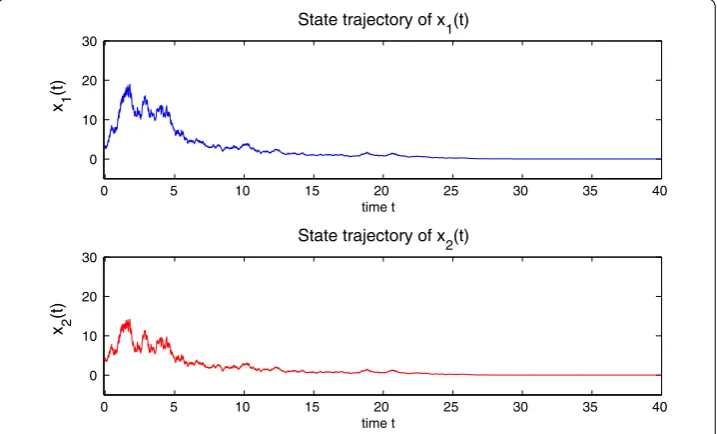
Thus, from Corollary ., we know the zero solutionx∗= of (.) is exponentially -stable (see Figure ), the exponential convergent rate is no less than . –π = ..
Remark . Apparently, –(P(t) +Q(t)) is not a nonsingularM-matrix for allt≥, and
hi(t) = e–t≡ is not true for allt≥, thus the results in [, ] are invalid for (.).
In addition, the delay functionsτij(t) do not satisfysupt≥τ˙ij(t) < , therefore, when model
(.) is autonomous, the results in [, ] are invalid for it.
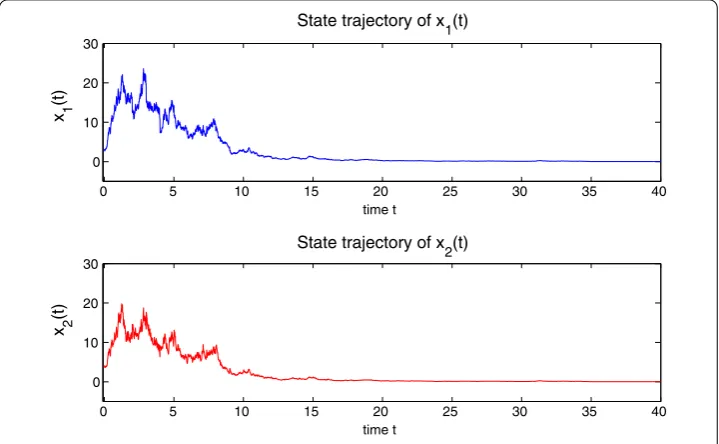
Figure 2 The state trajectories of model (5.1) with impulses (5.2).
Case. If
x(tk) =Ik
xtk–= .e.x
t–k+ .e.x
tk–,
x(tk) =Ik
xtk–= .e.x
tk–+ .e.x
t–k, tk–tk–= ,k∈N,
(.)
then we can get the following parameters of (A), (A), (A):
ˆ Rk=e.
. . . .
, ρ(Rˆk) =e., ρ(Rˆk) =
(z,z) > |z=z
.
Therefore, =∞k=(ρ(Rˆk))∩M() ={(z,z) > |z =z} is not empty. Letz=
(, )T∈andγ
k=e., we can obtain fork∈N
lnγk
tk–tk–
=lne
.
= . =γ <λ–μ= ..
From Corollary ., we know the zero solution to (.) with impulses (.) is exponen-tially -stable (see Figure ).
6 Conclusion
Competing interests
The authors declare that they have no competing interests.
Authors’ contributions
All authors have made equal and significant contributions in writing this paper. All authors read and approved the final manuscript.
Acknowledgements
This work is supported by National Natural Science Foundation of China under Grant 11271270, Fundamental Research Fund of Sichuan Provincial Science and Technology Department under Grants 2013JYZ014, 2012JYZ019, Scientific Research Fund of Sichuan Provincial Education Department under Grant 16TD0029 and Project of Leshan Normal University under Grant Z1324.
Received: 7 May 2015 Accepted: 16 November 2015
References
1. Cao, J, Zhou, D: Stability analysis of delayed cellular neural networks. Neural Netw.11, 1601-1605 (1998) 2. Chua, LO, Yang, L: Cellular neural networks: theory. IEEE Trans. Circuits Syst.35, 1257-1272 (1988)
3. Arik, S: An analysis of global asymptotic stability of delayed cellular neural networks. IEEE Trans. Neural Netw.13, 1239-1242 (2002)
4. Liao, X, Wang, J: Algebraic criteria for global exponential stability of cellular neural networks with multiple time delays. IEEE Trans. Circuits Syst.50, 268-274 (2003)
5. Lakshmikantham, V, Bainov, D, Simeonov, P: Theory of Impulsive Differential Equations. World Scientific, Singapore (1989)
6. Long, S, Xu, D: Delay-dependent stability analysis for impulsive neural networks with time varying delays. Neurocomputing71, 1705-1713 (2008)
7. Gopalsamy, K: Stability of artificial neural networks with impulses. Appl. Math. Comput.154, 783-813 (2004) 8. Pan, J, Liu, X, Zhong, S: Stability criteria for impulsive reaction-diffusion Cohen-Grossberg neural networks with
time-varying delays. Math. Comput. Model.51, 1037-1050 (2010)
9. Long, S, Song, Q, Wang, X, Li, D: Stability analysis of fuzzy cellular neural networks with time delay in the leakage term and impulsive perturbations. J. Franklin Inst.349, 2461-2479 (2012)
10. Haykin, S: Neural Networks. Prentice Hall, Englewood Cliffs (1994)
11. Blythe, S, Mao, X, Liao, X: Stability of stochastic delay neural networks. J. Franklin Inst.4, 338-481 (2001)
12. Yang, Z, Xu, D, Xiang, L: Exponentialp-stability of impulsive stochastic differential equations with delays. Phys. Lett. A
359, 129-137 (2006)
13. Balasubramaniam, P, Syed Ali, M, Arik, S: Global asymptotic stability of stochastic fuzzy cellular neural networks with multiple time-varying delays. Expert Syst. Appl.37, 7737-7744 (2010)
14. Sun, Y, Cao, J:pth moment exponential stability of stochastic recurrent neural networks with time-varying delays. Nonlinear Anal., Real World Appl.8, 1171-1185 (2007)
15. Cheng, Q, Cao, J: Global synchronization of complex networks with discrete time delays and stochastic disturbances. Neural Comput. Appl.20, 1167-1179 (2011)
16. Li, H, Chen, B, Lin, C, Zhou, Q: Mean square exponential stability of stochastic fuzzy Hopfield neural networks with discrete and distributed time-varying delays. Neurocomputing72, 2017-2023 (2009)
17. Luo, Q, Zhang, Y: Almost sure exponential stability of stochastic reaction diffusion systems. Nonlinear Anal.71, 487-493 (2009)
18. Huang, C, Cao, J: Almost sure exponential stability of stochastic cellular networks with unbounded distributed delays. Neurocomputing72, 3352-3356 (2009)
19. Ren, F, Cao, J: Anti-synchronization of stochastic perturbed delayed chaotic neural networks. Neural Comput. Appl.5, 515-521 (2009)
20. Mao, X: Stochastic Differential Equations and Applications. Ellis Horwood, New York (1997)
21. Huang, C, He, Y, Huang, L, Zhu, W:pth moment stability analysis of stochastic recurrent neural networks with time-varying delays. Inf. Sci.178, 2194-2203 (2008)
22. Yuan, Z, Yuan, L, Huang, L, Hu, D: Boundedness and global convergence of non-autonomous neural networks with variable delays. Nonlinear Anal., Real World Appl.10, 2195-2206 (2009)
23. Huang, C, He, Y, Huang, L: Stability analysis of non-autonomous stochastic Cohen-Grossberg neural networks. Nonlinear Dyn.57, 469-478 (2009)
24. Li, B, Zhou, Y, Song, Q:P-Moment asymptotic behavior of non-autonomous stochastic differential equation with delay. In: Advances in Neural Networks - ISNN 2010. Lecture Notes in Computer Science, vol. 6063, pp. 561-568 (2010) 25. Jiang, M, Shen, Y: Stability of non-autonomous bidirectional associative memory neural networks with delay.
Neurocomputing71, 863-874 (2008)
26. Zhao, H, Mao, Z: Boundedness and stability of nonautonomous cellular neural networks with reaction-diffusion terms. Math. Comput. Simul.79, 1603-1617 (2009)
27. Lou, X, Cui, B: Boundedness and exponential stability for nonautonomous cellular neural networks with reaction-diffusion terms. Chaos Solitons Fractals33, 653-662 (2007)
28. Wu, A, Fu, C: Global exponential stability of non-autonomous FCNNs with Dirichlet boundary conditions and reaction-diffusion terms. Appl. Math. Model.34, 3022-3029 (2010)
29. Niu, S, Jiang, H, Teng, Z: Boundedness and exponential stability for nonautonomous FCNNs with distributed delays and reaction-diffusion terms. Neurocomputing73, 2913-2919 (2010)
30. Yang, Z, Xu, D: Global dynamics for non-autonomous reaction-diffusion neural networks with time-varying delays. Theor. Comput. Sci.403, 3-10 (2008)
32. Huang, Y, Xu, D, Yang, Z: Dissipativity and periodic attractor for non-autonomous neural networks with time-varying delays. Neurocomputing70, 2953-2958 (2007)
33. Xu, D, Long, S: Attracting and quasi-invariant sets of non-autonomous neural networks with delays. Neurocomputing
77, 222-228 (2012)
34. Zhang, Q, Wei, X, Xu, J: Delay-dependent exponential stability criteria for non-autonomous cellular neural networks with time-varying delays. Chaos Solitons Fractals36, 985-990 (2008)
35. Zhang, Q, Wei, X, Xu, J: Global exponential stability for nonautonomous cellular neural networks with delays. Phys. Lett. A351, 153-160 (2006)
36. Long, S, Wang, X, Li, D: Attracting and invariant sets of non-autonomous reaction-diffusion neural networks with time-varying delays. Math. Comput. Simul.82, 2199-2214 (2012)
37. Long, S, Xu, D: Global exponential p-stability of stochastic nonautonomous Takagi-Sugeno fuzzy cellular neural networks with time-varying delays and impulses. Fuzzy Sets Syst.253, 82-100 (2014)
38. Long, S, Xu, D: Global exponential stability of nonautonomous cellular neural networks with impulses and time-varying delays. Commun. Nonlinear Sci. Numer. Simul.18, 1463-1472 (2013)
39. Wang, X, Guo, Q, Xu, D: Exponentialp-stability of impulsive stochastic Cohen-Grossberg neural networks with mixed delays. Math. Comput. Simul.79, 1698-1710 (2009)
40. Zhu, W: Global exponential stability of impulsive reaction-diffusion equation with variable delays. Appl. Math. Comput.205, 362-369 (2008)
41. Zhu, W, Xu, D, Yang, C: Exponential stability of singularly perturbed impulsive delay differential equations. J. Math. Anal. Appl.328, 1161-1172 (2007)
42. Xu, D, Yang, Z: Impulsive delay differential inequality and stability of neural networks. J. Math. Anal. Appl.305, 107-120 (2005)
43. Xu, L, Xu, D:P-Attracting andp-invariant sets for a class of impulsive stochastic functional differential equations. Comput. Math. Appl.57, 54-61 (2009)
44. Long, S, Xu, D: Stability analysis of stochastic fuzzy cellular neural networks with time-varying delays. Neurocomputing74, 2385-2391 (2011)
45. Berman, A, Plemmons, R: Nonnegative Matrices in Mathematical Sciences. Academic Press, New York (1979) 46. Horn, R, Johnson, C: Matrix Analysis. Cambridge University Press, Cambridge (1985)