R E S E A R C H
Open Access
A novel code-based iterative PIC scheme for
multirate CI/MC-CDMA communication
Mithun Mukherjee
*and Preetam Kumar
Abstract
This paper introduces a novel code-based iterative parallel interference cancellation technique (Code-PIC) for the multirate carrier interferometry/multicarrier code division multiple-access (CI/MC-CDMA) system, which supports simultaneous transmission of high and low data rate users. In Code-PIC scheme, multiple-access interference (MAI) for the desired user is estimated based on the projection of subcarrier and subsequent removal of interference from the received signal depending on specific high or low data rate users. Carrier interferometry (CI) codes are used to minimize the cross-correlation between users, which significantly reduces the multiple-access interference (MAI) for the desired user. The effect of MAI in CI/MC-CDMA is reduced by giving proper phase shift to different set of users. Improved estimation of MAI in Code-PIC results in lower residual interference after interference cancellation. Simulation results show that Code-PIC scheme offers improved BER performance over AWGN and Rayleigh fading channels compared to Block-PIC and Sub-PIC with reduced latency and complexity.
1 Introduction
Multicarrier code division multiple-access (MC-CDMA) system is a promising technique for high-speed commu-nication system due to robustness against intersymbol interference (ISI) over multipath. The capacity of CDMA in cellular and wireless personal communication systems is limited by multiple-access interference (MAI) due to simultaneous transmission of more than one user. The interference power increases linearly with the number of simultaneous users. To alleviate MAI, several multiuser detection schemes have been proposed in the literature [1]. The conventional detector follows single-user detec-tion (SUD). In SUD, every user is detected separately in the presence of MAI. Performance improvement is observed with multiuser detection (MUD) schemes, where the information about multiple user is used to detect the desired user. Although notable performance gain is obtained with maximum-likelihood (ML) multiu-ser detector, the complexity of the detector grows expo-nentially with the number of users. The iterative expectation-maximization (EM) algorithm enables approximating the ML estimate. EM-based joint data detector [2] has excellent multiuser efficiency and is robust against errors in the estimation of the channel
parameters. ML approach requires high computational complexity. To mitigate computational complexity, sub-optimal MUD like minimum mean-square error (MMSE) has been proposed. A non-linear MMSE multiuser deci-sion-feedback detectors (DFDs) are relatively simple and can perform significantly better than a linear multiuser detector. Multiuser decision-feedback detectors (DFDs) based on the minimum mean-squared error (MMSE) are reported in [3] over multipath. The MMSE adaptive receiver has a much better performance than matched fil-ter receiver with a slightly higher computational com-plexity. The group pseudo-decorrelator, the group MMSE detector and the pseudo-decorrelating decision-feedback detector are proposed by Kapur et al. [4].
Considerable performance improvement can be achieved by the use of interference cancellation (IC) technique. Interference cancellation detector removes interference by subtracting estimates of interfering sig-nals from the received signal. Serial interference cancel-lation (SIC) has been the active area of research due to its lower complexity compared with other multiuser receiver. SIC [5] removes the interference serially. It is expected that bit error rate (BER) performance improves after each iteration stage of iterative SIC. In high-speed data communications, parallel interference cancellation (PIC) [6] is more preferable due to reduced delay. Hard-ware complexity is one of the main drawbacks of PIC. * Correspondence: [email protected]
Department of Electrical Engineering, Indian Institute of Technology Patna, Patna, India - 800013
Performance analysis of improved PIC has been reported in [7]. However, if some of users’information is wrongly detected, then the estimated MAI increases the interference power resulting in degraded BER per-formance for desired user. The error propagation can be minimized when hard decision is replaced by soft deci-sion of received bits. Soft decideci-sion-based IC schemes have been proposed by different authors [8-10].
Fast adaptive MMSE/PIC iterative algorithm [11] has been proposed to reduce overhead introduced during the receiver’s training period. Least-squares (LS) joint optimi-zation method [12] is presented for estimating the inter-ference cancellation (IC) parameters, the receiver filter and the channel parameters. Lamare et al. proposed a low-complexity near-optimal ordering MMSE design criteria [13] for efficient decision-feedback receiver structure along with successive, parallel and iterative interference cancellation structures. Significant performance improve-ment is obtained with iterative interference cancellation receiver for underloaded CDMA [9,10,14,15].
Non-linear PIC or SIC performs better compared to other MUD in overloaded system. Suboptimum multiu-ser detection [16] for overloaded systems has been pro-posed, but with very specific constraints on the signal set. Multistage iterative interference cancellation has been found suitable in overloaded system [17-19]. Recently, iterative multiuser detection with soft IC for multirate MC-CDMA has been proposed in [20].
The effect of MAI that arises from the cross-correla-tion between different users’code can be minimized by usingCarrier Interferometry(CI) codes [21,22]. CI codes provide flexible system capacity [23] with good spectral sharing. CI codes of lengthN can support N simulta-neous users orthogonally. User capacity can be increased up to 2N by adding additional N pseudo-orthogonal users to the existing system [22]. For synchronous CI/ MC-CDMA uplink, threshold PIC (TPIC) and Block-PIC [24] have been designed to provide better perfor-mance than conventional PIC scheme. Block-PIC signifi-cantly outperforms the conventional PIC with a slight increase in complexity. Single user bound with a 1dB off is obtained in Block-PIC at a BER of 1e-03. In [25], sub-carrier PIC (Sub-PIC) has been developed for high-capa-city CI/MC-CDMA with variable data rates. Although the system capacity has been increased up to three times (i.e., system capacity 3N), higher BER restricts real-time data communication.
This paper attempts to improve the performance of mul-tirate CI/MC-CDMA system by a novel code-based itera-tive PIC (Code-PIC) scheme. Proper phase shifts between different set of users reduce the effect of MAI. We have shown that BER performance of multirate CI/MC-CDMA improves considerably by using subcarrier projection method of the interfering users. Performance for different
combination of low and high data rate users is shown over different channel conditions like additive white Gaussian noise (AWGN) and slow-frequency selective Rayleigh fad-ing channel. Performance comparisons with Block-PIC and Sub-PIC are also presented in this work.
The paper is organized as follows: System model of CI/MC-CDMA is discussed in Sections 2, and Section 3 describes iterative interference cancellation receiver. In Section 4, multirate high-capacity system is explained. Code-PIC for different user sets is outlined in Section 5. Simulation results are presented in Section 6. Computa-tional complexities of convenComputa-tional PIC, Block-PIC, Sub-PIC and Code-Sub-PIC for multirate CI/MC-CDMA system are evaluated in Section 7. Finally, in Section 8, conclu-sions are drawn.
2 System model
This section describes the model of CI/MC-CDMA sys-tem considered in the paper. Synchronous CI/MC-CDMA system with K users is considered. Each user employs Nsubcarriers with binary phase-shift keying (BPSK) modulation. CI code [21,22] of length Nforkth user (1≥k≥K) corresponds to
β0
k,β
1
k,βk2,. . . βkN−1
=
ejθk0,ejθk1,ejθk2,. . .ejθ N−1 k
=
1,ejθk,e2jθk,. . .e(N−1)jθk
(1)
where
θk= 2πk
N k= 1, 2,. . .,N
2πk
N +Nπ k=N+ 1,N+ 2,. . ., 2N
(2)
2.1 Transmitter
The transmitted signal corresponding to nth data sym-bol of thekth user is
sk(t) = N−1
i=0
M
n=1
ak[n] exp
j(2πfit) +iθk
.p(t−nTb) (3)
whereM is the number of data symbols per user per frame.ak[n] isnth input data symbol ofkth user, which is
modeled as a sequence of independent and identically dis-tributed (i.i.d.) random variables taking values from ± 1 with equal probability. {fi=fc+iΔf, (i= 0, 1,2, . . .N- 1)}is
the frequency ofith narrow band subcarrier with center frequencyfc.Δfis selected such that orthogonality between
carrier frequencies can be maintained. Typically,Δf= 1/Tb
whereTbis bit duration of Nyquist pulse shapep(t). The
transmitted signal for K users can be expressed as
S(t) =
K
k=1
2.2 Channel model
The channel is modelled as a slowly varying frequency selective Rayleigh fading channel. It is assumed that every user experiences an independent propagation. Each carrier undergoes a flat fading over entire width. The frequency selectivity over the entire band-width results correlated subcarrier. The correlation betweenith subcarrier fade andjth subcarrier fade can be modeled as [26]
ρij=
1
1 + ((fi−fj)/(f)c)2
(5)
where (Δf)cis the coherence bandwidth. Bandwidth of
each subcarrier is chosen to be less than (Δf)c, i.e., 1/Tb ≪ (Δf)c <BW, where BW is the total bandwidth of the
transmission. For multipath frequency selective channel, we have assumed 4-fold Rayleigh fading [21,24], i.e.,
BW/(Δf)c = 4.
The transfer function of the channel of theith subcar-rier forkth user isξi,k=ai,k. exp(bi,k), whereai,kandbi,k
are complex channel gain and carrier phase offset for
ith subcarrier of kth user, respectively.
2.3 Receiver
The received signalr(t) can be written as
r(t) =
K
k=1 N−1
i=0
αi,kak[n]. exp(j(2πfit+iθk+βi,k)).p(t−nTb) +η(t) (6)
where bi,k is random carrier phase offset uniformly
distributed over [0, 2π] forkth user in ith subcarrier. Rician amplitude distribution can be applied forai,k in
indoor data communication, where line of sight(LOS) components in received signal can be found. Rayleigh fading would be more appropriate in long distance wire-less communication where LOS is hardly possible. For channel model, each resolvable multipath component is assumed to follow Rayleigh fading characteristics. The advantage of using orthogonal code vanishes when mul-tipath fading paths are assumed.h(t) represents AWGN with zero mean and double-sided power spectral density N0/2.
The received signalr(t) is projected onNorthogonal subcarriers and is despread using kth user’s CI code. Theith subcarrier component of received signalr(t) can be written as
yi=
2 N0Tb
Tb
0
r(t) exp (−j(2πfit)) dt (7)
where yi is the projected N orthogonal subcarrier
component of the received signalr(t).
The decision variables forkth user at different subcar-riers may be expressed as
rk=r0,kiter,r1,kiter,. . .,rkN−1,iter (8)
where rk
i,iter is decision variable for ith subcarrier of
kth user atiter-th iteration stage.
rk
i,iter=α∗i,k. exp(−j(iθk))yi +
K
m=1,m=k
2Eb
N0
ˆ
a(miter−1)α∗i,kαi,mexp
j
i(θm−θk) +
ˆ βi,m−βi,k
+ηiexp(−j(iθk))
(9)
where * denotes the complex conjugate and hi is
Gaussian random variable with zero mean and variance of N0/2. Ebis the transmitted bit energy and aˆ(kiter) is
the estimated data ofkth user at iter-th iteration stage.
ˆ
βi,m is the estimate of the phase for ith subcarrier of
mth user. For synchronous transmission, βˆi,m=βi,k is assumed. Further, it is assumed that the received power of every user is same.
Whenyiis multiplied bykth user’s spreading code,
Xk= N−1
i=0
yiexp(−j(iθk))
=
2Eb
N0 ak[n] +
N−1
i=0
K
m=1,m=k
2Eb
N0
amexpj(i(θm−θk))+ N−1
i=0
ηiexp(−j(iθk))
(10)
Taking the real part ofXk,
Yk=
2Eb N0
ak[n] +Ik+Nk (11)
where
Yk=[Xk] = N−1
i=0
yiexp (−j(iθk))
(12)
Ik=
⎡ ⎣N−1
i=0
K
m=1,m=k
2Eb
N0ˆ
amexp[j(i(θm−θk))]
⎤ ⎦ (13)
Nk= N−1
i=0
ηiexp(−j(iθk))
(14)
Ikis the MAI experienced by kth user due to (K- 1)
users. Multiplication of noise (hi) by the user’s
spread-ing code (exp(-j(iΔθk))) does not change the noise
distri-bution. So, additive noise term Nk is zero mean
Gaussian random variable with variance ofN0/2 forkth
The average bit error probability forkth user is given by
The average BER of all users is given by
P(e) = 1
From the Equation (15), it is clear that if probability of
noise and interference term is higher than
2Eb N0 , then
BER tends to increase. So, cancellation of interference is necessary to obtain a lower bit error probability. This motivates the need for interference cancellation technique.
3 Iterative interference cancellation receiver
In this section, conventional PIC structure is discussed. The estimated interference due to (K - 1) users is directly subtracted from r(t) for the desired kth user. The improved received signal ˆriter
k (t) ofkth user may be
where ˆsiterm (t) is the estimated signal atiter-th iteration for themth user. ˆsiter
3.1 Subcarrier PIC (Sub-PIC)
In Sub-PIC, the received signal is projected onN ortho-gonal subcarrier, and the interference due to other users is subtracted at subcarrier level. Using Equations (7) and (17), the received signal of kth user after orthogonal projection is given as:
ˆ
where yˆi is the projected N orthogonal subcarrier component of ˆrkiter(t). When yˆi is multiplied by kth user’s spreading code,
ˆ
where ˆIiterk is the estimated MAI experienced by kth user due to (K- 1) users atiter-th iteration.
So, received data ofkth user atiter-th iteration can be given as
The average bit error probability in Sub-PIC for kth user is given by
Pk(e) =
Sub-PIC scheme compared to error probability in case of simple matched filter output (Equation (15)).
Again, Zˆiter
k can be written as
ˆ
Ziterk =
2Eb N0
ak[n] +Witerk +Nk (25)
where
Witerk =Ik− ˆI iter
k (26)
The term Witer
k stands for the residual or uncancelled interference that arises due to imperfect cancellation. In iterative receiver structure, Witer
k is reduced after every iteration stages. For initial estimations, after forming the decision variablesrk, minimum mean-square error com-biner (MMSEC) is employed to make decision in an AWGN channel [27]. Also, in slow-frequency selective channel, the performance of MMSEC is a good solution [28]. MMSEC exploits diversity of frequency selective channel to minimize intercarrier interference (ICI).Yk
can be written as Yk=rkω¯ for aˆ0k[n], where ω¯ is the weight vector of the combiner [27]. The decision ofkth user atiterthiteration becomes
ˆ
aiterk [n]∼= sgn
ˆ
Ziterk
ˆ
a0k[n] = sgn{Yk}
(27)
The scheme represented by Equation (27) is referred as hard decision PIC (HDSub-PIC) [25]. The BER per-formance of Sub-PIC improves significantly by taking soft estimation of the interfering users. Insoft decision Sub-PIC (SDSub-PIC), the estimation of the received data is performed by taking soft decisions using non-lin-ear function [17]. The soft decision of Xkis given by
˜
xk=φ(Yk− ˆI iter
k ), wherej(x) is the non-linear function. Different types of non-linearities like dead-zone non-lin-earities, hyperbolic tangent and piecewise linear approxi-mation of hyperbolic tangent can be used forj{(x)}.
i. Dead-Zone Nonlinearity:
φ(x) =
sgn(x)|x| ≥λ
0 |x|< λ (28)
If l = 0 then it becomes similar to hard decision-based estimation in Equation (27).
ii. Hyperbolic Tangent:
φ(x) =
sgn(x) |x| ≥ λ
tanh(x/λ)|x|< λ (29)
iii. Piecewise linear approximation of Hyperbolic Tan-gent: In piecewise linear approximation, for all iteration the functionj{(x)} can be written as
φ(x) =
sgn(x)|x| ≥ λ
x/λ |x|< λ (30)
The non-linear parameterlis selected such that mini-mum BER can be obtained for iterative IC process. Here, in SDSub-PIC technique, we have considered pie-cewise linear approximation of hyperbolic tangent as a non-linear function of soft decision IC process. In the last stage of iteration, the final decision is made by hard detector, aˆk[n] = sgn{Yk− ˆI
iter
k }. In the next section, multirate high-capacity CI/MC-CDMA with 3N users system is discussed.
4 Multirate high-capacity 3Nsystem
In CI/MC-CDMA system described in Section 2, N
length CI codes support Northogonal users and addi-tionalNusers are added by pseudo-orthogonal CI codes [21,22]. To support more users, a high-capacity CI/MC-CDMA system is proposed in [29], where the capacity is increased up to 3N users through the splitting of pseudo-orthogonal CI (PO-CI) codes. As defined earlier, the CI code for kth user (1 <= k <= K) is given by
1,ejθk,e2jθk,. . .,e(N−1)jθk. This code is divided into odd and even parts. Further, orthogonal subcarriers are also divided into odd and even parts. The odd/even par-titioning of PO-CI and odd/even separation of available subcarriers are useful in adding extra users and hence the system capacity.
In multimedia communication, users transmit at vari-able data rate. In this paper, different data rate users are broadly grouped into high data rate users (HDR) and low data rate users (LoDR). HDR users are assigned by
N contiguous subcarriers. Non-orthogonal odd/even subcarriers with odd/even CI code are allocated to LoDR users. In multipath fading channel, if some of the subcarriers are passed through deep fade, then other subcarriers are used to ensure low BER. The non-con-tiguous odd-even subcarrier allocation ensures better performance in deep fade as compared to contiguous subcarrier allocation. Proper user allocation algorithm [29] is maintained to minimize the cross-correlation between different user sets. In multirate high-capacity system model, there are five user sets.
U1 : assigned normal CI; transmit through all subcarriers
U2: assigned odd CI codes; transmit through odd subcarriers
U4: assigned odd CI codes; transmit through even subcarriers
U5: assigned even CI codes; transmit through even subcarriers
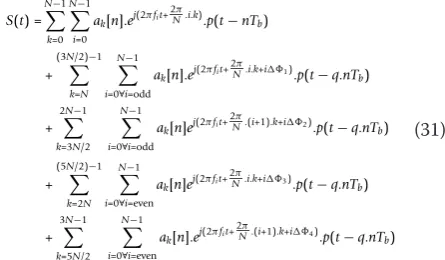
The transmitted signal for multirate high-capacity sys-tem can be expressed as
S(t) =
It is assumed that HDR users transmit data at ‘q’ times higher than LoDR users. The angles ΔF1, ΔF2,
ΔF3and ΔF4are phase shift for the different LoDR sets
(Ui,i = 2, 3, 4, 5) with respect to HDR users assigned
by normal CI codes. Different angles are shown in Figure 1.
These phase angles are chosen such that the interfer-ences between different sets is reduced. Let us assume thatR1,2(j, k) represents the cross-correlation between
jth user in group 1 andkth user in group 2.
Here, the cross-correlation betweenjth user in ortho-gonal group 1 and all the users in group 2 is identical to the cross-correlation between (j+ 1)th user in orthogo-nal group 1 and all the users in group 2. The total num-bers of users in group 1 and group 2 are K1 andK2, respectively.
Let R1,2(j) is the total cross-correlation between jth user and all the users in group 2.
R1,2(j) = in one set has same total cross-correlation from users of the other set. If both sets have same number of users, i. e., K1 =K2, then the total cross-correlation betweenjth user in orthogonal group 1 and all the users in group 2 is identical to the cross-correlation betweenk’th user in orthogonal group 2 and all the users in group 1. Total cross-correlation between group 1 and group 2 can be written as spreading sequence in Ux user set and kth spreading
sequence inUyuser set. For real signal, the expression is
RUx,Uy(j,k) =
Total cross-correlation betweenjth user and all the user ofU2 set becomes
RU1,U2(j) =
1 KU2
KU2
k=1
RU1,U2(j,k) (40)
where KUx represents total number of users inUxset. In general,
RU1,Um(j) = 1 KUm
KUm
k=1
RU1,U2(j,k), m∈2, 3, 4, 5 (41)
RU1,Um(j,k) = 1 2f
N−1
i=0∀i=odd
cos [i(θj−θk)], m∈2, 3 (42)
and
RU1,Um(j,k) = 1 2f
N−1
i=0∀i=even
cos [i(θj−θk)], m∈4, 5 (43)
So, total cross-correlation between jth user inU1 set and all the users in other set is given by
RU1,(U2,U3,U4,U5)(j) =
R2 U1,U2(j) +R
2 U1,U3(j) +R
2 U1,U4(j) +R
2
U1,U5(j) (44)
From Equation (44), it is clear that the users of the same set of subcarrier used by U1 user set create inter-ference to the jth user ofU1. set. Assuming orthogonal-ity is maintained in subcarrier, there is no cross-correlation between [U2, U4] set and [U2, U5] set. U2
and U3 user sets are using different set of subcarriers that is utilized by U4 and/or U5 sets. In same subcar-riers, the cross-correlation between two different user set is minimized by proper phase separation described in Equation (32). ForU2 user set, all users from U1set and U3 user create interference on odd subcarrier. Then, total interference for jth user in U2 user is obtained by
RU2,(U1,U3)(j) =
R2U2,U1(j) +R2U2,U3(j) (45)
In multipath channel, intercarrier interference (ICI) occurs due to non-orthogonality between subcarrier. So, MAI in multipath fading channel is more than AWGN channel due to ICI.
5 Code-based parallel interference cancellation technique (code-PIC)
As discussed in Section 4, there are two groups of users,
B1and B2, based on data rates whereU1Î B1,U2,3,4,5Î B2 andU2 ∩ U3 ∩U4 ∩ U5 =j. The users ofB1 group utilize N available subcarriers, and B2 users employ alternate odd/even subcarrier. Users in B2 group are
assigned pseudo-orthogonal CI (PO-CI) codes such that cross-correlation between users fromB1 andB2 group is low. This results in reduced MAI between users.
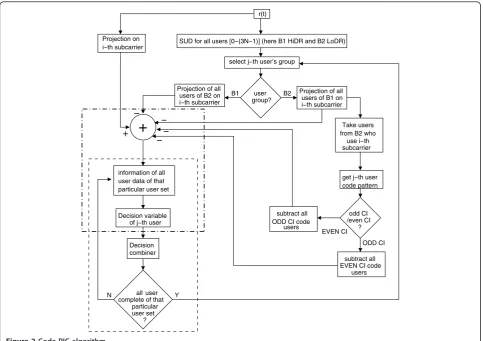
The estimated interference is cancelled out using a code-based PIC (Code-PIC) scheme. Steps involved in Code-PIC scheme is described next with a simplified structure shown in Figure 2.
5.1 Steps involved in Code-PIC scheme
Received signalr(t) is projected ontoNorthogonal sub-carriers. The initial estimates of all users (1 ≥ k≥3N) are obtained with single-user detector (SUD). In multi-stage iterative receiver, all users from a selected group are detected first. After that, all users from the next groups are selected. In Code-PIC, MAI is reduced using the following steps at a given iteration:
step 1: At the first stage of iterative receiver, the group of desired user (sayjth user) is identified.
step 2: If the desired user belongs to B2 group
(LoDR), then signal components for B1 users are recon-structed and projected onto N subcarriers. Now, the MAI due to allB1 users is estimated onith subcarrier. Estimated interference is subtracted from the received signal. After that, steps 3 and 4 are performed.
OR
If the desired user group is B1, then to obtain the decision on odd subcarrier, reconstructed signals ofU2
and U3 are considered; otherwise, for even subcarrier operation, reconstructed signal ofU4 and U5 users are projected onith subcarrier. MAI due toB2group is esti-mated and subtracted from the received signal compo-nent at subcarrier level. Step 4 is performed for all users ofB1group.
step 3:The subcarrier set (ith subcarrier) ofjth user is identified. If the subcarrier set is odd subcarrier, then signal components due to U2 and U3 set are recon-structed; otherwise, U4 andU5 users are considered. Then, the code pattern (ODD CI or EVEN CI) of jth user is also detected. If the code pattern is ODD CI, then reconstructed signal components ofU3 orU5 user sets (depends on which user set is selected based onith subcarrier set) are projected on theith subcarrier; other-wiseU2 orU4 user sets are projected. MAI due to pro-jected user sets is estimated and subtracted from the received signal.
step 4: The received signal component consists of
users of only jth user set. The interference due to other users of jth user set is estimated and subtracted to obtain improved decision via decision combiner forjth user. This step is repeated for all users ofjth user set.
5.2 Decoding ofB1users
For a given desired user fromB1 group, MAI is caused due to all users fromB1 group and the users ofB2 who use same subcarrier ofB1 group. The estimated MAI of
kth user due to other (K - 1) users at ‘iter’ iteration stage (ˆIiter
k ) may be expressed as
ˆ Iiterk =
⎡ ⎣N−1
i=0
N
m=1,m=k
2Eb
N0ˆ
aiterm −1eji(θm−θk)
+
N−1
i=0∀i=odd ⎛ ⎝3N/2
m=N+1
2Eb
N0 ˆ
aiter−1
m eji(θm−θk)
+
2N
m=(3N/2)+1
2Eb
N0ˆ
aiterm −1ej(i+1)(θm−θk)
⎞ ⎠
+
N−1
i=0∀i=even ⎛ ⎝ 5N/2
m=2N+1
2Eb
N0
ˆ
aiterm −1eji(θm−θk)
+
3N
m=(5N/2)+1
2Eb
N0ˆ
aiterm −1ej(i+1)(θm−θk)
⎞ ⎠ ⎤ ⎦
(46)
and
ˆ Ikiter(U
1)=ˆI iter k(U1,U1)+ˆI
iter k(U1,U2)+ˆI
iter k(U1,U3)+ˆI
iter k(U1,U4)+ˆI
iter
k(U1,U5) (47)
where aˆiterk , ˆIiter
k(Ui) and ˆI iter
k(Ui,Uj) are the estimated data of kth user, total estimated MAI for Ui user set and
MAI due to Ujuser set for theUi user set, respectively,
at ‘iter’ iteration stage. We assumed that HDR users transmit data at ‘q’ times higher than LoDR users. While calculating ˆIiter
k(U1) fornth bit, ˆI iter
k(U1,Ui), (i= 2, 3, 4, 5) remains same for taking the decision of all consecu-tive ‘q’ number of bits. So, time and complexities become less in Code-PIC technique. The major draw-back of this type of technique is that if one of the bits of LoDR is wrongly estimated, then it can effect ‘q’ number of HDR bits. Error propagation can be mini-mized if hard decision is replaced by soft decision of received data bits [7,10,17]. In the last stage of iteration, the final decision is made by hard detector,
ˆ
ak= sgn{Yk− ˆI iter k }.
Projection on i−th subcarrier
select j−th user’s group
from B2 who Take users
use i−th subcarrier user
group?
ODD CI code subtract all
users
subtract all
users EVEN CI code
get j−th user code pattern
odd CI /even CI
? SUD for all users [0−(3N−1)] (here B1 HiDR and B2 LoDR)
r(t)
Projection of all users of B2 on i−th subcarrier
EVEN CI
ODD CI
B1 B2
i−th subcarrier Projection of all
users of B1 on
N Y
Decision variable of j−th user information of all user data of that particular user set
combiner Decision
complete of that particular
user all
user set ?
+
+
− −
− −
5.3 Decoding ofB2users
Let us takeU2 user set as one of the desired user set of
B2 group. Only odd subcarriers of the available subcar-riers are used byU2 set. So, the users who use odd sub-carrier create interference on U2 set. All B1 users are non-orthogonal to set B2 users. Interference due to HDR users can be written as
ˆ
Iiterk(U2,U1)=
⎡
⎣ N−1
i=0∀i=odd
m∈B1
2Eb N0ˆ
aiterm−1exp
j(i(θm−θk))
⎤⎦
(48)
InB2 group, onlyU2,U3 users utilize odd subcarriers. There is no interference due toU4, U5, assuming proper orthogonality maintained in subcarrier. ˆIiterk(U
2) can be written as
ˆ
Iiter k(U2)=ˆI
iter k(U2,U1)+ˆI
iter k(U2,U3)+
⎡ ⎣ N−1
i=0∀i=odd 3N/2
m=(N+1),m=k
2Eb
N0ˆa iter−1 m eji(θm−θk)
⎤ ⎦ (49)
This proper estimation and subtraction of MAI from the received signal improves the system performance. MAI experienced by other users set can be obtained in similar way.
6 Simulation results
This section demonstrates the BER performance compar-ison of BPSK-modulated synchronous CI/MC-CDMA system with Block-PIC, Sub-PIC and Code-PIC at differ-ent signal-to-noise ratios (SNR) using Monte Carlo simu-lations in MATLAB. Both hard and soft decisions of received data bits are used to estimate the MAI. Perfect channel estimation and synchronization are assumed at the receiver. No forward error correcting code is employed for data transmission. For multipath frequency selective channel, we have assumed 4-fold Rayleigh fad-ing [21]. It is also assumed that HDR users transmit data at 4 times higher than LoDR users. In the next subsec-tion, results over AWGN channel are presented and then the results over Rayleigh fading channel are reported.
6.1 AWGN channel
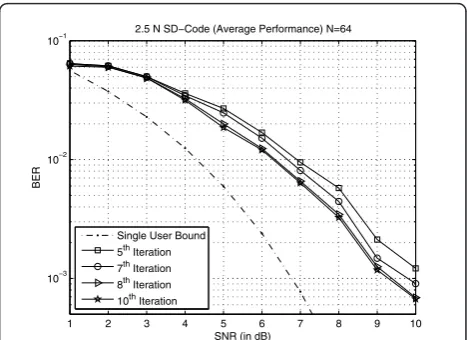
Figure 3 illustrates the performance of SDCode-PIC technique for 2.5 user multirate system with 64 HDR users and 96 LoDR users. Number of subcarriers (N) is 64. From the figure, it is clear that BER performance improves by increasing the number of iterations. The estimated MAI becomes closer to actual MAI as num-ber of iterations increases. So, the residual part of MAI (Ik− ˆIiter
k ) becomes less. Subtraction of estimated MAI results in the improvement in BER performance. After 5th stage of iteration, a BER of 1.3e-03 is obtained at 10 dB SNR. Bit error probability of 6.7e-04 is observed after 8th iteration, at same SNR. After a certain number
of iterations, the residual interference cannot be removed further. So, BER performance remains almost same for higher number of iterations. From the simula-tion, the performances of 8th and 10th stages are almost same. So, for 2.5Nuser multirate system, the number of iterations is fixed at 8 without increasing latency and complexities involved in higher stage of iterations.
The performance comparison of SDCode-PIC and SDSub-PIC scheme is evaluated in Figure 4 for 2.5N
multirate system (NHDR users and 1.5NLoDR users). A total of 160 users (64 HDR + 96 LoDR) are transmit-ting data at two different data rates over AWGN chan-nel. In SDSub-PIC, estimation of the interference for desired user is done without considering interference
1 2 3 4 5 6 7 8 9 10 10−3
10−2 10−1
SNR (in dB)
BER
2.5 N SD−Code (Average Performance) N=64
Single User Bound 5th Iteration 7th Iteration 8th Iteration 10th Iteration
Figure 3 Performance of the SDCode-PIC with different iteration for 2.5N user system over AWGN channel; (64 HDR + 96 LoDR = 160 users) users, subcarrier (N) = 64,l= 0.7.
1 2 3 4 5 6 7 8 9 10 10−3
10−2 10−1
SNR (in dB)
BER
(2.5 N Average BER Performance) N=64
Single User Bound SDSub−PIC (8th Iteration) SDCode−PIC (5th Iteration) SDCode−PIC (8th Iteration)
from other user group. So, large number of iteration stages is required to cancel interference to achieve allowable BER. In SDCode-PIC, the interference is esti-mated based on the knowledge of desired user group and interfering user group. So, the improved estimation ensures less number of iteration to get same BER per-formance or even better than SDSub PIC. From the fig-ure, it is clear that the performance of SDCode-PIC after 5th stage is better than that of the 8th stage of SDSub-PIC over an AWGN channel. A SNR gain of 1.5 dB is obtained in SDCode-PIC compared to SDSub-PIC at a BER of 2e-03 after 8th stage of iteration.
In Figure 5, the results are reported for evaluating the effect of adding users more thanN(K>N), i.e., overload-ing in multirate CI/MC-CDMA system. The number of high data rate (HDR) users is fixed at 64. The interference effect on high data rate users due to LoDR group is observed in this figure. For 96 LoDR users (1.5NLoDR), the interference due to LoDR is more than 76 LoDR (1.2N
LoDR) user system. The average BER of 2.5N(1NHDR + 1.5NLoDR) and 2.2N(1NHDR + 1.2NLoDR) user multi-rate systems are 6.2e-04 and 4.5e-04, respectively, at 10 dB SNR using SDCode-PIC after 8th iteration over AWGN. System is also tested with 70 LoDR (1.1N) users with sub-carrier (N) = 64. At 10 dB SNR, the BER reduces to 3e-04 after same iteration over an AWGN channel. The degra-dation in SNR is 2.3 dB compared to single user bound over AWGN channel at a BER of 3e-04. A SNR gain of 0.8 dB is obtained in 2.1Nsystem compared to 2.2Nuser sys-tem at a BER of 6e-04. The gain in SNR is 1.3 dB in 2.1N
user system compared to 2.5Nuser system at 7e-04 BER.
6.2 Rayleigh fading channel
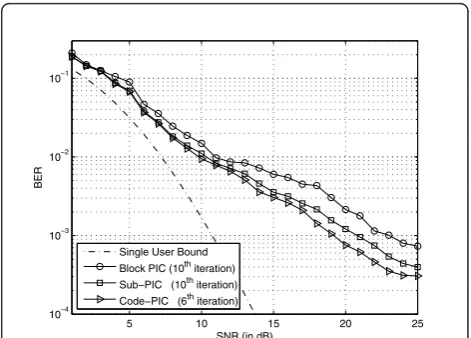
In Figure 6, the performance of Code-PIC is compared with Block-PIC [24] and Sub-PIC [25] for 2Nsystem
with hard decisions. 64 (1N) HDR users, 32 LoDR (N/2) users (using odd subcarrier) and 32 LoDR (N/2) users (using even subcarrier), i.e., a total of 128 users transmit data simultaneously. After 10th stage of iteration, a BER of 7.3e-04 is obtained at 25 dB SNR with Block-PIC. In Sub-PIC, a BER of 4e-04 is observed at 25 dB SNR. But, in Code-PIC, only after 6th iteration, BER of 3e-04 is observed. From the figure, it is clear that Code-PIC pro-vides a performance gain of about 4 dB and 2 dB com-pared to Block-PIC and Sub-PIC, respectively, at a BER of 1e-03 with reduced number of iterations.
Figure 7 illustrates the performance comparison between three soft decision-based PIC schemes. At 25 dB SNR, a BER of 5.6e-05 is obtained using
SDCode-1 2 3 4 5 6 7 8 9 10 10−4
10−3 10−2 10−1
SNR (in dB)
BER
SDCode−PIC (Average Performance) N=64 after 8th iteration
Single User Bound 2.5 N (1N HDR+1.5N LoDR) 2.2 N (1N HDR+1.2N LoDR) 2.1 N (1N HDR+1.1N LoDR)
Figure 5Different loading in SDCode-PIC with different SNR (in dB) value over AWGN channel; subcarrier (N) = 64, andl= 0.7.
5 10 15 20 25
10−4 10−3 10−2 10−1
SNR (in dB)
BER
Single User Bound Block PIC (10th iteration) Sub−PIC (10th iteration) Code−PIC (6th iteration)
Figure 6Comparison of Code-PIC (6th iteration), with Sub-PIC (10th iteration) and Block-PIC (10th iteration) for 2Nsystem over 4-fold Rayleigh fading channel; 64 HDR + 64 LoDR = total 128 users, subcarrier (N) = 64.
5 10 15 20 25
10−4 10−3 10−2 10−1
SNR (in dB)
BER
Single User Bound SDBlock PIC (9th iteration) SDSub−PIC (9th iteration) SDCode−PIC (8th iteration)
PIC after 8th iteration compared to 5e-04 and 2e-04 for SDBlock-PIC and SDSub-PIC, respectively, after 9th iteration. From the result, it is clear that soft decision-based Code-PIC (SDCode-PIC) performs significantly better than soft decision-based Sub-PIC (SDSub-PIC) [30] and soft decision based Block-PIC (SDBlock-PIC) with less number of iterations. From the figure, it is clear that SDCode-PIC performs better than SDBlock-PIC and SDSub-SDBlock-PIC with reduced complexity.
It has been observed through simulations that for a given BER of about 1e-03, Code-PIC requires 4 itera-tions, while Block-PIC and Sub-PIC require 8 and 7 iterations, respectively, for 2Nsystem. Also from Figures 6 and 7, it is observed that Code-PIC requires less num-ber of iterations and hence results in reduced latency.
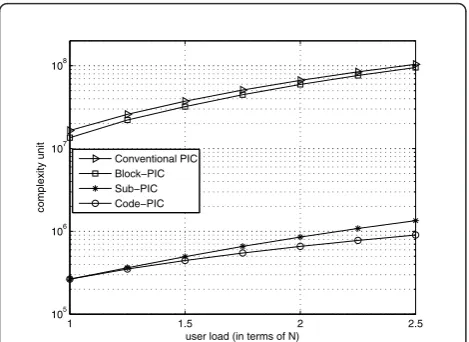
7 Complexity comparison
This section evaluates the computational complexities of conventional PIC [24], Block-PIC [24], Sub-PIC [25] and Code-PIC for multirate CI/MC-CDMA system over AWGN channel. Computational complexity per bit per-iod of PIC algorithm is computed in terms of number of HDR users (K1), number of LoDR users (K2), number of available subcarriers (N) and number of iterations (num_iter) [31]. We define the complexity unit as one real multiplication or one signed addition. More com-plex operation like division is considered as multiplica-tion operamultiplica-tion [32]. It is also assumed that the sgn(.)
operation and binary comparison require no additional computational complexity [32].
In multirate CI/MC-CDMA, it is assumed that there are
K1HDR users andK2 LoDR users (K1+K2≥3N). The number of LoDR users inUi, (i= 2,3,4,5) set equals to
K2/4. In a given bit period, the total computational com-plexity of multistage PIC detector can be expressed as
CTOTAL=num iter×CPIC+Cx (50)
where CPIC is the complexity of one iteration for the
hard decision PIC, and Cx is additional computation required for soft decision PIC technique (equals to zero if only hard decision is used). Table 1 shows the CPIC of
one iteration for the four PIC schemes.
In conventional PIC, computation complexity isN[K1
+K2 + 1)N+ 1] (K1 +K2) per iteration for (K1 +K2) users. From Table 2 and Figure 8, it is observed that complexity of Block-PIC is almost same as conventional PIC, which is also reported in [24]. In Sub-PIC, MAI is estimated and subtracted at subcarrier level. So, compu-tational complexity is reduced compared to Block-PIC and conventional PIC schemes. In Code-PIC, computa-tion required to estimate the MAI is significantly reduced by the proper selection of the interfering user sets. This further simplifies the subtraction of MAI. Hence, the computation complexity CCCC is signifi-cantly less for Code-PIC compared to other schemes. It is also observed from Table 2 that for a given system load, complexity of Code-PIC is significantly less than conventional PIC and Block-PIC. Further, it is observed from Figure 8 that the complexity of Code-PIC is com-parable to Sub-PIC up to a system load of about 1.5N
and for higher loads Code-PIC outperforms Sub-PIC.
8 Conclusion
In this paper, Code-PIC scheme is introduced for multi-rate CI/MC-CDMA system. The performance is com-pared with Block-PIC and Sub-PIC with hard and soft estimates of received data bits over AWGN and fre-quency selective Rayleigh fading channels. The proposed scheme provides significant performance improvement with less complexity and reduced latency compared to PIC schemes like Block-PIC and Sub-PIC. In frequency selective channel for 2N multirate system (N = 64), SDCode-PIC ensures SNR gain of 6 dB and 2 dB com-pared to SDBlock-PIC and SDSub-PIC, respectively, at a BER of 5e-04. From the results, we conclude that Code-PIC is a powerful technique to reduce MAI for multirate CI/MC-CDMA system over frequency selective channel with overloaded condition. It will be interesting to
Table 1 Complexity per iteration(CPIC)for four PIC schemes
PIC Scheme Complexity
Conventional PIC
N[(K1+K2+ 1)N+ 1](K1+K2)
Block-PIC N[(log(K1+K2) - 1)N+ 1]log(K1+K2)
+N[(K1+K2-log(K1+K2) - 1)N+ 1](K1+K2-log(K1+ K2))
Sub-PIC [N(K1+K2) + 1]( K1
4 +K2) + [N(K1+ 1) + 1] 3K1
4
Code-PIC [N(K1+K2) + 1] K1
4+ [N(K1+ 1) + 1] 3K1
4 + [N(K1+ K2
4−1) + 1]K2
Table 2(CPIC)of the 1st iteration for different PIC schemes
PIC System load
1N 1NHDR
1.5N
1NHDR+0.50NLoDR 2N
1N HDR+1N LoDR
2.25N
1NHDR+1.25NLoDR
2.5N
1NHDR+1.5NLoDR
Conventional PIC 16519168 37361664 66592768 84354048 104212480
Block-PIC 22133254 32088263 59484359 76328135 95269063
Sub-PIC 363600 494688 855168 1084560 1346720
evaluate the performance of this scheme under imper-fect timing and frequency synchronization over non-ideal channel conditions. The SNR penalty can be reduced further by using suitable error correcting codes.
Acknowledgements
The authors would like to thank the anonymous reviewers for their constructive comments.
Competing interests
The authors declare that they have no competing interests.
Received: 13 April 2011 Accepted: 2 November 2011 Published: 2 November 2011
References
1. S Verdu,Multiuser Detection(Cambridge: Cambridge University Press, 1998) 2. A Kocian, B Fleury, EM -based joint data detection and channel estimation
of DS- CDMA signals. IEEE Transactions on Communications51(10), 1709–1720 (2003). doi:10.1109/TCOMM.2003.818091
3. G Woodward, R Ratasuk, M Honig, P Rapajic, Minimum mean-squared error multiuser decision-feedback detectors for DS-CDMA. IEEE Transactions on Communications50(12), 2104–2112 (2002). doi:10.1109/
TCOMM.2002.806550
4. A Kapur, M Varanasi, Multiuser detection for overloaded CDMA systems. IEEE Transactions on Information Theory49(7), 1728–1742 (2003). doi:10.1109/TIT.2003.813562
5. P Patel, J Holtzman, Analysis of a simple successive interference cancellation scheme in a DS/CDMA system. IEEE Journal on Selected Areas in Communications12(5), 796–807 (1994). doi:10.1109/49.298053 6. D Divsalar, M Simon, D Raphaeli, A new approach to parallel interference
cancellation for CDMA, inIEEE GLOBECOM3, 1452–1457 (1996)
7. D Divsalar, M Simon, D Raphaeli, Improved parallel interference cancellation for CDMA. IEEE Transactions on Communications46(2), 258–268 (1998). doi:10.1109/26.659484
8. M Mostofa, K Howlader, B Woerner, Iterative interference cancellation and decoding using a soft cancellation factor for DS-CDMA, inIEEE VTC.3, 2076–2080 (2000)
9. RR Muller, JB Huber, Iterated Soft-Decision Interference Cancellation for CDMA, inBroadband Wireless Communications, ed. by Luise and Pupolin (Springer, 1998), pp. 110–115
10. W Zha, S Blostein, Soft-decision multistage multiuser interference cancellation. IEEE Transactions on Vehicular Technology52(2), 380–389 (2003)
11. W Hamouda, P McLane, A fast adaptive algorithm for MMSE receivers in DS- CDMA systems. IEEE Signal Processing Letters11(2), 86–89 (2004). doi:10.1109/LSP.2003.819855
12. R de Lamare, R Sampaio-Neto, A Hjorungnes, Joint iterative interference cancellation and parameter estimation for CDMA systems. IEEE Communications Letters11(12), 916–918 (2007)
13. R de Lamare, R Sampaio-Neto, Minimum Mean-Squared Error Iterative Successive Parallel Arbitrated Decision Feedback Detectors for DS-CDMA Systems. IEEE Transactions on Communications56(5), 778–789 (2008) 14. N Correal, R Buehrer, B Woerner, Improved CDMA performance through
bias reduction for parallel interference cancellation, inIEEE PIMRC97, 565–569 (1997)
15. P Renucci, B Woerner, Optimisation of soft interference cancellation for DS-CDMA. Electronics Letters34(8), 731–733 (1998). doi:10.1049/el:19980512 16. D Djonin, V Bhargava, New results on low complexity detectors for
over-saturated CDMA systems, inIEEE GLOBECOM.2, 846–850 (2001) 17. F Vanhaverbeke, M Moeneclaey, H Sari, Increasing CDMA capacity using
multiple orthogonal spreading sequence sets and successive interference cancellation, inIEEE International Conference on Communications.3, 1516–1520 (2002)
18. P Kumar, S Chakrabarti, A New Overloading Scheme for Cellular DS-CDMA using Orthogonal Gold Codes.IEEE VTC, 1042–1046 (2008)
19. P Kumar, S Chakrabarti, An Analytical Model of Iterative Interference Cancellation Receiver for Orthogonal/Orthogonal Overloaded DS-CDMA System. Springer’s International Journal of Wireless Information Networks 17, 64–72 (2010). doi:10.1007/s10776-010-0112-2
20. YP Tu, WH Fang, HY Lu, YT Chen, Iterative Multiuser Detection with Soft Interference Cancellation for Multirate MC-CDMA Systems.IEEE VTC, 708–712 (2008)
21. B Natarajan, C Nassar, S Shattil, M Michelini, Z Wu, High-performance MC-CDMA via carrier interferometry codes. IEEE Transactions on Vehicular Technology50(6), 1344–1353 (2001). doi:10.1109/25.966567
22. D Wiegandt, Z Wu, C Nassar, High-throughput, high-performance OFDM via pseudo-orthogonal carrier interferometry spreading codes. IEEE Transactions on Communications51(7), 1123–1134 (2003). doi:10.1109/
TCOMM.2003.814196
23. M Michelini, S Hijazi, C Nassar, Z Wu, Spectral sharing across 2G-3G systems, inConference Record of the Thirty-Seventh Asilomar Conference on Signals, Systems and Computers, 2003.1, 13–17 (2003)
24. V Thippavajjula, B Natarajan, Parallel interference cancellation techniques for synchronous carrier interferometry/MC-CDMA uplink 4G cellular systems, in
IEEE VTC.1, 399–403 (2004)
25. SP Maity, M Mukherjee, Subcarrier PIC Scheme for High Capacity CI/MC-CDMA System with Variable Data Rates. IEEE Mobile WiMAX Symposium0, 135–140 (2009)
26. W Xu, LB Milstein, Performance of multicarrier DS-CDMA systems in the presence of correlated fading, inIEEE VTC.3, 2050–2054 (1997) 27. A Akansu, M Tazebay, M Medley, P Das, Wavelet and subband transforms:
fundamentals and communication applications. IEEE Communications Magazine35(12), 104–115 (1997). doi:10.1109/35.642839
28. Y Lee, N Kim, H Park, Performance of MC-CDMA Systems With MMSEC Over Rayleigh Fading Channels. IEEE Transactions on Vehicular Technology59(6), 3126–3130 (2010)
29. M Mukherjee, P Kumar, A New Code Allocation Algorithm for Multirate CI/ MC-CDMA System.IEEE Conference on Communication Systems and Networks (COMSNETS), 1–6 (2011)
30. M Mukherjee, P Kumar, A New Iterative Soft Decision Subcarrier PIC scheme for CI/MC-CDMA system.IEEE PIMRC 2010 Fundamentals and PHY (PIMRC 2010 Track 1), 767–772 (2010)
31. R Buehrer, N Correal-Mendoza, B Woerner, A simulation comparison of multiuser receivers for cellular CDMA. IEEE Transactions on Vehicular Technology49(4), 1065–1085 (2000). doi:10.1109/25.875213 32. IDR Brown, Multistage parallel interference cancellation: convergence
behavior and improved performance through limit cycle mitigation. IEEE Transactions on Signal Processing53, 283–294 (2005)
doi:10.1186/1687-1499-2011-155
Cite this article as:Mukherjee and Kumar:A novel code-based iterative PIC scheme for multirate CI/MC-CDMA communication.EURASIP Journal on Wireless Communications and Networking20112011:155.
1 1.5 2 2.5
105 106 107 108
user load (in terms of N)
complexity unit
Conventional PIC Block−PIC Sub−PIC Code−PIC