221
Sequence-to-Sequence Models for Data-to-Text Natural Language
Generation: Word- vs. Character-based Processing and Output Diversity
Glorianna Jagfeld, Sabrina Jenne, Ngoc Thang Vu Institute for Natural Language Processing (IMS)
Universit¨at Stuttgart, Germany
{jagfelga,beersa,thangvu}@ims.uni-stuttgart.de
Abstract
We present a comparison of word-based and character-based sequence-to-sequence models for data-to-text natural language generation, which generate natural lan-guage descriptions for structured inputs. On the datasets of two recent generation challenges, our models achieve compa-rable or better automatic evaluation re-sults than the best challenge submissions. Subsequent detailed statistical and human analyses shed light on the differences be-tween the two input representations and the diversity of the generated texts. In a controlled experiment with synthetic train-ing data generated from templates, we demonstrate the ability of neural models to learn novel combinations of the templates and thereby generalize beyond the linguis-tic structures they were trained on.
1 Introduction
Natural language generation (NLG) is an actively researched task, which according to Gatt and Krahmer (2018) can be divided into text-to-text generation, such as machine translation (Koehn,
2017), text summarization (See et al., 2017), or open-domain conversation response genera-tion (Vinyals and Le,2015) on the one hand, and data-to-text generation on the other hand. Here, we focus on the latter, the task of generating tex-tual descriptions for structured data. Data-to-text generation comprises the generation of system re-sponses based on dialog acts in task-oriented dia-log systems (Wen et al.,2015b), sport games re-ports and weather forecasts (Angeli et al.,2010), and database entry descriptions (Gardent et al.,
2017a). In this paper, we focus on sentence plan-ning and surface realization. We build on
data-to-text datasets of two recent shared tasks for end-to-end NLG, namely the E2E challenge (Novikova et al., 2017b) and WebNLG challenge (Gardent et al., 2017b). Example input-text pairs for both datasets are shown in Figure1.
Neural sequence to sequence (Seq2Seq) mod-els (Graves, 2013; Sutskever et al., 2014) have shown promising results for this task, especially in combination with an attention mechanism ( Bah-danau et al.,2014;Luong et al.,2015). Several re-cent NLG approaches (Duˇsek and Jurc´ıcek,2016;
Mei et al.,2016;Kiddon et al.,2016;Agarwal and Dymetman,2017), as well as most systems in the E2E and WebNLG challenge are based on this ar-chitecture. While most NLG models generate text word by word, promising results were also ob-tained by encoding the input and generating the output text character-by-character (Lipton et al.,
2015;Goyal et al.,2016;Agarwal and Dymetman,
2017). Five out of 62 E2E challenge submissions operate on the character-level. However, it is diffi-cult to draw conclusions from the challenge results with respect to this difference, since the submitted systems also differ in other aspects and were eval-uated on a single dataset only.
E2E input:name[Midsummer House], customer rating [average], near [The Bakers]
reference 1:Customers gave Midsummer House, near The Bakers, a 3 out of 5 rating.
reference 2:Midsummer house has an average customer rating and is near The Bakers.
delexicalized input:name[NAME], customer rating [average], near [NEAR] delexicalized reference 1:Customers gaveNAME, nearNEAR, a 3 out of 5 rating.
WebNLG input:cityServed(Abilene Regional Airport[Abilene]), isPartOf(Abilene[Texas])
reference 1:Abilene is in Texas and is served by the Abilene regional airport.
reference 2:Abilene, part of Texas, is served by the Abilene regional airport.
delexicalized input:city served(AGENT-1[BRIDGE-1]), is part of(BRIDGE-1[PATIENT-1]) delexicalized reference 1:BRIDGE-1 is inPATIENT-1 and is served by theAGENT-1.
Figure 1: Example input-reference pairs from the E2E and WebNLG development set.
generate novel structures resulting from template combinations.
In sum, we make the following contribution:
• We compare word- and character-based Seq2Seq models for NLG on two datasets.
• We conduct an extensive automatic and man-ual analysis of the generated texts and com-pare them to human performance.
• In an experiment with synthetic training data generated from templates, we demonstrate the ability of neural NLG models to learn template combinations and thereby general-ize beyond the linguistic structures they were trained on.
2 Related Work
This section reviews relevant related work accord-ing to the two main aspects of this paper: differ-ent input and output represdiffer-entations for data-to-text NLG as well as measuring and controlling the variation in the generated outputs.
2.1 Input and Output Representations
While the first NLG systems relied on hand-written rules or templates that were filled with the input information (Cheyer and Guzzoni,2006;
Mirkovic et al., 2006), the availability of larger datasets has accelerated the progress in statistical methods to train NLG systems from data-text pairs in the last twenty years (Oh and Rudnicky,2000;
Mairesse and Young, 2014). Generating output via language models based on recurrent neural net-works (RNNs) conditioned on the input (Sutskever et al.,2011) proved to be an effective method for end-to-end NLG (Wen et al.,2015a,b,2016).
The input can be represented in several ways: (1) In a discrete vector space via one-hot-vectors (Wen et al., 2015a,b), or in a continuous space either (2) by encoding fixed-size input in-formation in a feed-forward neural network (Zhou et al., 2017; Wiseman et al., 2017) or (3) by the means of an encoder RNN, which processes variable-sized inputs sequentially, giving rise to the Seq2Seq architecture.
Character-based Seq2Seq models were first pro-posed for neural machine translation (Ling et al.,
2015;Chung et al.,2016;Lee et al.,2017). Their main advantage over word-based models is that they can represent an unlimited word inventory with a small vocabulary. They can learn to copy any string from the input to the output, which is especially useful for data-to-text NLG, as informa-tion from the input such as the name of a restau-rant or a database entity is often expected to ap-pear verbatim in the generated text. Word-based models, in contrast, have to make use of delexical-ization during pre- and postprocessing (Wen et al.,
2015b;Duˇsek and Jurc´ıcek,2016) or have to apply dedicated copy mechanisms (Gu et al.,2016;See et al.,2017;Wiseman et al.,2017) to handle open vocabularies. The other side of the coin is that se-quences are much longer in character-based pro-cessing, implying longer dependencies and more computation steps for encoding and decoding.
Subword-based representations (Sennrich et al.,
found them to perform much worse than word-or character-based representations. Our impres-sion is that recurring entity names in the training data coming from multiple reference texts for the same input lead to overfitting on the training vo-cabulary and to poor generalization to novel in-puts. This is also reflected by the rather unsatisfy-ing performance of subword-based approaches in the E2E1 and WebNLG challenge (ADAPT sys-tem (Gardent et al.,2017b)).
2.2 Output Diversity
Evaluation of data-to-text NLG has traditionally centered around semantic fidelity, grammaticality, and naturalness (Gatt and Krahmer, 2018;Oraby et al., 2018b). More recently, the controllability of the style of the outputs and their variation has moved into focus as well (Ficler and Goldberg,
2017;Herzig et al.,2017;Oraby et al.,2018b,a).
Oraby et al.(2018b) showed that the n-gram en-tropy of the outputs of a neural NLG system is sig-nificantly lower compared to its training data. This can be seen as evidence that the NLG system ex-tracts only a few dominant patterns from the train-ing data that it will generate over and over. With-out explicit supervision signals, neural NLG mod-els cannot distinguish linguistic or stylistic vari-ation from noise. In the context of image cap-tion generacap-tionDevlin et al.(2015) found Seq2Seq models to exactly reproduce sentences from their training data for 60% of the test instances.
Several approaches have been proposed to con-trol NLG outputs with respect to certain stylistic aspects, e.g., mimicking a specific persona or char-acter (Lin and Walker,2011;Walker et al.,2011;
Li et al., 2016), personality traits (Mairesse and Walker, 2008; Herzig et al., 2017; Oraby et al.,
2018b,a), or various linguistic aspects such as for-mality, voice, descriptiveness (Ficler and Gold-berg,2017;Bawden,2017;Niu et al.,2017). All share the feature that the NLG model is condi-tioned on a representation of the desired aspect in addition to the usual semantic input representa-tion. While this approach makes it possible to suc-cessfully control particular, clearly defined aspects of the generated texts, further research is needed to grant more flexible and comprehensive NLG out-put control.
1The subword-based
bzhang submitsystem has the sec-ond best ROUGE-L score, but ranks poorly in terms of BLEU and quality in the human evaluation, see http://www.macs. hw.ac.uk/InteractionLab/E2E/#results.
3 Models
To encode variable-length inputs and generate variable-length texts, we implement a standard Seq2Seq model (Cho et al., 2014) with Long Short-Term Memory (LSTM) cells (Hochreiter and Schmidhuber, 1997) and attention. Given a training dataset of input-text pairs D =
{(x1,y¯1),(x2,y¯2). . .}, the model encodes an in-put sequencex = {x1. . . xn}of symbolsxi into
a sequence of hidden states{h1. . . hn}by
apply-ing a recurrent neural network (RNN) with LSTM cells that can store and forget sequence informa-tion:
ht=LSTM(Xinxt, ht−1) (1)
The decoder generates the output se-quencey1. . . ymone symbolytat a time by
com-putingp(yt|y1. . . yt−1, x) =softmax(Wout(ct)).
The decoder output ct, also referred to as
con-text vector, summarizes the input information in each decoding step as weighted sum of the en-coder hidden states: ct =Pni=1αtihi. The
atten-tion weightsαtiare computed with the general
at-tention mechanismαti = softmax(stWahi)(
Lu-ong et al.,2015). The decoder hidden statesstare
computed recursively based on the previous output token and decoder output:
st=LSTM((Xout(yt−1)◦ct−1), st−1) (2)
s0is initialized to the final encoder hidden state hn,h0, c−1are initialized to 0;◦denotes concate-nation. The parameters of the models are the input and output embedding matricesXin,Xout, the
en-coder and deen-coder LSTM parameters, the attention matrixWa and the output matrixWout. They are optimized by minimizing the cross entropy of the generated textsyjwith the given referencesy¯jfor
each example in the training set.
Instead of forcing the decoder to decide on a single output symbol in each decoding step, we apply beam search (Cho et al., 2014; Bahdanau et al., 2014) to explore n-best partial hypotheses in parallel.
In the word-based model, each input symbolxt
and output symbolytdenotes a token. In contrast,
4 Data
We use two recently collected crowd-sourced data-to-text datasets since they are larger and offer more linguistic variety than previously available datasets (Novikova et al., 2017b; Gardent et al.,
2017a). The E2E dataset (Novikova et al.,2017b) consists of 47K restaurant descriptions based on 5.7K distinct inputs of 3-8 attributes (name, area, near, eat type, food, price range, family friendly, rating), split into 4862 inputs for training, 547 for development and 630 for testing. The WebNLG dataset (Gardent et al.,2017a) contains 25K ver-balizations of 9.6K inputs composed of 1-7 DB-pedia triples from 15 categories such asathletes, comic characters, food, sport teams. It is divided into 6893 inputs for training, 872 for development and 1862 for testing. Both datasets have multiple verbalizations for each input. On average there are 8.3 (min. 1, max. 46) verbalizations per input in the E2E dataset and 2.63 (min. 1, max. 12) in the WebNLG dataset, respectively.
To preprocess both datasets, we lowercase all inputs and references and represent the inputs in the bracketed format as shown in Figure1. For the word-based processing we additionally tokenize the texts with the nltk-tokenizer (Bird et al.,2009) and apply delexicalization, as also illustrated in Figure1. For the E2E dataset we adopt the chal-lenge’s baseline delexicalization strategy (Duˇsek and Jurc´ıcek,2016), which replaces the values of the two open-class attributes name and near in the input and references by placeholders. For the WebNLG dataset, we adopt the delexicalization strategy of the TILBURGsubmissions to the
chal-lenge, since it performed well and does not require external information. They replaced the subject and object entities of the DBpedia triples in the input and text by numbered placeholdersAGENT
-N,PATIENT-N, BRIDGE-N, depending on whether they only appear as subject, object or in both roles in the input of an instance. Additionally, we split properties at the camel case in this dataset for both the word- and character-based models as proposed by the ADAPTand MELBOURNEsubmissions. Ta-ble1displays statistics for both datasets and pro-cessing types.
5 Experiments
We conduct our experiments with the OpenNMT toolkit (Klein et al., 2017), which we extend to also perform character-based processing. We
E2E WebNLG word char. word char.
[image:4.595.312.524.61.141.2]avg. input length 28.5 106.0 24.8 139.8 avg. text length 20.0 109.3 18.8 117.1 input vocabulary 48 39 312 78 output vocabulary 2,721 53 4,264 83
Table 1: E2E and WebNLG training split statis-tics for word-based processing after delexicaliza-tion and character-based processing.
tuned the hyperparameters for each dataset and processing method to optimize the BLEU score on the development sets. The word-based model for the E2E dataset is trained by stochastic gradient descent (SGD) (Robbins and Monro,1951) and an initial learning rate of 1.0. For all other models, we achieved better performance with the Adam optimizer (Kingma and Ba,2015) with an initial learning rate of 0.001. If there is no improvement in the development perplexity, or in any case after the eighth epoch, we halve the learning rate. Also, we clip all gradients to a maximum of five. We use a batch size of 64. To prevent overfitting, we drop out units in the context vectors with a prob-ability of 0.3. We keep the model with the lowest development perplexity in 13 training epochs.
The word-based E2E model has 64-dimensional word embeddings and a single encoder and de-coder layer with 64 units each. All other models use 500-dimensional word- or character embed-dings and two layers in the encoder and decoder with 500 dimensions each. While a unidirectional encoder was sufficient for the word-based mod-els, bidirectional encoders were beneficial for the character-based models on both datasets.
We use a beam size of 15 for decoding with the word-based models, and found a smaller beam of five to yield better results for the character-based models. This is probably due to the much smaller vocabulary size of the character-based models.
For automatic evaluation, we report BLEU ( Pa-pineni et al.,2002), which measures the precision of the generated n-grams compared to the refer-ences, and recall-oriented ROUGE-L (Lin,2004), which measures the longest common subsequence between the generated texts and the references. We compute these scores with the E2E challenge evaluation script2.
6 Results and Analysis
Table2 and3display the results on the E2E and WebNLG test sets for models of the respective challenges and our own models3. Since the perfor-mance of neural models can vary considerably due to random parameter initialization and random-ized training procedures (Reimers and Gurevych,
2017), we train ten models with different random seeds for each setting and report the average (avg) and standard deviation (SD).
On the E2E test set, our single best word- and character-based models reach comparable results to the best challenge submissions. The word-based models achieve significantly higher BLEU and ROUGE-L scores than the character-based models4. On the WebNLG test set, the BLEU score of our best word-based model outperforms the best challenge submission by a small mar-gin. The character-based model achieves a sig-nificantly higher ROUGE-L score than the word-based model, whereas the BLEU score difference is not significant. In the following, we analyze our models in more detail.
6.1 Analysis of Within-Model Performance Differences
The large performance span of the character-based models on the E2E dataset is due to a single outlier model; the second worst model scores 64.5 BLEU points. The worst-scoring model had a lower ac-curacy of 91.8% on the development set, whereas all other models scored above 92.2%. To gain more insight on what might constitute the large performance difference, we manually compared the generated texts for ten randomly selected in-puts for each number of attributes (60 inin-puts in to-tal) of the character-based model with the best and worst BLEU score. We found that the worst model makes many mistakes on inputs with three to five attributes, often adding, modifying or removing information, whereas the outputs are mostly cor-rect for inputs with six attributes or more. For these, the outputs of the model with the low-est BLEU score are occasionally even better than those of the best model, which often omits
in-3For an exact comparison, we recomputed the
WebNLG challenge results with the E2E evaluation script. They are usually 1-2 points below the scores reported byGardent et al.(2017b).
4All tests for significance in this paper are conducted with
Wilcoxon rank sum tests with Bonferroni correction at a p-level of0.05.
formation (mainly concerning the attributefamily friendly). We conclude that the large performance difference might be caused by automatic evalua-tion measures punishing addievalua-tions more severely than omissions.
We also observe a large performance span for the WebNLG word-based models. Here, we have two models that score exceptionally well with 57.4/58.4 BLEU points, whereas the remaining eight models only obtain BLEU scores in a range of 43.8-48.1. Again, we observe that better models in terms of BLEU score obtain higher accuracies on the development set. We manually compared the outputs of ten randomly chosen inputs for each number of input triples (75 inputs in total) for the model with the highest and lowest BLEU score. In this case, we found that the large difference in the automatic evaluation measures seems jus-tified: The low-scoring model often hallucinates information not present in the input and generally produces many ungrammatical texts, which is not the case for the best model.
system BLEU ROUGE-L
challenge
baseline 65.9 68.5
Thomson Reuters (np 3) 68.1 69.3
Thomson Reuters (np 4) 67.4 69.8
HarvardNLP & H. Elder 67.4 70.8
own
word 67.8±0.8 70.4±0.6
character 64.6±6.0 67.9±4.7
word (best on dev.) 67.8 70.2
char. (best on dev.) 67.6 70.4
Table 2: E2E test set results. Own results corre-spond to avg±SD of ten runs and single result of best models on the development set.
6.2 Automatic Evaluation of Human Texts
system BLEU ROUGE-L
challenge
baseline 32.1 43.3
MELBOURNE 43.4 61.0
TILBURG-SMT 43.1 58.0
UPF-FORGE 37.5 58.8
own
word (best on dev.) 44.2 60.9
char. (best on dev.) 41.3 58.4
word 37.0±3.8 56.3±2.6
[image:6.595.76.286.61.233.2]character 39.7±1.7 58.4±0.7
Table 3: WebNLG test set results. Own results correspond to single best model on development set and avg±SD of ten runs.
character-based models5. Strikingly, on the E2E development set, both model variants significantly outperform human texts by far with respect to both automatic evaluation measures. While the human BLEU score is significantly higher than those of both systems on the WebNLG devel-opment set, there is no statistical difference be-tween human and system ROUGE-L scores. This further demonstrates the limited utility of BLEU and ROUGLE-L scores to evaluate NLG out-puts, which was previously suggested by weak correlations of such scores with human judg-ments (Scott and Moore, 2006;Reiter and Belz,
2009;Novikova et al., 2017a). Furthermore, the high scores on the E2E dataset imply that the mod-els succeed in picking up patterns from the train-ing data that transfer well to the similar develop-ment set, whereas human variation and creativity are punished by lexical overlap-based automatic evaluation scores.
6.3 Manual Error Analysis
Since the expressiveness of automatic evaluation measures for NLG is limited, as shown in the pre-vious subsection, we performed a manual error analysis on inputs of each length. We define the input length as the number of input attributes for the E2E dataset, ranging from three to eight, and number of input triples for the WebNLG dataset, ranging from one to seven. We randomly selected
5
For a fair comparison between human and model perfor-mance, we randomly removed one reference for each instance in the models’ evaluation to ensure the same average number of references. We excluded 55 WebNLG instances that had only one reference.
metric human word char.
E2E
BLEU 55.5±0.7 68.2±1.4 65.8±2.6 ROUGE-L 62.0±0.4 72.1±0.7 69.8±2.6
WebNLG
[image:6.595.308.527.63.188.2]BLEU 48.3±0.7 40.6±4.2 43.7±2.4 ROUGE-L 62.4±0.3 58.5±3.0 63.1±0.8
Table 4: E2E and WebNLG development set re-sults in the format avg±SD. Human results are av-eraged over using each human reference as predic-tion once.
E2E WebNLG
word char. word char.
content errors
info. dropped 40.0 30.0 42.9 66.7
info. added 0.0 0.0 6.7 1.9
info. modified 4.4 0.0 19.0 1.9
info. repeated 0.0 0.0 15.2 28.6
linguistic errors
punctuation errors 5.6 5.6 8.6 3.8 grammatical errors 13.3 14.4 15.2 12.4 spelling mistakes 0.0 0.0 9.5 5.7
overall correctness
content correct 55.6 70.0 46.7 31.4 language correct 83.3 81.1 69.5 79.0
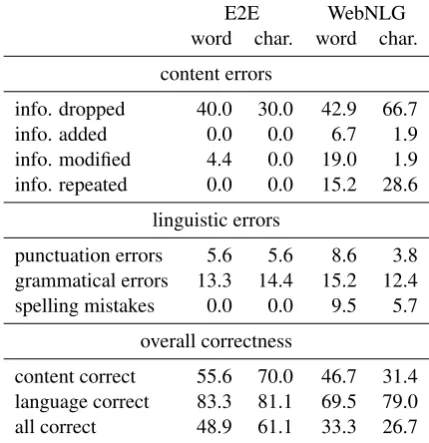
all correct 48.9 61.1 33.3 26.7
Table 5: Percentage of affected instances in man-ual error analysis of 15 randomly selected devel-opment set instances for each input length.
15 development instances for each input length, resulting in a total of 90 annotated E2E instances and 105 WebNLG instances.
One annotator (one of the authors of this paper) manually assessed the outputs of the models that obtained the best development set BLEU score as summarized in Table56. As we can see from the
bottom part of the table, all models struggle more with getting the content right than with produc-ing lproduc-inguistically correct texts; 70-80% of the texts generated by all models are completely correct lin-guistically.
6
[image:6.595.308.523.251.473.2]E2E WebNLG
human word character human word character
unique sents. 866.3±16.5 203.5±30.6 366.8±60.0 1,185.0±12.6 603.7±144.3 875.4±30.2 unique words 419.7±16.7 64.4±2.3 73.1±7.2 1447.3±7.4 620.3±35.5 881.5±26.0
word E 6.5±0.0 5.1±0.0 5.5±0.0 7.1±0.0 6.3±0.0 6.6±0.0
1-3-grams E 10.4±0.0 7.7±0.1 8.2±0.1 11.6±0.0 10.1±0.1 10.5±0.1 % new texts 99.7±0.2 98.2±0.3 98.8±0.2 91.1±0.3 69.8±4.8 87.5±0.6 % new sents. 85.1±1.1 61.8±6.4 71.4±4.7 87.4±0.4 57.2±5.8 82.1±1.2
Table 6: Linguistic diversity of development set references and generated texts as avg±SD. ‘% new’ de-notes the share of generated texts or sentences that do not appear in training references. Higher indicates more diversity for all measures.
Comparing the two datasets, we again observe that the WebNLG dataset is much more challeng-ing than the E2E dataset, especially with respect to correctly verbalizing the content. This can be at-tributed to the increased diversity of the inputs and texts and to the limited availability of training data for this dataset (cf. Table 1). Moreover, spelling mistakes only appeared in WebNLG texts, mainly concerning omissions of accents or umlauts. This also indicates that there is too few and noisy data for the models to learn the correct spelling of all words. Notably, we did not observe any non-words generated by the character-based models.
The most frequent content error in both datasets concerns omission of information. For the E2E dataset, the family friendly attribute is most fre-quently dropped by both model types, indicating that the verbalization of this boolean attribute is more difficult to learn than other attributes, whose values mostly appear verbatim in the text. Infor-mation modification of the word-based model is mainly due to confusingEnglishwithItalianfood. Information addition and repetition only occur in the WebNLG dataset. The latter is an especially frequent problem of the character-based model, af-fecting more than a quarter of all texts.
In comparison, character-based models repro-duce the content more faithfully on the E2E dataset while offering the same level of linguis-tic quality as word-based models, leading to more correct outputs overall. On the WebNLG dataset, the word-based model is more faithful to the in-puts, probably because of the effective delexi-calization strategy, whereas the character-based model errs less on the linguistic side. Overall, the word-based model yields more correct texts, stressing the importance of delexicalization and data normalization in low resource settings.
6.4 Automatic Evaluation of Output Diversity
While correctness is a necessity in NLG, in many settings it is not sufficient. Often, variation of the generated texts is crucial to avoid repetitive and unnatural outputs. Table 6 shows automatically computed statistics on the diversity of the gener-ated texts of both models and human texts and on the overlap of the (generated) texts with the training set. We measure diversity by the num-ber of unique sentences and words in all develop-ment set references and generated texts, as done e.g. byDevlin et al.(2015). Additionally, we re-port the Shannon text entropy as measure of the amount of variation in the texts following (Oraby et al.,2018b). We compute the text entropy E for words (unigrams) and uni-, bi-, and trigrams as follows:
E=−X w∈V
f(w) total ∗log2
f(w)
total (3)
whereV is the set of all word types or uni-, bi-and trigrams,f denotes frequency and total is the token count or total number of uni-, bi- and tri-grams in the texts, respectively.
To measure the extent by which the models geralize beyond plugging in restaurant or other en-tity names into templates extracted from the train-ing data, we compute the results on the delexical-ized outputs of the word-based models and delex-icalize the character-based models’ outputs. For the human scores, we generatenartificial predic-tion files, treating eachn-th reference (42 for E2E, 8 for WebNLG) as reference, apply delexicaliza-tion, and average the scores for thenfiles.
Template 1:NAME:::::::is::a:::::::::::::::::::[FAMILY-FRIENDLY]::::::::EATTYPEwhich serves [FOOD] food [in thePRICE RANGE price range].[It:::::has::a:::::::RATING:::::::rating]::::[and::is:::::::located::in:::the::::::AREA::::::area[,::::near::::::::NEAR]]. [It is notFAMILY -FRIENDLY.]
Example: NAMEis a family-friendly coffee shop which serves Chinese food in the low price range. It
has a high customer rating and is located in the city centre area, nearNEAR.
Template 2: The [FAMILY-FRIENDLY]EATTYPE NAME serves [FOOD] food [in the PRICE RANGE
price range]. [It is located in theAREAarea[, nearNEAR].] [It has aRATINGrating.][It is notFAMILY
-FRIENDLY.]
Example: The family-friendly coffee shop NAME serves Chinese food in the low price range. It is
located in the city centre area, nearNEAR. It has a high customer rating.
Learned combinations of Template 1 and 2:
• NAME:::::::is::a:::::::::restaurantwhich serves English food in the moderate price range. It is located in the city centre area, nearNEAR. It has a customer rating of 1 out of 5.It is not family friendly.
•The family-friendly pubNAMEserves Indian food in the low price range.::It:::has::a::::::::customer::::::rating::of::5
:::
out::of::5::::and::is::::::located:::in:::the::::::::riverside:::::area,::::near::::::NEAR.
Figure 2: Templates used for synthetic training data generation, parts in brackets are realized only if the input contains the corresponding attribute. Learned combinations are two template combinations produced by a model trained on data generated from both templates.
texts and sentences from the training data than the human texts. Interestingly, however, the character-based models generate significantly more unique sentences and copy significantly less from the training data than the word-based models, which copy about 40% of their generated sentences from the training data.
7 Generalizing from Templates
In search for empirical evidence that neural mod-els are able to surpass the structures they were trained on, we train Seq2Seq models with syn-thetic training data created by templates. This enables us to control the variation in the training data and identify novel generations of the model (if any). We investigate two questions: (1) Do the neural NLG models indeed accurately learn the templates from the training data? (2) Do they learn to combine the training templates to produce more varied outputs than seen during training?
We generate synthetic training data based on two templates. Template 1 corresponds to UKP-TUDA’s submission to the E2E challenge7, where the order of describing the input information is fixed. Specifically, the restaurant’s customer rat-ing is always mentioned before its location. For Template 2, we change the the beginning of the template and switch the order of mentioning the
7https://github.com/UKPLab/e2e-nlg-challenge-2017/
blob/master/components/template-baseline.py
rating and location of the restaurant as shown in Figure 2. Potential combinations of the two templates are to combine the beginning of Tem-plate 1 with the ordering of rating and area of Template 2 or vice versa. We generate a single reference text for all 2261 training inputs of the E2E dataset where the NAME and EATTYPE at-tribute are present as these are the two obliga-tory attributes for the templates. We train word-based models on training data generated with Template 1, Template 2 and the concatenation of the training data from Template 1 and 2. To keep the amount of training data equal in all experi-ments, we once repeat the training corpus gener-ated only with Template 1 or Template 2. The hy-perparameters for the three models can be found in the appendix.
c@1 c@2 c@5 c@30
template 1 0.8 0.8 0.9 1.7
template 2 1.0 1.2 1.3 1.9
template 1+2 0.9 1.6 2.2 3.3
[image:8.595.307.511.599.675.2]+ reranker 0.9 1.9 2.7 3.3
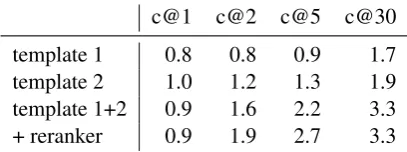
Table7shows our manual evaluation of the top 30 hypotheses for 10 random E2E test inputs gen-erated by models trained with data synthesized from the two templates. As is evident from the first two rows, all models learned to generalize from the training data to produce correct texts for novel inputs consisting of unseen combinations of input attributes. It was verified in the manual evaluation that 100% of the texts generated by models trained on a single template adhered to this template. Yet, the picture is a bit different for the model trained on data generated by both templates. While the top two hypotheses are equally distributed between adhering to Template 1 and Template 2, more than 5% among the lower-ranked hypotheses consti-tute a template combination such as the example shown in the bottom part of Figure2. For 60% of the examined inputs, there was at least one such hypothesis resulting from template combination, of which two thirds were actually correct verbal-izations of the input.
Since we found that the models frequently ranked correct hypotheses below hypotheses with content errors, we implemented a simple rule-based reranker rule-based on verbatim matches of at-tribute values. The reranker assigns an error point to each omission and addition of an attribute value. As can be seen in the final row of Table7, this sim-ple reranker successfully places correct hypothe-ses higher up in the ranking, improving the prac-tical usability of the generation model by now of-fering almost three correct variants for each input among the top five hypotheses on average.
8 Conclusion
We compared word-based and character-based Seq2Seq models for data-to-text NLG on two datasets and analyzed their output diversity. Our main findings are as follows: Overall, Seq2Seq models can learn to verbalize structured inputs in a decent way; their success depends on the extent of the domain and available (clean) training data.
Second, in a comparison with texts produced by humans, we saw that neural NLG models can even surpass human performance in terms of automatic evaluation measures. On the one hand, this un-veils the ability of the models to extract general patterns from the training data that approximate many reference texts, but on the other hand also once more stresses the limited utility of such mea-sures to evaluate NLG systems.
Third, in light of the multi-faceted analysis we performed, it is difficult to draw a general con-clusion on whether word- or character-based pro-cessing is more useful for data-to-text generation. Both models yielded comparable results with re-spect to automatic evaluation measures. In the manual error analysis, the character-based model performed better on the E2E dataset, whereas the word-based model generated more correct outputs on the WebNLG dataset. Character-based models were found to have a significantly higher output diversity.
Finally, in a controlled experiment with word-based Seq2Seq models trained on data synthesized from templates, we showed the capability of such models to perfectly reproduce the templates they were trained on. More importantly, models trained on two templates could generalize beyond their training data and come up with novel texts. In fu-ture work, we would like to extend this line of re-search and train more model variants on a higher number of templates.
References
Shubham Agarwal and Marc Dymetman. 2017. A sur-prisingly effective out-of-the-box char2char model on the e2e nlg challenge dataset. InProceedings of the 18th Annual SIGdial Meeting on Discourse and Dialogue, pages 158–163, Saarbr¨ucken, Germany.
Gabor Angeli, Percy Liang, and Dan Klein. 2010. A simple domain-independent probabilistic approach
to generation. InProceedings of the 2010
Confer-ence on Empirical Methods in Natural Language Processing, EMNLP ’10, pages 502–512, Strouds-burg, PA, USA.
Dzmitry Bahdanau, Kyunghyun Cho, and Yoshua Ben-gio. 2014. Neural Machine Translation by Jointly Learning to Align and Translate. arXiv e-prints, abs/1409.0473.
Rachel Bawden. 2017.Machine translation, it’s a ques-tion of style, innit? the case of english tag quesques-tions. InProceedings of the 2017 Conference on Empirical Methods in Natural Language Processing, EMNLP 2017, pages 2507–2512, Copenhagen, Denmark.
Steven Bird, Ewan Klein, and Edward Loper. 2009. Natural Language Processing with Python, 1st edi-tion. O’Reilly Media, Inc.
Adam Cheyer and Didier Guzzoni. 2006. Method and apparatus for building an intelligent automated as-sistant. Patent US 11/518,292 (Patent pending).
phrase representations using rnn encoder–decoder for statistical machine translation. InProceedings of the 2014 Conference on Empirical Methods in Nat-ural Language Processing (EMNLP), pages 1724– 1734, Doha, Qatar.
Junyoung Chung, Kyunghyun Cho, and Yoshua Ben-gio. 2016. A character-level decoder without ex-plicit segmentation for neural machine translation. InProceedings of the 54th Annual Meeting of the As-sociation for Computational Linguistics, ACL 2016, Volume 1: Long Papers, pages 1693–1703, Berlin, Germany.
Jacob Devlin, Hao Cheng, Hao Fang, Saurabh Gupta, Li Deng, Xiaodong He, Geoffrey Zweig, and Mar-garet Mitchell. 2015. Language models for image captioning: The quirks and what works. In Pro-ceedings of the 53rd Annual Meeting of the Associ-ation for ComputAssoci-ational Linguistics and the 7th In-ternational Joint Conference on Natural Language Processing of the Asian Federation of Natural Lan-guage Processing, ACL 2015, Volume 2: Short Pa-pers, pages 100–105, Beijing, China.
Ondˇrej Duˇsek and Filip Jurc´ıcek. 2016. Sequence-to-sequence generation for spoken dialogue via deep syntax trees and strings. InProceedings of the 54th Annual Meeting of the Association for Computa-tional Linguistics, ACL 2016, Volume 2: Short Pa-pers, pages 41–51, Berlin, Germany.
Jessica Ficler and Yoav Goldberg. 2017. Controlling linguistic style aspects in neural language genera-tion.CoRR, abs/1707.02633.
Claire Gardent, Anastasia Shimorina, Shashi Narayan, and Laura Perez-Beltrachini. 2017a. Creating
train-ing corpora for NLG micro-planners. In
Proceed-ings of the 55th Annual Meeting of the Association for Computational Linguistics, ACL 2017, Volume 1: Long Papers, pages 179–188, Vancouver, Canada.
Claire Gardent, Anastasia Shimorina, Shashi Narayan, and Laura Perez-Beltrachini. 2017b. The WebNLG
Challenge: Generating Text from RDF Data. In
Proceedings of the 10th International Conference on Natural Language Generation, pages 124–133, San-tiago de Compostela, Spain.
Albert Gatt and Emiel Krahmer. 2018. Survey of the state of the art in natural language generation: Core tasks, applications and evaluation.Journal of Artifi-cial Intelligence Research (JAIR), 61:65–170.
Raghav Goyal, Marc Dymetman, and ´Eric Gaussier. 2016. Natural language generation through character-based rnns with finite-state prior knowl-edge. In Proceedings of the 26th International Conference on Computational Linguistics, COLING 2016, Technical Papers, pages 1083–1092, Osaka, Japan.
Alex Graves. 2013. Generating sequences with recur-rent neural networks.CoRR, abs/1308.0850.
Jiatao Gu, Zhengdong Lu, Hang Li, and Victor O. K. Li. 2016. Incorporating copying mechanism in
sequence-to-sequence learning. In Proceedings of
the 54th Annual Meeting of the Association for Com-putational Linguistics, ACL 2016, Volume 1: Long Papers, pages 1631–1640, Berlin, Germany.
Jonathan Herzig, Michal Shmueli-Scheuer, Tommy Sandbank, and David Konopnicki. 2017. Neural response generation for customer service based on personality traits. InProceedings of the 10th Inter-national Conference on Natural Language Genera-tion, INLG 2017, pages 252–256, Santiago de Com-postela, Spain.
Sepp Hochreiter and J¨urgen Schmidhuber. 1997. Long Short-Term Memory.Neural Computation, 9(8).
Chlo´e Kiddon, Luke Zettlemoyer, and Yejin Choi. 2016. Globally coherent text generation with neural checklist models. InProceedings of the 2016 Con-ference on Empirical Methods in Natural Language Processing, EMNLP 2016, pages 329–339, Austin, TX, USA.
Diederik Kingma and Jimmy Ba. 2015. Adam: A Method for Stochastic Optimization. In Interna-tional Conference on Learning Representations, San Diego, CA, USA.
Guillaume Klein, Yoon Kim, Yuntian Deng, Jean Senellart, and Alexander M. Rush. 2017. Opennmt: Open-source toolkit for neural machine translation. CoRR, abs/1701.02810.
Philipp Koehn. 2017. Neural machine translation. CoRR, abs/1709.07809.
Jason Lee, Kyunghyun Cho, and Thomas Hofmann. 2017. Fully character-level neural machine trans-lation without explicit segmentation. TACL, 5:365– 378.
Jiwei Li, Michel Galley, Chris Brockett, Georgios Sp-ithourakis, Jianfeng Gao, and William B. Dolan. 2016. A Persona-Based Neural Conversation Model. In Proceedings of the 54th Annual Meet-ing of the Association for Computational LMeet-inguis- Linguis-tics, ACL 2016, Volume 1: Long Papers, pages 994– 1003, Berlin, Germany.
Chin-Yew Lin. 2004. ROUGE: A Package for Auto-matic Evaluation of summaries. In Proceedings of the ACL workshop on Text Summarization Branches Out, pages 74–81, Barcelona, Spain.
Grace Lin and Marilyn Walker. 2011. All the worlds a stage: Learning character models from film. In Pro-ceedings of the Seventh AIIDE Conference, pages 46–52, Palo Alto, CA, USA.
Zachary Chase Lipton, Sharad Vikram, and Julian McAuley. 2015. Capturing meaning in product re-views with character-level generative text models. CoRR, abs/1511.03683.
Thang Luong, Hieu Pham, and Christopher Manning. 2015. Effective approaches to attention-based neu-ral machine translation. InProceedings of the 2015 Conference on Empirical Methods in Natural Lan-guage Processing, EMNLP 2015, pages 1412–1421, Lisbon, Portugal.
Franc¸ois Mairesse and Steve J. Young. 2014. Stochas-tic language generation in dialogue using fac-tored language models. Computational Linguistics, 40(4):763–799.
Francois Mairesse and Marilyn Walker. 2008. Train-able Generation of Big-Five Personality Styles through Data-driven Parameter Estimation. In Pro-ceedings of the 46th Annual Meeting of the Asso-ciation for Computational Linguistics (ACL 2008), pages 165–173, Columbus, OH, USA.
Hongyuan Mei, Mohit Bansal, and Matthew Walter. 2016. What to talk about and how? selective generation using lstms with coarse-to-fine align-ment. InProceedings of the Conference of the North American Chapter of the Association for Compu-tational Linguistics Human Language Technolo-gies (NAACL HLT), pages 720–730, San Diego, CA, USA.
Danilo Mirkovic, Lawrence Cavedon, Matthew Purver, Florin Ratiu, Tobias Scheideck, Fuliang Weng, Qi Zhang, and Kui Xu. 2006. Dialogue manage-ment using scripts and combined confidence scores. US Patent App. 11/298,765.
Xing Niu, Marianna Martindale, and Marine Carpuat. 2017. A study of style in machine translation: Con-trolling the formality of machine translation output. InProceedings of the 2017 Conference on Empirical Methods in Natural Language Processing, EMNLP 2017, pages 2814–2819, Copenhagen, Denmark.
Jekaterina Novikova, Ondˇrej Duˇsek, Amanda Cercas Curry, and Verena Rieser. 2017a. Why we need new
evaluation metrics for NLG. InProceedings of the
2017 Conference on Empirical Methods in Natural Language Processing, EMNLP 2017, pages 2231– 2242, Copenhagen, Denmark.
Jekaterina Novikova, Ondˇrej Duˇsek, and Verena Rieser. 2017b. The e2e dataset: New challenges for
end-to-end generation. InProceedings of the 18th Annual
SIGdial Meeting on Discourse and Dialogue, pages 201–206, Saarbr¨ucken, Germany.
Alice Oh and Alexander Rudnicky. 2000. Stochas-tic language generation for spoken dialogue sys-tems. In Proceedings of the 2000 ANLP/NAACL Workshop on Conversational Systems - Volume 3, ANLP/NAACL-ConvSyst ’00, pages 27–32, Stroudsburg, PA, USA.
Shereen Oraby, Lena Reed, Sharath T. S., Shubhangi Tandon, and Marilyn A. Walker. 2018a. Neural mul-tivoice models for expressing novel personalities in dialog. In Interspeech, pages 3057–3061, Hyder-abad, India. ISCA.
Shereen Oraby, Lena Reed, Shubhangi Tandon, Sharath T. S., Stephanie Lukin, and Marilyn Walker. 2018b. Controlling personality-based stylistic varia-tion with neural natural language generators. In Pro-ceedings of the 19th Annual SIGdial Meeting on Dis-course and Dialogue, pages 180–190, Melbourne, Australia.
Kishore Papineni, Salim Roukos, Todd Ward, and Wei-Jing Zhu. 2002. Bleu: A method for automatic eval-uation of machine translation. In Proceedings of the 40th Annual Meeting on Association for Com-putational Linguistics, ACL ’02, pages 311–318, Stroudsburg, PA, USA.
Nils Reimers and Iryna Gurevych. 2017. Reporting score distributions makes a difference: Performance
study of lstm-networks for sequence tagging. In
Proceedings of the 2017 Conference on Empirical Methods in Natural Language Processing, pages 338–348, Copenhagen, Denmark.
Ehud Reiter and Anja Belz. 2009. An investigation into the validity of some metrics for automatically
evalu-ating natural language generation systems.
Compu-tational Linguistics, 35(4):529–558.
Herbert Robbins and Sutton Monro. 1951. A stochas-tic approximation method. Annals of Mathematical Statistics, 22:400–407.
Donia Scott and Johanna Moore. 2006. An NLG eval-uation competition? Eight Reasons to Be Cautious. In Proceedings of the Fourth International Natu-ral Language Generation Conference, INLG 2006, Special Session on Sharing Data and Comparative Evaluations, Sydney, Australia.
Abigail See, Christopher Manning, and Peter Liu. 2017.Get to the point: Summarization with
pointer-generator networks. In Association for
Computa-tional Linguistics.
Rico Sennrich, Barry Haddow, and Alexandra Birch. 2016.Neural machine translation of rare words with
subword units. InProceedings of the 54th Annual
Meeting of the Association for Computational Lin-guistics, ACL 2016, August 7-12, 2016, Berlin, Ger-many, Volume 1: Long Papers.
Amanda Stent, Matthew Marge, and Mohit Singhai. 2005. Evaluating evaluation methods for generation in the presence of variation. InComputational Lin-guistics and Intelligent Text Processing, pages 341– 351, Berlin, Heidelberg. Springer.
Ilya Sutskever, Oriol Vinyals, and Quoc V. Le. 2014. Sequence to Sequence Learning with Neural Net-works. In Proceedings of the 27th International Conference on Neural Information Processing Sys-tems, NIPS’14, Cambridge, Massachusetts, USA. MIT Press.
Oriol Vinyals and Quoc V. Le. 2015. A neural conver-sational model. InProceedings of the International Conference on Machine Learning, Deep Learning Workshop, Lille, France.
Marilyn A. Walker, Ricky Grant, Jennifer Sawyer, Grace I. Lin, Noah Wardrip-Fruin, and Michael Buell. 2011. Perceived or Not Perceived: Film Character Models for Expressive NLG. InICIDS, volume 7069 ofLecture Notes in Computer Science. Springer.
Tsung-Hsien Wen, Milica Gasic, Dongho Kim, Nikola Mrksic, Pei-hao Su, David Vandyke, and Steve J. Young. 2015a. Stochastic language generation in di-alogue using recurrent neural networks with convo-lutional sentence reranking.CoRR, abs/1508.01755.
Tsung-Hsien Wen, Milica Gasic, Nikola Mrksic, Lina Maria Rojas-Barahona, Pei-Hao Su, David Vandyke, and Steve J. Young. 2016. Multi-domain neural network language generation for spoken
di-alogue systems. InNAACL HLT 2016, The 2016
Conference of the North American Chapter of the Association for Computational Linguistics: Human Language Technologies, pages 120–129, San Diego, CA, USA.
Tsung-Hsien Wen, Milica Gasic, Nikola Mrksic, Pei-hao Su, David Vandyke, and Steve J. Young. 2015b. Semantically Conditioned LSTM-based Natural Language Generation for Spoken Dialogue Systems. InProceedings of the 2015 Conference on Empirical Methods in Natural Language Process-ing, EMNLP 2015, pages 1711–1721, Lisbon, Por-tugal.
Sam Wiseman, Stuart Shieber, and Alexander Rush. 2017. Challenges in data-to-document generation. InProceedings of the 2017 Conference on Empirical Methods in Natural Language Processing, EMNLP 2017, pages 2253–2263, Copenhagen, Denmark.
Yonghui Wu, Mike Schuster, Zhifeng Chen, Quoc V. Le, Mohammad Norouzi, Wolfgang Macherey, Maxim Krikun, Yuan Cao, Qin Gao, Klaus Macherey, Jeff Klingner, Apurva Shah, Melvin Johnson, Xiaobing Liu, ukasz Kaiser, Stephan Gouws, Yoshikiyo Kato, Taku Kudo, Hideto Kazawa, Keith Stevens, George Kurian, Nishant Patil, Wei Wang, Cliff Young, Jason Smith, Jason Riesa, Alex Rudnick, Oriol Vinyals, Greg Corrado, Macduff Hughes, and Jeffrey Dean. 2016. Google’s neural machine translation system: Bridging the gap
between human and machine translation. CoRR,
abs/1609.08144.
Ming Zhou, Mirella Lapata, Furu Wei, Li Dong, Shao-han Huang, and Ke Xu. 2017. Learning to gen-erate product reviews from attributes. In Proceed-ings of the 15th Conference of the European Chap-ter of the Association for Computational Linguistics, EACL 2017, Volume 1: Long Papers, pages 623– 632, Valencia, Spain.
A Hyperparameters for Models Trained on Synthetic Training Data
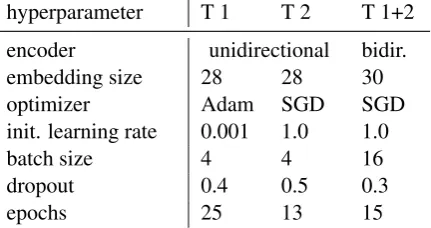
For the model trained on template-generated data, we tune the hyperparameters to achieve 100% ac-curacy for their best hypotheses on template-generated references on the development set. All models have a single-layer LSTM with 64 hid-den units in the encoder and decoder. We half the learning rate starting from the eighth train-ing epoch or if the perplexity of the validation set does not improve. The gradient norm is capped at two. The decoder uses the general attention mech-anism. For decoding, we set the beam size to 30. Table 8 shows hyperparameters which differ for the models.
hyperparameter T 1 T 2 T 1+2
encoder unidirectional bidir.
embedding size 28 28 30
optimizer Adam SGD SGD
init. learning rate 0.001 1.0 1.0
batch size 4 4 16
dropout 0.4 0.5 0.3
epochs 25 13 15
[image:12.595.310.526.373.487.2]