R E S E A R C H
Open Access
Robust adaptive synchronization of complex
network with bounded disturbances
Chengjie Xu
1,2, Housheng Su
3, Chen Liu
1and Guohua Zhang
1**Correspondence:
[email protected] 1School of Sience, Hunan University
of Technology, Zhuzhou, China Full list of author information is available at the end of the article
Abstract
In this paper, we investigate distributed robust adaptive synchronization for complex networked systems with bounded disturbances. We propose both average
synchronization protocol and leader-following synchronization protocol based on adaptive control and variable structure control strategies. The synchronization conditions do not require any global information except a connection assumption under the adaptive control method. Furthermore, the external disturbances are attenuated effectively. Finally, we present numerical simulations to illustrate the theoretical findings.
Keywords: Complex network; Synchronization; Adaptive control; Variable structure control; Disturbance
1 Introduction
Recently, distributed cooperative control for complex networked systems has absorbed a mount of attention due to its widely applications in biological, physical, social, and many
engineering sciences. Researches including synchronization [1–4], consensus [5,6],
con-tainment [7,8], and flocking [9] are intensively investigated.
Among the distributed cooperative control for complex networked systems, synchro-nization is one of the most fundamental problems, which means that the states of the agents reach an agreement on a common physical quantity of interest by implement-ing an appropriate consensus protocol based on the information from local neighbors
[10]. In the past decades, many different control protocols have been reported for
driv-ing the complex network to synchronize, such as adaptive control [11,12], impulsive
con-trol [13,14], intermittent control [15], and event-triggered control [16,17]. Furthermore,
synchronization behavior is mainly influenced by the dynamics of each node. Synchro-nization (or consensus) of networked systems with nonlinear dynamics or disturbances
is intensively investigated [18]. Synchronization was studied for heterogenous networks
with piecewise smooth nonlinear coupling topology [19]. On one hand, external
distur-bance is a main source of instability and poor performance, which widely exists in real processes. Thereby it is of great significance to investigate distributed coordination for nonlinear multiagent systems with bounded disturbances. A robust consensus algorithm was studied for double integrator multiagent systems with exogenous disturbances by
uti-lizing a nonsmooth back-stepping control technique [20]. The work in [21] investigated
the consensus of the multiagent systems with a nonlinear coupling function and external
disturbances based on disturbance observer andH∞control method. Robust consensus tracking was investigated for a class of second-order multiagent systems with disturbances
and unmodeled dynamics [22]. Using sliding-mode control method, the work in [23]
in-vestigated the finite consensus and containment of first-order nonlinear multiagent
sys-tems with disturbances under directed topology. In [24] a distributed leader-following
consensus problem was studied for second-order multiagent systems with bounded dis-turbances. Leader-following consensus conditions were derived for nonlinear multiagent systems with communication delay and communication noise under switching topology
[25]. Adaptive consensus was investigated for uncertain parabolic PDE agents [26]. On the
other hand, for reducing the number of controlled nodes, a pinning control is proposed
for synchronization control of complex network [27,28], in which the authors drive the
agents to realize synchronization via controlling a part of the nodes. For adjusting the
cou-pling gains, adaptive pinning control protocols were proposed for networked systems [29].
Adaptive pinning impulsive synchronization was investigated for time-delayed complex
networks [30]. An adaptive pinning synchronization criterion was obtained for linearly
coupled reaction–diffusion neural networks with mixed delays [31].
Motivated by the works mentioned, in this paper, we focus on nonlinear multiagent systems with external disturbances. With the hybrid aid of adaptive control, pinning con-trol, and variable structure control strategy, we propose a fully distributed synchronization protocol, which can guarantee that the consensus condition requires no any global infor-mation. The main contribution of this paper is twofold: (a) The disturbances are modeled as a nonlinear function dependent on the relative information between the neighboring agents. This leads to that the subsystems are coupled by an unknown nonlinear func-tion, which exactly improves the complexity of the stability analysis; (b) adaptive control is involved for adjusting the coupling gains for the average synchronization, and adaptive pinning control protocol is designed for the leader-following case; (c) variable structure control strategy is used for attenuating the bounded channel disturbances.
The rest of the paper is organized as follows. In Sect.2, we state the model considered
in the paper and give some basic definitions, lemmas, and assumptions. In Sect.3, we
propose an adaptive average synchronization protocol and give the convergency analysis
for the nonlinear complex network with bounded disturbances. In Sect.4, we investigate
adaptive leader-following synchronization. Numerical examples are included to
demon-strate the proposed protocol in Sect.5. Finally, Sect.6concludes the paper.
2 Preliminaries and model description
In this section, we introduce some notations and preliminaries. ByInwe denote then×n
identity matrix. For a matrixA(or a vectorx),AT(orxT) represents the transpose ofA
(orx);x1,x2, andx∞denote the 1-, 2-, and∞-norms of a vectorx, respectively;
A⊗Bdenotes the Kronecker product of matricesAandB.
LetG= (V,E,A) be a undirected graph with a nonempty set of nodesV= (υ1,υ2, . . . ,υN),
a set of edgesE⊆V×V, and a weighted adjacent matrixA= [aij]. In a undirected graph,
we denote an edge by (υi,υj), which means that verticesiandjcan obtain information from
each other;aij=ajirepresents the weight of the edge (υj,υi), andaij> 0⇐⇒(υj,υi)∈E;
the neighbor sets are defined asNi={υj|(υj,υi)∈E}; and the Laplacian matrixL= [lij]∈
RN×Nis defined asl
ii= N
In this paper, we investigate distributed robust adaptive synchronization for complex
networked systems with bounded disturbances. The dynamics of theith subsystem are
described as
˙
xi(t) =f(t,xi) +ci(t)
j∈Ni
aij(xj–xi)
+
j∈Ni
aijg(xj–xi) +ui, i= 1, 2, . . . ,N, (1)
wherexi,ui∈Rnare the state and input vectors of theith subsystem, respectively,f :R×
Rn→Rn,i= 1, 2, . . . ,k, are continuous vector-value functions, andg:Rn→Rndenotes
the disturbances dependent on the relative information between nodesiandj.
Remark1 System (1) can be considered as a class of nonlinear coupled complex networks. Also, it can be used to describe the network with channel disturbances.
The following assumptions and lemmas are necessary for the main results.
Assumption 1 The functionf(t,x) satisfies the global Lipschitz condition, that is, there
exist a constantη> 0 such that
f(t,x1) –f(t,x2)2≤ηx1–x22, ∀x1,x2∈RN.
Assumption 2 There exists a constantγ> 0 such that
g(xj–xi)∞≤
γ
N, i,j= 1, 2, . . . ,N.
Assumption 3 The topology graph is fixed and connected.
Lemma 1([32]) The Laplacian matrix L has a simple eigenvalue0,and the remaining eigenvalues are positive if and only if the undirected graph is connected.
Lemma 2([10]) For an undirected connected graph G with Laplacian matrix L and a vector x satisfying1Tx= 0,we have
min x=0
xTLx
xTx
=λ2(L).
Lemma 3([33]) If L= (lij)∈RN×Nis a symmetric irreducible matrix with lii= – N
j=1,j=ilij,
lij=lji≤0 (i=j),then L is semipositive definite,and for any matrix E=diag(e, 0, . . . , 0)with
e> 0,all eigenvalues of the matrix(L+E)are positive.
Lemma 4([34]) Suppose that a scalar function V(x,t)satisfies the following conditions: (a) V(x,t)is lower bounded;
(b) V˙(x,t)is negative semidefinite; (c) V˙(x,t)is uniformly continuous int.
3 Average synchronization of complex network with bounded disturbances
In this section, we investigate distributed robust adaptive average synchronization for complex networked systems with bounded disturbances. The main purpose of this section
is to design a distributed consensus protocol for system (1) such thatxi(t)→xj(t)→ ¯x(t)
ast→ ∞, wherex¯(t) =
N
i=1xi(t)
N . The proposed consensus protocol is
ui(t) =ci(t)sgn
j∈Ni
aij(xj–xi)
, i= 1, 2, . . . ,N, (2)
where the initial values of adaptive parametersci(0) > 0,i= 1, 2, . . . ,N,ci(t) are decided by
˙
ci(t) =τi
j∈Ni
aij(xj–xi) T
j∈Ni
aij(xj–xi)
+τi
j∈Ni
aij(xj–xi) 1
=τi
j∈Ni
lijxj T
j∈Ni
lijxj
+τi
j∈Ni
lijxj 1
, (3)
τi> 0 is the weight ofci(t), andsgn(·) is defined assgn(x) = 1 forx> 0,sgn(x) = –1 forx< 0,
andsgn(x) = 0 forx= 0.
Remark2 Adaptive synchronization protocol (2)–(3) is called a node-based adaptive
con-trol [11,12], in which the adaptive parameters are decided by the addition of relative
in-formation between theith node and its neighbor nodes, whereas the adaptive parameter
of the edge-based adaptive control is adjusted by any two adjacent nodes. Both adaptive methods can guarantee that the synchronization conditions do not depend on the infor-mation of the Laplacian matrix. The disadvantage is that the computing complexity in-creases. The cost-guaranteed adaptive control will be given in the future work.
Remark3 According to (3), ˙ci(t) > 0. Then we can conclude thatci(t) > 0 for allt≥0
becauseci(0) > 0.
Under the proposed protocol, system (1) can be rewritten as
˙
xi(t) =f(t,xi) +ci(t)
j∈Ni
aij(xj–xi) +
j∈Ni
aijg(xj–xi)
+ci(t)sgn
j∈Ni
aij(xj–xi)
, i= 1, 2, . . . ,N. (4)
Letei(t) =xi(t) –x¯(t). Then
˙
ei(t) =f(t,xi) +ci N
j=1
aij(xj–xi) + N
j=1
aijg(xj–xi)
+cisgn N
j=1
aij(xj–xi)
–
N j=1f(t,xj)
–
Theorem 1 Consider a networked multiagent system with N following nodes,where each following node has dynamics as in(1).Suppose that Assumptions1,2,and3hold.Using the consensus protocol (4)with adaptive strategy(5)for(1),average synchronization of system(1)can be achieved.Furthermore,all the following nodes will asymptotically track the average state.
Proof According to Lemma1,L˜ is positive definite. We choose the Lyapunov candidate function
DifferentiatingV respect totalong (10), we obtain
Noting thatL1N= 0, we have
According to Assumption1, we have
Substituting (13) and (14) into (12), we can conclude
˙
V≤–(c– 1)eTL2⊗In
e+η2eTe– (c–γ)
j∈Ni
lijej 1
. (15)
Since Lis real and symmetric, there is an orthogonal matrixQ such thatL=QTΛQ.
Denoting L12 =QTΛ12Q, we have 1TL1= 1TL12L121= 0. Therefore 1TL12 = 0, and thus
1TL12e= 0. According to Lemma2, eT(L2⊗In)e= ((L12 ⊗In)e)T(L⊗In)((L12 ⊗In)e)≤ λ2((L
1
2⊗In)e)T((L12⊗In)e) =λ2eT(L⊗In)≤λ2
2eTe. Then we have
˙
V≤–(c– 1)λ22eTe+η2eTe– (c–γ)
j∈Ni
lijej 1
. (16)
Sincec>max{1 + λη2 2
,γ},V˙ ≤0, and thusV is not increasing and is bounded. Thenei,ci
are bounded, which means thatf¯(t,x) is also bounded. From (12),V˙ is bounded. SoV
is uniformly continuous. By Lemma4we conclude thatV˙(e,t)→0 ast→ ∞. Denoting
W(e(t)) = ((c– 1)λ22–η2)eTe, we have 0≤W(e(t))≤–V˙. We know thatW(e(t))→0 as
t→ ∞, and thusei(t)→0, that is,limt→∞(xi–x¯) = 0 for alli= 1, 2, . . . ,N. Theorem1is
proved.
Remark4 In Theorem1, we see that the synchronization condition does not depend on the eigenvalue of the Laplacian matrix. This is different from the nonadaptive control case, in which the control gain is no less than a threshold value depending on the eigenvalue.
4 Leader-following synchronization of complex network with bounded disturbances
In this section, we investigate distributed robust adaptive leader-following synchroniza-tion for complex networked systems with bounded disturbances. Suppose that there exists a leader (or virtual leader) in the network, which is described as
˙
x0(t) =f
t,x0(t)
. (17)
The main purpose of this section is designing a distributed consensus protocol for system (1) such that
lim
t→∞xi–x0= 0.
We propose the consensus protocol
ui(t) =ci(t)hi(x0–xi) +ci(t)
j∈Ni
aij(xj–xi) +hi(x0–xi)
, i= 1, 2, . . . ,N. (18)
In (4) the adaptive parametersciis decided by
˙
ci(t) =τi
j∈Ni
aij(xj–xi) +hi(x0–xi) T
j∈Ni
aij(xj–xi) +hi(x0–xi)
+τi
j∈Ni ˜
lijej
1
whereτi> 0 is the weight of ci(t) andci(0) > 0,sgn(·) is defined assgn(x) = 1 forx> 0,
sgn(x) = –1 forx< 0, andsgn(x) = 0 forx= 0. If theith node is pinned by the virtual leader,
thenhi= 1; otherwise,hi= 0.
Under the proposed protocol, system (1) can be rewritten as
Theorem 2 Consider a networked multiagent system with N following nodes and a virtual leader,where each following node has dynamics as in(1),and the virtual leader is described as in(17).Suppose that Assumptions1,2,and3hold.Using the consensus protocol(18)
with adaptive strategy(19)for(1),leader-following synchronization of system(1)can be achieved if there exists at least one pinned node.Furthermore,all the following nodes will asymptotically track the virtual leader.
Proof According to Lemma1,L˜ is positive definite. We choose the Lyapunov candidate function
DifferentiatingV with respect totalong (10), we obtain
Substituting (27) and (28) into (26), we have
According to Assumption1, we have
eT(L˜⊗In)f¯(t,x)
is also bounded. ThenW(e(t)) is uniformly continuous with respect tot. According to
Lemma 4, W(e(t))→0 as t→ ∞. Then ei(t)→0, that is,limt→∞(xi–x0) = 0 for all
i= 1, 2, . . . ,N. Theorem2is proved.
5 Simulations
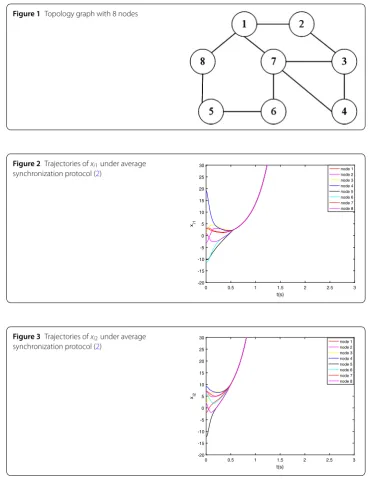
Figure 1Topology graph with 8 nodes
Figure 2Trajectories ofxi1under average synchronization protocol (2)
Figure 3Trajectories ofxi2under average synchronization protocol (2)
is described as the graph in Fig.1. According to the definition of the topology graph, we
conclude that the Laplacian matrix is
˜
L=
⎛ ⎜ ⎜ ⎜ ⎜ ⎜ ⎜ ⎜ ⎜ ⎜ ⎜ ⎜ ⎜ ⎜ ⎝
4 –1 0 0 0 0 –1 –1
–1 2 –1 0 0 0 0 0
0 –1 3 –1 0 0 –1 0
0 0 –1 2 0 0 –1 0
0 0 0 0 2 –1 0 –1
0 0 0 0 –1 2 –1 0
–1 0 –1 –1 0 –1 4 0
–1 0 0 0 –1 0 0 2
⎞ ⎟ ⎟ ⎟ ⎟ ⎟ ⎟ ⎟ ⎟ ⎟ ⎟ ⎟ ⎟ ⎟ ⎠
Theith node is described as
˙
xi(t) =f(t,xi) +ci(t)
j∈Ni
aij(xj–xi) +
j∈Ni
aijg(xj–xi) +ui,
wheref(t,xi) = 3xi1+ 2sin2xi+cosxi2satisfies the global Lipschitz condition. The
non-linear disturbance function is chosen asg(xj–xi) =sin3(xj–xi) +cos(xj–xi). It is easy to
verify that Assumptions1and2hold.
According to Theorem 1, the average synchronization should be realized under
pro-tocol (2) with adaptive strategy (3). The simulation results are shown in Figs.2–3. The
state of each node synchronizes to the average state. We have chosen the initial values as
c1(0) = 0.4,c2(0) = 0.7,c3(0) = 0.6,c4(0) = 1.2,c5(0) = 0.2,c6(0) = 0.5,c7(0) = 0.9,c8(0) = 0.8.
According to Fig.4, the trajectories of the adaptive parametersci,i= 1, 2, . . . , 8,
asymptot-ically converge to constants.
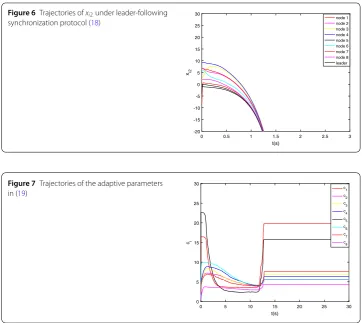
According to Theorem2, the leader-following synchronization should be realized
un-der protocol (18) with adaptive strategy (19). The initial values of the leaders are chosen
as (1.2, –1)T. Choose the first node as a pinned node. From Figs.5–6, all the followers can
track the leader asymptotically;ci(0),i= 1, . . . , 8, are chosen as 0.3, 1.2, 0.7, 0.8, 1.6, 0.5, 2.0,
0.4. According to Fig.7, the trajectories of the adaptive parametersci,i= 1, 2, . . . , 8,
asymp-totically converge to constants.
Figure 4Trajectories of the adaptive parametersci
in (3)
Figure 6Trajectories ofxi2under leader-following synchronization protocol (18)
Figure 7Trajectories of the adaptive parameters in (19)
6 Conclusions
In this paper, we investigated distributed robust adaptive synchronization problem for nonlinear complex networked systems with bounded disturbances. Based on adaptive control and variable control strategies, we proposed both the average synchronization and leader-following synchronization protocols and obtained the synchronization, which can guarantee that the synchronization conditions require no any global information except a connection assumption under the adaptive control method. Finally, we presented numer-ical simulations to illustrate the theoretnumer-ical results.
Funding
This work was partially supported by the National Natural Science Foundation of China under Grant No. 61703154, Natural Science Foundation of Hunan Province (2017JJ2070, 2019JJ60061), Outstanding Young Project of the department of education in Hunan province (16B070), China Postdoctoral Science Foundation (2016M602298), and MOE Key Laboratory of Image Processing and Intelligence Control (IPIC2017-04).
Availability of data and materials
There do not exist supporting data regarding this manuscript.
Competing interests
The authors declare that there is no conflict of interests regarding this manuscript.
Authors’ contributions
All authors contributed equally to the writing of this paper. All authors read and approved the final manuscript.
Author details
Publisher’s Note
Springer Nature remains neutral with regard to jurisdictional claims in published maps and institutional affiliations.
Received: 11 March 2019 Accepted: 9 October 2019
References
1. Cao, Y., Yu, W., Ren, W., Chen, G.: An overview of recent progress in the study of distributed multi-agent coordination. IEEE Trans. Ind. Inform.9(1), 427–438 (2013)
2. Guan, Z., Liu, Z., Feng, G., Wang, Y.: Synchronization of complex dynamical networks with time-varying delays via impulsive distributed control. IEEE Trans. Circuits Syst. I57(8), 2182–2195 (2010)
3. Su, H., Wu, H., James, L.: Positive edge-consensus for nodal networks via output feedback. IEEE Trans. Autom. Control 64(3), 1244–1249 (2019)
4. Su, H., Wu, H., Chen, X.: Observer-based discrete-time nonnegative edge synchronization of networked systems. IEEE Trans. Neural Netw. Learn. Syst.28(10), 2446–2455 (2017)
5. Ren, W., Beard, R.: Consensus seeking in multiagent systems under dynamically changing interaction topologies. IEEE Trans. Autom. Control50(5), 655–661 (2005)
6. Su, H., Wu, H., Chen, X., Chen, M.Z.: Positive edge consensus of complex networks. IEEE Trans. Syst. Man Cybern. Syst. 48(12), 2242–2250 (2018)
7. Xu, C., Zheng, Y., Su, H., Zeng, H.: Containment for linear multi-agent systems with exogenous disturbances. Neurocomputing160, 206–212 (2015)
8. Li, Z., Ren, W., Liu, X., Fu, M.: Distributed containment control of multi-agent systems with general linear dynamics in the presence of multiple leaders. Int. J. Robust Nonlinear Control23, 534–547 (2013)
9. Chen, S., Pei, H., Lai, Q., Yan, H.: Multi-target tracking control for coupled heterogenous inertial agent systems based on flocking behavior. IEEE Trans. Syst. Man Cybern. Syst. (2018).https://doi.org/10.1109/TSMC.2017.2789335
10. Xu, C., Zhao, Y., Qin, B., Zhang, H.: Adaptive synchronization of coupled harmonic oscillators under switching topology. J. Franklin Inst.356(2), 1067–1087 (2019)
11. Li, Z., Wen, G., Duan, Z., Ren, W.: Designing fully distributed consensus protocols for linear multi-agent systems with directed graphs. IEEE Trans. Autom. Control60(4), 1152–1157 (2015)
12. Li, Z., Ren, W., Liu, X., Xie, L.: Distributed consensus of linear multi-agent systems with adaptive dynamic protocols. Automatica49, 1986–1995 (2013)
13. Zhao, Y., Chen, H., Xu, C.: Nontrivial solutions for impulsive fractional differential equations via Morse theory. Appl. Math. Comput.307, 170–179 (2017)
14. Liu, B., Hill, D., Sun, Z.: Input-to-state-KL-stability with criteria for a class of hybrid dynamical systems. Appl. Math. Comput.326, 124–140 (2018)
15. Zhang, Z., Chen, S., Su, H.: Scaled consensus of second-order nonlinear multi-agent systems with time-varying delays via aperiodically intermittent control. IEEE Trans. Cybern. (2018).https://doi.org/10.1109/TSMC.2018.2883793
16. Chen, S., Guan, J., Gao, Y., Yan, H.: Observe-based event-triggered tracking consensus of non-ideal general linear multi-agent systems. J. Franklin Inst. (2018).https://doi.org/10.1016/j.jfranklin.2018.05.019
17. Ge, X., Han, Q.: Distributed formation control of networked multi-agent systems using a dynamic event-triggered communication mechanism. IEEE Trans. Ind. Electron.64(10), 8118–8127 (2017)
18. Yu, W., Chen, G., Cao, M.: Consensus in directed networks of agents with nonlinear dynamics. IEEE Trans. Autom. Control56(6), 1436–1441 (2011)
19. De Lellis, P., Di Bernardo, M., Liuzza, D.: Convergence and synchronization in heterogeneous networks of smooth and piecewise smooth systems. Automatica56, 1–11 (2015)
20. Du, H., Li, S., Shi, P.: Robust consensus algorithm for second-order multi-agent systems with external disturbances. Int. J. Control85(12), 1913–1928 (2012)
21. Yang, H., Guo, L., Han, C.: Robust consensus of multi-agent systems with uncertain exogenous disturbances. Commun. Theor. Phys.56, 1161–1166 (2011)
22. Hu, G.: Robust consensus tracking of a class of second-order multi-agent dynamic systems. Syst. Control Lett.61, 134–142 (2012)
23. Zhang, Y., Yang, Y., Zhao, Y., Wen, G.: Distributed finite-time tracking control for nonlinear multi-agent systems subject to external disturbances. Int. J. Control86(1), 29–40 (2013)
24. Meng, Z., Lin, Z., Ren, W.: Robust cooperative tracking for multiple non-identical second-order nonlinear systems. Automatica49, 2363–2372 (2013)
25. He, P.: Consensus of uncertain parabolic PDE agents via adaptive unit-vector control scheme. IET Control Theory Appl.12(18), 2488–2494 (2018)
26. He, P., Li, Y., Park, J.H.: Noise tolerance leader-following of high-order nonlinear dynamical multi-agent systems with switching topology and communication delay. J. Franklin Inst.353(1), 108–143 (2016)
27. Yu, W., Chen, G., Lü, J.: On pinning synchronization of complex dynamical networks. Automatica45, 429–435 (2009) 28. Zhou, J., Lu, J., Lü, J.: Pinning adaptive synchronization of a general complex dynamical network. Automatica44(4),
996–1003 (2008)
29. Turci, L.F.R., De Lellis, P., Macao, E.E.N., Di Bernardo, M.: Adaptive pinning control: a review of the fully decentralized strategy and its extensions. Eur. Phys. J. Spec. Top.223, 2649–2664 (2014)
30. Gong, X., Wu, Z.: Adaptive pinning impulsive synchronization of dynamical networks with time-varying delay. Adv. Differ. Equ.2015, Article ID 240 (2015)
31. He, P.: Pinning control and adaptive control for synchronization of linearly coupled reaction–diffusion neural networks with mixed delays. Int. J. Adapt. Control Signal Process.32(8), 1103–1123 (2018)
32. Godsil, C., Royle, G.: Algebra Graph Theory. Springer, Berlin (2001)
33. Chen, T., Liu, X., Lu, W.: Pinning complex networks by a single controller. IEEE Trans. Circuits Syst. I, Regul. Pap.54(6), 1317–1326 (2007)