Efficient Leakage-free Authentication of Trees, Graphs and
Forests
Ashish Kundu
∗IBM T J Watson Research Center Hawthorne, New York, USA
[email protected]
Mikhail Atallah, Elisa Bertino
Department of Computer Science and CERIAS,Purdue University. West Lafayette, Indiana, USA
{mja,bertino}@cs.purdue.edu
ABSTRACT
Leakage-free authentication of trees and graphs have been studied in the literature. Such schemes have several practical applications especially in the cloud computing area. In this paper, we propose an authentication scheme that computes only one signature (opti-mal). Our scheme is not only super-efficient in the number of sig-natures it computes and in its runtime, but also is highly versatile – it can be applied not only to trees, but also to graphs and forests (disconnected trees and graphs). While achieving such efficiency and versatility, we must also mention that our scheme achieves the desired security – leakage-free authentication of data objects rep-resented as trees, graphs and forests. This is achieved by another novel scheme that we have proposed in this paper – a secure nam-ing scheme for nodes of such data structures. Such a scheme as-signs "secure names" to nodes such that these secure names can be used to verify the order between the nodes efficiently without leaking information about other nodes. As far as we know, our scheme is the first such scheme in literature that is optimal in its efficiency, supports two important security concerns – authenticity and leakage-free (privacy-preserving/confidentiality), and is versa-tile in its applicability as it is to trees, graphs as well as forests. We have carried out complexity as well as experimental analysis of this scheme that corroborates its performance.
1.
INTRODUCTION
In the emerging cloud computing paradigms, hosting and dis-tribution of data is carried out by third party infrastructures and servers, which may not be trusted (e.g., Amazon EC2, Amazon Web Services AWS, “Database as a Service”[8]). In such third-party data distribution settings, an important requirement is to as-sure data authenticity. Data authenticity must be asas-sured even when the data that a user can access is a subset of the signed data, as users maybe authorized to only access a subset of the data. In the cloud-computing paradigms, which are increasingly being employed in order to store and publish sensitive information belonging to in-dividuals (such as healthcare) and enterprises, protection of
pri-∗Part of this work was carried out by the author at CERIAS and
Department of Computer Science, Purdue University
Permission to make digital or hard copies of all or part of this work for personal or classroom use is granted without fee provided that copies are not made or distributed for profit or commercial advantage and that copies bear this notice and the full citation on the first page. To copy otherwise, to republish, to post on servers or to redistribute to lists, requires prior specific permission and/or a fee.
Copyright 200X ACM X-XXXXX-XX-X/XX/XX ...$10.00.
Figure 1: (a) TreeT and subtreeTδ. (b) GraphGand subgraph
Gδ.
vacy and confidentiality are as important as verifying authenticity of data [1]. Such leakages can be used to infer sensitive informa-tion that is not part of the received data, which in turn would lead to privacy and confidentiality breaches.
Leakage-free authentication of data in cloud have several appli-cations such as in assuring healthcare, biological, and financial data (XML, graphs) while protecting privacy and confidentiality (for HIPAA compliance), and in authenticating XPath query results. Healthcare-specific examples, where leakages during authentica-tion of trees and graphs lead to privacy breaches are given in [11] and [12], respectively.
The problem is how doesAlice(the trusted data owner) sign the data (which is basically, a rooted directed tree or a directed graph)
once, so that the authenticity of a portion of the data (subtree or a subgraph) received by a user can be verified without leaking any information about the remaining part of the data. An authentication scheme for a tree or a graph must allow one to verify the integrity of its content (content integrity) as well as its structure (structural integrity). Information that is not in a subtree/subgraph but is in its source graph is referred to asextraneous information.
Leakage-free property: As an example, consider the tree in Fig-ure 1(a) and suppose that the user receives the subtreeTδ. The user
should neither receive nor should be able to infer anything about the extraneous information: nodesb, f, gandh, and edgese(d, b),
e(h, d),e(h, g), ande(g, f). The user should not be able to learn about the existence ofbfrom the process that verifies the order be-tween siblingsaandc. In the case of graphs, another basic form of leakage is about immediate ancestors of a node. For example, as-sume that the user receivesGδ, subgraph ofGin Figure 1(b). The
user should not learn that nodechas another immediate ancestor other thand(which ish), which is inGδ. For nodesa, bandd,
the user should not learn whether they have any other immediate ancestors inG.
Our Contributions. In this paper, we propose an authentication scheme for data objects represented as trees, graphs or even as forests (disconnected trees/graphs). The proposed scheme supports two important security properties: it (1) can be used to sign and ver-ify authenticity of data objects, and (2) does not leak information during authentication of data. The proposed scheme (1) is optimal in the number of signatures it computes for any tree/graph/forest: one signature; (2) can be used to authenticate not only trees but also graphs and forests. We have also proposed a notion of se-cure names that can be used to verify order between two siblings of a tree/graph without leaking information as described earlier. Two schemes are proposed – the first one is in-efficient but pro-vides an understanding on how an effcient scheme can be devised. The second naming scheme that we have proposed is both secure and efficient. Next, we propose signature schemes for trees and graphs based on these secure names and Condensed-RSA signature scheme. Both schemes are secure with respect to the two properties – authenticity and leakage-free properties. The CRSA schemes for trees and graphs computeO(m)number of signatures computed for trees, wheremis the number of nodes.
In the next part of the paper, we show that we can achieve better efficiency (than CRSA signatures) in leakage-free authentication of trees, graphs and forests: only one signature is computed and the number of expensive cryptographic operations such as modular exponentiations is reduced to as many as two. We are not aware of any other scheme in the literature that is more efficient and/or more secure (unforgeable and leakage-free). Later in the paper, we present experimental results related to computation of secure names, Condensed-RSA (CRSA) based signature schemes, and the single signature scheme (leakage-free redactable signature scheme – LFR scheme). Our schemes are highly scalable. The scheme for trees can accommodate trees with a high branching factors and very large number of nodes in the order of millions, which is cor-roborated by our experimental results. Branching factors of 100 and 300 (which result in trees with nodes as many as 1 million and 27 millions, respectively, with the height being 3) are handled by the proposed scheme quite efficiently. We also show how replay attacks can be prevented, how dynamic modifications to trees and graphs are handled.
Related Work. One of the most widely applied and extended techniques for authentication of tree-structured data is the Merkle hash technique [14] (MHT), which is binding (that is, integrity-preserving) but it has a major drawback in that it is not hiding (i.e., it leaks information) [5]. It has been used in many scenar-ios such as: integrity assurance of XML [7], selective dissemina-tion of XML data [2], integrity assurance of DAGs [13] and veri-fying completion of query results [16]. Merkle hash technique is integrity-preserving, but at the same time leaks [5]. Such a tech-nique is not suitable for integrity assurance in high assurance en-vironment and in privacy-preserving enen-vironments. The MHT and the techniques derived from it leak not only the Merkle hash of the nodes that the user does not have access to, but also the structural relationships, such as the parent-child relationships, and the sibling relationships as well as the structural ordering pertaining to nodes that the user does not have access to. Redactable and sanitizable1
signature schemes have been developed in order to verify integrity of parts of a linear structured message that has been signed. A message in this context is a linear sequence of sub-messages. In this paper, our focus is on more complex structures: trees, graphs
1Sanitizable signatures require a designated sanitizer, and
redactable signatures allow for publicly sanitizable.
and forests. Moreover, all the schemes (except one mentioned later) leak structural information of the parts that are not part of the sub-message (such parts are called redacted or sanitized ones) being validated.
There is little work concerning the problem of leakage-free in-tegrity verification of trees and graphs.
Kundu and Bertino recently proposed the scheme for trees [11] and graphs [12], which overcome such drawback of the MHT. How-ever, these schemes use order between random numbers to verify order between siblings. However, the structural signature scheme for graphs is more expensive than the one proposed in this paper in terms of the number of integrity verifiers (per node and back-edges): it requires more than one depth first-traversals of graphs with cycles (proportional to the number of back-edges), where as the proposed scheme requires only one depth-first traversal of the graph (irrespective of the number of back-edges). Brzuska et al [4] proposed formal definitions of redactable structural signatures and described a scheme for trees. However, their scheme is an expen-sive one for trees: it computes quadratic number of signatures for the children of each non-leaf node (in number of siblings) in order to verify ordering among siblings. In contrast, in our scheme that is presented in this paper, we just computeonly onesignature for any tree, graph or forest. Moreover, our single signature scheme can be easily applied to not only trees, but also graphs and forests.
2.
SECURE NAMES
In this section, we describe a notion of “secure names” that are assigned to the nodes in a tree. The purpose of secure names is to convey the order of siblings (which node is to the left of which other node) without leaking anything else (e.g., whether they are adjacent siblings, how many other siblings are between them, etc). For example, in Figure 1(a),a, b, andcare siblings such that a
≺b≺c. Secure namesηa, ηb, andηcare assigned toa, b, and
c, respectively. Givenηa, andηc, alongwithaandb, a user can
establish the fact thata≺c. But it cannot learn anything aboutb, or its existence (extraneous information).
The signing procedure traverses a treeT(V, E)bottom-up, and assigns anN-bit secure nameηxto each nodexin the tree, and then
computes the signatureσTof the tree using these secure names.
2.1
Preliminary Scheme (Scheme-1)
Our approach for generating secure names follows a bottom-up strategy. Letv1, . . . , vk be a list of siblings listed in left to right
order. Letlsb(s)denote the least significant bit of the bit-strings. The secure names of siblingsviandvi+1are computed such that
the least significant bits of the hash ofηvikηvi+1 andthe hash of ηvi+1kηvi are1and0, respectively. We call this as theordering
propertyof secure names. This scheme is given in Figure 2.
Example: In the tree in Figure 1(a), N-bit secure names ηa,
and ηb, are assigned toa, andb, respectively. ηa is a assigned
as a random. ηbis computed such thatlsb(H(ηa kηb))= 1 and
lsb(H(ηb kηa))= 0. This process is repeated for each set of
sib-lings.
2.1.1
Complexity
Scheme-1 takes exponential amount of time in terms of the num-ber of children of a tree. The probability that a particular choice of
ris found suitable forηvπ(i)is4
−i+1, and the average number of
r values generated for the selection of such anηvi is4
i−1
. The expected time to compute the secure names allksiblings is there-fore: Pk
i=14
i−1
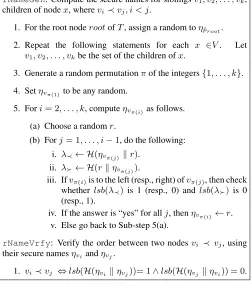
rNameGen: Compute the secure names for siblingsv1, v2, . . . , vk,
children of nodex, wherevi≺vj, i < j.
1. For the root noderootofT, assign a random toηˆproot.
2. Repeat the following statements for each x ∈V. Let
v1, v2, . . . , vkbe the set of the children ofx.
3. Generate a random permutationπof the integers{1, . . . , k}.
4. Setηvπ(1)to be any random.
5. Fori= 2, . . . , k, computeηvπ(i)as follows.
(a) Choose a randomr.
(b) Forj= 1, . . . , i−1, do the following: i. λ≺← H(ηvπ(j) kr).
ii. λ← H(rkηvπ(j)).
iii. Ifvπ(i)is to the left (resp., right) ofvπ(j), then check
whether lsb(λ≺)is 1 (resp., 0) and lsb(λ) is 0 (resp., 1).
iv. If the answer is “yes” for allj, thenηvπ(i)←r.
v. Else go back to Sub-step 5(a).
rNameVrfy: Verify the order between two nodesvi ≺vj, using
their secure namesηviandηvj.
1. vi≺vj ⇔lsb(H(ηvi kηvj))= 1∧lsb(H(ηvj kηvi)) = 0.
Figure 2: Algorithm to compute secure names for T(V, E)
(Scheme-1).
all secure names is(n−`)∗(4k−1)/3
. Moreover, although it is quite unlikely to happen, it is nevertheless possible that two non-sibling nodes receive the same secure name. In such a case, step 5(a) should be repeated.
Given its high cost, we need to find a more efficient solution – perhaps of linear complexity.
2.2
Efficient Scheme (Scheme-2)
Figure 3: Secure namesηVi andηx of siblings Vi andxin the
context of the efficient naming scheme.
The main drawback of the Scheme-1 is the fact that the worst-case time to compute anηx, when xis the(j+ 1)’th leftmost
child of its parent, is exponential inj(Step3in Section 2.1). This section describes an improved scheme that does not suffer from this drawback. As earlier, a non-leaf node in a tree hasknumber of children. In what follows, we describe a more efficient scheme for constructing a secure scheme.
The idea is, as before, to compute theηx’s (secure names)
bottom-up and, within a set of siblings, in left-to-right order. The main difference is how a secure nameηx is computed. This scheme
(Scheme-2) is given in Figure 4.
In this approach, we split theN-bit long secure nameηx of a
nodexinto two disjoint parts: ηlxandηxr of sizesLandRrefer
to the left and right parts ofηx, respectively (Figure 3). Ifxis the
leftmost child (i.e., the first child) of its parent thenηxis selected
randomly. Ifxis(m+ 1)’th leftmost child of its parent, thenηx
depends on the secure names of its left siblings. Letwbe a left sibling ofx: w≺x. Two bits (bw andb0w) inηwl and two bits
(bx andb0x) inηxl are selected and their values are set such that
bw⊕ bx< b0w⊕ b
0
x.bwandbxare thej’th leftmost bit inwand
x, respectively, wherejis computed usingηr
wandηrxin this order
(becausew≺x). Similarlyb0wandb0xare the (j0)’th leftmost bit
inwandx, respectively, wherej0is computed usingηwr andηrxin
the reverse order. AlongwithN,(L−2∗k), andRare sufficiently large as security parameters.
Example: ForN = 512, chooseL=360 fork≤100, andR=152 in the context of current computational power. In the tree in Fig-ure 1(a), secFig-ure names ηa, and ηb, are assigned to a, andb,
re-spectively. ηais anN-bit random and each bit ofηal is marked as not-used. ηbis computed as follows. ηrb is anR-bit random and
ηl
bis initialized to 0. Each bit ofηbl is marked asnot-used. jis
computed as (1+H(ηra k ηrb) mod L). Sincej’th leftmost bits
ofηal andηlbreferred to asbi andb, respectively, are marked as not-used,j0is computed as (1+H(ηr
bkηra) mod L). If (j6= j
0
) and the (j0)’th leftmost bits ofηalandηblreferred to asb
0
iandb
0
, re-spectively, are marked asnot-used, then proceed as follows. Assign either (0,0) or (1,1) to (bi,b0i) inηla, and (0,1) or (1,0) to (b,b
0
) inηl b.
Such an assignment assures thatbi⊕b(= 0)< b0i⊕b
0
(= 1). The
j’th and (j0)’th bits ofηaandηbare marked asused. ηcdepends
on bothηaandηb. This process is repeated for each set of siblings.
2.2.1
Complexity
The above algorithm translates into a simple and constant-time test of which of two given siblings is to the left of the other. But we need to analyze the expected number of re-starts. Suppose that the sizeLof the left part (ηl
x) of a secure name is500. The
proba-bility of a “collision” and re-start at Step (1) is the probaproba-bility that
2knumbers drawn randomly from the500choices[1,500]are not all distinct, i.e., that at least 2 of them are equal. This is the clas-sic birthday problem, and the probability of a re-start is (assuming
2k≤500):1−Q2k−1
j=1 {(1−(j/500))} ≈1−e
−(2k)(2k−1)/1000
. For2k = 50this probability is 0.91, hence the expected number of re-starts is(1/(1−0.91) = 11, which is much better than the preliminary scheme where the expected number of re-starts would have been proportional to425. Scheme-2 incurs linear costO(n)
in terms of the number of nodes in the tree.
3.
TREES
In this section, we describe the signature, distribution and ver-ification protocols for trees. Prior to computing the signatures, a dummy node is inserted by splitting an edge: ife(x, y)is an edge in the original tree, add a nodewsuch thate(x, w)ande(w, y)are the new edges in the modified tree. Secure nameηw of each
in-serted nodewis a random. Such nodewwhen given to a user only when the user has access tobothxandy. The ordering between them is not needed to be verified by secure names.
3.1
Leakage-Free Signatures of Trees (
rSign)
rNameGen: Compute the secure name for x such that
v1, v2, . . . , vk, xare siblings, wherevi≺vj≺x, i < j.
1. Choose a sufficiently largeN. ChooseLandRare such that (a)N=L+R, (b)R≥log(L), and (c)(L−2∗k)andRare sufficiently large as security parameters. Letηr
xandηxl refer
to the right-part consisting ofRand left-part consisting ofL
bits of the secure nameηxofx.
2. Assign random values toηr
x, and zero values toηlx. Associate
with each bit ofηlxa status that is initially set tonot-used.
3. Compute secure names of siblings in the left-to-right order of the siblings. Letv1, . . . , vk be the siblings to the left ofx,
whereviis theith leftmost one. (Each of theηvi’s of thesek
siblings ofxhave already been computed.)
4. Fori= 1tokdo the following.
(a) λ≺← H(ηr vi k η
r
x);j ← 1 + (λ≺ mod L). Letbi
(resp.,b) denote thejth leftmost bit ofηlvi (resp.,η
l x).
If the status ofbisnot-usedthen continue with the next step, else go back to step (2).
(b) λ←H(ηr
x k ηvri);j 0
← 1 + (λmod L). Letb0i
(resp.,b0) denote the(j0)’th leftmost bit ofηvli (resp., ηlx).
(c) If (j6= j0) and the status ofb0isnot-usedthen proceed to the next step, else go back to step (2).
(d) Setbandb0such thatbi⊕b < b0i⊕b
0 .
(e) Change the status ofbandb0fromnot-usedtoused.
rNameVrfy: Verify whethery ≺ z, using their secure namesηy
andηz.
1. j←1 + (H(ηr
ykηrz) mod L)
2. j0←1 + (H(ηrzkηry) mod L)
3. Letbyandbz be thej’th, andb0yandb
0
zare the(j
0
)’th bits in
ηyandηz, respectively.
4. Check the following:y ≺ z ⇔ by⊕bz< b0y⊕b
0
z.
Figure 4: Efficient algo to compute secure names for a tree (Scheme-2).
inserted nodes, no contents is used inIV. Using theIVs, we de-fine a signatureσT(V,E) (also referred to asσT) forT(V, E). In
cases when “the received subtree (sent to the user) is the same as the original tree” is a sensitive information, the signature of a tree may be salted using a random value in order to protect this fact. The (salted) tree signature is publicly available or passed to the user alongwith the subtree that the user has access to. σT(V,E)is
an aggregate signature, computed over theIVs of its nodes. We define a signature for trees based on the condensed-RSA (CRSA) signatures [15]. A brief summary of CRSA is given in [12].
DEFINITION3.1 (INTEGRITYVERIFIER). Letxbe a node in treeT(V, E), andcxbe the content of nodex. Its integrity verifier (IV) denoted byξx, is defined as:ξx← H(ηˆpxkηxkcx).
In what follows, we define the signature of a tree based on Condensed-RSA signature scheme [15] and aggregate signatures [3].
rSign: Sign treeT(V, E).
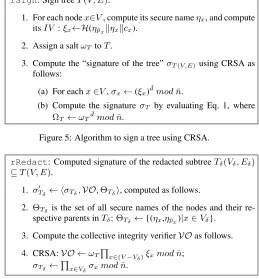
1. For each nodex∈V, compute its secure nameηx, and compute
itsIV :ξx←H(ηˆpxkηxkcx).
2. Assign a saltωTtoT.
3. Compute the “signature of the tree”σT(V,E)using CRSA as
follows:
(a) For eachx∈V,σx←(ξx)
¯
d
modn¯.
(b) Compute the signatureσT by evaluating Eq. 1, where
ΩT←ωT
¯
d
modn¯.
Figure 5: Algorithm to sign a tree using CRSA.
rRedact: Computed signature of the redacted subtreeTδ(Vδ, Eδ) ⊆T(V, E).
1. σ0Tδ← hσTδ,VO,ΘTδi, computed as follows.
2. ΘTδ is the set of all secure names of the nodes and their
re-spective parents inTδ:ΘTδ←{(ηx,ηˆpx)|x∈Vδ}.
3. Compute the collective integrity verifierVOas follows.
4. CRSA:VO ←ωTQx∈(V−Vδ)ξxmodn¯; σTδ←
Q
x∈Vδσxmod¯n.
Figure 6: Algorithm to redact a subtree using CRSA.
DEFINITION3.2 (SIGNATURE OFTREES USINGCRSA). Let
T(V, E)be a tree. LetHdenote a random oracle. Let the RSA sig-natureσxof each nodexbe defined as followsσx ← ξ
¯
d xmodn¯, whereξxis theIV ofx. Let the salt beωT be a random, and let
ΩT←ωT
¯
dmodn¯
. The signature ofT, denoted byσT, is defined as
σT = ΩT
Y
x∈V
σxmodn.¯ (1)
3.2
Distribution (
rRedact)
The distributorDsends the following items to Bob, who has ac-cess toTδ(Vδ, Eδ), a subtree of treeT(V, E): (Tδ(Vδ, Eδ),VOTδ,σT),
whereVOTδ(Vδ,Eδ)(also referred to asVOTδ) is the verification
object ofTδ, andσT the signature of theT(V, E). The
follow-ing steps show how to computeVOTδ.Dcomputes two collective integrity verifiersσTδ and∆Tδas part ofVOTδover the integrity
verifiers of all the nodes that are not in the subtree and also includes the salt.
VOis used to verify the signature of the tree, and is used to detect if any node(s) has been dropped formTδin an unauthorized
manner. σTδis used to verify the signature of all the nodes in the
subtree in an aggregate manner, and is used to detect if any node(s) has been injected formTδ in an unauthorized manner. ηx is the
secure name ofx.
3.3
Authentication (
rVrfy)
Bob receives the subtreeTδ(Vδ, Eδ), the signature of the tree
σT, and the verification objectVO. As part of the content
authenti-cation process, Bob computes the integrity verifiers of the nodes in
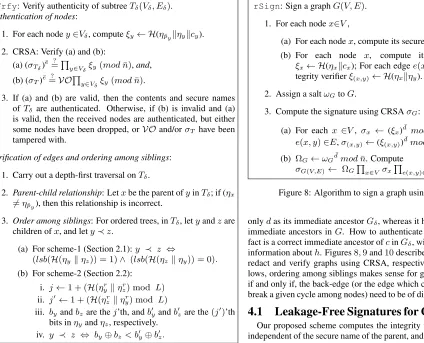
rVrfy: Verify authenticity of subtreeTδ(Vδ, Eδ). Authentication of nodes:
1. For each nodey∈Vδ, computeξy← H(ηˆpykηykcy).
2. CRSA: Verify (a) and (b): (a) (σTδ)
¯
e ? =Q
y∈Vδξy(modn¯),and,
(b) (σT)e¯
? =VOQ
y∈Vδξy(mod¯n).
3. If (a) and (b) are valid, then the contents and secure names of Tδ are authenticated. Otherwise, if (b) is invalid and (a)
is valid, then the received nodes are authenticated, but either some nodes have been dropped, orVOand/orσThave been
tampered with.
Verification of edges and ordering among siblings:
1. Carry out a depth-first traversal onTδ.
2. Parent-child relationship: Letxbe the parent ofyinTδ; if (ηx
6
=ηˆpy), then this relationship is incorrect.
3. Order among siblings: For ordered trees, inTδ, letyandzare
children ofx, and lety≺z.
(a) For scheme-1 (Section 2.1):y ≺ z ⇔
(lsb(H(ηykηz)) = 1)∧ (lsb(H(ηzkηy)) = 0).
(b) For scheme-2 (Section 2.2): i. j←1 + (H(ηyrkηrz) mod L)
ii. j0←1 + (H(ηr
z kηry) mod L)
iii. byandbzare thej’th, andby0 andb0zare the(j0)’th
bits inηyandηz, respectively.
iv. y ≺ z ⇔ by⊕bz < b0y⊕b0z.
Figure 7: Algorithm to verify a subtree using CRSA.
is verified with the help of secure names: the parent-child relation-ship, and the order among the siblings. Authentication of contents and structural positions of the subtree received includes (1) verifi-cation of integrity and, (2) verifiverifi-cation of the source of the subtree. The integrity verification of structural relations in a tree involves traversing the tree and using the secure-name of two siblings of its parent or its sibling. The user can carry out verification of integrity of an0-node subtree inO(n0)-time. The verification procedure is given in Figure 7.
4.
GRAPHS
Consider a simple graphGshown in Figure 1(b). It is a directed acyclic graph (DAG) with nodechaving two immediate ancestors –dandhOur solution for trees described earlier, does not work for graphs. In case of graphs, a node may have multiple incom-ing edges (i.e., multiple immediate ancestors such asc), whereas in case of trees, a node has only one parent (immediate ancestor) except for the root, which does not have any parent. Therefore, in the context of graphs, we cannot use the notion of integrity verifiers that is used for trees (Definition 3.1). The challenge in designing leakage-free signatures for graphs arises from the fact that the set
αδ(x)of immediate ancestors of a nodexin a subgraphGδ is a
(possibly empty) subset of the setα(x)of immediate ancestors of
xin G. The question is how to verify the authenticity ofαδ(x)
without leaking any information about (α(x)\αδ(x)): whether it
is empty or non-empty, what is its size, etc? For example,chas
rSign: Sign a graphG(V, E).
1. For each nodex∈V,
(a) For each nodex, compute its secure nameηx.
(b) For each node x, compute its integrity verifier
ξx← H(ηxkcx); For each edgee(x, y), compute its
in-tegrity verifierξ(x,y)← H(ηxkηy).
2. Assign a saltωGtoG.
3. Compute the signature using CRSAσG:
(a) For eachx ∈V, σx ←(ξx)
¯
d modn¯
; For each edge
e(x, y)∈E,σ(x,y)←(ξ(x,y)) ¯
d
modn¯.
(b) ΩG←ωG
¯
d
mod¯n. Compute
σG(V,E)← ΩGQx∈VσxQe(x,y)∈Eσ(x,y)modn.¯
Figure 8: Algorithm to sign a graph using CRSA.
onlydas its immediate ancestorGδ, whereas it hasdandhas the
immediate ancestors inG. How to authenticate the fact thatdin fact is a correct immediate ancestor ofcinGδ, without leaking any
information abouth. Figures8,9and10describe schemes to sign, redact and verify graphs using CRSA, respectively. In what fol-lows, ordering among siblings makes sense for graphs with cycles if and only if, the back-edge (or the edge which can be removed to break a given cycle among nodes) need to be of different semantics.
4.1
Leakage-Free Signatures for Graphs (
rSign)
Our proposed scheme computes the integrity verifier of a node independent of the secure name of the parent, and integrity verifiers for edges. It computes secure names for nodes that have specific ordering with their siblings. If in a graph, the ordering between some siblings is not possible, then the secure names of such nodes are just randoms.
DEFINITION4.1 (INTEGRITYVERIFIER: NODE). Letxbe a node in graphG(V, E), andcx be the content of nodex. Its in-tegrity verifier (IV) denoted byξx, is defined as:ξx← H(ηxkcx).
DEFINITION4.2 (INTEGRITYVERIFIER: EDGE). Lete(x, y)
be an edge in graphG(V, E). Its integrity verifier (IV) denoted by
ξ(x,y), is defined as:ξx← H(ηxkηy).
Signature of a graph is then computed as the aggregate signa-ture of the integrity verifiers of nodes and edges. Distribution is similar in the case of trees: if a user has access to a specific set of nodes and edges, signatures of the integrity verifiers of the edges and nodes as well as the secure names of the nodes are given to the user alongwith the nodes and edges. Also the aggregate signature of theseIVs are given to the user alongwith the signature of the source graph and the verification object.
The signature scheme has a complexity ofO(|V|+|E|). It com-putes as many signatures as the number of nodes and edges in the graph (as in the case of trees) and another signature for the whole graph.
4.2
Distribution of Graphs (
rRedact)
rRedact: Computation of the redacted signature ofGδ(Vδ, Eδ):
1. ComputeσGδand∆Gδas follows.
2. CRSA: (a)σGδ ←
Q
y∈Vδσy
Q
e(x,y)∈Eδσ(x,y)modn¯.
(b)∆Gδ←ωG
Q
y∈V−Vδξy
Q
e(x,y)∈E−Eδξ(x,y)mod¯n.
3. ΘGδ←{ηx|x∈};VOGδ←hσGδ,∆Gδ,ΘGδi.
Figure 9: Algorithm to redact a subgraph using CRSA.
rVrfy: Verification of authenticity of subgraphGδ(Vδ, Eδ) Authentication of contents:
1. For each nodex∈Vδin a subgraphGδ(Vδ, Eδ), compute its
integrity verifier: ξx← H(ηxkcx).
2. For each edge e(x, y), compute its integrity verifier:
ξ(x,y)← H(ηxkηy).
3. CRSA: Compute (a) ((σGδ) ¯
e ? =Q
x∈Vδξx(modn¯))and,
(b) ((σG)e¯
? = ∆Gδ
Q
x∈Vδξx(modn¯)).
4. If (a) and (b) are valid, then the contents and secure names ofGδ are authenticated. Otherwise, if (b) is invalid and (a)
is valid, then the received nodes are authenticated, but either some nodes have been dropped, ∆Gδ and/or σG have been
tampered with.Parent-child relationshipis verified during this process.
Verification of ordering among siblings:
1. Carry out a depth-first traversal onGδ.
2. Order among siblings: InGδ, letyandzare children ofx,
and lety≺z.
(a) For scheme-1 (Section 2.1): y ≺ z ⇔(lsb(H(ηy k
ηz)) = 1)∧ (lsb(H(ηzkηy)) = 0).
(b) For scheme-2 (Section 2.2):
i. j←1 + (H(ηr
ykηrz) mod L)
ii. j0←1 + (H(ηzrkηry) mod L)
iii. byandbzare thej’th, andb0yandb
0
zare the(j
0 )’th bits inηyandηzrespectively.
iv. y ≺ z ⇔ by⊕bz < b0y⊕b
0
z.
Figure 10: Algorithm to verify a subgraph using CRSA.
whereVOGδ (also referred to asVOGδ) is a verification object,
andσGis the signature ofG.
∆Gδ is used to verify the signature of the graph, and is used to
detect if any node(s) has been dropped formGδin an unauthorized
manner. σGδ is used to verify the signature of all the nodes in
the subgraph in an aggregate manner, and is used to detect if any node(s) has been injected formGδin an unauthorized manner.ηx
is the secure name ofx.
Example: Dhas to send Gδ in our example to Bob. σGis a
CRSA-signature.Dcomputes the∆Gδas a modular multiplication
of the saltωG, and the integrity verifiers off,g, andh, becausef,
g, andhare not inGδ. NowVOGδis the tuple consisting ofσGδ, ∆Gδ and a set consisting of an element for each node inGδ. D
then sends the signature of the graphσGandVOGδalongwithGδ,
to the user.
4.3
Authentication (
rVrfy)
Bob receives the subgraphGδ(Vδ, Eδ), the secure nameηx of
each nodex, verification objectVOGδ, and the signature of the
graphσG. It verifies the authenticity of the contents; if they are
authentic then the structural integrity is verified.
4.3.1
Authentication of the contents of subgraph
GδBy contents, we mean the contents of each nodexas well as
ηx. In order to authenticate contents ofGδ(Vδ, Eδ), Bob first
com-putes the integrity verifiersξx for each node, and then combines
them appropriately with∆Gδ in order to verify the signatureσG.
If the signature verifies, the edges and ordering among siblings are also verified. Authentication of contents ofGδ(Vδ, Eδ)has a
com-plexity ofO(|Vδ|+|Eδ|).
Example: Bob computes the integrity verifiers ofa,b,candd
inGδin our example. Consider CRSA signatures. Bob computes
a modular multiplication of these integrity verifiers together with
∆Gδ received as part ofVOGδ. Then Bob applies the signature
verification process of CRSA on the result of this multiplication and the received signatureσGof the graph. If the verification turns
out to be valid, the contents are authenticated.
5.
SINGLE SIGNATURE SCHEME
In this section, we propose a construction of leakage-free redactable signaturesfor trees that is secure as well as highly efficient (com-putesonly onesignature). The LFR signature scheme is based on the notion of secure namesdeveloped earlier in the paper, and the redactable set signaturesdeveloped by Johnson, Molnar, Song and Wagner (JMSW) [9].
Review of JMSW Redactable Set Signatures: Johnson etal. [9] de-veloped a redactable set signaturescheme based on RSA primitives and random oracle. The signature secure (EU-CMAover⊂and
∪operation). Since it is redactable, given thesignature of a set, and the elements that are to be removed from the set (thatresults in the subset), anyone who knows the public key, can efficiently com-putethe signature of the subset. The signature is history-independent, and thus canbe shown to be a leakage-free redactable signature for sets. Let the public keybe¯eand the RSA modulus be¯n. Some con-straints on RSA are thatn¯=p¯.q¯, wherep¯andq¯are “safe primes”.Given a setS = {s1, s2, . . . , sn}, its signatureσS is computed as
fol-lows: computeH(S) = Q
1≤i≤nH(Si)mod n¯, andI(S) =
HS−1 mod φ(¯n), whereφ(¯n) = (¯p−1)(¯q−1). SignatureσSis
computed as(¯e)I(S). Verification proceeds as follows: Given a set S’, and asignatureσ, one computes theH(S0) =Q
1≤i≤|S0|H(S 0
i),
whereSi0is the i’th element inS
0
; And then it is checkedif (σ)H(S0 )
is equal to¯e. If the equality holds,σis a validsignature of the set
S0. In order to compute the signature of a subsetS00 ⊂ S, one redacts the hashes of the elementsS\S00fromthe signatureσSas
follows: computeH(S\S00)andσS00is computed asσSH(S\S
00)
.
5.1
LFR Signature:
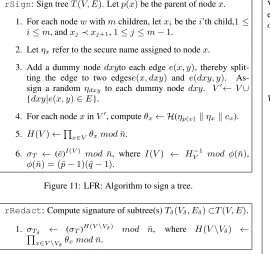
rΠIn this section, we present an LFR signature schemerΠfor trees that can be easily extended to graphs/forests. Ordered graphs and forests can be signed using theabove scheme. The number of sig-natures computed is optimal:1, and the number of hashingscarried out is O(|V|+|E|). The signing, distribution, and verification schemes are given in Figures 11, 13, and 12, respectively.
rSign: Sign treeT(V, E). Letp(x)be the parent of nodex.
1. For each nodewwithmchildren, letxibe thei’th child,1≤
i≤m, andxj≺xj+1,1≤j≤m−1.
2. Letηxrefer to the secure name assigned to nodex.
3. Add a dummy nodedxyto each edgee(x, y), thereby split-ting the edge to two edgese(x, dxy) and e(dxy, y). As-sign a random ηdxy to each dummy node dxy. V0← V∪
{dxy|e(x, y)∈E}.
4. For each nodexinV0, computeθx← H(ηp(x)kηxkcx).
5. H(V)←Q
x∈Vθxmodn¯.
6. σT ← (e¯)I(V) mod n¯, whereI(V) ← HV−1 mod φ(¯n),
φ(¯n) = (¯p−1)(¯q−1).
Figure 11: LFR: Algorithm to sign a tree.
rRedact: Compute signature of subtree(s)Tδ(Vδ, Eδ)⊂T(V, E).
1. σTδ ← (σT)
H(V\Vδ) mod ¯n, where H(V\V
δ) ←
Q
x∈V\Vδθxmod¯n.
Figure 12: LFR: Algorithm to redact a subtree.
Single signature scheme: Our single signature scheme takes a singletraversal on a tree/graph/forest, and incurs cost ofO(n+ m), wherenandmare number of nodes and edges,respectively. The number of signatures computed is 1, and the number oforder-preserving encryptions that are carried out isn/k, as that many groupsof siblings are there. The cost of computing a subtree/subgraph/sub-forest ofn0nodes andm0edges isO(n−n0+m−m0), because
n−n0nodes andm−m0edges have to be redacted from the signa-ture. The cost of verifying theintegrity of a subtree/subgraph/sub-forest isO(n0+m0), but needs to verifyonly1signature. There is no decryption of the encrypted integers.Brzuska et al’s scheme: For trees, it computesnsignatures for thetree, and quadratic number of signatures for each group of siblings: O(k2)(and there aren/k
such groups of siblings),kis the arity of the tree.More precisely, it computesO(n+nk)signatures, and incurs cost ofO(n+nk). The cost of computing a subtree ofn0nodes isO(n0+n0k), becausen0k
orderings and their signatures have tobe selected. The cost of veri-fying the integrity of a subtree/subgraph/sub-forestisO(n0+n0k): these many signatures are verified.Comparison: In comparison to our scheme, signing by Brzuska et al’s isn+nktimes more ex-pensive. For computation of signature of redactedsignatures, our scheme requires one modular exponentiation, whereas the other scheme doesnot need any such operations; however, their scheme incursO(nk)moretraversal cost. Verification of the integrity of a subtree using Brzuska et al’s is(n0+n0k)times more expensive than our scheme.
6.
PERFORMANCE RESULTS
We carried out experiments over the two schemes proposed in Sections 2.1 and 2.2.We implemented these two techniques in Java
1.6and JCA 6.0 (Java Cryptography Architecture) APIs. The ex-periments were carried out on a IBM Thinkpad with the following specification: Linux (Ubuntu 8.10) on Intel Core 2 Duo CPU2.2GHz with 2.98GB RAM. SHA-512 is used as the hash function.
Verification (rVrfy): Verify (σ,Tδ(Vδ, Eδ)); verifier receivesθxfor
each nodexinVδ, andθdxyfor each edgee(x, y)inVδ.Verification of Contents:
1. For each nodexinV0, computeθx← H(ηp(x)kηxkcx).
2. H(Vδ)←Qx∈Vδθxmodn¯,θx=H(ηp(x)kηxkcx).
3. IfσTδ
H(Vδ)mod¯n= ¯e, all nodes are authenticated.
Verification of Edges and Ordering:
1. Carry out a depth-first traversal onTδ.
2. Parent-child relationship: Letxbe the parent ofyinTδ; if (ηx
6
=ηˆpy), then this relationship is incorrect.
3. Order among siblings: For ordered trees, inTδ, letyandzare
children ofx, and lety≺z.
(a) For Scheme-1 (Section 2.1):y ≺ z ⇔
(lsb(H(ηykηz)) = 1)∧ (lsb(H(ηzkηy)) = 0).
(b) For Scheme-2 (Section 2.2): i. j←1 + (H(ηr
ykηzr) mod L)
ii. j0←1 + (H(ηrzkηyr) mod L)
iii. byandbzare thej’th, andb0yandb
0
zare the(j
0 )’th bits inηyandηzrespectively.
iv. Check:y ≺ z ⇔ by⊕bz< b0y⊕b
0
z.
4. If contents, the edges, and the orderings among all siblings are verified to be authentic, return 1, else return 0.
Figure 13: LFR: Algorithm to verify a subtree.
Computing Secure Names: Our performance results corroborate the theoretical analysis and show that the second technique outper-forms the first technique both in the number of attempts and the time required to successfully assign a secure name to a nodes es-pecially when the breadth of a tree is as high as in the order of hundreds. We considered trees of branching factor (the number of children a non-leaf node can have) ranging from 1 to 100. Consid-ering the upper limit, a tree that has a breadth of 100 and a height as small as 3, can have as many as 1 million nodes. In the plots, the rank of a child among its siblings (other children of the same par-ent) isi,0≤ i≤99. Figures 14 and 15refer to the performance results with respect to (1) and (2),respectively.Scheme 1 and 2 re-spectively refer to the preliminary technique(Sections 2.1) and the better technique(Section 2.2).
We have also carried out the experiments for branching factor 1 to 300, which requires modification of the size of the secure names (only in the case of the second technique) in order to accommodate the breadth of 300, which could not have been possible with the size of 512-bits for the secure name; 300 is a very large branching factor – a tree of a small height 3 and branching factor 300 has as many as 27 million nodes. The plots in Figures 16 and17 refer to the performance results with respect to the number of attempts to compute a secure name of a node and the time to compute such a secure name, respectively with respect to the position of a node among its siblings.
Performance of Signature Schemes
0 5 10 15 20 25 30 35 40
0 10 20 30 40 50 60 70 80 90 100
No. of Attempts
Rank of a Node among its Siblings Scheme 1 Scheme 2
Figure 14: Average number of attempts to assign a secure name to a node; branching factor≤100.
0 5000 10000 15000 20000 25000
0 10 20 30 40 50 60 70 80 90 100
Time to Compute a Secure Name of a Node (micro-sec)
Rank of a Node among its Siblings Scheme 1 Scheme 2
Figure 15: Average time in micro-sec to assign a secure name to a node; branching factor≤100.
0 20 40 60 80 100
0 50 100 150 200 250 300
No. of Attempts
Rank of a Node among its Siblings Scheme 1 Scheme 2
Figure 16: Average number of attempts to assign a secure name to a node; branching factor≤300.
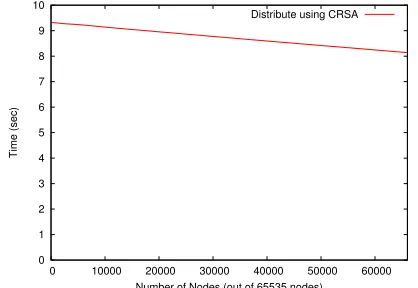
sign secure names to the siblings prior to signing the data. The time to compute signatures, distribute and verify them include the time to compute secure names. These performance results are applica-ble for forests as well, as the schemes for them are only different from the tree in the sense of representation of the edges. The ex-perimental results for sign, verify and distribute hold for not only tree but also for graphs and forests. The X-axis for trees represents the number of integrity verifiers for nodes, whereas the graphs and forests, it represents the number of integrity verifiers for nodesand
graphs. The Y-axis represents the time taken to compute the secure namesandsign, distribute and verify.
0 10000 20000 30000 40000 50000 60000 70000 80000 90000
0 50 100 150 200 250 300
Time to Compute a Secure Name (micro-sec)
Rank of a Node among its Siblings Scheme 1 Scheme 2
Figure 17: Average time in micro-sec to assign a secure name to a node; branching factor≤300.
0 200 400 600 800 1000 1200
0 10000 20000 30000 40000 50000 60000
Time (sec)
Number of Integrity Verifiers Sign using CRSA
Figure 18: CRSA: Time to sign the integrity verifiers of a tree/graph/forest.
0 1 2 3 4 5 6 7 8 9 10
0 10000 20000 30000 40000 50000 60000
Time (sec)
Number of Nodes (out of 65535 nodes) Distribute using CRSA
Figure 19: CRSA: Time to redact the integrity verifiers of a tree/graph/forest.
0 0.02 0.04 0.06 0.08 0.1 0.12 0.14 0.16 0.18 0.2
0 10000 20000 30000 40000 50000 60000
Time (sec)
Number of Nodes (out of 65535 nodes) Verify using CRSA
Figure 20: CRSA: Time to verify the integrity verifiers of a tree/graph/forest.
0 10 20 30 40 50 60 70 80 90
0 500000 1e+06 1.5e+06 2e+06
Time (sec)
Number of Nodes
Signing
Figure 21: LFR: Signing a tree/graph/forest.
0 2 4 6 8 10 12
0 200000 400000 600000 800000 1e+06
Time (sec)
Number of Nodes (out of 2 Million nodes) Redaction
Figure 22: LFR: Computation of redacted signature of a sub-tree/subgraph/subforest.
cost is not included in the plot for verification.
LFR: Single Signature Scheme
Signing a tree using our scheme (that deals with sibling ordering as well) of2∗220(more than 2 Million) nodes requires about 70
seconds (Figure21), which is in fact quite efficient. In contrast, for a tree with65535nodes, computing the RSA signatures for Brzuska et al’s signature scheme [4] takes more than1100seconds (even without sibling ordering). It is significantly expensive than our signing scheme. The time to compute signatures of redacted
0 0.5 1 1.5 2 2.5 3 3.5 4 4.5 5
0 200000 400000 600000 800000 1e+06
Time (sec)
Number of Nodes (out of 2 Million nodes) Verification
Figure 23: LFR: Verification of a subtree/subgraph/subforest.
subtrees decreases as the size of the redacted subtree increases (Fig-ure22), because the number of nodes to be redacted decreases with the increase in the size of the subtree. It takes about 5 seconds to compute the redacted signature of a 1-Million-node subtree (of a 2 Million node tree). It corroborates the fact that redaction of signa-tures is more efficient than re-computing them. Verification of the signature of a redacted subtree of 1 Million nodes (of a 2 Million node tree) requires about 5 seconds (Figure23) , which is signifi-cantly less expensive than Brzuska et al’s scheme: that has to verify 1 Million signatures just for parent-child relationships.
7.
SECURITY ANALYSIS
We prove the security of the signature schemes by proving the free property of the secure names, unforgeability and leakage-free property of the signature schemes, for both trees and graphs. In what follows,Adenotes a probabilistic polynomial time (PPT) adversary.
7.1
Secure Names
LEMMA7.1 (LEAKAGE-FREEPROPERTY). Under the
ran-dom oracle hypothesis, secure names computed by Scheme-2 are leakage-free.
PROOF. Sketch: Consider that an adversaryAcan determine with non-negligible probability whether a given set of secure names for a subset of siblingsVδhave been computed as part of the
com-putation of secure names ofV (Vδ⊂V), or have been computed
afresh. Consider the sets of nodes as output fromA:V0 = {x,z} andV1= {x,y,z},x≺y≺z. bis drawn uniformly and randomly from{0,1}. The adversary then receives the challenge(V0,Θ0).
Consider thatb = 1, andAoutputsb0 = 1. Adetermines that there are one or more siblings in betweenxandz. It implies that thej0thand (j0)’th bit positions for (x,y) pair and/or for (y,z) pair are known toA, which implies thatAhas been able to carry out second-preimage attack onH. The bits of the secure names are assigned using⊕operation, and the probability of each bit being assigned 0 or 1 is 1
2. R: the number of bits on theη
r
w,wis either
As earlier, let all secure names be in the interval[1 : U]. To prove that a secure nameηxreveals nothing about its rankiamong
its siblings, it suffices to prove that the process for secure-name assignment is such that the probability of a bit inηxbeing either 0
or 1 is1
2, and it is true for all the bits inηx. We give a proof by
induction.
Basis: Case I:xis the left-most child of its parent:ηxis randomly
chosen.
Case II:xis the second left-most child of its parent: Letv1be the left sibling ofx. TheRbits are randomly chosen. Two out of the remaining bits referred to asbandb0are chosen such that (b1⊕b)<
(b01⊕b0) (Step 2 of the scheme). However,b1andb01are bits in the
randomv1, i.e. the probability that the value ofb1(orb01) is either 0
or 1 is12. Result of the XOR (⊕) of a random number with another (possibly non-random) number is also a random number [10]. Thus
bandb0are also random bits. The remaining bits ofxare “not used” and randomly chosen. Thus the numbern(x))is a random.
Inductive step:
Ifvkis thek’th left-most child of its parent andηvk is a random
number, thenηxis also a random number wherexis the(k+ 1)’st
leftmost child of its parent.r(vk) + 2(k−1)number of bits inηx
are already “used”. By Step 2 in the scheme, two bits at positions
jandj0that are still unused inηvkare chosen. Ther(x)bits are
randoms as well as the two bits atjandj0leftmost positions inηx
are also randoms. The remaining bits are “not used” and chosen randomly. Thusηxis also a pseudo-random.
7.2
Trees
LEMMA 7.2. The signature schemerΠ≡(rGen,rSign,rRedact,
rVrfy) for trees using the CRSA scheme is existentially unforge-able under the adaptive chosen-message attack over the subset op-eration.
PROOF. Sketch: Unforgeability of the signature is due to the unforgeability of CRSA. If the signature of a tree can be forged by anA, thenAhas managed to solve the RSA problem or the Com-putational Diffie-Hellman problem, which however are assumed to be hard problems.
Given the correctness of the secure names (1 or scheme-2), the order between siblings can be verified. In case the order between siblings or edge relationship in a tree has been forged, then the hash functionHis not a random oracle, which contradicts our assumption.
LEMMA 7.3. The signature schemerΠ≡(rGen,rSign,rRedact,
rVrfy) for trees using the CRSA scheme is leakage-free.
PROOF. Sketch: rΠis leakage-free if and only if the secure naming scheme is leakage-free, which is proven in Lemmas??and
??.
7.3
Graphs
LEMMA 7.4. The signature schemerΠ= (rGen,rSign,rRedact,
rVrfy) for graphs using the CRSA scheme is existentially unforge-able under the adaptive chosen-message attack over the subset op-eration.
Proof is similar to the proof of Lemma 7.2.
LEMMA 7.5. The signature schemerΠ= (rGen,rSign,rRedact,
rVrfy) for graphs using the CRSA scheme is leakage-free.
Proof is similar to the proof of Lemma 7.3.
7.4
Single Signature Scheme
The following lemmas state the security of the proposed con-structionrΠ.
LEMMA 7.6. Under the random oracle hypothesis, and the as-sumption that the RSA problem is hard, and that the secure nam-ing scheme Scheme-2 is secure,rΠis existentially unforgeable un-der chosen-message attack over subset (and union) operation over trees/graphs/forests.
PROOF. Suppose thatrΠcan be forged for a subtreeTδ. In one
scenario, either a nodexcan be substituted by another nodeyin the subtree such thatθx=θy. It implies thatHhas encountered a
colli-sion, contradicting the assumption thatHis a random oracle. Simi-larly, forging a wrong parent-child relationship is not feasible under the random oracle hypothesis. If forging is carried out by forging the signature of a set (other than subset and union operations), then the JMSW signature scheme has been broken, which implies that the adversary has solved the RSA problem efficiently [9]. The or-der between two siblings cannot be forged unor-der the random oracle hypothesis (because theHinvolvesθxof each nodex).
LEMMA 7.7. Under the random oracle hypothesis, and the as-sumption that the RSA problem is hard, thenrΠis leakage-free.
PROOF. Suppose thatrΠ is not leakage-free for a subtreeTδ
of treeT. In other words, ifTδ andT are given to therΠ, the
signature that one receives fromTδleaks the fact whether it was
computed from scratch or by redaction from the signature ofT. If existence of a sibling inT, but not inTδ, is leaked by the signature
ofTδ, then the plaintext values of the position of a sibling among
other siblings has been recovered, i.e., the secure naming scheme Scheme-2 has computed secure names that are not leakage-free, which however is not true. If a parent-child (edge) relationship between two nodesxandyinTδis leaked, thenθdxyis not distinct,
which is a contradiction.
8.
DISCUSSION
We would now describe how the schemes presented in this paper can be used for certain other scenarios.
Forests
Our single-signature scheme for graphs can be used to sign and authenticate forestsas-it-is, i.e., a set of dis-connected trees/graphs in a leakage-free manner. Our scheme for graphs does not depend on connected-ness of graphs.
8.1
Encrypted Trees, Graphs and Forests
In cloud computing, often plaintext data is not delivered to the cloud servers. If the contents of the nodes are encrypted (but not the structure), out schemes (including the structural signature schemes) can be used directly to such scenarios. The only changes that are needed are (1) Share with the server the integrity verifiers, which are hashed values. (2) use a perfect one-way hash functions [6] to compute the hashes, which can then be hashed again to be con-verted to full-domain hashes. Perfect one-way hash functions do not leak contents of the message being hashed, whereas standard (such as SHA1 or SHA2) hash functions leak information.
8.2
Dynamic Trees, Graphs and Forests
elliptic curve followed by a bilinear operation. In an updated graph, the signature of immediate ancestors has also to be updated appro-priately. Unlike in the MHT, in our schemes, the updates do not get propagated up in a tree. They do not affect the secure name of other siblings or nodes in Scheme-1; however, in Scheme-2, they affect the secure name of other siblings. The single signature scheme sup-ports both redaction and union of two signatures, which is why, it also supports dynamic updates on trees, graphs and forests.
Computation of a new secure name in thej’th rank among its siblings does not affect any secure names of other siblings in case of Scheme-1. However, in the case of Scheme-2, it affects the secure names of all other siblings.
9.
CONCLUSION AND FUTURE WORKS
In this paper, we propose an authentication scheme for data ob-jects represented as trees, graphs or even as forests (disconnected trees/graphs). The proposed scheme supports two important secu-rity properties: it (1) can be used to sign and verify authenticity of data objects, and (2) does not leak information during authentica-tion of data. The proposed scheme (1) is optimal in the number of signatures it computes for any tree/graph/forest: one signature; (2) can be used to authenticate not only trees but also graphs and forests. In order to achieve such level of security as well as ef-ficiency, we developed the notion of secure names, and proposed an efficient scheme for computation of secure names. Experimen-tal results corroborate our complexity analysis, and show that our schemes are highly scalable, which is essential in a cloud comput-ing paradigm. We are in the process of implementcomput-ing this scheme as part of a security stack of a cloud computing platform that is planned to host biological databases used by both academia and industry.
10.
REFERENCES
[1] M. Armbrust, A. Fox, R. Griffith, A. D. Joseph, R. H. Katz, A. Konwinski, G. Lee, D. A. Patterson, A. Rabkin, and M. Zaharia. Above the clouds: A Berkeley view of cloud computing. Technical report, Technical Report No. UCB/EECS-2009-28, EECS Department, University of California, Berkeley, 2009.
[2] E. Bertino, B. Carminati, E. Ferrari, B. Thuraisingham, and A. Gupta. Selective and authentic third-party distribution of XML documents.IEEE Transactions on Knowledge and Data Engineering, 16(10):1263–1278, 2004.
[3] D. Boneh, C. Gentry, H. Shacham, and B. Lynn. Aggregate and verifiably encrypted signatures from bilinear maps. In
Proceedings of the 22nd Annual International Conference on Theory and Applications of Cryptographic Techniques (EUROCRYPT), 2003.
[4] C. Brzuska, H. Busch, Ö. Dagdelen, M. Fischlin, M. Franz, S. Katzenbeisser, M. Manulis, C. Onete, A. Peter,
B. Poettering, and D. Schröder. Redactable signatures for tree-structured data: Definitions and constructions. In
Proceedings of the 8th International Conference on Applied Cryptography and Network Security (ACNS), volume 6123 ofLecture Notes in Computer Science, pages 87–104. Springer Berlin / Heidelberg, June 22-25, 2010.
[5] A. Buldas and S. Laur. Knowledge-binding commitments with applications in time-stamping. InProceedings of the 10th International Conference on Practice and Theory in Public Key Cryptography (PKC), pages 150–165, Berlin, Heidelberg, 2007. Springer-Verlag.
[6] R. Canetti, D. Micciancio, and O. Reingold. Perfectly one-way probabilistic hash functions (preliminary version). InProceedings of the 30th Annual ACM Symposium on Theory of Computing (STOC), pages 131–140, New York, NY, USA, 1998. ACM.
[7] P. Devanbu, M. Gertz, A. Kwong, C. Martel, G. Nuckolls, and S. G. Stubblebine. Flexible authentication of xml documents.J. Comput. Secur., 12(6), 2004.
[8] H. Hacigumus, S. Mehrotra, and B. Iyer. Providing database as a service. InProceedings of the 18th International Conference on Data Engineering (ICDE), pages 29–38, Washington, DC, USA, 2002. IEEE Computer Society. [9] R. Johnson, D. Molnar, D. Song, and D. Wagner.
Homomorphic signature schemes. InProceedings of the RSA Conference on the Cryptographers’ Track (CT-RSA), pages 244–262, London, UK, 2002. Springer-Verlag.
[10] J. Katz and Y. Lindell.Introduction to Modern Cryptography: Principles and Protocols. Chapman & Hall/CRC, first edition, 2007.
[11] A. Kundu and E. Bertino. Structural signatures for tree data structures.Proceedings of the VLDB Endowment,
1(1):138–150, 2008.
[12] A. Kundu and E. Bertino. How to authenticate graphs without leaking. InProceedings of the 13th International Conference on Extending Database Technology (EDBT 2010), volume 426 ofACM International Conference Proceeding Series. ACM, March 22-26, 2010.
[13] C. Martel, G. Nuckolls, P. Devanbu, M. Gertz, A. Kwong, and S. G. Stubblebine. A general model for authenticated data structures.Algorithmica, 39(1):21–41, 2004.
[14] R. C. Merkle. A certified digital signature. InProceedings of the Annual International Cryptology Conference (CRYPTO), pages 218–238, New York, NY, USA, 1989. Springer-Verlag New York, Inc.
[15] E. Mykletun, M. Narasimha, and G. Tsudik. Authentication and integrity in outsourced databases.ACM Transactions of Storage, 2(2):107–138, 2006.