Drowsy Driver Identification Using Eye Blink
detection
Mr. Raees Ahmad1, Prof. J.N. Borole2 1,2
Department of Electronics and Telecommunication, North Maharashtra University
GF’s Godavari College of Engineering, MIDC, Jalgaon (INDIA)
Abstract
-
As field of signal processing is widening in various security and surveillance applications, motivated the interest for implementing better application with less complications. A non-intrusive machine vision based concepts is used to simulate Drowsiness Detection System. The system is consisting of web camera which placed in a way that it records driver’s head movements in order to detect drowsiness. As drowsiness is detected, a signal is issued to alert the driver. The system deals with detecting face, eyes and mouth within the specific segment of the image. All the possible actions have been considered and output is generated accordingly. Drowsiness is determined by observing the eye blinking action of the driver. Other than drowsiness, driver’s attention while driving is also considered. The proposed algorithm is developed to minimize the complexity level from existing system while efficiency has given prime importance which was a main objective of the paper. The system is implemented using cascade object identifier from vision toolbox of Matlab, which detects face, eyes, nose and mouth from the image which is captured from web camera. For this system Region of Interest is location of eyes and mouth which are determined and indicated by rectangle. Logic has been used here to identify whether eyes are open or closed unlike general methods. From mouth portion yawning is determined and considered. Project is simulated for on line and off line video with all possible situations of a driver.
Results are formulated under different categories like normal driver, driver with glass under different light intensities. It is concluded that proposed system can also be utilized for other application. Results obtained from the proposed system provide efficient system analysis and overallgood efficiency with some precautions by using simple flow of programming.Keywords- Drowsiness, ROI, Surveillance, EEG, EOG.
I. INTRODUCTION
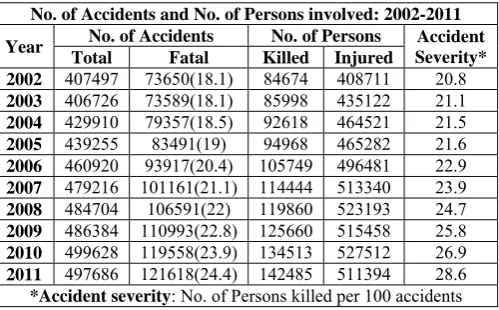
India with 1.21* billion population stand second behind China. India’s population is 1/6th of world population. The development of a country depends on its youth population, in this segment India is on top but still not completely developed. We are facing lot of problems which restricting development of the country. One of the problems is Road accidents. According to report presented by Ministry of Road Transport and Highways Government of India in 2011 country saw 4.97 lakh road accidents which is 1 accident per minute. Resulting 1,42,485 deaths in the year 2011. Some interesting figures have been collected from 2002-2011 as below [1].
Table I. No.of Accidents and No.of Persons involved:2002-11
No. of Accidents and No. of Persons involved: 2002-2011
Year No. of Accidents No. of Persons Accident Severity*
Total Fatal Killed Injured
2002 407497 73650(18.1) 84674 408711 20.8 2003 406726 73589(18.1) 85998 435122 21.1 2004 429910 79357(18.5) 92618 464521 21.5 2005 439255 83491(19) 94968 465282 21.6 2006 460920 93917(20.4) 105749 496481 22.9 2007 479216 101161(21.1) 114444 513340 23.9 2008 484704 106591(22) 119860 523193 24.7 2009 486384 110993(22.8) 125660 515458 25.8 2010 499628 119558(23.9) 134513 527512 26.9 2011 497686 121618(24.4) 142485 511394 28.6
*Accident severity: No. of Persons killed per 100 accidents
From above figures it can be observed that road accidents are consistently increasing every year. There are various reasons which are responsible for accidents to occur. The details of causes of Road accidents as given in [1] by Government of India is summarizes as follows.
i) Due to Driver (77%) ii) Weather Condition (1%) iii) Vehicle Condition (2%) iv) Pedestrian’s fault (2%) v) Cyclist’s Fault (1%) vi) Road Condition (2%) vii) Other (14%)
For major of accidents occurred “Driver” is found responsible with different reasons. To address the issue of Road safety different pronged strategy may be adopted as:
i) Engineering ii) Enforcement iii) Education iv) Emergency Care
As various functionalities have been added in different Vehicles to avoid or sometimes to minimize the effect of accidents. Driver’s drowsiness or fatigue has been found as one of the main causes of accidents. To determine the drowsiness different measures can be useful like heart beat rate, brain signals and eye blinking. While eye blinking is found robust parameter which can detect drowsiness of driver. Various methods have been developed to solve this problem which can be classified as
a) Intrusive Methods:
In this method electrodes are used to identifying drowsiness. The idea behind this technique is to use Electroencephalogram (EEG) signals which shows the brain electrical activity and can be recorded as changes in electrical voltages on the scalp [4]. In this paper from EEG signal Electrooculogram (EOG) which is generated due to eye blinking/ eye movement is determined. To filter out EOG from EEG signals H∞ adaptive filter is used. Two set
of EEG signal were recorded by using electrode for 134 sec duration which is sampled at 256 Hz. EEG and EOG signals were filtered using two different 100-tap linear phase FIR band pass filter. From result it is concluded that presented algorithm based on H∞ adaptive filter performs
better than previous algorithm which was based on LMS algorithm. In the year 2010, Junfeng Gao, Yong etc proposed a new technique for removal of Artifacts from EEG signal [5]. They have decomposed EEG signal into Independent component by Independent component analysis (ICA). Authors have developed Peak Detection algorithm of independent components to identifying the eye blink. They have experimented 15 different healthy subjects each for two minute. Electrodes were placed on different 16 channels and got the sensitivity of 98% and specificity of 97%.
EEG and EOG signals are complex in nature and need to process precisely therefore number of methods have been investigated by researchers. In [6] EOG signals were recorded between Cornea and Retina. Discrete wavelet Transform is used to decompose EOG signal in 4 levels. By setting a threshold value for coefficients Eye Blinking is determined. One EOG sample was taken from standard database and experimented for different Wavelet Transform thresholding which results in maximum of 100% efficiency for eye blink detection and minimum of 95%. It is concluded that Symlet based approach is best. Continuous Wavelet Transform in accordance with SVM method is developed for Eye blink detection from EOG Signals is introduced [7]. The combination of Brain and visual activity is presented [8] for drowsiness detection. Brain activity is measured using single EEG channel. Through eye blinking visual activity is recorded. Eye blinking features then extracted from EOG channel. Authors have calcula
ted drowsiness from visual
and brain activity separately and merged both results using fuzzy logic. Three different drowsy levels were indicated as “awake, drowsy and very drowsy”, by using cascading rules. Different 20 targets were tested by the system and efficiency is found to be 80%. Finally it is concluded that for high efficiency high frame rate video must be processed. A wireless Brain-Computer interface system [9] has been presented by Chin, Che-Jui Chang etc. In this paper physiological signal acquisition module is used. Physiological signals are processed using embedded signal processing module. Authors have adopted same technique to identify drowsiness as in previous paper except wireless physiological signal acquisition module and embedded module. The system’s performance have been checked by recording sample EEG signals under alert and drowsy condition, these samples used as data base and matchedwith recorded sample in experiment. Though efficiency of 76% - 88.7% is recorded but experiment was performed on 4- lane highway on a straight line, therefore system’s performance on ordinary road condition and crowded traffic condition were not discussed. Hence practical application of the system seems difficult. A generalized EEG based drowsiness prediction system [10] has been proposed by using a self-organizing neural fuzzy system. As name shows the basic of drowsiness detection is same as in previous work except fuzzy system. In this paper Virtual Reality (VR) based dynamic driving simulator is used to collect experimental result. Support vector Machine is employed here for solving the problem of function approximation and regression estimation. Overall efficiency of system is found more than 95%.
As above literature reflects all the methods are based on EEG and EOG signal. The EEG and EOG signal were collected by connecting electrodes on the body of target which makes it annoying for target. Moreover processing of such signals is tedious task hence Kamil, Krzysztof etc. have presented drowsiness detection system using Microwave Doppler Sensor [11]. The paper is based on eyelid detection, estimation of eye blink duration and eye blink frequency. The concept of Doppler Radar system have been employed. Multiple receiver architecture is used in sensor. A SSB modulation of transmitted signal has been applied in order to allow for beam steering at the intermediate frequency. The recorded signals by the sensor are analyzed in frequency domain using Fast Fourier transform (FFT) and Wavelet Transform is used to analyze in time-frequency domain. System’s efficiency of 84% - 94% were observed depending upon the position of head.
b) Non-Intrusive Methods:
the system more robust but on the price of increased complexity level. A passive method is presented without SVM for drowsiness detection [14]. In this paper simple web cam was installed on car dash board. Viola-Jones technique was used to recognize the face from image. Then eyes were searched on detected face portion. If eyes were found, stored as template; if not last saved template is used in template-matching procedure. From eyes, eye blinking was determined by converting eyes template in binary form. Then after a specified time if eyes were closed or open continuously, it was concluded that the driver is in drowsy condition.
The combination of multiple eye detection and tracking is presented [15] by Francesco and Giancarlo. In this paper they have combined two different approaches to detect and track eyes. Simple competitive and boosted competitive approaches were combined considering that change in situation will lead to limit the working of one approach. Single camera remote eye tracker was used to perform experiments. It is found that using two different approaches we can get robust and efficient system to tackle the problem of eye detection and tracking which can be the principle operation in other application. Color based approach [16] is presented by Axel, Ayoub and Bernd. The authors have used Viola-Jones algorithm for face detection. By using cascade model eyes were detected and fixed ROI was set to avoid extra computation. A color has been used as potential feature. From mean color value around the eyes will gives the information about eyelid movement. Result which obtained by the authors shows the good efficiency and even system works target having very dark eye lashes. The problem of glass wearing target is also solved. The problems due to change in illumination and driver posture [17] were solved by Wei Zhang, Cheng and Lin. Authors have introduced robust algorithm to solve above problems. Percentage value of eye lid closure, maximum closure duration, blink frequency, average value of opening of the eyes and closing velocity of the eyes were calculated. Adaboost based face detector is used for face detection. Eyes were identified by active sharp model. The problem of illumination is resolved using self quotient image instead of original image. Mean-shift algorithm is used to achieve robustness in the proposed system. The result shows the accuracy of more than 86% is achieved.
More efficient system is presented by Yuriy, Francesco and Mirabelli. Proposed system is based on single web camera placed on front of the face. For fast detection of eyes Viola-Jones algorithm with Haar-like features as input to classifier [18] is used. Eyes were tracked but not on all frames by assuming that person during work does not move frequently and rapidly with static background which saves the processing time. For eye blink detection ROI is converted into gray level and further binarized. With setting a threshold value eye blink is detected. Obtained results reflects the 94% overall efficiency. A comparative study on automatic eye blink detection is presented by Kyril, Stefanos and Maja PAntic. Viola –Jones algorithm is used by the author for face detection. Eyes are detected by employing eyeAPI [19] which uses isophote curvature. Appearance-based eye tracker is used to track the eyes and
hence ROI. Eye blinking, Blink duration and Blink frequency are calculated. Authors have concluded that System with Gabor filter generates good result. Large scale Naturalistic driving data processing [20] for Eye/ head tracking is proposed. Authors have developed algorithm which enhances the signal quality captured from video of driver data and increases the data handling quality. Authors have processed the data which was acquired by SeMiFOT project. SeMiFOT project was involved with 44 unique drivers and 13 eye tracker equipped vehicle had been used to drive 10,000 trips. It has been concluded that while handling large database post-enhancement and quality handling are the critical parameters and need to be researched furthermore.
II. PROPOSED SYSTEM
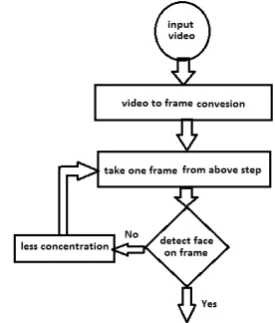
As discussed above various methods have been simulated, to provide full freedom to driver computer Vision based system is presented. The basic flow of the proposed system is shown below.
Figure 1. Basic block diagram of proposed system As shown in above figure the system is consist of a web camera which will be placed in front of driver. The web camera will cover the facial expression and head movement of the driver. For simulation purpose saved video as well as online video are considered here. Web camera record the head movement as well as facial expression. Recorded video are converted into frames, each frame then processes one by one. From each frame we have to find out whether image frame does have any face or not. If face is not found, unlike papers till date have considered previous image in such cases, we are considering this as “less concentration” and further we are taking next frame as shown below.
Face and Eyes Detection
The most efficient face detection method “Viola-Jones” is used to detect the face. Since this method works on variable face sizes in image which is useful for our system which we are going to set as generalized system independent of driver’s height and face orientation. Here region of Interest is front view, which is detected using CART method. After detecting face on image frame, different objects on face are determined like eyes, nose and mouth. Though nose in not a required feature as compared to eyes and mouth, but from identified nose we can easily find out eye pair and mouth with thumb rule. For object detection Haar like features are extracted from figures. These features are processed through cascade classifier, this object uses a cascade of classifiers to efficiently process image regions for the purpose of identifying a desired object in this case eyes and mouth. Each stage in the cascade applies complex binary classifiers in more increasing fashion, which permits the algorithm to reject regions quickly that do not contain the target. If the target object is not found in the cascade at any stage, the detector quickly rejects the region and processing is terminated. The object avoids invoking computation-intensive classifiers further down the cascade after terminating as shown in figure.
Region of Interest is indicated by rectangles on image. We have assigned name to detected object as right_eye, left_eye, nose and mouth. The problem of eye tracking which is very important and complex procedure is achieved by processing new frame each time. Which result in detection of eyes every time accurately, unlike eye tracking which generally considered previous location as correct one if eyes are not detected in present image.
Figure 3. Cascade classifier for object detection
Calculation of Eye Blinking
The main feature for drowsiness detection is eye blinking. The normal eye blinking rate is vary from 12-19 per minute. The frequency less than this normal range indicates the drowsy condition of a person/driver. In this paper we have considered all the possibilities of an eye. Eye may be fully open , fully closed and partially open/closed. Instead of calculating blinking rate, we have calculated average drowsiness. For eye blinking, detected eye is equated with zero, which indicates closed eye. Whereas non zero value is considered as fully open /partially open eye. The average drowsiness is calculated as follows:
Where d: drowsiness
After calculating % drowsiness, if this value is found to be more than a set threshold value then alert signal is generated for driver. The calculation is based on either eye’s status if only one is detected. Moreover yawning is also considered and used to generate the alert signal.
III.EXPERIMENTAL RESULT
Online and offline video are processed on two different system :
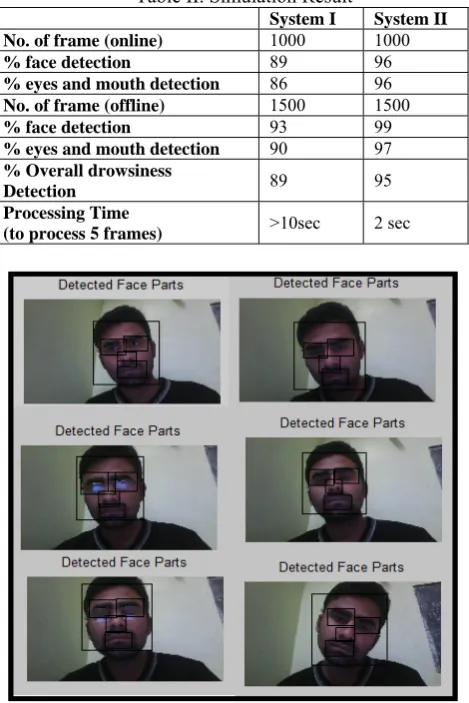
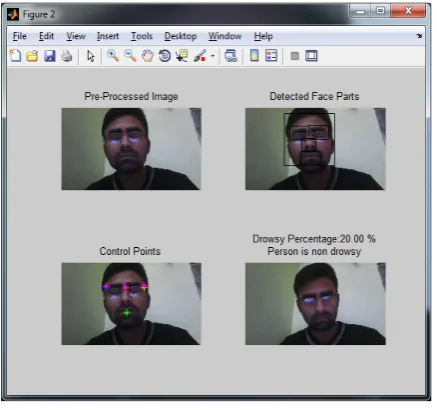
System I: Inspiron 15 (DELL), core i3 processor(64bit) with 4GB of RAM, VGA inbuilt web cam, MATLAB 13. System II: Inspiron 15 (DELL), core i3 processor(64bit) with 8GB of RAM, 3 MP USB web cam, MATLAB 13. For simulation purpose different drivers actions are recorded and processed. The results are formulated in table II given below. Different 500 frames have been processed on systemI and system II. The obtained results are subject to ambient illumination. If illumination is increased system fails to detect face and object. This limitation helps the system whenever multiple faces are found in an image frame, then the system detects only face which is closer i.e having sufficient illumination. The system’s efficiency is found to be above 90%, which can be further increased by using web camera with high resolution. Figure 4 and 5 shows the different images with detected face and eyes with final result.
Table II. Simulation Result
System I System II
No. of frame (online) 1000 1000
% face detection 89 96
% eyes and mouth detection 86 96
No. of frame (offline) 1500 1500
% face detection 93 99
% eyes and mouth detection 90 97
% Overall drowsiness
Detection 89 95
Processing Time
(to process 5 frames) >10sec 2 sec
Figure 5. Output showing %drowsiness
IV.CONCLUSIONS AND FUTURE WORK
Through Simulation result we revealed the characteristics of drowsy driver. It has been found that drowsiness affects rule-based driving rather than skilled-based driving. We suggest that in new drowsiness detection system skilled-based driving should also be considered. We can made method developed in this paper generalize to detect other driving faults. Higher level cognitive functions involved in complex tasks need to be addressed in future studies. It can be observed that person’s motivation can help significantly in complex tasks. Research Engineers and policy makers should share the desk. For example driver’s characteristics under fatigue condition must be taken while training process. Information obtained from these kind of tests will be useful for implementation of individualized drowsiness detection system.
ACKNOWLEDGMENT
The author would like to thank Dr. B.K. Mukharji, honourable Principal of Godavari College of Engineering Jalgaon. We would like to extend our heartiest thank to HOD of Electronics and Telecommunication department Dr. K.P. Rane, for his consistent support throughout this work. We would like to thanks to editors and reviewers for their valuable suggestions to publish this paper. We would like to give Special thanks to Mr. V.D. Choudhary for his valuable support.
REFERENCES
[1] “Road accidents in India Issues and dimensions”, Ministry of Road Transport and Highway Government of India, 2012.
[2] Ronald R. Knipling and Walter W. Wierwille, “ Vehicle-Based Drowsy Driver Detection: Current Status and Future Prospects”, IVHS America Fourth Annual Meeting, Atlanta.
[3] Fengyi Songa, Xiaoyang Tana,_, Songcan Chena, Zhi-Hua Zhoub, “ A Literature Survey on Robust and Efficient Eye Localization in Real-life Scenarios”.
[4] S. Puthusserypady and T. Ratnarajah, “H∞ Adaptive Filters for Eye
Blink Artifact Minimization From Electroencephalogram”, IEEE
signal processing letters, vol.12,No.12, December 2005.
[5] Junfeng Gao, Pan Lin, Yong Yang and Pei Wang, “Automatic Removal of Eye-Blink Artifacts Based on ICA and Peak Detection algorithm”, 2nd International Asia conference in Control, Automation
and Robotics 2010.
[6] A.Sammaiah, B.Narsimha, E.Suresh and M. sanjeeva Reddy, “On the Performance of Wavelet Transform Improving Eye Blink Detection for BCI”, IEEE proceedings of ICETECT, 2011.
[7] Andreas /bulling, Jamie A.Ward, Hans Gallersen and Gerhard Troster ,“Eye Movement Analysis for Activity Recognition Using
Electrooculography”, IEEE Transactions on Pattern analysis and
Machine Intelligence, vol.33, No.4, April 2011.
[8] Antoine Picot, Sylvie Charbonnier and Alice Caplier, “On-Line Detection of Drowsiness Using Brain and Visual Information”, IEEE Transactions on System, Man and Cybernetics-Part A: Systems and Humans, Vol.42, No.3, May 2012.
[9] Chin-Teng Lin, Che-Jui Chang, Bor-Shyh Lin, Shao-Hang Hung, Chih-Feng Chao and I-Jan Wang, “A Real-Time Wireless
Brain-Computer Interface System for Drowsiness Detection”, IEEE
Transactions on Biomediccal Circuits and Systems, Vol.4, No.4, August 2010.
[10] Fu-Chang Lin, Li-Wei Ko, Chung-Hsiang Chuang, Tung-Ping Su and Chin-Teng Lin, “Generalized EEG-Based Drowsiness Prediction
System by Using a Self-Organizing Neural Fuzzy System”, IEEE
Transactions on Circuits and Systems-I: Regular Papers, Vol.59, No.9, September 2012.
[11] Kamil Staszek, Krzysztof Wincza and Slawomir Gruszczynski, “Driver’s Drwosiness Monitoring System Utilizing Microwave
Doppler Sensor”, 19th International conference on Microwaves,
Radar and wireless Communications, May 21-23, MIKON 2012. [12] John J.Magee, Margrit Betke, James Gips, Matthew R. Scott and
Benjamin N. waber, “A Human-Computer Interface Using Symmetry
Between Eyes to detect Gaze Direction”, IEEE Transactions on
Systems, Man and Cybernetics-Part A: Systems and Humans, Vol.38, No.6, November 2008.
[13] Zhiwei Zhu and Qiang Ji ,“Robust real-time eye detection and tracking under variable lighting conditions and various face
orientations”, Computer Vision and Image Understanding 98,
ELSEVIER 2004.
[14] Andrea Cristiani, Marco Porta, Davide Gandini, Gian
MarioBertolotti and Nikola Serbedzija, “Driver drowsiness identification by means of passive techniques for eye detection and
tracking”, Fourth IEEE International Conference on Self-Adaptive
and Self-Organizing Systems Workshop, 2010.
[15] Giancarlo Iannizzotto and Francesco La Rosa, “Competitive
Combination of Multiple Eye Detection and Tracking Techniques”,
IEEE Transaction on Industrial Electronics, Vol.58, No.8, August
2011.
[16] Axel Panning, Ayoub Al-Hamadi and Bernd Michaelis, “A Color
Based Approach for Eye Blink Detection in Image Sequence”, IEEE
international Conference on Signal and Image Processing Applications, 2011.
[17] Wei Zhang, Bo Cheng and Yingzi Lin, “Driver Drowsiness
Recognition Based on Computer Vision Technology”, TSINGHUA
SCIENCE and TECHNOLOGY, Vol.17, No.3, June 2012.
[18] Yuriy Kurylyak, Francesco Lamonaca and Giovanni Mirabelli, “Detection of the Eye Blinks for Human’s Fatigue Monitoring”,
IEEE 2012.
[19] Kyril Mincov, Stefanos Zafeiriou and Maja Pantic, “A Comparison of Different Features For Automatic Eye Blinking Detection With an
Application To Analysis Of Deceptive Behavior”, Proceedings of
the 5th ISCCSP, Italy, May 2012.
[20] Christer Ahlstrom, Trent Victor, Claudia Wege and Erik Steinmetz, “Processing of Eye/Head-Tracking Data in Large-Scale Naturalistic Driving Data Sets”, IEEE Transactions on Intelligent Transpotation Systems, vol.13, No.2, June 2012.
[21] Ji Hyun Yang, Zhi-Hong Mao, Louis Tijerina, Tom Pilutti, Joseph F.Coughlin and Eric Feron, “Detection of Driver Fatigue caused by
Sleep Deprivation”, IEEE Transactions on Systems, Man and