FCC-ee and the CR effects
NelliPukhaeva1,∗
1Joint Institute for Nuclear Research, 141980 Dubna, Russia
Abstract. The proposed new FCC-ee e+e−
colliders will be hosted in the Geneva area as the new 100 km tunnel will allow producing collisions at centre-of-mass energies from 90 to 350 GeV and beyond at several interaction points and will be used for a precision measurement at theZpole,WWthreshold,HZ cross section maximum andtt¯threshold with an unequaled accuracy.
New measurements, which will be realized with large amount of data and at high energies accessible at the FCC-ee would allow a detailed study of the Color Reconnection phenomenon, especially in the hadronicWWdecays, and would be helpful for other studies, for example in search for these effects int¯tand in Higgs decays.
1 Introduction
FCC (Future Circular Collider), which could be in a new 100 km circular tunnel in the Geneva area will host a lepton-lepton, a hadron-hadron, and a lepton-hadron colliders, respectively as the project evolves.
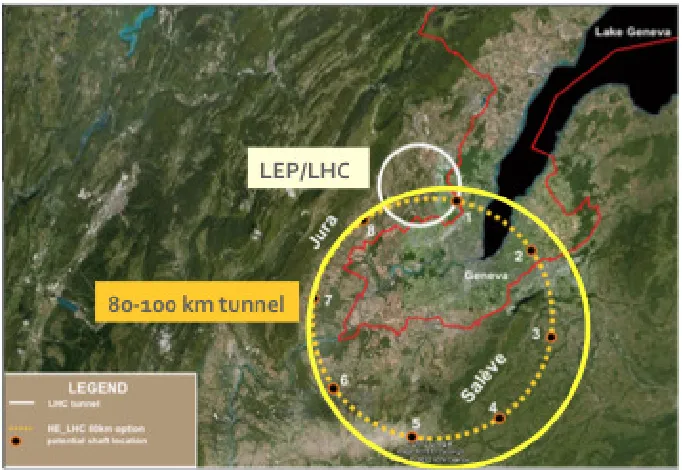
The first part will be the FCC-ee, which is formally called TLEP[1] (see Fig. 1) providing e+e−collisions at a high luminosity in order to enable precision studies of several fundamental elementary particles. It will produce collisions at centre-of-mass energies from 90 to 350 GeV and beyond at several interaction points for making a precision measurement at theZpole, WWthreshold,HZcross section maximum andtt¯threshold with an unequaled accuracy[2].
The events will be as "clean" as at LEP, with no pile-up interactions and negligible beam background.
The new particle accelerators will be an instrument to understand the physics underlying new observations. It must be new phenomena, albeit at unknown energy scales, as shown by the evidence for non-baryonic dark matter, the cosmological baryon-antibaryon asymmetry and non-zero neutrino masses, which are all evidence for physics beyond the Standard Model. The color reconnections (CR) issues will reappear at FCC-ee high-energye+e−colliders. The hadronic and semileptonicWWevents will be studied to probe the impact of CR effects. Both the top andWhave decay lengths of order of 0.1 fm, and their decay products participate in the swapping of colors. Thett¯decays with hadronic final states will allow the study of the CR effects. The CR uncertainties thereby affect the precision of measurements of the Higgs boson properties, which is one of the primary purposes of futuree+e−colliders.
2 FCC-ee timescale and physics programme
Today the various possibilities are on the table for the choice of the most appropriate ma-chine(s) to analyze new phenomena (pp,e+e−,µ+µ−andγγcolliders and it seems that circular
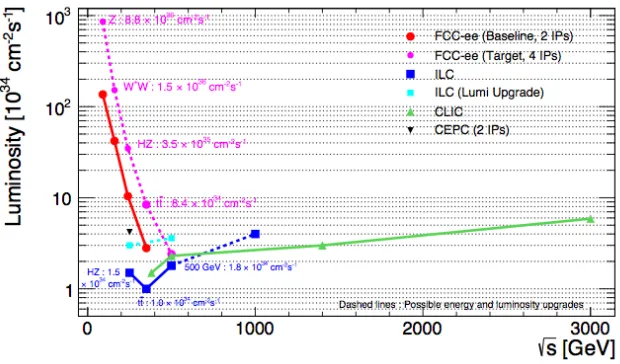
e+e−colliders have the best potential (Fig. 2).
The choice of the most appropriate machine(s) to analyze these new phenomena may be determined by historical precedents, which reveal the important role played by lower-energy precision measurements when establishing roadmaps for future discoveries with higher-energy machines.
In the late 1970’s, precision measurements of neutral currents reinforced the prediction of the existence of theWandZbosons and constrained the values of their masses. TheWandZ bosons were then discovered in the early 1980’s as was expected at the CERNS ppS¯ collider with masses in the range predicted. Subsequently, the CERN LEPe+e−collider measured the properties of theZ andW bosons with a high precision in 1990’s. These precise mea-surements led to the prediction of the top-quark mass, which was discovered at the FNAL Tevatron with the predicted mass. The measurement ofmtop, together with the precise mea-surement of theW mass at the Tevatron in the past decade, led in turn to a prediction of the mass of the Higgs boson, which was discovered at LHC within the predicted mass range.
The construction and installation of the collider and detectors of the FCC-ee and VHE-LHC setups could start and then proceed in parallel with the HL-VHE-LHC running for next five years with considerations to start commissioning for the first FCC physics run as early as 2030.
Figure 1.The 80 km tunnel (dashed circle) and the 100 km version (full line) that would host the TLEP and VHE-LHC in the Geneva area
improvement in precision by two orders of magnitude, i.e. an increase in statistics by four orders of magnitude to at least 1011Zdecays, would be necessary [3].
The baseline of the physics programme of FCC-ee would consist of [4]
• two years at theZpole (one of which is the year with the designed luminosity of 5.6ab−1 at each IP);
• one or two years at theWWthreshold with luminosity of 1.6ab−1per year at each IP and with periodic returns to theZpeak;
• five years at 240 GeV as a Higgs factory, with luminosity of 500 f b−1per year at each IP and with periodic returns to theZpeak;
• five years at thett¯threshold with the luminosity of 130 f b−1per year at each IP and with periodic returns to theZpeak.
Figure 2.The luminosity expected at TLEP (full red line), with four interactions points, the luminosities expected at linear colliders, ILC (blue line) and CLIC (green line)
The Higgs boson coupling needs to be measured with a one-percent accuracy or better to be sensitive to the 1 TeV new physics and with a permil accuracy to be sensitive to the multi-TeV new physics. In the Higgs decay channels toW+W−andZ0Z0, the fully hadronic decays would be sensitive to the CR between the two gauge-boson systems.
The FCC-ee will be aW factory with more than 2 x 10⁸W pairs produced at center-of-mass energies at theWW threshold and above. Since the quantity of data expected at the WWproduction threshold is 105times larger than that produced at LEP, the measurements to be performed at the FCC-ee at these center-of-mass energies need to be thoroughly reviewed starting from the study of the design. The precision achieved at LEP onmWwas about 300 MeV per experiment. A statistical error of 1 MeV on theW mass will be achievable at the FCC-ee per experiment and it would already be a very sensitive probe of new physics and would allow detailed tests of the CR phenomenon in the hadronicWWchannel.
3 Nonperturbative QCD effects and hadronization
Quantum Chromodynamics is the only unbroken Yang-Mills theory that can be compared directly with experiment. It exhibits the unique and complicating feature of self-interactions between massless gauge bosons (moreover with a tree-level coupling, which is relatively large) and, related to that, the still fundamentally puzzling feature of confinement. Its rich structure is probed in a particularly clean way by theee → hadronsprocess, where quarks produced from the vacuum turn into (jets of) hadrons. At CM energies above a few GeV, this process can be described via a combination of quark and gluon bremsstrahlung showers, which may be treated perturbatively and constrained by fits to data. These two components correspond to short and long wavelengths, respectively, and a hadronization process, which must be parameterized or modeled nonperturbatively and constrained by fits to data. The two components corresponding to short and long wavelengths may formally be factorized from each other. This is the basis of all calculations in QCD.
The confinement remains one of the fundamental unsolved problems in the quantum field theory. For infrared safe observables, its effects may be minimized and cast in terms of factorized and universal long-distance corrections (power corrections) and/or functions (FFs, PDFs). Monte-Carlo models (such as the string or cluster ones) attempt to go further and provide an explicit non-perturbative modeling of the hadronization process. The latter allows direct comparisons with data at the particle level. Moreover, comparing models based on qualitatively different assumptions with data would allow one (if done carefully) to extract knowledge about the properties of the nonperturbative dynamics, a famous example being the discovery of the ’string effect’ in the early eighties[5]. In both cases, there are free parameters that must be extracted from fits (or ’tunes’ in the Monte Carlo (MC) context) to data. In this context, the clean environment ofe+e−collisions is a sine qua non.
3.1 The CR effects models
There are several new models proposed during the last years. New models were introduced to study uncertainties in the top mass measurement and study the effect of CR in top decays [6]. In the ’forces’ model, the reconnection involving top decay products are performed as follows. Two sets of gluons are constructed, one containing the gluons produced in the top decaysgtand the other containing the gluons from the rest of the reaction productsgr. Iterating overgt in random order, one forces the gluons from top to exchange colors with gluons from the rest of the event.
A second class of models is also introduced, GM (Gluon-Move) and swap models, which simulate reconnections between all gluons in the event. The swap model is a generalization of the ’smallest∆λ’, where the∆λis a tunable parameter which expresses a CR strength.
The ’move’ model works as follows. The final state gluon is attached to a string piece between partons, the string length∆λchanges as a result of moving the gluon to another string piece between other partons.
The model SCI (Soft Color Interaction) [7], where CR is described as a stochastic color exchange between perturbative partons and a background color field, which modifies the color structure of hadronization, such that color singlet systems may appear well separated in rapidity.
The new models implemented to study CR effects at hadronic colliders show different behaviors fore+e−. The CS model gives rise to very limited variations, while for the GM
models even one specific scenario shows large enough deviations to be excluded by the LEP data. All these new models could be used for any process.
Modeling and testing of CR in hadronic collisions is rather more complicated. How-ever, the estimation of the average transverse momentum with increasing charged multiplicity plays an important role.
The paper [9] discussed whether the QCD vacuum behaves like a superconductor and it was concluded that there are two possibilities. If it is like a type I superconductor, the string should correspond to a flux tube, similar to an elongated bag, with more or less homogeneous color electric field. The diameter of the flux tube should be of order of 1 fm (a typical hadron bag diameter) and it is expected that the geometry of the flux tube would be determined only when the separation of the color charges reaches this order of magnitude. If the vacuum is like a type II superconductor, the string would correspond to a vortex line with a thin core which is surrounded by an exponentially falling electric field. The diameter of this field would be about 1 fm but the size of the core could be much smaller. In this case geometry of the string would be determined already when the separation reaches the core size.
All those assumptions were introduced in the later version on PYTHIA8.
4 The effects of CR at FCC-ee
The measurements at LEP convincingly demonstrated that the color reconnections (e.g. be-tween the two decay systems in hadronicWWevents) exist in nature, ruling out the no-CR scenario at 99.5% CL [10]. The effect became the topic of significant interest in particu-lar since ’string drag’ had a noticeable effect on extractions of theW mass. However, apart from the conclusion that it exists and the exclusion of some of the most aggressive (and pos-sibly unrealistic) scenarios, not much differential information is available to constrain new generations of models.
The issue has reappeared with potentially enhanced effects in hadronic collisions where it can affect the top mass extraction and significant effects may be indicated by soft-QCD distributions in both minimum-bias and underlying-event measurement.
High-statisticse+e−measurements are necessary to tell the other side of the story [13]. In particular, it was suggested [12] that with thousands of time moreWWevents at the FCC-ee rather than at LEP, theWmass issue could be turned around using the huge sample of semi-leptonic (in which no CR can occur between the two decay systems) processes to determine MWwith a high precision and then one can use this extracted value as a constraint to measure CR in the fully hadronic ones. Other measurement include the particle flow between jets, or charges in the charged multiplicity as a function of topology. Complementary studies should, of course, also be performed in ee → ttand multi-jet states of hadronic Z decays. The perspectives of pinning down the CR mechanism at the FCC-ee are, therefore, good.
4.1 Interconnection effects atWW
Figure 3.The effects of CR forWWbosons in the string hadronization models
4.2 Interconnection effects att¯t
Since both the top and the W bosons have decay lengths of order of 0.1 fm, their decay products participate in the swapping of colors. Similarly to theW+W−, the perturbative
re-structuring is suppressed because of the space-time separation between the decays of thet¯t quarks. At the perturbative level the rearrangement effects are negligibly small [14]. How-ever, the non-perturbative aspects are not so well understood and there is no obvious reason why interconnection effects have to be small in the fragmentation process.
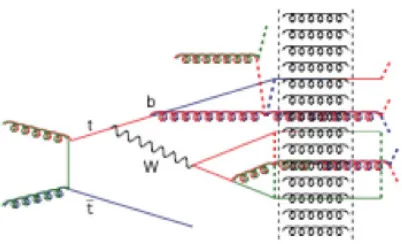
tt¯quark pairs are mainly produced through a QCD process. These pairs can be produced from either a pair of gluons or a pair of quarks in the initial state, Fig. 4. Top quarks are col-ored particles, the decay occurs before the hadronization and fragmentation owing to its large mass and width. Due to this effect, all its properties are transferred to its decays products, which are expected to be 99% of the cases aWboson and abquark. Fully hadronic channels dominate and are about 44%. BothW bosons decay into a pair of quark and anti-quark of different flavor. As a result, six quarks are produced in total.
Figure 4.The top decay in the string hadronization models
The effect of CR was studied at Tevatron for measured top masses [15,19]. They used the Perudgia Tune Monte-Carlo model which included the Color Reconnection effects estimated from the LEP parameters obtained by the Professor collaboration [15] for underlying events. The uncertainty of the color reconnection was not evaluated for the Run I data because ap-propriate Monte-Carlo tools were not available that time. Both collaborations estimated this effect in the Run II by comparing the value ofmtextracted from ensembles oftt¯events gen-erated by PYTHIA using the difference between two parton shower simulations: A-PRO and ACR-PRO, where A-PRO is a model without color reconnection and ACR-PRO includes the color reconnection. The resulting uncertainties ofmtare 0.32% for the CDF and 0.16% for the D0.
4.3 CR in Higgs decays
The Higgs state is very narrow (of order of 4 MeV) and very long-lived. The hadronization of the rest of the event already happened and the produced hadrons already spread out by the time when the Higgs boson decays. That mean that the Higgs boson itself decays essentially in a vacuum and has no interactions with the rest of the event neither in e+e− nor in pp collisions.
Figure 5.The Standard Model Higgs boson decay branching ratio
In the Standard Model, the Higgs boson is a pure CP-even state, but in various extensions there can be a CP-odd admixture, and an important tack is to set stringent limits on this, Fig. 5. One possibility is to study angular correlations inH0 → WW → qqqqdecays [8]. The main point here is that CR also changes jet directions since the particle flow around a parton is biased in the direction towards its color partner due to standard string effects. This can give rise to deviations that could be misinterpreted, unless CR is well understood.
5 Summary
Future e+e− colliders like FCC-ee will allow one to better understand and investigate
these phenomena for the same classes of events, namely in the hadronicWWchannel. First results of the study of the CR effects ate+e−colliders were presented at the first workshop
“Parton Radiation and Fragmentation from LNC to FCC-ee”, which took place at CERN on November 21-22, 2016 [13]. The study of these phenomena at the FCC-ee energies will be continued using the new CR models which are implemented in the PYTHIA8 framework.
References
[1] M. Bicer et al. [TLEP design Working Group], JHEP1401, 164 (2014)
[2] M. Koratzinos, A. Blondel, E. Gianfelice-Wendt and F. Zimmermann, arXiv:1506.00933.
[3] 1st FCC-ee workshop on precision observables and radiative corrections, July 2015, https://indico.cern.ch/event/387296/
[4] F. Zimmermann, 1st FCC annual workshop, Washington, March 2015, https://indico.cern.ch/event/340703/
[5] M. Green, J. Schwarz and E. Witten,Superstring Theory, (Cambridge University Press, 1987)
[6] S. Argyropoulos and T. Sj ¨ostrand, JHEP1411, 043 (2014)
[7] R. Enberg, G. Ingelman, N. Timneanu, Phys.Rev. D64, (2001) 114015 [8] J. Christiansen, T. Sj ¨ostrand, Eur.Phys.J. C75(9), 441 (2015)
[9] G. Gustafson, U. Petterson and P. Zevas, Phys. Lett. B209, 90 (1998)
[10] S. Schael et al., ALEPH, DELPHI, L3, OPAL, LEP Electroweak Collaboration, Phys.Rept.532, 119-244 (2013)
[11] N.E. Pukhaeva, Phys.Part.Nucl.Lett.15(5), 492-498 (2018) [12] D. d’Enterria, inProc. of 18th LCEPPh, Moscow(2016) 182
[13] FCC-ee precision physics workshop, Feb. 2016,https://indico.cern.ch/event/469561/ [14] V.S. Fadin, V.A. Khose and A.D. Martin, Phys.Lett. B320, 141 (1994)
[15] V.M. Abazov et al. (D0 Collaboration), Phys.Rev. D83, (2011) 092002 [16] B.R. Webber, J.Phys.G: Nucl. Part. Phys.24, 287 (1998)
[17] P.Skands and D. Wicke, Eur.Phys.J. C52, 133 (2007) [18] N.E. Pukhaeva, onProceeding XIV APMWP, Grodno(2018)