_____________________________________________________________________________________________________ *Corresponding author: E-mail: [email protected];
www.sciencedomain.org
ARMS-PCR Based SNP Analysis of MTHFR C677T
Allele Using Syber Green in Pancreatic Tumour
Ajit K. Saxena
1*, Ramanuj K. Gupta
1, Anil
2and Manoj Kumar
21
Department of Pathology and Lab Medicine,All India Institute of Medical Sciences, Phulwarishriff,
Walmi, Patna-801507, India. 2
Department of General Surgery, All India Institute of Medical Sciences, Phulwarishriff, Walmi, Patna-801507, India.
Authors’ contributions
This work was carried out in collaboration between all authors. All authors read and approved the final manuscript.
Article Information
DOI: 10.9734/BJMMR/2016/20599 Editor(s): (1) Valeria Denninghoff, Molecular Pathology and Molecular Onco-Hemathology laboratory, University Institute CEMIC. Argentina. (2)Chan-Min Liu, School of Life Science, Xuzhou Normal University, Xuzhou City, China. (3)Salomone Di Saverio, Emergency Surgery Unit, Department of General and Transplant Surgery, S. Orsola Malpighi University Hospital, Bologna, Italy. Reviewers: (1) Bhaskar Sharma, Suresh Gyan Vihar University, Rajasthan, India. (2)Anonymous, University of Florence, Italy. (3)Nitin Gupta, Ivy Hospital, Hoshiarpur, India. Complete Peer review History:http://sciencedomain.org/review-history/12016
Received 31st July 2015 Accepted 8th October 2015 Published 29th October 2015
ABSTRACT
In human, carcinoma of pancreas, a rare disease and mortality rate is quite high in Indian population. Epidemiological studies support the hypothesis that folate metabolism regulate DNA stability and prevent cancer. Because folate have been linked to dietary supplement and defect in folate metabolism have been increase risk of developing cancer shows adverse effect on health conditions. In the present study we have assess methylene tetrahydrofolate reductase gene polymorphism (MTHFR) 677 C T using ARMS PCR based SNP analysis using Syber green in the cases of pancreatic tumour to determine the “risk factor”. Interestingly, our findings reveals that 33.0% frequency (one case) showing mutation of MTHFR 677 TT genotype (rare type) in homozygous condition with Tm value 82.50°C for mutant 677T allele shifted to 67 7C allele (83.50°C). Two cases (66%) showing CC (wild type) all ele and Tm value 82.83°C for 677C allele. In MTHFR 677TT is a rare mutation and individuals show very low enzymatic activity due to the substitution of alanine to valine. The study further continue to confirm the mutation by
Saxena et al.; BJMMR, 11(12): 1-6, 2016; Article no.BJMMR.20599
visualization on agarose gel electrophoresis of the same PCR product, again showing (Lane- 2) the band of 50 kb of mutant 677TT allele in the same case, suggesting an relevant role of folate metabolism and subsequent impairment of aberrant DNA methylation during carcinogenesis with increasing “high risk” for the development of carcinoma due to allele TT mutation of MTHFR. However, large samples size is required to further confirm the association.
Keywords: Pancreatic tumour; ARMS PCR; MTHFR polymorphism.
1. INTRODUCTION
Pancreatic tumour, a most common form of cancer mortality and their incidence varies in different countries due to different life style including food habit and other environmental factors [1,2]. To reduce the global burden of pancreatic cancer in the coming decades it is become necessary to indentify the “risk factor” for the prevention of such disease in this region. Since methylenetetrahydrofolate reductase (MTHFR) play an important role to regulate folate metabolism by irreversible catalyzing the conversion of 5,10- methylenetetrahydrofolate to 5- methylenetetrahydrofolate and is also involved against oxidative stress to maintain pancreatic homeostasis during injury [3,4]. Recent studies of MTHFR 677 C T gene polymorphism on cancer risk are highly controversial and conflicting findings have been documented in the current literature [5-8]. However, earlier studies of same authors on MTHFR gene in other carcinoma of cervix and ovary rather than pancreas has been associated with risk factor [9,10]. Therefore, the interest has been generated to assess a short case study to find out the mutation of polymorphic genes variation in methylenetetrahydrofolate reductase (MTHFR) using sensitive allele refractory mutation system – polymerase chain reaction (ARMS PCR).
2. MATERIALS AND METHODS
2.1 Samples
Blood samples were obtained in sterile EDTA vials from pancreatic cancer patients (n=3) and controls of the same age group after clinical diagnosis from the OPD of All India Institute of Medical Sciences who refers these cases to Genetic Laboratory of the Department of Pathology & Lab Medicine for the study of MTHFR C677T polymorphism by RT PCR (Bio Red Mini Opticcon,USA) Syber green method. Genomic DNA were isolated using Bioneer kits (Korea) and quantified using Nanodrop spectrophotometer (Thermoscientific, USA) and
samples were stored at -20°C till the SNP analysis was performed.
2.2 Primer Design
The primers for tetra plex real-time PCR assay were designed for genotyping of MTHFR 677C T
(http://cedar.genetics.soton.ac.uk/public_html/pri mer1.html) and further confirmed by BLAST program at http:// www.ncbi.nlm.nih.gov/blast to determine the specificity of the primers. To increase the specificity of the reaction a mismatch at the 2 position of the 3' end both the allele-specific primers were selected and further confirmed by software [11]. Earlier, the effect of the mismatch at the 2 position of the 3' end of the allele-specific primers on the specificity of the reaction already documented in the literature [12]. To obtain amplicons with distinct melting points, the hypothetical ‘Tm’ values were calculated using known software or Web sites (for example, http://eu.idtdna.com/analyzer/Applications/OligoA nalyzer/). The selection of the primers were based on the amplicons ‘Tm’ values and following primers used in present study:
MTHFR-T, 5' –
GCACTTGAAGGAGAAGGTGTCTGCGGGCGT-3' ; MT MTHFR-C-polyG, 5' – GGCGGGCGGCCGGGAAAAGCTGCGTGATGA TGAAATAGG-3' ; MTHFR-cf, 5' -TGTCATCCCTATTGGCAGGTTACCCCAAA-3' ;
MTHFR-cr, 5'
-CCATGTCGGTGCATGCCTTCACAAAG-3' [13] .These group of tetra-primer ARMS PCR using SYBR Green based on melting-point (Tm) analysis was part of strategy of our interest to detect SNP of mutant of MTHFR allele (wild-type & mutant alleles and also the same PCR product further confirmed by agarose gel electrophoresis.
2.3 Real-time PCR Method
and distilled water was taken to performed time PCR. The PCR protocol on the Light (BioRed USA) was as an initial denaturation step (95 "C for 7 min) was followed by amplification and quantification steps repeated for 30 cycles (95"C for 10 s, 60"C for 10 s, 72
s, with a single fluorescence measurement at the end of the elongation step at 72°
curve analyzed the data and reaction was terminated by cooling to 40°C. Melting curves were constructed by lowering the temperature to 65°C and later increasing the temperature by 0.2"C/s to 98°C to measuring the change fluorescence consistently. Tm values were assigned to develop plot generated by the RTPCR of the negative derivation of fluorescence versus temperature (!dF/dT) of the melting curve for amplification products measured at 530 nm.
3. RESULTS
In the present study of MTHFR gene polymorphism carry out in few
carcinoma of pancreas using highly sensitive and reliable method using tetra-primer PCR which amplifies both wild-type and mutant alleles 677C>T of MTHFR gene with a controls of the same group in a single PCR tube. The method employs four set of primers to amplify a larger non-allele- specific fragment containing the mutation site and allele-specific amplicons representing each of the two allelic forms. The study reveals that of Tetra-primer
generated amplicons with Tm value 82.83 the 677C allele (controls) and Tm value
a
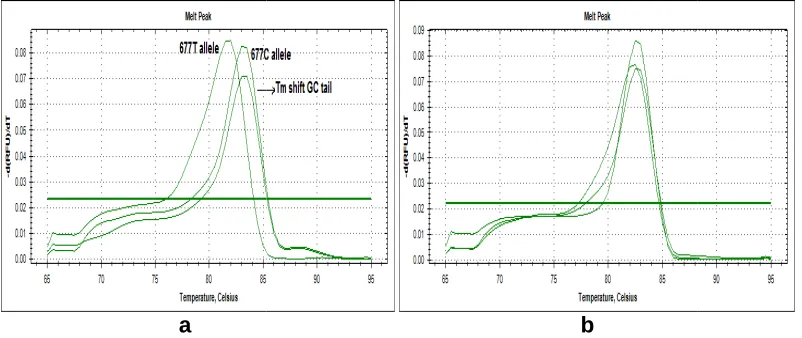
Fig. 1a & b. ARMS T-Plex real - time PCR assay for MTHFR C677T genotyping using wild (CC) and mutant (TT) allele (1a). The effect of addition of a short GC tail on the
677C allele with melting-curve analysis for the allele specific and non allele specific amp between cases and controls samples (Fig.
and distilled water was taken to performed Real-. The PCR protocol on the Light Cycler (BioRed USA) was as an initial denaturation step (95 "C for 7 min) was followed by amplification and quantification steps repeated for 30–40 cycles (95"C for 10 s, 60"C for 10 s, 72°C for 20 s, with a single fluorescence measurement at the
°C, a melting-curve analyzed the data and reaction was
C. Melting curves were constructed by lowering the temperature to C and later increasing the temperature by C to measuring the change in fluorescence consistently. Tm values were assigned to develop plot generated by the RTPCR of the negative derivation of fluorescence versus temperature (!dF/dT) of the melting curve for amplification products
present study of MTHFR gene polymorphism carry out in few cases of carcinoma of pancreas using highly sensitive and primer PCR which type and mutant alleles 677C>T of MTHFR gene with a controls of the oup in a single PCR tube. The method employs four set of primers to amplify a larger specific fragment containing the specific amplicons representing each of the two allelic forms. The primers PCR value 82.83°C for
value 82.50°C
for the 677T allele, and 83.50°C for677C allele in cases of carcinoma of pancreas. Because values are close to one another, a short GC tail is added to the inner 677C
allele-and genotype support on the
amplicons with unique shape of the melting peaks as documented in Figs. 1a & b.
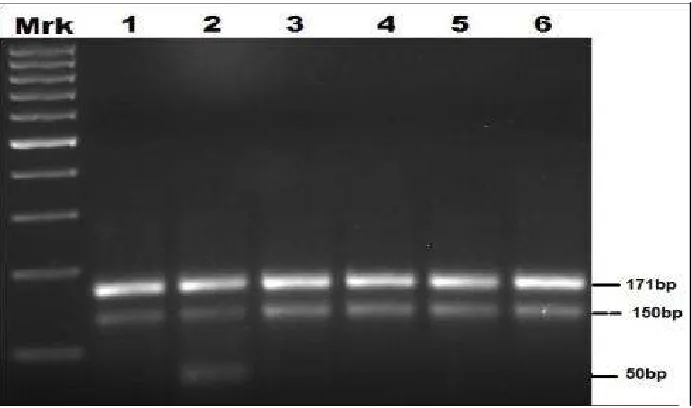
The above findings based on ARMS PCR further confirmed by agarose gel electrophoresis in the same PCR product (both cases & controls). In one case (33%) showing rare 677TT mutant allele as shown in Lane-2 and having and of 50bp band , while in two cases (wild type) 677CC (66%) allele were observed in homozygous condition (Lane-1 &
controls samples only 677CC (wild type) bands are visualized in lane 4, 5 & 6 (Fig. 2).
4. DISCUSSION
Etiopathology of tumour biology is highly complex and pancreatic carcinoma is one of the important for surgical point of view neoplasia associated high risk of mortality rate. Epidemiological studies shows that an association between low folate intake and an increased risk for the development of cancer. In this manuscript, we have undertaken a case control study to investigate the role of MTHFR 677C T gene polymorphisms and their susceptibility in pancreatic tumour. MTHFR, thermolabile enzyme that play a crucial role the folate metabolic pathway involving DNA synthesis and methylation.
a b
time PCR assay for MTHFR C677T genotyping using wild (CC) and mutant (TT) allele (1a). The effect of addition of a short GC tail on the Tm
curve analysis for the allele specific and non allele specific amp between cases and controls samples (Fig. 1b)
C for677C allele in cases of carcinoma of pancreas. Because Tm values are close to one another, a short GC tail -specific primer genotype support on the Tm specific amplicons with unique shape of the melting
1a & b.
The above findings based on ARMS PCR further confirmed by agarose gel electrophoresis in the same PCR product (both cases & controls). In one case (33%) showing rare 677TT mutant 2 and having and of
cases (wild type) 677CC (66%) allele were observed in 3). In case of controls samples only 677CC (wild type) bands
6 (Fig. 2).
of tumour biology is highly complex and pancreatic carcinoma is one of the important for surgical point of view neoplasia associated high risk of mortality rate. Epidemiological studies shows that an association between low folate intake and an risk for the development of cancer. In this manuscript, we have undertaken a case-control study to investigate the role of MTHFR 677C T gene polymorphisms and their susceptibility in pancreatic tumour. MTHFR, thermolabile enzyme that play a crucial role in the folate metabolic pathway involving DNA
Saxena et al.; BJMMR, 11(12): 1-6, 2016; Article no.BJMMR.20599
Fig. 2. RT PCR products of MTHFR gene polymorphism are separated on Agarose (3%) gel electrophoresis stained by ethedium bromide and allele specific amplicons are visualized &
characterized on Gel Doc system (Bio Red USA).T- Plex analysis showing 677CC genotype (wild type) in lane -1&3 (171bp, 150bp) and lane -2 carrying homozygous mutant 677TT allele
(rare type) of 50bp in cases of carcinoma of pancreas while lane- 4, 5 & 6 carrying homozygous 677CC allele (wild type) in controls
Interestingly, in the recent year we have observed the genetic susceptibility in various types of tumor lead to a growing attention to the MTHFR C677T gene polymorphisms associated risk in tumour biology. Interestingly, polymorphisms in MTHFR may interact with folate status to influence genomic methylation. A recent study by Frisco et al reports that subjects with low folate status and carrying the TT variant of the MTHFR 677 C T (ala val) polymorphism had relative hypomethylaton of DNA extracted from whole blood compared with homozygous wild types, an effect that was mitigated by high folate status [14]. Methylenetetrahydrofolate reductase (MTHFR) mutation are commonly associated with folate metabolism to increase “risk factor” for the development of neural tube defects, recurrent pregnancy loss and development of pancreatic carcinoma with genetic interaction between MTHFR alleles has been poorly defined in Eastern region of India.
Folic acid metabolism plays an important role in the maintenance of genomic stability. Dietary factors including folate play an important protective role and there are also plausible explanatory mechanisms. Factor influencing development of such cancer risk is still not known but certainly associated with genetic and
epigenetic variation regulating folate metabolism [15]. The MTHFR 677 TT genotype led to elevated homocysteine levels and DNA hypomethylation in folate-depleted subjects lead to provide the genomic instability, leading to carcinogenesis. Because one case showing 677TT mutation (33%) of MTHFR polymorphisms determining variant “ T” genotype as a risk factor for carcinoma of pancreas and changes in the mutation frequency may be either due racial differences or environmental factor including dietary supplement between population. Meta-anlysis study revealed that there is a controversial finding between different groups of the authors regarding involvement of MTHFR 677C T gene polymorphism in development of adenocarcinoma of pancreas [16].
the reaction can be monitored over time. After real-time PCR amplification, the Light Cycler continuously monitors the decrease in fluorescence resulting from the release of SYBR Green during DNA melting point analysis by slowly increasing the temperature. Because the allele-specific (inner) primers are designed in opposite orientations, they generate amplicons targeting opposite sides of the mutation point and the amplicons generally have different Tm (melting temperatures) depending on their GC content, length, and sequence. To verify our results we also run the PCR product on 3% agarose gel.
5. CONCLUSION
Multiple proceedings cause critical loss of gene activity and thereby predispose to cancer. How the normal cells become progressively transformed to malignant cell as a magnitude of damage to the genome in term of a gain, loss, or mutation of the genetic information? The finding of such small study is quite interesting because of using ARMS PCR to detect rare mutation of MTHFR 677TT allele and has important implications to asses “risk factor” for the development of carcinoma of pancreas in Indian population. However, further study is continued and required to collect more sample size to make the study significant.
CONSENT
It is not applicable.
ETHICAL APPROVAL
It is not applicable.
ACKNOWLEDGEMENTS
Author AKS thankfully acknowledged to the patients who participate in the study.
COMPETING INTERESTS
Authors have declared that no competing interests exist between the authors.
REFERENCES
1. Raimondi S, Maisonneuve P, Lowenfels AB. Epidemiology of pancreatic cancer: An overview. Nat Rev Gastroenterol Hepatol. 2009;6(12):699-708.
2. Hidalgo M. Pancreatic cancer. N Engl J Med. 2010;362(17):1605-17.
3. Goyette P, Pai A, Milos R, Frosst P, Tran P, Chen Z, Chan M, Rozen R. Gene structure of human and mouse methylenetetrahydrofolate reductase (MTHFR). Mammalian Genome. 1998; 9(8):652-6
4. Takeshi Suzuki, Keitaro Matsuo, Akira Sawaki, Nobumasa Mizuno, Akio Hiraki, et al. Alcohol drinking and one-carbon metabolism-related gene polymorphisms on pancreatic cancer risk. Cancer Epidemiol Biomarkers Prev. 2008;17(10): 2742-7.
5. Loic Le Marchand, Lynne R Wilkens, Laurence N Kolonel, Brian E Henderson. The MTHFR C677T polymorphism and colorectal cancer: The multiethnic cohort study. Cancer Epidemiol Biomarkers Prev. 2005;14(5):1198-203.
6. Chun-Xia Yang, Keitaro Matsuo, Hidemi, Masayuki Shinoda, Shunzo Hatooka, et al. Gene--environment interactions between alcohol drinking and the MTHFR C677T polymorphism impact on oesophageal cancer risk: Results of a case--control study in Japan. Carcinogenesis. 2005; 26:1285-1290.
7. Li Wang, Xiaoping Miao, Wen Tan, Xinghua Lu, Ping Zhao, Xiaohang Zhao, Yi Shan, Hui Li, Dongxin Lin. Genetic
polymorphisms in
methylenetetrahydrofolate reductase and thymidylate synthesis and risk of pancreatic cancer. Clinical Gastroenterology and Hepatology. 2005; 3(8):743–751.
8. Ivan Nisevic, Jelena Dinic, Aleksandra Nikolic, Valentina Djordjevic, Snezana Lukic, Milenko Ugljesic, Marina Andjelic-Jelic, Natasa Petrovic-Stanojevic, Dragica Radojkovic. MTHFR C677T polymorphism in chronic pancreatitis and pancreatic adenocarcinoma. Cell Biochemistry and Functionpages. 2008;26(6):659–663. 9. Singh GK, Ajit K Saxena, Anjula Garima,
Panday S, Panday LK. p53 gene inactivation modulate methylenetetra-hydrofolate C667T gene polymorphism associated risk factor for the development of cervical carcinoma-A tissue specific genetic heterogeneity. Journal of Clinical & Experimental Oncology. 2013;23:134-137. 10. Anupama, Panday S, Panday LK, Ajit K
Saxena et al.; BJMMR, 11(12): 1-6, 2016; Article no.BJMMR.20599
“risk factor” for the development of ovarian cancer. Journal of Experimental Therapeutics and Oncology. 2015;11(1): 67-70.
11. Ye S, Dhillon S, Collins AR, Day IN. An efficient procedure for genotyping single nucleotide polymorphisms. Nucleic Acid Res. 2011;29(17):88-8.
12. Old JM, Varawalla NY, Weatherall DJ, Rapid detection and prenatal diagnosis of beta-thalassaemia: Studies in Indian and Cypriot populations in the UK. Lancet. 1990;336:834–837.
13. Ibrahim Baris, Ozdal Etlik, Vedat Koksal, Zeynep Ocak, Saniye Tugba Baris. SYBR green dye-based probe-free SNP genotyping: Introduction of T-Plexreal-time PCR assay. Analytical Biochemistry. 2013; 4410:225-231.
14. Duthie SJ. Folic acid deficiency and cancer mechanism of DNA instability. British Medical Bulletin. 1999;55:578-592.
15. Friso S, Cho SW, Girelli D, Mason JB, Dolnokowski CG, Bagley PJ, Olovieri O Jacques PF, Rosenberg IH, Corrocher R, Selhub J. A common mutation in the 5,10- Methylenetetrahydrofolate reductase gene affects genomic DNA methylation through an interaction with folate status. Proc Natl Acad Sci. 2002;99:5606-5611.
16. Yu-Liang Tu, Shi-Bin Wang, Xiang-Long Tan. MTHFR gene polymorphism is not involved in pancreatic cancer: A Meta-analysis. Asian Pacific Journal of Cancer Prevention. 2012;13(9):4627-4630.
_________________________________________________________________________________ © 2016 Saxena et al.; This is an Open Access article distributed under the terms of the Creative Commons Attribution License (http://creativecommons.org/licenses/by/4.0), which permits unrestricted use, distribution, and reproduction in any medium, provided the original work is properly cited.
Peer-review history: