1998;316;611-613
BMJ
Judith Stephenson and John Imrie
assess behavioural interventions?
Why do we need randomised controlled trials to
http://bmj.com/cgi/content/full/316/7131/611
Updated information and services can be found at:
These include:
References
http://bmj.com/cgi/content/full/316/7131/611#otherarticles
17 online articles that cite this article can be accessed at:
http://bmj.com/cgi/content/full/316/7131/611#BIBL
This article cites 14 articles, 3 of which can be accessed free at:
Rapid responses
http://bmj.com/cgi/eletter-submit/316/7131/611
You can respond to this article at:
service
Email alerting
box at the top right corner of the article
Receive free email alerts when new articles cite this article - sign up in the
Topic collections
(328 articles)
Randomized Controlled Trials: descriptions
Articles on similar topics can be found in the following collections
Notes
http://www.bmjjournals.com/cgi/reprintform
Education and debate
Why do we need randomised controlled trials to assess
behavioural interventions?
Judith Stephenson, John Imrie
The value of the randomised controlled trial still gener-ates debate.1Although some of the earliest examples of
these trials can be found in behavioural and psycho-social research, this is not an area that has adopted read-ily the randomised controlled trial to assess interven-tions.2Two recent developments have intensified debate
about the role of randomised controlled trials—the urgent need to find effective behavioural interventions against HIV3 4and the advance of evidence based
medi-cine, which is moving the randomised controlled trial beyond clinical trials into areas such as health promotion. This article considers the merits and limita-tions of randomised controlled trials in the behavioural area compared with clinical medicine, and asks how these trials can be applied successfully to assess behavioural interventions.
Merits and limitations
The merits and limitations of randomised controlled trials in general have been widely discussed5 6; only key
points are repeated here. In clinical medicine, the ran-domised controlled trial is considered the best way of measuring the efficacy of interventions because of its ability to minimise bias and avoid false conclusions. Random assignment of individuals to different treatment groups is the best way of achieving a balance between groups for the known and unknown factors that influence outcome. This may seem to run counter to the traditional medical model of the doctor deciding which treatment is best for each patient, but it is considered ethical only when there is genuine uncertainty about which treatment to offer. By the same token, failure to tackle genuine uncertainty about treatments through randomised controlled trials can be considered unethical because it allows ineffective or harmful treatments to continue unchecked.
Limitations
Aside from ethical issues, the limitations of randomised controlled trials are relative, and shared to some degree by other study designs. These include cost, fea-sibility, and relevance to the real world. The effect of an intervention in an ideal research setting (efficacy) may well differ from its effect in the real world (effectiveness). This is particularly true of “explanatory” trials, which are designed to establish a cause and effect relation, but less so of “pragmatic” trials, which aim to
mimic real life situations.7Efficacy tends to differ from
effectiveness because people who give informed consent to enter trials usually differ, in ways that affect outcome, from those who are eligible but decline or are not invited. Furthermore, taking part in research often involves procedures and commitments that are different from routine practice. In this sense, effective-ness cannot be judged from tightly controlled research, but without prior evidence of efficacy, it can be hard to attribute events in the real world to the effectiveness of an intervention (see below).
What is the debate?
Debate about randomised controlled trials generally takes one of two forms. If it is accepted that the randomised controlled trial is the method of choice for estimating the efficacy of interventions, then debate is confined to the conditions which permit the trial on ethical and practical grounds and make the findings useful beyond the trial itself.7If a randomised
control-led trial is not possible for ethical or practical reasons,
Summary points
Merits of randomised controlled trials in behavioural and psychosocial research do not differ fundamentally from those in clinical medicine
Interventions that target behaviour are often complex and demanding, as are the requirements of good randomised controlled trials to assess their efficacy
Standardising the content and delivery of an intervention in a trial may be more challenging than justifying randomisation during informed consent
When blinding of participants and researchers to treatment allocation is impossible, it is important to minimise bias through blinded assessment of the outcome
The contribution that participant choice makes to the efficacy of an intervention is hard to measure
Department of Sexually Transmitted Disease, University College London Medical School, London WC1 6AU Judith Stephenson, senior lecturer in epidemiology John Imrie, research fellow Correspondence to: Dr Stephenson [email protected]. ac.uk
observational studies may be the only way of assessing an intervention, and some of these have undoubtedly been useful. To accept the randomised controlled trial as the best way of gauging efficacy is not necessarily to dismiss other study designs that have the same objective.1 7 8 For example, no randomised controlled
trial of the efficacy of condoms in preventing sexual transmission of HIV has been carried out. Given the seriousness of HIV disease and the consistency of early, albeit inconclusive, studies supporting condom use, such a trial would have been unethical. However, in a well designed prospective study of sexual partners whose HIV status differed, the seroconversion rate was zero between couples who used condoms consistently and about 5% per year in those who did not.9Given
this evidence of condom efficacy, we can be more con-fident that the decrease in the rates of sexually transmitted diseases and HIV infection in Thailand is due to the effectiveness of a nationwide campaign that dramatically increased condom use in brothels.10
The second form of debate involves more fundamental opposition to randomised controlled trials. In the behavioural and psychosocial field, ethical objections have been raised about withholding inter-ventions that are believed or assumed to be beneficial. In addition, it is argued that randomised trials are not applicable in this field because they ignore the importance of external influences, participant choice, qualitative research methods, and the complexity of behavioural and psychosocial interventions.11
Assessing behavioural interventions
Behaviours and outcomes related to health are clearly influenced by complex social and economic factors.12
Randomised controlled trials may have little to contribute in terms of explaining how and why these factors affect health and behaviour, but this does not deny their usefulness in testing applied interventions with specific objectives. In fact, randomisation seeks to balance out external influences between groups so that the true effect of an applied intervention is detectable. For example, advertising and pricing policies undoubt-edly have a major impact on smoking levels, but the
effectiveness of a specific intervention to stop smoking—for example, hypnosis—is best examined by a randomised controlled trial of smokers.13
Interventions that target behaviour are often demanding and costly. They generally require several sessions run by highly skilled staff. Without evidence of efficacy, scarce resources might be better spent elsewhere, and the possibility of causing harm should be considered. One study of counselling after an HIV test found that the incidence of gonorrhoea in people who tested negative was twice as high in the six months after testing and counselling than in the preceding six months.14Without a control group these findings are
hard to interpret, and there are few good trials in this area. The point is that well meaning measures may not work as intended.
Behavioural interventions are often evaluated through uncontrolled, before and after compari-sons.4 15Dissatisfaction with these comparisons in
clini-cal medicine is partly related to the statisticlini-cal law known as regression to the mean. If extreme values (for example, of blood cholesterol) are singled out from a distribution, they are likely, for purely statistical reasons, to fall closer to the usual level if measurement is repeated. In the absence of a control group, lower cholesterol concentrations at follow up might merely reflect the laws of statistics but be wrongly attributed to the effect of an intervention.
It is easy to imagine a similar, although non-statistical, phenomenon occurring in a behavioural set-ting. For example, people are most at risk of contracting a sexually transmitted disease when they are taking greater sexual risks than usual, and are likely to return to their usual level of risk behaviour afterwards. If people with a sexually transmitted disease were recruited to an uncontrolled study of a behavioural intervention, lower rates of sexually trans-mitted diseases or increased condom use might be expected at follow up, even if the intervention had no effect (particularly if participants were reluctant to dis-close high risk behaviour or if the process of diagnos-ing a sexually transmitted disease and treatment alone had had an impact). Effects of this kind could not be detected without a comparable (randomised) control group receiving standard care but not the intervention of interest.
Randomised controlled trials have
limitations
An important limitation to randomised controlled trials in behavioural or psychosocial research relates to “blinding” and participant choice. Blinding to treat-ment allocation in clinical trials (for example, by using placebos that are indistinguishable from active drugs) is intended to prevent the expectations of patients or researchers from influencing the outcome. In behav-ioural trials, blinded allocation to treatment may be impossible, but blinded assessment of outcome need not be. For example, in a randomised controlled trial of psychotherapy versus supportive listening in patients with irritable bowel syndrome, both the psychiatrist and the patients knew which treatment group they were in, but the outcomes (psychological and bowel symptoms) were assessed by another psychiatrist and
Is it the cognitive-behavioural component of the therapy that works, or is non-specific group support more important?
BMJ/SOUTHAMPT
ON
COMM
TRUST/PREUSS
on 12 June 2006 bmj.com
a gastroenterologist who were blind to treatment allocation.16
Does choice improve outcome?
Excluding choice by allocating patients randomly to one or other treatment is seen as a great strength in clinical trials. In behavioural trials, this has brought criticism. Choosing your preferred intervention, it is argued, increases motivation and thereby the success of the intervention.17Even if this is true, can such a
moti-vational effect be measured? Some researchers claim it can be measured by comparing outcomes between those who are randomly assigned to a particular inter-vention and those who choose it.17The problem with
this is that people who choose an intervention probably differ from those who do not in ways that affect the outcome. For example, in the trial of patients with irritable bowel syndrome, psychotherapy was bet-ter than supportive listening at three months, at which time the supportive listening group was offered psychotherapy.16 The 77% who accepted the offer
clearly differed in psychological symptoms—at the point of decision—from the 23% who declined. Other (unknown) factors related to irritable bowel syndrome may also have differed between the two subgroups.
Inappropriate for exploratory research
As noted above, randomised controlled trials are not appropriate for exploratory research into factors that determine behaviour related to health. This is the domain of qualitative research.18 Identifying the
cultural context, values, beliefs, and community norms of target groups through good qualitative research is the key to the design and implementation of promising interventions. Examples can be found in the develop-ment of behavioural interventions led by peers to reduce the risk of infection with HIV, particularly among hidden or hard to reach groups such as inject-ing drug users who are not in contact with treatment services, and young gay men.19 20Clearly the strengths
of qualitative research should not be pitted against those of randomised controlled trials.
Standardisation is a major challenge
Standardising the content and delivery of a complex intervention in a randomised controlled trial is a major challenge. More extensive training and monitoring of those delivering the intervention may be needed than in clinical trials. Monitoring can be done through supervision and feedback or,more objectively,by audio-taping or videoaudio-taping random sessions by independ-ent assessors. Careful monitoring and qualitative research may explain why complex interventions fail or, conversely, shed light on the factors that lead to behaviour change—the active ingredients.21For
exam-ple, if a support group based on cognitive-behavioural therapy proves effective, is it the cognitive-behavioural component of the treatment that works, or is non-specific group support more important? To be confident about which is most effective would require each component to be tested in additional experi-ments or a trial with several arms. Both options are usually too costly and too lengthy to be realistic. In terms of assessing healthcare interventions, pragmatic randomised controlled trials may therefore be more appropriate and manageable than explanatory ones,
even if they do not identify the active ingredient. By comparison with the effort required to standardise and monitor a complex intervention, the additional effort of justifying randomisation to potential participants is small, while the gain in reducing bias is great.
Conclusion
The value of the randomised controlled trial in behav-ioural research does not generally differ fundamentally from its value in clinical medicine. Issues that occasion-ally arise in other areas, such as lack of opportunity for blinding and complexity of intervention, are particular features of behavioural and psychosocial research. Standardising the content and delivery of a complex intervention may prove more limiting than random allocation. When interventions are complex, pragmatic trials may be more likely to succeed than explanatory ones.
Funding: JS is funded by a Medical Research Council programme grant and JI by a North Thames research and development project grant.
Conflict of interest: None.
1 Black N. Why we need observational studies to evaluate the effectiveness
of health care.BMJ1996;312:1215-8.
2 Powers E, Witmer H. An experiment in the prevention of delinquency— the Cambridge-Somerville youth study. New York: Columbia University Press, 1951.
3 Coates TJ, Aggleton P, Gutzwiller F, Des Jarlais D, Kinata M, Kippax S,
et al. HIV prevention in developed countries.Lancet1996;348:1143-8.
4 Oakley A, Fullerton D, Holland J. Behavioural interventions for
HIV/AIDS prevention.AIDS1995;9:479-86.
5 Oakley A, Fullerton D. The lamp-post of research: support or illumination? The case for and against randomised controlled trials. In:
Oakley A, Roberts H, eds.Evaluating social interventions. A report of two
workshops. Ilford: Barnardo’s, 1996.
6 Pocock SJ. The justification for randomised controlled trials. In:Clinical
trials. A practical approach. Chichester: Wiley, 1983:50-65.
7 Stephenson JM, McKeigue P. Pitfalls in patient selection and statistical
procedures in diabetes research. In: Mogensen CE, Standl E, eds.Research
methodologies in human diabetes. Part 2. Berlin: Walter de Gruyter, 1995.
8 Smith PG. Evaluating interventions against tropical diseases. Int J
Epidemiol1986;16:159-66.
9 De Vincenzi I, for the European Study Group on Heterosexual Transmission of HIV. Human immunodeficiency virus (HIV) transmis-sion from HIV infected persons to their stable heterosexual partners:
follow-up of a European cohort of 304 couples. N Engl J Med
1994;331:341-6.
10 Rojanapithayakorn W, Hanenberg R. The 100% condom program in
Thailand.AIDS1996;10:1-7.
11 Oakley A. Who’s afraid of the randomized trial? Some dilemmas of the
scientific method and “good” research practice. In: Roberts H, ed.Women’s
health counts. London: Routledge, 1990.
12 Susser M. The tribulations of trials—intervention in communities.Am J
Public Health1995;85:156-9.
13 Law M, Tang JL. An analysis of the effectiveness of interventions intended
to help people stop smoking.Intern Med1995;155:1933-41.
14 Zenilman JM, Erickson B, Fox R, Reichart CA, Hook III EW. Effect of HIV
post test counseling on STD incidence.JAMA1992;267:843-5.
15 Choi K, Coates TJ. Prevention of HIV infection.AIDS1994;8:1371-89.
16 Guthrie E, Creed R, Dawson D, Tomenson B. A randomised controlled trial of psychotherapy in patients with refractory irritable bowel
syndrome.Br J Psychol1993;163:321.
17 Brewin CR, Bradley C. Patient preferences and randomised clinical trials.
BMJ1996;299:313-5.
18 Pope C, Mays N. Reaching the parts other methods cannot reach: an introduction to qualitative methods in health and health services
research.BMJ1995;311:42-5.
19 Power R, Jones S, Kearns G, Ward J. An ethnography of risk management amongst illicit drug injectors and its implications for the development of
community-based interventions.Soc Health Illness1996;18:86-106.
20 Kelly J, St. Lawrence J, Brasfield T. AIDS/HIV risk reduction: the effects of
endorsements by popular people in three cities.Am J Public Health
1992;80:1483-9.
21 O’Leary A, DiClemente RJ, Aral SO. Reflections on the design and
reporting of STD/HIV behavioral interventions research.AIDS Educ Prev
1997;9:1-15.
(Accepted 21 July 1997)
on 12 June 2006 bmj.com
Hypertension treatment and control in sub-Saharan
Africa: the epidemiological basis for policy
Richard S Cooper, Charles N Rotimi, Jay S Kaufman, Walinjom FT Muna, George A Mensah
Although enormous challenges persist in the control of infection in sub-Saharan Africa, non-communicable diseases are also important threats to the health of adult Africans.1 2Controversy exists, however, over the
priority these conditions deserve in the competition for scarce resources. It has recently been argued that hypertension treatment, for example, should not be attempted in sub-Saharan Africa given the high costs.3
Unfortunately, these discussions take place in an infor-mation vacuum, since it is impossible to define the bur-den of chronic conditions in societies where health statistics are unavailable.4Cohort studies may serve as a
proxy for vital statistics and give approximate answers to questions on the usefulness of treatment for chronic disease.5 Hypertension is particularly suited to this
model because it is easily diagnosed, highly prevalent, and information on outcomes is plentiful.
Hypertension is the most common cardiovascular condition in the world and the problem of defining a strategy for control confronts all societies. Hyperten-sion is fully treatable, but social conditions in Africa make the implementation of blood pressure control programmes difficult. Lack of a clear strategy based on evidence has undermined further these efforts. We outline here the epidemiological data on hypertension that are available to guide health policy in sub-Saharan Africa.
Burden of hypertension in sub-Saharan
Africa
Sub-Saharan Africa is a diverse region comprising 47 countries. It is home to approximately 480 million people.6Among the elite in African society, the model
for hypertension control currently in force in Europe and the United States would be entirely appropriate. However, most Africans (fully 75%) live in rural areas
and are marginally integrated into the cash economy, while around 20% live in extreme poverty in cities. The challenge lies in developing effective strategies for these sections of society.
Distribution of hypertension
The prevalence of hypertension is low in rural Africa,7
and a graded increase is seen in the urban poor and working class.8–12Comparing prevalences in studies is
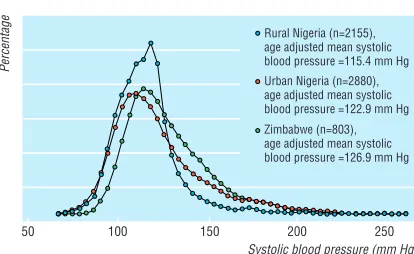
difficult, however, as sampling and measurement vary. We recently completed surveys in three communities using a common sampling and measurement protocol (table).13In southwest Nigeria, blood pressure in
villag-ers rose modestly with age compared with values in residents of urban areas. Seven per cent of the rural sample had hypertension (defined as blood pressure greater than 160/95 mm Hg or antihypertensive treat-ment). High blood pressure was more common among the urban poor from Ibadan in Nigeria (17%), and sub-stantially more prevalent in salaried workers in Harare, Zimbabwe (26%). Figure 1 shows the gradual upward
Although the relative risk of a cardiovascular event in people with high and normal blood pressure is similar in Africa and the United States, the absolute risk is up to 13 times greater in Africans
BRUCE
P
A
T
ON/P
ANOS
PICTURES
Summary points
In sub-Saharan Africa it is difficult to formulate and justify policy on treating chronic conditions such as hypertension as there are no health statistics from which to judge likely costs and benefits
Cohort studies on hypertension in Nigeria and Zimbabwe and epidemiological information show that between 10 and 20 million people in sub-Saharan Africa may have hypertension and that treatment could prevent around 250 000 deaths each year
Taking account of both relative risk and absolute risk of a cardiovascular event or death, a systolic pressure of 160 mm Hg is recommended as a threshold for treatment in Africa
The reduction in population attributable risk associated with treatment could be 2% in Africa compared with 0.15% in the Unites States—some 13 times higher
“Number needed to treat” analysis shows that the costs of drugs to prevent one death would be $1800 (£1104) in Africa and $14 000 to $1m (£8589 to £613 496) in the United States
This evidence challenges the assertion that treatment for hypertension should not be a health priority in sub-Saharan Africa
Department of Preventive Medicine and Epidemiology, Loyola University Stritch School of Medicine, Maywood, IL 60153, USA Richard S Cooper, chairman Charles N Rotimi, assistant professor Jay S Kaufman, research associate University of Health Sciences, Yaounde, Cameroon Walinjom FT Muna, chief of cardiology Medical College of Georgia, Augusta, GA, USA George A Mensah, associate professor of medicine
Correspondence to: Dr Cooper rcooper@orion. it.luc.edu
BMJ1998;316:614–7
on 12 June 2006 bmj.com
shift in the distributions of blood pressures across these groups.
Estimates of preventable deaths
These data represent the principal social strata of African society. They include the range of previous estimates and provide a reference point for consider-ing the burden of hypertension. The estimated distribution of the African population between the three sectors was 75% rural, 20% urban poor, and 5% urban salaried workers and elite. Based on a sub-Saharan population of 500 million, half of whom are older than 25, a hypertension prevalence of 5-10% yields 10-20 million cases. If annual mortality is 2%, and 5% of deaths result from hypertension, then approximately 250 000 deaths each year are prevent-able.
Risk factors
In Africa, as elsewhere, obesity and sodium intake are risk factors for hypertension.12 14–17 In industrialised
societies such as the United States, obesity accounts for 25% of cases of hypertension. However, the relative leanness of Africans means that the contribution of obesity to high blood pressure is only around 10%.15
Psychosocial factors in hypertension have been studied little. Instruments for measuring these factors in African societies have not been developed. No trials of preventive measures that have reduced risk factors for hypertension have been reported from Africa. Drug treatment is therefore the only proved option at present.
Impact of hypertension on mortality
Although the sequelae of hypertension are predict-able,18the net impact of high blood pressure on all
cause mortality is not. Given the high all cause mortality in Africa, and the small proportion of people who reach an age where sequelae are common, the contribution of hypertension is uncertain. We know of only one prospective study that has been published. In three years of follow up of 1200 adults from the rural district of Igboora-pa, Oyo State, Nigeria, the relative risk of death in people with hypertension was 1.6,19a
value observed in many other studies.20 Mortality in
this community was high (2.8% per year) and hypertension was associated with a large attributable risk of about 2% per year. It seems unlikely, however, that all of the attributable risk in people with
hyperten-sion resulted solely from cardiovascular diseases. Chronic diseases are a predisposing factor for fatal infection, and this could lead to short survival in patients with stroke, heart failure, or renal insufficiency. Under these circumstances prevalence surveys would underestimate disease burden, and prospective risk estimates would exaggerate the cause specific role of hypertension. If this analysis is correct, this interaction between chronic and acute conditions changes consid-erably the framework within which the value of treating chronic disease in Africa should be viewed.
Mortality in African adults is unknown and probably varies considerably between regions from 1% to 2.5% per year.21Community and hospital studies
suggest that 5% to 15% of people die from cardiovascular diseases—mainly stroke and congestive heart failure resulting from hypertension.2 5 22 23 By
combining the data on prevalence and relative risk summarised above, we can also estimate the deaths attributable directly to hypertension from the Igboora-pa study. The annual mortality in people over age 25 was 2.8%, and hypertension was associated with a relative risk of 1.6. Calculation of the population attributable risk confirms that about 5% of deaths can be attributed to hypertension. Given that half of all deaths occur in adults, the overall contribution of hypertension would therefore be around 2.5%. By comparison, a study of global disease burden ascribed 5.8% of deaths at all ages to hypertension.24
Potential for hypertension control with
drugs
Who is a candidate for antihypertensive treatment? An answer to this critical question requires information on projected benefit, feasibility, and cost effectiveness of treatment.24–28 While practical considerations will be
paramount in the end, it remains essential to describe the medical consequences of the decision that is taken. The calculations presented here are preliminary ones, intended to place the value of hypertension treatment in context. In particular, they provide a counter argument to the view of some that treating hypertension is not cost effective in Africa, and that support should be removed.3
Analysis by “number needed to treat”
Data on the benefit of drug treatment for hypertension in industrialised countries probably understate its impact. Observational studies in westernised societies since the 1960s do not reflect the natural history of the disease, given its widespread treatment.29In trials, some
patients in the placebo arm cross over to treatment.30 31
Indeed, early placebo trials contradict the impression from later trials on “mild” hypertension, and should be
Mean blood pressure (mm Hg) and age in three cohort studies in Africa
Age group
Systolic pressure Diastolic pressure
Rural Urban poor workersUrban Rural Urban poor workersUrban
25-34 107 111 118 69 71 73 35-44 113 119 123 73 77 79 45-54 118 131 129 76 81 81 55-64 124 135 139 77 81 87
>65 129 143 142 75 82 84
70 50
30
10
5
10
150 160 170 180
Treatment threshold (mm Hg)
Population attributable risk (%)
Individual attributable risk (%)
200 50
30
Number needed to treat Individual attributable risk Population attributable risk
Fig 1 Probability density distribution of age adjusted systolic blood pressure in three African communities.
on 12 June 2006 bmj.com
considered as the background for policy decisions. In the first Veterans Administration cooperative trial, one of 73 patients taking treatment and 27 of the 70 control subjects had a cardiovascular event.32–34 The
excess in absolute event rates was 28% per year. Under these conditions, four patients would need to be treated each year to prevent one cardiovascular event. In the second Veterans Administration trial, in which patients with diastolic pressures of 90-114 mm Hg were enrolled, the annual cardiovascular event rates were 5.5% in the treated group and 16.7% in the con-trol group, and death rates were 1% and 3% respectively. The corresponding number needed to treat values would be nine each year to prevent a cardiovascular event and 50 to prevent a death. In patients with milder hypertension, however, reductions in mortality were substantially smaller, and the number needed to treat rose to over 1000.25 35
Proposed guidelines for treatment
Choosing an appropriate threshold for treating blood pressure is problematic in Africa. Because resources are scarce, an argument exists for raising the cut off point to reduce the cost. An objective decision, however, requires information that enables benefits to be quantified. The relative risk is the usual basis for determining the treatment threshold. In most studies, the relative risk in people whose blood pressure is greater than 140/90 mm Hg compared with those who have normal blood pressure is around 1.6, and increases 50% with each succeeding 10 mm Hg increase in systolic pressure.21If the probability of an
event is low, the absolute benefit of treatment is small, no matter what the relative risk. Annual death rates in cohorts in the United States are 0.15% and 0.30% for people with normal and high blood pressures respectively.21 These rates produce the same relative
risk as cardiovascular event rates in people with normal and high blood pressure in Africa (2% and 4% respectively). In the United States, the reduction in attributable risk associated with treatment could be 0.15% at most, while in Africa it could be 2%—some 13 fold higher. This order of magnitude difference in attributable risk is the central problem in assessing the potential benefit of treatment in Africa.
Absolute versus relative risk
Absolute levels of risk that warrant treatment in Africa are probably in the range of 1%-3%. In the preliminary findings of the prospective study in rural Nigeria, mortality was 2.8% per year in people with normal blood pressure, but 5.1% per year in those with hyper-tension.19If treatment for hypertension eliminated all
the excess, then the number needed to treat per year to prevent a death would be 43. Obviously, this estimate is based on the optimistic assumption that 100% control could be achieved, and is an upper bound of what is possible. However, as noted, the Veterans Administra-tion trials gave similar estimates.32–34
In other regions of the world, recommendations for treatment are based on relative risks. With the exception of New Zealand, where absolute levels have been introduced,36blood pressure thresholds are either
160/95 mm Hg or 140/90 mm Hg.36It is assumed that
adopting these thresholds in Africa would achieve equivalent benefit. While this is a reasonable assump-tion in relaassump-tion to relative risk, the situaassump-tion in terms of attributable risk could be very different. Taking into account both relative and absolute risk, we believe that a systolic pressure of 160 mm Hg is still currently justi-fied as the threshold. We calculate that the annual mortality in people with blood pressures above this would be around 4%, compared with 1%-2% in those with normal pressures. The number needed to treat to prevent one death would therefore be around 50 each year, and the number needed to treat to prevent a seri-ous cardiovascular complication would be lower.
Making a compromise
Although benefit at the level of the individual rises as the treatment threshold increases, the benefit at the population level falls (fig 2). A compromise is required which makes treatment worthwhile for individuals, yet still has an impact on public health. The healthcare system must allocate funds to urgent priorities. All of these decisions ultimately require epidemiological data incorporated into the decision making model. An important attribute of the algorithm shown in fig 2 is its potential to determine a useful level of absolute risk (or the number needed to treat) and to calculate from this the blood pressure that should be used as the cut off point. With this approach it is not necessary to rely on relative risk thresholds adopted by external expert panels.
Costs in relation to numbers needed to treat
Given the data on reductions in mortality associated with diuretic drugs andâblockers, a strong argument exists for using these as standard treatment30 31 37Costs
in Nigeria are 10-15 cents (US$) per tablet, yielding annual expenditure of $36 (£22) for treatment with one drug only. Assuming a number needed to treat of 50, the cost of drugs alone to prevent one death would be $1800 (£1104) in Africa. In the United States, how-ever, the number needed to treat per year to prevent a death is 1354 for people of similar age, and costs for drugs alone to prevent one death range from $14 000 to $1 million (£8589 to £613 496), depending on the drug used.25
Systolic blood pressure (mm Hg)
50
Rural Nigeria (n=2155), age adjusted mean systolic blood pressure =115.4 mm Hg Urban Nigeria (n=2880), age adjusted mean systolic blood pressure =122.9 mm Hg Zimbabwe (n=803), age adjusted mean systolic blood pressure =126.9 mm Hg
100 150 200 250
Percentage
Fig 2 Individual attributable risk, number needed to treat, and population attributable risk in relation to thresholds for hypertension treatment. Smoothed plots were derived from analysis of adult mortality in Igboora-Pa, Nigeria19
on 12 June 2006 bmj.com
Conclusions
Complex problems confront any attempt to design a public health strategy to control chronic disease in developing countries, particularly Africa. The obliga-tion for the health professions is to assess potential benefit to patients in the local context, without impos-ing external standards. For example, the rationale for dismissing the value of hypertension treatment was based on the costs estimated in the United States, which are unlikely to apply in Africa.3Only after the
health benefits have been defined can useful discus-sions take place on the social and political possibility that such treatment will be made available. While acknowledging the obstacles to implementing chronic care for asymptomatic conditions in Africa today, the spectre of low cost effectiveness should not foreclose the scientific debate. Otherwise concern over chronic disease in developing countries is little more than hand wringing. Empirical evidence challenges the assertion that hypertension treatment should not be a health priority, suggesting instead that investment in an organised care system would reap large gains in adult health.
Funding: This work was supported by grants from the NHLBI (HL 45508 and HL 47910).
Conflict of interest: None.
1 Murray CJL, Lopez AD. Mortality by cause for eight regions of the world:
global burden of disease study.Lancet1997;349:1269-76.
2 Feachem RG, Jamison DT, Bos ER. Changing patterns of disease and mortality in sub-Saharan Africa. In: Feachem RG, Jamison DT, eds.
Disease and mortality in sub-Saharan Africa. Washington, DC: World Bank, 1991:3-27.
3 Feachem RGA, Kjellstron T, Murray CJL, Over M, Phillips MA, eds.The
health of adults in the developing world.Washington DC: World Bank, 1992:273.
4 Kaufman JS, Asuzu MC, Rotimi CN, Johnson OO, Owoaje EE, Cooper RS. The absence of adult mortality data for sub-Saharan Africa: a
practi-cal solution.Bull WHO1997;75:389-95.
5 Asuzu MC, Johnson OO, Owoaje EE, Rotimi CN, Kaufman JS, Cooper
RS. Questions on adult mortality.World Health Forum1996;17;373-6.
6 World Bank.Social indicators of development, 1990.Baltimore, MD: Johns
Hopkins University Press, 1991.
7 Donnison CP. Blood pressure in the African native.Lancet1929;i:6-11.
8 Kaufman JS, Barkey N. Hypertension in Africa: an overview of prevalence
rates and causal risk factors.Ethnic Dis1993;3(suppl):S83-101.
9 Poulter N, Khaw KT, Hopwood BEC, Mugambi M, Peart WS, Rose G, et al. Blood pressure and associated factors in a rural Kenyan community.
Hypertension1984;6:801-13.
10 Bunker CH, Ukoli FA, Nwankwo MU, Omene JA, Currier GW, Holifield-Kennedy L. Factors associated with hypertension in Nigerian civil
servants.Prev Med1992;21:710-22.
11 Cooper R, Rotimi C, Ataman S, McGee D, Osotimehin B, Kadiri S, et al. The prevalence of hypertension in seven populations of West African
origin.Am J Public Health1997;87:160-8.
12 Akinkugbe OO, ed.Non-communicable diseases in Nigeria: final report of a
national survey. Lagos: Federal Ministry of Health and Social Services, 1997.
13 Cooper RS, Puras A, Tracy JA, Kaufman JS, Ordunez PO, Mufunda J, et al. Evaluation of an electronic blood pressure device for epidemiologic
studies.Blood Pressure Monitoring1997;2:35-40.
14 Kaufman JS, Owaje EE, James SA, Rotimi C, Cooper RS. The determinants of hypertension in West Africa: Contribution of anthropo-metric and dietary factors to urban-rural and socio-economic gradients.
Am J Epidemiol1996;143:1203-18.
15 Kaufman JS, Durazo-Avizu RA, Rotimi CN, McGee DL, Cooper RS, for the International Collaborative Study on Hypertension in Blacks. Obes-ity and hypertension prevalence in populations of African origin: results
from the international collaborative study on hypertension in blacks.
Epi-demiology1996;7:398-405.
16 Bennett S, Wilkins HA. Within-person variation in urinary sodium, potassium and creatinine concentrations, and their relationship to
changes in the blood pressure of adult male Gambians.J Trop Med
Hygiene1993;96:267-73.
17 M’Buyamba-Kabangu JR, Fagard R, Lijnen P, Mbuy wa Mbuy R, Staessen J, Amery A. Blood pressure and urinary cations in the urban Bantu of
Zaire.Am J Epidemiol1986;124:957-68.
18 Collins R, Peto R, MacMahon S, Hebert P, Fiebach NH, Ederlein KA, et al. Blood pressure, stroke, and coronary heart disease. Part 2. Short-term reductions in blood pressure: overview of randomized drug trials in their
epidemiological context.Lancet1990;335:827-38.
19 Kaufman JS, Rotimi CN, Brieger WR, Oladukun MA, Kadiri S, Osotimehin BO, et al. The mortality risk associated with hypertension:
preliminary results of a prospective study in rural Nigeria.J Hum
Hyper-tens1996;10:461-4.
20 Stamler R. The primary prevention of hypertension and the population
blood pressure problem. In: M Marmot, P Elliott, eds.Coronary heart
dis-ease epidemiology: from etiololgy to public health. New York: Oxford University Press, 1992:415-34.
21 Cooper RS, Osotimehin B, Kaufman J, Forrester T. Adult mortality in
Africa: what should we conclude in the absence of data? Lancet
1998;351:208-10.
22 Adetunji JA, Murray CJL, Evans TG. Causes of death in Africa: a review. Population Association of America annual meeting, New Orleans, LA, 9-11 May 1996. (Abstract.)
23 Project team, policy implications of adult morbidity and mortality: a pre-liminary report of the adult morbidity and mortality project, Tanzania,
December, 1993. In: Feachem RG, Jamison DT, eds.Disease and mortality
in sub-Saharan Africa. Washington, DC: The World Bank, 1991. 24 Murray CJL, Lopez AD. Evidence-based health policy—lessons from the
global burden of disease study.Science1996;274:740-3.
25 Pearce KA, Furber CD, Psaty BM, Kirk J. Comparative cost-effectiveness of
first-line drugs for uncomplicated hypertension.Am J Hypertens1998 (in
press).
26 Jamison DT, Mosley WH, eds.Disease control priorities in developing
countries.New York: Oxford University Press, 1993.
27 Whelton PK, Brancati FL, Appel LJ, Klag MJ. The challenge of hyperten-sion and atherosclerotic cardiovascular disease in economically
develop-ing countries.High Blood Pressure1995;4:36-45.
28 World Hypertension League. Economics of hypertension control.Bull
WHO1995;73:417-24.
29 Sytkowski PA, D’Agostino RB, Belanger AJ, Kannel WB. Secular trends in long-term sustained hypertension, long-term treatment and cardio-vascular mortality. The Framingham heart study 1950 to 1990.
Circulation1996;93:697-703.
30 SHEP Cooperative Research Group. Prevention of stroke by antihyper-tensive drug treatment in older persons with isolated systolic hypertension: final results in the systolic hypertension in the elderly
pro-gram (SHEP).JAMA1991;265:3255-64.
31 Hypertension Detection and Follow-up Program Group. Five-year findings of the hypertension detection and follow-up program. I. Reduc-tion in mortality of persons with high blood pressure, including mild
hypertension.JAMA1979;242:2562-71.
32 Freis ED. The Veterans Administration cooperative study. In: Paul O, ed.
Epidemiology and control of hypertension. New York: Symposia Specialists, 1975:449-84.
33 Veterans Administration Cooperative Study Group on Antihypertensive Agents. Effects of treatment on morbidity in hypertension: results in pa-tients with diastolic blood pressure averaging 115 through 129 mm Hg.
JAMA1970;202:1028-34.
34 Veterans Administration Cooperative Study Group on Antihypertensive Agents. Effects of treatment on morbidity in hypertension: results in patients with diastolic blood pressure averaging 90 through 114 mm Hg.
JAMA1970;213:1143-52.
35 MRC Working Party. Medical Research Council trial of treatment of
hypertension in older adults: principal results.BMJ1982;304:405-12.
36 Chalmers J. Treatment guidelines in hypertension: current limitations
and future solutions.J Hypertens1996;14(suppl 4):S3-8.
37 Joint National Committee on Detection, Evalution and Treatment of High Blood Pressure. The fifth report of the Joint National Committee on Detection, Evaluation, and Treatment of High Blood Pressure (JNC V).
Arch Intern Med1993;153:154-83.
(Accepted 22 October 1997)
One hundred years ago
Whisky biscuits
Ardent spirits have been put before the American public in a new form. Whisky can now be eaten as well as drunk. Enticing-looking jelly cakes and biscuits are sold, which have been found to contain a certain amount of whisky, and the United States Board of Health and the Board of Education are reported to have
embarked on a crusade against the shopkeepers selling and the bakers manufacturing the whisky bakers’ stuff. It is also stated that alcoholic candy, containing an intoxicating proportion of beer, imported from Germany, is being sold in Manchester. (BMJ1898;ii:648)
on 12 June 2006 bmj.com
The new genetics
The new genetics in clinical practice
John Bell
Common diseases are currently defined by their clinical appearance, with little reference to mechanism. Molecu-lar genetics may provide the tools necessary to define diseases by their mechanisms. This is likely to have pro-found effects on clinical decisions such as choice of treatment and on our ability to characterise more clearly the course of disease and contributory environmental factors. This information also raises the possibility that new therapeutic interventions can be obtained ration-ally, based on a clear understanding of pathogenesis. Most of these genetic factors will act as “risk factors” and should be managed ethically and practically, as would other risk factors (in hypertension or hypercholester-olaemia, for example). The rapid advances in human molecular genetics seen over the past five years indicate that within the next decade genetic testing will be used widely for predictive testing in healthy people and for diagnosis and management of patients.
Molecular genetics was originally used in medicine to map and identify the major single gene disorders, such as cystic fibrosis1and polycystic kidney disease.2
The excitement in the field has shifted to the elucidation of the genetic basis of the common diseases. With the help of very large, well characterised family collections, genetic linkages for many of the major causes of morbidity and mortality in Western populations have been identified. The genes and DNA variants responsible for these disorders are now being cloned at an ever increasing pace. Large scale genotyp-ing, increasingly integrated genetic and expressed sequence maps,3 and large scale sequencing
pro-grammes4have all contributed to this remarkable
evo-lution in our understanding of how genes might modify our susceptibility to disease.
Considering the current rapid acquisition of genetic information relating to common disease and the dramatic technological developments that con-tinue to fuel the field, it would be surprising if most of the major genetic factors involved in human disease were not defined over the next 5-10 years. This information will form an important template for rede-fining disease, clarifying biological mechanisms responsible for disease, and developing new treatment for most disorders.
The rapid developments in human molecular genet-ics have often been underestimated, largely due to a fail-ure to recognise the power of new technologies being applied to the problem. The use of information encoded within the genome for clinical practice has previously been limited by problems of scaling up accurate detection of DNA variation for rapid and inexpensive analysis. The problem will soon be resolved, perhaps by the use of oligonucleotide array technology or “chips.”5
The ease with which this can be accomplished will determine how widespread DNA diagnostics will become, but there is little doubt that the problem is likely to be solved, technologically, in the near future.
The role of genes for susceptibility to disease has been emphasised in clinical medicine; it is now clear
that this represents too narrow a perspective for the genetics of the future. Although such genes will be critical for redefining diseases and understanding their pathogenesis, equally important will be loci that deter-mine disease progression, disease complications, and response to treatment.
A new taxonomy of disease
Perhaps the most important single contribution of the new genetics to health care is that it will create a biological rather than a phenotypic framework with which to categorise diseases. Clinical physiology and biochemistry have provided many insights into the biological disturbances that accompany disease, but it is genetics that is able to identify the pathways that are unambiguously involved in pathogenesis. Such genetic information will eventually lead to the redefinition of disease on the basis of biochemical events rather than phenotype; on molecular events driving biological processes rather than a correlation of clinical syndromes and outcomes.
The ability to redefine common human disease, using genetics to define the biochemical processes responsible for disease, will allow the subdivision of heterogeneous diseases such as hypertension or diabetes into discrete entities. Such subdivision is likely to help explain the wide variation of these diseases, including apparent differences in physiology, clinical course, and response to treatment, and it might also provide a basis for identifying environmental factors that contribute only to certain subtypes of disease. This has already begun in diabetes, where definition of the involvement of HLA genes suggested an immune mechanism in a subset of patients, leading to the subdivision into type I and type II diabetes.6 More
recently, type II diabetes has been subdivided further on the basis of distinct mechanisms involving glucose phosphorylation and insulin (glucokinase) secretion,
Summary points
Genetic information is likely to transform the practice of clinical medicine
Genetics will provide a taxonomy of disease that is based on biochemical mechanisms rather than phenotype
Genetic information will be used to identify individuals who are likely to respond to or suffer toxicity from drugs
Genetic variation will be another form of “risk factor” and will permit early treatment and directed screening
See editorial by Gill
This is the first of four articles discussing the broader implications of advances in genetics
Nuffield Department of Clinical Medicine, University of Oxford, John Radcliffe Hospital, Oxford OX3 9DU John Bell, Nuffield professor of clinical medicine [email protected]. ac.uk
BMJ1998;316:618–20
on 12 June 2006 bmj.com
transcriptional regulation (HNF), and insulin receptor dysfunction.
Disease mechanisms have led to clear definitions of infectious diseases. For example, our understanding of hepatitis has progressed: it used to be viewed as a clini-cal syndrome with a wide variety of outcomes, and is now seen as a set of quite specific diseases defined by the aetiological agent, each with its own clinical course, prognosis, and (perhaps) response to treatment. An understanding of the biological process underlying the clinical phenotype has been of unquestionable benefit in defining and managing disease, and doctors are unlikely to attempt to manage a jaundiced patient with hepatitis without attempting to define the specific viral agent involved. Similarly, pharmaceutical companies are unlikely to attempt to develop novel vaccines or therapies without precise information about the disease type. Even in a well defined disease such as viral hepatitis, aspects of disease progression such as viral persistence will need to await genetic clarification.
Understanding the biological events and pathways identified by genetics as contributing to disease will lead to clear definition of disease. Such information may become the starting point in the management of most patients.
A new taxonomy of disease based on genetics is already being developed. The first examples of disease definition have come from the loci in common disease that seem to resemble autosomally inherited traits in families. Although these contribute to disease in only a small proportion of affected people, they provide considerable insights into disease mechanisms. Breast cancer (BRCA1, BRCA2),7 8 colon cancer (FAP,
HNPCC),9and diabetes (MODY 1, 2 and 3)10–12all have
such highly penetrant loci, and their elucidation has provided some of the first insights into disease pathogenesis. The controversy over the potential role of impaired insulin secretion versus insulin resistance has
been clarified by our understanding of mechanisms that result in each type of pathophysiology (glucokinase mutations versus insulin receptor mutations). Disease genes that contribute a component of susceptibility but require other genetic and environmental factors for dis-ease to occur are also now available for disdis-ease definition. Apo E4 involvement in Alzheimer’s disease is leading to revelations about its pathogenesis,13 while
angiotensin converting enzyme14and angiotensinogen15
probably contribute to different forms of cardiovascular disease in more predictable ways. The result of these developments is that we are beginning to move toward a refined taxonomy in medicine that is based on biochemical mechanisms and driven by genetics.
Genetic information in clinical practice
Early diagnosis, patient stratification, and improved management
With an increasing trend to focus healthcare resources so that they are most efficiently used, to develop accurate definition of disease to predict its clinical course, to target other forms of screening, and to choose optimal treatment, it is likely that genetic information will be an essential part of future clinical practice. Already it is pos-sible to identify people at high risk of breast or colon cancer and to focus screening (such as mammography or colonoscopy) or early interventional treatment on these groups. In both breast and colon cancer we under-stand the genetic basis for about 5% of cases, a sufficiently large number of patients to overwhelm the already stretched genetic screening capacity in the United Kingdom. As we learn more about the effect of individual mutations on phenotype and as we identify more high frequency, low penetrance genes in both of these diseases, the pressure for screening in populations with and without symptoms will increase. Similarly, in diabetes, both the aetiological mutations (HNF, glucoki-nase)10 11and other loci (ACE)16contribute to the course
of the disease or the frequency of complications; hence these and other genes will be important prognostic indi-cators for those managing the disease and will need to be tested for. Even relatively simple management decisions regarding individuals at risk of deep venous thrombosis (patients with total hip replacement, or those taking the oral contraceptive pill) may benefit from evaluation of their factor V Leiden status.17 Decisions
about the best treatment (CETP alleles and statins, 5′-lipooxygenase in asthma, or tacrine in Alzheimer’s disease) or the side effects of drugs (cytochrome P-450 and flecanide) may rely on genetic stratification.18These
and many other indications for the use of genetic screening in patients with disease are likely to emerge in the coming years, and the pressure from patients and doctors for such services is likely to increase steadily.
Discovery and development of drugs
One of the earliest applications of this genetic information will be in the discovery and development of new drugs. Genetics is now widely used to identify new targets for drug designs, and it is increasingly recognised that defining disease populations by genotype will prob-ably correlate with response to drug treatment. The variety of mechanisms that underlie complex disease may account for the wide variations in response seen in clinical practice and the difficulty often encountered in
Understanding of how genes might modify our susceptibility to disease is evolving
BIOPHOT
O
ASSOCIA
TES/SPL
A new taxonomy of disease: diabetes
Type I
Autoimmune (HLA, INS)
Type II
Insulin resistant (INS receptor) Insulin secretion (glucokinase)
Insulin transcription (?) (HNF1á, HNF4á, IPF)
on 12 June 2006 bmj.com
drug development of showing consistent large benefits in trial populations. Wise pharmaceutical companies are already introducing genotyping in their trials to predict response, and eventually this information will be needed to protect individuals from receiving a drug if they are unlikely to respond to it. Effort will also be focused on defining more clearly the basis for severe side effects of drugs and not giving them to people likely to experience side effects. Disease definition and drug response will go hand in hand, and lifelong treatment is unlikely unless an accurate genetic diagnosis provides an indication of response. Development of drugs along genetic guide-lines will be a major force driving implementation of genetic screening by healthcare providers, as both response to treatment and complications will have been defined genetically for many new therapeutic agents.
Genes as risk factors
An indication of how important genetic information will be in defining disease and predicting outcomes in complex diseases can be gained from our knowledge of Apo E4 and Alzheimer’s disease. Homozygosity for this allele is associated with a shift of about 20 years in the average age of onset of Alzheimer’s disease.13These
effects are at least as great as other more conventional risk factors in common disease (such as hypertension in hypercholesterolaemia). Although current recom-mendations suggest that Apo E genotyping be used as an adjunct to diagnosis in cognitively impaired people, it is likely that genetic stratification by Apo E genotype will define drug response, and hence such genotyping may soon be applied in clinical trials and eventually will be more relevant to daily clinical practice.
Examples such as Apo E4 raise the question of whether a genetic susceptibility factor might best be treated as another “risk factor.” Other risk factors (blood pressure or cholesterol concentrations) show similar patterns of incomplete penetrance and have been considered for population screening. There is little reason that risk factors based on DNA should not be treated in the same way. Genetic factors that can be used to predict the risk of a population rather than an individual should be viewed in the same way as other risk factors, particularly if safe treatment or environ-mental modification were available.
This raises the possibility of population screening to detect important susceptibility loci when interven-tion becomes available. The obvious requirement for such screening would be validation by large scale trials
on the benefits of such early detection and treatment. A combination of conventional and genetic risk factors may be optimal for identifying populations at risk. In hypertension or hypercholesterolaemia, risks vary greatly. Treating the extremes of variation has the most favourable cost benefit ratio, but most “at risk” patients fall within the normal range. Genetics could be used to identify those who have additional genetic risks and in whom reduction of these variables might be beneficial, even where such variables might be in the “normal” range. There are some trial data to support such an approach.19
Conclusion
The widespread redefinition of disease through genetics will be accompanied by the use of genetics for prediction and diagnosis and to optimise treatment in most common diseases. This is likely to occur within the next decade. Testing for genetic “risk factors,” even in people without symptoms, may develop (as it has for other risk factors), and this information may be used to identify people at increased risk, for early intervention. There is a possibility, however, that DNA diagnostics and pharmacogenomics will be used without proper evaluation—especially as few resources are available for rigorous evaluation and pressure continues to intro-duce this information in routine clinical practice.
Funding: Wellcome Fund.
Conflict of interest: JB sits as a non-executive member on the board of Oxagen, a genomic biotechnology company, but holds no equity.
1 Riordan JR, Rommens JM, Kerem B-S, Alon N, Rozmahen R, Grzelcak Z, et al. Identification of the cystic fibrosis gene: cloning and characterisation
of complementary DNA.Science1989;245:1066-73.
2 European Polycystic Kidney Disease Consortium. The polycystic kidney disease 1 gene encodes a 14 kb transcript and lies within a duplicated
region on chromosome 16.Cell1994;77:881-6.
3 Schuler GD, Boguski MS, Stewart EA, Stein LD, Gyapay G, Rice K, et al. A
gene map of the human genome.Science1996;274:540-6.
4 Marshall E. Genome researchers take the pledge.Science1996;272:477-8.
5 To affinity . . . and beyond [editorial].Nature Genet1996;14:367-70.
6 Ludworth AG, Woodrow JC. HL-A antigens and diabetes mellitus.Lancet
1974;2:1153.
7 Miki Y, Swensen J, Shattuck-Eidens D, Fureal PA, Harshman K, Tavtigian S, et al. A strong candidate for the breast and ovarian cancer
susceptibil-ity gene BRACT.Science1994;266:66-71.
8 Wooster R, Bignell G, Lancester J, Swift S, Seal S, Mangion J, et al.
Identi-fication of the breast cancer susceptibility gene BRCA2. Nature
1995;378:789-92.
9 Kinzler KW, Vogelstein B. Lessons from hereditary colorectal cancer.Cell
1996;87:159-70.
10 Yamagata K, Hiroto F, Oda N, Kaisaka PJ, Menzel S, Cos NJ, et al. Muta-tions in the hepatocyte nuclear factor-4a gene in maturity-onset diabetes
of the young (MODY1).Nature1996;384:458-60.
11 Froguel P, Zouali H, Vionnet N, Velho G, Vaxillaire M, Sun F, et al. Famil-ial hyperglycemia due to mutations in glycokinase: definition of a subtype
of diabetes mellitus.N Engl J Med1993;328:697-702.
12 Yamagata K, Oda N, Kaisaki PJ, Menzel S, Furuta H, Vaxillaire M, et al. Mutations in the hepatocyte nuclear factor-1a gene in maturity-onset
diabetes of the young (MODY3).Nature1996;384:455-8.
13 Roses A. Apolipoprotein E genotyping in the differential diagnosis, not
prediction, of Alzheimer’s disease.Ann Neurol1995;38:6-14.
14 Cambien F, Poirier O, Lecerf L, Evans A, Cambou JP, Arveiler D, et al. Deletion polymorphism in the gene for angiotensin-converting enzyme
is a potent risk factor for myocardial infarction.Nature1992;359:641-4.
15 Jeunemaitre X, Soubrier F, Kotelevtsev YV, Lifton RP, Williams CS, Charru A, et al. Molecular basis of human hypertension: role of
angiotensinogen.Cell1992;71:169-80.
16 Schmidt S, Schone N, Ritz E. Association of ACE gene polymorphism and diabetic nephropathy? The Diabetic Nephropathy Study Group.
Kidney Int1995;47:1176-81.
17 Ridker PM, Miletick JP, Stampfer MJ, Goldhaber SZ, Linkpainter K, Hen-nekens CH. Factor V Leiden and risks of recurrent idiopathic venous
thromboembolism.Circulation1995;92:2800-2.
18 Nebert DW. Polymorphisms in drug-metabolising enzymes: what is their
clinical relevance and why do they exist?Am J Hum Genet997;60:265-71.
19 Sacks FM, Pfeffer MA, Moye LA, Rouleau JL, Rutherford JD, Cole TG, et al. The effects of Pravastatin on coronary events after myocardial
infarction in patients with average cholesterol levels.N Engl J Med
1996;335:1001-9. Clinical benefit accruing from genetic studies
of disease
• A new taxonomy of disease based on mechanisms, not phenotype
• New drugs developed rationally from our understanding of pathogenesis
• Drug development and utilisation focused on disease subtypes likely to respond to treatment
• Adverse effects of drugs avoided by genetic screening
• “Risk factor” analysis will facilitate environmental modification, screening, and therapeutic management of people before they develop symptoms
on 12 June 2006 bmj.com
Continuing medical education
Quality issues in continuing medical education
Hans Asbjørn Holm
The need for continuous learning as part of a doctor’s professional career is evident. The best ways of introducing and nurturing this learning have been the subject of much controversy, and the quality of medical education at all levels is being questioned and debated in many countries. This article looks at some trends and issues that are being addressed in order to improve the effectiveness of doctors’ continuous learning.
Contribution of learning theory to
medical education
Innovations in undergraduate medical education are influencing the whole spectrum of medical education. So too is the growing literature on adult learning1–4and
the doctor as learner.5 6The works of Schön especially
clarify the importance of the professionals’ reflection on their everyday practice as a means of continuous change and learning.7 8
Clinical problem solving has been identified as the core activity of how doctors learn and keep developing their competence. Creating an environment that provides practitioners with opportunities to explore and understand the personal theories underpinning their own practice is crucial for continuous profes-sional development at all stages.9
Continuing medical education
Although a division of medical education into stages— undergraduate, postgraduate, and continuing medical education (CME)—seems sound from a regulatory and legal perspective, there are no fundamental differences in the way people learn across the continuum. The student often is told what to learn, but the qualified doctor is responsible for directing his or her own (life-long) learning.10
Most doctors work in teams with other doctors, other health professionals, and administrators. Suc-cessful functioning depends not only on the doctor but on the performance of the whole team. This multipro-fessional team represents a complex learning system which must be reflected in the planning of CME.11
Motivation for continuous learning
What is it that keeps doctors striving to maintain their competence throughout decades of professional life?
The driving force among the outstanding doctors interviewed in different working environments by Manning and DeBakey was “their pride in performance—a desire never to be (or to be seen as) professionally inadequate.”12Similarly, in the physician
change study the desire to be more competent in the delivery of health care to patients was the key force for change; regulations had little impact.13
Strict legislative and regulatory measures are thus not likely to be an effective way of maintaining profes-sional competence. Reliable and valid identification of those few doctors whose practice falls well below accepted standards requires well planned and rather expensive programmes.14These doctors undoubtably
present a great challenge to the profession and to the licensing bodies. For them CME is hardly the “cure,” and this must be acknowledged.15
Mandatory or voluntary?
In the United States, most boards (licensing authori-ties) issue specialists with time limited certificates.16The
need for doctors to get recertified every few years to retain their “board certified” status has fuelled a multi-billion dollar enterprise. This consists mostly of didac-tic courses offered to doctors in need of credit hours to meet recertification requirements.
The rationale for time limited certificates is twofold: firstly, to encourage doctors to learn and keep up to date; secondly, to identify those doctors who continue to meet the specialty boards standards—and those who do not.16
In Europe, participation in CME programmes is largely voluntary, but both the European Union of Medical Specialists and the Standing Committee of
Self directed learning
“A process in which learners take the initiative . . . for increasing self and social awareness; critically analysing and reflecting on their work . . . defining their learning needs . . . formulating goals . . . identifying human and material resources for learning . . . choosing
appropriate learning strategies . . . and reflecting on and evaluating their learning.”4
Summary points
A doctor’s desire to be more competent in the delivery of health care is the most important motivating factor for continuous learning and change
Continuing medical education must be planned to meet the needs of doctor and based on both self assessment and peer review
The role of mandatory traditional programmes in maintaining competence is questionable
Medical colleges and societies need to improve their educational competence to be able to deliver high quality continuing medical education
More programmes should be linked to the workplace; they should include group based activities and use quality improvement tools
This is the fifth in a series of seven articles looking at international trends and forces in doctors’ continuing professional development
Norwegian Medical Association, PO Box 1152 Sentrum, N-0107 Oslo, Norway Hans Asbjørn Holm, deputy secretary general
hans.asbjoern.holm@ legeforeningen.no Series editors: Hans Asbjørn Holm and Tessa Richards
BMJ1998;316:621–4 on 12 June 2006