Lattices
L´eo Ducas?, Vadim Lyubashevsky??, and Thomas Prest? ? ?
Abstract. Efficient implementations of lattice-based cryptographic sche-mes have been limited to only the most basic primitives like encryption and digital signatures. The main reason for this limitation is that at the core of many advanced lattice primitives is a trapdoor sampling al-gorithm (Gentry, Peikert, Vaikuntanathan, STOC 2008) that produced outputs that were too long for practical applications. In this work, we show that using a particular distribution over NTRU lattices can make GPV-based schemes suitable for practice. More concretely, we present the first lattice-based IBE scheme with practical parameters – key and ciphertext sizes are between two and four kilobytes, and all encryp-tion and decrypencryp-tion operaencryp-tions take approximately one millisecond on a moderately-powered laptop. As a by-product, we also obtain digital signature schemes which are shorter than the previously most-compact ones of Ducas, Durmus, Lepoint, and Lyubashevsky from Crypto 2013.
Key words: Lattice Cryptography, Identity-Based Encryption, Digital Signatures, NTRU
1
Introduction
Recent improvements in efficiency have firmly established lattice-based cryptog-raphy as one of the leading candidates to replace number-theoretic cryptogcryptog-raphy after the eventual coming of quantum computing. There are currently lattice-based encryption [HPS98,LPR13a,LPR13b], identification [Lyu12], and digital signature schemes [GLP12,DDLL13] that have run-times (both in software and in hardware), key sizes, and output lengths that are more or less on par with traditional number-theoretic schemes. But unfortunately, the extent of practi-cal lattice-based cryptography stops here. While number-theoretic assumptions
?
University of California, San [email protected]. This research was sup-ported in part by the DARPA PROCEED program and NSF grant CNS-1117936. Opinions, findings and conclusions or recommendations expressed in this material are those of the author(s) and do not necessarily reflect the views of DARPA or NSF.
?? ´
Ecole Normale Sup´erieure, INRIA. [email protected]. This research was partially supported by the ANR JCJC grant “CLE”.
? ? ? ´
allow for very efficient constructions of advanced schemes like identity-based en-cryption [BF01], group signatures [CS97,BBS04], etc. none of these schemes yet have practical lattice-based realizations.
One of the major breakthroughs in lattice cryptography was the work of Gentry, Peikert, and Vaikuntanathan [GPV08], that showed how to use a short trap-door basis to generate short lattice vectorswithout revealing the trap-door.1 In [GPV08], this was used to give the first lattice-based construction of secure hash-and-sign digital signatures and identity-based encryption schemes. This vector-sampling algorithm has since become a key component in many other lattice constructions, ranging from hierarchical IBEs [CHKP12,ABB10] to the recent breakthrough in multi-linear map constructions [GGH13]. Unfortunately, even when using improved trap-doors [AP11,MP12] and instantiating with ideal lattices [LPR13a], signature schemes that used the GPV trap-door approach were far less practical (by about two orders of magnitude) than the Fiat-Shamir ones [GLP12,DDLL13], and identity-based encryption had ciphertexts that were even longer - having ciphertexts on the order of millions of bits.2
1.1 Our results
Our main result is showing that the GPV sampling procedure can in fact be used as a basis for practical lattice cryptography. The two main insights in our work are that one can instantiate the GPV algorithm using a particular distribution of NTRU lattices that have nearly-optimal trapdoor lengths, and that a particular parameter in the GPV algorithm can be relaxed, which results in shorter vectors being output with no loss in security. As our main applications, we propose identity-based encryption schemes that have ciphertext (and key) sizes of two and four kilobytes (for approximately 80-bit and 192-bit security, respectively) and digital signatures that have outputs (and keys) of approximately 5120 bits for about 192-bits of security. We believe that this firmly places GPV-based cryptographic schemes into the realm of practicality. The IBE outputs are orders of magnitude smaller than previous instantiations and the signature sizes are smaller by about a factor of 1.3 than in the previously shortest lattice-based scheme based on the same assumption [DDLL13].
Our schemes, like all other practical lattice-based ones, work over the poly-nomial ringZq[x]/(xN+ 1), whereN is a power of 2 andqis a prime congruent to 1 mod 2N. For such a choice ofq, the polynomialxN+ 1 splits intoN linear factors overZq, which greatly increases the efficiency of multiplication over the ring. Our hardness assumption is related to the hardness, in the random oracle model, of solving lattice problems over NTRU lattices. These assumptions under-lie the NTRU encryption scheme [HPS98], the NTRU-based fully-homomorphic encryption scheme [LTV12], and the recent signature scheme BLISS [DDLL13].
1
A very similar algorithm was earlier proposed by Klein [Kle00], but was utilized in a different context and was not fully analyzed.
2
Table 1. Comparing our IBE (GPV) with a recent implementation [Gui13] of the Boneh-Franklin scheme (BF). Our implementation was done in C++, using the NTL and GnuMPlibraries. Timings were performed on an Intel Core i5-3210M laptop with a 2.5GHz CPU and 6GB RAM. The complete implementation can be found on github.com/tprest/Lattice-IBE/.
Scheme GPV-80 GPV-192 BF-128 BF-192 User Secret key size 11 kbits 27 kbits 0.25 kbits 0.62 kbits Ciphertext size 13 kbits 30 kbits 3 kbits 15 kbits User Key Generation 8.6 ms 32.7 ms 0.55 ms 3.44 ms Encryption 0.91 ms 1.87 ms 7.51 ms 40.3 ms Decryption 0.62 ms 1.27 ms 5.05 ms 34.2 ms
Table 2.IBE scheme parameters (see Section 5).
Security parameterλ 80 192 Root Hermite factor [GN08]γ 1.0075 1.0044 Polynomial degree N 512 1024
Modulus q ≈223 ≈227
User Public key size 13 Kbits 30 Kbits User Secret key size 11 Kbits 27 Kbits Ciphertext size 13 Kbits 30 Kbits Ciphertext expansion factor 26 30
And even though this assumption is not related to the hardness of worst-case lat-tice problems via some worst-case to average-case reduction3, in the fifteen years that the assumption has been around, there were no serious cryptanalytic threats against it. The work of [DDLL13] also provided experimental evidence that the computational complexity of finding short vectors in these special NTRU lattices was consistent with the extensive experiments of Gama and Nguyen on more gen-eral classes of lattices [GN08], some of which are connected to the hardness of worst-case lattice problems.
We implemented our schemes in software (see Table 1), and most of the algorithms are very efficient. The slowest one is user key generation, but this procedure is not performed often. More important is the underlying encryption scheme, which in our case is the Ring-LWE scheme from [LPR13a,LPR13b], which already has rather fast hardware implementations [PG13]. And as can be seen from the tables, decryption and encryption are very fast in software as well and compare very favorably to state-of-the-art implementations of pairing-based constructions.
3 The work of [SS11] showed a connection between problems on NTRU lattices and
1.2 Related Work
Following the seminal work of [GPV08], there were attempts to improve sev-eral aspects of the algorithm. There were improved trap-doors [AP11], more efficient trap-door sampling algorithms [Pei10,MP12], and an NTRU signature scheme proposal [SS13]. All these papers, however, only considered parameters that preserved a security proof to lattice problems that were known to have an average-case to worst-case connection. To the best of our knowledge, our work is the first that successfully utilizes GPV trapdoor sampling in practice.
1.3 Identity-Based Encryption Scheme
In a public-key IBE scheme, the public key of every user in the system is a combi-nation of themaster authority’spublic key along with an evaluation of a publicly-computable function on the user’s name or i.d.. The secret key of each user is then derived by the master authority by using his master secret key. We now give a brief description of the IBE in this paper, which is built by using the GPV algorithm to derive the user’s secret keys from an NTRU lattice [GPV08,SS13], and then using the Ring-LWE encryption scheme of [LPR13a,LPR13b] for the encryption scheme.
The master public key in the scheme will be a polynomialhand the secret key will consist of a “nice basis” for the 2N-dimensional lattice generated by the rows ofAh,q=
−A(h) IN qIN ON
, whereA(h) is the anti-circulant matrix whoseith row consists of the coefficients of the polynomialhximodxN+ 1 (see Definition 1). A user with identityid will have a public key consisting ofhas well ast= H(id), whereH is some publicly-known cryptographic hash function mapping into Zq[x]/(xN + 1). The user’s secret key will consist of a small polynomials2 such thats1+s2h=t, wheres1is another small polynomial (how one generates these keys is explicited in Alg. 3 in Section 5). Encryption and decryption will proceed as in the Ring-LWE scheme of [LPR13a]. To encrypt a message m ∈ Z[x]/(xN + 1) with binary coefficients, the sender chooses polynomialsr, e1, e2
with small coefficients and sends the ciphertext
(u=rh+e1, v=rt+e2+bq/2cm).4
To decrypt, the receiver computes v−us2 =rs1+e2+bq/2cm−s2e1. If the parameters are properly set, then the polynomialrs1+e2−s2e1will have small coefficients (with respect to q), and so the coordinates in whichm is 0 will be small, whereas the coordinates in which it is 1 will be close toq/2. Notice that for decryption, it is crucial for the polynomial rs1+e2 −s2e1 to have small coefficients, which requiress1 ands2to be as small as possible.
While the above follows the usual encryption techniques based on LWE, we need a little tweak to make the security proof based on KL-divergence work
4
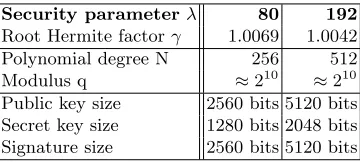
Table 3.Signature scheme parameters (see Section 5).
Security parameterλ 80 192 Root Hermite factorγ 1.0069 1.0042 Polynomial degree N 256 512
Modulus q ≈210 ≈210
Public key size 2560 bits 5120 bits Secret key size 1280 bits 2048 bits Signature size 2560 bits 5120 bits
(see Section 4), since this argument only applies to search problems (while CPA security is a decisional problem). To do so we use a key-encapsulation mechanism, that is we encrypt a random keykrather thanm, and then use it as a one-time-pad to send m⊕H0(k) whereH0 is a hash function.
1.4 Interlude: A Hash-and-Sign Digital Signature Scheme
The first part of the above IBE is actually a hash-and-sign digital signature scheme. The public (verification) key corresponds to the master authority’s pub-lic key, the secret (signing) key is the master secret key, messages correspond to user i.d.’s, and signatures are the user secret keys. To sign a message m, the signer uses his secret key to compute short polynomials s1, s2 such that s1+s2h = H(m), and transmits s2. The verifier simply checks that s2 and H(m)−hs2are small polynomials. In the IBE, the modulusqis set deliberately large to avoid decryption errors, but this is not an issue in the signature scheme. By selecting a much smallerq, which allows one to sample from a tighter distri-bution, the signature size can be made more compact than the user secret key size in the IBE.
In Table 3, we present some possible parameters for such signature schemes. The size of the keys and signatures compare very favorably to those of the BLISS signature scheme [DDLL13]. For example, for the 192 bit security level, the signature size in BLISS is approximately 6500 bits, whereas signatures in this paper are approximately 5000 bits. In fact, further improvements to the signature size may be possible via similar techniques that were used for BLISS. The main drawback of the hash-and-sign signature scheme is that signing requires sampling a discrete Gaussian over alattice, whereas the Fiat-Shamir based BLISS scheme only required Gaussian sampling over the integers. At this point, the signature scheme in this paper yields smaller signatures but BLISS is much faster. Since both BLISS and this current proposal are very new, we believe that there are still a lot of improvements left in both constructions.
1.5 Techniques and Paper Organization
on the length of the Gram-Schmidt orthogonalized vectors in the trap-door ba-sis of the public lattice. In Section 3 we show, by experimental evidence backed up by a heuristic argument, that there exist distributions of NTRU lattices that have trap-doors whose lengths are within a small factor of optimal. Once we have such short trap-doors (which correspond to the master secret key in the IBE), we can use the GPV algorithm to samples1, s2 such thats1+s2h=t. In order for (s1, s2) to reveal nothing about the trap-door, it’s important thats1, s2come from a distribution such that seeing (h, s1, s2, t) does not reveal whether s1, s2 were generated first and thentwas computed ass1+hs2=t, or whethertwas first chosen at random and thens1, s2 were computed using the GPV sampler.
To prove this, [GPV08] showed that the distribution of s1, s2 produced by their sampler isstatistically-close to some trapdoor-independent distribution. In Section 4, we show that the requirement of statistical closeness can be relaxed, and we can instead use Kullback-Leibler divergence to obtain shorter secret keys. The intuition behind using KL-divergence can be described by the following ex-ample. IfBcdenotes a Bernoulli variable with probability con 1, then trying to distinguish with constant probability B1/2+/2 from B1/2 requires O(1/2) sam-ples. Therefore if there is no adversary who can forge in time less than t (for some t > 1/2) on a signature scheme where some parameter comes from the distribution B1/2, then we can conclude that no adversary can forge in time less than approximately 1/2 if that same variable were distributed according to
B1/2+/2. This is because a successful forger is also clearly a distinguisher be-tween the two distributions (since forgeries can be checked), but no distinguisher can work in time less than 1/2. On the other hand, distinguishingB fromB0 requires onlyO(1/) samples. And so if there is a timetforger against a scheme using B0, all one can say about a forger against the scheme usingB is that he cannot succeed in time less than 1/. In both cases, however, we have statisti-cal distancebetween the two distributions. In this regard, statistical distance based arguments are not tight; but the KL-divergence is finer grained and can give tighter proofs. Indeed, in the first case, we can set 1/ to be the square root of our security parameter, whereas in the second case, 1/would have to be the security parameter. In Section 4, we show that the GPV algorithm produces samples in a way that allows us to work with parameters for which the inverse of the statistical distance is the square root of the security parameter, whereas previous work required it to be the security parameter itself.
1.6 Conclusions and Open Problems
Our work used a distribution over NTRU lattices that is somewhat new – rather than having very short vectors, our secret key has vectors with a small Gram-Schmidt maximum. It is unclear how this compares in terms of dificulty to the hardness of lattice problems under the ”standard” NTRU distribution. On the one hand, the vectors in our secret key are longer, but on the other hand, our secret key is more ”orthogonal”. General lattice algorithms (such as BKZ) don’t seem to exploit this feature, but it is an interesting open problem whether other techniques could be used for improved cryptanalysis of our schemes.
2
Preliminaries
2.1 The Ring Z[x]/(xN + 1)
For the rest of the paper,N will be a power-of-two integer. We will work in the ring R=∆ Z[x]/(xN + 1) (and occasionally R0 ∆
=Q[x]/(xN + 1)). Among other useful properties,xN + 1 is irreducible, soR0 is a cyclotomic field.
We clarify a few notations. Let f =PN−1
i=0 fix
i and g=PN−1
i=0 gix
i be polyno-mials inQ[x].
– f gdenotes polynomial multiplication inQ[x], whilef∗g=∆f g mod (xN+1).
– (f) is the vector whose coefficients aref0, ..., fN−1. (f, g)∈R2N is the
con-catenation of (f) and (g).
– bfeis the coefficient-wise rounding off. The same notation applies for vec-tors.
2.2 Anticirculant matrices
Definition 1 (Anticirculant matrix). An N-dimensional anticirculant ma-trix of f is the following Toeplitz matrix:
AN(f) =
f0 f1 f2 . ..fN−1
−fN−1 f0 f1 . ..fN−2
. .. . .. . .. . .. . ..
−f1 −f2 . .. . .. f0
=
(f) (x∗f)
. . .
(xN−1∗f)
When it is clear from context, we will drop the subscriptN, and just write
A(f). Anticirculant matrices verify this useful property:
Lemma 1. Let f, g ∈ R. Then AN(f) +AN(g) = AN(f +g), and AN(f)×
AN(g) =AN(f∗g).
2.3 Gaussian Sampling
Definition 2 (Discrete Gaussians). The n-dimensional Gaussian function
ρσ,c:Rn→(0,1]is defined by:
ρσ,c(x)
∆ = exp
−kx−ck
2 2σ2
For any latticeΛ⊂Rn,ρσ,c(Λ)
∆
=P
x∈Λρσ,c(x). Normalizingρσ,c(x)byρσ,c(Λ),
we obtain the probability mass function of the discrete Gaussian distribution DΛ,σ,c.
Using an algorithm inspired by Klein [Kle00], Gentryet al. [GPV08] showed that it was possible to sample vectors according to this discrete Gaussian dis-tribution using a short basis Bof the lattice Λ. There is a requirement on the width of the Gaussianσ related to the so called smoothing parameter. In sec-tion 4 we detail this sampler and show, using KL-divergence that the condisec-tion on the widthσcan be reduced by a factor√2.
2.4 Hardness Assumptions
We can base the hardness of our IBE scheme on two assumptions that have been previously used in the literature. The first assumption deals with NTRU lattices and states that if we take two random small polynomialsf, g∈ Rq, their quotientg/f is indistinguishable from random inRq. This assumption was first formally stated in [LTV12], but it has been studied since the introduction of the NTRU cryptosystem [HPS98] in its computational form (i.e. recovering the polynomials f andg from h). Despite more than fifteen years of cryptanalytic effort, there has not been any significant algorithmic progress towards solving either the search or decision version of this problem. As a side note, Stehle and Steinfeld [SS11] showed that for large enoughf andggenerated from a discrete Gaussian distribution, the quotient g/f is actually uniform in Rq. Thus if one were to use larger polynomials, the NTRU assumption would be unnecessary. Using smaller polynomials, however, results in much more efficient schemes.
3
Optimizing the Master Key Generation
One of the most important parameters in the scheme is the Master Secret Key: its size impacts the speed of the computations and, more importantly, the size of the users’ secret keys. The smaller these secret keys will be, the more secure and efficient the scheme is (with the additional advantage that these keys can be sent more easily). While our scheme can be instantiated in any ring lattice, we choose to work in the family of NTRU lattices because the Gram-Schmidt norm of some bases are both small and easy to compute. In the end, this is what will determine the size of the users’ secret keys.
3.1 The NTRU Lattices
Definition 3 (NTRU lattices). LetN be a power-of-two integer,qa positive integer, and f, g∈ R. Leth=g∗f−1 modq. The NTRU lattice associated to
handq is
Λh,q ={(u, v)∈ R2|u+v∗h= 0 modq} Λh,qis a full-rank lattice ofZ2N generated by the rows ofAh,q =
−AN(h) IN qIN ON
.
This basis is storage-efficient since it is uniquely defined by a single polynomial h∈ Rq, however it proves to be a poor choice if one wants to perform standard lattice operations. Assuming his uniformly distributed inRq,Ah,q has a very large orthogonal defect.
This makes this basis not very appropriate for solving usual lattice problems such as finding the closest lattice vector to a target point. However, as explained in [HHGP+03], another basis can be found by computingF, G∈ Rsuch that:
f∗G−g∗F=q (1)
Finding such (F, G) can be achieved efficiently and we describe one way (which is not new) of doing it in Section 5. A short basis is then provided by the following proposition.
Proposition 1. Let f, g, F, G∈ Rverifying (1) andh=g∗f−1 modq. Then Ah,q=
−A(h) IN qIN ON
andBf,g=
A(g) −A(f)
A(G)−A(F)
generate the same lattice.
Proof. ConsiderP=Ah,q×B−f,g1 the change-of-basis matrix between Ah,q and
Bf,g. One can check thatqP=O2N modq, soP∈Z2N×2N. Also,|det(P)|= 1
soP−1∈Z2N×2N. We can conclude thatAh,qandBf,gboth generate the same
lattice. ut
Definition 4 (Gram-Schmidt norm [GPV08]). Let B = (bi)i∈I be a
fi-nite basis, andB˜ = (˜bi)i∈I be its Schmidt orthogonalization. The
Gram-Schmidt norm ofB is the value
kBk˜ = max i∈I k
˜
An interesting property of NTRU lattices is related to the Gram-Schmidt norm of their bases: they can be small and can be computed quickly. These two facts and their benefits for our scheme are discussed in the following subsection.
3.2 Bounding the Gram-Schmidt norm
The lattice over which we do Gaussian sampling is Λh,q, and the size of the secret keys we sample will be proportional tokBk˜ , where Bis the basis ofΛh,q used in the Gaussian sampler. It is very important then that the Gram-Schmidt normkBk˜ ofB is as small as possible.
Proposition 1 tells us thatBf,gis a basis ofΛh,q. The second step is to compute its Gram-Schmidt norm kB˜f,gk. For general lattices, this is done by applying the Gram-Schmidt process to the basis and computing the maximum length of the resulting vectors. In the case of NTRU lattices, however, Lemmas 2 and 3 allow to compute kB˜f,gk much faster, in timeO(Nlog(N)) instead of O(N3).
Lemma 2. Let Bf,g be as defined in Proposition 1, andb1, ...,b2N be the row
vectors of Bf,g. ThenkB˜f,gk=max{kb˜1k,kb˜N+1k}
Proof. For V a subspace of R2N and b ∈
R2N, let us denote ProjV(b) the orthogonal projection of bover V. We also call r the linear isometry (f, g)7→
(x∗f, x∗g) (see the notations from Subsection 2.1), so that for anyi6N,bi= ri−1(b
1) andbN+i =ri−1(bN+1). LetVi =Span(b1, ...,bi)⊥. By definition of the Gram-Schmidt orthogonalization, for anyi∈J1,2NK, ˜bi=ProjVi−1(bi). Moreover, one can check the two following properties :
– kProjV(b)k6kbk
– V⊆W⇒ kProjV(b)k6kProjW(b)k
From the first property comes the fact that for anyi∈J1, NK, kb˜ik6kb1k=
kb˜1k. Provingkb˜N+ik6kb˜N+1kis a bit trickier. SinceSpan(b1, ...bN) is stable byr, so isVN. One can check thatProjVN(bN+i) =r
i−1(Proj
VN(bN+1)). Now
VN+i−1⊆VN, so :
kb˜N+ik=kProjVN+i−1(bN+i)k6kProjVN(bN+i)k=kProjVN(bN+1)k=k
˜ bN+1k
Which concludes this proof. ut
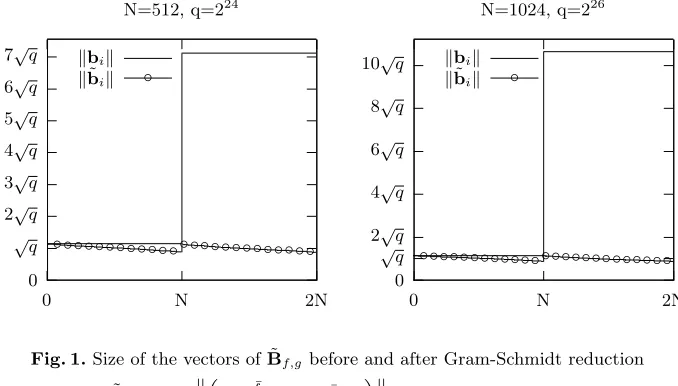
Figure 1 illustrates the result of Lemma 2. Before the reduction, all the vectors of each semi-basis are of the same size, but after the reduction, the largest vector of ˜Bf,g is either ˜b1 or ˜bN+1.
Instead of computing 2N values kb˜1k, ...,kb˜2Nk, there is now only two of them to compute. We already know that kb˜1k = kb1k, and we introduce a notation which will provide us an expression forkb˜N+1k.
Definition 5. Let f ∈ R0. We denotef¯the unique polynomial inR0 such that
A(f)t=A( ¯f). If f(x) =PN−1
i=0 fixi, thenf¯(x) =f0−P N−1 i=1 fN−ixi
0 √
q 2√q 3√q 4√q 5√q 6√q 7√q
0 N 2N
N=512, q=224
kbik kb˜ik
◦◦◦◦◦◦◦◦◦◦◦◦◦◦◦◦◦◦◦◦◦◦◦◦◦ ◦
0 √
q 2√q 4√q 6√q 8√q 10√q
0 N 2N
N=1024, q=226
kbik kb˜ik
◦◦◦◦◦◦◦◦◦◦◦◦◦◦◦◦◦◦◦◦◦◦◦◦◦ ◦
Fig. 1.Size of the vectors of ˜Bf,gbefore and after Gram-Schmidt reduction
Lemma 3. kb˜N+1k=
qf¯ f∗f¯+g∗g¯,
q¯g f∗f¯+g∗¯g
Proof. Letk= f¯f∗F+¯g∗G
∗f¯+g∗¯g mod(x
N + 1) and writek(x) =PN−1
i=0 kixi. Then
c=∆bN+1− N−1
X
i=0
kibi+1= (G,−F)−(k∗g,−k∗f) =
qf¯
f ∗f¯+g∗g¯,
q¯g f ∗f¯+g∗g¯
is orthogonal to Span(b1, ...,bN). By the uniqueness of the Gram-Schmidt de-composition,c= ˜bN+1 and the result follows. ut This enables us to computekB˜f,gkonly from (f, g), gaining some time when generating the Master Key. Knowing (f, g) is enough to know almost instantly whether the basis ˜Bf,gwill be a good one for Gaussian sampling. After deriving this formula forkB˜f,gk, we ran experiments to compute it for different values of N, q and initial vectorb1.
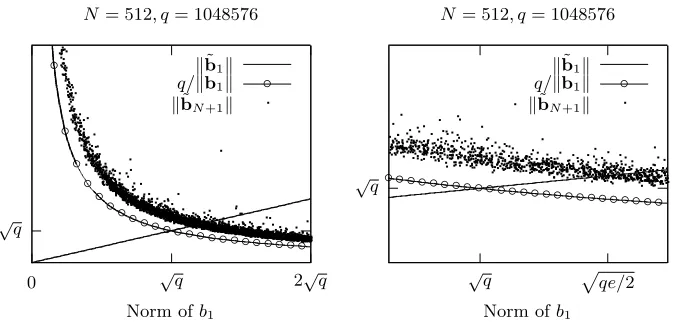
For fixed values ofkb1kandq, experiments show no correlation between the dimensionN andkB˜f,gk. Moreover, they suggest thatkb˜N+1kis actually pretty close to its lower boundq/kb1k(see Lemma 4 for the proof of this bound). Both experiments and a heuristic indicate that the optimal choice for kb1k is
kb1k ≈
pqe
2, since we then getkb˜N+1k ≈ kb˜1k. And so in our experiments, we sampleb1 with a norm slightly bigger than
pqe
2 ≈1.1658
√
q. The heuristic can be found in the full version of this paper.
The following lemma provides a theoretical lower bound forkb˜N+1k, given qandkb1k. In our case,kb˜N+1k is very close to its lover bound.
Lemma 4. LetB= (bi)16i62N be a NTRU basis.kb˜N+1kadmits the following
√ q
0 √q 2√q
Norm ofb1
N = 512, q= 1048576
kb˜1k q/kb1k
◦
◦
◦ ◦
◦ ◦ ◦
◦ ◦◦◦◦◦ ◦ ◦◦ ◦◦◦◦◦◦◦ ◦ kb˜N+1k
√ q
√
q p
qe/2
Norm ofb1
N= 512, q= 1048576
kb˜1k q/kb1k
◦ ◦ ◦◦ ◦◦◦◦◦◦◦◦◦◦◦ ◦ ◦◦ ◦◦◦ ◦◦◦◦ ◦ kb˜N+1k
Fig. 2. Values of candidates k˜bN+1k and kb˜1k for kB˜f,gk, with N = 512, q = 220.
q/kb1kis the lower bound forkb˜N+1kgiven in Lemma 4.
Proof. We have|det(Bf,g)|=|det( ˜Bf,g)|= N
Q
i=1
kb˜ik. We know that|det(Bf,g)|= qN and that for any k in
J1;NK, kb˜ik 6 kb˜1k and kb˜N+ik 6 kb˜N+1k. So
qN
6kb1kNkb˜N+1kN. ut
With the results of these experiments, we can now design an efficient Master Key Generator found in Section 5.
4
Optimizing the User Key Generation
Many arguments in lattice based cryptography are driven by a smoothing condi-tion, that is that the parameterσof some Gaussian is greater than the smoothing parameter. We recall thatDΛ,σ,c is defined in Definition 2.
Definition 6 (Smoothing parameter [MR07]).For anyn-dimensional lat-ticeΛ and real >0, the smoothing parameter η(Λ) is the smallests >0 such
that ρ1/s√
2π,0(Λ∗\0)6. We also define a scaled versionη0(Λ) = 1
√
2πη(Λ). This is in particular the case for the correctness of the sampling algorithm of [GPV08]: it is correct up to negligible statistical distance for any choice of s=ω(√logn)· kBk˜ . A concrete sufficient condition to ensureλ-bits of security was computed in [DN12a]
Theorem 1 (Theorem 1 of [DN12a], Concrete version of [GPV08, Th. 4.1]). Let n, λ be any positive integers, and = 2−λ/(2n). For any basis B ∈ Zn×n, and for any target vector c ∈ Z1×n, Alg. 1 is such that the statistical distance ∆(DΛ(B),σ,c,Gaussian Sampler(B, σ,c))is less than 2−λ, provided:
σ≥ kBk ·˜ η0(Z) where η0(Z)≈ 1 π·
s
1 2ln
2 +2
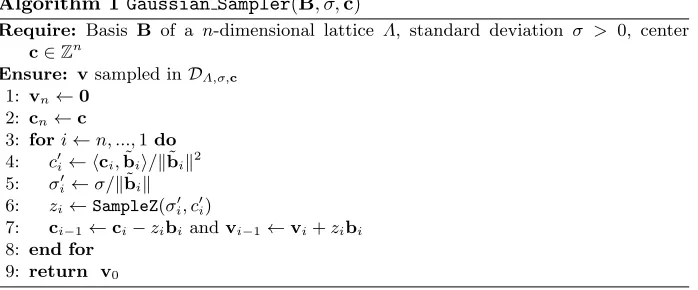
Algorithm 1Gaussian Sampler(B, σ,c)
Require: Basis B of a n-dimensional lattice Λ, standard deviation σ > 0, center c∈Zn
Ensure: vsampled inDΛ,σ,c 1: vn←0
2: cn←c
3: fori←n, ...,1do 4: c0i← hci,b˜ii/kb˜ik2 5: σi0←σ/kb˜ik 6: zi←SampleZ(σ0i, c
0 i)
7: ci−1←ci−zibiandvi−1←vi+zibi 8: end for
9: return v0
The sub-algorithmSampleZ(σ0, c0) samples a 1-dimensional GaussianDZ,σ0,c0. This can be achieved in various ways: rejection sampling, look-up tables, etc. For our imple-mentation, we chose an hybrid method using the discrete Gaussian sampling from [DDLL13] and “standard” rejection sampling.
Fig. 3.Description of Klein-GPV Gaussian Sampler
In this section, we sketch why the condition= 2−λ/(4N) can be relaxed to ≤2−λ/2/(4√2N);
asymptotically square-rooting the minimal value of; this impacts the value of η0(Z) by a factor
√
2, that is one can usethe same algorithm with a standard deviation σ shorter by a factor √2. To do so we rely on a finer grained mea-sure of “distance”5 between distributions, called Kullback-Leibler Divergence (or KL Divergence). Interestingly, this common notion from information theory, has to our knowledge been used in cryptography only in the context of symmet-ric key cryptanalysis [Vau03]. The use of KL Divergence recently found similar application in lattice based Cryptography, namely for an enhanced implementa-tion [PDG14] of Bliss[DDLL13]. It is defined as follows:
Definition 7 (Kullback-Leibler Divergence).Let P andQbe two distribu-tions over a common countable set Ω, and let S ⊂Ω be the support of P. The Kullback-Leibler Divergence, notedDKL of QfromP is defined as:
DKL(PkQ) = X
i∈S ln
P(i)
Q(i)
P(i)
with the convention thatln(x/0) = +∞ for anyx >0.
5
For complements the reader can refer to [CT91]. We only require two essential properties : additivity:DKL(P0× P1kQ0× Q1) =DKL(P0kQ0) +DKL(P1kQ1), and the inequalityDKL(f(P)kf(Q))≤DKL(PkQ)).
Lemma 5 (Bounding Success Probability Variations [PDG14]).Let EP
be an algorithm making at most q queries to an oracle sampling from a dis-tribution P and outputting a bit. Let ≥ 0, Q be a distribution such that
DKL(PkQ)≤, andx(resp.y) denote the probability thatEP (resp.EQ) outputs
1. Then,
|x−y| ≤ √1
2
√
q.
Concrete security. This lemma lets us conclude that if a scheme isλ-bit secure with access to a perfect oracle for distribution P, then it is also about λ-bit secure with oracle access toQifDKL(PkQ)≤2−λ.
To argue concrete security according to Lemma 5, consider a search problem
SP using oracle access to a distributionP, and assume it is notλ-bit hard; that
is there exists an attackerAthat solve SP with probabilitypand has running
time less than 2λ/p; equivalently (repeating the attack until success) there exists an algorithmA0 that solvesSP in time≈2λwith probability at least 3/4. Such algorithms make q ≤2λ queries to P. If D
KL(PkQ)≤2−λ, Lemma 5 ensures us that the success ofA0 againstSQwill be at least 1/4; in other word ifSQ is
λ-bit secure,SP is also aboutλ-bit secure.
Note that this applies to search problems only, therefore, it is unclear if it could be directly applied to any CPA scheme: CPA security is a decisional problem, not a search problem. Yet our IBE design makes this argument valid: we designed encryption using key-encapsulation mechanism, the random key k being fed into a hash functionH0 to one-time-pad the message. ModelingH0 as a random oracle, one easily proves that breaking CPA security with advantage pis as hard as recoveringk with probabilityp; which is a search problem. ut
The point is that the KL Divergence is in some cases much smaller than statisti-cal distance; and it will indeed be the case for Klein sampling as used in [GPV08] and described in Fig. 3.
Theorem 2 (KL Divergence of the Gaussian Sampler). For any ∈
(0,1/4n), if σ>η0(Z)· kBk˜ then the KL Divergence between DΛ(B),c,σ and the
output ofGaussian Sampler(B, σ,c)is bounded by21−1+ 1−
n2
≈8n22.
Proof. The probability that Klein’s algorithm outputs x=˜x on inputsσ,B,c
is proportional to
n
Y
i=1 1 ρσi,c0i(Z)
·ρσ,c(˜x)
for σi = σ/kb˜ik and some c0i ∈ R that depends on c and B. as detailed in [GPV08]. By assumption, σi ≥ η(Z), therefore ρσi,c0i(Z) ∈ [
1−
(see [MR07, Lemma 4.4]). The relative error to the desired distribution (propor-tional to ρσ,c(x˜)) is therefore bounded by 1−
1+ 1−
n
; we can conclude using
Lemma 2 from [PDG14]. ut
This last theorem implies that the condition ≤ 2−λ
4N of [DN12a] can be relaxed to≤2−λ/2
4√2N which conclude this section.
5
The Schemes and their Security Analysis
5.1 The IBE Scheme
We recall that an IBE scheme is composed of four algorithms:Master Keygen, which generates the Master Keys, Extract, which uses the Master Secret Key to generate users’ secret keys for any identity, Encrypt, which allows anybody to encrypt a message for an user given the Master Public Key and the user’s identity, andDecrypt which enables an user to decrypt the messages intended to him with his secret key.
Algorithm 2Master Keygen(N, q) Require: N, q
Ensure: Master Secret KeyB∈Z2qN×2N and Master Public Keyh∈ Rq 1: σf = 1.17p q
2N {σf chosen such thatE[kb1k] = 1.17 √
q} 2: f, g← DN,σf
3: Norm←maxk(g,−f)k,
qf¯
f∗f¯+g∗¯g, qg¯
f∗f¯+g∗¯g
{We computekB˜f,gk} 4: if Norm>1.17√q, go to step 2
5: Using extended euclidean algorithm, computeρf, ρg∈ RandRf, Rg∈Zsuch that – ρf·f=Rf mod (xN+ 1)
– ρg·g=Rg mod (xN+ 1)
6: ifGCD(Rf, Rg)6= 1 orGCD(Rf, q)6= 1, go to step 2
7: Using extended euclidean algorithm, computeu, v∈Zsuch thatu·Rf+v·Rg= 1 8: F←qvρg, G← −quρf
9: k=
j
F∗f¯+G∗¯g f∗f¯+g∗¯g
m
∈ R
10: ReduceF andG:F←F−k∗f, G←G−k∗g 11: h=g∗f−1 modq
12: B=
A(g) −A(f) A(G)−A(F)
Here,Bis a short basis ofΛh,q, making it a trapdoor for sampling short ele-ments (s1, s2) such thats1+s2∗h=tfor anyt, without leaking any information about itself.
Algorithm 3Extract(B, id)
Require: Master Secret Key B ∈ Z2qN×2N, hash function H : {0,1}∗ → ZNq, user identityid
Ensure: User secret keySKid∈ Rq 1: if SKidis in local storagethen 2: OutputSKidto userid 3: else
4: t←H(id)∈ZNq
5: (s1, s2)←(t,0)−Gaussian Sampler(B, σ,(t,0)){s1+s2∗h=t}
6: SKid←s2
7: OutputSKidto useridand keep it in local storage 8: end if
Algorithm 4Encrypt(id, m)
Require: Hash functions H : {0,1}∗ →
ZNq and H 0
: {0,1}N → {0 ,1}m
, message m∈ {0,1}m
, Master Public Keyh∈ Rq, identityid Ensure: Encryption (u, v, c)∈ R2
qofmunder the public key ofid 1: r, e1, e2← {−1,0,1}N; k← {0,1}N (uniform)
2: t←H(id)
3: u←r∗h+e1∈ Rq
4: v←r∗t+e2+bq/2c ·k∈ Rq
5: Drop the least significant bits ofv:v←2`
v/2`
6: Output (u, v, m⊕H0(k))
Note that encryption is designed using a key-encapsulation mechanism; the hash of the key k is used to one-time-pad the message. If H0 is modeled as a random oracle, this makes the CPA security (a decisional problem) of the scheme as hard as finding the key k exactly (a search problem). Basing the security argument on a search problem is necessary for our KL Divergence-based security argument to hold, as explained in Section 4.
Algorithm 5Decrypt(MSid,(u, v, c))
Require: User secret keySKid, encryption (u, v, c) ofm Ensure: Messagem∈ {0,1}N
1: w←v−u∗s2
2: k←j w q/2
m
3: Outputm←c⊕H0(k)
In order for an user to decrypt correctly,y=r∗s1+e2−e1∗s2must have all its coefficients in (−4q,q4), so we need to set q big enough. In practice, this givesq>5.1·106forλ= 80, andq>5.6·106 forλ= 192.
Dropping bits can also lead to incorrect decryption. However, for`6blog2qc−
The computations leading to these values ofqand`can be found in the full version of this paper.
The scheme described above is only CPA-secure. In practice, we would want to make it CCA-secure by using one of the standard transformations (e.g. [FO99]).
5.2 Security analysis of the IBE scheme
We now use the techniques in [GN08,CN11,DDLL13] to analyze the concrete security of the scheme. The way lattice schemes are analyzed is to determine the hardness of the underlying lattice problem, which is measured using the “root Hermite factor” introduced in [GN08]. If one is looking for a vector v in an n-dimensional lattice that is larger than the nthroot of the determinant, then the associated root Hermite factor is
kvk
det(Λ)1/n =γ
n (2)
If one is looking for an unusually-short planted vectorvin an NTRU lattice, then the associated root Hermite factor, according to the experiments in [DDLL13] is
p
n/(2πe)·det(Λ)1/n
kvk =.4γ
n. (3)
Based on the results in [GN08,CN11], one can get a very rough estimate of the hardness of the lattice problem based on the value of γ (unfortunately, there has not been enough lattice cryptanalysis literature to have anything more that just a rough estimate). For values of γ ≈ 1.007, finding the vector is at least 280-hard. For values less that 1.004, the problem seems completely intractable and is approximated to be at least 192-bits hard.
The most vulnerable part of our IBE scheme will be the actual encryption. Still, we will first run through the best attacks on the master public key and user secret keys because these correspond exactly to attacks on the key and signature forgery, respectively, in the hahs-and-sign digital signature scheme. Our master public key polynomial h is not generated uniformly at random, but rather as g∗f−1. The best-known attack for distinguishing an NTRU polynomial from a random one is to find the polynomialsf, g that are “abnormally short”. This involves finding the shortf andg such thath∗f −g= 0 modq. This is equiv-alent to finding the vector (f, g) in a 2N-dimensional lattice with determinant qN. From Section 3, we know that the euclidean norm of the vector (f, g) is approximately 1.17√qand so calculating the value ofγ using (3), we get
p
2N/(2πe)·√q 1.17√q =.4γ
2N =⇒γ= (√N /1.368)1/2N,
with standard deviation of aboutσ= 1.17η0(Z)· kBk˜ , which givesσ= 1.5110√q for N = 256 (resp. σ = 2.2358√q for N = 512), and so the vector has length σ√2N, which by (2) results in a value ofγ,
σ√2N
√
q =γ 2N =⇒
γ= (2.137√N)1/2N forN = 256 γ= (3.162√N)1/2N forN = 512 which is 1.0069 forN = 256 and 1.0042 forN= 512.
We now move on to the hardness of breaking the CPA-security of the scheme. Encryption (disregarding the message) consists of (u=r∗h+e1, v=r∗t+e2), where the coefficients ofr, e1, e2have coefficients chosen from{−1,0,1}. In order to avoid decryption errors, the value of the modulusqhas to be set fairly high (see Table 1). The best-known attack against the encryption scheme involves essentially recovering the errors e1, e2. From the ciphertext (u, v), we can set up the equation (t∗h−1)∗e
1−e2 = (t∗h−1)∗u−vmodq, which can be converted into the problem of finding the 2N+ 1-dimensional vector (e1, e2,1) in a 2N+ 1-dimensional lattice with determinantqN. Using (3), we get
p
2N/(2πe)·√q
k(e1, e2,1)k =.4γ
2N =
⇒γ= (.74√q)1/2N,
which gives usγ= 1.0075 forN = 512 andγ= 1.0044 forN = 1024.
5.3 Analysis of the signature scheme
In our signature scheme, the Keygen is provided by Algorithm 2, Signature by Algorithm 3 and Verification by checking the norm of (s1, s2) as well as the equalitys1+s2∗h=H(message). Since there is no encryption, we can discard the CPA-security analysis at the end of the previous section, as well as the issues regarding correctness of the encryption. This leads to much smaller values forN andq, which can be found in the Table 3 of Section 1.
We now analyze the bitsize of the secret key, public key and signature. The public key ish∈ Rq, as well as the signatures1, so their bitsizes areNdlog2qe. The secret key isf such thatf∗h=g modq. Given the procedure to generate
b1= (f, g), with high probability each coefficient off has absolute value at most equal to 6σf (if it isn’t the case, one just need to resample the coefficient).f can therefore be stored usingN(1 +dlog2(6σf)e) bits, whereσf = 1.17p2qN.6
Acknowledgments
The authors wish to thank David Xiao and Aurore Guillevic for helpful conver-sations, as well as the anonymous Asiacrypt’14 reviewers.
6
References
[ABB10] Shweta Agrawal, Dan Boneh, and Xavier Boyen. Lattice basis delegation in fixed dimension and shorter-ciphertext hierarchical ibe. In CRYPTO, pages 98–115, 2010.
[AG11] Sanjeev Arora and Rong Ge. New algorithms for learning in presence of errors. InICALP (1), pages 403–415, 2011.
[AP11] Jo¨el Alwen and Chris Peikert. Generating shorter bases for hard random lattices. Theory Comput. Syst., 48(3):535–553, 2011.
[BBS04] Dan Boneh, Xavier Boyen, and Hovav Shacham. Short group signatures. InCRYPTO, pages 41–55, 2004.
[BF01] Dan Boneh and Matthew K. Franklin. Identity-based encryption from the weil pairing. CRYPTO ’01, pages 213–229, 2001.
[CHKP12] David Cash, Dennis Hofheinz, Eike Kiltz, and Chris Peikert. Bonsai trees, or how to delegate a lattice basis. J. Cryptology, 25(4):601–639, 2012. [CN11] Yuanmi Chen and Phong Q. Nguyen. Bkz 2.0: better lattice security
estimates. ASIACRYPT’11, pages 1–20, 2011.
[CS97] Jan Camenisch and Markus Stadler. Efficient group signature schemes for large groups (extended abstract). InCRYPTO, pages 410–424, 1997. [CT91] Thomas M. Cover and Joy Thomas. Elements of Information Theory.
Wiley, 1991.
[DDLL13] L´eo Ducas, Alain Durmus, Tancr`ede Lepoint, and Vadim Lyubashevsky. Lattice signatures and bimodal gaussians - crypto 2013. InCRYPTO (1), volume 8042 ofLecture Notes in Computer Science. Springer, 2013. [DN12a] L´eo Ducas and Phong Q. Nguyen. Faster gaussian lattice sampling using
lazy floating-point arithmetic. ASIACRYPT’12, pages 415–432, Berlin, Heidelberg, 2012. Springer-Verlag.
[DN12b] L´eo Ducas and Phong Q. Nguyen. Learning a zonotope and more: crypt-analysis of ntrusign countermeasures. ASIACRYPT’12, pages 433–450, Berlin, Heidelberg, 2012. Springer-Verlag.
[FO99] Eiichiro Fujisaki and Tatsuaki Okamoto. Secure integration of asymmetric and symmetric encryption schemes. InCRYPTO, pages 537–554, 1999. [GGH13] Sanjam Garg, Craig Gentry, and Shai Halevi. Candidate multilinear maps
from ideal lattices. InEUROCRYPT, pages 1–17, 2013.
[GLP12] Tim G¨uneysu, Vadim Lyubashevsky, and Thomas P¨oppelmann. Practical lattice-based cryptography: A signature scheme for embedded systems. In
CHES, pages 530–547, 2012.
[GN08] Nicolas Gama and Phong Q. Nguyen. Predicting lattice reduction. EU-ROCRYPT’08, pages 31–51, Berlin, Heidelberg, 2008. Springer-Verlag. [GPV08] Craig Gentry, Chris Peikert, and Vinod Vaikuntanathan. Trapdoors for
hard lattices and new cryptographic constructions. STOC ’08, pages 197– 206, New York, NY, USA, 2008. ACM.
[Gui13] Aurore Guillevic. Etude de l’arithm´´ etique des couplages sur les courbes alg´ebriques pour la cryptographie. These, Ecole Normale Sup´erieure de Paris - ENS Paris, December 2013.
[HHGP+03] Jeffrey Hoffstein, Nick Howgrave-Graham, Jill Pipher, Joseph H.
Silver-man, and William Whyte. Ntrusign: digital signatures using the ntru lattice. CT-RSA’03, pages 122–140, 2003.
[Kle00] Philip Klein. Finding the closest lattice vector when it’s unusually close. SODA ’00, pages 937–941, 2000.
[LPR13a] Vadim Lyubashevsky, Chris Peikert, and Oded Regev. On ideal lattices and learning with errors over rings. J. ACM, 60(6):43, 2013. Preliminary version appeared in EUROCRYPT 2010.
[LPR13b] Vadim Lyubashevsky, Chris Peikert, and Oded Regev. A toolkit for ring-lwe cryptography. InEUROCRYPT, pages 35–54, 2013.
[LTV12] Adriana L´opez-Alt, Eran Tromer, and Vinod Vaikuntanathan. On-the-fly multiparty computation on the cloud via multikey fully homomorphic encryption. InSTOC, pages 1219–1234, 2012.
[Lyu12] Vadim Lyubashevsky. Lattice signatures without trapdoors. In EURO-CRYPT, pages 738–755, 2012.
[MP12] Daniele Micciancio and Chris Peikert. Trapdoors for lattices: Simpler, tighter, faster, smaller. InEUROCRYPT, pages 700–718, 2012.
[MR07] Daniele Micciancio and Oded Regev. Worst-case to average-case reduc-tions based on gaussian measures.SIAM J. Comput., 37(1):267–302, April 2007.
[NR06] Phong Q. Nguyen and Oded Regev. Learning a parallelepiped: cryptanal-ysis of ggh and ntru signatures. EUROCRYPT’06, pages 271–288, Berlin, Heidelberg, 2006. Springer-Verlag.
[PDG14] Thomas P¨oppelmann, L´eo Ducas, and Tim G¨uneysu. Enhanced lattice-based signatures on reconfigurable hardware. IACR Cryptology ePrint Archive, 2014.
[Pei10] Chris Peikert. An efficient and parallel gaussian sampler for lattices. CRYPTO’10, pages 80–97, Berlin, Heidelberg, 2010. Springer-Verlag. [PG13] Thomas P¨oppelmann and Tim G¨uneysu. Towards practical lattice-based
public-key encryption on reconfigurable hardware. InSAC, 2013. [RS10] Markus R¨uckert and Michael Schneider. Estimating the security of
lattice-based cryptosystems. IACR Cryptology ePrint Archive, 2010:137, 2010. [SS11] Damien Stehl´e and Ron Steinfeld. Making ntru as secure as worst-case
problems over ideal lattices. InEUROCRYPT, pages 27–47, 2011. [SS13] Damien Stehl´e and Ron Steinfeld. Making ntruencrypt and ntrusign as
se-cure as standard worst-case problems over ideal lattices.IACR Cryptology ePrint Archive, 2013:4, 2013.
![Table 1. Comparing our IBE (GPV) with a recent implementation [Gui13] of theBoneh-Franklin scheme (BF)](https://thumb-us.123doks.com/thumbv2/123dok_us/7906349.1312729/3.612.209.406.298.391/table-comparing-ibe-recent-implementation-theboneh-franklin-scheme.webp)