Efficient Dissection of Bicomposite Problems
with Cryptanalytic Applications
?Itai Dinur1, Orr Dunkelman2,
Nathan Keller3, and Adi Shamir4
1 Computer Science Department, Ben-Gurion University, Beer-Sheva, Israel 2 Computer Science Department, University of Haifa, Haifa, Israel 3 Department of Mathematics, Bar-Ilan University, Ramat Gan, Israel
4 Computer Science Department, The Weizmann Institute, Rehovot, Israel
Abstract. In this paper we show that a large class of diverse prob-lems have a bicomposite structure which makes it possible to solve them with a new type of algorithm calleddissection, which has much better time/memory tradeoffs than previously known algorithms. A typical ex-ample is the problem of finding the key of multiple encryption schemes with r independent n-bit keys. All the previous error-free attacks re-quired timeT and memoryM satisfyingT M = 2rn, and even if “false negatives” are allowed, no attack could achieveT M <23rn/4. Our new technique yields the first algorithm which never errs and finds all the possible keys with a smaller product ofT M, such asT = 24ntime and
M = 2n memory for breaking the sequential execution of r=7 block ci-phers. The improvement ratio we obtain increases in an unbounded way as r increases, and if we allow algorithms which can sometimes miss solutions, we can get even better tradeoffs by combining our dissection technique with parallel collision search. To demonstrate the generality of the new dissection technique, we show how to use it in a generic way in order to improve rebound attacks on hash functions and to solve with better time complexities (for small memory complexities) hard combina-torial search problems, such as the well known knapsack problem.
Keywords: Bicomposite problems, dissection algorithm, time-memory tradeoff, cryptanalysis, multiple encryption, knapsack problems
1
Introduction
A composite problem is a problem that can be split into several simpler subprob-lems which can be solved independently of each other. To prevent attacks based on such decompositions, designers of cryptographic schemes usually try to en-tangle the various parts of the scheme by using a complex key schedule in block ciphers, or a strong message expansion in hash functions. While we can formally split such a structure into a top part that processes the input and a bottom part
that produces the output, we cannot solve these subproblems independently of each other due to their strong interactions.
However, when we deal with higher level constructions which combine mul-tiple primitives as black boxes, we often encounter unrelated keys or indepen-dently computed outputs which can provide exploitable decompositions. One of the best examples of such a situation was the surprising discovery by Joux [18] in 2004 that finding collisions in hash functions defined by theparallel execution
of several independent hash functions is much easier than previously believed. In this paper we show the dual result that finding the key of a multiple-encryption scheme defined by thesequential executionof several independent cryptosystems is also easier than previously believed.
Since we can usually reduce the time complexity of cryptanalytic attacks by increasing their memory complexity, we will be interested in the full tradeoff curve between these two complexities rather than in a single point on it. We will be primarily interested in algorithms which use an exponential combination of
M = 2mnmemory andT = 2tntime for a small constantmand a larger constant
t, when the key sizengrows to infinity. While this setup may sound superficially similar to Hellman’s time/memory tradeoff algorithms [15], it is important to notice that Hellman’s preprocessing phase requires time which is equivalent to exhaustive search and memory which is at least the square root of the number of keys, and that in Hellman’s online phase the product of time and memory is larger than the number of keys. In our model we do not allow free preprocessing, we can use smaller amounts of memory, and the product of time and memory is strictly smaller than the number of keys.
P E E E E C
K1 K2 Ki Kr
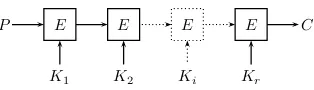
Fig. 1: Multiple Encryption Scheme withr Independent Keys
to the application of the various block ciphers, called in the sequel execution matrix. The attacker is given the rplaintexts at the top and the r ciphertexts at the bottom, and his goal is to find all the keys with a generic algorithm which does not assume the existence of any weaknesses in the underlying block ciphers. The reason we say that this problem is bicomposite is that the keys are independently chosen and the plaintexts are independently processed, and thus we can partition the execution matrix both horizontally and vertically into independent parts. In particular, if we know certain subsets of keys and certain subsets of intermediate values, we can independently verify their consistency with the given plaintexts or ciphertexts without knowing all the other values in the execution matrix. This should be contrasted with the standard constructions of iterated block ciphers, in which a partial guess of the key and a partial guess of some state bits in the middle of the encryption process usually cannot be independently verified by an efficient computation.
The security of multiple-encryption schemes had been analyzed for more than 35 years, but most of the published papers had dealt with either double or triple encryption (which are widely used as DES-extensions, e.g., in the electronic payment industry). For example, Diffie and Hellman’s original meet in the middle attack [8], Lucks’ improvement for Triple-DES [25], or Biham’s work on triple modes of operation [6]. While the exact security of double and triple encryption are well understood and we can not push their analysis any further, our new techniques show that surprisingly efficient attacks can be applied already when we make the next step and consider quadruple encryption, and that additional improvements can be made when we consider even longer combinations.1
Standard meet-in-the-middle (MITM) attacks (introduced in [8]), which ac-count for the best known results against double and triple encryption, try to split such an execution matrix into a top part and a bottom part with a single horizontal partition line which crosses the whole matrix from left to right. Our new techniques use a more complicated way to split the matrix into indepen-dent parts by exploiting its two dimensional structure. Consider, for example, the sequential execution of 7 independent block ciphers. We can find the full 7n-bit key in just 24n expected time and 2n expected memory by guessing two
of the seven internal states after the application of the third block cipher and one of the seven internal states after the application of the fifth block cipher. We call such an irregular way to partition the execution matrix with partial guesses a dissection, since it mimics the way a surgeon operates on a patient by using multiple cuts of various lengths at various locations.
Our new techniques make almost no assumptions about the internal struc-ture of the primitive operations, and in particular they can be extended with just a slight loss of efficiency to primitive operations which are one-way func-tions rather than easily invertible permutafunc-tions. This makes it possible to find improved attacks on message authentication codes (MACs) which are defined
1 These results are independent of the theoretical analysis proposed in [13] which
by the sequential execution of several keyed hash functions. Note that standard MITM attacks cannot be applied in this case, since we have to encrypt the in-puts and decrypt the outin-puts in order to compare the results in the middle of the computation.
To demonstrate the generality of our techniques, we show in this paper how to apply them to several types of combinatorial search problems. A main exam-ple is the knapsack problem: Given n generators a1, a2, . . . , an which are n-bit
numbers, find a subset that sums modulo 2n toS.2For 30 years, the best known
special purpose algorithm for this problem was the 1981 Schroeppel-Shamir al-gorithm [30], with complexity ofT =O(2n/2) andM =O(2n/4). At Eurocrypt
2011, Becker et al. [4] presented several improved special purpose algorithms for different ranges of (T, M) (see Section 5). Our generic dissection technique provides better time complexitiesfor small memory complexities.
To show the connection between knapsack problems and multiple-encryption, describe the solution of the given knapsack problem as a two dimensionalr×r
execution matrix, in which we partition the generators into r groups of n/r
generators, and partition each number intorblocks ofn/rconsecutive bits. Each row in the matrix is defined by adding the appropriate subset of generators from the next group to the accumulated sum computed in the previous row. We start with an initial value of zero, and our problem is to find some execution that leads to a desired valueS after the last row. This representation is bicomposite since the choices made in the various rows of this matrix are completely independent, and the computations made in the various columns of this matrix are almost independent as the only way they interact with each other is via the addition carries which do not tend to propagate very far into the next block. This makes it possible to guess and operate on partial states, and thus we can apply almost the same dissection technique we used for multiple-encryption schemes. Note that unlike the case of multiple-encryption in which the value ofrwas specified as part of the given problem, here we can choose any desired value ofrindependently of the given value ofn in order to optimize the time complexity for any available amount of memory. In particular, by choosing r = 7 we can reduce the best known time complexity for hard knapsacks when we use M = 2n/7 = 20.1428n
memory from 2(3/4−1/7)n = 20.6071n in [4] to 24n/7 = 20.5714n with our new
algorithm.
Previous algorithms for the knapsack problem [4, 30] crucially depend on two facts: (1) addition is an associative and commutative operation on numbers, and (2) sets can be partitioned into the union of two subsets in an exponential number of ways. Our algorithms make no such assumptions, and thus they can be applied under a much broader set of circumstances. For example, consider a non-commutative variant of the knapsack problem in which the generatorsai
are permutations over {1,2, . . . , k}, and we have to find a product of length `
of these generators which is equal to some given permutationS (a special case
2 We note that in the standard formulation of the knapsack problem, one searches
of this variant is the problem of finding the fastest way to solve a given state of Rubik’s cube by a sequence of face rotations, which was analyzed extensively in the literature). To show that this problem is bicomposite, we have to represent it by an execution matrix with independent rows and columns. Consider an`×k
matrix in which the i-th row represents the action of thei-th permutation in the product, and the j-th column represents the current location of element j
from the set. Our goal is to start from the identity permutation at the top, and end with the desired permutationS at the bottom. We can reduce this matrix to sizer×rfor various values ofrby bunching together several permutations in the product and several elements from the set. The independence of the rows in this matrix follows from the fact that we can freely choose the next generators to apply to the current state, and the independence of the columns follows from the fact that we can know the new location of each element j if we know its previous location and which permutation was applied to the state, even when we know nothing about the locations of the other elements in the previous state. This makes it possible to guess partial states at intermediate stages, and thus to apply the same dissection algorithms as in the knapsack problem with the same improved complexities.
We note that generic ideas similar to the basic dissection attacks were used before, in the context of several specific bicomposite problems. These include the aforementioned algorithms of Schroeppel and Shamir [30] and of Becker et al. [4] which analyzed the knapsack problem, the algorithm of van Oorschot and Wiener [29] which attacked double and triple encryption, and the results of Isobe [17] and of Dinur et al. [12] in the specific case of the block cipher GOST.3 A common feature of all these algorithms is that none of them could
beat the tradeoff curveT M =N3/4, whereN is the total number of keys. The
algorithms of [12, 17, 29, 30] matched this curve only for a single point, and the recent algorithm of Becker et al. [4] managed to match it for a significant portion of the tradeoff curve. Our new dissection algorithms not only allow to beat this curve, but actually allow to obtain the relation T M < N3/4 for any amount of
memory in the rangeM ≤N1/4.
Follow-up Work Since the conference version of this paper has appeared, the dissection technique was studied further and applied in numerous papers, in a wide variety of contexts. To mention a few:
On the theoretical side, Austrin et al. [1] transformed the complexity analysis of the dissection technique from the average-case complexity setting considered here to the worst-case complexity setting and Wang [31] generalized the appli-cation to knapsacks to the k-SUM problem.
On the practical side, Canteaut et al. [7] used dissection in their ‘sieve in the middle’ generic technique for MITM attacks, Lallemand and Naya-Plasencia [22] used it in their semi-practical attack on the full stream cipher Sprout, Baek et 3 The basic idea of guessing internal values and “attacking” from them appeared in
al. [2] used it in an attack on a new white-box implementation of the AES, Kirchner and Fouque [19] used it to obtain improved algorithms for lattice enu-meration, and Bar-On et al. [3] used it in attacks on reduced-round AES.
In a follow-up work [11], the authors applied the dissection technique to Feis-tel networks, obtaining generic attacks that outperform the best-known special-ized attacks on a number of block ciphers, including the AES candidate DEAL. In addition, in [10] the authors elaborated on how to apply dissection to solve Rubik’s cube with the smallest possible number of face rotations.
Paper Organization The paper is organized as follows: In Section 3 we intro-duce the dissection technique and present our best error-free attacks on multiple encryption. In Section 4 we consider the model when “false negatives” are al-lowed, and show that the dissection algorithms can be combined with the parallel collision algorithm of van Oorschot and Wiener [29] to get an improved time-memory tradeoff curve. In Section 5, we apply our techniques to other crypto-graphic problems, such as solving the hardest instances of knapsack problems, and improving rebound attacks on hash functions. Finally, Section 6 concludes the paper and describes some open problems.
2
Notations and Conventions
In this paper, when we consider multiple encryption (mostly in Sections 3 and 4), we denote the basic block cipher by E and assume that it uses n-bit blocks and n-bit keys (we can easily deal with other sizes, but it makes the notation and the discussion cumbersome). We denote by Ei the encryption process with
key ki, and denote by E[1...r] the multiple-encryption scheme which uses r
in-dependent keys to encrypt the plaintext P and produce the ciphertext C via
C =Ekr(Ekr−1(· · ·Ek2(Ek1(P))· · ·)). The intermediate value produced by the
encryption ofPj underE[1...i] is denoted by Xji, and the decryption process of
E[1...r] is denoted byD[1...r](which applies the keys in reverse order). To attack
E[1...r], we are usually given r plaintext/ciphertext pairs, which are expected to make the key unique (at intermediate stages, we may be given fewer than
j−i+ 1 plaintext/ciphertext pairs forE[i...j], and then we are expected to
pro-duce all the compatible keys). In all our exponential complexity estimates, we consider expected rather than maximal possible values (under standard random-ness assumptions, they differ by no more than a logarithmic factor), and ignore multiplicative polynomial factors innandr.
When we consider execution matrices for bicomposite problems (mostly in Section 5), we denote the matrix by S, and the j’th element in its i’th row (which corresponds to the intermediate stateXi
jin multiple encryption) bySi,j.
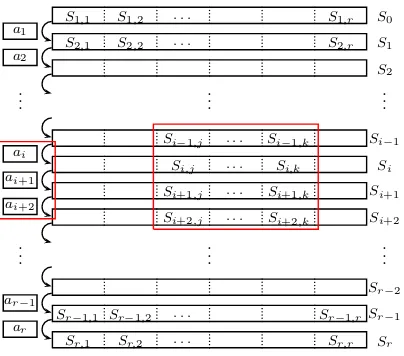
In addition, we denote the ‘actions’ that can be performed on a state at thei’th row byai. The execution matrix notations are demonstrated in Figure 2, which
Sr
Sr−1
Sr−2
.. . ..
. ..
.
Si+2
Si+1
Si
Si−1
.. . ..
. ..
.
S0
S1
S2
Sr,1 Sr,2 . . . Sr,r
Sr−1,1 Sr−1,2 . . . Sr−1,r
S2,1 S2,2 . . . S2,r
S1,1 S1,2 . . . S1,r
Si+2,j . . . Si+2,k
Si+1,j . . . Si+1,k
Si,j . . . Si,k
Si−1,j . . . Si−1,k
ar−1
ar
ai
ai+1
ai+2
a1
a2
Fig. 2: An Execution Matrix of a Bicomposite Search Problem
can independently verify their consistency without knowing all the other values in the execution matrix.
3
Dissecting the Multiple-Encryption Problem
In this section we develop our basic dissection algorithms that allow to solve efficiently the problem of multiple encryption. Given r-encryption with r in-dependent keys, r n-bit plaintext/ciphertext pairs and 2mn memory cells, the
algorithms find all possible values of the keys which comply with the plain-text/ciphertext pairs, or prove that there are no such keys. The algorithms are deterministic, in the sense that they do not use random bits and they always succeed since they implicitly scan all possible solutions.
This section is organized as follows. In Section 3.1 we briefly describe the classical meet-in-the-middle attack which serves as a basis to our algorithms. In Section 3.2 we present the most basic dissection algorithm, and apply it to 4-encryption. In Section 3.3, we discuss natural extensions of the basic dissec-tion algorithm, which dissect the cipher in a symmetric way by splitting it into parts of equal size. In Section 3.4 we introduceasymmetricdissection algorithms (which split the cipher into parts of different sizes), and present a sequence of asymmetric dissection algorithms which are more efficient than the symmetric ones. In Section 3.5, we present a formal framework for dissection algorithms, and show the optimality of our algorithms in this framework. While our basic algorithms and analysis apply only to the case where M = 2n, in Section 3.6
deterministic dissection algorithms for all r ≤40 and m ≤10 in Table 1. Fi-nally, in Section 3.7 we describe dissection algorithms in the case where instead of encryptions we are given a sequence of keyed one-way functions.
A reader which is interested mainly in the ideas of the dissection algorithms and not in details and generalizations, may concentrate on Sections 3.2 and 3.4 and leave the other sections for later reading.
3.1 Previous Work — The Meet-in-the-Middle Attack
The trivial algorithm for recovering the key of anr-encryption scheme is exhaus-tive search over the 2rn possible key values, whose time complexity is 2rn, and
whose memory requirement is negligible. In general, with no additional assump-tions on the algorithm and on the subkeys, this is the best possible algorithm.
In [27] Merkle and Hellman observed that if the keys used in the encryption are independent, an adversary can trade time and memory complexities, using a MITM approach. In this attack, the adversary chooses a valueu, 1≤u≤ br/2c, and for each possible combination of the firstukeys (k1, k2, . . . ku) she computes
the vector (Xu
1, X2u, . . . , Xru) =E[1...u](P1, P2, . . . , Pr) and stores it in a sorted
table (along with the respective key candidate). Then, for each value of the lastr−ukeys, the adversary computes the vectorD[u+1...r](C
1, C2, . . . , Cr) and
checks whether the value appears in the table (each such collision suggests a key candidate (k1, . . . , kr)). The right key is necessarily suggested by this approach,
and in cases when other keys are suggested, additional plaintext/ciphertext pairs can be used to sieve the wrong key candidates.
The time complexity of this algorithm isT = 2(r−u)n, whereas its memory
complexity is M = 2un. Hence, the algorithm allows to achieve the tradeoff
curve T M = 2rn for any values T, M such that M ≤ 2br/2cn.4 Note that the
algorithm can be applied also if the number of available plaintext/ciphertext pairs isr0 < r. In such a case, it outputs all the possible key candidates, whose expected number is 2(r−r0)n
(since the plaintext/ciphertext pairs yield anr0n-bit condition on the 2rn possible keys).
The MITM attack, designed for breaking double-encryption, is still the best known generic attack on double encryption schemes. It is also the best known attack up to logarithmic factors5for triple encryption, which was studied very
ex-4 We note that the algorithm, as described above, works only for u∈
N. However, it can be easily adapted to non-integer values ofu≤ br/2c, preserving the tradeoff curve T M = 2rn. This is done by trying 2un key candidates for (k1, . . . , kdue),
storing the relevant partial encryptions, and testing the relevant (kdue+1, . . . , kr). If this procedure fails, the next 2unkey candidates for (k1, . . . , kdue) are tested, and so
forth.
5 A logarithmic time complexity improvement can be achieved in these settings as
Input: Four plaintexts (P1, P2, P3, P4) and their corresponding ciphertexts (C1, C2, C3, C4)
1: for allcandidate values ofX12=Ek2(Ek1(P1))do
2: Run the standard MITM attack on 2-round encryption with (P1, X12) as a single
plaintext-ciphertext pair
3: for allobtained 2nvalues of (k1, k2) of the previous stepdo
4: ComputeX22=Ek2(Ek1(P2)) (i.e., partially encryptP2 underk1, k2) 5: Store in a sorted table the corresponding values ofX22, along with the values
of (k1, k2)
6: Run the standard MITM attack on 2-round encryption with (X12, C1) as a single
plaintext-ciphertext pair
7: for allobtained 2nvalues of (k3, k4)do
8: ComputeX22=Dk3(Dk4(C2)) (i.e., partially decryptC2 using (k3, k4)) 9: if the suggested value forX22 appears in the tablethen
10: Retrieve the corresponding (k1, k2) from the table 11: if Ek4(Ek3(Ek2(Ek1(P3, P4)))) = (C3, C4)then 12: return (k1, k2, k3, k4)
Algorithm 1: TheDissect2(4,1) Algorithm
tensively due to its relevance to the former de-facto encryption standard Triple-DES.
3.2 The Basic Dissection Algorithm: Attacking 4-Encryption
In the following, we show that for r ≥ 4, the basic MITM algorithm can be outperformed significantly, using a dissection technique. For the basic caser= 4, considered in this section, our algorithm runs in time T = 22n with memory
2n, thus allowing to reach T M = 23n, which is significantly better than the
T M = 24n curve suggested by the meet-in-the-middle attack.
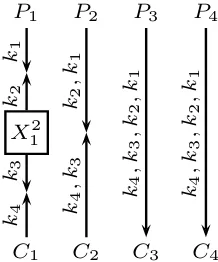
The main idea behind the algorithm is to dissect the 4-encryption into two 2-encryption schemes, and to apply the MITM attack to each of them sepa-rately. The partition is achieved by enumerating parts of the internal state at the dissection point. The basic algorithm, which we callDissect2(4,1) is given
in Algorithm 1 and illustrated in Figure 3. The notationDissect2(4,1) means “a
dissection algorithm for 4-encryption, withm= 1 (i.e., with 2mn= 2nmemory),
and the division performed after round 2”.
It is easy to see that once the right value for X12 is considered, the right
values of (k1, k2) are found in Step 2 and the right values of (k3, k4) are found
in Step 6, and thus, the right value of the key is necessarily found. The time complexity of the algorithm is 22n. Indeed, Steps 2 and 6 are called 2ntimes (for
each value ofX2
1), and each of them runs the basic MITM attack on 2-encryption
P1 P2 P3 P4
C1 C2 C3 C4
X12
k1
k2
k3
k4 k2
,
k1
k4
,
k3 k4
,
k3
,
k2
,
k1
k4
,
k3
,
k2
,
k1
Fig. 3: Illustration of theDissect2(4,1) Algorithm for 4-Encryption
(for a random block cipher, about 2−n of the keys satisfy that the encryption of
a given plaintext P is a given ciphertextC), the number of expected collisions in the table of X2
2 is 2n. Thus, the expected time complexity of the attack6 is
2n·2n= 22n.
The memory consumption of the 2-encryption MITM steps (Steps 2 and 6) is expected to be about 2n. The size of the table computed in Step 5 is also
2n, since each MITM step is expected to output 2n key candidates. Hence, the
expected memory complexity of the entire algorithm is 2n.
3.3 Natural Extensions of the Basic Dissection Algorithm
We now consider the case (r > 4, m= 1) and show that natural extensions of theDissect2(4,1) algorithm presented above, allow us to significantly increase
the gain over the standard MITM attack for larger values ofr.
It is clear that any algorithm for r0-encryption can be extended to attack r-encryption for anyr > r0, by trying all possibler−r0keys (kr0+1, . . . , kr), and
applying the basic algorithm to the remaining E[1...r0]. The time complexity is
increased by a multiplicative factor of 2(r−r0)n, and hence, the ratio 2rn/T M is
preserved. This leads to the following natural definition.
Definition 1. The gain of an algorithm A for r-encryption whose time and memory complexities areT andM, respectively, is defined as
Gain(A) = log(2rn/T M)/n=r−log(T M)/n.
The maximal gain amongst all deterministic algorithms for r-encryption which use2mn memory, is denoted byGain
D(r, m)(where “D” stands for
“determin-istic”).
By the trivial argument above,GainD(r,1) is monotone non-decreasing with
r. TheDissect2(4,1) algorithm shows thatGainD(r,1)≥1 forr= 4, and hence,
for allr≥4. Below we suggest two natural extensions, which allow to increase the gain up to√r.
The LogLayer Algorithm: The first extension of theDissect2(4,1) is the
recursive LogLayerr algorithm, applicable whenr is a power of 2, which tries
all the possibleX2i
1 fori= 1,2, . . . , r/2−1 and runs simple MITM attacks on
each subcipherE[2i+1,2i+2]separately. As each such attack returns 2n candidate
keys (which can be stored in memory of (r/2)·2n), the algorithm then groups 4
encryptions together, enumerates the valuesX4i
2 fori= 1,2, . . . , r/4−1, and runs
MITM attacks on each subcipherE[4i+1...4i+4] separately (taking into account
that there are only 2n possibilities for the keys (k
4i+1, k4i+2) and 2n possibilities
for the keys (k4i+3, k4i+4)). The algorithm continues recursively (with logrlayers
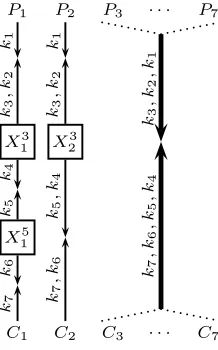
in total), until a single key candidate is found. We illustrate LogLayer for 8-encryption in Figure 4.7
P1 P2 P3 . . . P8
C1 C2 C3 . . . C8
X14 X24
X12
X16
k1
k2
k3
k4
k5
k6
k7
k8 k2
,
k1
k4
,
k3
k6
,
k5
k8
,
k7
k4
,
k3
,
k2
,
k1
k8
,
k7
,
k6
,
k5
Fig. 4: Illustration of theLogLayerAlgorithm for 8-Encryption
7
We note that one can slightly reduce the memory complexity of the attack by using only the pair (P3, C3) for checking the consistency between the candidates for the subkeys (k1, . . . , k4) and the candidates for the subkeys (k5, . . . , k8) and then using
The memory complexity ofLogLayerr is 2n (as we need to store no more
than r tables, each of size 2n). As in the j-th layer of the attack, (r/2j)−1
intermediate values are enumerated, and as each basic MITM attack has time complexity of 2n, the overall time complexity of the attack is
logr
Y
j=1
2n((r/2j)−1)·2n = 2n(r−logr).
Therefore,Gain(LogLayerr) = logr−1, which shows thatGainD(r,1)≥ blogrc−
1.
TheSquarer Algorithm: This logarithmic gain ofLogLayerris significantly
outperformed by the Squarer algorithm, applicable when r = (r0)2 is a
per-fect square. The Squarer algorithm starts by by enumerating all Xr
0 1 , Xr
0 2 , . . .,
Xr0
r0−1, X2r 0 1 ,X2r
0
2 , . . . , X2r 0
r0−1, . . .,X
r0(r0−1)
1 ,X
r0(r0−1) 2 , . . . , X
r0(r0−1)
r0−1 , i.e., (r0−1)
intermediate values everyrrounds forr0−1 plaintexts. Given these values, the adversary can attack each of the r0-encryptions (e.g., E[1...r0]), separately, and
obtain 2n “solutions” on average, which are stored in sorted tables. Then, the
adversary can treat eachr0-round encryption as a single encryption with 2n
pos-sible keys, and apply an r0-encryption attack to recover the key. We illustrate Square9 for 9-encryption in Figure 5.
The time complexity ofSquareris equivalent to repeating 2(r
0−1)(r0−1)n
times a sequence of r0+ 1 attacks onr0-encryption. Hence, the time complexity is at most 2[(r0−1)(r0−1)+(r0−1)]·n, and the memory complexity remains 2n. Therefore,
Gain(Squarer)≥
√
r−1, which shows thatGainD(r,1)≥ b
√
rc −1.
Obviously, improving the time complexity of attacking r0-encryption with 2n memory reduces the time complexity of Square
r as well. However, as the
best attacks of this kind known to us yield a gain of O(√r0) = O(r1/4), the
improvement to the overall gain ofSquareris asymptotically negligible.
3.4 Asymmetric Dissections: 7-Encryption and Beyond
A common feature shared by theLogLayerrand theSquareralgorithms is their
symmetry. In both algorithms, every dissection partitions the composition into parts of the same size. In this section, we show that a better gain can be achieved by an asymmetric dissection.
We observe that the basic dissection attack on 4-encryption is asymmetric in its nature. Indeed, after the two separate MITM attacks are performed, the suggestions from the upper part are stored in a table, while the suggestions from the lower part are checked against the table values. As a result, the number of suggestions in the upper part is bounded from above by the size of the memory (which is now assumed to be 2n and kept in sorted order), while the number of
P1 P2 P3 P4
C1 C2 C3 C4
. . . P9
. . . C9 X3
1 X23
X16 X
6 2 k2
,
k1
k3
k5
,
k4
k6
k8
,
k7
k9
k6
,
k5
,
.
.
.
,
k2
,
k1
k9
,
k8
,
k7
Fig. 5: Illustration of theSquare9 Algorithm for 9-Encryption
P1 P2 P3 . . . P7
C1 C2 C3 . . . C7 X13 X23
X15
k1
k3
,
k2 k1
k3
,
k2
k4
k5
k6
k7 k5
,
k4
k7
,
k6
k3
,
k2
,
k1
k7
,
k6
,
k5
,
k4
Fig. 6: Illustration of theDissect3(7,1) Algorithm for 7-Encryption
algorithm. This is indeed the case, as illustrated by theDissect3(7,1) algorithm
Input: Seven plaintexts (P1, P2, . . . , P7) and their corresponding ciphertexts (C1, C2, . . . , C7)
1: for allcandidate values ofX13, X23 do
2: Apply the basic MITM algorithm toE[1...3] with (P1, X13) and (P2, X23) as the
plaintext-ciphertext pairs
3: for allobtained 2nvalues of (k1, k2, k3) of the previous stepdo
4: ComputeX33, X43, . . . , X73=E [1..3]
k1,k2,k3(P3, P4, . . . , P7)
5: Store in a sorted table the corresponding values ofX33, X43, . . . , X73, along with
the values of (k1, k2, k3)
6: Apply Dissect2(4,1) to E[4...7] with (X13, C1) and (X23, C2) as the
plaintext-ciphertext pairs
7: for allobtained 22nvalues of (k4, k5, k6, k7)do
8: ComputeX33, X43, . . . , X73=D [4...7]
k4,k5,k6,k7(C3, C4, . . . , C7)
9: if the suggested value forX33, X43, . . . , X73 appears in the tablethen
10: return (k1, k2, . . . , k7)
Algorithm 2: TheDissect3(7,1) Algorithm
The memory complexity of the algorithm is 2n, as both the basic MITM
attack on triple encryption and the algorithmDissect2(4,1) require 2nmemory,
and the size of the table computed in Step 5 is also 2n.
The time complexity is 24n. Indeed, two n-bit intermediate encryption
val-ues are enumerated, both the basic MITM attack on triple encryption and the algorithm Dissect2(4,1) require 22n time, and the remaining 22n possible
val-ues of (k4, k5, k6, k7) are checked instantly. This leads to a time complexity of
22n·22n= 24n. This shows thatGain(Dissect
3(7,1)) = 2, which is better than
the algorithmsLogLayerrandSquarer, for which the gain is only 1.
The algorithmDissect3(7,1) can be extended recursively to larger values of
r, to yield a better asymptotical gain compared to the symmetric algorithms we presented. Given the algorithmDissectj(r0,1) such thatGain(Dissectj(r0,1)) =
`−1, we define the algorithm Dissect1
N EXT =Dissect`+1(r0+`+ 1,1) for r
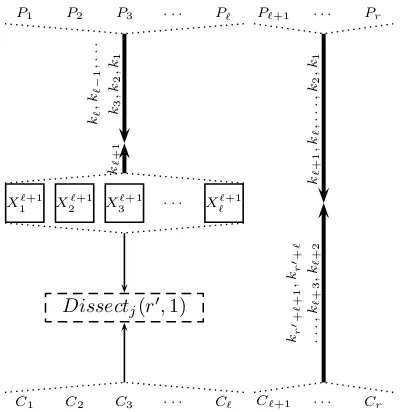
-encryption, wherer=r0+`+ 1, using Algorithm 3 depicted in Figure 7. A similar argument to the one used for Dissect3(7,1) shows that the time
and memory complexities ofDissect`+1(r,1) are 2r 0n
and 2n, respectively, which
implies thatGain(Dissect`+1(r,1)) =`. In fact,Dissect3(7,1) can be obtained
fromDissect2(4,1) by the recursive construction just described.
The recursion leads to a sequence of asymmetric dissection attacks with mem-ory M = 2n, such that the gain increases by 1 with each step of the sequence.
Letr` be the smallest number of rounds at with a gain of`is achieved, then by
the construction, the sequence satisfies the recursion
Input: r plaintexts (P1, P2, . . . , Pr) and their corresponding ciphertexts (C1, C2, . . . , Cr)
1: for allcandidate values ofX1`+1, X2`+1, . . . , X``+1do
2: Apply the basic MITM algorithm toE[1...(`+1)]with (P1, X1`+1), (P2, X2`+1), . . . ,
(P`, X``+1) as the plaintext-ciphertext pairs
3: for allobtained 2nvalues of (k1, k2, . . . , k`+1) of the previous stepdo
4: Partially encryptP`+1, P`+2, . . . , Pr using (k1, k2, . . . , k`+1)
5: Store in a sorted table the corresponding values of X``+1+1, X``+2+1, . . . , Xr`+1, along with the values of (k1, k2, . . . , k`+1)
6: ApplyDissectj(r0,1) toE[(`+2)...r]with (X1`+1, C1), (X2`+1, C2), . . . , (X``+1, C`) as the plaintext-ciphertext pairs
7: for allobtained 2(r0−`)nvalues of (k`+2, k`+3, . . . , kr)do 8: Partially decryptC`+1, C`+2, . . . , Cr using (k`+2, k`+3, . . . , kr)
9: if the suggested value forX``+1+1, X``+2+1, . . . , Xr`+1 appears in the tablethen 10: return (k1, k2, . . . , kr)
Algorithm 3: TheDissect`+1(r0+`+ 1,1) Algorithm
P1 P2 P3 . . . Pℓ Pℓ+1 . . . Pr
C1 C2 C3 . . . Cℓ Cℓ+1 . . . Cr
kℓ
,
kℓ−
1 , . . . k3 , k2 , k1 kℓ + 1
X1ℓ+1 X
ℓ+1
2 X
ℓ+1
3 . . . X
ℓ+1 ℓ kℓ + 1 , kℓ , . . . , k2 , k1
Dissectj(r′,1)
kr ′+ ℓ + 1 , kr ′+ ℓ . . . , kℓ + 3 , kℓ + 2
Fig. 7: Illustration of theDissect`+1(r0+`+ 1,1) Algorithm for (r0+`+ 1)-Encryption
which (together with r0 = 2 which follows from the basic MITM attack) leads
to the formula:
r`=
(`+ 1)(`+ 2)
The asymptotic gain of this sequence is obtained by representing`as a function of r, and is equal to (√8r−7−3)/2≈√2r, which is bigger than the√rgain of theSquareralgorithm.
The analysis presented in Section 3.5 shows that the algorithms obtained by the recursive sequence described above are the optimal amongst all dissection algorithms that split the r rounds into two (not necessarily equal) parts and attacks each part recursively, using any dissection algorithm.
We conclude that as far as only dissection attacks are concerned, themagic sequenceof the minimal numbers of rounds for which the gains are`= 0,1,2,3, . . ., called in the sequelmagic numbers, is:
M agic1={2,4,7,11,16,22,29,37,46,56, . . .}.
This “magic sequence” (also known as the Lazy Caterer’s sequence) will appear several more times in the sequel.
3.5 The Dissectu(r,1) Algorithm
In this section, we present a formal treatment of the dissection algorithm and show the optimality of the sequence M agic1 presented above for algorithms
which use the following framework: In the outer loop of the algorithm, the ad-versary dissectsE[1...r] into two parts,E[1...u]andE[u+1...r], and guesses a few of theXu
i values. Then she finds candidates for the keysk1, k2, . . . , kuby attacking
E[1...u], and stores their values in a sorted table, along with some additional
Xu
j values. At this point, the adversary attacksE[u+1...r], deduces the candidate
values for ku+1, ku+2, . . . , kr, computes the correspondingXju values, and looks
on-the-fly for matches in the table (each suggesting a value for the entire key of E[1...r]). Obviously, the attacks on E[1...u] and E[u+1...r] themselves can be
performed using dissection algorithms.
As explained in Section 3.4, the number ofXu
i values the adversary has to
guess is dictated by the number of key suggestions fork1, k2, . . . , ku yielded by
the attack onE[1...u], since only these suggestions have to be stored in memory.
As the amount of memory allowed in Dissectu(r,1) is 2n, we assume that the
adversary guesses u−1 values of the form Xu
i, as this makes the number of
suggestions 2n (under standard randomness assumptions).
Therefore, theDissectu(r,1) attack onr-encryption can be defined by
Algo-rithm 4. Of course, the algoAlgo-rithms Dissect3(7,1) andDissect`+1(r0+`+ 1,1)
presented in Section 3.4 are special cases ofDissectu(r,1).
Complexity Analysis of Dissectu(r,1): It is easy to see that since the
memory complexity of the attacks onE[1...u]andE[u+1...r]is at most 2n, then the
memory complexity of the whole attack is 2n(recall that we expect 2ncandidates
fork1, k2, . . . , ku). Moreover, for the right guess of the X1u, X2u, . . . Xuu−1values,
Input: r plaintexts (P1, P2, . . . , Pr) and their corresponding ciphertexts (C1, C2, . . . , Cr)
1: for allcandidate values ofX1u, X2u, . . . , Xuu−1do
2: Apply the basic MITM algorithm to E[1...u] with (P1, X1u), (P2, X2u), . . . ,
(Pu−1, Xuu−1) as the plaintext-ciphertext pairs
3: for allobtained 2nvalues of (k1, k2, . . . , ku) of the previous stepdo 4: Partially encryptPu, Pu+1, . . . , Pr using (k1, k2, . . . , ku)
5: Store in a sorted table the corresponding values ofXuu, Xuu+1, . . . , Xru, along with the values of (k1, k2, . . . , ku)
6: Attack E[(u+1)...r] (possibly using dissection) with (X1u, C1), (X2u, C2), . . . ,
(Xuu−1, Cu) as the plaintext-ciphertext pairs
7: for allobtained 2[r−u−(u−1)]n valuesa of (ku+1, ku+2, . . . , kr)do 8: Partially decryptCu, Cu+1, . . . , Cr using (ku+1, ku+2, . . . , kr)
9: if the suggested value forXuu, Xuu+1, . . . , Xruappears in the tablethen 10: return (k1, k2, . . . , kr)
a
We recall that when attackingE[u+1...n], we expect that out of the 2(r−u)npossible keys, only one in 2(u−1)n is consistent with the givenu−1 “plaintext”-ciphertext pairs.
Algorithm 4: TheDissectu(r,1) Algorithm
in Step 9. Hence, the attack indeed returns the right key (perhaps with a few other candidates).
The time complexity of the attack is 2(u−1)ntimes the complexity of Steps 2
and 6. The running time of Step 2 (attackingu≤ br/2crounds8) does not affect
the proof of optimality of our algorithms, and thus we ignore it.
Using our framework, we assume that the most efficient way to implement Step 6 is by callingDissectu∗(r−u,1) algorithm for someu∗< r−u. Thus, the
running time of Step 6 is at least the time complexity of theDissectu∗(r−u,1)
algorithm. In addition, one needs to note that the number of solutions suggested by this part of the attack is 2(r−2u+1)n, i.e., we expect another 2(r−2u+1)n
ac-cesses to the table as part of Step 7). For convenience of notation, let
f1(r), min
1≤u≤r−1{r−1−Gain(Dissectu(r,1))},
so that the lowest possible time complexity of an algorithm in our framework on
r-encryption with 2n memory is 2f1(r)n.
Using this notation, the time complexity ofDissectu(r,1) is at least
2(u−1)n·maxn2f1(u)n,2f1(r−u)n,2(r−2u+1)no.
8 For a good block cipher E, the problem of attacking the encryption and the
Therefore, for a given value of r, the optimal value of u is the one that minimizes the above expression. In other words:
f1(r) = min
1≤u≤r{u−1 + max{f1(u), f1(r−u), r−2u+ 1}}. (1)
We can simplify this expression by plugging in u = br/2c, and obtaining
f1(r)≤ br/2c+ 1 +f1(dr/2e). Thus, sincef1(r) is non-decreasing, the minimum
cannot be obtained foru >br/2c, which implies:
f1(r) = min
1≤u≤br/2c{u−1 + max{f1(r−u), r−2u+ 1}}. (2) Using Equation 2 and the known values off1(1) =f1(2) = 1 (which follow
from the standard MITM algorithm on 2-encryption), it is easy to show by induction on r that the minimal complexities are achieved by the sequence of algorithms presented in Section 3.4.
Remark 1. One may be concerned by the fact that when the algorithm is run recursively there are no additional “plaintext” values that allow constructing the table in Step 2 (as we require at least one additional “plaintext” to filter some of the key candidates found in Step 6). This issue is solved by the fact that once the top part (being E[1...r∗] for some r∗) has at most 2n possible keys, we can
partially encrypt as many plaintexts as we have to generate the required data.
3.6 Deterministic Dissection Algorithms for m >1
While the algorithms presented above seem tailored to the casem= 1, it turns out that a small tweak in the recursive sequence of the dissection algorithms pre-sented in Section 3.4 is sufficient to obtain optimal algorithms in our framework for any integerm >1.
First, we define the general family of dissection algorithmsDissectu(r, m),
which correspond to a memory complexity of 2mn, in Algorithm 5.
As in the case m = 1, we denote fm(r) = r−m−GainD(r, m), so that
the lowest possible time complexity of a deterministic dissection attack on r -encryption with 2mn memory is 2fm(r)n. In these notations, exactly the same analysis as in the case m= 1 shows that
fm(r) = min
1≤u≤br/2c{u−m+ max{fm(r−u), r−2u+m}}. (3) The optimal choice of the “cut points” u for each value of r is obtained by a recursive sequence of algorithms, which is a simple generalization of the sequence that we obtained form= 1.
First, note that if an algorithmDissectj(r0, m) satisfiesGain(Dissectj(r0, m))
=`−m, then the algorithmDissect`+m(r0+`+m, m) (which usesDissectj(r0, m)
as a subroutine in the lower part) satisfiesGain(Dissect`+m(r0+`+m, m)) =`.
Input: r plaintexts (P1, P2, . . . , Pr) and their corresponding ciphertexts (C1, C2, . . . , Cr)
1: for allcandidate values ofX1u, X2u, . . . , Xuu−mdo
2: Apply the basic MITM algorithm to E[1...u] with (P1, X1u), (P2, X2u), . . . ,
(Pu−m, Xuu−m) as the plaintext-ciphertext pairs
3: for allobtained 2mnvalues of (k1, k2, . . . , ku) of the previous stepdo 4: Partially encryptPu−m+1, Pu−m+2, . . . , Prusing (k1, k2, . . . , ku)
5: Store in a sorted table the corresponding values ofXuu, Xuu+1, . . . , Xru, along with the values of (k1, k2, . . . , ku)
6: Attack E[(u+1)...r] (possibly using dissection) with (X1u, C1), (X2u, C2), . . . ,
(Xuu−1, Cu) as the plaintext-ciphertext pairs
7: for allobtained 2[r−u−(u−1)]n values of (ku+1, ku+2, . . . , kr)do 8: Partially decryptCu, Cu+1, . . . , Cr using (ku+1, ku+2, . . . , kr)
9: if the suggested value forXuu, Xuu+1, . . . , Xruappears in the tablethen 10: return (k1, k2, . . . , kr)
Algorithm 5: TheDissectu(r, m) Algorithm
As the starting points for the sequence, we start with the m algorithms
Dissectm+i(2m+2i, m) fori= 0,1, . . . , m−1. In the algorithmDissectm+i(2m+
2i, m), the adversary enumeratesiintermediate values afterm+irounds, applies simple MITM attacks on each part separately, and then applies a MITM attack between the 2mn key suggestions from the two parts. The time and memory
complexities of the algorithm are 2(m+i)n and 2mn, respectively, and hence, its
gain is i.
Using thesemstarting points and the recursive step, the entire sequence can be computed easily. It turns out that the “magic sequence” of the numbers of rounds at which the gain`= 0,1,2, . . .obtained is
M agicm={2m,2m+ 2,2m+ 4, . . . ,4m,4m+ 3,4m+ 6, . . . ,
7m,7m+ 4,7m+ 8, . . . ,11m, . . .},
and the asymptotic gain is approximately√2mr.
Using Equation (3), it is easy to show by induction on r that the optimal complexities amongstDissectu(r, m) algorithms are achieved by the sequence of
algorithms presented above.9
We present the time and memory complexities of the optimalDissectu(r, m)
algorithms for allr≤40 andm≤10 in Table 1.
9 Our algorithms only work for integer values of m, since u−m (the number of
r m= 1m= 2m= 3m= 4m= 5m= 6m= 7m= 8m= 9m= 10
1 1 1 1 1 1 1 1 1 1 1
2 1 1 1 1 1 1 1 1 1 1
3 2 2 2 2 2 2 2 2 2 2
4 2 2 2 2 2 2 2 2 2 2
5 3 3 3 3 3 3 3 3 3 3
6 4 3 3 3 3 3 3 3 3 3
7 4 4 4 4 4 4 4 4 4 4
8 5 4 4 4 4 4 4 4 4 4
9 6 5 5 5 5 5 5 5 5 5
10 7 6 5 5 5 5 5 5 5 5
11 7 6 6 6 6 6 6 6 6 6
12 8 7 6 6 6 6 6 6 6 6
13 9 8 7 7 7 7 7 7 7 7
14 10 8 8 7 7 7 7 7 7 7
15 11 9 8 8 8 8 8 8 8 8
16 11 10 9 8 8 8 8 8 8 8
17 12 11 10 9 9 9 9 9 9 9
18 13 11 10 10 9 9 9 9 9 9
19 14 12 11 10 10 10 10 10 10 10
20 15 13 12 11 10 10 10 10 10 10
21 16 14 12 12 11 11 11 11 11 11
22 16 14 13 12 12 11 11 11 11 11
23 17 15 14 13 12 12 12 12 12 12
24 18 16 15 14 13 12 12 12 12 12
25 19 17 15 14 14 13 13 13 13 13
26 20 18 16 15 14 14 13 13 13 13
27 21 18 17 16 15 14 14 14 14 14
28 22 19 18 16 16 15 14 14 14 14
29 22 20 18 17 16 16 15 15 15 15
30 23 21 19 18 17 16 16 15 15 15
31 24 22 20 19 18 17 16 16 16 16
32 25 22 21 19 18 18 17 16 16 16
33 26 23 21 20 19 18 18 17 17 17
34 27 24 22 21 20 19 18 18 17 17
35 28 25 23 22 20 20 19 18 18 18
36 29 26 24 22 21 20 20 19 18 18
37 29 27 25 23 22 21 20 20 19 19
38 30 27 25 24 23 22 21 20 20 19
39 31 28 26 25 23 22 22 21 20 20
40 32 29 27 25 24 23 22 22 21 20
Items marked in bold are magic numbers.
Table 1:fm(r) Values
3.7 Dissection Algorithms for a Composition of Keyed One-Way Functions
NMAC [5]. It turns out that the deterministic dissection algorithms presented above can be easily modified to yield efficient dissection algorithms for this sce-nario.
In the scenario of composition of OWFs, the goal is to retrievek1, k2, . . . , kr
used in
F[1...r](P) =Fkr(Fkr−1(· · ·Fk2(Fk1(P))· · ·)),
where Fk(·) is a keyed one-way function from an n-bit input and an n-bit key
into an n-bit output. We shall assume that the keyed one-way functionF is a family of 2k random functions (where each function corresponds to a different
key).
Given 22n memory, one can simply store a table of (Fk(X), k, X) sorted by
the values of Fk(X) and k. Thus, given Fk(X) and k, one can find all possible
X values (there is one such value on average) that are “encrypted” intoFk(X)
under the keyk. As this actually generates the “decryption” functionality by one memory access per each possibleX (and thus amortized complexity of one mem-ory access per each (Fk(X), k) tuple), we can repeat the same Dissectu(r, m)
algorithms designed for multiple-encryption, ifm≥2.
In case we only have 2n memory, we use a slightly different approach in the
dissection of F[1...r] into two parts. In the lower part, instead of fixing
inter-mediate values and checking which keys “decrypt” the known outputs10 into
these intermediate values, we go over all tuples of (intermediate values, key) and store in a table those tuples which comply with the known outputs.11Then,
we obtain candidates for the keys in the upper part and check them against the table. This procedure is somewhat less efficient than the originalDissectu(r, m),
but obtains similar asymptotical results.
In the simplest case ofr= 3, the algorithm, which we callDissectOW F2(3),
is defined as in Algorithm 6.12
Steps 1 and 2 go over 22nvalues, with ann-bit filtering condition (in Step 3).
Hence, their running time is 22nand the expected memory consumption13is 2n.
Step 5 iterates over all 22n values of (k
1, k2), and for each such key pair, we
expect on average one value ofX2
1 in the table. This value suggests on average a
single value ofk3, from which we obtain a suggestion for the complete key. We
conclude that the time complexity of DissectOW F2(3) is 22n and its memory
complexity is 2n.
10As we consider one way functions, we use the terms inputs and outputs rather than
plaintexts and ciphertexts.
11
Different from the case of multiple encryption, in the case of one-way functions, we build a table for the lower part of the cipher.
12Recall that we discuss only the case in which 2nmemory is given, as for 22nmemory
the previousDissectalgorithms are still applicable. Hence, we omit the amount of memory from the notation.
13A given output may have several inputs (even when the key is fixed), thus the number
of “solutions” to the equation Fk3(X
2
1) = C1 may be larger than 2n. However,
Input: Three inputs (P1, P2, P3) and their corresponding outputs (C1, C2, C3) 1: for allcandidate values ofX12 do
2: for allk3do
3: if Fk3(X
2
1) =C1 then
4: Store (X12, k3) in a sorted table
5: for allcandidate values ofk1, k2 do
6: ComputeX12=Fk2(Fk1(P1)) 7: if X12 appears in the tablethen
8: Obtaink3from the table
9: if F[1...3](P2, P3) = (C2, C3)then
10: return (k1, k2, k3)
Algorithm 6: TheDissectOW F2(3) Algorithm
We note that (similarly to the case of multiple-encryption) a trivial extension of DissectOW F2(3) allows us to retrieve the key of a composition of r OWFs
for any r≥3, in time 2(r−1)n and memory 2n. Moreover, if we are given only
r−1 input/output pairs, the same algorithm allows us to retrieve the 2n keys
which comply with these pairs. This algorithm will be used in the recursive step below.
Starting withDissectOW F2(3), we can recursively construct a sequence of
dissection algorithms. The construction is similar to theDissectN EXT
construc-tion presented in Secconstruc-tion 3.4, with a few differences which follow from the special structure of OWFs.
Given ` ≥ 2 and an algorithm DissectOW Fj(r0) whose gain is `−1, i.e.,
Gain(DissectOW Fj(r0)) =`−1, we define the algorithmDissectOW FN EXT =
DissectOW Fr0(r0+`+ 1) forr-encryption, wherer=r0+`+ 1, by Algorithm 7.
An analysis similar to that of theDissect1N EXT algorithm presented in
Sec-tion 3.4 shows that the time and memory complexities ofDissectOW FN EXT are
T = 2r0n
andM = 2n. Indeed, the only essential difference betweenDissectOW F N EXT
andDissect1
N EXT is the second part of Step 1 (i.e., computing the preimages),
but the time complexity of this part is 22n, which is less than the complexity of
the other steps of the algorithm, since`≥2.
This shows that the sequence of DissectOW Fj(r) algorithms satisfies the
same recursion relation as the sequenceDissectj(r,1). Hence, if we denote by ˜r`
the`’th element of the sequence (i.e., the number of rounds for which the gain is`), then
˜
r`= ˜r`−1+`+ 1.
Since ˜r0= 3, we get the formula
˜
r`=r`+ 1 =
(`+ 1)(`+ 2)
Input:rinputs (P1, P2, . . . , Prand their corresponding outputs (C1, C2, . . . , Cr)
1: for allcandidate values ofX1r0, Xr
0
2 , . . . , Xr
0 ` do 2: for allkr0+1, kr0+2, . . . , kr do
3: if F[r0+1...r](X1r0, Xr
0
2 , . . . , Xr
0
` ) = (C1, C2, . . . , C`)then 4: Store (X1r0, Xr
0
2 , . . . , Xr
0
` , kr0+1, kr0+2, . . . , kr) in a sorted table 5: ApplyDissectOW Fj(r0) toE[1...r
0]
with (P1, Xr
0
1 ),(P2, Xr
0
2 ), . . . ,(P`, Xr 0 ` ) as the input-output pairs
6: for allobtained 2(r0−`)nvalues of (k1, k2, . . . , kr0) of the previous stepdo 7: ComputeX1r0, Xr
0
2 , . . . , Xr
0
` =F[1...r 0]
(P1, P2, . . . , P`) 8: if X1r0, Xr
0
2 , . . . , Xr
0
` appears in the tablethen 9: Obtainkr0+1, kr0+2, . . . , kr from the table
10: if F[1...3](P`+1, P`+2, . . . , Pr) = (C`+1, C`+2, . . . , Cr)then 11: return (k1, k2, . . . , kr)
Algorithm 7: TheDissectOW Fr0(r) Algorithm (for r=r0+`+ 1)
Therefore, the “magic sequence” corresponding to a composition of OWFs is
M agicOW F1 ={3,5,8,12,17,23, . . .},
and the asymptotic gain is approximately√2r, as in the basicr-encryption case.
4
Parallel Collision Search via Dissection
In Section 3, we only considered deterministic algorithms forr-encryption schemes which never err, that is, algorithms which find all the possible values of the keys which comply with the plaintext-ciphertext pairs, or prove that there are no such keys. For this type of algorithm, we improved the previously best known generic tradeoff curve (obtained by MITM attacks) fromT M = 2rn toT M = 2(r−√2r)n
using our dissection algorithms.
We now consider non-deterministic algorithms which find the right keys with some probabilityp <1, which can be made arbitrarily close to one (i.e., Monte Carlo algorithms). In this case, an improved tradeoff curve of T2M = 2(3/2)rn
can be obtained by the parallel collision searchalgorithm of van Oorschot and Wiener [29]. In this section, we combine the dissection algorithms presented in Section 3 with the parallel collision search algorithm to obtain an even better tradeoff curve with a multiplicative advantage of at least 2(√2r/8)nover the curve of [29].
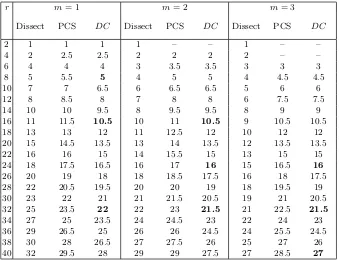
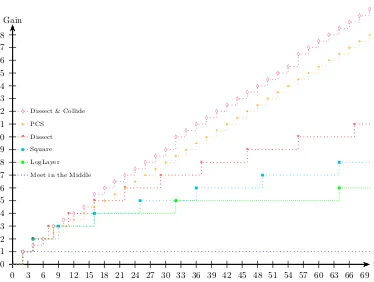
compared to the PCS algorithm. Finally, we present a comparison between the performances of the dissection, PCS, and Dissect & Collide algorithms for se-lected values ofrandmin Table 2.
4.1 Brief Description of the Parallel Collision Search Algorithm
We start with a brief description of the Parallel Collision Search (PCS) algorithm of van Oorschot and Wiener [29]. For more information on the algorithm and its applications, the reader is referred to the original paper [29].
The Memoryless Algorithm The simplest way to present the PCS algorithm is to consider “memoryless” (i.e., constant memory) attacks onr-encryption. As mentioned in Section 3, the time complexity of exhaustive search is 2rn, and the
MITM attack does not perform better given constant memory. Van Oorschot and Wiener showed that the time complexity can be reduced to 2(3/4)rn, using
the PCS algorithm.
The basic observation behind the algorithm is that given constant memory, one can efficiently find key candidates which comply with half of the plaintext-ciphertext pairs.
Assume, for sake of simplicity, thanr is even and the adversary is given r
plaintext-ciphertext pairs (P1, C1), . . . ,(Pr, Cr). The first step of the PCS
al-gorithm consists of finding candidates for the keys (k1, . . . , kr), which comply
with the pairs (P1, C1), . . . ,(Pr/2, Cr/2). In order to find them, the adversary
constructs the two step functions
Fupper: (k1, . . . , kr/2)7→(X1r/2, . . . , X
r/2
r/2), and
Flower: (k
r/2+1, . . . , kr)7→(X1r/2, . . . , X
r/2
r/2),
and uses a variant of Floyd’s cycle finding algorithm [20] to find a collision be-tween them. Thus, the adversary obtains a value of (k1, . . . , kr/2, kr/2+1, . . . , kr)
which complies with (P1, C1), . . . ,(Pr/2, Cr/2). As both functions are from (r/2)n
bits to (r/2)n bits, Floyd’s algorithm is expected to find a collision in time 2(r/4)n, with constant memory. In the sequel, we call such collisions partial
col-lisions.
In the second step of the algorithm, the adversary checks whether the found key candidate also complies with the pairs (Pr/2+1, Cr/2+1), . . . ,(Pr, Cr). By
standard randomness assumptions, this occurs with probability 2−(r/2)n, and
hence the adversary is expected to find the key after testing 2(r/2)n candidates.
The total time complexity of the algorithm is thus 2(3/4)rn.
We note that one may be tempted to use the naive approach to find a collision betweenFupperandFlower, by trying to construct a self-colliding chain of values,
(for more details, refer to [29]). Moreover, the adversary has to use different flavors of the step functions Fupper andFlower in order to produce the 2(r/2)n
distinctpartial collisions required for the second step of the algorithm. Thus, the algorithm is probabilistic also in the sense that its success probability depends on the (randomly chosen) starting points of Floyd’s algorithm and the different flavors.
Time/Memory Tradeoff in Parallel Collision Search If more memory is available, then the algorithm described above can be combined with the tech-niques used in the classical Hellman’s time-memory tradeoff attack [15] to ob-tain the tradeoff curve T2M = 2(3/2)rn. The reduction in the time complexity
is achieved by obtaining many partial collisions simultaneously, with a lower amortized time per collision.
Assume that the available memory is M = 2mn. The adversary chooses
M random starting points Vi, and for each of them she computes a chain of
values starting from Vi. Each chain is terminated once a value with (r/4−
m/2)nzero LSBs is obtained, and this “distinguished point” is stored in a table, along with Vi and its total length. For each reached distinguished point, the
adversary checks whether it already appears in the table. If it indeed appears, then the corresponding chains give a collision betweenFlower and Fupper with
high probability. This collision can be easily found using the two starting points of the chains, and their lengths.
The expected length of each of the 2mn paths is 2(r/4−m/2)n, and thus the
structure covers a total of about 2(r/4+m/2)nvalues. Using the birthday paradox,
since every path contains about 2(r/4−m/2)nvalues, we expect it to collide with at
least one of the 2(r/4+m/2)ncovered points with high probability. Thus, we expect
to find a total of about 2mn partial collisions using this algorithm. Generating
the structure requires a total of about 2(r/4+m/2)noperations, and we can obtain
each of the 2mnpartial collisions in about 2(r/4−m/2)n time (the expected length
of a chain in the structure). Thus, the total time complexity of obtaining the collisions is about 2(r/4+m/2)n, which implies that the time complexity of the
algorithm is also about 2(r/4+m/2)n.
In total, the algorithm requires about 2(r/4+m/2)noperations in order to find
2mnpartial collisions. Since 2rn/2 partial collisions are needed, the overall time
complexity is
T = 2(r/4+m/2)n·2(r/2−m)n = 2(3r/4−m/2)n,
which leads to the tradeoff curveT2M = 2(3/2)rn.
4.2 The Dissect & Collide Algorithm
In this section, we present the Dissect & Collide (DC) algorithm, which uses dissection to enhance the PCS algorithm.
step functions ˜Fupperand ˜Flowerin such a way that all the keys they suggest
par-tially encryptPi toXir/2 and partially decryptCitoXir/2, for alli≤u. This is
achieved by incorporating an attack onE[1...r/2]with (P
1, X1r/2), . . . ,(Pu, Xur/2)
as the plaintext-ciphertext pairs into the function Fupper, and similarly with
E[r/2+1...r] andFlower. As a result, a partial collision which complies with the
pairs (P1, C1), . . . ,(Pr/2, Cr/2) can be found at a smaller “cost” than in the PCS
algorithm. It should be noted that this gain could potentially be diminished by the “cost” of the new step functions ˜F, which is higher than the “cost” of the simple step functions F. However, we show that when the efficient dissection algorithms presented in Section 3 are used to attack the subciphersE[1...r/2]and
E[r/2+1...r], the gain is bigger than the loss, and the resultingDC algorithm is
faster than the PCS algorithm (given the same amount of memory).
A Basic Example: Applying DC to 8-encryption As the idea of the
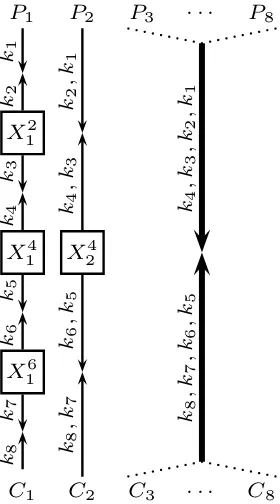
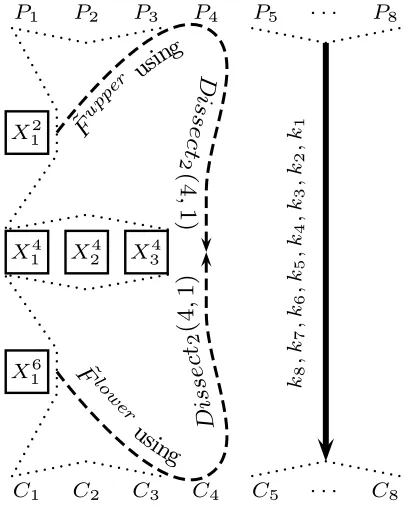
DC algorithm is somewhat involved, we illustrate it by considering the simple case (r = 8, m = 1). In the case of 8-encryption, the goal of the first step in the PCS algorithm is to find partial collisions which comply with the pairs (P1, C1), . . . ,(P4, C4). Given memory of 2n, the average time in which PCS finds
each such collision is 21.5n. TheDC algorithm allows us to achieve the same goal
in 2n average time.
In the DC algorithm, we fix three intermediate values: (X4
1, X24, X34), and
want to attack the subciphers E[1...4] and E[5...8]. Recall that the algorithm
Dissect2(4,1) presented in Section 3 retrieves all 2n values of (k1, k2, k3, k4)
which comply with the pairs (P1, X14),(P2, X24),(P3, X34) in time 22nand memory
2n. Furthermore, given a fixed valueX2
1, there is a single value of (k1, k2, k3, k4)
(on average) which complies with the three plaintext-ciphertext pairs and theX2 1
value, and this value can be found in time 2n(since theDissect
2(4,1) algorithm
starts with guessing the valueX2
1 and then performs only 2noperations for each
guess).
Given plaintexts (P1, P2, P3, P4), their corresponding ciphertexts (C1, C2, C3,
C4), and a guess for (X14, X24, X34):
Define the step functions ˜Fupper and ˜Flower by:
˜
Fupper:X127→X44 and F˜lower:X167→X44.
In order to compute the step function ˜Fupper, apply theDissect
2(4,1) algorithm
toE[1...4]with the plaintext-ciphertext pairs (P
1, X14),(P2, X24),(P3, X34) and the
intermediate valueX2
1 to obtain a unique value of the keys (k1, k2, k3, k4). Then,
partially encryptP4throughE[1...4]with these keys to obtain ˜Fupper(X21) =X44.
The function ˜Flower is computed similarly. The resulting algorithm is given in
Algorithm 8 and depicted in Figure 8.
By the construction of the step functions, each suggested key (k1, . . . , k4)
(or (k5, . . . , k8)) encrypts (P1, P2, P3) to (X14, X24, X34) (or decrypts (C1, C2, C3)
to (X4
1, X24, X34), respectively), and hence, each collision between ˜Fupper and
˜
Flower yields a suggestion of (k
Input: Eight plaintexts (P1, P2, . . . , P8) and their corresponding ciphertexts (C1, C2, . . . , C8)
1: for allcandidate values ofX14, X24, X34do
2: Use PCS to obtain 2ncollisions between ˜Fupperand ˜Flower
3: for allobtained collisionsdo
4: if Ek[1..8]
1,...,k4,k5,...,k8(P5, P6, P7, P8) = (C5, C6, C7, C8)then 5: return k1, . . . , k4, k5, . . . , k8
Algorithm 8: TheDC(8,1) Algorithm
P1 P2 P3 P4 P5 . . . P8
C1 C2 C3 C4 C5 . . . C8
X14 X24 X34
X12
X16
˜
F
upper
us
ing
D
is
se
ct
2
(4
,
1
)
˜
F
low er
usin
g
D
is
se
ct
2
(4
,
1
)
k8
,
k7
,
k6
,
k5
,
k4
,
k3
,
k2
,
k1
Fig. 8: Illustration of theDC(8,1) Algorithm for 8-Encryption
pairs (P1, C1), . . . ,(P4, C4). Since we find 2n collisions in step 1(a), we expect
a collision for each possible value ofX4
4. Thus, once we iterate over the correct
value of (X4
1, X24, X34), we expect a collision on the correct value of X44, which
Since the step functions are fromnbits to nbits, we can find the required 2n partial collisions with 2n invocations using 2n memory in Step 2. By the
properties of the algorithm Dissect2(4,1) mentioned above, the invocation of
the step functions ˜F can be performed in 2n time and memory. Thus, Step
2 requires a total of 22n time, and the total running time of the algorithm is
24n−n·22n= 25n.
We note that while our DC algorithm outperforms the respective PCS al-gorithm (whose time complexity is 25.5n), it has the same performance as the
Dissect4(8,1) algorithm presented in Section 3. However, as we show in the
se-quel, for larger values ofr, theDCalgorithms outperform theDissectalgorithms significantly.
The General DC(r, m) Algorithms We are now ready to give a formal definition of theDC(r, m) class of algorithms, applicable tor-encryption (for an even r),14 given memory of 2mn. An algorithmA∈DC(r, m) is specified by a
numberu, 1≤u≤r/2, and two setsIupper andIlowerof intermediate locations
in the subciphers E[1...r/2] and E[r/2+1...r], respectively, such that |Iupper| =
|Ilower|=r/2−u.
To apply the algorithm, u intermediate values (X1r/2, . . . , X
r/2
u ) are fixed,
and the step functions ˜Fupperand ˜Flower are defined by:
˜
Fupper:Vupper7→(Xur/+12, . . . , X
r/2
r/2), and
˜
Flower:Vlower7→(Xur/+12, . . . , Xr/r/22),
whereVupperandVlowerdenote intermediate values at the locationsIupperand
Ilower, respectively.
The step function ˜Fupper is computed by applying a dissection attack to
E[1...r/2] with the plaintext-ciphertext pairs (P
1, X1r/2), . . . ,(Pu, Xur/2), where
the intermediate values at locations Iupper are fixed to the values Vupper, to
retrieve a unique value of the keys (k1, . . . , kr/2), and then partially encrypting
(Pu+1, . . . , Pr/2) with these keys to obtain (Xur/+12, . . . , X
r/2
r/2). The step
func-tion ˜Flower is computed in a similar way, with respect to E[r/2+1...r] and the
set Ilower. The adversary finds 2mn collisions between ˜Fupper and ˜Flower
us-ing a Hellman-like data structure, where each collision gives a suggestion of (k1, . . . , kr/2, kr/2+1, . . . , kr), complying with the plaintext-ciphertext pairs (P1, C1),
. . . ,(Pr/2, Cr/2). The resulting algorithm is described in Algorithm 9.
Denote the time complexity of each application of ˜F byS = 2sn. An easy computation shows that the overall time complexity of the algorithmDC(r, m) is:
2(r/2)n·2((r/2−u−m)/2)n·2sn= 2((3/4)r−(u+m−2s)/2)n. (4)
14We note that for sake of simplicity, we discuss in this section only even values ofr.