www.ijiset.com
Authenticated Session Tracking Verification for Secure Internet Services
B.Vaishnavi 1, G. Rajeswarappa 2
1
Dept.of CSE, JNTUA, Andhra Pradesh, India, [email protected]
2 Dept.of CSE, JNTUA, Andhra Pradesh, India,[email protected]
Abstract
Session administration in designated web administrations is as a rule in light of username and watchword, express logouts and instruments of individual session lapse using great timeouts. Rising biometric choices empower substituting username and watchword with biometric learning over the span of session establishment, yet in such a procedure still a solitary check is esteemed adequate, and the distinguishing proof of a client is viewed as changeless all through the complete session. Also, the span of the session timeout might simply influence on the convenience of the administration and subsequent client pride. This paper investigates promising conceivable decisions outfitted by method for making utilization of biometrics inside of the administration of sessions. A safe convention is characterized for unending confirmation through ceaseless client check. The convention decides versatile timeouts fixated on the lovely, recurrence and type of biometric data straightforwardly got from the buyer. The sensible conduct of the convention is outlined by means of Mat lab reenactments, even as model headquartered quantitative assessment is actualized to analyze the limit of the convention to qualification security assaults practiced through elite sorts of assailants. At some point or another, the present model for PCs and Android advanced mobile phones is talked about.
Keywords: CASHMA, Authentication, Biometric, Protocol,
Session Management..
1. Introduction
Relaxed consumer authentication is primary in most of today's ICT programs. Person authentication methods are almost always based on pairs of username and password and confirm the identification of the user best at login phase. No assessments are carried out throughout working sessions that are terminated by means of an express logout or expire after an idle activity period of the person. Security of web-founded applications is a significant challenge, due to the up to date develop within the frequency and complexity of cyber-assaults; biometric tactics [10] present emerging solution for at ease and depended on authentication, where username and password are changed by way of biometric knowledge. However, parallel to the spreading utilization of biometric programs, the motivation in their misuse can also be growing,
specifically due to the fact that their feasible utility within the fiscal and banking sectors [2], [1].
Such observations result in arguing that a single authentication point and a single biometric data CANNOT guarantee a ample degree of safety [5], [7]. Actually, in a similar way to typical authentication procedures which depend on username and password, biometric consumer authentication is most likely formulated as a “single shot” [8], providing person verification handiest for the period of login section when one or more biometric qualities is also required. As soon as the person’s identity has been established, the approach assets are on hand for a constant interval of time or unless express logout from the user. This process assumes that a single verification (on the establishing of the session) is ample, and that the identity of the consumer is consistent for the period of the whole session. For instance, we take into account this simple scenario: a user has already logged right into a protection- valuable carrier, after which the consumer leaves the computer unattended within the work subject for a while. This quandary is even trickier within the context of cell instruments, probably used in public and crowded environments, the place the gadget itself can also be misplaced or forcibly stolen at the same time the user session is active, permitting impostors to impersonate the person and access strictly private knowledge. In these situations, the offerings the place the users are authenticated will also be misused conveniently [8], [5]. A basic answer is to make use of very quick session timeouts and periodically request the consumer to enter his/her credentials again and again, but this is not a definitive answer and closely penalizes the carrier usability and finally the pleasure of customers.
1.1 Existing System
www.ijiset.com In existing, a multi-modular biometric
confirmation system is composed and created to see the physical vicinity of the purchaser signed in a PC.
The work in one more present paper, proposes a multi-modular biometric unfaltering validation answer for adjacent access to high-assurance techniques as ATMs, where the uncooked data got are weighted inside of the client check process, set up on i) style of the biometric qualities and ii) time, because of the way that stand-out sensors are prepared to outfit uncooked information with unique timings. Point ii) presents the need of a worldly incorporation strategy which is dictated by the supply of past perceptions: built up on the thought that over the long haul, the intensity inside of the purchased (getting more seasoned) qualities diminishes. The paper applies a decadence perform that measures the instability of the rating processed by means of the check perform.
1.2
Disadvantages of Existing System
None of current strategies underpins constant confirmation.
Rising biometric arrangements permit substituting username and secret word with biometric data amid session establishment, however in such a procedure still a solitary confirmation is esteemed adequate, and the recognizable proof of a customer is viewed as changeless amid the complete session.
2. Proposed System
This paper exhibits a fresh out of the box new strategy for client check and session administration that is used in the using so as to set cognizant assurance various leveled multilevel structures (CASHMA) framework for comfortable biometric validation on the net. CASHMA is proficient to work safely with a net supplier, incorporating administrations with high security needs as internet managing an account offerings, and it is intended to be utilized from outstanding buyer contraptions, e.g., advanced mobile phones, PC PCs and even biometric stands set at the passageway of comfortable regions.
Depending on the inclinations and benchmarks of the proprietor of the online administration, the CASHMA confirmation supplier can supplement a standard verification benefit, or can supplant it. Our unfaltering verification methodology is grounded on evident securing of biometric information and on versatile timeout organization on the preparation of the trust postured in the individual and in the distinctive subsystems utilized for confirmation. The individual session is open and comfortable paying little mind to conceivable unmoving activity of the buyer, in the meantime abilities abuses are distinguished by continually affirming the vicinity of the proper customer.
Our strategy does not require that the response to a man confirmation jumble is finished by the shopper device (e.g., the logout methodology), yet it is straightforwardly treated by method for the CASHMA verification administration and the net offerings, which rehearse there have response frameworks. Gives a tradeoff in the middle of convenience and assurance. To auspicious identify abuses of pc assets and deflect that an unapproved client noxiously replaces an approved one, choices set up on multi-modular biometric enduring validation [5] are proposed, transforming client confirmation directly into an unfaltering system instead of an onetime predominance [8]. To keep that a solitary biometric quality is produced, biometrics verification can depend on more than one biometrics attributes. Eventually, the utilization of biometric verification permits accreditations to be gotten straightforwardly, i.e., without unequivocally telling the individual or requiring his/her transaction, which is major to confirmation higher administration ease of use. We show a few illustrations of evident obtaining of biometric data. Face can likewise be got even as the individual is situated in passageway of the advanced, however not intentionally for the obtaining of the biometric information; e.g., the client could likewise be perusing a literary SMS or watching a film on the cell phone. Voice can be purchased when the buyer talks on the cell telephone or with other individuals close-by if the receiver interminably catches recorded past. Keystroke information might likewise be gained every time the customer sorts on the console, for representation, when composing a SMS, visiting, or seeking on the web. This methodology separates from customary confirmation procedures, where username/secret word are asked for just when at login time or unequivocally required at attestation steps; such typical verification strategies hinder ease of use for more grounded security, and present no arrangements against imitation or taking of passwords.
www.ijiset.com
multilevel designs (CASHMA) [1]) approach for comfortable biometric verification on the web. CASHMA is able to work safely with any assortment of web bearers, together with administrations with extreme security needs as internet managing account administrations, and it's intended to be utilized from stand-out buyer contraptions, e.g., PDAs, tablet PCs or even biometric booths situated at the passageway of loose ranges. Depending on the inclinations and prerequisites of the proprietor of the net supplier, the CASHMA verification administration can supplement a normal validation supplier, or can substitute it. The methodology we presented in CASHMA for usable and very agreeable client classes is a nonstop consecutive (a solitary biometric methodology specifically is introduced to the system [2]) multi-modular biometric confirmation convention, which adaptively processes and revives session timeouts on the preparation of the trust put inside of the client. Such worldwide trust is assessed as a numeric worth, processed with the guide of reliably assessing the trust each inside of the purchaser and the (biometric) subsystems utilized for getting biometric information. In the CASHMA connection, every subsystem contains the whole equipment/program variables quintessential to collect and confirm the realness of one biometric characteristic, together with sensors, appraisal calculations and the greater part of the enhancements for information transmission and administration. Trust inside of the individual is settled on the preparation of recurrence of upgrades of new biometric tests, in the meantime have faith in each subsystem is registered on the establishment of the lovely and assortment of sensors utilized for the securing of biometric tests, and on the peril of the subsystem to be meddled.
3. System Architecture
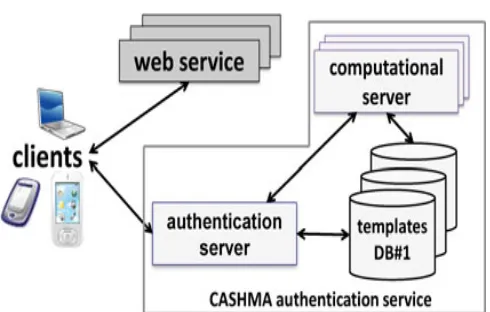
Fig. 1 General perspective of the CASHMA engineering.
The general methodology comprises of the CASHMA validation supplier, the clients and the web offerings (Fig. 1), related by means of verbal trade channels. Each dispatch direct in Fig. 1 executes particular efforts to establish safety which are not examined right here for curtness.
The CASHMA confirmation supplier involves: i) a validation server, which associates with the clients, ii) an accumulation of high-performing computational servers that perform examinations of biometric data for check of the selected clients, and iii) databases of formats that contain the biometric layouts of the enlisted clients (these are required for shopper validation/check). The net administrations are the considerable amount of administrations that utilization the CASHMA confirmation bearer and interest the verification of enlisted clients to the CASHMA validation server. These offerings are most likely any style of web supplier or application with necessities on purchaser realness. They must be enlisted to the CASHMA confirmation bearer, communicating additionally their trust edge. In the event that the online offerings receive the ceaseless confirmation convention, over the span of the enrollment approach they should concur with the CASHMA enlistment authoritative focus on qualities for parameters h; alright and s.
Eventually, by method for customers we infer the clients' gadgets (desktop and portable workstation PCs, advanced cells, tablet, and so on.) that gather the biometric learning (the uncooked data) like the a considerable amount of biometric characteristics from the clients, and transmit these data to the CASHMA confirmation server as a part of the verification technique toward the objective web administration. A customer incorporates i) sensors to aggregate the crude information, and ii) the CASHMA utility which transmits the biometric learning to the verification server. The CASHMA confirmation server endeavors such information to utilize individual validation and progressive check methodologies that contrast the crude learning and the put away biometric layouts.
www.ijiset.com
aftereffect of the obtaining of information from the surrounding environment as, for instance, voice of men and ladies neighborhood the CASHMA shopper, yet are considered out of extension for this paper.
4. The Continuous Authentication Protocol
The consistent verification convention makes it feasible for conveying versatile session timeouts to a web supplier to snare and save a protected session with a supporter. The timeout is customized on the establishment of the trust that the CASHMA verification technique places in the biometric subsystems and inside of the client. The proposed convention requires a consecutive multi-modular biometric technique made out of n unmoral biometric subsystems that can go to a choice freely on the legitimacy of a purchaser. Case in point, these subsystems might likewise be one subsystem for keystroke acknowledgment and one for face cognizance. The execution of the convention comprises of two back to back stages: the preparatory segment and the upkeep segment. The preparatory area means to validate the client into the methodology and set up the session with the net transporter. Over the span of the protection segment, the session timeout is adaptively upgraded when client distinguishing proof confirmation is completed utilizing contemporary crude information outfitted by method for the purchaser to the CASHMA verification server.
4.1 Authentication Phase
Fig.2.Initial phase in case of successful user authentication.
This segment is structured as follows:
The user (the patron) contacts the net service for a provider request; the online carrier replies that a legitimate certificate from the CASHMA
authentication carrier is required for authentication.
Utilizing the CASHMA application, the patron contacts the CASHMA authentication server. The first step consists in obtaining and sending at time t0 the info for the different biometric characteristics, above all chosen to perform a strong authentication method (step 1). The appliance explicitly shows to the user the biometric characteristics to be furnished and viable retries.
The CASHMA authentication server analyzes the biometric data bought and performs an authentication approach. Two unique potentialities arise right here. If the consumer identity shouldn't be demonstrated (the global believe stage is under the believe threshold gmin), new or further biometric knowledge are requested (back to step 1) except the minimum believe threshold gmin is reached. Alternatively if the user identity is successfully verified, the CASHMA authentication server authenticates the user, computes an initial timeout of length T0 for the user session, set the expiration time at T0 +t0, creates the CASHMA certificates and sends it to the purchaser (step 2).
The patron forwards the CASHMA certificates to the web carrier (step 3) coupling it with its request.
The online carrier reads the certificate and authorizes the customer to make use of the requested provider (step 4) unless time t0 + T0. For readability, steps 1-4 are represented in Fig. 2
for the case of triumphant consumer verification simples.
4.2 Maintenance Phase
www.ijiset.com
It is made out of three stages rehashed iteratively:
When at time ti the client programming gets late (new) crude data (comparing to no less than one biometric quality), it conveys them to the CASHMA confirmation server (step 5). The biometric data might likewise be obtained straightforwardly to the client; the client might simply regardless go to a choice to outfit biometric information which are far-fetched got in a straightforward way (e.g., unique mark). At last when the session timeout goes to lapse, the supporter could unequivocally inform to the shopper that contemporary biometric information is needed.
The CASHMA verification server gets the biometric data from the purchaser and confirms the character of the client. On the off chance that check shouldn't be successful, the individual is set apart as not legitimate, and thus the CASHMA confirmation server does not capacity to revive the session timeout. This doesn't recommend that the client is diminishing off from the present session: if distinctive biometric data is outfitted sooner than the timeout terminates, it's still practical to get a fresh out of the plastic new authentication and revive the timeout. On the off chance that check is triumphant, the CASHMA verification server applies the calculation indicated to some extent to adaptively process another timeout of size Ti, the termination time of the session at time Ti + ti after which it makes and sends a shiny new declarations to the buyer (step 6).
The client gets the endorsements and advances it to the web supplier; the online supplier peruses the testaments.
The progressions of the redesign portion are spoken to in Fig.3 for the instance of powerful individual confirmation (step 6b).
5. Literature Survey
5.1 Study about Continuous Verification Using
Multimodal Biometrics
In this paper we portray a framework that constantly checks the vicinity/investment of a signed in client. This is finished by coordinating multimodal aloof biometrics in a Bayesian system that consolidates both worldly and methodology data comprehensively, as opposed to consecutively. This permits our framework to yield the likelihood that the client is still present notwithstanding
when there is no perception. Our execution of the constant confirmation framework is conveyed also, extensible, so it is anything but difficult to connect to extra no concurrent modalities, notwithstanding when they are remotely created. In light of genuine information coming about because of our execution, we observe the outcomes to be promising.
5.2 Study about Continuous Temporal Integration for
Continuous Multimodal Biometrics
Regularly, biometric frameworks validate the client at a specific minute in time, conceding or denying access to assets for the complete session. This model of validation does not fittingly address situations where an alternate individual might assume control over a framework from the first client (either eagerly or something else). We propose a multimodal framework that performs confirmation consistently by incorporating data transiently and in addition crosswise over modalities. Such constant confirmation gives continuous (instead of onetime) confirmation and can without much of a stretch be combined with another framework for powerfully changing access to benefits likewise. We introduce a starting methodology for worldly joining taking into account instability spread after some time for assessing channel yield conveyance from later history, and characterization with instability. Our strategy works ceaselessly by processing expected qualities as an element of time contrasts. Our preparatory tests demonstrate that fleeting data progresses verification precision. These observational results are promising and legitimize further examination.
6. Simulated Result
www.ijiset.com
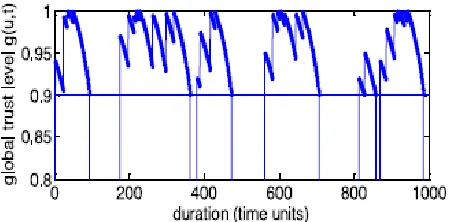
Fig. Global believe degree and forty authentications for a carrier with excessive security standards.
7. Conclusion
The reproduced consequence of Protection dangers to the CASHMA strategy have been broke down both for the enlistment approach (i.e., introductory enrollment of a man inside of the methodology), and the verification approach itself. We record here just on validation. The biometric framework has been considered as decayed in capacities from [10]. For verification, we considered accumulation of biometric elements, transmission of (crude) information, components extraction, coordinating perform, format hunt and archive organization, transmission of the coordinating positioning, determination work, verbal trade of the mindfulness results (take conveyance of/reject determination).
References
[1] CASHMA-Context Aware Security by Hierarchical Multilevel Architectures, MIUR FIRB, 2005.
[2] L. Hong, A. Jain, and S. Pankanti, “Can Multibiometrics Improve Performance?” Proc. Workshop on Automatic Identification Advances Technologies (AutoID ’99) Summit, pp. 59-64, 1999.
[3] S. Ojala, J. Keinanen, and J. Skytta, “Wearable Authentication Device for Transparent Login in Nomadic Applications Environment,” Proc. Second Int’l Conf. Signals, Circuits and Systems (SCS ’08), pp. 1-6, Nov. 2008.
[4] BioID “Biometric Authentication as a Service (BaaS),” BioID Press Release, https://www.bioid.com, Mar. 2011.
[5] T. Sim, S. Zhang, R. Janakiraman, and S. Kumar, “Continuous Verification Using Multimodal Biometrics,” IEEE Trans. Pattern Analysis and Machine Intelligence, vol. 29, no. 4, pp. 687-700, Apr. 2007.
[6] L. Montecchi, P. Lollini, A. Bondavalli, and E. La Mattina, “Quantitative Security Evaluation of a Multi-Biometric Authentication System,” Proc. Int’l Conf. Computer Safety, Reliability and Security, pp. 209-221, 2012.
[7] S. Kumar, T. Sim, R. Janakiraman, and S. Zhang, “Using Continuous Biometric Verification to Protect Interactive Login
Sessions,” Proc. 21st Ann. Computer Security Applications Conf. (ACSAC ’05), pp. 441-450, 2005.
[8] A. Altinok and M. Turk, “Temporal Integration for Continuous Multimodal Biometrics,” Proc. Workshop Multimodal User Authentication, pp. 11-12, 2003.
[9] C. Roberts, “Biometric Attack Vectors and Defences,” Computers & Security, vol. 26, no. 1, pp. 14-25, 2007.
[10] S.Z. Li and A.K. Jain, Encyclopedia of Biometrics. first ed., Springer, 2009.
B.Vaishnavi received the B.Tech Degree in Computer Science and Engineering from Vaishnavi Institute of Technology for Women, JNTUA in 2014. She is currently working towards the Master’s Degree in Computer Science and Engineering, in Sri Venkateswara Engineering College for Women, JNTUA. She interest lies in the areas of Web Development Platforms, SQL, and Cloud Computing Technology.