Online Active Noise Control System Design
and Implementation
B.Muthukumaran1, N.Jayakandhan2
Assistant Professor, Dept. of ECE, SRM University, Kattankulathur, Chennai, Tamilnadu, India1
PG Student [Embedded], Dept. of ECE, SRM University Kattankulathur, Chennai, Tamilnadu, India2
ABSTRACT: In modern years, noise related disputes caused by construction tools, Operating heavy machines and electric train in automotive have been increasing, resultant to delays and heavy budget in the manufacturing or construction progress and automobile car-in cabin case. This leads to severe vulnerabilities, health problems to neighboring residents in construction surrounding, health problems for Labors in an industrial unit and environmental pollution as well. The causes of the above issues to deal with passive noise control approaches such as acoustic materials, enclosures and sound proof barriers have been broadly used. Though those passive approaches have a narrow outcome when used to attenuate low frequency noise band.
The primary objective of this project is to propose a new methodology for low cost and high performance Active Noise Control (ANC) system to enhance the constraint, here the online or real time Active Noise Control System constructs by using ARM CORTEX M3 controller with inbuilt high speed Analog to Digital (A/D) converter and Digital to Analog (D/A) converter.
The concern noise level is measured by the microphone, acquired signal converted into the digital controller will generate an opposite phase signal, which will feed into the dynamic loud speaker and it will control the closed loop. Root locus analysis of the adaptation process performed in online active noise control.
KEYWORDS: Active Noise Control, Root Locus, ARM CORTEX M3, ANC, DAQ System.
I.INTRODUCTION
Basedon research the proposed system is an active noise controlin the construction process. Active Noise Control is an alternative for passive noise control, by estimating the traditional noise management efforts and their associated problems.Resulting the series of researches on the construction noise disputes active noise management model ANC issuggested, so the acoustic and damage produced by the construction equipment is reduced.The system contains dB measurement unit at both ends, electric microphone to measure the primary noise produced by construction area the absorbed noise is the input of the microcontroller and its phase shift the primary noise with 180 degrees, the addition of primary noise and phase shift noise to be cancelled and the silence will be produced and measured by the dynamic loudspeaker. The system can measure the input noise and output noise in dB to confirm the noise reduction.
The paper is organized as different section such as the System Frame Work for noise cancellation theory, hardware and circuit design, experimental results and validation are presented. Final section concludes the paper.
II.EXISTING SYSTEM AND LIMITATION
In the Current System, the machinery operators in factory, heavy machine operators in construction site and workers in heavy machinery running environment used to wear “ANC headphones” to avoid the damage caused to humans in heavy noise generation environments that leads to increasing of over cost in construction site and factories. But the generated acoustic noise might affect the people other than operators those who are working on construction sites. The efficiency of the manpower also decreases significantly. For its solution, a specially designed system is proposed, which is to be installed at the construction site or near to machinery operators who are exposed to sounds of SPL >90dB. This headphone will be devised in a special manner to allow only the human voice to reach the ears. So as to filter out all the sounds having frequencies outside the human audible frequency range and will cancel out the undesired noise within human audible range. The basic principles behind the headphone are Active Noise Cancellation to cancel out the undesired noise within the audible frequency range and a Band pass filter to filter out noise which are outside the human audible frequency range. The noise dose of the operators handling noisy equipment, e.g., vibrating screens, pay loaders, mine exhaust fans, drills, dumpers, Dozers, compressors, etc. were observed to be quite high.
Limitations are of noise related clashes caused by construction equipment have increased, resulting in delays and cost overruns in the construction process. Heavy noise leads to hazards, serious health problems for workers in factory. Automotive industry facing Noise, Vibration and Harshness (NVH), sound quality is very important to customers. LMS Algorithm widely adopted in ANC for relatively stationary disturbance (Stationary sinusoidal or Stochastic white noise environment).
III. SYSTEM FRAMEWORK Theory of ANC Basics
Destructive interference to be used for the concept of noise cancellation. During the sinusoidal wave and opposite phase of that sinusoidal wave overlays, this result depending on the frequency, amplitude and relative phase of the two waves. If the primary wave and the inverse of the primary wave come across at a junction at the same time, occurs the total cancellation. The identified original signal and generate the inverse without delay in all directions are the challenges where noises interaction and superimpose. Most importantly, ANC can block selectively. ANC is developing rapidly because it authorizes perfections in noise control, often with potential benefits in size, weight, volume, and cost. Blocking low frequency has the priority since most acoustic noises are under 1 KHz, for example excavator noise or noise from the compressor. This mainly led us to focus our project on low frequency noise cancellation.
Algorithm
The specific objective of this paper is to conduct a root locus analysis of the FxLMS algorithm for repetitive impulses without any simplification for the secondary path. The main contributions can be summarized as: Building an equivalent transfer function of the FxLMS algorithm for repetitive impulses, and a numerical solution for the root locus analysis is given, and deriving an explicit formula of the maximum step size for the stability of the FxLMS algorithm for a pure delay secondary path. Extensive numerical simulations were conducted to validate the accuracy of the theoretical analysis.
Fig2. Feed forward control diagram configured with fxLMS algorithm.
Fig2 shows the representation of control diagram is the common feed forward control configured with the FxLMS algorithm, where the reference signal, is the primary noise, and error signals after superposition of the primary noise and secondary cancelling noise. The secondary transfer path (electroacoustic dynamics from the control speaker to the error microphone) model S (z) can be estimated by using an online or offline system identification method.
The output signal, error signal, and the filter weight update equation of the fxLMS algorithm are summarized respectively as,
y(n) = W(n)T *X(n) (1)
e(n) = d(n)-y’(n) (2)
W(n+1) = W(n)+µe(n)[s^(n)*X(n)] (3)
Proposed System block diagram
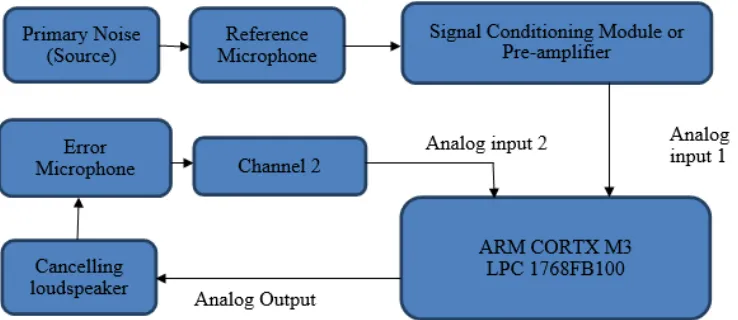
Fig 3. Block Diagram of Active Noise Control System
In the fig3, the ANC system consists of four modules: a reference microphone, a controller, a loudspeaker, and an error microphone. The purposes of each module in the system are as follows:
Reference microphone—records the noise to be revoked, and pass on the measured noise signals to the controller. Control system: This system generates a signal with the reverse phase and the similar amplitude by processing the noise signal sent from the error sensors and microphones, and spreads the signal to the control speaker.
Control speaker: This component serves to produce a sinusoidal wave to revoke construction noise in response to the signal processed by the controller.
Error sensor: This sensor evaluates whether the noise was cancelled successfully. If noise cancellation is insufficient, the controller received the measured error signal transmission from error sensor, and the signal is modified to improve the cancellation effect.
In the ANC system, the arrangement of the system’s modules for noise management has a significant effect on the performance of the system. Therefore, it is important to determine an appropriate placement pattern so as to enhance the noise elimination effect. This consists of modifying the positioning of the microphones, the control speakers, and the error sensors First, to cancel noise effectively, it is desirable that the noise generated by construction equipment and the control source released from the speaker have dependability. However, maintaining consistency between noise sources at a construction site can be challenging, as more noise sources may cause noise-related disputes. Moreover, construction activities are conducted usually over wide areas. Therefore, it is effective to minimize the distance between the control source and the noise source by installing the control source at a location close to the equipment. Second, the amounts of the noise source and the control source must be balanced. If the processed control source is greater than the noise source caused by the construction equipment, the noise reduction effect occurs in only certain areas, follow-on in a limit to reduce the sound pressure in construction areas. For comparison, if the control source is too large compared with the noise source, the sound pressure level can increase for the reason of that constructive interference. Therefore, an environmental manager needs to fine-tune the amounts of sources to progress the noise effect when the active noise control is applied.
IV.HARDWARE CIRCUIT DESIGN
The project will be using various hardware circuits are as a noise measurement circuit, ARM CORTEX M3 (LPC1768 Microcontroller) Processor circuit (converting the measured noise to opposite noise from the total noise is being neutralized), and noise cancellation circuit. In this section we will see about the noise measurement and noise cancellation circuit.
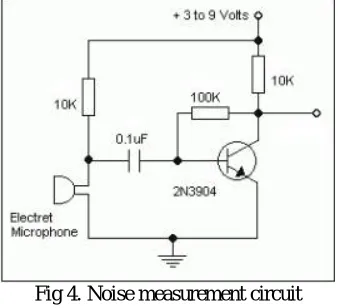
Fig 4. Noise measurement circuit
In the Fig 4. Shows the noise measurement circuit which is used to measure primary noise from Electret microphone and the measured noise is to be fed into the DAQ system.
Fig 5. Noise cancellation circuit
In the Fig 5. Shows the Noise Cancellation Circuit,Whichreceives the opposite phase noisegenerated from DAQ System and feed into speaker for the noise to be cancelled.
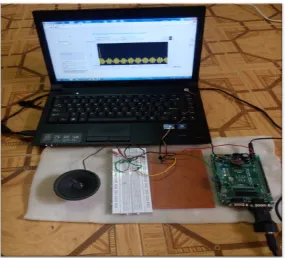
Fig 6. Complete Setup of Single channel ANC system
V. SOFTWARE TOOL
The project utilizes labVIEW software because of its graphical programming feasibility, so that user can drag the controls and build the block diagram of our requirement in block diagram window. The purpose of this labVIEWwas to get familiar with the functions and limitations ofanalog-to-digital converters (ADC) and digital-to-analog convertors (DAC). In fig 7,a labVIEWprogram was written that would utilize the DAQ's DAC in order to create an analog signal using labVIEW, then an ADC was built using the built in DAC of the DAQ. The advantages are to reduce test costs and improve measurements.
Fig 7. Block Diagram of ANC system in LabVIEW
VI. EXPERIMENTAL RESULTS AND VALIDATION
In the fig 8, it shows the graph of time Vs amplitude of generic form of analog sinusoidal wave produced from frequency generator and observed by the microphone.
Fig 8. Shows the sinusoidal wave as primary noise produced from signal generator.
In the fig 9, it shows the graph of time Vs amplitude of generic form of analog sinusoidal noise and the anti-noise, the signal in green color or at the upper graph is sine wave and the signal in red color or at the lower graph is the opposite phase of sine wave.
Fig 9. Shows the concept of sinusoidal noise and anti-noise of sinusoidal wave.
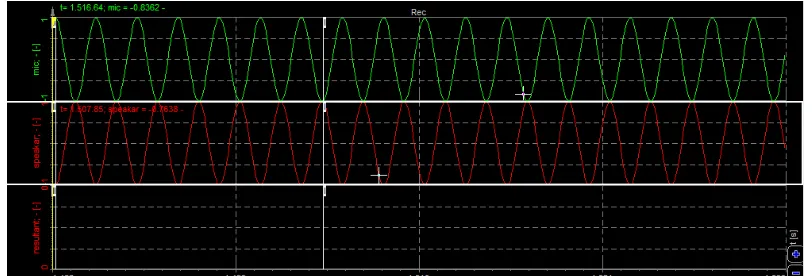
In the fig 10, it shows the graph of time Vs amplitude of theoretical form of ANC system which consists of analog sinusoidal noise, analog anti-noise of sinusoidal signal and cancelled noise. Here we cannot observe the cancelled noise because of neutralization.
In the fig 11, it shows the graph of time Vs amplitude of real time ANC system which consists of primary noise, anti-noise of primary anti-noise and cancelled anti-noise. Here we can observe the cancelled anti-noise because in real time ANC does not cancel the whole noise because of few seconds time delay to generate anti-noise.
Fig 11. Shows the real time noise cancellation by the superposition of noise and anti-noise being cancelled.
VII.CONCLUSION
Thus an active noise control management model was suggested for construction site, so that simulation to assess the applicability of the ANC was conducted. For the noise cancellation, low frequency bands less than 1000Hz were found to be efficient in the simulations. However the frequency increased then noise cancelling to be declined. The project suggested a process model and possibility of the site application on ANC as a measure to supplement the current limited passive noise control used throughout construction. Moreover, noise management using ANC can contribute not only to attenuating the noise produced by construction sites, but also to reducing adverse effects such as project delays and compensation payments.
REFERENCES
[1] Nahyun Kwon, Moonseo Park, Hyun-Soo Lee, Joseph Ahn and Mingyu Shin “Construction Noise Management Using Active Noise Control Techniques”, ASME Transactions on Journal of Construction Engineering and Management, vol.1, pp. 1-11, 2016
[2] Guohua Sun, Kingfeng Li, TeikC.Lim “Root Locus Analysis of the Adaptation Process in Active Noise Control for Repetitive Impulses”, ASME Transactions on Journal of Dynamic Systems, Measurement and Control, vol.138, pp.1-12, 2016.
[3] ThiloBein, Sven Herold, Dirk Mayer “Recent advances in active noise and vibration control” EuroNoise 2015 conference held in Fraunofer LBF, Division Adaptronics, Darmstadt, Germany, vol.1, pp. 2195-2200, 2015.
[4] JieDuan, Mingfeng Li, TeikC.Lim, Mig-Ran Lee, Ming-Te Chang, Wayne Vanhaaften, Takeshi Abe “A Computationally Efficient Multichannel Active Road Noise Control System” ”, ASME Transactions on Journal of Dynamic Systems, Measurement and Control, vol.137, pp.1-7, 2015.
[5] Walter J Kozacky and TokunboOgunfunmi “An active noise control algorithm with gain and power constraints on the adaptive filter” Springer Transactions on Journal on Advances in signal processing held in USA, vol.1, pp-1-12, 2013.
[6] E. Y. KIM, B. H. KIM and S. K. LEE “ACTIVE NOISE CONTROL IN A DUCT SYSTEM BASED ON A FREQUENCY-ESTIMATION
ALGORITHM AND THE FX-LMS ALGORITHM”, Conference of International journal of Automotive Technology, vol.14, no.2, pp.291-299, 2013.
[7] J. H. PARK and S. K. LEE “A NOVEL ADAPTIVE ALGORITHM WITH AN IIR FILTER AND A VARIABLE STEP SIZE FOR ACTIVE
NOISE CONTROL IN A SHORT DUCT”, Conference of International journal of Automotive Technology, vol.13, no.2, pp.223-229, 2012 [8] S. Pavithra, S. V. Narasimhan, “Feedback active noise control based on forward–backward LMS predictor”, Springer -Verlag London limited,
vol.1, pp.1-9, 2012.