Multi-Valued Byzantine Broadcast: the
t < n
Case
Anonymous submission
Abstract. Byzantine broadcast is a distributed primitive that allows a specific party to consistently distribute a message amongn parties in the presence of po-tential misbehavior of up to t of the parties. All known protocols implementing broadcast of an `-bit message from point-to-point channels tolerating anyt < n
Byzantine corruptions have communication complexity at least Ω(`n2). In this paper we give cryptographically secure and information-theoretically secure pro-tocols for t < n that communicate O(`n) bits when ` is sufficiently large. This matches the optimal communication complexity bound for any protocol allowing to broadcast `-bit messages. While broadcast protocols with the optimal com-munication complexity exist for t < n/2, this paper is the first to present such protocols for t < n.
1 Introduction
1.1 Byzantine Broadcast
The Byzantine broadcast problem (aka Byzantine generals) is stated as follows [PSL80]: A specific party (the sender) wants to distribute a message amongnparties in such a way that all correct parties obtain the same message, even when some of the parties are malicious. The malicious misbehavior is modeled by a central adversary who corrupts up totparties and takes full control of their actions. Corrupted parties are calledByzantine and the remaining parties are calledcorrect. Broadcast requires that all correct parties agree on the same valuev, and if the sender is correct, thenvis the value proposed by the sender. Broadcast is one of the most fundamental primitives in distributed computing. It is used to implement various protocols like voting, bidding, collective contract signing, etc. Basically, this list can be continued with all protocols for secure multi-party computation as defined by Yao [Yao82, GMW87].
There exist various implementations of Byzantine broadcast from synchronous point-to-point communication channels with different security guarantees. In the model without trusted setup, perfectly-secure Byzantine broadcast is achievable when t < n/3 [PSL80, BGP92, CW92]. In the model with trusted setup, cryptographically or information-theoretically secure Byzantine broadcast is achievable for anyt < n[DS83, PW96].
Closely related to the broadcast problem is the consensus problem. In consensus each party holds a value as input, and then parties agree on a common value as output of consensus. In this paper we consider the case where any number of parties may be Byzantine. In this case the consensus problem is not well-defined, and hence we do not treat it here.
1.2 Efficiency of Byzantine Broadcast
In this paper we focus on the efficiency of broadcast protocols. In particular, we are interested in optimizing their communication complexity. The communication complexity of a protocol is defined by Yao [Yao79] to be the number of bits sent/received by correct parties during the protocol run.1
Historically, the broadcast problem was introduced for binary values [PSL80]. However, in various applications long values are broadcast rather than bits. Examples of such appli-cations are general purpose multi-party computation protocols and specific tasks like voting. Such a broadcast of long values is calledmulti-valued broadcast. In this paper we study the communication complexity of multi-valued broadcast protocols.
Many known protocols for multi-valued broadcast [TC84, FH06, LV11, Pat11] are actually constructionsfrom a broadcast of short messages and point-to-point channels. Communication complexity of such constructions is computed in terms of the point-to-point channels and the broadcast for short messages usage. The security of the protocol is based on the security of the construction and the security of the broadcast for short messages.
Let us denote the communication complexity of a short s-bit message broadcast with B(s). The most trivial construction is to broadcast the message bit by bit, which is perfectly secure for t < n and has communication complexity `B(1). The construction by Turpin and Coan [TC84] is perfectly secure and toleratest < n/3 while communicating O(`n2+nB(1))
1
bits. The construction by Fitzi and Hirt [FH06] is information-theoretically secure and toler-atest < n/2 while communicatingO(`n+n3κ+nB(n+κ)) bits, whereκ denotes a security parameter. The construction by Liang and Vaidya [LV11] is perfectly secure and tolerates
t < n/3 while communicatingO(`n+√`n2B(1) +n4B(1)) bits. This construction can even be extended to tolerate more than n/3 corruptions [LV11]. However, the extended protocol in-herently requirest < n/2 (see Appendix A for the details). The construction by Patra [Pat11] is perfectly secure and toleratest < n/3 while communicating O(`n+n2B(1)) bits.
In this paper we consider the case where t < n. In this model existing protocols [DS83, PW96] were designed to broadcast bits, but they can be easily adopted to broadcast long messages. A simple modification of the protocol by Dolev and Strong [DS83] is cryptograph-ically secure and has communication complexityΩ(`n2+n3κ). Analogously, the protocol by Pfitzmann and Waidner [PW96] is information-theoretically secure and has communication complexityΩ(`n2+n6κ) [Fit03]. Also the protocols of [HMR14] can be seen as multi-valued constructions fort < n. However, their resulting communication complexity is Ω(`n3).
Another measure of protocol efficiency often considered is round complexity. There are two principal classes of protocols with respect to this measure: constant-round and non-constant round. In the model without trusted setup, constant-round binary Byzantine broadcast is achievable when t < n/3 [FM88]. In the model where public-key infrastructure (PKI) has been set up via a trusted party, constant-round binary Byzantine broadcast is achievable for
t < n/2 [KK06], but is not achievable for t < n[GKKO07].
1.3 Contributions
Consider any protocol for multi-valued broadcast. Since each correct player must learn the value proposed by the sender, the communication costs of the broadcast protocol must be at least O(`n). In this paper we give two generic constructions for a multi-valued broadcast which allow to achieve optimal communication complexity ofO(`n) bits for t < n. The first construction is cryptographically secure and communicatesO(`n+n(B(κ) +nB(1))) bits. The second construction is information-theoretically secure and communicatesO(`n+n3(B(κ) +
nB(1))) bits. The constructions takeO(n2) andO(n3) rounds, respectively. The following table summarizes the complexity costs of the existing constructions for multi-valued broadcast:2
Threshold Security Bits Communicated Literature
t < n/3 perfect
O(`n2+nB(1)) [TC84]
O(`n+ (√`n2+n4)B(1)) [LV11]
O(`n+n2B(1)) [Pat11]
t < n/2 inf.-theor. O(`n+n3κ+ (n2+nκ)B(1)) [FH06]
t < n
perfect `B(1) Trivial
inf.-theor. O(`n+ (n4+n3κ)B(1)) This paper
cryptographical O(`n+ (n2+nκ)B(1)) This paper
In order to obtain a concrete protocol for multi-valued broadcast one takes the above con-structions and composes them with the existing protocols for a bit broadcast (e.g., [BGP92,
2
DS83,PW96]). The security of the composed protocol is then the “minimal” security provided by the construction and the bit broadcast protocol employed. For example, when composing information-theoretical construction fort < n/2 [FH06] with cryptographically secure proto-col for t < n [DS83] we obtain multi-valued broadcast protocol with cryptographic security toleratingt < n/2 and communication complexity O(`n+n4(n+κ)). Further instantiations are described in the following table:
Threshold Security Bits Communicated Literature
t < n/3 perfect
O(`n2
) Trivial with [BGP92]
O(`n+√`n4+n6) [LV11] with [BGP92]
O(`n+n4) [Pat11] with [BGP92]
t < n/2 inf.-theor. O(`n+n
7κ) [FH06] with [PW96]
cryptographical O(`n+n4(n+κ)) [FH06] with [DS83]
t < n
inf.-theor. Ω(`n
2
+n6κ) [PW96]
O(`n+n10κ) This with [PW96]
cryptographical Ω(`n
2+n3κ) [DS83]
O(`n+n5κ) This with [DS83]
We note that all multi-valued constructions are onlyasymptotically optimal in`, i.e., they only outperform the trivial construction when relatively long messages are broadcast. Such long messages appear, for example, in voting protocols [CGS97] (where the set of authorities agree on the set of ballots), or in multi-party computation protocols [GMW87] (when all gates on a particular level of the circuit are evaluated in parallel). In particular, multi-party computation protocols for t < n (e.g., [AJLA+12, GGHR14]) achieve better communication complexity when combined with the broadcast constructions presented in this paper.
Furthermore, we investigate the round complexity of constructions for multi-valued broad-cast. While for the case oft < n/2 constant-round constructions exist (e.g., [FH06]), we prove that in the settings with t < n constant-round constructions do not exist.3 This is a gen-eralization of the impossibility result given in [GKKO07], because the underlying broadcast procedure for small messages can be used to distribute PKI (by letting the parties broadcast their public keys) and hence PKI cannot be sufficient to implement broadcast in a constant number of rounds.
2 Model and Definitions
Parties.We consider a setting consisting ofn parties (players) P ={P1, . . . , Pn} with some
designated party called the sender, which we denote with Ps for some s∈ {1, . . . , n}. For a
set of parties A ⊆ P let A denote P \A. We assume that the parties are connected with a synchronous authentic point-to-point network. Synchronous means that all parties share a common clock and that the message delay in the network is bounded by a constant.
Broadcast definition. A broadcast protocol allows the sender Ps to distribute a value vs
among partiesP such that: 3
Termination: Every correct partyPi ∈ P terminates.
Consistency: All correct parties inP decide on the same value.
Validity: If the sender Ps is correct, then every correct party Pi ∈ P decides on the value
proposed by the sendervi =vs.
Adversary.The faultiness of parties is modeled in terms of a central adversary corrupting up tot < nparties, making them deviate from the protocol in any desired manner. We distinguish two types of security in this paper: cryptographic and information-theoretic. Cryptographic security guarantees that the protocol is secure based on some computational assumptions (e.g., signatures and/or collision-resistant hash functions), while information-theoretical (also called statistical) security captures the fact that even a computationally unbounded adversary cannot violate the security of the protocol with a non-negligible probability.
3 Protocols Overview
We present cryptographically and information-theoretically secure constructions for multi-valued broadcast. Both constructions are built over point-to-point channels and an oracle for broadcasting short messages. When describing protocols we often say that players broadcast messages, while meaning that they actually use the given broadcast oracle.
On the highest level both constructions broadcast the long message block by block, where each block is broadcast using a special protocol for block broadcast. This block broadcast protocol achieves optimal communication complexity only in good executions, while in bad executions more bits need to be communicated. We select the number of blocks in such a way that good executions outnumber bad ones and the total communication complexity is optimal. Whether an execution is good or bad is determined using theDispute Control Frame-work [BH06]. Dispute control is a technique which keeps track of disputes (also called con-flicts) between players and ensures that occurred disputes cannot show up again. Intuitively, an execution is good if it is dispute-free, and bad otherwise.
We employ the dispute control framework as follows. We consider a set of unordered pairs of parties∆, where{Pi, Pj} ∈∆represents the fact that parties Pi andPj accuse each other
of being Byzantine. Parties start a protocol by setting ∆ to be the empty set. Then during the protocol run they add new disputes to ∆ when they learn about new accusations. We ensure that ∆ always remains valid, meaning that if {Pi, Pj} ∈ ∆ then at least one of the
playersPi, Pj is Byzantine.
4 Cryptographically Secure Construction
First, we present a protocol CryptoBlockBCfor broadcasting blocks. CryptoBlockBC makes use of an external procedure for broadcasting short values and a set of disputes∆. Then we plug CryptoBlockBCin the protocol CryptoBC, which broadcasts an `-bit message block by blockq times. In each invocation of CryptoBlockBC we will use the same global variable ∆
with the disputes among the players. This means that if parties Pi and Pj conflict during
4.1 Block Broadcast Protocol CryptoBlockBC
The protocol CryptoBlockBC employs a collision-resistant hash function CRHash, i.e., no efficient algorithm can find two different inputsv, v0 with CRHash(v) =CRHash(v0).4 In the beginning of the protocol the sender broadcasts a hashh=CRHash(vs) of the value it holds.
The goal of the protocol is to ensure that all correct players learn vs. All parties during the
protocol run are divided into two sets: H and H. The set H consists of happy players who have already learnedvs, andH who have not. At each iteration of CryptoBlockBCwe try to
move a player fromH toH. We select a pair of playersPx, Py such thatPx∈H andPy ∈H.
ThenPx sends the value it holds toPy. This procedure is meaningless if partiesPx, Py are in
the dispute, so the pair is chosen such that{Px, Py} 6∈ ∆. Once Py receives a value from Px
it verifies that its hash ish; in the positive casePy is included inH and in the negative case
a conflict between Px and Py is found. Hence at each iteration we either include one player
intoH or we discover a new conflict between a pair of players.
ProtocolCryptoBlockBC(vs):
1. Parties initialize happy setH to be{Ps}.
2. Sender Ps: Broadcasth:=CRHash(vs).
3. While ∃Px, Py ∈ P s.t. Px ∈H and Py ∈H and {Px, Py} 6∈∆do
r.1 Px: Sendvx to player Py. Denote received value by vy.
r.2 Py: If h=CRHash(vy) broadcast 1, else broadcast 0.
r.3 If Py broadcasted 1 then parties add Py toH, otherwise they add {Px, Py} to∆.
4. ∀Pi∈ P: If Pi ∈H decide onvi, otherwise decide on ⊥.
Lemma 1. Given that the initial dispute set ∆s is valid and CRHash is a collision-resistant
hash function, protocol CryptoBlockBCachieves broadcast (ofvs) and terminates with a valid
dispute set ∆e. Furthermore, the protocol terminates in O(n+d) rounds communicating at
most B(|h|) + (n+d)(|vs|+B(1)) bits, where d = |∆e| − |∆s|, |h| is the output length of
CRHash, and|vs|is the block length.
Proof. First, we prove that at each iteration of the while loop all correct players inH always hold the same valuev such thatCRHash(v) =h. A player is included intoH under condition that it broadcasts 1 at Stepr.2, which he does only if it holds a value v with CRHash(v) =
h. Hence for any two correct players Pi, Pj ∈ H it must hold that CRHash(vi) = h and
CRHash(vj) =h. Since CRHash is collision-resistant it implies thatvi =vj.5
(Validity of ∆e) We show that wheneverPx and Py are correct then{Px, Py} is not added
to∆at Stepr.3. A correct Px ∈H holdsvx withCRHash(vx) =h and sendsvx =vy toPy at
Stepr.1, who successfully verifies that CRHash(vy) = h and broadcasts 1 at Step r.2, hence
{Px, Py} is not added to ∆at Stepr.3.
(Termination) At each iteration of the while loop either the happy set H or the dispute set ∆grows. |H| is limited by n and |∆| is limited by n2, hence the number of iterations is limited.
4 This is rather informal definition of collision resistance for unkeyed hash functions, for a more formal
treatment see [Rog06].
5 More formally, when an adversary can provoke two correct players to hold colliding values for CRHash
(Consistency)We prove that in the end of the protocol all correct players belong either to
H (and decide on the same value v) or to H (and decide on⊥). As shown above ∆remains valid in all iterations, hence for correct players Px and Py the pair {Px, Py} 6∈ ∆. Hence, if
Px ∈H and Py ∈H then the while loop does not terminate.
(Validity)The senderPs is always inH. IfPsis correct then it decides onvs and due to the
consistency criterion all other correct players decide onvs as well.
(Complexity analysis)At each iteration of the while loop eitherH or∆grows. Hence, the total number of iterations of the while loop is upper bounded byn+dwheredis|∆e| − |∆s|.
This implies that the number of rounds the construction employs isO(n+d). Furthermore, the total communication costs of the protocol are upper bounded byB(|h|) + (n+d)(|vs|+B(1)).
u t
4.2 Constructing Broadcast for Long Messages
Now we plug inCryptoBlockBCin the protocol CryptoBCwhich broadcasts a message block by block.
ProtocolCryptoBC(vs, q):
1. Parties initialize dispute set ∆with the empty set.
2. Sender Ps: Cut vs inq piecesv1, . . . , vq (add padding if required).
3. Forr = 1, . . . , q invokeCryptoBlockBC(vr), denote the output of partyPi by vri.
4. ∀Pi∈ P: If one ofvir=⊥then output ⊥, otherwise output v1i|| · · · ||v q i.
Since block broadcast is invoked q times, due to Lemma 1 the total communication com-plexity is at most
q
X
i=1
B(|h|) + (n+di)(`/q+B(1))
=qB(|h|) + (qn+
q
X
i=1
di)(`/q+B(1))
bits. We know that the sum ofdiis upper bounded by the total number of possible disputesn2.
Hence we have that communication complexity is upper bounded byqB(|h|) + (qn+n2)(`/q+ B(1)). By settingq =nwe get that the total communication is at most 2`n+2n2B(1)+nB(|h|) which isO(`n+n(B(κ) +nB(1))).
The number of rounds the construction employs is Pq
i=1ri, where each ri ∈ O(n+di).
Hence, forq=n we have that the total number of rounds isO(n2).
The following theorem summarizes the cryptographically secure construction presented in this section:
Theorem 1. In the setting with t < n, the construction CryptoBC with q = n achieves cryptographically secure broadcast of`-bit messages inO(n2)rounds by communicatingO(`n+
n(B(κ) +nB(1))) bits (where κ is a security parameter and B(s) is the complexity of the underlying broadcast for short s-bit messages).
In order to obtain a concrete multi-valued broadcast protocol we instantiate CryptoBC with the protocol [DS83]:
5 Information-Theoretically Secure Construction
This section is organized similar to the cryptographic case. First, we present a protocol
ITBlockBC for broadcasting blocks which is analogous to CryptoBlockBC, with the differ-ence that it relies on a universal hash function instead of a collision-resistant one. As in the cryptographic case we then plug ITBlockBC in the ITBC protocol, which broadcasts a mes-sage block by block q times. Then, we count the communication complexity of the resulting protocolITBC, and select the number of blocks q which makes it optimal.
5.1 Universal Hash Functions
Consider a family of functionsU ={Uk}k∈K indexed with a key set K, where each function
Uk maps elements of some setX to a fixed set of bins Y. The familyU is calledε-universal if
for any two distinct messagesv1 and v2,
|{k∈ K | Uk(v1) =Uk(v2)}|
|K| ≤ε.
6
A ε-universal hash function can for example be constructed as follows: Let X = {0,1}`,
K=Y = GF(2ν), and any valuev∈ {0,1}` be interpreted as a polynomialf
v over GF(2ν) of
degree d`/νe −1. The hash function is defined as Uk(v) = fv(k). We know that two distinct
polynomials of degree d`/νe −1 can match in at most d`/νe −1 points. Hence, for any two distinctv1, v2 ∈ {0,1}`,
|{k∈ {0,1}ν |U
k(v1) =Uk(v2)}|
2ν ≤
d`/νe −1 2ν ≤2
−ν`.
So,{Uk}k∈{0,1}ν is a family of (2−ν`)-universal hash functions.
We will denote aε-universal hash function withITHash.
5.2 Block Broadcast Protocol ITBlockBC
Similarly to the cryptographic case all parties during the protocolITBlockBCrun are divided into two sets: H and H. The set H consists of happy players who have already learned
vs, and H who have not. The difference to the cryptographic case is that the set H is not
monotonically growing—it may happen that the same player may be added/removed fromH
several times. At each iteration ofITBlockBCwe try to move a player fromH toH. We select a pair of playersPx, Py such thatPx∈H,Py ∈Hand{Px, Py} 6∈∆. ThenPxsends the value
it holds to Py. Now player Py needs to verify that the value received from Px is the value
that correct parties in H hold. In order to do so, Py broadcasts a key k forε-universal hash
functionITHash, and thenPs broadcasts a hashhfor this key. As long asPy honestly chooses
k uniformly at random, with overwhelming probability correct players will obtain different hashes if they hold different values. If a party in H∪ {Py} \ {Ps} holds a value with a hash
h, then he broadcasts 1, and 0 otherwise (the sender Ps does not broadcast because if he is
correct he can broadcast only 1). If every party broadcasts 1, then the iteration was successful 6
Ps
H Stay happy
(Psand those
who broadcasted 1)
Become unhappy (broadcasted 0) Pz
Piu
Piu+1 Conflict
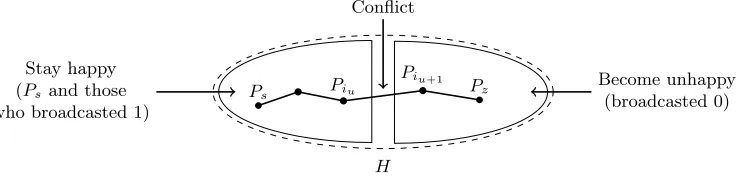
Fig. 1.Conflict finding inITBlockBC
andPy is added toH. Otherwise, some of the parties inH∪ {Py}do not hold the right value
and we search for new disputes.
An important difference from the cryptographic case is that disputes may occur not only between Px and Py, but between any two parties in H. In order to find such disputes, one
must be able to reason about the history of howH was formed. We will keep a history setT which will contain pairs of players (Px, Py) such thatPy learned the value it holds fromPx.
ProtocolITBlockBC(vs):
1. Parties initialize happy setH to be{Ps} and history setT to be∅.
2. While ∃Px, Py ∈ P s.t. Px ∈H and Py ∈H and {Px, Py} 6∈∆do
r.1 Px: Sendvx to player Py. Denote received value by vy. Add (Px, Py) to T.
r.2 Py: Generate random k∈ K and broadcast it.
Sender Ps: Broadcasth:=ITHashk(vs).
r.3 ∀Pi ∈H∪ {Py} \ {Ps}: Ifh=ITHashk(vi) then broadcast 1, otherwise 0.
r.4 If all parties broadcasted 1 - Add Py toH.
else
- For all (Pi, Pj)∈T s.t.Pi broadcasted 1 (resp. Pi =Ps) and
Pj broadcasted 0, add{Pi, Pj}to∆.
- Set H to{Ps},T to∅.
3. ∀Pi∈ P: If Pi ∈H decide onvi, otherwise decide on ⊥.
Lemma 2. Given that the initial dispute set ∆s is valid and ITHash is a universal hash
function, protocol ITBlockBC achieves broadcast (of vs) and terminates with a valid dispute
set∆e (except with negligible probability). Furthermore, the protocol terminates inO(n+nd)
rounds communicating at most(n+nd)(|vs|+B(|h|) +B(|k|) +nB(1)) bits, whered=|∆e| −
|∆s|, |h| is the output length of ITHash, |k| is the key length of ITHash, and |vs| is the block
length.
Proof. First, we prove that at each iteration of the while loop all correct players inH always hold the same valuev. More precisely, we need to show that if a correct playerPy is added to
H, then, given that all correct players inHhold the same valuev, it holds thatvy =v. We have
that all parties inH∪ {Py} \ {Ps} broadcast 1 at Step r.3. This implies that Py successfully
verifies that ITHashk(vy) = h, and all correct parties in H verify that ITHashk(v) = h.
Due to the fact that Py is correct, the key k is chosen uniformly at random, so given that
ITHashk(vy) =ITHashk(v), it must hold with overwhelming probability 1−ε thatvy =v.
found. We have that not all players inH∪ {Py} \ {Ps}broadcasted 1. Consider two possible
cases:
(Exists Pz ∈H\ {Ps} which broadcasts 0 at step r.3) ForPz to be included in H there must
exist a sequence of players Pi1, Pi2, . . . , Pik in H such that Pi1 = Ps, Pik = Pz and
(Pij, Pij+1) ∈ T for all j = 1, . . . , k −1 (see illustration in Figure 1). In the r
th
itera-tion some of the players in H stayed happy (Ps and those who broadcasted 1) and some
become unhappy (broadcasted 0). We know thatPsstayed happy andPz became unhappy.
Hence in a rowPi1, Pi2, . . . , Pik there are players of both types. Then we have that exist two
playersPiu, Piu+1 such that Piu stays happy and Piu+1 becomes unhappy. By construction of T, (Piu, Piu+1) ∈ T implies that {Piu, Piu+1} is not yet in ∆. Consequently, the pair {Piu, Piu+1} will be identified as having a conflict and will be added to∆.
(EachPi ∈H\ {Ps} broadcasts 1 at step r.3) It means that Px broadcasts 1 (or Px = Ps)
and Py broadcasts 0. Hence the new dispute{Px, Py} will be added to∆.
Now we proceed with the proof of the current lemma.
(Validity of ∆e)We show that wheneverPi andPj are correct then {Pi, Pj}is never added
to∆. The pair{Pi, Pj}is added to∆only whenPisent somev toPj (i.e., (Pi, Pj)∈T), and
they disagree for some keykwhether ITHashk(v) equalsh. Hence, Pi orPj is corrupted.
(Termination)There can be at mostnsuccessive iterations where the setHgrows (condition at Step r.4 is true). As shown above whenever condition at Step r.4 is false a new conflict is found. The number of conflicts is limited and so must be the number of the while loop iterations.
(Consistency)We prove that in the end of the protocol all correct players belong either to
H (and decide on the same value v) or to H (and decide on⊥). As shown above ∆remains valid in all iterations, hence for any two correct playersPx, Py, the pair{Px, Py} 6∈∆. Hence,
ifPx ∈H and Py ∈H then the while loop does not terminate.
(Validity)The correct senderPs is always inH. The sender Ps decides onvsand due to the
consistency criterion all other correct players decide onvs as well.
(Complexity analysis)There can be at most nconsecutive iterations, where no conflict is found, hence the total number of iterations is at most n+nd, where d= |∆e| − |∆s|. This
implies that the number of rounds the construction employs isO(n+nd). Furthermore, since the communication costs of each iteration are at most|vs|+B(|h|) +B(|k|) +nB(1), we have
that the total communication costs of the protocol are upper bounded by (n+nd)(|vs|+
B(|h|) +B(|k|) +nB(1)). ut
5.3 Constructing Broadcast for Long Messages
Similarly to the cryptographic case, we plug ITBlockBC in the protocol ITBC which simply broadcasts a message block by block. The protocol ITBC is a copy of the protocol CryptoBC
with the only difference thatCryptoBlockBCis substituted withITBlockBC. Due to Lemma 2 the total communication complexity of ITBC is at most
q
X
i=1
(n+din)(`/q+B(|h|) +B(|k|) +nB(1))
=n(q+
q
X
i=1
di)(`/q+B(|h|) +B(|k|) +nB(1)).
The number of rounds the construction employs is Pq
i=1ri, where each ri ∈ O(n+ndi). Hence, forq=n2 we have that the total number of rounds isO(n3).
The following theorem summarizes the information-theoretically secure construction pre-sented in this section:
Theorem 3. In the setting witht < n, the construction ITBCwithq =n2achieves information-theoretically secure broadcast of `-bit messages in O(n3) rounds by communicating O(`n+
n3(B(κ) +nB(1))) bits (where κ is a security parameter and B(s) is the complexity of the underlying broadcast for short s-bit messages).
In order to obtain a concrete multi-valued broadcast protocol we instantiate ITBC with the protocol [PW96]:
Theorem 4. Instantiating the construction ITBC with q = n2 and [PW96] as underlying broadcast for short messages results in an information-theoretically secure multi-valued broad-cast protocol for t < n with communication complexity O(`n+n10κ) (where κ is a security parameter).
6 On The Round Complexity of Multi-Valued Constructions
While the primary goal of this paper is to build communication efficient protocols, one often optimizes the protocols with respect to another measure of the protocols’ efficiency, number of rounds employed by a protocol. According to this measure there are two principal classes of the protocols: constant-round and non-constant round. In the following we investigate whether it is possible to obtain protocols optimal in both measures, that is, constant-round multi-valued broadcast protocols with optimal communication complexity fort < n.
The goal of this paper is to build protocols for efficient multi-valued constructions. We stress that by construction we understand a protocol fornplayers which realizes multi-valued broadcast on top of bilateral channels and a special procedure for broadcasting bits. We explicitly distinguish such constructions and plain multi-valued broadcast protocols (e.g., [DS83, PW96]) that directly implement broadcast from bilateral channels.
When t < n/2 both communication and round optimal multi-valued broadcast protocols can be built by combining constant-round construction [FH06] with a constant-round binary broadcast protocol (e.g., [KK06, GKKO07]). For the case of arbitraryt < nit has been shown that no plain protocol can achieve broadcast in a constant number of rounds [GKKO07]. In the context of this paper this shows that no concrete instantiation of a multi-valued construction and a procedure for broadcasting bits can be constant-round. However, it is still interesting to understand whether a non-trivial constant-round construction for multi-valued broadcast exists separately. Next we show that this is not possible, i.e., there is a separation between
t < n/2 and t < n cases not only for broadcast protocols but between constructions for multi-valued broadcast as well.
A construction’s failure probability (based on the definition [GY89]). Consider any multi-valued construction protocol π = (π1, . . . , πn). A scenario is a triple (v, B,A)
where v ∈ {0,1}` is a value that the sender broadcasts, B ⊆ P is a set of malicious players
over the randomness used by honest parties and the adversary in the corresponding scenario.7 Then the failure probability of π is defined as max
v,B,Aεπ,v,B,A, i.e., as the maximum failure
among all scenarios.
Impossibility framework. We employ a standard indistinguishability argument that is used to prove that certain security goals cannot be achieved by any protocol in the Byzantine environment [PSL80]. Such a proof goes by contradiction, i.e., by assuming that the security goals can be satisfied by means of some protocol π = (π1, . . . , πn). Then the programs πi
are used to build a configuration with contradictory behavior. The configuration consists of (possibly) multiple copies ofπi connected with bilateral channels and given admissible inputs.
Once the configuration is built, one simultaneously starts all the programs in the configuration and analyzes the outputs produced by the programs locally. By arguing that the view of some programs πi and πj in the configuration is indistinguishable from their view when run by
the corresponding players Pi and Pj (while the adversary corrupts the remaining players in
P \ {Pi, Pj}) we can deduce consistency conditions on the outputs by πi and πj that lead
to a contradiction. The main novelty in the following proof is that we consider an extended communication model where in addition to bilateral channels players are given access to a special procedure for broadcasting short messages. While following the path described above, we need to additionally describe how the calls to this procedure are handled.
Theorem 5. Every non-trivial 8 multi-valued construction for t < n which takes less than
n−1 rounds fails with probability at least 1/(2n).
Proof. Take any non-trivial constructionπ = (π1, . . . , πn) which requiresq < n−1 rounds and
has error probabilityε. Without loss of generality, assume as well that the sender isP1, i.e., the sender’s program isπ1. On the highest level our proof consists of three steps. (i) we define a configuration (inspired by [GKKO07]). (ii) we show that all programs in the configuration must output the same valuevwith probability 1−nε. (iii) we use an information flow argument to prove that there is a program in the configuration that outputsv with probability at most 1/2. Finally, we combine the probability inequalities given by (ii) and (iii) to conclude that
ε≥1/(2n).
(i) Consider a chain of n programs π1, π2, π3, . . . , πn connected with bilateral channels as
shown in Figure 2. In this configuration only programs that are connected communicate, i.e.,
π1 communicates only withπ2 and receives no messages from parties inP \ {P1, P2}. Let π1 be given as input a uniform random variableV chosen from the input domain {0,1}`. Now
we execute the programs. Whenever any program broadcasts any value using the broadcast procedure this value is delivered to all programs in the configuration.
(ii) First, we prove that any pair of connected programs (πi, πi+1) in the chain outputs the same value. One can view the configuration as the player Pi running the program πi and
Pi+1 running πi+1 while the adversary corrupting P \ {Pi, Pi+1} is simulating the programs
π1, . . . , πi−1 and πi+2, . . . , πn. Due to the consistency property,πi and πi+1 must output the same value with probability at least 1−ε. Since every connected pair of programs in the chain outputs the same value with probability at least 1−ε, then all the programs in the
7
In all executions we assume that the procedure to broadcast bits is perfectly secure, i.e., the values broadcast with it are consistently delivered to the parties.
8
π1 π2 π3 π4 π5 π6 π7 . . . πn
V
Fig. 2.The configuration to show the impossibility of non-trivial construction
configuration output the same value with probability at least 1−(n−1)ε. Moreover, the configuration can be viewed as P1 executing π1 while the adversary corrupts P \ {P1} and simulates the remaining programs. Due to the validity property, π1 must output V with probability at least 1−ε. Finally, all the programs in the chain output V with probability 1−nε.
(iii) Let Sir be a random variable denoting the state of the program πi in the chain after r
rounds of the protocol execution. By state we understand the input that the program has, the set of all messages that the program received up to therthround over point-to-point channels and via the underlying broadcast procedure together with the random coins it has used. Let
Br be a random variable denoting the list of the values that have been broadcast with the broadcast procedure up to therth round.
After r rounds only programs π1, π2, . . . , πr+1 can receive full information about V. The remaining programs in the chainπr+2, πr+3, . . . , πncan receive only the information that was
distributed with the broadcast procedure, i.e., the information contained inBr. That is, one can verify by induction that for anyrand for alli≥r+2 holdsI(V;Sir|Br) = 0. Hence, for the last program in the chainπnafter qrounds of computation it holds thatI(V;Snq|Bq) = 0 and
hence I(V;Snq) ≤ H(Bq). Because we assumed that the construction is non-trivial, at most
`−1 bits can be broadcast with the broadcast procedure. Hence, we have thatH(Bq)≤`−1. Combining these facts we get that I(V;Snq) ≤`−1. Hence, the last program πn outputsV
with probability at most 1/2. However, we have shown above that all programs (includingπn)
output V with probability at least 1−nε. Hence, we have that 1/2≥ 1−nε which implies
thatε≥1/(2n). ut
7 Conclusions
Existing multi-valued broadcast protocols achieve optimal communication complexity only for t < n/3 [LV11] or t < n/2 [FH06]. In this paper we proposed the first multi-valued broadcast protocols that tolerate anyt < nByzantine corruptions and achieve optimal com-munication complexity O(`n) for sufficiently long messages of ` bits. One of the proposed protocols is cryptographically secure and the other one is information-theoretically secure. The cryptographically secure protocol is based on the security of the signature scheme and a collision-resistance of the hash function employed. It communicatesO(`n+n5κ) bits. The information-theoretically secure protocol may fail with a negligible probability and needs to communicateO(`n+n10κ) bits.
References
[AJLA+12] Gilad Asharov, Abhishek Jain, Adriana L´opez-Alt, Eran Tromer, Vinod Vaikuntanathan, and Daniel Wichs. Multiparty computation with low communication, computation and interaction via threshold fhe. In Proceedings of the 31st Annual International Conference on Theory and Applications of Cryptographic Techniques, EUROCRYPT’12, pages 483–501, Berlin, Heidelberg, 2012. Springer-Verlag.
[BGP92] Piotr Berman, Juan A. Garay, and Kenneth J. Perry. Bit optimal distributed consensus. In Computer Science Research, pages 313–322. Plenum Publishing Corporation, New York, NY, USA, 1992. Preliminary version appeared in STOC ’89.
[BH06] Zuzana Beerliova-Trubiniova and Martin Hirt. Efficient multi-party computation with dispute control. In Shai Halevi and Tal Rabin, editors,Theory of Cryptography Conference — TCC 2006, volume 3876 ofLecture Notes in Computer Science, pages 305–328. Springer-Verlag, March 2006. [CGS97] Ronald Cramer, Rosario Gennaro, and Berry Schoenmakers. A secure and optimally efficient multi-authority election scheme. InAdvances in Cryptology - EUROCRYPT ’97, International Confer-ence on the Theory and Application of Cryptographic Techniques, Konstanz, Germany, May 11-15, 1997, Proceeding, volume 1233 of Lecture Notes in Computer Science, pages 103–118. Springer, 1997.
[CW92] Brian A. Coan and Jennifer L. Welch. Modular construction of a byzantine agreement protocol with optimal message bit complexity.Information and Computation, 97:61–85, March 1992. Preliminary version appeared in PODC ’89.
[DS83] Danny Dolev and H. Raymond Strong. Authenticated algorithms for Byzantine agreement. SIAM Journal on Computing, 12(4):656–666, 1983. Preliminary version appeared in STOC ’82.
[FH06] Matthias Fitzi and Martin Hirt. Optimally efficient multi-valued Byzantine agreement. In Pro-ceedings of the 26th annual ACM symposium on Principles of distributed computing, PODC ’06, pages 163–168, New York, NY, USA, 2006. ACM.
[Fit03] Matthias Fitzi. Generalized Communication and Security Models in Byzantine Agreement. PhD thesis, ETH Zurich, March 2003. Reprint as vol. 4 of ETH Series in Information Security and Cryptography, ISBN 3-89649-853-3, Hartung-Gorre Verlag, Konstanz, 2003.
[FM88] Paul Feldman and Silvio Micali. Optimal algorithms for byzantine agreement. In Janos Simon, editor,STOC, pages 148–161. ACM, 1988.
[GGHR14] Sanjam Garg, Craig Gentry, Shai Halevi, and Mariana Raykova. Two-round secure mpc from indistinguishability obfuscation. In Yehuda Lindell, editor,TCC, volume 8349 ofLecture Notes in Computer Science, pages 74–94. Springer, 2014.
[GKKO07] Juan A. Garay, Jonathan Katz, Chiu-Yuen Koo, and Rafail Ostrovsky. Round complexity of authenticated broadcast with a dishonest majority. InProceedings of the 48th Annual IEEE Sym-posium on Foundations of Computer Science, FOCS ’07, pages 658–668, Washington, DC, USA, 2007. IEEE Computer Society.
[GMW87] Oded Goldreich, Silvio Micali, and Avi Wigderson. How to play any mental game. InProceedings of the 19th annual ACM symposium on Theory of computing, STOC ’87, pages 218–229, New York, NY, USA, 1987. ACM.
[GY89] R. L. Graham and A. C. Yao. On the improbability of reaching byzantine agreements. InProceedings of the twenty-first annual ACM symposium on Theory of computing, STOC ’89, pages 467–478, New York, NY, USA, 1989. ACM.
[HMR14] Martin Hirt, Ueli Maurer, and Pavel Raykov. Broadcast amplification. In Yehuda Lindell, editor, TCC, volume 8349 ofLecture Notes in Computer Science, pages 419–439. Springer, 2014. [KK06] Jonathan Katz and Chiu-Yuen Koo. On expected constant-round protocols for byzantine
agree-ment. InIn Advances in Cryptology—Crypto ’06, pages 445–462. Springer-Verlag, 2006.
[LV10a] Guanfeng Liang and Nitin Vaidya. Complexity of multi-value byzantine agreement. Technical re-port, University of Illinois at Urbana-Champaign, 2010. Available athttp://www.crhc.illinois. edu/wireless/papers/ba_sum_capacity_0729.pdf.
[LV10b] Guanfeng Liang and Nitin Vaidya. Short note on complexity of multi-value byzantine agreement. CoRR, abs/1007.4857, 2010.
[LV14] Guanfeng Liang and Nitin Vaidya. Personal Communication, 2014.
[Pat11] Arpita Patra. Error-free multi-valued broadcast and Byzantine agreement with optimal communi-cation complexity. InProceedings of the 15th international conference on Principles of Distributed Systems, OPODIS ’11, pages 34–49. Springer, 2011.
[PSL80] Marshall C. Pease, Robert E. Shostak, and Leslie Lamport. Reaching agreement in the presence of faults. Journal of the ACM, 27(2):228–234, 1980.
[PW96] Birgit Pfitzmann and Michael Waidner. Information-theoretic pseudosignatures and Byzantine agreement fort≥n/3. Technical report, IBM Research, 1996.
[Rog06] Phillip Rogaway. Formalizing human ignorance. In Phong Q. Nguyen, editor,VIETCRYPT, volume 4341 ofLecture Notes in Computer Science, pages 211–228. Springer, 2006.
[TC84] Russell Turpin and Brian A. Coan. Extending binary Byzantine agreement to multivalued Byzan-tine agreement. Information Processing Letters, 18(2):73–76, 1984.
[Yao79] Andrew C. Yao. Some complexity questions related to distributive computing (preliminary report). InProceedings of the eleventh annual ACM symposium on Theory of computing, STOC ’79, pages 209–213, New York, NY, USA, 1979. ACM.
A On the Constructions of Liang and Vaidya [LV11, LV10a, LV10b]
In [LV11] it is stated that the broadcast constructions presented there can be extended to toleratet ≥n/3. We contacted the authors and they said that this statement is misleading and it should have been “t < n/2” instead of “t≥n/3” to be more clear [LV14]. Below we detail why [LV11] inherently requires t < n/2 and cannot be extended beyond this bound (this reasoning applies to the related constructions [LV10a, LV10b]).
Essentially, the construction relies on a player set S such that all players in S have the same valuev and S is guaranteed to contain at least one correct player. The value v is the value that should be agreed on. This technique requires that suchS is unique. Uniqueness of