Modelling Time, or A Step Towards Reduction-based
Security Proofs for OTP and Kerberos
Jörg Schwenk
Horst Görtz Institute Ruhr-University Bochum, Germany[email protected]
ABSTRACT
The notion of time plays an important role in many practi-cally deployed cryptographic protocols, ranging from One-Time-Password (OTP) tokens to the Kerberos protocol. How-ever, time is difficult to model in a Turing machine environ-ment.
We propose the first such model, where time is modelled as a global counter T. We argue that this model closely matches several implementations of time in computer en-vironments. The usefulness of the model is shown by giv-ing complexity-theoretic security proofs for OTP protocols, HMQV-like one-round AKE protocols, and a variant of the basic Kerberos building block.
1.
INTRODUCTION
Authentication.
Authentication is, besides key agreement, the most im-portant security goal in cryptographic protocols. Loosely speaking, an authentication protocol is secure if the prob-ability that anactive adversary breaks the protocol is the same as for apassiveadversary. For many cryptograhic pro-tocols, authentication is of major importance: TLS is used to authenticate the server (e.g. through EV certificates), and One-Time-Password (OTP) schemes (e.g. SecureID) or Kerberos (and WWW variants like OpenID or SAML) have been designed as authentication protocols.
Authentication with nonces.
Replay attacks are one major threat for authentication protocols, so thefreshnessof a message must be guaranteed. In practical implementations, this is achieved by securely including “new” values into some protocol messages: either nonces chosen by the other party, or timestamps.
Noncescan easily be modelled in a Turing machine based environment: They are either read from a random input tape, or they are randomly generated by a probabilistic Tur-ing machine. The security analysis then only has to take into
account the probability distribution of these values. How-ever, for one-sided authentication, this implies at least two messages, and for mutual authentication at least three mes-sages, since each authenticating party has to receive back the nonce chosen by itself, and returned by the authenti-cated party.
Authentication with Timestamps.
Timestampsare more difficult to model, because time is not measurable for a Turing machine after it finished its computation, and waits for fresh input. (In practice, this is comparable to the problem of using time in smartcard computations: If the smart card is disconnected from power supply, it is no longer able to even increase a local clock.) However, timestamps enable us to design more efficient pro-tocols, with less latency.
Reduction-based proofs in a Turing Machine model.
A Turing Machine (TM) is a mathematical model of a (von Neumann) computer. The famous Church-Turing the-sis states that any computable algorithm can be implemented using a TM. Since a TM is a mathematical object, math-ematical proof techniques can be applied, and these proofs form the basis of all theoretical computer science. On the other hand, subtle errors in the model may invalidate such proofs [20].
Definition 1 (Turing Machine [20]). ATuring
Ma-chine Mis a tupleM= (Q,Γ, b,Σ, δ, q0, F), whereQis a
finite, non-empty set ofstates,Γis thetape alphabet,b∈Γ
is the blank symbol, Σ ⊆ Γ− {b} is the input alphabet,
q0 ∈Q is the initial state, F ⊆Q is the set offinal or
ac-cepting states, and δ : (Q−F)×Γ →Q×Γ× {L, R} is a partial function called the transition function. A Turing machine is started by setting its internal state to q0,
writ-ing the input strwrit-ing on the (infinite) tape, and positionwrit-ing its read/write head on the first input symbol. As long as no accepting state is reached, δ(s, q) = (s0, q0, m) is evaluated, where s is the actual state of the TM, andq is the symbol read by the read/write head from the tape. As a result of this evaluation of δ, the internal state of M is set to s0, the symbolq0 is written on the tape by overwritingq, anf the read/write head either moves right (m=R) or left (m=L).
In complexity theory, large classes of efficiently computable (P) and efficiently decidable problems (N P) were defined by giving polynomial reductions to some well-known problems [18]. In cryptography, complex systems are shown to be se-cure by giving a polynomial reduction to a well-studied as-sumption (e.g. factoring of large integers, orP 6=N P). The basis for this research was the formalization of all computa-tional processes as (probabilistic) Turing Machines (TM).
Research on reduction-based proofs for cryptographic pro-tocols started with the seminal paper of Bellare and Rog-away [6] in 1993. Up to the best of our knowledge, random-ness played an important role in all subsequent papers, but time stamps were never investigated.
Modelling Time.
Time plays an important role in IT security: X.509 cer-tificates and other security tokens have a validity period, some One-Time-Password (OTP) systems need loosely syn-chronized clocks between hardware token and server, GPS Spoofing may only be detected by comparing internal clock values with the time contained in GPS signals, and malware may protect itself by querying external time sources.
However, running an internal (independent) clock always means measuring some physical parameter: movements of a pendulum, oscillation rate of a crystal, or an electronic transition frequency. Thus the main problem with time is that we simply cannot model “real” time in a Turing Machine based model. All formal models claiming to be able to model time must therefore be carefully checked if they satisfy all restrictions imposed by Definition 1 or one of its variants. If they deviate from this strict formalism, the results may become invalid.
Instead, we have to find a suitable approximation for time, which preserves the most important security guarantees of-fered by “real” time. 1
If we look at one implementation of time, we get a mo-tivation for the choice of our model: The Network Time Protocol (NTP, [32]) delivers the actual time to an appli-cation on request. Thus in our model we have chosen to implement time as a global counterT, which is accessible to all Turing machines in our computing environment. If a fresh message has to be sent, the sending TM request a timestampts = (t, aux) from T. Upon reception of such a request,T first increases its local counter (t←t+ 1). Then the actual valuetis returned, optionally with auxiliary data auxappended. This auxiliary data may e.g. be a digital sig-nature, to prevent Denial-of-Service attacks by an adversary who would issue large values liket+ 2k>> t.
One can easily derive variants of this model, for example: Turing Machines may queryT whenever they are activated, or even on each computation step they make. Each query may increase the counter, or a different pattern may be de-signed to increase it. The channel betweenT and the pro-cess oracles may be insecure, authentic, or evenuntappable
[27], the latter guaranteing that the adversary may never
1Please note that some usecases of time may cause
addi-tional moidelling problems. E.g. the lifetime of a public key in an X.509 certificate is often limited, because with in-finite lifetime, the adversary may compute the private key in non-polynomial time. To include this in a formal model, we would have to somehow couple the time value used in the protocol with the number of computation steps of the adversary.
influence the communication with the time source. From all these variants, we have chosen what we believe to be the simplest model, which however offers similar security guar-antees than the other variants.
The Notion of Time-Security.
Our starting point is the definition of secure authentica-tion protocols, given in the seminal paper by Bellare and Rogaway [6]. They motivated their definitions by introduc-ing abenign adversary, who forwards all messages faithfully. They defined an authentication protocol to be secure if the winning probability of any adversary is (up to a negligible difference) equal to the winning probability of this benign adversary. They showed that this condition is, for many protocols using random nonces, equivalent to requiring that both parties only accept if they havematching conversations
(cf. Definition 7). Our main goal is to find a replacement for the concept ofmatching conversations, since in one- and two-message protocols, this concept is not applicable: here the responder oraclealwayshas a matching conversation to the initator oracle, but due to replay attacks active adver-saries may influence the system significantly: With a benign adevrsary, there is at most one responder oracle that will accept on a single message; with an active adversary, there may be arbitrary many.
In this paper we only consider cryptographic protocols consisting of one or two messages. (If we have three mes-sages, we can use random nonces, and achieve better security goals.) Thus there always is one oracle (responder) that has to decide whether to accept or reject after receiving a single message, and before (or without) sending a message. We will consider a protocol to be time-secure, if for each ini-tiator oracle that has sent a message there is at most one responder oracle that accepts, and that this responder ora-cle will accept only if the message was forwarded unmodified by the adversary. The second goal can be achieved by using cryptographic primitives like message authentication codes or signature schemes, but for the first goal we need times-tamps.
For two-message protocols, we can additionally base the acceptance condition for initiator oracles (which send and receive one message) on the classical notion of matching con-versations (if a nonce is used, which is howevernotthe case in all previously proposed two-message protocols), or we can also apply the notion of time-security here.
Scope of our results.
The results presented in this paper are directly applicable to OTP schemes based on counters, e.g. all OTP schemes based on the HOTP algorithm [34], which is the basis for many commercially deployed OTP schemes. HOTP uses an 8 Byte counter, a shared key between initiator and respon-der, and HMAC-SHA-1 as the MAC algorithm. The counter value at the initiator is incremented with every OTP gener-ation, whereas the counter at the server is only incremented after a successful authentication, to the counter value used in the OTP. This exactly mirrors our time model. However, usability considerations have lead to the introduction of a truncation function, which reduces the entropy of the OTP significantly, and thus a throttling scheme must be used to prevent exhaustive MAC searches. These usability enhance-ments are out-of-scope here.
SecureID or TOTP [35]) are based on clock counters, the main difference to HOTP being that the responder counter is increased independantly. We could modify the acceptance condition and the communication withT at the responder to include this in our model (see Appendix); however, in oder to get similar security properties, we would also have to add a second counter at the responder, in order to prevent replay attacks of OTPs within one given time step (default value is 30 seconds).
For two-message protocols, our results can be used to de-vise new protocols which may achieve explicit authentication for both initiator and responder, in addition to authenti-cated key exchange. With respect to the latter property, the model presented here is “weak” in the sense that it does not consider queries like RevealDHExponent or RevealState [16]; again, this is in order to keep the model (and the proofs) simple.
One important motivation for considering a hybrid def-inition of explicit authentication (using nonces and times-tamps) was the fact that the two-party two-message build-ing blocks of the Kerberos protocol (cf. Section 7) are of this type. In our model, we can show that these building blocks are authentication protocols, but we cannot cover the key exchange part of Kerberos: here a suitable theory for Single-Sign-On protocols is still missing.
Contribution.
The contributions of this paper are as follows:
• We propose the first theoretically consistent model for timestamps in cryptograhic protocols, which covers all Turing Machine-based implementations.
• We give a security definition for explicit authentication extending [6], applicable to a wide range of protocols.
• We show the usefulness of our definition by giving ex-amples of secure one and two message protocols, to-gether with formal security proofs.
• We sketch modified versions of the basic building block of the well-known Kerberos protocol (with time stamps, but without validity time ranges), for which security proofs (for authentication only) are possible in our model.
2.
RELATED WORK
Timestamps.
An overview on usage and security problems of times-tamps can be found in [29]. (See [19] for an updated version.) Motran et al. [33] use a different model for timestamping documents: they assume that a unique random string is broadcasted in each time period. An actual overview on hash-then-publish timestamping can be found in [11]. [26] shows that if malleable encryption (e.g. a streamcipher) is used, timestamp based authentication protocols may fail. [38] covers one-time passwords, but in the different context of password-based authenticated key exchange (PAKE).
Authenticated Key Exchange.
Reasearch on formal security models for two-party authen-tication and authenticated key exchange (AKE) protocols started with the seminal paper of Bellare and Rogaway [6].
In [7], 3-party session key distribution protocols were inves-tigated, but authentication was omitted.
In the following years, research on cryptographic protocols focused either on authenticated group key exchange [28], or the higly efficient two-message protocols (see below). Ex-plicit authentication was difficult to achieve in these proto-cols, thus variants of the AKE model introduced by Canetti and Krawczyk [13] were used.
Authenticated Key Exchange with Timestamps.
In a paper whose goals are closest to our work, Barbosa and Farshin [2] introduce two different models (one based on Canetti-Krawczyk and one following Bellare-Rogaway) to model AKE with timestamps, and a total of 6 theorems. In [2], time is modeled as a local clock LocalTime, which is incremented by sending TICK requests. In comparison to our work (we use a global clock), [2] has a couple of draw-backs:
• There is no executional model which describes how local clocks are incremented and kept synchronized. Since desynchronization of local clocks is a major issue in practice, this is an important omission. (We use the global counter and received messages to synchronize.)
• In a secure authenticated key exchange protocol, the success probabilities of active and passive adversaries are roughly the same. For 3-message protocols using nonces, this was formalized using ”matching conversa-tions” in [6]. [2] tries to reformulate these definitions to the 1-message settings, but the important partnering definition is flawed: An active adversary may simply send a message generated by piiA to pi
j
B and pi j+1 B .
Then according to [2], Definition 5, the three oracles are not partnered, thus the adversary may ask RE-VEAL topijB and at the same time TEST topiiA, and
thus always win the security game.
• The adversary is allowed to increment the local clock. This is counterintuitive: to name an extreme example, GPS spoofing can only be detected if a reliable local clock is available, despite all cryptographic protection mechanisms [41].
• Finally, the proof of Theorem 6, which looks simi-lar to the results in our paper, doesn’t make use of timestamps at all: The same security guarantees can be achieved if timestamps are replaced with sequence numbers, because sychronizity of local clocks is not modeled.
Two-message protocols.
In 1986, Matsumoto et al. [30] first studied implicitly authenticated Diffie-Hellman protocols, which results in a line of research generated many protocols. Research on this topic was re-initiated by the introduction of the MQV [31,
Kerberos.
The Kerberos protocol [37] was introduced to the aca-demic community in [39,21]. First informal security inves-tigations were published in [8,17].
Formal analysis in Dolev-Yao-style models was started in [4, 3, 12]. Cremers and Mauw [15] analyzed protocols which were generalizations of the public-key and private-key Needham-Schroeder protocol [36], which was the model for Kerberos. Recently, Backes et al. [1] gave an analysis of the authentication and key secrecy properties of Keberos, and Li [25] gave an analysis of Kerberos in the Hoare logic. Blanchetet al. [9] presents a proof on Kerberos that is somehow a mixture between Dolev-Yao and reduction-based proofs: they use assumptions from reduction based cryptog-raphy (e.g. IND-CCA2) to show that a set of ad-hoc security properties is fulfilled. However their proof is not a reduction in the sense that ‘if one of these security properties is vio-lated, then at least one of the assumptions can be broken”.
Boldyreva and Kumar [10] provide valuable insights into the encryption schemes employed in Kerberos v5 by showing that under reasonable assumptions, a “modified general pro-file” can be shown to be IND-CCA and INT-TXT secure.
3.
DEFINITIONS
NotationWe use ∅ to denote the empty string, and [n] = [1, n] = {1, . . . , n} ⊂ N for the set of integers between 1 andn. IfAis a set, then we use a ←$ Ato denote that a is drawn uniformly random fromA. In caseA is a proba-bilistic algorithma ←$ A is used to denote that A returns awhen executed with fresh random coins. We useκto de-note the security parameter. x← A$ (y) denotes the output xof the probabilistic algorithmAwhen run on inputyand randomly chosen coins.
Digital Signature Schemes A digital signature scheme is a triple SIG = (SIG.Gen,SIG.Sign,SIG.Vfy), consisting of the key generation algorithm (sk, pk)←$ SIG.Gen(1κ) generating a (public) verification key pk and a secret signing key sk on input of the security parameterκ, the signing algorithm σ←$ SIG.Sign(sk, m) generating a signature for messagem, and the verification algorithmSIG.Vfy(pk, σ, m) returning 1, ifσis a valid signature formunder keypk, and 0 otherwise. Security is formalized in the following security game that is played between a challengerC and an adversaryA.
1. The challenger generates an asymmetric key pair (sk, pk)
$
←SIG.Gen(1κ) and the public keypk is given to the adversary.
2. The adversary may adaptively query q messages mi
withi∈[q] of his choice to the challenger. The chal-lenger responds to each of these queries with a signa-tureσi=SIG.Sign(sk, mi) onmi.
3. The adversary outputs a message/signature pair (m, σ).
Definition 2. We say thatSIGis (t, , q)-secureagainst
existential forgeries under adaptive chosen-message attacks
(EUF-CMA), if for all adversariesAthat run in timet mak-ing at mostq queries it holds that
Pr[(m, σ)← A$ C(1κ, pk)such that
SIG.Vfy(pk, m, σ) = 1∧m6∈ {m1, . . . , mq}]≤.
Symmetric Encryption SchemesA symmetric encryption (SE) scheme is a pair SE = (SE.Enc,SE.Dec), consisting of the encryption algorithm SE.Enc(k, m) generating a ciphertext cfor messagemunder keyk, and the deterministic decryp-tion algorithmSE.Dec(k, c) returning m, ifcis a valid en-cryption and the error symbol⊥otherwise. Security against chosen ciphertext attacks is formalized in the following se-curity game that is played between a challenger C and an adversaryA.
1. The adversary may adaptively query the challenger for encryptions SE.Enc(k, m) of arbitrary plaintexts m, and for decryptions SE.Dec(k, c) of arbitrary cipher-textsc.
2. The adversary outputs two (fresh) messages m0 and
m1 of the same length.
3. The challenger tosses coin b ← {$ 0,1}. It then sets c=SE.Enc(k, mb) and sendscto the adversary.
4. The adversary may again adaptively query plaintexts mand ciphertextsc0 of his choice, with the restriction thatm /∈ {m0, m1}andc06=c.
5. Finally the adversary outputs a bitb0.
Definition 3. We say that SE is (t, , q)-secure under
chosen ciphertext attacks (CCA), if all adversaries A that run in timetmaking at mostq encryption queries have ad-vantage of at mostto distinguish the ciphertext ofm0from
that of m1, i.e.
Pr
b=b0
−1/2 ≤.
Public Key Encryption Schemes A public key encryption (PKE) scheme is a triple PKE = (PKE.Gen,PKE.Enc, PKE.Dec), consisting of the key generation algorithm (sk, pk)
$
←PKE.Gen(1κ) generating a (public) encryption keypkand a secret decryption keyskon input of the security parameter κ, the probabilistic encryption algorithm PKE.Enc(pk, m) generating a ciphertextcfor messagem, and the determin-istic decryption algorithmPKE.Dec(sk, c) returningm, ifc is a valid encryption and the error symbol⊥otherwise. Se-curity is formalized in the following seSe-curity game that is played between a challengerC and an adversaryA.
1. The challenger generates an asymmetric key pair (sk, pk)←$ PKE.Gen(1κ) and the public keypkis given to the adversary.
2. The adversary may adaptively query the challenger for decryptions of arbitrary ciphertextsc. The challenger responds to each of these queries with the output of PKE.Dec(sk, c).
3. The adversary outputs a messagem∗.
4. The challenger tosses coin b ← {$ 0,1}. It then sets c0 =PKE.Enc(pk, m∗) andc1 =PKE.Enc(pk, r) for a
uniformly random messager that is of the same size asm∗and sendscbto the adversary.
5. The adversary may again adaptively query ciphertexts cof his choice, now with the restriction that c6=cb.
6. Finally the adversary outputs a bitb0.
Definition 4. We say thatPKEis (t, , q)-secureunder
adaptive chosen ciphertext attacks(CCA), if all adversaries
A that run in timet making at most q decryption queries have advantage of at mostto distinguish the ciphertext of
m∗from that of a truly random value, i.e.
Pr
b=b0
−1/2≤.
Message Authentication CodesAmessage authentication code
is an algorithm MAC. This algorithm implements a de-terministic function w = MAC(Kmac, m), taking as input a (symmetric) key Kmac ∈ {0,1}κ and a message m, and returning a stringw.
Consider the following security experiment played between a challengerC and an adversaryA.
1. The challenger samplesKmac
$
← {0,1}κ
uniformly ran-dom.
2. The adversary may query arbitrary messages mi to
the challenger. The challenger replies to each query withwi=MAC(Kmac, mi). Hereiis an index, ranging
between 1 ≤i ≤ q for some q ∈ N. Queries can be made adaptively.
3. Eventually, the adversary outputs a pair (m, w).
Definition 5. We say thatMACis a(t, , q)-secure mes-sage authentication code, if for all adversariesAthat run in timetand queries at mostqmessages holds that
Pr[(m, w)← A$ C(1κ) :
w=MAC(Kmac, m)∧m6∈ {m1, . . . , mq}]≤MAC.
4.
FORMAL MODEL
In this section, we describe the execution environment, where we try to model normal protocol execution, the ad-versarial capabilities, which describe against which type of adversary our protocol should be secure, and the security model which describes security games where the winning events correspond to a security breach of the protocol.
4.1
Execution Environment
Parties and process oracles.
We distinguish betweenparties{P1, . . . , Pn}and process
oraclesπis, i∈ {1, . . . , l}, run by party Pi. These process
oracles and the party itself are modelled as Turing machines. Oracles can be initialized, can send and receive messages according to the protocol specification, and terminate either infinished,acceptorrejectstate2. The complete set of
states for oracles is Λ ={not initialized,wait,finished,
accept,reject}. In addition, we have two special partiesT
andA.
Each partyPihas two local variables: A local time counter
Ti, and a long-lived keyki. This long-lived key is either a
public key pair, or a list ofn−1 symmetric keys shared with the other parties.
2
We need an additional finalfinishedstate for one-message protocols because initiator oracles always have to reach a fi-nal state, but this can be no winning event for the adversary.
Long-lived keys of party Pi can be accessed for
crypto-graphic operations, and the counter valuestiofPican be
in-creased, by all process oracles (or oracles, for short)π1i, ..., πil
of this party. Computed nonces, intermediate state values, and session keys are only known to a single oracle. If a ses-sion key is computed by an oracleπsi, the valuek is stored
in a variableK when the oracle entersacceptorfinished
state. The current state of each oracle is stored in variable Λ, and the transcript of all messages sent and received (in chronological order) in variableTi,s.
There is one special partyT, which has a local counter T with actual state t; on request, this party increases the value oftby 1 and returns the actual value oftas a message ts= (t, aux) over the network.
The adversary A is another special party which imple-ments, as a Turing machine, a strategy to break the cryp-tographic protocol. The event(s) which define a protocol break are modelled as winning events in different games de-fined below.
Initiator and responder oracles.
Our security definition is focused on protocols with one and two messages; for protocols with three and more mes-sages nonces can be used instead of timestamps, and the classical definitions and results from the Bellare-Rogaway and Canetti-Krawczyk models apply. For our security defi-nitions, we need to distinguish betweeninitiatorand respon-deroracles.
Definition 6. An oracle who sends the first message in a protocol is called initiator, and an oracle who receives the first message is calledresponder.
Increase local time on message reception.
Each partyPi has a local timer Ti with actual state ti.
Each time a message with a valid timestampts= (t, aux) is received by some oracleπis, the valuetis compared to the
actual stateti. Ift≤ti, the message is rejected. Ift > ti,
the message is validated further, and ti is replaced by the
(greater) value t: ti ← t. (This is how many smartcards
handle time.) Only after this update of the local timerTi,
πs
i may accept or send a message (if required by the protocol
specification).
Retrieve actual time when sending a message.
When trying to send a message toPj,πsi has no knowledge
about the local time tj. Therefore the oracle requests an
(authenticated) new timestamp ts = (t, aux) from T, and compares it withTi. Ift > Ti, this value is securely included
in the protocol message.
Remark: Without any interference from an active adver-sary, t is guaranteed to be strictly greater than all local time values. However, an active adversary controlling the network may replay old time values.
Non-authenticated Time.
large time value t∗ =t+ 2k. All parties receiving a valid
message containing this time value will be blocked for 2k time periods.
However, our model uses an active adversary with com-plete control on the network. Thus he can always perform DoS attacks, e.g. disconnect some party for 2ktime periods from the network. Thus the power of our adversary is not increased by omitting signatures.
In a weaker adversarial model however, e.g. where the ad-versary controls only well-defined parts of a communication network, authenticated timestamps may make sense.
Local states of oracles.
An initiator oracleπis will, after being initiated, retrieve
the actual time valuet, prepare and send a message of the form3 (Pi, Pj, t, nsi, m, σ) where Pj denotes the identity of
the intended receiving party, nsi a nonce chosen randomly
byπs
i,mthe actual message, andσthe cryptographic
pro-tection of the message.
In a one-message protocol,πsi will immediately switch to finished state, and can no longer be activated; here the nonce may be omitted. A responder oracleπtj will be
acti-vated by a protocol message, which will be checked according to the protocol specification. If the check succeeds,πt
j will
switch toacceptstate.
In a two-message protocol, after sending the first message, an initiator oracleπiswill switch to awaitstate to wait for
a response message, and can also no longer be activated to send messages. A responder oracleπjt will be activated by
a message, which will be checked according to the protocol specification. If the check succeeds, πt
j will prepare a
re-sponse message which includes the nonce from the received message, send this message, and switch to accept mode. Upon reception of a message from some responder, an ini-tiator oracle will check if this message contains the nonce from the first message, and if the message is valid according to the protocol specification. If both criteria are fulfilled, it will switch toacceptmode.
Matching Conversations.
Bellare and Rogaway [6] have introduced the notion of
matching conversations in order to define correctness and security of an AKE protocol precisely. We adapt this notion and use it accordingly to define secure authentication for all following protocol types.
Recall, thatTi,sconsists of all messages sent and received byπsi in chronological order (not including the
initialization-symbol>). We also say thatTi,sis thetranscriptofπs i. For
two transcriptsTi,sandTj,t, we say thatTi,sis aprefix of Tj,t, ifTi,scontains at least one message, and the messages inTi,s are identical to and in the same order as the first |Ti,s|messages ofTj,t.
Definition 7 (Matching conversations). We say that
πsi has a matching conversationtoπjt, if
• Tj,t is a prefix ofTi,s and πs
i has sent the last
mes-sage(s), or
• Ti,s=Tj,t andπt
jhas sent the last message(s). 3The exact structure of the message is specified for each
protocol separately.
We say that two processesπs
i andπjthave matching
conver-sationsifπsi has a matching conversationto processπ t j, and
vice versa.
4.2
Adversarial Capabilities
We assume that the adversary completely controls the net-work, including access to the time oracleT. He may learn session keys, and he may learn some long-lived keys.
All this is modelled through queries. TheSendquery mod-els that the adversary completely controls the network: All messages are sent toA, who may then decide to drop the message, to store and replay it, or to alter and forward it. Thus messages received through a Sendquery are handled by the process oracles exactly like real protocol messages: They may be rejected, they may be answered, or they may start or terminate a protocol session. TheSendmessage en-ables the adversary to initiate and run an arbitrary number of protocol instances, sequential or in parallel.
TheRevealandCorruptqueries model real world attacks: Brute force key searches or malware attacks on PC systems in case of the Revealquery, and e.g. sidechannel of fault attacks on smartcards in the case of theCorruptquery.
Finally theTestquery is one important building block in defining security of a protocol (more precisely: key indistin-guishability).
Formally stated:
• Send(πis, m): The adversary can use this query to send
any messagemof his own choice to oracleπs
i. The
ora-cle will respond according to the protocol specification, depending on its internal state. Ifm=>consists of a special symbol>, thenπs
i will respond with the first
protocol message.
• Reveal(πsi): Oracleπ s
i responds to aReveal-query with
the contents of variableK. Note that we havek6=∅
only if Λ∈ {accept,finished}.
• Corrupt(Pi): This query is used in a public key setting.
Oracleπ1
i responds with the private keyski from the
long-term key pairki = (pki, ski) of party Pi. Then
the party and all its oracles are marked as corrupted.
• Corrupt(Pi, j): This query is used in symmetric key
settings. Oracleπ1
i responds with the long-term secret
keyki,j shared between partyPi and partyPj. Then
this key is marked as corrupted.
• Test(πs
i): This query may only be asked once
through-out the game. Oracleπs
i handles this query as follows:
If the oracle has stateK=∅, then it returns some fail-ure symbol⊥. Otherwise it flips a fair coinb, samples a random elem‘entk0
$
← K, setsk1 =k to the ’real’
session key, and returnskb.
Definition 8. An oracle is calledcorruptedif it is marked as corrupted (public key case), or if it uses a corrupted long-term key in its computations (symmetric case).
4.3
Security Model 1: One-message Protocols
AbenignadversaryAis an adversary that forwards mes-sages without modifying them. We would like to define a secure authentication protocol as a protocol where the win-ning probability of any adversary equals, up to a negligible difference, the winning probability of a benign adversary.
Freshness vs. validity time periods.
One major difference to [6], due to our definition of time, is the fact that even with a benign adversary there are situ-ations where the responder oracle may not accept: Assume there are two different initiator oracles πs1
A1 and π
s2
A2, who
both intend to send a message to partyB. They retrieve two time valuest1, t2 fromT, witht2=t1+ 1. Now ifπAs22 is the
first oracle who actually sends a message toB, then some responder oracleπt
B will accept this message, and increase
TB:=t2. If nowπAs11sends its message, it will be rejected to
to the fact thatt1< TB. Please note that this may happen
even if a benign adersary also forwards all messages in the same order as received.
Real-world protocols avoid this problem by defining valid-ity time periods: A message will be accepted if it is not older than, say, 5 minutes, or if it was received at a time that is within the timeframe explicitely mentioned in the message. However, including validity time periods in the model poses different problems: either replay attacks will become possi-ble during the validity time frame and we must change our security definitions, or we have to introduce an additional counter at each party for each other party to exclude these replay attacks (see Appendix).
Thus, for the sake of clarity, we decided to keep the model of time simple, and to accept the consequence that even with benign adversaries, responder oracles may not accept.
Replay attacks.
The main class of attack we want to protect against is
replay attacks. In a replay attack,Amay intercept a message sent by a sending oracle, and forward it to two or more receiving oracles. We would like to call a protocol secure if at most one of these receiving oracles accepts, because this is exactly what we can expect from a benign adversary. To achive this goal across several parties, we have to include the identity of the receiving party in the first message.
Security Game GA−1. In this game, the challenger C
sets up a protocol environment with n partiesP1, ..., Pn,
and prepares l protocol oracles πi1, ..., πli for each party.
If initiated by the adversary by a special start message, these oracles act as initiator oracles, and if initiated with a normal protocol message, they act as responder oracles.
C generates long-lived keys (or long-lived key pairs, resp.) for each party (for each pair of parties, resp.), and simu-lates the time oracleT.Tand all countersTi, i∈ {1, ..., n}
are initialized to 0.
Amay now ask up toqSendandCorruptqueries. Awins the game if there are at least two responder oracles that accept the same message, or if there is a responder ora-cle that accepts a message from an uncorrupted expected sender which has not been issued by any sender oracle.
Definition 9. A protocolΠis a(τ, q, ) time-secure
au-thentication protocol, if for each adversary A that runs in time τ and asks at mostq queries, with probability at least
1−we have that
1. for each responder oracle that accepts, there is exactly
one uncorrupted finished initiator oracle, and
2. for each finished initiator oracle, there is at most one responder oracle that accepts.
Authenticated Key Exchange.
We will now extend the definition to key exchange. Here each session key should be indistinguishable from a ran-domly chosen key, for any adversary.
Security GameGAKE−1. The setup of this game is the
same as inGA−1. In addition, the adversary is allowed to
ask upt toq−1Revealqueries, and oneTestquery to an oracleπsi, subject to the following conditions:
• If πsi is an initiator, then no Revealquery may be
asked to any responder oracle receiving the message fromπs
i.
• Ifπsi is an responder, then noRevealquery may be
asked to the unique initiator oracle that has sent the message, and the party of this initiator oracle ust be uncorrupted.
At the end of the game,Aissues a bitb0and wins the game ifb=b0, wherebis the bit chosen byπisin answering the
Testquery.
Definition 10. A one-message protocol Π is a (τ, q, ) time-secure authenticated key exchange protocol, if Π is a
(τ, q, ) time-secure authentication protocol in the sense of Definition 9, and if for each adversaryAthat runs in time
τ and asks at mostq queries, we have that that
AdvA=|P r(b=b0)−1/2| ≤
in GameGAKE−1.
4.4
Security Model 2: Two-message Protocols
With the publication of HMQV [23] research on one-round key agreement protocols intensified. However, since the re-sponder is always subject to replay attacks, the notion of
authentication protocol developed in [6] was given up, and was replaced by a new definition for authenticated key ex-changeproposed by Canetti and Krawczyk [13].
In this section, we try to give a new definition of a se-cure authentication protocol, by combining timestamps and nonces. We use this hybrid approach since this is a building block of the Kerberos protocol, where several two-message protocols of this kind are combined.4
Remark: Please note that this definition does not apply to two-message protocols currently discussed in the literature, because most of them neither use timestamps nor nonces.
Authentication.
4It should be clear that we also can achive mutual
Security Game GA−2. In this game, the setup is
iden-tical to GameGA−1.
Amay now ask up toqSendandCorruptqueries. Awins the game if there are at least two responder oracles that accept the same message, if there is a responder oracle that accepts a message from an uncorrupted expected sender which has not been issued by any sender oracle, or if there is a initiator oracle that accepts without having a matching conversation with a responder.
Definition 11. A two-message protocol Π is a (τ, q, )
time-nonce-secureauthentication protocol, if for each adver-saryAthat runs in timeτ and asks at mostqqueries, with probability at least1−we have that
1. for each responder oracle that accepts, there is exactly one uncorrupted finished initiator oracle,
2. for each finished initiator oracle, there is at most one responder oracle that accepts, and
3. for each initiator oracle that accepts, there is exactly one responder oracle that has a matching conversation.
Authenticated Key Exchange.
We will again extend the definition to key exchange. Here each session key should be indistinguishable from a ran-domly chosen key, for any adversary.
Security GameGAKE−2. The setup of this game is the
same as inGA−1. In addition, the adversary is allowed to
ask up to q−1Revealqueries, and oneTestquery to an uncorrupted oracleπsi, subject to the following conditions:
• If πs
i is an initiator, then no Reveal query may be
asked to any responder oracle receiving the message from πs
i, and all responder oracles must be
uncor-rupted.
• Ifπis is an responder, then noRevealquery may be
asked to the unique initiator oracle that has sent the message, and the party of this initiator oracle must be uncorrupted.
At the end of the game,Aissues a bitb0and wins the game ifb=b0, wherebis the bit chosen byπsi in answering the
Testquery.
Definition 12. A two-message protocol Π is a (τ, q, ) time-nonce-secureauthenticated key exchange protocol, ifΠ
is a(τ, q, )time-nonce-secure authentication protocol in the sense of Definition 11, and if for each adversaryAthat runs in timeτ and asks at mostq queries, we have that
AdvA=|P r(b=b0)−1/2| ≤
in GameGAKE−2.
5.
ONE-TIME-PASSWORDS
In a One-Time-Password (OTP) protocol, an initiator (party A) wants to authenticate against a responder (partyB). To achieve this goal,Arequests a timestamp fromT, and ap-pends a cryptographic checksum to the message consisting of the identifiers ofAandB, and the timestampt. Typically, symmetric cryptography is used in OTP protocols. Thus in
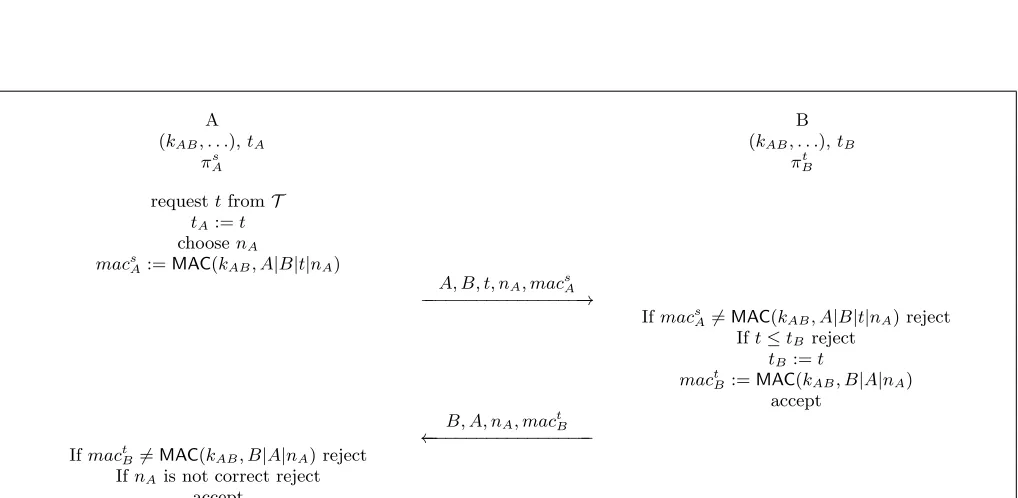
our example, we assume that a message authentication code MACis used for this purpose. The OTP protocol is defined in Figure 5.
Theorem 1. If MAC is a (τM AC, M AC, qM AC) secure
message authentication code, then ΠOT P is a (τ, q, )
time-secure authentication protocol with τM AC ≈τ, qM AC ≈q,
and
≤n2·M AC.
Proof. The proof is modelled as a short sequence of
games. GameG0 is the original game, where our adversary
tries to force an oracle to accept withotp∗which is either faked, or has already been accepted by a different oracle. Thus we have
0=.
InG1, we guess the initiator party A, and the receiver
party B. They share a common symmetric key kAB. Our
guess is that the adversary will succeed in making one re-ceiver oracleπtB accept either a fake OTPotp∗, or that two
oracles πtB and π t0
B will accept the same OTP otp. If our
guess is wrong, we abort the game, and the adversary looses. Thus his winning probability is reduced by a factorn2.
n2·1 =0.
In G2, we abort the game if the adversary A forges a
valid message authentication code MACfor keykAB. This
may happen only with probabilityM AC, since we could use
such an adversary to break the security of theMACscheme: The simulator replaces allMACcomputations involving the key kAB with calls to aMACchallenger CMAC which uses a randomly chosen MAC key k; if A forges a valid message authentication codemacfor a fresh otp message which has not been queried from the MAC challenger, then we have broken theMACchallenge. Thus we have
1≤2+MAC.
Since we have excluded MAC forgeries in this game, we are left with OTPsotp= (C, S, ts,MAC(kCS, C.S.ts)) which
were generated by non-corrupted oracles, where only the valuetsmay be influenced by the adversary. Thus condition 1 of Definition 9 is always true (i.e. holds with probability 1), and we are left with condition 2.
IfAtries to sendotpto any oracle of a party T 6=S,T will not accept because the target identity is different. If A tries to sendotpto oracle πs
C, butotphas already been
accepted byπtC,π s
C will not accept because ts≤tC. Thus
also condition 2 is always fulfilled (i.e. holds with probability 1) we have
2= 0.
6.
ONE-ROUND AUTHENTICATION
PRO-TOCOLS
A (kAB, . . .),tA
πsA
B (kAB, . . .),tB
πtB
requesttfromT
tA:=t
macsA:=MAC(kAB, A|B|t)
−otp= (A, B, t, mac s A) −−−−−−−−−−−−−−−−→−
IfmacsA6=MAC(kAB, A|B|t) reject
Ift≤tB reject
tB :=t
accept
Figure 1: The One-message Authentication protocol ΠOT P.
A (kAB, . . .),tA
πs A
B (kAB, . . .),tB
πt B
request tfromT
tA:=t
choosenA
macsA:=MAC(kAB, A|B|t|nA)
−A, B, t, nA, mac s A −−−−−−−−−−−−−−−−→−
Ifmacs
A6=MAC(kAB, A|B|t|nA) reject
Ift≤tB reject
tB:=t
mactB :=MAC(kAB, B|A|nA)
accept
←
− B, A, nA, mac t B −−−−−−−−−−−−−−−−−
Ifmact
B6=MAC(kAB, B|A|nA) reject
IfnA is not correct reject
accept
6.1
Authentication
Theorem 2. If MAC is a (τM AC, M AC, qM AC) secure
message authentication code, then the ΠH2A protocol
de-fined in Figure 6.1 is a(τ, q, ) time-nonce-secure authenti-cation protocol with respect to Definition 11 withτ≈τM AC,
q≈qM AC, and
≤n2·M AC+n2l·(
(nl)2
2λ +M AC).
Proof. AdversaryAcan win the game by either making an initiator oracle accept, or a responder oracle, or both. Thus we have
≤I+R.
Since we can apply the proof of Theorem 1 to the respon-der oracle, we haveR≤n2·M AC.
Thus we are left with the proof for the initiator oracle. The proof is modelled as a short sequence of games. Game G0 is the original game, but the adversary only wins this
game if an initiator oracle to accepts. Thus we have
0=I.
InG1, we guess the initiator oracle πsA that will accept,
and the responder party B. They share a common sym-metric keykAB. If our guess is wrong, we abort the game,
and the adversary looses. Thus his winning probability is reduced by a factorl·n2.
l·n2·1=0.
In G2, the simulator replaces all computations with the
key kAB with a MAC oracle. We abort the game if the
adversaryAforges a valid message authentication codeMAC for this oracle. Thus we have
1≤2+MAC.
InG3, we abort the game if two oracles choose the same
nonce. The probability for this is bounded above by (nl2λ)2.
Thus we have
2≤3+
(nl)2
2λ .
Since we have excluded MAC forgeries and nonce colli-sions,Acan only make an initiator oracle accept if he for-wards a message from one of the (possibly many) responder oracles that have received the message from the initator or-acle containing the chosen nonce. Thus there is a matching conversation, and we have
3= 0.
6.2
Authenticated Key Exchange
The novel authenticated key exchange protocol presented in Figure 6.2 is modelled after the building blocks of the Kerberos protocol: authentication and session key encryp-tion are based on symmetric cryptography, and the session key is chosen by the responder (the Kerberos server). Vari-ants of this protocol are used three times sequentially in Kerberos, with the same initiator (the Kerberos client), but different responders (Ticket Granting Ticket Server, Ticket Server, Server).
Theorem 3. If MACis a (τ, M AC, qM AC) secure
mes-sage authentication code, and SE is a (τ, SE, qSE) secure
symmetric encryption scheme, then the ΠORAKEl protocol
defined in Figure 6.2 is a(τ, q, )time-secure authented key exchange protocol with respect to Definition 12 with
≤n2·M AC+ln2(
(nl)2
2λ +M AC) +n 2
·SE.
Proof. AdversaryAcan win the game by either
break-ing the acceptance condition, or key indistbreak-inguishability, or both. Thus we have
≤A+KE.
Since we can apply the proof of Theorem 2 to the respon-der oracle, we haveA≤n2·M AC+ln2((nl)
2
2λ +M AC).
Thus we are left with the proof for key indisinguishability. In GameG1, we first have to guess the symmetric keykeAB
that will be used to encrypt the session key for the test oracle. If we guessed wrong, the adversary loses the game. Thus we loose a factorn2 in this game.
In Game G2, we replace all computations involving the
key keAB with our SE-challenger. SinceAis not allowed to
corrupt the key used in the test session, we can still simulate all protocol messages. Now if A is able to distinguish real from random keys, our SE-challenger is able to break the CCA-security of the symmetric encryption scheme.
7.
KERBEROS
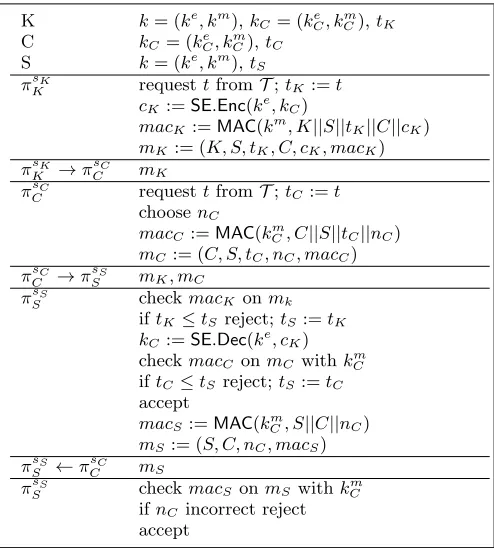
It remains unclear why the three message pairs in Ker-berso (see Appendix B) should have a different structure. Thus we will give a modified two-party building block in Figure 7 which can be substituted for any two-party block in the original Kerberos protocol, without changing the pro-tocol flow or the initial key setup.
We are able to prove that this modified building-block consists of a one-message time-secure key exchange protocol, and a two-message time-nonce-secure authentication proto-col. By concatenating these building blocks, the Kerberos protocol can be shown to be secure.
Theorem 4. The one-message protocol consisting of mes-sage mK only is a time-secure authenticated key exchange
protocol betweenK andS in the sense of Definition 10.
Proof. (Sketch) TheMACconstruction guarantees that
for each accepting oracle, there must be exactly one uncor-rupted oracle that has sent the message. The timestamp guarantees that there is at most one acceptingS-oracle, and the encryption prevents the adversary from getting any in-formation on the ciphertext.
Theorem 5. If executed after the reception of message
mK by K, the two-message protocol consisting of messages
mC and mS is a time-nonce-secure authentication protocol
betweenCandS in the sense of Definition 11.
Proof. (Sketch) The proof is similar to the proof of
The-orem 2.
8.
CONCLUSION AND FUTURE WORK
A
(kAB= (keAB, kABm ), . . .),tA
πsA
B
(kAB= (kABe , kmAB), , . . .),tB
πBt
request tfromT
tA:=t
choosenA
macs
A:=MAC(kABm , A|B|t|nA)
−A, B, t, nA, mac s A −−−−−−−−−−−−−−−−→−
Ifmacs
A6=MAC(kmAB, A|B|t|nA) reject
Ift≤tB reject
tB:=t
choosek ctB :=SE.Enc(k e AB, k)
mactB:=MAC(kmAB, B|A|nA|ctB)
accept
←
−B, A, nA, c t B, mactB −−−−−−−−−−−−−−−−−
Ifmact
B6=MAC(kABm , B|A|nA|ctB) reject
IfnA is not correct reject
k:=SE.Dec(keAB, ctB)
accept
Figure 3: The One-Round Authenticated Key Exchange (ORAKE1) protocol.
K k= (ke, km),k
C= (kCe, kmC),tK
C kC= (keC, kmC),tC
S k= (ke, km),tS
πsK
K requesttfromT;tK :=t
cK:=SE.Enc(ke, kC)
macK:=MAC(km, K||S||tK||C||cK)
mK:= (K, S, tK, C, cK, macK)
πsK K →π
sC
C mK
πsC
C requesttfromT;tC:=t
choosenC
macC:=MAC(kmC, C||S||tC||nC)
mC:= (C, S, tC, nC, macC)
πsC C →π
sS
S mK, mC
πsS
S checkmacK onmk
iftK ≤tS reject;tS:=tK
kC:=SE.Dec(ke, cK)
checkmacC onmCwithkmC
iftC≤tS reject;tS:=tC
accept
macS:=MAC(kmC, S||C||nC)
mS:= (S, C, nC, macS)
πsS S ←π
sC
C mS
πsS
S checkmacS onmS withkCm
ifnCincorrect reject
accept
Figure 4: A Generic Kerberos bulding block.
environment. We tried to formalize the security goal that replay attacks are prevented by timestamps.
This model can be exended in various directions: (1) Most time-based security infrastructures or protocols use validity time frames, which can be modelled by allowing the respon-der to query the time oracle T on reception of a message. However, precautions must be taken to disallow replay at-tacks. (2) If time is involved, the power of an active ad-versary should be restricted to get more realistic security models: currently, DoS attacks by the adversary cannot be prevented.
The analysis of a building block of Kerberos given here is far from being a complete reduction based proof for Ker-beros. Here a model is needed that formalizes the role of the trusted third Kerberos party in each basic three-party step, a model that may be useful in analyzing the varient of SSO protocols being proposed today.
9.
REFERENCES
[1] Michael Backes, Iliano Cervesato, Aaron D. Jaggard, Andre Scedrov, and Joe-Kai Tsay. Cryptographically sound security proofs for basic and public-key kerberos. pages 362–383, 2006.
[2] Manuel Barbosa and Pooya Farshim. Security analysis of standard authentication and key agreement
protocols utilising timestamps. In Bart Preneel, editor,
AFRICACRYPT, volume 5580 ofLecture Notes in Computer Science, pages 235–253. Springer, 2009. [3] Giampaolo Bella and Lawrence C. Paulson. Kerberos
version 4: Inductive analysis of the secrecy goals. In Jean-Jacques Quisquater, Yves Deswarte, Catherine Meadows, and Dieter Gollmann, editors,ESORICS, volume 1485 ofLecture Notes in Computer Science, pages 361–375. Springer, 1998.
analysis of the kerberos authentication system.J. UCS, 3(12):1337–1381, 1997.
[5] Mihir Bellare and Adriana Palacio. The
knowledge-of-exponent assumptions and 3-round zero-knowledge protocols. pages 273–289, 2004. [6] Mihir Bellare and Phillip Rogaway. Entity
authentication and key distribution. pages 232–249, 1994.
[7] Mihir Bellare and Phillip Rogaway. Provably secure session key distribution: The three party case. pages 57–66, 1995.
[8] Steven M. Bellovin and Michael Merritt. Limitations of the kerberos authentication system. InUSENIX Winter, pages 253–268, 1991.
[9] Buno Blanchet, Aaron D. Jaggard, Andre Scedrov, and Joe-Kai Tsay. Computationally sound mechanized proofs for basic and public-key Kerberos. pages 87–99, 2008.
[10] Alexandra Boldyreva and Virendra Kumar. Extended abstract: Provable-security analysis of authenticated encryption in kerberos. pages 92–100, 2007.
[11] Ahto Buldas and Margus Niitsoo. Optimally tight security proofs for hash-then-publish time-stamping. In Steinfeld and Hawkes [40], pages 318–335.
[12] Frederick Butler, Iliano Cervesato, Aaron D. Jaggard, and Andre Scedrov. A formal analysis of some properties of kerberos 5 using msr. InCSFW, pages 175–. IEEE Computer Society, 2002.
[13] Ran Canetti and Hugo Krawczyk. Analysis of key-exchange protocols and their use for building secure channels. pages 453–474, 2001.
[14] Kim-Kwang Raymond Choo, Colin Boyd, and Yvonne Hitchcock. Examining indistinguishability-based proof models for key establishment protocols. In Bimal K. Roy, editor,ASIACRYPT, volume 3788 ofLecture Notes in Computer Science, pages 585–604. Springer, 2005.
[15] Cas Cremers and Sjouke Mauw. A family of multi-party authentication protocols - extended abstract. InProc. 1st Benelux Workshop on Information and System Security (WISSEC) 2006, 2006.http://www.cosic.esat.kuleuven.be/ wissec2006/papers/9.pdf.
[16] Cas J. F. Cremers. Session-state reveal is stronger than ephemeral key reveal: Attacking the naxos authenticated key exchange protocol. In Michel Abdalla, David Pointcheval, Pierre-Alain Fouque, and Damien Vergnaud, editors,ACNS, volume 5536 of
Lecture Notes in Computer Science, pages 20–33, 2009. [17] Bryn Dole, Steven W. Lodin, and Eugene H. Spafford.
Misplaced trust: Kerberos 4 session keys. InNDSS. IEEE Computer Society, 1997.
[18] M. R. Garey and David S. Johnson.Computers and Intractability: A Guide to the Theory of
NP-Completeness. W. H. Freeman, 1979.
[19] Stuart Haber and Henri Massias. Time-stamping. In Henk C. A. van Tilborg and Sushil Jajodia, editors,
Encyclopedia of Cryptography and Security (2nd Ed.), pages 1299–1303. Springer, 2011.
[20] John E. Hopcroft, Rajeev Motwani, and Jeffrey D. Ullman.Introduction to Automata Theory, Languages,
and Computation. Addison-Wesley, 3rd edition, 2006. [21] John T. Kohl. The use of encryption in kerberos for
network authentication. In Gilles Brassard, editor,
CRYPTO, volume 435 ofLecture Notes in Computer Science, pages 35–43. Springer, 1989.
[22] Hugo Krawczyk. Hmqv: A high-performance secure diffie-hellman protocol. In Victor Shoup, editor,
CRYPTO, volume 3621 ofLecture Notes in Computer Science, pages 546–566. Springer, 2005.
[23] Hugo Krawczyk. HMQV: A high-performance secure diffie-hellman protocol. pages 546–566, 2005.
[24] Laurie Law, Alfred Menezes, Minghua Qu, Jerome A. Solinas, and Scott A. Vanstone. An efficient protocol for authenticated key agreement.Des. Codes Cryptography, 28(2):119–134, 2003.
[25] Qin Li, Fan Yang, Huibiao Zhu, and Longfei Zhu. Formal modeling and analyzing kerberos protocol. In
Proc. 2009 WRI World Congress on Computer Science and Information Engineering, volume 7, pages 813–819. IEEE, 2009.
[26] Zhan Liu and Mi Lu. Authentication protocols with time stamps: – encryption algorithm dependent. In Hamid R. Arabnia, editor,International Conference on Internet Computing, pages 81–86. CSREA Press, 2006.
[27] Emmanouil Magkos, Mike Burmester, and Vassilios Chrissikopoulos. Receipt-freeness in large-scale elections without untappable channels. In Beat Schmid, Katarina Stanoevska-Slabeva, and Volker Tschammer, editors,I3E, volume 202 ofIFIP
Conference Proceedings, pages 683–694. Kluwer, 2001. [28] Mark Manulis. Provably secure group key exchange,
2007.
[29] Henri Massias, X. Serret Avila, and Jean-Jacques Quisquater. Timestamps: Main issues on their use and implementation. InWETICE, pages 178–183. IEEE Computer Society, 1999.
[30] Tsutomu MATSUMOTO, Youichi TAKASHIMA, and Hideki IMAI. On seeking smart public-key-distribution systems.IEICE TRANSACTIONS, E69-E
No.2:pp.99–106, 1986/02/20.
[31] Alfred Menezes, Minghua Qu, and Scott A. Vanstone. Some new key agreement protocols providing mutual implicit authentication.SecondWorkshop on Selected Areas in Cryptography (SAC 95), 1995.
[32] D. Mills, J. Martin, J. Burbank, and W. Kasch. Network Time Protocol Version 4: Protocol and Algorithms Specification. RFC 5905 (Proposed Standard), June 2010.
[33] Tal Moran, Ronen Shaltiel, and Amnon Ta-Shma. Non-interactive timestamping in the bounded-storage model.J. Cryptology, 22(2):189–226, 2009.
[34] D. M’Raihi, M. Bellare, F. Hoornaert, D. Naccache, and O. Ranen. HOTP: An HMAC-Based One-Time Password Algorithm. RFC 4226 (Informational), December 2005.
[35] D. M’Raihi, S. Machani, M. Pei, and J. Rydell. TOTP: Time-Based One-Time Password Algorithm. RFC 6238 (Informational), May 2011.
computers.Communications of the ACM, 21(21):993–999, December 1978.
[37] C. Neuman, T. Yu, S. Hartman, and K. Raeburn. The Kerberos Network Authentication Service (V5). RFC 4120 (Proposed Standard), July 2005. Updated by RFCs 4537, 5021, 5896, 6111, 6112, 6113, 6649, 6806. [38] Kenneth G. Paterson and Douglas Stebila.
One-time-password-authenticated key exchange. In Steinfeld and Hawkes [40], pages 264–281.
[39] Jennifer G. Steiner, B. Clifford Neuman, and Jeffrey I. Schiller. Kerberos: An authentication service for open network systems. InUSENIX Winter, pages 191–202, 1988.
[40] Ron Steinfeld and Philip Hawkes, editors.Information Security and Privacy - 15th Australasian Conference, ACISP 2010, Sydney, Australia, July 5-7, 2010. Proceedings, volume 6168 ofLecture Notes in Computer Science. Springer, 2010.
[41] Nils Ole Tippenhauer, Christina P¨opper,
Kasper Bonne Rasmussen, and Srdjan Capkun. On the requirements for successful gps spoofing attacks. In Yan Chen, George Danezis, and Vitaly Shmatikov, editors,ACM Conference on Computer and
Communications Security, pages 75–86. ACM, 2011.
APPENDIX
A.
MODELING VALIDITY TIME INTERVALS
To be able to model validity time intervals, the model can be modified as follows.
Retrieve actual time when sending a message.
When trying to send a message toPj,πsi requests a new
timestampts= (t, aux) fromT, and compares it with Ti.
If t > ti, the oracle calculates another value texp := t+
nexp. Bothtand texp are securely included in the protocol
message.
Increase local time on message reception.
Each party Pi has a local timer Ti with actual state ti.
Each time a message with a timestamptj is received from
some oracle πtj, the oracle π s
i receiving this message
com-pares the valuetjto the actual statetiofTi. Iftj≤ti, the
message is rejected. Iftj> ti,tiis replaced by the (greater)
valuetj:ti←tj, and the message is validated further. Now
πsi requests a new timestampts= (t, aux) fromT, and
com-pares it withtexpfrom the message. Iftexp≤t, the message
is rejected, elseti←tand the message is validated further.
B.
KERBEROS OVERVIEW
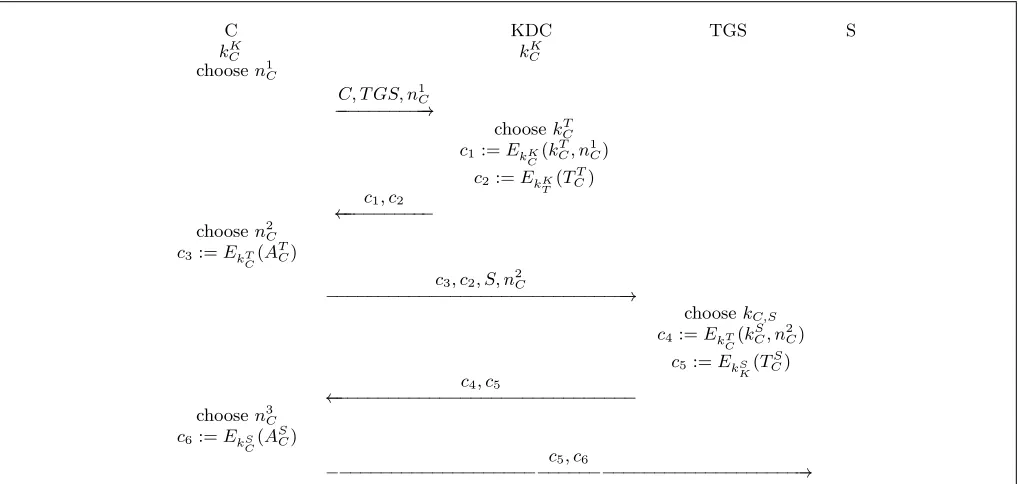
The Kerberos protocol is a four-party protocol, executed between a client C, a Key Distribution Center KDC, a Ticket Granting Service T GS, and a server S. All mes-sages exchanged between these parties are relayed through the clientC.
The protocol flow, depicted in Figure B can be divided in three two-message flows, which follow nearly the same pattern: The initiator (always the clientC) sends a message to the responder (KDC resp. T GS resp. S, in this order) containing the ID of the client, the ID of thenextresponder, a nonce, and in the last two cases an encrypted authenticator (which contains a timestamp).
C kK C
KDC kK
C
TGS S
choosen1C
−C, T GS, n 1 C −−−−−−−−−→−
choosekCT
c1:=EkK C(k
T C, n1C)
c2:=EkK T(T
T C)
←
−−−−−−−−−−c1, c2
choosen2 C
c3:=EkT C(A
T C)
−−−−−−−−−−−c3, c2, S, n 2 C
−−−−−−−−−−−−−−−−−−−→
choosekC,S
c4:=EkT C(k
S C, n2C)
c5:=EkS K(T
S C)
←
−−−−−−−−−−−−−−−−−−−−−−−−−−−−−−c4, c5
choosen3 C
c6:=EkS C(A
S C)
−−−−−−−−−−−−−−−−−−−−−−−−−−−−−−−−−−−−−−−−−−−−−−c5, c6 →