Protection
?Corrected Version
Miros law Kuty lowski and Maciej G¸ebala
Faculty of Fundamental Problems of Technology, Wroc law University of Technology
{miroslaw.kutylowski, maciej.gebala}@pwr.wroc.pl
Abstract. In this paper we provide a corrected and generalized version of the scheme presented at SOFSEM’2012 in our paper “Optimizing Seg-ment Based DocuSeg-ment Protection” (SOFSEM 2012: Theory and Practice of Computer Science, LNCS 7147, pp. 566-575).
We develop techniques for protecting documents with restricted access rights. In these documents so calledsegments are encrypted. Different segments may be encrypted with different keys so that different user may be given differentaccess rights. Hierarchy of access rights is represented by means of a directed acyclicaccess graph. The segments are encrypted with keys - where each key corresponds to one node in the access graph. The main feature of the access graph is that if there is an arch−→AB in the graph, then all segments labelled withBcan be decrypted with the key corresponding to nodeA.
We show how to minimize the space overhead necessary for auxiliary keying information stored in the document. We provide an algorithm based on node disjoint paths in the access graph and key derivation based on one-way functions. Our current solution, based on maximal weighted matchings, provides an optimal solution for creating subdocuments, in case when frequency of creating each subdocument is known.
Keywords: document protection, access rights, key management, key hierarchy, directed acyclic graph
1
Introduction
We consider securing digital documents from unauthorized access. Since digital documents can be copied and cryptographic mechanisms secure their integrity the ease of creating the copies is not only an advantage, but also creates new challenges: namely it is hard to protect the document from unauthorized access. If the document has to be presented as a whole or not presented at all, then protection via encryption is enough: the document becomes readable only for a party that gets the decryption key (this approach is followed in particular in
?
broadcast systems). The situation is different, if certain parts of a document have to be disclosed selectively. In order to catch this situation the model of segment based protection has been introduced.
Segment Based Document Protection Securing multiple parts of a docu-ment in different ways is a concept that appeared many times the literature; for recent application oriented work see [1],[2] and in particular the former version of this paper [3]. The idea is the following:
– The document contents is encoded together with some auxiliary information for management of access rights; in particular a standard XML-encoding can be used.
– The documents contents is divided into segments, a segment is a part of the document that is dedicated to the readers with exactly the same access rights.
– Access to a segment is protected by encryption with a symmetric key that is available only to the parties that are entitled to read this segment. – Dependencies of access rights between segments are described by a directed
acyclic graph (dag) calledaccess graph. Its nodes are segments of a document. Access graph defines a partial ordering of segments: we say thatA B if there is a directed path from nodeAto nodeB. The edges describe inherited access rights. Namely, ifAB, then a user having the right to read segment Ashould also be given possibility to decrypt and read segmentB.
– A document stores publickey information. A user having a key corresponding to a segmentA can use this meta-data to derive the key of any segmentB such thatAB.
Obviously, the access graph should be acyclic. The relationneed not to be a linear ordering.
Our main goal is to minimize the size of auxiliary key information to be stored in the document. However, computational complexity, flexibility, scalability and simplicity of the solution are also important factors.
1.1 Preliminary Techniques
Linear schemes. Let the access graph define a linear ordering A1 A2
. . .Am. The keys may be derived using a one-way functionF (see e.g. [4]):
– K1 is chosen at random,
– fori= 2, . . . , m:
Ki:=F(Ki−1) (1)
ThenKi is assigned toAi, fori≤m.
Formula (1) can be used by a holder ofKito derive the keysKi+1, . . . ,Km.
Tree schemes. A similar solution can be applied if access graph is a tree ([5]): if a node Ahas child nodesB1, . . .Bk, andK has been assigned toA, then for i≤kthe nodeBi gets the key
Ki:=Fi(K) (2)
where F1, . . . , Fk are distinct and unrelated one-way functions. For instance,
we can use a cryptographic hash functionH and set:Fi(x) def
= H(i, x). Another solution would be that
Ki:=H(K, A, Bi) (3)
In both cases we require strong cryptographic properties ofH- immunity against all kinds ofrelated preimage attacks. For instance, givenKiandKj, it should be
infeasible to deriveK satisfying simultaneouslyKi =Fi(K) and Kj =Fj(K),
as well as to deriveKt fort6=i, j. Therefore the tree scheme requires stronger
functions than the linear scheme, where one-wayness seem to be sufficient.
Arbitrary posets. The interesting case is when the access graph is a poset (see e.g. [6] and [2]). If we apply the same method as for trees, then we get into troubles for each node B that have more than one incoming arcs. In this case the key forBis derived in many conflicting ways. DesigningF such that we get the same values is generally hopeless, as this would mean creating conflicts ofF almost on demand.
A simple solution is to store an offset for the arcs of the access graph. Namely, if a nodeChas two parent nodesAandBholding, respectively,KAandKB, then
the keyKCis derived asKC:=F(KA, A, C)⊕∆AC andKC:=F(KB, B, C)⊕ ∆BC, where ∆AC, ∆BC are the public offset stored for the arcs
−→
AC and −BC−→. Obviously, ∆AC can be derived as KC⊕F(KA, A, C). If a node C has more
parent nodes, then we define nonzero offsets for all but one incoming arcs. In order to save space, we can set (at most) one of the offsets to a string of zeroes. Which offsets should be set to the zero string is the main topic of this paper.
1.2 Document Encoding and Problem Statement
Let us restate our goals from [3]. We concern creating offsets in two cases:
linear scheme: in this case we use a number of node disjoint paths and assign the keys along the paths according to Equation (1) – i.e. with the zero offsets. tree scheme: in this case we embed a number of node disjoint trees and assign the keys within each tree according to Equation (2) – i.e. with the zero offsets.
In both cases the remaining offsets are determined as⊕of the keys on the ends of the arch (if both are already determined).
Problem 1 ([3]). Given a dag G, embed some number of trees inGso that
– the embedded trees are node disjoint,
– the number of arcs that do not belong to any of embedded trees is minimal.
Problem 2 ([3]). Given a dag G, embed some number of paths inGso that
– the embedded paths are node disjoint,
– the number of arcs that do not belong to any of embedded paths is minimal.
2
Tree-Based Key Derivation
In [3] we have proposed the following greedy algorithm:
Algorithm 1 Input:dagG
Output: subgraph G0 of Gthat consists of a set of disjoint trees and contains the maximal possible number of arcs
Algorithm:
Construct a reduced graphG0, a subgraph ofG, in the following way:
for each nodev∈Gof indegree greater than 1 pick up an arbitrary arc with endpoint vand remove all other arcs with endpointv.
The construction has the following simple properties:
– G0 is a forest,
– the number of edges inG0 does not depend on the random choices,
– every forest which is a subgraph ofGis a subgraph of some forest generated by Algorithm 1.
For details see [3].
3
Sequential Key Derivation
The situation for node disjoint paths is more complicated. The example from Fig. 1 shows that a greedy procedure may lead to suboptimal solutions.
v
u w
v
u w
v
u w
Fig. 1. ([3]) Let us consider a dag consisting of arcs (v, u), (v, w) and (w, u) - a triangle with sourcev and sinku. If during a greedy procedure we take the arc (v, u) (or remove (v, w)), then the final solution will contain just one path with a single arc. On the other hand, the optimal solution is the path (v, w),(w, u).
first case, no edge will be added in this stage and the final output will contain only arc−vu→, which is not optimal.
This example also shows that Lemma 1 from [3] is false. The gap in the proof is disregarding the case when an optimal solution already contains an arc starting from a pointv. In this case it might be impossible to remove this arc from the solution and to include another arc starting fromv.
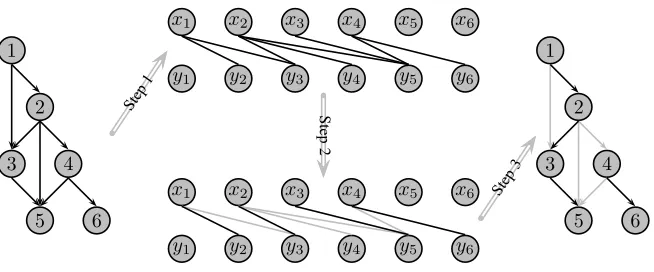
New Algorithm. Below we present a simple Algorithm 2 that solves the prob-lem of finding the maximal set of node disjoint paths. Execution of the algorithm for an example dag is shown in Figure 2.
Algorithm 2 Input:dagG= (V, E)
Output:subgraphSofGthat consists of node disjoint paths and contains the maximal possible number of arcs
Algorithm:
1. construct bipartite graphH = (V0, E0) where V0={xi : ∀i∈V } ∪ {yi : ∀i∈V }and
E0={ hxi, yji : ∀(i, j)∈E}
2. find maximal matching for graphH
3. for each edgehxi, yjithat belongs to the maximal matching, add arc (i, j) toS
Now we argue that Algorithm 2 outputs an optimal solution.
Lemma 1. OutputSof Algorithm 2 defines a family of disjoint paths inGthat contains the maximal possible number of arcs.
Proof. Consider a nodei. Since at most one edge of the formhxi, yjibelongs to
1
2
3 4
5 6
x1 x2 x3 x4 x5 x6
y1 y2 y3 y4 y5 y6
x1 x2 x3 x4 x5 x6
y1 y2 y3 y4 y5 y6
1
2
3 4
5 6
Ste
p1
S
te
p
2
Ste
p3
Fig. 2. Execution of the Algorithm 2 for an example dag.
each node inS is at most 1. Similarly, the matching contains at most one edge of the formhxk, yii. Therefore, there is at most one arc inS with the endpoint i. It follows that the indegree of each node in S is at most 1. As both indegree and outdegree of each node in S is at most 1, it defines a set of node disjoint paths.
On the other hand, it is easy to see that a set of node disjoint paths in G defines a matching consisting of the same number of edges in the graph H defined by Algorithm 2. Therefore any set of node disjoint paths in Gdoes not have more arcs than the number of edges in the maximal matching inG. ut
Let us observe that Algorithm 2 not only derives the optimal solution, but it is also efficient – its time complexity is O(p|V||E|) (see [7]).
4
Weighted Graphs
In this section we show that Algorithm 2 can be generalized to solve the open problems formulated in [3]. Namely, in some application areas it might be useful to generate subdocuments of a given document truncated to those segments that are readable by some specific group of users. In this case we consider a subgraph
¯
Gof access right graphGwith the following property: ifvis a vertex in ¯G, then all arcs of the form (v, u) fromGare also arcs of ¯G. Therefore, a nodevfrom ¯G has the same ancestors in ¯Gas inG. If D is an encoded document with access graph G, we construct a new documentD0 such that:
– D0 contains only those segments that correspond to the nodes of ¯G, all
remaining segments are removed,
– D0 contains only those key information fields that correspond to the arcs of
¯ G.
the goal is to maximize the number of arcs in all documents, for which the offsets need not to be stored:
X
D0 subdocument ofD
f r(D0)·gain(D0) (4)
where gain(D0) denotes the number of arcs in the access graph corresponding to
D0, for which there is no offset information.
Tree-based scheme. Given a node v in G of indegree higher than 1, Algo-rithm 1 selects one of arcs with endpointv. For the generalized scheme we need to optimize the choice taking into account frequency data about access rights. Namely, to each node w in G we associate frequency parameter f r(w) which describes the fraction of users that are given the access rights corresponding to w. We can easily see that the arc (u, v) is contained in the fractionf r(u) of all documents assigned to the users. Therefore in order to minimize the value (4) the modified Algorithm 1 for a nodevselects an arc (u, v) such that
f r(u) = max{f r(u0)|(u0, v) is an arc inG} .
This minimizes the number of offset information regarding the arcs pointing to v in all documents given to the users. As the choices done by the algorithm at different nodes are not dependent, these leads to an optimal solution when regarding the whole access graph.
Sequential scheme. For the sequential scheme we modify Algorithm 2 to solve
Maximum Weighted Bipartite Matching Probleminstead ofMaximum Bipartite Matching Problem. The weight of an edgehxi, yjiis defined asf r(i). It is easy
to see that weight of the of a matching equals to the gain defined by (4). As the time complexity of solving Maximum Weighted Bipartite Matching Problem isO(|V||E|log|V|) [8], finding the optimal solution is possible for access graphs of realistic sizes.
References
1. Qiu, R., Tang, Z., Gao, L., Yu, Y.: A novel xml-based document format with printing quality for web publishing. In: Imaging and Printing in a Web 2.0 World; and Multimedia Content Access: Algorithms and Systems IV. Proc. SPIE 7540, Society of Photographic Instrumentation Engineers (2010) 0J (Cited on page 2.) 2. Xu, D., Tang, Z., Yu, Y.: An efficient key management scheme for segment-based
document protection. In: Consumer Communications and Networking Conference (CCNC), 2011 IEEE. (2011) 896 –900 (Cited on pages 2 and 3.)
4. Levin, L.A.: The tale of one-way functions (2003). Available from:http://arxiv. org/abs/cs.CR/0012023[retrieved on May 20, 2011] (Cited on page 2.)
5. Hassen, H.R., Bouabdallah, A., Bettahar, H.: A new and efficient key management scheme for content access control within tree hierarchies. In: AINA Workshops (1), IEEE Computer Society (2007) 551–556 (Cited on page 3.)
6. Atallah, M.J., Blanton, M., Fazio, N., Frikken, K.B.: Dynamic and efficient key management for access hierarchies. ACM Trans. Inf. Syst. Secur. 12(3) (2009) (Cited on page 3.)
7. Hopcroft, J.E., Karp, R.M.: Ann5/2algorithm for maximum matchings in bipartite graphs. SIAM Journal on Computing2(4) (1973) 225–231 (Cited on page 6.) 8. Edmonds, J., Karp, R.M.: Theoretical improvements in algorithmic efficiency for
![Fig. 1. ([3]) Let us consider a dag consisting of arcs (a single arc. On the other hand, the optimal solution is the path (triangle with source(v, u), (v, w) and (w, u) - a v and sink u](https://thumb-us.123doks.com/thumbv2/123dok_us/7886401.1308531/5.612.183.447.116.192/fig-consider-consisting-single-optimal-solution-triangle-source.webp)