IJISET - International Journal of Innovative Science, Engineering & Technology, Vol. 2 Issue 5, May 2015. www.ijiset.com
ISSN 2348 – 7968
Performance Evaluation of Various Routing
Protocols with Geographic Greedy
Forwarding In Ad-Hoc Network
Chaman SinghP
*
P
, Sandeep KumarP
*
P
, Jethu SinghP
*
P
, Vaishali IngaleP
**
P
, Rahul DesaiP
**
*Final year students, Information Technology, Army Institute of Technology, Pune
**Asst Professor, Information Technology, Army Institute of Technology, Pune
U
AbstractU–The wireless networks is most advanced in the field of networking. Ad-hoc is the new era in the of filed networking an Ad-hoc doesn’t required support of any kind buy means of infrastructure or any administration to handle out the work. They have very limited range in which Ad-hoc work irrespective oftheir geographical situation .Mainly the work in two forms one is node as carrier and transmitter which is very complex in any case. They are not restricted to only one position the can move to other location as time pass. (MANET)in general is said to be wireless Ad-hoc network. They are called peer-to–peer, and self-constructing network. As topologies change rapidly the new term ology comes to play new technology almost Sideline the guidelines or connect them to the larger Internet space. These are suitable for various protocol such AODV, DSDV,AOMDV DSR and GREEDY which are available to use on this paper we going to compare Ad-hoc routing protocols. On the bases of Percentage out of order Delivery, End to End delay, jitter, throughput. Inthispaper
all assumption are carried out
forcomparative study for future research.
.UKeywordU – MANET, AODV, DSDV, AOMDV, GREEDY, DSR, PDR,
1UIntroduction
The wireless networking is most prominent now days which enable the one particular user to share thedata and the services which may be regardless of their geographic position. Wireless networking is classified in two types: one is Infrastructure Networking and Infrastructure less (Ad-hoc) Networking infrastructure network is a networkin which mainly is the collection physical things that can be anything like server or network components. They are mainly bunch of things which are moveable from one place to other place and they are only things which can think intelligently
Infrastructure less (Ad-hoc) Networks Wi-Fi networks are generally created by Wi-Fi routers while ad-hoc networks are usually short –lived networks created by a device. But it isn’t always so simple. Mobile networking in which all nodes can be connected dynamically inthe
arbitrary fashion their ranges are short in this each node acts as a self-router and transmit the data. Ad-hoc mode is also known as “peer-to-peer” mode. The Ad-hoc networks don’t require an admin access point. Devices on the wireless mode can connect to other in this mode services[1,2].
Geographic Greedy Forwarding
Geographic greedy isone out of several types of ad hoc routing protocols which are reactive, proactive geographic stateless routing the geographic is the simple routing protocol to be implement on the NS2.It has various factor to be used first one is that no node in a network does not maintain any routing table.That we are going to keep neighbors list at the routing component but such information is available at logical link layer Geographic greedy forwarding one of the most simple to implement and as efficient to transmit the data.This is the reason why we are using the greedy in networking this make it as a most promise able selection in routing wireless. In this destination of particular node is selected by the forwarding the node through the selection of each intermediate node in a completely full filled distributed system. Then the packet has to be forwarded to make a hop by hop with its route .Geographic greedy has to face some challenges like holesare used to make sure that forwarding process should be blocked this type of node is called stuck node. It can be caused by jamming, power exhaustion and noise interference
The geographic greedy forwarding protocol can be implemented by five steps.
1.)On receiving a packet from the upper most layers, in the source node adds a header including the destination Identification and location.
2.)Source nodes sends packet closer to their allyneighborhood which remain always close to them.
3.)After receiving packet from a neighborhood node forwards the packet if it has been already exists. Then it became destination.
4.)If there is no neighborhood closer than it is called local minimum simply drops the packet.
5.)When the packet is made through this entire step it finally reaches its destination then the geographic routing gets completed.
Fig 1: Greedy forwarding node
2Installation and Compilation in NS2
The installation take place in LINUX operating system the steps are -:
1) First step is to unzip the ns.allinone-2.34.tar_1.gz folder after getting it done ns-allinone-2.34 is our folder.
2) Second step copyingthe folder ns.allinone-2.34.tar_1.gz, now it will give ns-allinone-2.34.tar_1.
3) Third step extract and make 2.34.tar_1.gz get ns-allinone-2.34.tar_1.
4) Go to ns-ns-allinone-2.34 folder and. /install.
There are various steps to be performed
1) Open terminal and edit .bashrc file.
2) Add the TCL library, LD library path in .bashrc file .save this.
To run this in NS2 on windows platform it required.
Then type this command /user/local/ns-allinone-2.34/ns-2.34/directory again go to terminal and type this.
#.configure
# .make clean
# .make
# .makes install
Aftercompletion of the installation part and recompilation, then this NS file is created.
#ns [<file>][<args>]
3Ad-hoc Routing Protocols for Wireless Network
Ad Hoc On-Demand Distance Vector Routing (AODV)
The AODV is active only when we want to discover routes .It has similarity to DSR which has same character which discovers route when they are on demand by user .AODV has very mechanism in which it maintain routing information in the routing table in which only one entry of packet is allowed for particular destination. But in DSR it allows multi point destination because of the cache which highly store the routing information in table. They are completely depended on the routing table’s entry for the destination. When packets has source of information and route of destination known to then first they will send RREQ which means request then after that route will RREP replay to the packet for transmission [3-5].
Dynamic Source Routing (DSR)
destination. Cache memory where the pervious destination is stored in order to fast moving if the similar address occur again. It has two operational mode one is “route discovery” and second one is “route maintains”[3-5].
Ad-hoc On-demand Multiple Distance Vector (AOMDV)
AOMDV is Ad-hoc multiple distance vector which is an advance version on AODV .In this all routers gives advertise to hop count to other , because of its property of route discovery it always try to find more and more multi paths between source and destination. When the route which fails to deliver the packets it search for new route to deliver that. Sudden routes are not formed only new routes are formed when all other not able to deliver the packet. One of the best efficient way to transfer of data
Greedy Routing on Ad-hoc
Greedy routing is a position based routing is routing principal that heavily really on the base of geographic position information. It can be used in wireless networks because of its greedy nature this protocol always look for shortest and best path irrespective of the conscious. In this routing protocol nodes are self-determine to tell their current position and so that of the source has the current information of destination. In this the packetwhich is carrying the info of destination should not come in
contact with network topology or route discovery.
4Factors for Performance Evaluation in Ad-Hoc network
Percentage out of order Delivery
In this the information which has to send to destination the rate of dropped information by the mean of external measure of connectionless routing of
particular node totransport layer
protocols such as TCP which prefer in-order delivery.
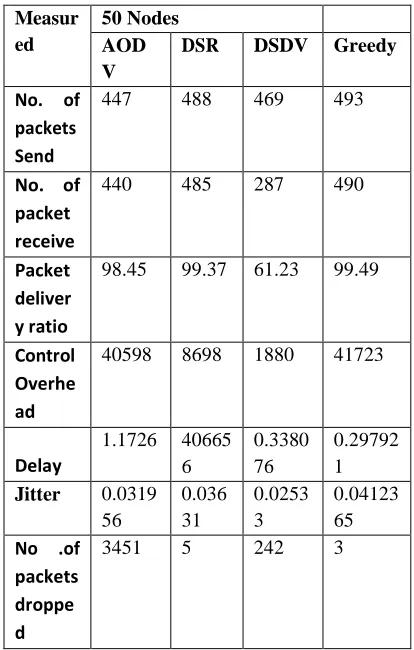
Measur ed
50 Nodes AOD V
DSR DSDV Greedy
No. of packets Send
447 488 469 493
No. of packet receive
440 485 287 490
Packet deliver y ratio
98.45 99.37 61.23 99.49
Control Overhe ad
40598 8698 1880 41723
Delay
1.1726 40665 6
0.3380 76
0.29792 1
Jitter 0.0319 56
0.036 31
0.0253 3
0.04123 65
No .of packets droppe d
3451 5 242 3
Table 1: No. of Nodes 50
End to End Delay
Simple term to express delay is average time or actual time of a packet to reach its destination with respective time given to it but delay caused by various factor like search for route discovery by router, data packet in queue wait of its turn to get transmitted to final destination. The packet which made through the queue is counted or gets marked by the router. If the end to end delay is lesser in any protocol the efficiency of data packet delivery almost become high [5-7].
End To End delay = ∑ Arrival time- send time
∑ Number of connection
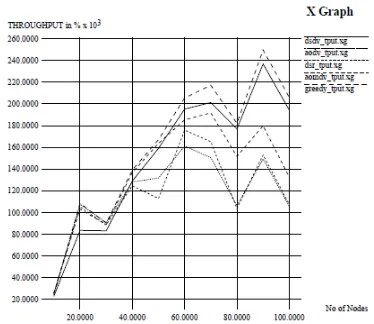
Throughput
In general the throughput is measured by theproductivity of a machine[6-7] .Total number of packet send in a particular period of time, basically we see check
for the system performance,
efficiency,rate of transfer from one node to another node at fixed time provided to it . By simple mean we can say that throughput is one of the main factor in the routing protocol which give us idea of bit rate/time for packet .It is measured in Kbps, Mbps, and Gbps.
Fig: 2 Throughput vs. Number of nodes
Jitter
Jitter is one of the factors in wireless networks which make connection nervous all the time .Due to the various delays in reaching of packets in time, efficiency, congestion, hardware and more in that list but main factor is from. Sometime the jitter factor is high that packets are out of reach this causes the drop in packets.
CONCLUSION
After evaluating all the factors of routing the AODV, DSDV, DSR, AOMDV and GREEDY on some cases like End to End delay, Throughput, jitter greedy always has showed up advanced improvement .Protocols other than this does not have a direct impact on the data routing performance.Data traffic in greedy is compare to be less so that packet deliveries always improving in many any case we see greedy always give better result in any case. In many cases the power efficiency is more likely get reduce as the data load or packet transfer is more, for that we make sure that routing protocols should have the power factor remains alwayshigh.
Reference
1.) C.E Perkins and P Bhagwat , “Highly Dynamic destination –sequenced distance vector Routing (DSDV) For mobile computing ” Proc ACM SIGCOMM” 94, London , UK, Sep 1994 , PP. 244-44.
2.)T. Clauses et al, optimized link Sate
Routing,http://www.ietf.org.internet-draft –ieft-manet-ossr-11.txt, July
2013,IETF Internet Draft.
3.)E.Sapho ,L.Baroli, G.Mino, F.Xhafia ,V.Kolici , R.Miho ,Implementation of CAVENET and its usage for erformance evaluation of AODV,OLSR and DYMO protocols in vehicular networks”, Mobile information system vol. 6 bo 3, 2010,pp. 213-237.
4.)FanBaiahmedhelmy “A Framework to systematically analyze the impact to mobility on performance of routing
Protocols for adhoc networks ”, IEEE INFOCOM 2004
5.)ZhenJiangComputerScienceDepartme nt West Chester University
West Chester, PA 19383, USA
6.)http://en.wikipedia.org/wiki/Geograph ic_routing
7.)http://www.cs.cmu.edu/~srini/15-744/F04/readings.html
8.)http://www.cs.cmu.edu/~srini/15-744/S01/readings.html